
On this date in 1963, Ngo Dinh Diem, the first president of South Vietnam, was executed in the back of an armored personnel carrier along with his younger brother and secret police chief, Ngo Dinh Nhu, the day after their government had been overthrown in a military coup.
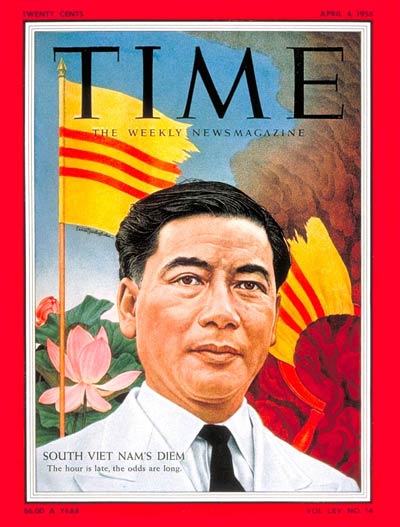 Born into the Buddhist country’s Catholic elite, Diem was brought up as a French colonial administrator but fled Vietnam in 1950 under a death sentence from Ho Chi Minh’s nascent Vietminh. Over several years living and lecturing in the United States, he established his anti-communist bona fides with influential conservatives and was returned to his native country as Prime Minister when the U.S. inherited the foundering French war against nationalist guerrillas.
Fearing communist victory at the polls, Diem blocked scheduled 1956 elections to unify North and South Vietnam, making an interim division permanent. But Diem made an inconsistent American client, often spurning Washington’s advice and alienating the Buddhist majority with heavy-handed authoritarianism that eventually prompted Buddhist monks to begin public self-immolation as a form of protest.

The government responded by arresting monks.
By now more a liability than an asset, Diem was ousted with the blessing of a fellow Catholic head of state, John F. Kennedy.
This first successful coup — Diem had already quashed attempted putsches in 1960 and 1962 — began a cycle of internecine revolts in which weak South Vietnamese governments were toppled in rapid succession … leaving Saigon ever more visibly the puppet of Washington, and dragging the United States ever more deeply into the Vietnam War.
On this day..
- 1984: The Hondh-Chillar Massacre
- 1675: Boyarina Morozova, Old Believer
- 1907: Afanasi Matushenko
- 1715: Seven at Tyburn
- 1803: Ludovicus Baekelandt, Vrijbos bandit
- 1483: Henry Stafford, Duke of Buckingham
- 82 BCE: The defeated populares of the Battle of the Colline Gate
- 1984: Velma Barfield, the first woman in the modern era
- 1801: James Legg, crucified ecorche
- 1972: Evelyn Anderson and Beatrice Kosin, missionaries
- 1920: James Daly, Connaught Rangers mutineer
- 1924: Ali Reshti and Sayyid Husain, to placate America
- 2001: Mona Fandey, witch doctor
 Denying the authority of the British (civilian) court,