1957: Larbi Ben M’Hidi, in the Battle of Algiers

On this date in 1957, Algerian revolutionary Larbi Ben M’Hidi — more familiarly referred to as Si Larbi or Ben M’Hidi — was extrajudicially executed in French custody.

He was one of the founders of the militant nationalist National Liberation Front (FLN) and was a critical commander in the guerrilla war against French occupation, the Battle of Algiers. Small wonder he also features prominently in the cinematic masterpiece of the same name, where he and his opposite number, the French Col. Mathieu, are bracingly clear-eyed as to their respective sides’ necessary forms of terror.

In this scene,* for instance, the captured Ben M’Hidi is asked by a journalist whether it is not cowardly to have women kill people with bombs hidden in their baskets.

“Isn’t it even more cowardly to attack defenseless villages with napalm bombs that kill many thousands of times more?” the shackled M’Hidi replies. “Obviously, planes would make things easier for us. Give us your bombers, sir, and you can have our baskets.”

This exchange adapts a conversation that “Col. Mathieu’s” real-life model, Marcel Bigeard, reportedly had with his prisoner over dinner.

Bigeard respected Ben M’Hidi too much to torture him but the French brass was not so sanguine — perceiving that the Algerian would present a great danger to the occupation as a political prisoner. This was a dirty war, and men like Ben M’Hidi met dirty fates.

Major Paul Aussaresses,** the officer eventually tasked with dispatching the revolutionary, described how it happened in his The Battle of the Casbah: Terrorism and Counterterrorism in Algeria 1955-1957.

Ben M’Hidi didn’t want to cooperate and Bigeard knew full well what the consequences of such a refusal would be … would he have talked under torture? We knew that Ben M’Hidi was responsible for most of the attacks and that he deserved the gallows ten times over, yet it wasn’t absolutely certain that he would be found guilty in court.

On March 3, 1957, [General Jacques] Massu and I discussed the problem in the presence of [Massu’s second-in-command Roger] Trinquier. We agreed that a trial of Ben M’Hidi was not a good idea. There would have been international repercussions …

“So what do you think?” asked Massu.

“I don’t know why Ben M’Hidi should get preferential treatment compared to the other rebels. When it comes down to terrorism the leaders don’t impress me any more favorably than their underlings. We’ve already executed many poor devils who were carrying out this guy’s orders and here we are hesitating for three weeks just to find out what we’re going to do about him!”

“I agree with you completely, but Ben M’Hidi is not just some cipher who will be quickly forgotten. We can’t just make him simply disappear into thin air.”

“There’s no way we can hand him over to the police either. They claim they’ll give him the third degree to make him talk but I’m convinced he won’t say a word. If there were to be a trial and he hasn’t confessed, he could actually walk away free, along with the entire FLN cadre. So let me take care of him before he becomes a fugitive, which is bound to happen if we keep on hesitating.”

“Very well, go ahead and take care of him,” answered Massu with a sigh. “Do the best you can. I’ll cover you.”

I understood that Massu already had the government’s approval to proceed.

I picked up Ben M’Hidi the following night at El-Biar. Bigeard made sure he was somewhere else because he had been told ahead of time that I was coming to take the prisoner away. I came with a few Jeeps and a Dodge pick-up. There were about a dozen men from my first squad, all of them armed to the teeth. Captain Allaire was in charge and had a little combat group lined up and presenting arms. I asked him to go get Ben M’Hidi and hand him over to me.

“Present arms!” ordered Allaire, when Ben M’Hidi, who had just been awakened, was escorted out of the building.

To my amazement the paratroopers of the 3rd RPC gave the defeated FLN leader his final honors. It was Bigeard in effect paying his respects to a man who had become his friend. This spectacular and somewhat useless demonstration didn’t make my job any easier. Obviously at that instant Ben M’Hidi fully understood what was in store for him. I quickly shoved him into the Dodge. We traveled very fast since an ambush to free him was always a possibility. I gave very strict orders to the NCO guard sitting next to the FLN leader:

“If we’re ambushed, you shoot him immediately, even if we come out unharmed. Make sure you knock him off without hesitating!”

We stopped at an isolated farm that was occupied by the commando unit belonging to my regiment and located about twenty kilometers south of Algiers, on the left off the main road. A pied-noir had placed the farm at our disposal. It was a modest building and the living quarters were on the ground floor. My second team was waiting for us there.

The commando unit of the 1st RCP included about twenty men, some of whom were draftees, but all of them were completely reliable. Captain Allard, nicknamed Tatave, who was very much devoted to me, was in charge. I had told him what was going on and he had been briefed. I told him to have his men set up in a corner of the room where Ben M’Hidi would be placed. The farm was messy and they had to move a few bales of hay around and sweep the floor. While this was taking place the prisoner was kept isolated in another room, which had been prepared. One of my men was standing guard at the door.

Then I entered with one of the soldiers and together we grabbed Ben M’Hidi and hanged him by the neck to make it look like suicide. Once I was sure he was dead, I immediately had him taken down and brought the body to the hospital. Following my orders, the NCO who was driving left the engine running while the car was parked, in order to be able to drive off at top speed without volunteering any explanations as soon as the emergency room doctor appeared. It was about midnight.

I immediately phoned Massu.

“General, Ben M’Hidi has just committed suicide. His body is at the hospital. I will bring you my report tomorrow.”

Massu grunted and hung up the phone. He knew full well that my report had been ready since early afternoon, just to make sure. Judge [Jean] Berard was the first one to read it. It described in detail the suicide that was to take place the next night. Berard was impressed:

“Well, this is very good! You know, it does make sense!”

Actually the report didn’t make sense for very long. Massu called me to his office a few days later.

“Aussaresses, I’m in the shit. District Attorney [Jean] Reliquet [a torture foe -ed.] has called me in.”

“What? He dared summon you!”

“Yes, to discuss the suicide of Ben M’Hidi.”

“But that’s an outrageous thing to do! Because of your position you shouldn’t have to answer the summons. I’ll go, since I’m your representative to the legal authorities.”

I therefore paid a visit to the judge’s office.

“Mr. District Attorney, I am here to represent General Massu. Because of my position I can discuss the circumstances of Ben M’Hidi’s death. I’m also the author fo the report that you’ve seen.”

The district attorney was absolutely enraged.

“Yes, of course! Let’s discuss your report! What you state in it is purely circumstantial. And only circumstantial! There’s no proof. Can you military types offer any proof at all?”

“I can offer our good faith.”

I think that had I slapped Reliquet across the face it would have had less of an impact than that answer.

“Your good faith!” he answered, choking on the words. “Your good faith as soldiers. Soldiers who are suddenly being candid?”

I put my beret back on, saluted him, clicking my heels, and walked out of the room.

We never heard from the district attorney again after that. The death of Ben M’Hidi was a decisive blow to the FLN in Algiers. The attacks died down and the bulk of the rebels began retreating toward the Atlas Mountains near Blida.

We used the farmhouse again where Ben M’Hidi had been executed. I had the men dig a long ditch and some twenty bodies, including that of a woman, were buried there.

The French military’s success by 1957 in the Battle of Algiers did not clinch its fight to retain Algeria — which attained its independence in 1962, to the horror of the far right. But it did put the army in such a vaunting position vis-a-vis the civilian authorities — one can see it in Aussaresses’s disdainful treatment of Reliquet — that the generals would author a 1958 coup led by Gen. Massu himself which called Charles de Gaulle out of retirement and initiated France’s Fifth (and current) Republic.

Larbi Ben M’Hidi’s name today graces one of the main thoroughfares of Algiers.

* The full film is a must-watch and can often be searched up in the usual places. This press interrogation occurs about 88 minutes in … closely followed by a scene of a spokeman announcing that M’Hidi “hanged himself” and Col. Mathieu allowing that he “appreciated the moral fiber, courage and commitment of Ben M’Hidi to his own ideals. Notwithstanding the great danger he represented, I pay tribute to his memory.” Game recognizes game.

** Eventually, General Paul Aussaresses … although he’d be stripped of this rank (and of his Legion of Honor) for celebrating the use of torture in Algeria in The Battle of the Casbah.

On this day..

1525: Cuauhtémoc, the last Aztec emperor

Although the primary accounts — those by conquistadors Hernán Cortés and Bernal Díaz del Castillo, and historian Francisco Lopez de Gomara* — did not explicitly record the date, February 28 is the traditionally recognized anniversary of the execution of the last Aztec emperor, Cuauhtémoc.

A monument to Cuauhtemoc in Mexico City. (Author’s photo; public domain)

Cuauhtemoc (English Wikipedia entry | Spanish) was enthroned early in 1521, in a Tenochtitlan already in the train of devastation brought by the Spanish, which had over the preceding months laid low the Emperor Moctezuma II (by violence) and his brother Cuitlahuac (by smallpox, a disease that halved the city’s population within a year).

He was about 23 or 24 years old, a nobleman who must have distinguished himself in war — “a handsome man, both as regards his countenance and his figure,” in Bernal Diaz’s estimation; “a valiant man and a good warrior” by Gomara’s account.

And it would fall to him to bear his proud kingdom’s ruin.

Having previously been welcomed to Tenochtitlan as guests, Cortes and the Spanish had fought their way out and now returned as besiegers, joined by most of the Aztecs’ resentful former subject kingdoms. They soon had Tenochtitlan in a stranglehold, undaunted by the frightening sacrifice of captured prisoners.

all in a moment the large drum of Huitzilopochtli again resounded from the summit of the temple, accompanied by all the hellish music of shell trumpets, horns, and other instruments. The sound was truly dismal and terrifying, but still more agonizing was all this to us when we looked up and beheld how the Mexicans were mercilessly sacrificing to their idols our unfortunate companions, who had been captured in Cortes’ flight across the opening.

We could plainly see the platform, with the chapel in which those cursed idols stood; how the Mexicans had adorned the heads of the Spaniards with feathers, and compelled their victims to dance round the god Huitzilopochtli; we saw how they stretched them out at full length on a large stone, ripped open their breasts with flint knives, tore out the palpitating heart, and offered it to their idols. Alas! we were forced to be spectators of all this, and how they then seized hold of the dead bodies by the legs and threw them headlong down the steps of the temple, at the bottom of which other executioners stood ready to receive them, who severed the arms, legs, and heads from the bodies, drew the skin off the faces, which were tanned with the beards still adhering to them, and produced as spectacles of mockery and derision at their feasts ; the legs, arms, and other parts of the body being cut up and devoured!

In this way the Mexicans served all the Spaniards they took prisoners; and the entrails alone were thrown to the tigers, lions, otters, and serpents, which were kept in cages. These abominable barbarities we were forced to witness with our own eyes from our very camp; and the reader may easily imagine our feelings, how excessively agonizing! the more so as we were so near our unfortunate companions without being able to assist them. Every one of us thanked God from the bottom of his soul for His great mercy in having rescued us from such a horrible death!

Bernal Diaz

Wracked by famine after Cortes successfully cut off its food and water, Tenochtitlan succumbed that August. (The conquistadors found they could barely endure the stench of countless rotting bodies as they took control of the famished city.) When captured, Cuauhtemoc implored Cortes through tears (again according to Bernal Diaz),

I have done what I was bound to do in the defence of my metropolis, and of my subjects. My resources have now become entirely exhausted. I have succumbed to superior power, and stand a prisoner before you. Now draw the dagger which hangs at your belt, and plunge it into my bosom.

There would be no bosom-daggering. Cortes had a much worse fate in mind.

He saluted Cuauhtemoc for his intrepidity in defense, vowing to maintain the latter as the ruler of Mexico … Cortes’s ruler, to ratify the dictates of the conquerors, beginning with commanding his remaining loyalists to surrender. Cuauhtemoc obeyed, with what posterity can only guess must have been fathomless shame and sorrow.

Upon humiliation, Cortes heaped physical torture when the invaders’ ransack of their captured city turned up far less lesser quantities of material loot than they had anticipated — torture which Cuauhtemoc and a cousin-king of a loyal Aztec ally both endured heroically without augmenting the Spanish bottom line. Bernal Diaz once again:

The next thing which Cortes did was to collect all the gold, silver, and jewels that had been found in Mexico, of which, however, there was very little; for Quauhtemoctzin, it was said, had ordered all the treasures to be thrown into the lake four days previous to his capture. A great quantity had likewise been purloined by the Tlascallans, Tezcucans, Huexotzincans, Cholullans, and other auxiliary troops which had assisted us in the siege, besides what had fallen into the hands of the troops on board the brigantines.

The crown officials were positive that Quauhtemoctzin had concealed the greater part, and asserted that Cortes was very pleased that the monarch refused to say a word where it was hidden; for he would then be able to get the whole treasure into his own possession.

The officers then proposed that Quauhtemoctzin and the king of Tlacupa, his most intimate friend and cousin, should be put to the torture, in order to extort from them a confession as to what had become of the treasures: but Cortes could not make up his mind to insult so great a monarch as Quauhtemoctzin, whose territory more than trebled that of Spain, and that for mere lust after gold. Moreover, the monarch’s household assured us they had given up all the gold they possessed to the officers of the crown, which, it was well known, amounted to 380,000 pesos, the whole of which had been melted into bars; and one thing is certain, that the emperor’s and Cortes’ fifths were deducted from that sum; but the conquistadores were not at all satisfied, and considered this sum much below the real amount, and several expressed their suspicion to Alderete, the royal treasurer, that Cortes’ only reason for not wishing to put the monarch to the torture was, that he might secretly take possession of all his riches. Cortes, not willing that such a suspicion should any longer he upon him, or that he should afterwards be called to an account on this score, at last consented that both should be put to the torture.


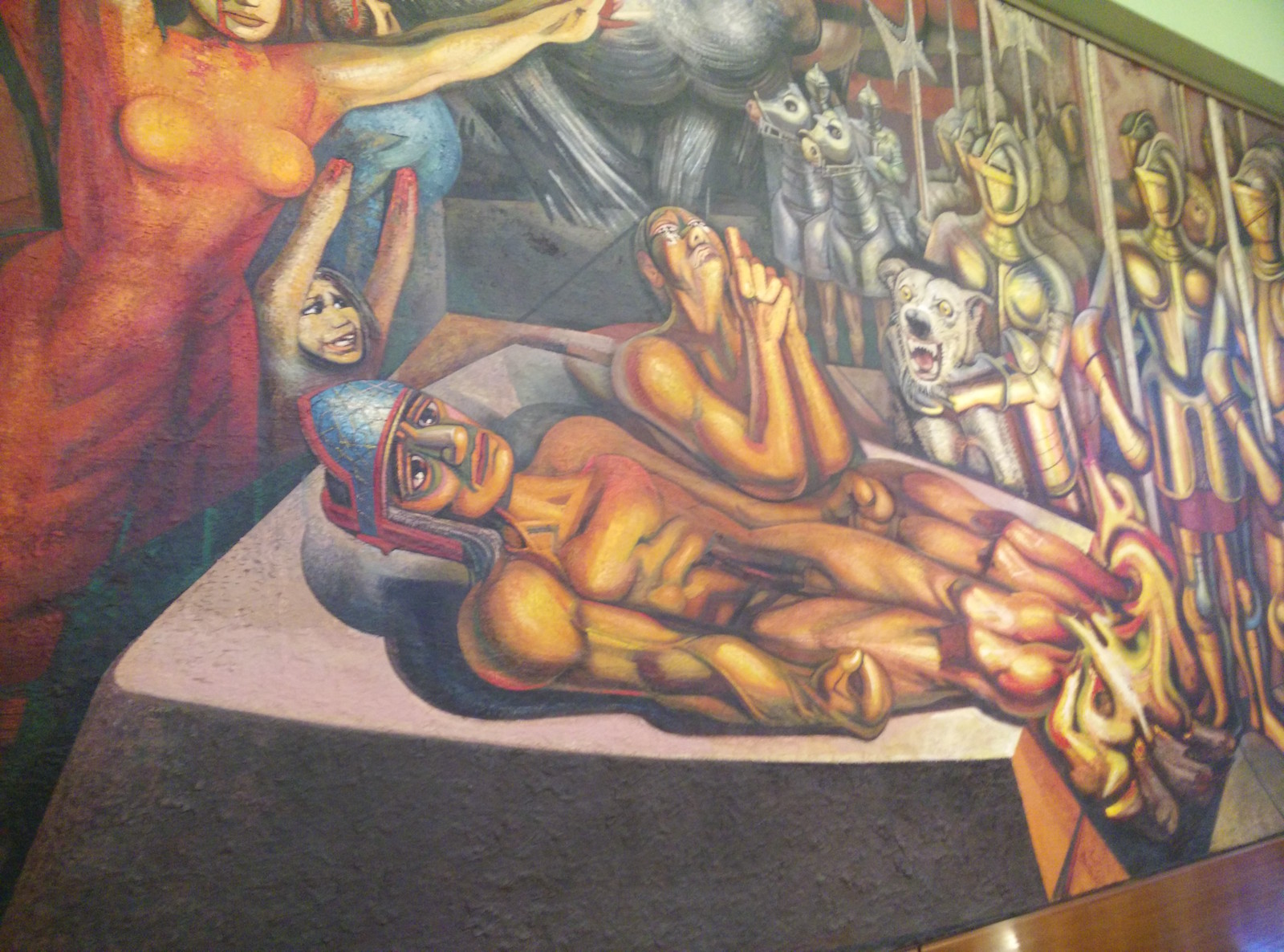
Detail view (click for the full image) of David Alfaro Siquieros‘s monumental 1950-51 mural, The Torment of Cuauhtemoc.

Boiling hot oil was then applied to their feet; upon which they confessed that, four days prior to Quauhtemoctzin’s capture, all the gold, with the cannon, crossbows, and muskets, which we had lost in the night of sorrows, when we retreated from Mexico, besides those which had been taken in Cortes’ last defeat on the causeway, had been thrown into the lake. A number of good swimmers were then sent to dive for the treasure in the spot they pointed out, but nothing was found. Yet there was some truth in the statement; for I was myself present when Quauhtemoctzin led us to a large and deep reservoir of water, built of stone, which lay near his palace. From this reservoir we fished up a sun of gold similar to the one sent us by Motecusuma, besides many jewels and other trinkets, though all of little value. The king of Tlacupa also informed us that he had hidden all manner of valuable things in some large houses, about twelve miles from Tlacupa, and he would accompany us there to point out the spot where he had buried them.

Alvarado was then despatched thither with six soldiers, among which number I also was; but when we arrived at the spot, this king assured us he had merely invented all this in the hopes that we would have killed him in a moment of anger at our disappointment.

(Diaz later added that “the suspicion was become pretty general that he [Cortes] had concealed the greater part of Quauhtemoctzin’s treasure,” and indeed some disgruntled companions — unsatisfied with the share they had been allotted for so magnificent a conquest — would come to lodge this charge against Cortes formally with Emperor Charles V.)

Cortes eventually brought both these hostages/puppet kings/torture victims along with him on a 1524-1525 expedition to Honduras, perhaps to deprive them of any opportunity to rebel in his absence.

On the evening of February 27, Cortes received a report or a rumor that the Indian kings had rebellion on their mind just the same. The timetable from this report to execution is uncertain from the records, but if it was not within 24 hours it cannot have been much longer. Diaz, a hostile-to-Cortes witness here whose narrative indicates his dismay at proceedings, describes it thus:

I have now to relate a circumstance of a very different nature, which occasioned much grief to us all. Quauhtemoctzin and other Mexican chiefs who accompanied our army had, it would appear, spoken among themselves, or secretly determined to put the whole of us to death, then march back to Mexico, and assemble the whole armed power of the country against the few remaining Spaniards, and raise an insurrection throughout the whole of New Spain. This circumstance was discovered to Cortes by two distinguished Mexican chiefs, one of whom was named Tapia, and the other Juan Velasquez. This latter personage had been Quauhtemoctzin’s captain-general during our war with Mexico, and his testimony was borne out by the investigation which Cortes made into the matter, and by the confession of several of the caziques themselves who were implicated in the conspiracy. These men fearlessly declared, that seeing how carelessly and dispiritedly we roamed about; that numbers of the men were ill from want of food; that four of our musicians, with the buffoon and five soldiers, had died of hunger; and that three other men had turned back, more willing to run the risk of reaching Mexico again than of moving forward, the thought struck them that they could not do better than fall suddenly upon us while we were crossing some river or marsh, particularly as they were upwards of 3000 in number, all armed with lances, and several of them with swords. Quauhtemoctzin did not hesitate to acknowledge that these men had spoken the truth, but added that the conspiracy did not emanate with him, and that he himself had never for a moment contemplated carrying it into effect, but had merely spoken about it with the other caziques. All the cazique of Tlacupa confessed was, his having declared to Quauhtemoctzin that it was better to die at once than daily to have death before their eyes on these fatiguing marches, and see their countrymen and relations perish with hunger.

These were sufficient proofs for Cortes, and without any further ceremony he sentenced Quauhtemoctzin and his cousin the king of Tlacupa to the gallows. Before, however, this sentence was executed, the Franciscan monks, with the assistance of Dona Marina, strove to comfort these unfortunate men, and commended their souls to God. When they were being led to the place of execution, Quauhtemoctzin turned to Cortes, and said: “Oh Malinche! I have for a long time perceived, from your false words, that you had destined me for such a death, because I did not lay violent hands on myself when you entered my city of Mexico! Why are you thus going to put me unjustly to death? God will one time ask this of you!”

The king of Tlacupa said, he could only rejoice in a death which he would be permitted to suffer with his monarch Quauhtemoctzin.

Previous to their being hung, both these unhappy caziques confessed to father Juan, who understood the Mexican language, and they begged of him to commend their souls to God. For Indians they were good Christians, and they died in the true faith, and fully believed in our holy religion.

The death of these two monarchs grieved me excessively, for I had known them in all their glory, and on our march they honoured me with their friendship, and showed me many little attentions; for instance, they would often order their servants to go in quest of fodder for my horse; besides which, they were innocent of the guilt imputed to them, and it was the opinion of all who accompanied this expedition that they were put to death unjustly.

But I will leave this miserable subject, and return to our march, on which we henceforth observed the utmost vigilance, for we greatly feared the Mexicans might rise up in arms against us, after they had thus beheld their monarch ignominiously hung by the neck from a tree. But hunger, fatigue, and sickness weighed heavier upon their minds than the misfortune of Quauhtemoctzin.


Detail view (click for the full image) of the “rebel” kings hanged from a tree.

Gomara and, of course, Cortes characterize the accusations against the Indian kings as true and the proceedings against them lawful. From the footnotes in this same Bernal Diaz volume, we have this from the later Jesuit historian and ethnographer Juan de Torquemada, who was fluent in Nahuatl:

I find it differently represented in a history written in the Mexican language, and which I believe to be perfectly correct. While Cortes (the Mexican author says) was quartered in a certain township, the Mexican chiefs one evening began to discourse among themselves about the recent hardships they had suffered, and Cohuanacotzin said to Quauhtemoctzin, to Tetlepanquetzaltzin, and to other distinguished Mexicans, ‘Thus you see, gentlemen, from kings we are become slaves, and we suffer ourselves to be led about by Cortes and this handful of Christians. If we were other people than we are, and would break through the promise we have made these Spaniards, we could play them a pretty trick here, and revenge ourselves upon them for all they have done to us, and the ill-treatment my cousin Quauhtemoctzin has suffered at their hands.’ To this the Mexican monarch replied, ‘I beg of you Cohuanacotzin to drop this subject, lest some one should overhear us, and imagine we were in earnest.’ It appears (continues Torquemada) that they were indeed overheard, for the whole of this discourse was reported to Cortes by a low-minded Mexican of the lower classes.

By law, Mexican flags fly at half-staff in his honor on February 28.

* These texts are cited throughout the post, but for ease of reference … Bernal Diaz: Memoirs of the Conquistador Bernal Diaz del Castillo, vol. 1, vol. 2 | Gomara: The Pleasant Historie of the Conquest of the West India; now called New Spaine | Cortes: History of New Spain, which is a Spanish text as I could not locate an English translation. However, even the Anglophone is liable to appreciate (from p. 225) the illustrations of Indian material culture observed by the Spaniards.

On this day..

1799: Andrea Serrao, Bishop of Potenza

On this date in 1799, the Bishop of Potenza was lynched by the faithful.

Andrea Serrao English Wikipedia entry | Italian) was a late disciple of the reformist Jansenist movement which tended among many other things to such Enlightenment-friendly notions as liberty of conscience, the reduction of the papal authority, and “regalism” — the doctrine of secular supremacy over ecclesiastical.

According to Owen Chadwick’s The Popes and European Revolution, Serrao as Bishop of the southern Italian city of Potenza

found a cathedral in disrepair, a seminary closed for the last eleven years. He raised the money for a rebuilding of the cathedral, reopened the seminary, of which the products were suspect for their ideas of liberty. He was as strong a reformer as [fellow Jansenist Bishop Scipione de’]Ricci,* and with many of the same ideas. He held a diocesan synod which is unknown because the acts were afterwards destroyed by government; but evidently its conclusions resembled those of Ricci’s Synod of Pistoia. He may have been more radical than Ricci, for he wanted clergy to be allowed to marry.

In December of 1798, Bourbon authority collapsed in the Kingdom of Naples — which ruled all of southern Italy, including Potenza — leading to the formation of the Parthenopean Republic. Serrao fully embraced it, “and urged them to obey the new government; and at the end of his address the people cried ‘Long live the French government. Long live liberty!’ and rushed out into the piazza to plant a tree of liberty. Bishop Serrao then accepted the office of civil commissioner of Potenza.” (Chadwick again)

But this Republic was destined for an imminent and bloody conclusion.

The most immediate reaction, and the one that led to Serrao’s abrupt death, was the summons of Fabrizio Cardinal Ruffo to a popular anti-Republican movement, called Sanfedismo (“Holy Faith”). In early February, a bare two weeks after the Parthenopean Republic’s establishment, Ruffo ventured from the royal refuge on Sicily and landed at his native Calabria like Che Guevara, with nothing but a handful of companions.

“Brave and courageous Calabrians, unite now under the standard of the Holy Cross and of our beloved sovereign,” Ruffo’s summons to a resistance implored. “Do not wait for the enemy to come and contaminate our home neighbourhoods. Let us march to confront him, to repel him, to hunt him out of our kingdom and out of Italy and to break the barbarous chains of our holy Pontiff. May the banner of the Holy Cross secure you total victory.”

Ruffo’s message was a winner and almost instantly began attracting holy guerrillas by the hundreds; in a few months’ time, Ruffo secured the surrender of the Republicans in Naples itself, by which time his army is reputed to have numbered 17,000.

And even in its earliest promulgation, it attained — seemingly to Andrea Serrao’s surprise — strength enough to overwhelm that tree of liberty stuff in Potenza within days of Ruffo’s landing. Back to Chadwick:

When Ruffo’s bands drew near to Potenza, many peasants and some priests regarded Bishop Serrao as ‘the enemy of the Pope, the king, and God’. Warned to escape, he said that he trusted his fellow-citizens. When the professors and students at the seminary wanted to make a bodyguard, he forbade them to arm.

Very early on 24 February 1799 soldiers of the Potenza guard smashed the tree of liberty, and raided the bishop’s palace. They came upon Serrao still in bed, and killed him with two shots of a pistol. Bleeding to death, he uttered the words ‘Long live the faith of Jesus Christ! Long live the Republic!’ The guards broke into the seminary next door, and murdered the rector as his students fled. After sacking palace and seminary they cut off the heads of bishop and rector and carried them in triumph round the city on pikes.

* There’s an interesting public domain biography of Ricci which, without any direct reference to Serrao, delves into the theological and political conflicts of the age that would have been of interest to our principal.

On this day..

1974: Khosrow Golsorkhi and Keramat Daneshian, Iranian revolutionaries

Death is our most modest gift to the people. Each death is a small window closing on nihilism. And each death is a panel of mystery closing on lies, corruption, poverty, and hunger. Thus, a window will open that lets in the light of life. Let us sacrifice our life for this light — this light.

[Signed,]
People’s Fadaee, Keramat Daneshian
February 8, 1974

Khosrow Gol(e)sorkhi* and Keramat Daneshian, poets and revolutionaries, were shot on this date in 1974 by the Shah of Iran.

Stock of a provincial family with ties to the Communist Tudeh party, Golsorkhi — much the more famous of the two — became a noted writer of radical prose and poetry in the 1960s and 1970s.

Their defiance — Golsorkhi’s especially — of a military court trying them on a trumped-up charge of attempting to kidnap Shah Mohammad Reza Pahlavi‘s son made them Che Guevara-like figures for young Iranian leftists of the time.**

Badly misreading the direction of the wind, the Shah televised their prosecution as a show trial — and the poets used the platform to completely upstage not only their judges but the rotting monarchy they were there to uphold. Farsi speakers can enjoy Golsorkhi on video —

— while this version has English subtitles:

“Equality”
by Khosrow Golsorkhi
(translated by Sherry Laici)

The teacher was shouting at the board.
He flushed angrily
and his hands were covered with chalk dust.
The students in the last row of seats were eating fruits and making noises;
on the other side of the class a student was flipping through a magazine.
None of the students were paying attention
because the teacher was shouting and pointing to the algebraic equations.

The teacher wrote on the blackboard, which reminded us of darkness and cruelty,
1=1
one is equal to one.

One of the students rose
(always one must rise)
and said softly,
“The equation is a blunder.”

The teacher was shocked
and the student asked,
“If one human being was one unit
Does one equal one, still?”
It was a difficult question and the students were silent.
The teacher shouted,
“Yes, it is equal!”

The student laughed,
“If one human being was one unit,
the one who had power and money would be greater than the poor one
who had nothing but a kind heart.
If one human being was one unit,
the one who was white would be greater than the one who was black.
If one human being was one unit,
equality would be ruined.
If one were equal to one
how would it be possible for the rich to get richer?
Or who would build China’s wall?
If one were equal to one,
who would die of poverty?
or who would die of lashing?
If one were equal to one,
who would imprison the liberals?”

The teacher cried:
“Please write in your notebooks
one is not equal to one.”

Abdy Javadzadeh notes in Iranian Irony: Marxists Becoming Muslim that Golsorkhi’s lyrical self-vindication — one could hardly call it a “defense” addressed to the parameters of a court that he openly scorned — “spoke volumes on how Marxism developed within the Iranian opposition,” marrying the language of revolution with that of Islam.

“Life is nothing but a struggle for your belief.”

I will begin my talk with a quotation from Hussein, the great martyr of the people of the Middle East. I, a Marxist-Leninist, have found, for the first time, social justice in the school of Islam and then reached socialism. In this court, I am not bargaining for my life or even my life span. I am but a drop in the great struggle of the Iranian people … I am not bargaining for my life, because I am the child of a fighting people.

The real Islam in Iran has always played its part in liberation movements … When Marx says, in a class society, wealth is accumulated on one side and poverty, hunger, and misery on the other, whilst the producer of wealth is the poor, and Ali says, a castle will not be built unless thousands become poor, we cannot deny that there are great similarities. This is the juncture of history in which we can claim Ali to be the world’s first socialist … and we too approve of such Islam, the Islam of Hussein.

Golsorkhi also scored points by dunking on the military brass sitting in judgment — shooting back at the chief judge when admonished to stay on topic, “Don’t you give me any orders. Go and order your corporals and squadron leaders.”

The more you attack me the more I pride myself, for the further I am from you the closer I am to the people. The more your hatred for my beliefs, the stronger the kindness and support of the people. Even if you bury me — and you certainly will — people will make flags and songs from my corpse.

For his part, Daneshian kept to a more straightforward secular-revolutionary tone.

Millions of people in the armed forces, without having an active role in society or production, are busy in a useless game … such force has no other purpose than the suppression of people’s voice of liberation. The shootings of farmers, peasants, and people’s fighters are their principle duty … Liberated people, social movements on their way to liberation, reverberates the news of shedding poverty, corruption and injustice in the world.

Three others condemned with them were not so eager as our principals to embrace revolutionary martyrdom, and bent the knee to the Shah in exchange for their lives.

* The name “Golsorkhi” means “rose bush”. According to Iranian cleric Mohammad-Ali Abtahi — popularly known as the “blogging mullah” — the censors at the time proceeded to suppress a forthcoming children’s book with the entirely coincidental title We Wake the Rose Bush as potentially Golsorkhi-sympathetic. “In a country where a colonel is running the cultural section, how can you answer such reasoning?”

** The Che analogy was drawn by Hooman Majd in The Ayatollah Begs To Differ: The Paradox of Modern Iran, noting that “his bravery … only served to make him a hero and a symbol of the Shah’s merciless dictatorship.”

On this day..

1955: Three for the death of King Ananda of Thailand

On this date in 1955, Thai royal secretary Chaliew Pathumros and royal pages Butr Patamasarin and Chit Singhaseni were shot as regicides. (Many other transliterations of these names, and the other Thai names in this post, are possible.) Few now believe that it was they who killed the young King of Thailand, Ananda Mahidol … but who really did it?


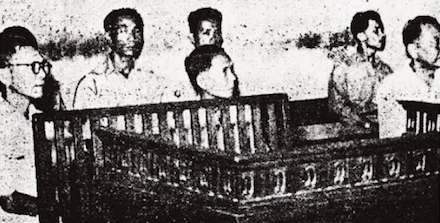
The defendants left to right across the front row: Chit Singhaseni, Butr Patamasarin, and Chaliew Pathumros.

Inheriting the throne of Siam — it became Thailand in 1939* — as a nine-year-old expatriate student in Switzerland, the wispy King Ananda would be described by Lord Mountbatten as “a frightened, short-sighted boy … a pathetic and lonely figure.” Some questioned whether he wanted to be king; others, whether monarchy would or should survive in Thailand at all. (Absolute monarchy had given way to constitutional monarchy in 1932.) Ananda’s own deceased father, a prince who had gone to Harvard, studied medicine, and married a commoner, seemed to model a different direction altogether, and Ananda’s legally questionable selection in 1935 might have been designed intentionally to enthrone a figure with no capacity for governance.

In any event, he would not bear this strange burden for very long — for his reign ended at 9:20 in the morning on June 9, 1946, announced by the single report of His Majesty’s own Colt .45 in Boromphiman Throne Hall. Ananda Mahidol was 20 years old, and he’d been expecting within a few days to fly back to Switzerland and wrap up his law degree. Instead, shot dead in the head at point-blank range, he was the vortex of a murder(?) mystery that continues to this day to elude a satisfactory accounting. His younger brother immediately succeeded him as King Bhumibol Adulyadej and would reign for 70 years** but even he couldn’t say what happened in this 1980 BBC interview.

The palace initially announced that the king had killed himself accidentally while toying with his gun but as more information leaked out it speedily rubbished the hypothesis of accidental or suicidal self-infliction. According to a British forensic pathologist who examined the evidence,†

The pistol found at the King’s side was by his left hand, but he was right-handed. The wound, over the left eye, was not in one of the elective sites, nor a “contact” discharge. The direction of fire was not inward towards the centre of the head.

Such findings pointed to the more politically explosive possibility that someone else shot King Ananda, which was also the conclusion of an official Thai inquiry late in 1946.

Soon, charges that the late king had been murdered at the behest of Prime Minister Pridi Banomyong — a republican who in his student days had been prominent in the successful movement to overthrow royal absolutism — were being aggressively bandied by his opposition. This rumor would eventually be enlisted as justification for a 1947 military coup that forced Pridi to flee Thailand.

Having made the punishment of Ananda’s assassins part of his putsch’s raison d’etre, the authoritarian former Axis collaborator Field Marshal Phibun now fixed his gaze on three palace servants who had been close to the young king in his last hours. Through them, Phibun’s new regime could condemn Pridi in absentia.

In a bizarre and ridiculous legal saga that began in 1948, the trio would be depicted as part of a sinister plot under Pridi’s direction to slay the king — Chaliew as Pridi’s instrument, and the two pages, who were in personal attendance upon Ananda at the time of his death, as complicit witnesses/accessories. (The judgment never quite says directly who pulled the trigger.) Over the course of the legal odyssey, two of the scapegoats’ defense attorneys were murdered, and two more arrested for treason: representing these regicides was such a dangerous task that by the end their team comprised only two young attorneys, one of whom was Chaliew’s freshly-graduated daughter.

Even so, only Chit was convicted in the first go-round but prosecution appeals against the verdict succeeded in condemning both of the other men, too. (One can read the full verdict in English here.) They would be executed one by one via a machine gun fusillade to the back, delivered through a screen — the distinctive local method. Bhumibol could have spared them. He didn’t.

But talk of these men as arch-traitors faded as political exigencies shifted in the subsequent decades. Their alleged conspiracy was incoherently depicted from the start, and nothing of direct evidence really implicated them: one can see in the BBC clip above that King Bhumibol doesn’t even bother discussing them when asked about Ananda’s death. It’s left the rather consequential question of who killed the king in a puzzling irresolution, a situation compounded by Thailand’s expansive lèse majesté law which renders taboo many obvious lines of inquiry when a royal is slain in a closed residence peopled by other royals. Speculation still centers on the three main scenarios considered from the outset: suicide, homicide, and accident.

Suicide

South African historian Rayne Kruger examined the obscure event in The Devil’s Discus: The Death of Ananda, King of Siam and concluded that it might have been suicide after all. In Kruger’s conception, it would have been occasioned by the young king’s mooning over a fellow law student back in Switzerland (Marylene Ferrari) who was forbidden him by his royal station.

It was published in 1964, and is banned under Thailand’s aggressive censorship program.

Homicide

William Stevenson’s The Revolutionary King postulates that fugitive Japanese war criminal Masanobu Tsuji, who was hiding out in Thailand at the time, masterminded the king’s assassination.

Bhumibol and the Thai court permitted Stevenson intimate access for several years researching this volume, although this did not prevent the book from also meeting a chilly reception in Thailand. (It’s unclear to me whether it was in fact ever formally banned, as some sites assert.) Although Stevenson’s theory about the killer doesn’t have many adherents, one supposes that in view of the author’s access, Bhumibol must have suggested it or assented to it during their private conversations.

Accident

Scottish journalist and former Reuters Bangkok correspondent Andrew MacGregor Marshall, author of another book banned in Thailand (A Kingdom in Crisis: Thailand’s Struggle for Democracy in the Twenty-First Century), has argued that the only plausible inference from the strange pattern of circumstantial evidence is that King Bhumibol himself — then an 18-year-old — pulled the trigger, likely by accident while horsing around with Ananda.

If Ananda was not assassinated by an intruder, did not shoot himself by accident, and did not commit suicide, that means he was shot by somebody known to be at the Barompiman Hall that morning. And only one person was not able to fully account for their movements that morning: Bhumibol. In particular, his testimony to investigators appeared to conflict with that of the royal nanny …

Discrepancies in the accounts of what happened when Bhumibol went to see Ananda at 9 a.m. are also telling. Investigators began to suspect the most likely scenario was that Bhumibol had indeed gone to see Ananda, but had not been turned away by the pages as he and they were later to claim. He went into Ananda’s room.

What happened there over the next 20 minutes, only Bhumibol knows for sure.

Bhumibol and Ananda both owned several guns and enjoyed playing with them. Indeed, Bhumibol had been known in the past to playfully point a gun at his brother. This has led many people to speculate privately that Bhumibol and Ananda were playing some kind of game in the bedroom that morning and that something had gone terribly wrong. The forensic evidence suggests Ananda was asleep when he was killed, however, although there remains the likelihood that, as the British ambassador’s secret cable suggests, the scene was rearranged after Ananda’s death. In any event, no credible explanation for the death of Ananda has ever been proposed other than this: between 9 a.m. and 9:20 a.m. Ananda’s Colt .45 was taken out from his bedside cabinet, and somehow Bhumibol came to shoot his brother with it, with the muzzle very close to Ananda’s forehead. Perhaps they were playing, or perhaps Ananda was still dozing and Bhumibol wanted to wake him with a practical joke, holding the gun to his head and pulling the trigger. Most probably, he removed the magazine from the Colt .45 automatic, put it to his brother’s head, and pulled the trigger, forgetting that even with the magazine removed, one round remains in the breech. Less likely, but possible, is that they argued about something and Bhumibol brandished the gun in a fit of anger. Bhumibol alone has the answer, and he seems unlikely to ever give us the truth.

This theory, which is also of course lèse majesté in Thailand, is supported by Paul Handley, yet another journo with a banned book (The King Never Smiles: A Biography of Thailand’s Bhumibol Adulyadej).

Marshall’s website zenjournalist.org touches this event in a number of posts; he makes the case most directly and thoroughly in “The Tragedy of King Bhumibol”, Part III and Part IV. These and other posts also marshall diplomatic cables and intelligence reports showing that Bhumibol as the killer was common private scuttlebutt among both Thai and foreign officials from the very first days to the point of being received, albeit publicly unutterable, wisdom. For example, American diplomat Kenneth Landon‡ casually remarks as fact that King Ananda was “killed by his brother, either intentionally or accidentally, by the gun the OSS guy had given them to play with” in this recording made by his son for a family history. (It occurs in passing at 4:48)

Rumor is not proof, of course, but this theory would certainly account for the shroud of permanent mystery surrounding June 9, 1946, not to mention the king’s own grave public persona (“The King Never Smiles …”). For Marshall, Bhumibol — a fun-loving, jazz-playing sprite at the time he allegedly shot his beloved older brother — was a figure of monumental tragedy and, at least before he got to the point of allowing innocent people to take the fall for it, his dissembling about Ananda’s death

was not a way of shirking responsibility. Quite the reverse: his failure to confess was in many ways a profound sacrifice. Had he told the truth about the death of Ananda, he could have escaped back to Switzerland for a very comfortable life as a playboy prince, albeit a notorious one. Instead, he lied, and accepted the crushing burden of kingship, a role that he had never wanted. He resolved to devote himself tirelessly to royal duty for the rest of his life. It probably seemed the only way he could even begin to make amends.

* Thailand was again Siam from 1946 to 1948. I’ve simply used “Thai” and “Thailand” throughout this post about events overlapping this period, the better to avoid confusion.

** Bhumibol, who died in 2016, was among the world’s longest-reigning monarchs ever. As of this writing his son holds the throne.

† The palace immediately took control of, and meddled with, the scene, so the available evidence falls very far short of what a crime scene investigator might wish for.

‡ Kenneth Landon’s wife Margaret, his longtime companion in Siam/Thailand since the two first went as missionaries in 1927, is noteworthy as the author of Anna and the King of Siam, which is the basis for (among other adaptations) the Rodgers and Hammerstein musical The King and I and the Jodie Foster film Anna and the King.

On this day..

2 CE: Iullus Antonius

On some undateable occasion in the second year of our Lord, Roman Emperor Augustus had his notorious daughter’s lover put to death.

Half-predator and half-prey in the incestuous Julio-Claudian family web, Iullus Antonius was the son of Augustus‘s great (and here, long-vanquished) rival Marc Antony, as well as the half-brother of Augustus’s discarded first wife.

Who fain at Pindar’s flight would aim,
On waxen wings, Iulus, he
Soars heavenward, doom’d to give his name
To some new sea.

Pindar, like torrent from the steep
Which, swollen with rain, its banks o’erflows,
With mouth unfathomably deep,
Foams, thunders, glows,

All worthy of Apollo’s bay,
Whether in dithyrambic roll
Pouring new words he burst away
Beyond control,

Or gods and god-born heroes tell,
Whose arm with righteous death could tame
Grim Centaurs, tame Chimaeras fell,
Out-breathing flame,

Or bid the boxer or the steed
In deathless pride of victory live,
And dower them with a nobler meed
Than sculptors give,

Or mourn the bridegroom early torn
From his young bride, and set on high
Strength, courage, virtue’s golden morn,
Too good to die.

Antonius! yes, the winds blow free,
When Dirce’s swan ascends the skies,
To waft him. I, like Matine bee,
In act and guise,

That culls its sweets through toilsome hours,
Am roaming Tibur’s banks along,
And fashioning with puny powers
A laboured song.

Your Muse shall sing in loftier strain
How Caesar climbs the sacred height,
The fierce Sygambrians in his train,
With laurel dight,

Than whom the Fates ne’er gave mankind
A richer treasure or more dear,
Nor shall, though earth again should find
The golden year.

Your Muse shall tell of public sports,
And holyday, and votive feast,
For Caesar’s sake, and brawling courts
Where strife has ceased.

Then, if my voice can aught avail,
Grateful for him our prayers have won,
My song shall echo, “Hail, all hail,
Auspicious Sun!”

There as you move, “Ho! Triumph, ho!
Great Triumph!” once and yet again
All Rome shall cry, and spices strow
Before your train.

Ten bulls, ten kine, your debt discharge:
A calf new-wean’d from parent cow,
Battening on pastures rich and large,
Shall quit my vow.

Like moon just dawning on the night
The crescent honours of his head;
One dapple spot of snowy white,
The rest all red.

Horace, celebrating Iullus Antonius‘s verse in verse. The latter’s verse has not reached posterity, though he was a well-regarded poet in his time.

Contrary to what one might expect, Augustus didn’t hold the kid’s parentage against him* and “not only granted him his life, but after honouring him with the priesthood, the praetorship, the consulship, and the governorship of provinces, had admitted him to the closest ties of relationship through a marriage with his sister’s daughter.” (Per Marcus Velleius Paterculus**)

But at some point Iullus took his relations rather too far for the old man by achieving the favors of Augustus’s only daughter, Julia — notorious of ancient scribes for her promiscuity and eventually destined to be murdered off when her crusty, cuckolded husband Tiberius attained the purple.

There is nobody party to this event that comes out the better for it; Augustus for his part really cemented his uptight prig reputation for the history books, and Tacitus censures him because in “[c]alling, as he did, a vice so habitual among men and women by the awful name of sacrilege and treason, he went far beyond the indulgent spirit of our ancestors, beyond indeed his own legislation.”

In the telling of Cassius Dio:

when [Augustus] at length discovered that his daughter Julia was so dissolute in her conduct as actually to take part in revels and drinking bouts at night in the Forum and on the very rostra, he became exceedingly angry. He had surmised even before this time that she was not leading a straight life, but refused to believe it. For those who hold positions of command, it appears, are acquainted with everything else better than with their own affairs; and although their own deeds do not escape the knowledge of their associates, they have no precise information regarding what their associates do. In the present instance, when Augustus learned what was going on, he gave way to a rage so violent that he could not keep the matter to himself, but went so far as to communicate it to senate. As a result Julia was banished to the island of Pandateria, lying off Campania, and her mother Scribonia voluntarily accompanied her. Of the men who had enjoyed her favours, Iullus Antonius, on the ground that his conduct had been prompted by designs upon the monarchy, was put to death along with other prominent persons, while the remainder were banished to islands. And since there was a tribune among them, he was not tried until he had completed his term of office. As a result of this affair many other women, too, were accused of similar behaviour, but the emperor would not entertain all the suits; instead, he set a definite date as a limit and forbade all prying into what had occurred previous to that time. For although in the case of his daughter he would show no mercy, remarking that he would rather have been Phoebe’s father than hers, he nevertheless was disposed to spare the rest. This Phoebe had been a freedwoman of Julia’s and her accomplice, and had voluntarily taken her own life before she could be punished. It was for this that Augustus praised her.

* Iullus’s older brother was not so lucky, nor was Julius Caesar’s very dangerous son by Cleopatra.

** Worth noting: Velleius Paterculus says that Iullus died by his own hand rather than (as most other sources in antiquity give it) the executioner’s.

On this day..

1584: Five Catholic priests

John Hungerford Pollen collected and translated this document in Unpublished Documents Relating to the English Martyrs. It comprises the testimony of a friendly Catholic witness to the martyrdom of five priests at Tyburn on this date in 1584, as conveyed to another priest, the future martyr Robert Southwell. The historical moment for these martyrdoms was the weeks following the exposure of the Catholic Throckmorton Plot; most of the priests had been in prison many months, but appear to have their martyrdoms catalyzed by a seemingly perilous security situation.

The Martyrdome of Mr Haddock, Emerford, Fenn, Mutter, priests.

The 6 day of February Mr Heywood and five other priests were brought to the Kings-bench barre, indited of high treason for conspiring at Rhemes and Rome, as it was surmised against F. Campian. They all pleaded not guilty and so were conveyed to the Tower. F. Haywood was in Jesuit’s weed, so grave a man as ever I sett my eyes upon, he wore a coate of black very low and upon the same a cloke of black, downe almost to the grownde. He had in his hand a black staff and upon his head a velvet coyfe and there upon a broade seemly black felt.

The 9 [sic] of February the five priests were brought againe to the barre, and arrained upon the former endightment: they pleaded and protested innocency. Their old friend [Charles] Sledd [an informer noted, like George Eliot, for turning in Catholic priests -ed.] gave in evidence against them: The Jury found them out of hand Guilty, and the Judge gave sentence of death. Whereupon the priests soung Te Deum and such like godly verses.

Upon Wednesday being the last day of the Terme, these five priests were drawen from the Tower to Tyborne upon hurdles; the first that was brought into the cart under the gibbet was Mr Haddock, a man in complexion fayre, of countenance milde, and in professing of his faith passing stoute. One of the Sherifs called Spencer much incensed against them, together with certaine ministers bad Mr Haddock confesse the fact and ask the Queen forgivenesse. Whereupon Mr Haddock calling God to witnesse, protested upon his soule that he was not guilty of the treason, and therfore would not aske the Queen forgivenesse: and further sayd, ‘I take her for my lawfull Queen, I have seyd this morning these many paternosters for her, and I pray God she may raigne long Queene. If I had her in the wildernesse I would not for all the world putt a pinn towards her with intent to hurt her.’

Then seyd the Sherif Spenser, ‘There is since thy arrainment worse matter found against thee [by Munday the spye]’: Whereunto answered Mr Haddock, ‘You have found nothing since; and soe belyke I was wrongfully arrained.’

Then Antony Munday was brought in, who uttered these speeches, ‘Upon a time you and I, with another whose name I have forgotten, walking together at Rome, the other wished the harts [Munday actually said ‘heads’ -ed.] of 3 of the nobility being of her counsell. Whereupon you sayd, M. Haddock, To make up a masse, I would we had the hart [head] of the Queen.’

Then sayd Spenser and other of his officers, ‘Away with the villaine traytor.’

But Mr Haddock, moved with these foresaid talke and speeches sayd as followeth. ‘I am presently to give an account [of all that I have done during life before the tribunal of God]; and as before God I shal answer, I never spake nor intended any such thing. And Munday, if thou didst heare me speak any such thing, how chanced it thou camest not to the barre to give this in against me upon thy othe.’ ‘Why,’ sayd Munday, ‘I never heard of your arraingement.’

Then said Spencer, ‘Didst not thou call the Queen heretick?’ ‘I confesse,’ sayd Haddock, ‘I did.’ Whereupon Spencer together with the ministers and other of his officers used the aforesaid speeches of treason, traytor, and villaine.

Mr Haddock sayd secretly a hymne in latin and that within my hearing, for I stood under the gibbet. A minister being on the cart with him, requested him to pray in English that the people might pray with him. Where upon Mr Haddock put the minister away with his hand, saying, ‘Away, away, I wil have nothing to doe with thee.’ But he requested all Catholics to pray with him and for his country. Where upon sayd one of the standers-by, ‘Here be noe Catholicks’: ‘Yes,’ sayd another, ‘we be all Catholics.’ Then sayd Mr Haddock, ‘I meane Catholicks of the Catholick Roman Church, and I pray God that my bloud may encrease the Catholick faith in England’: whereunto sayd Spenser: ‘The Catholic faith, the devel’s faith. Away with the traytor Drive away the cartel’ And so Mr Haddock ended his life, as constantly as could be required.

When the cart was dryven away, this Spenser presently commanded the rope to be cut, but notwithstanding the officer strock at the rope sundry times before he fell downe; and the reporte of them that stood by the block was that at what time the tormenter was in pulling out of his bowells, Mr Haddock was in life. By his own confession he was 28 yeares of age.

After Mr Haddock was taken to the block Mr Hemerford was brought unto the cart; he was very milde, and sometime a scholler of St John’s College in Oxford. Spenser bad him confesse and aske forgivenesse as before: but he protested innocency as Mr Haddock had done; yet sayd, ‘Where in I have offended her, I ask her forgivenesse, but in this fact of treason alleaged against me, I never offended.’

Then sayd a minister, master of art of St John’s College of Oxford, ‘You and I ware of old acquaintance in Oxford, by which I request you to pray openly and in English, that the people may pray with you.’ Then said M Hemerford, ‘I understand latin well enough, and am not to be taught of you. I request only Catholicks to pray with me.’ Where upon answered the minister, ‘I acknowledge that in Oxford you were alwaies by farre my better. Yet many times it pleaseth God, that the learned should be taught by the simple.’ One Risse termed a Doctor of Divinity, asked Mr Hemerford whither he would hold with the Pope or the Queen, in case the Pope should send an army into England. Whereunto Mr Hemerford answered, That in case they were sent in respect of the Pope’s own person, then he would holde with the Queen; but if it were sent to suppresse heresy or to restore the land to the catholick faith, then he would holde with the Pope. His speech was short being not permitted to speak much, and in substance the rest of his speech, not here sett down verbatim, was to the same effect that Mr [Haddock’s] was. He was cutt downe half dead: when the tormentor did cutt off his membres, he did cry ‘Oh! A!’ I heard my self standing under the gibbet.

Mr Fenn was the third that suffred, being bidd to doe as before, answered as his fellows did & sayd. ‘I am condemned for that I with Ms Haddock at Rome did conspire, & at which time Mr Haddock was a student at Rome and I a prisoner in the Marshalsea, or at the lest I am sure that I was in England, but to my remembrance, I was a prisoner in the Marshalsea. Therefore good people judge you whether I am guilty of this fact or noe.’

A minister called Hene avouched a place of St Paul whereunto Mr Fenn said: ‘I am not to be taught my duty by you.’

The rest of his speeches were to the same effect his fellows were. Before the cart was driven away, he was stripped of all his apparell saving his shirt only and presently after the cart was driven away his shirt was pulled of his back, so that he hung stark naked, where at the people muttered greatly, and the other sherif, called Massam, sayd to the officers, ‘You play the knaves. They be men. Let them be used like men,’ and alwaies commanded that they should hang until they were dead. Notwithstanding the other sherif commanded that they should be cut downe presently, and soe was Mo Fenn, but his companions following him were permitted to hang longer.

Mr Nutter was the 4th man, sometime schollar of St John’s College in Cambridge, and Mr Munden was the fifth & last: they denyed the fact, acknowledged the Queen Majesty to be their Queene and prayed for her, as the former had done, and soe in most milde and constant manner ended their life. Many a one in my hearing sayd, ‘God be with their sweet soules.’

What I have putt downe I hard myself, and therefore I may boldly speake it. If you please, you may shew it to your friends, provyded alwaies you tell not my name.


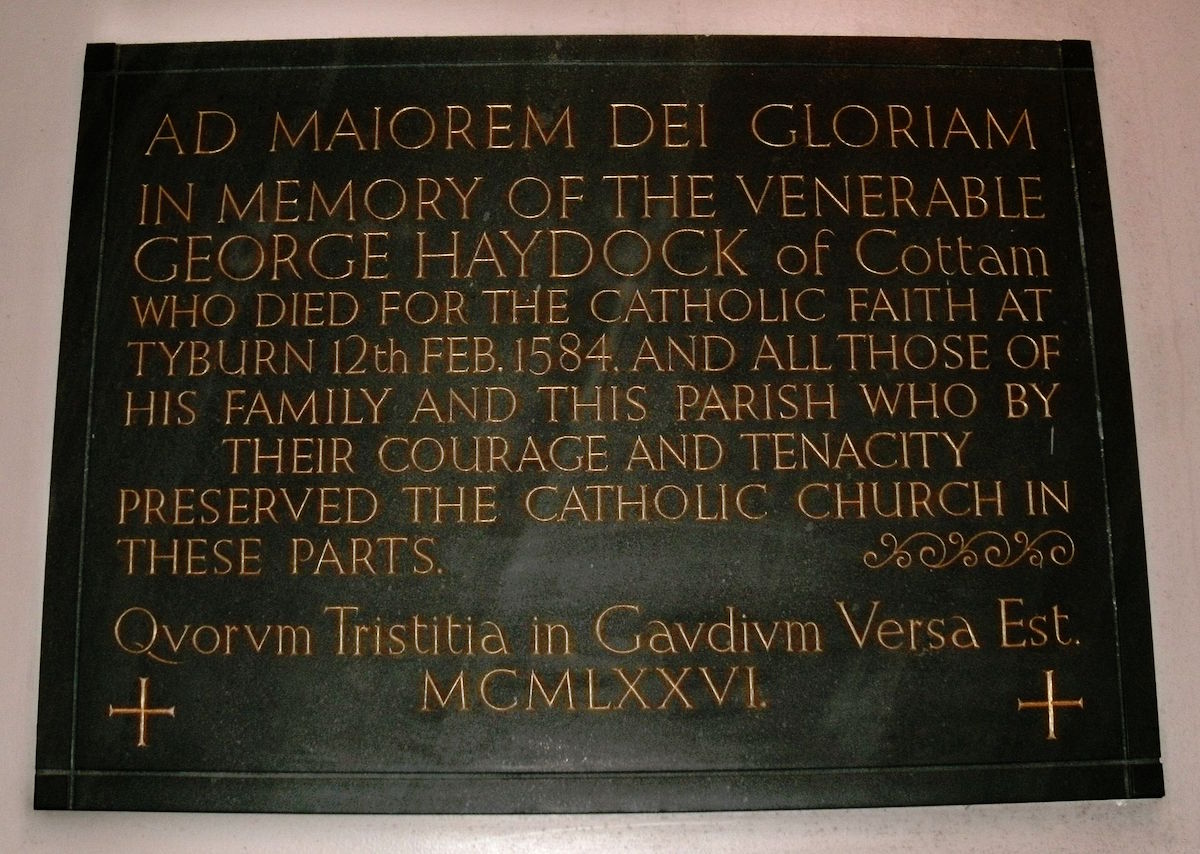
Plaque honoring George Haddock/Haydock at St. Andrew’s & Blessed George Haydock’s Catholic Church, Cottam, Lancashire. (cc) image by Skodoway.

On this day..

1938: Vladimir Antonov-Ovseyenko, Winter Palace stormer

Communist revolutionary and Soviet military leader Vladimir Antonov-Ovseyenko (or -Ovseenko) was purged on this date in 1938.

Portrait of Antonov-Ovseyenko by Yuri Annenkov.

The Ukrainian was a radical agitator from youth; he was expelled from military college in 1901 at age 17 for refusing to swear loyalty to Nicholas II and proceeded thereafter upon a cursus honorum of revolutionary tribulations — albeit, until World War I, as a Menshevik.

He stood in some danger of achieving these pages by the hand of the tsarist government rather than the Soviet one, on account of helping orchestrate the Sebastopol mutiny during the 1905 revolution, but his death sentence was commuted to hard labor.

Nothing chastised, Antonov-Ovseyenko escaped and returned to that life of militancy suitable to his badass underground nickname “Bayonet”, organizing workers and publishing illegal newspapers while dodging Stolypin‘s police. After several arrests, he finally fled for exile abroad.

According to Harold Walter Nelson’s Leon Trotsky and the Art of Insurrection, 1905-1917, it was in Paris writing for the red paper Nashe Slove (aka Golos) that the former cadet drew close to Trotsky, finding a common “conviction that the relationship between military events and the development of the revolution was critical,” and thereafter “Antonov-Ovseenko’s enthusiasm for columns on military topics opened the pages of Nashe Slovo to Trotsky’s articles” ultimately amounting to “several hundred pages of commentary on the war [World War I].” Ere long both figures would have opportunity to implement their doctrines on the battlefield.

Nashe Slovo was suppressed in 1916 after mutinying Russian soldiers were found to have read it, an event that also led to Trotsky’s being expelled from France to New York City.*

But the time for revolutionists’ exile was drawing to a close. Barely a year after the indignity of having his subversive exile ‘zine shuttered by the Third Republic, Antonov-Ovseenko — as secretary of the Petrograd Military Revolutionary Committee — led a posse of soldiers and sailors into the Winter Palace and arrested the Provisional Government, consummating the October Revolution.


Despite Sergei Eisenstein‘s epic re-creation in October: Ten Days That Shook the World, and the 1920 live re-enactment staged by Nikolai Evreinov, the Winter Palace was barely defended and Antonov-Ovseenko entered and found the Provisional Government without meeting resistance. He offered amnesty for the surrender of the remaining Winter Palace holdouts, and the offer was accepted.

Now a key military figure in the infant Communist state, Antonov-Ovseyenko helped clinch Soviet victory in the ensuing civil war, routing White armies in the Ukraine in 1918-1919 and putting down the Tambov Rebellion of peasant anti-Bolsheviks in 1920-1921.


Antonov-Ovseyenko (center) chills with Red Army officers.

By the later 1920s his Trotsky affiliation had significantly dimmed his star,** though he was still entrusted in the 1930s as a Soviet consul to several countries — the last of them the Spanish Republic during the Spanish Civil War, before falling prey to the purges mere months after his return.

His son, the lately deceased Anton Antonov-Ovseyenko, survived 13 years in the Gulag to become a dissident historian; his The Time of Stalin, published abroad in 1981 after being smuggled out of the USSR by Russia scholar Stephen Cohen, was one of the milestones along the way toward the public reckoning with Stalinism. “An embattled personality and fearless” in Cohen’s estimation, Anton Antonov-Ovseyenko died in 2013, still directing a Gulag museum in Moscow even though he had long since gone blind.

* Via Spain.

** In The Time of Stalin, Anton Antonov-Ovseyenko alleges that his father considered betting on the loyalty of the army in a coup against the Stalin faction, back when control of the post-Lenin state was still uncertain. “This cannot go on for long,” runs one letter the young Antonov-Ovseyenko quotes. “There remains one alternative — to appeal to the peasant masses dressed in Red Army greatcoats and call to order the leaders who have gone too far.” Trotsky also wrote in his memoir that such a coup was mooted within their circle.

On this day..

1885: August Reinsdorf and Emil Kuchler, Kaiser Wilhelm I bombers

On this date in 1885, anarchists August Reinsdorf and Emil Küchler were guillotined for a failed attempt on the life of Kaiser Wilhelm I.

The King of Prussia turned Emperor of the newborn (in 1871) Deutsches Reich, Wilhelm was honored by assassins equal in enthusiasm to his distinctive whiskers.* The versions distinguished by this post had the cheek to contemplate exploding the Kartätschenprinz** just as he ceremonially inaugurated an important national monument.


The Niederwalddenkmal still stands to this day. (cc) image from Philipp35466

The day was wet, and the dynamite fizzled. Everybody departed none the wiser but police spies later caught wind of the attempt, apparently when the would-be bombers Emil Küchler and Franz Reinhold Rupsch asked reimbursement from leftist typesetter August Reinsdorf, the plot’s mastermind.

Eight were eventually rounded up, secretly at first but later publicized to the prejudice of leftist parties.

Reinsdorf, Küchler and Rupsch all received death sentences; Rupsch’s was commuted in consideration of his youth.

The workers build palaces and live in miserable huts; they produce everything and maintain the whole machinery of state, and yet nothing is done for them; they produce all industrial products, and yet they have little and bad to eat; they are always a despised, raw and superstitious mass of servile minds. Everything the state does tends toward perpetuating these conditions forever. The upper ten thousand rest on the shoulders of the great mass. Is this really going to last? Is not a change our duty? Shall we keep our hands in our laps forever?

-Reinsdorf at trial

* We have in these pages already met one such predecessor who went under the fallbeil in 1878; the zeal of such men had given the Reich pretext to ban the Social Democrats.

** “Prince of Grapeshot”, a bygone nickname that paid derisive tribute to Wilhelm’s mailed fist in the Revolutions of 1848.

On this day..

1707: Baron Otto Arnold Peikel

A few line breaks have been removed for readability, and most of the author’s original footnotes excised, from this source text.

CHARLES XIIS TREATMENT OF
LIEUTENANT-GENERAL BARON PEIKEL.

By Charles Dalton, Esq.,
Editor of English Army Lists and Commission Registers, 1661-1714.

BARON PEIKEL (or Pykul) has been mistaken by several writers for his kinsman the better-known Count Patkul, the famous Livonian patriot, who was executed, after being mercilessly broken on the wheel, at a village near Casimir, in Great Poland, October 10th, 1707, by order of Charles XII. The confusion occasioned by the similarity in names may also be traced to the remarkable fact that both Peikel and Patkul held the rank of lieut.-general in the Polish Army; and the former succeeded the latter in command of the Saxon contingent which fought on the side of Augustus, King of Poland, against Charles XII. Fate decreed that both Peikel and Patkul should fall into the hands of the iron-hearted King of Sweden, and after a long imprisonment be executed within a few months of each other.

Here the parallel between these two Livonian patriots stops, as Peikel (English Wikipedia entry | Latvian) was neither a great commander nor a diplomatist, but he possessed one remarkable talent which alone makes him intrinsically interesting and worthy of a niche in the Temple of Fame. Baron Peikel claimed, and was allowed by impartial and trustworthy witnesses, to have discovered the secret of making gold!

The Province of Livonia [present-day Latvia and Estonia -ed.], which had been a bone of contention between the northern countries of Europe for centuries, was ceded by Poland to Sweden in 1660. The confiscation of Livonian estates, and the heavy taxes imposed by Charles XI, alienated the Livonian nobility and people from Sweden and Swedish rule.

The sympathies of the conquered province were with Poland, and thus it came to pass that when Russia and Poland engaged in war with Sweden, in 1700, some of the leading Livonian noblemen were found ranged against Charles XII, whose proclamation summoning them to return to their allegiance was treated with open defiance. Prominent among the Livonian revolters was Baron Peikel, who sided with Augustus II, King of Poland and Elector of Saxony.

Passing over the fluctuating fortunes of the Polish arms under Augustus the Strong (who was deposed in 1704, but re-elected some years later to the Polish Crown), we find that a battle was fought near Warsaw, in the summer of 1705, between the Saxons and Poles on one side, and the Swedes on the other. In this engagement the Saxons are said to have fought well, but not being supported by the Poles, who fled on the first discharge, had to retire. The loss on both sides was equal. General Bond (the Swedish commander) was killed, and Baron Peikel (the Saxon general) was taken prisoner. Peikel and several other Saxon officers taken on this occasion were sent to Stockholm, where they suffered a rigorous imprisonment.

In November, 1706, a treaty was concluded between Charles XII and Augustus II The cessation of hostilities only hastened Peikel’s doom. He was tried by the Advocate Fiscal in Stockholm as a traitor to his country, and being found guilty was sentenced to death. On the face of the evidence against Peikel, this sentence was doubtless a just one. But the prisoner had a strong argument in his favour against his condemnation, as appears from a contemporary MS.

Peikul (sic) happened to be born in Poland about three miles from the Livonian border, and this fact was used against him in a law-suit he had with an uncle for a considerable estate. After going through all the Livonian Courts it was, as is customary, brought to the King for decision, for to him is the last appeal in all civil causes. The King gave judgment against Peikul for this only reason because he was an alien and not his natural-born subject. However, this determination, unjust as it was, afterwards was brought as a good argument for Peikul against the King, when his Majesty condemned him as a natural-born subject of Sweden. But it seems, though his being born out of the King’s dominions proved a good reason for depriving him of his estate, it proved ineffectual to the saving of his life.

The sympathy of the Queen of Sweden (who was acting as Regent of the Kingdom during her grandson’s absence with the army), her ineffectual efforts to obtain a pardon for Peikel, the condemned nobleman’s extraordinary offers to the Queen and Senate for filling the Swedish Treasury, then at a very low ebb, provided his life were spared, and the remarkable proof he gave before witnesses of his ability to perform what he promised, are fully and graphically detailed by the British Envoy at Stockholm in his official letters to the Right Hon. Robert Harley, Secretary of State:

Mr. Robert Jackson to the Secretary of Stale.
Stockholm, January 5th, 1707.

An order is now come from the King to suffer all the Saxon officers now prisoners in Sweden to go where they please, except one Lieutenant General Pykull (sic), a native of Liefland [Livonia], who was taken about two years ago in Poland, and in November last was condemned here as a traitor for serving against this Crown, which sentence the King not only lately confirmed, but gave also at the same time express order for his execution as on the 7th instant; but the Queen-Mother and all the Royal family here having interceded for him, and not yet got his Majesty’s answer, her Majesty has therefore by her own authority reprieved him for a month, yet it is thought his pardon will not be granted at last.


Mr. Robert Jackson to the Secretary of State.
Stockholm, January 30th, 1707.

The King has renewed his former orders for the execution of Lieutenant-General Pykull, not having thought fit to hearken to the Queen-Mother’s intercession on that gentleman’s behalf.


Mr. Robert Jackson to the Secretary of State.
Stockholm, February 9th, 1707.

The Saxon Lieutenant-General Peikel was beheaded on Monday last;* he chose to be executed with an axe (though it be esteemed very dishonourable in this country) rather than with a sword, by reason of the unskilfulness of the executioner. There was no other crime laid to his charge in the Fiscal’s accusation than that he, being a native of Liefland, presumed in disobedience to his Majesty’s avocatoria** to serve his enemy, wherefore it was thought here that the King’s neither hearkening to the many high intercessions made on his behalf, nor the advantageous proposals he made to save his life, proceeded from the knowledge his Majesty must have of some other crimes of a blacker nature.

But the morning Peikel suffered he told the divines which assisted him, and administered the Sacrament to him, that having heard of a report spread as if he had been one who had particularly encouraged King Augustus to begin this war, on the prospect of the Lieflanders, his countrymen, revolting from Sweden; and also of another that he had been engaged in a design upon the King of Sweden’s person, he therefore took that opportunity to declare in that solemn manner that all such reports were false, and that he never had acted anything against his Swedish Majesty’s person, or Kingdom, contrary to the principles of a man of honour. And since his one crime was that he was born in the Swedish dominions, he could not allow to have deserved death merely for that reason.

But he added that it having pleased God some time ago to bring him wonderfully to the knowledge of a great secret in Nature, whereby he could not only himself have lived in the greatest happiness, but likewise have been capable of doing much good in the world. Yet he nevertheless suffered his ambition to prevail against his reason, which led him to accept the command of those troops amongst which he was taken prisoner, and for that he said he had justly incurred the punishment which was to be inflicted on him.

The secret he speaks of was making gold to a prodigious advantage; and he actually gave such proofs to the archiater at the Court, as well as some other knowing persons, of his profound knowledge in chemistry, that nobody now doubts of his having been able to perform what he pretended, and also proposed in case the King would have given him his life; and for your Honour’s curiosity I shall presume in my next humble account to send your Honour an extract of the said proposals (whereby, if he could have fulfilled his promise, would have arose a yearly revenue of five hundred thousand ducats to this Crown), and also an authentic relation of an experiment of his having had that secret performed by the Advocate Fiscal, and one Colonel Hugo Hamilton, a native of Ireland, who is Commandant of this city, and had the custody of Monsr. Peikel during his imprisonment, which papers being but lately come to my hands I have not yet had time to translate them.


Mr. Robert Jackson to the Secretary of State.
Stockholm, February 16th, 1707.

Having in my last presumed to mention several things relating to the lately executed Baron Peikel, I therefore now further presume to transmit, along with this, the translation of his proposals together with Colonel Hamilton’s relation of the experiment he made, both which papers I humbly take the liberty to beg may be managed with a little secrecy for fear of injuring some persons here, who are thought to have employed themselves too much in favour of the said Baron.

Translation of the extract of Lieut.-General Peikel’s proposals to the Queen and Senate.

That it having pleased God to bless his study and labour for bringing him to the knowledge of a great secret; and he now laying under sentence of death was willing, in case he could thereby save his life, not only to reveal the said secret to any one person, to be under an oath of secrecy, whom his Majesty should think proper to appoint, but would likewise oblige himself to make at his own charge this year four hundred thousand ducats for his Majesty; and in case he performed not he then desired no mercy, but that not only the punishment of death might be inflicted upon him by virtue of the sentence lately pronounced against him, but that also there might be added any further punishment, as a just reward, for his demerits in presuming to abuse his Majesty.

He further obliged himself to make yearly, so long as he lived, the same quantity of gold for the King’s use, his Majesty building only a proper house for carrying on the work, and being at the charge of providing materials, and maintaining the servants which should be found necessary to be employed therein, the whole charge of which he computed would not amount to twenty thousand ducats yearly.

When he had performed what he thus proposed two years he then desired to have a reasonable enlargement, but in the meantime to be under the strictest confinement that was possible, and besides he would bind himself by the most solemn oath never to endeavour to make his escape, neither during the time of his confinement nor when he should have his liberty; and for further security he would forthwith dispose of his estate in the Brandenburg country and buy other lands of like value in Sweden and establish his family here.

And to confirm the probability of his being able to perform what he proposed, he desired that Colonel Hugo Hamilton and the Advocate Fiscal might be commanded to give an account of the experiment they were eye-witnesses to, or rather had themselves performed by his directions, he only having now and then been present during the operation. The whole charge of which operation cost not above twelve crowns and yet produced the weight in gold of forty-nine ducats, and the officers of the Mint attested the gold to be perfectly fine as any they ever saw.

These proposals were presented along with a petition to the King, January 4th, 1707.

Translation of Colonel Hugo Hamilton’s relation.

To the Queen’s Majesty most humble relation:—

Whereas Peikel, who lies under the sentence of death, has, in all humility, informed your Majesty of his having the knowledge of making gold and likewise offered to reveal the said secret, agreeable to what I also in all humility lately had the honour to acquaint your Majesty; wherefore in obedience now to your Majesty’s most gracious commands that I should in writing give a further humble account of that matter, therefore with the same humble intention for the service and advantage of my most gracious Sovereign as in all humility I formerly represented, I do now, by the oath and duty wherewith I am bound, declare that when Peikel first intimated to me his having that secret I suspected the truth of it a long time, and looked on his making me that confidence as a design he had the better by one means or other to make his escape.

Wherefore I also took care to have him the better guarded; but he several times after repeating the matter, and withal offering in my presence to make a proof thereof, to convince me that what he said was a real truth, I thought that such an opportunity of serving my most gracious King ought not to be neglected, and therefore I asked him if he was willing that I might take a second person to be also present, whereto he agreeing I thought none could be more properly employed than the Advocate Fiscal, Thomas Fehman, his accuser, whom, Peikel approving of, I acquainted the said Advocate Fiscal therewith and requested him to be a witness at the operation, who thereupon expressed himself that in case there was any reality in the thing he could not be a faithful subject who would not endeavour to forward so important a work; yet for his own person he was unwilling to be concerned therein lest he should thereby incur too many undeserved censures, however I importuned him till he at length promised to be present.

I forthwith permitted Peikel to begin the operation, which he did by dissolving of a powder of mineral antimony and winestone from Montpelier; this was set forty days in digestion, and afterwards was burnt with a prepared spirit that produced a greyish-coloured metal, which being beaten to powder was likewise set forty days in fermentation; when that time was expired it was taken out and mixed with powdered common antimony, brimstone, and a little lead, and was afterwards melted in a melting-pot and cast into a pot of brass metal, at the bottom whereof it left a weighty and substantial white metal, which being afterwards again melted in a melting-pot produced the same pure and fine gold that I showed your Majesty; and lest that any other than the true powder should be conveyed into the said pot, the Advocate Fiscal and I did by ourselves make the experiment, and found that the like quantity of the powder by us weighed produced the same effect as when Peikel was present.

I must acknowledge that during this operation I always suspected some deceit would be therein practised, and therefore more narrowly observed everything that Peikel undertook, as did likewise the Advocate Fiscal, whereto we frequently admonished each other. And whereas the best opportunity to practise the deceit seemed to be by conveying gold among the common antimony wherewith the chemical prepared powder was to be mixed, I therefore directed Peikel, the evening before, to weigh the same, but when he was gone I cast it away and took the same quantity of other common antimony, and the effect the virtue of the other powder produced both the Advocate Fiscal and I were witnesses to; and I do further declare upon my salvation, and the disfavour of my most gracious Master, that I do firmly believe, and do not otherwise know, but he the said Peikel is really possessed of the knowledge he pretends, and this the Advocate Fiscal must likewise, as a faithful servant of his Majesty, confirm whenever he is called upon.†

It was further between us agreed and resolved on, according to the oath and duty wherewith we are bound, to make a discovery of this affair, whatever sentence Peikel should receive; that this has thus been transacted I own, but the great secret, which consists in a very small composition, and which he prepared in an hour’s time, and is laid at the last melting amongst the other powder, I neither know, nor desire to know, it only having been both our sincere intentions to promote what we judged might conduce to the advantage and service of our most gracious King.

(Signed) Hugo Hamilton.‡

The refusal of Charles XII to entertain the proposals made to him by Baron Peikel, or to allow the Queen Regent’s intercession to turn him aside from his fixed resolve, does not in any way throw discredit on Peikel’s honesty of purpose or belief in his ability to carry out what he had undertaken. Charles’s utter recklessness where money was concerned is a matter of history. When this monarch ascended the throne in 1697, at the age of fifteen, he found a full treasury and the country at the height of prosperity. In a few years’ time the treasury was well-nigh exhausted, and Sweden was engaged in a gigantic struggle with Russia.

Any other monarch, at the period in question, would have taken Peikel at his word and put him to the crucial test. Had the promised gold not flowed from Peikel’s crucible, Charles could have satisfied his own revengeful spirit by putting Peikel to death in the same barbarous manner that disgraced the execution of the unfortunate Count Patkul. The Lutheran minister who attended Patkul in his last hours, and who wrote a MS. narrative of the Count’s chequered career and miserable death, has left on record the following anecdote regarding Baron Peikel, which story, if true, leaves an indelible stain on the character of Charles XII whose many noble qualities were marred by an implacable spirit which neither knew how to forgive nor how to forget.

After King Charles had entirely got the better of Augustus (King of Poland), and the latter was forced to comply with everything required of him, Augustus, in order to put the best face he could on a bad matter, made great entertainment for the King of Sweden at a very fine pleasure-house not far distant from Dresden. Peikul’s poor lady and children had taken a great journey from Stockholm, on purpose to solicit for her husband’s pardon; and King Augustus with his courtiers, as well as several of the King of Sweden’s officers, had promised her to make use of the utmost of their interest in his behalf; and had contrived the matter so, that after the usual jollity and good humour, caused by a great feast, she, with her children, should unexpectedly come into the dining-room, and fall at the King of Sweden’s feet, imploring his mercy for her husband; to which King Augustus, with all the other noble guests, were to join their intercession.

So far matters were well concerted; but the King of Sweden, having by some means or other got an inkling of this design, after he was come to the place appointed for the feast, and being resolved that nothing should prevent his intention, desired leave to retire for a few minutes before dinner, into a private closet, where he called for pen, ink, and paper, and wrote and signed an order which he sent by express for Peikul’s immediate execution upon receipt of it. After this he came out to dinner, which being ended, the poor woman and her children came in and flung herself at King Charles’s feet, as it had been forecasted, in the midst of the mirth, King Augustus with all the company mixing their intercessions with her tears.

The King of Sweden, after some seeming struggle, granted the pardon which was desired, and signed an instrument to that purpose, which by Peikul’s friends was presently despatched away. But the King’s courier arrived first at Stockholm, and poor Peikul was beheaded about four hours before the second got thither.§

Voltaire tells us in his History of Charles XII that when King Augustus (whose Saxon subjects had been heavily subsidised by the Swedish monarch) heard that Peikel had been executed, he said “he did not wonder that the King of Sweden had so much indifference for the Philosopher’s Stone as Charles had found it in Saxony.”

Baron Peikel’s great secret died with him. By his own showing he had expected the greatest happiness from his chemical discovery, but the path he pursued was not the “golden mean” which Horace recommended when he wrote the lines:—

Auream quisquis mediocritatem
Diligit, tutus caret obsoleti
Sordibus tecti, caret invidenda
Sobrius aula.

[Whoever cultivates the golden mean avoids both the poverty of a hovel and the envy of a palace. -ed.]

* We’ve grappled often with calendar ambiguity in these pages, but this one is a fun case. England was still on the Julian calendar at this point so the most recent Monday as of Jackson’s letter would have been Monday, February 3.

However, Sweden in the first years of 18th century was trying its own calendar: a strategy to “catch up” to the Gregorian calendar gradually over a period of 40 years instead of all at once. So, locally in Sweden, the calendar was off from both the Julian (one day ahead) and the Gregorian (ten days behind) and the beheading occurred on Monday, February 4. This is also the date supplied by Swedish volumes that have primary source access; by the same token, correspondence on the same event from a German perspective reports (p. 234) the equivalent Gregorian date of Monday, February 14. (Protestant German states, together with Denmark and the Netherlands, had adopted the Gregorian calendar in 1700.) Any of the 3rd, 4th, or 14th are defensible as the execution date from these various perspectives; this post is riding with the local-to-the-execution-jurisdiction date.

Incidentally, Sweden’s strange attempt at calendar incrementalism proved a massive bust. A few years after Baron Peikel lost his head, Charles XII gave the Nordic calendar the chop too — ordering Sweden reverted back to the Julian schedule by the expedient of doubling the next leap-day. As a result, Sweden had a February 30, 1712. A free pack of Executed Today playing cards for anyone who can document a February 30 execution for the annals!

** Dalton’s original footnote on this word reads: “Royal Proclamation for all the King of Sweden’s subjects to return out of foreign service.”

† Sweden’s Royal Coin Cabinet still preserves the medal that was struck by the triumphant alchemist or prestidigitator out of his transmutation, stamped hoc aurum arte chimica conflavit holmle 1706 O. A. V. paykhull. (O. A. Von Paykhull cast this gold by chemical art at Stockholm, 1706.) This post badly wants an image of said artifact.

‡ A Scots-Irish officer, heir to the long tradition of Celtic involvement in Sweden.

§ Dalton’s footnote sources this anecdote to vol. 13 of Lord Somers’s Tracts by Walter Scott.

On this day..