On this date in 1996, Saudi Arabia beheaded four Muslim militants for a car bomb attack on the Office of Program Management for the Saudi Arabian National Guard (OPM-SANG) military facility at Riyadh, killing five U.S. nationals and two Indians. All four prisoners were Sunni veterans of the Afghan War against the USSR, but they were beheaded in great haste, the Saudis having refused U.S. investigators permission to interview them.
The Kingdom’s Interior Ministry remarked at the time that the executions ought to assure that “such repulsive acts would not be repeated.”
This fanciful aspiration was conclusively nullified 25 days later when a huge truck bomb blew apart an apartment complex being used by the U.S. military, killing 19 U.S. Air Force servicemen along with a Saudi: the Khobar Towers bombing,* a bin Laden operation which might have opened an opportunity to prosecute the terrorist back before 9/11 was a twinkling in his salt-and-pepper beard, had the U.S. FBI not expedientlyattributed Khobar Towers to Iran-backed Shia militants.
* The 1996 truck bombing is not to be confused with the 2004 Khobar massacre.
On this date in 1996 — his 19th birthday — Russian hostage Yevgeny Rodionov was beheaded by his captors outside a village in Chechnya.
The young conscript was seized by guerrillas/terrorists/rebels along with three other comrades* during the horrible Chechen War.
Whatever ransom was demanded, the young man’s family could not pay it and in the end the the kidnappers sawed off his head. Searching for his remains at great personal peril his mother met a Chechen who claimed to be Yevgeny’s executioner, and was told by him that “your son had a choice to stay alive. He could have converted to Islam, but he did not agree to take his cross off.”
If it was meant as a taunt it backfired, for the story was later picked up by Russian media and, championed by his mother, the young Rodionov has become elevated into a contemporary folk saint — icons and all.
From the standpoint of the Orthodox hierarchy, Rodionov’s cult is thoroughly unofficial, but when it comes to popular devotion people often vote with their feet. Rodionov’s martyrdom expresses themes of great importance to some Russians: the growing cultural currency of Orthodoxy after the fall of the irreligious Soviet Union; a muscular resistance to Islamic terrorism;** an intercessor for common people ground up in the tectonic shifts that have reshaped Russia.
Thy martyr, Yevgeny, O Lord, in his sufferings has received an incorruptible crown from thee, our God, for having thy strength he has brought down his torturers, has defeated the powerless insolence of demons. Through his prayers save our souls.
* The other three — Andrey Trusov, Igor Yakovlev and Alexander Zheleznov — were all likewise murdered by their kidnappers.
** Although the war that he died in ended for Moscow in humiliating futility, Rodionov only became widely visible in the early 2000s amid an upswing of Russian patriotism following the outrages of the Moscow apartment bombings. (And, a more successful re-run of Chechen hostilities.)
Hong Kong gangster Cheung Tze-keung was shot with four accomplices on this date in 1998.
Unsubtly nicknamed “Big Spender”, Cheung financed his bankbusting lifestyle with big-ticket heists and elite kidnappings, even threatening the Guinness world record by “earning” a $138 million ransom for the son of tycoon Li Ka-shing. (Cheung had the chutzpah to then solicit Li’s investment advice.)
After a (different) failed kidnapping, Cheung ducked into mainland China to lay low for a spell; he was arrested there in early 1998, months after his Hong Kong stomping-grounds had been transferred to Chinese sovereignty.
Although the man’s guilt was not merely plain but legend, his case was a controversial one when it became an early bellwether for Hong Kong’s judicial independence. Cheung was put on trial for his Hong Kong robbery and kidnapping spree not in Hong Kong but in Guangzhou, the neighboring mainland city — seemingly in order to subject him China’s harsher criminal justice system. (Among other differences, Hong Kong does not have the death penalty.)
“A crime — that of kidnapping certain Hong Kong tycoons — allegedly committed in Hong Kong by some Hong Kong residents [was] tried in the Guangzhou court,” one prominent Hong Kong lawyer explained. “Is it surprising that Hong Kong people are alarmed and ask how is this permissible?”
But if possession is nine-tenths of the law, the Guangzhou authorities had all the permission they could need — the criminal’s own person.
Pakistani army Capt. Arshad Jameel (or Jamil) was hanged at Hyderabad Prison 20 years ago today.
Capt. Jameel exploited a security sweep to orchestrate the summary execution of nine Indian-armed terrorists … who turned out not to be terrorists at all, but ordinary residents of Tando Bahawal village whom Jameel had a personal grudge with.
It was a resonant case in a country dominated by its military and only wide public outrage at the journalistic expose unveiling the crime put Jameel in the dock of a military court.
Even so, the wheels turned so painfully slow that Pakistanis could not but suspect an institution accustomed to a broad grant of impunity of dragging its feet. Four years deep into Jameel’s appeals, two sisters of victims protested the delay by publicly immolating themselves on September 11, 1996. They died painfully of their burns, but they got the result they wanted: appeal denied.
Lithuania conducted its last execution on this date in 1995, distinguishing Vilnius crimelord Boris Dekanidze with the milestone.
Dekanidze was born in Georgia, but had no citizenship anywhere. His father Georgy cashed in on the collapse of Soviet rule with businesses that, to survive and thrive in the 1990s, would be mobbed-up practically by definition. “When you have a collapse of government and total incompetence, people appear who can organize themselves and influence the lives of others,” Georgy said in this Newsweek report. “I can’t say if this is good or bad.” Georgy ran the Hotel Vilnius, an apt metaphor for the era.
The dapper son was convicted of ordering the murder of investigative reporter Vitas Lingys, founder of the still-extant Lithuanian newspaper Respublia* — a conviction sustained on the evidence given by the admitted gunman, Igor Akhremov.
“The collapse of government and total incompetence” was a much more nettlesome foe than this or that murderer, however. The single bullet fired into Dekanidze’s head on the morning of July 12, 1995 crippled his own criminal syndicate, the “Vilnius Brigade” — but it was not long before new gangs emerged to replace it.
Lithuania abolished the death penalty in 1998.
* Despite the punishment meted out in this one case, a wave of 1990s journalist assassinations around the former Soviet Union during the 1990s went mostly unsolved.
On this date in 1996, 29-year-old Daren Lee Bolton was executed in Arizona for the 1986 kidnapping, rape and murder of a Tucson toddler. Bolton had taken two-year-old Zosha Lee Pickett from her bedroom at night, stabbed her to death and left her body in an abandoned taxi in a storage lot two blocks from her home. It was found a couple of days later.
The medical examiner would testify that the toddler may have suffered “excruciating” pain for up to half an hour before she bled out.
After little Zosha’s death, the police lifted some fingerprints but couldn’t match them to any suspect, so in 1987 they sent them out to other states for them to have a try. Bolton had some convictions in Illinois, and so his prints were in the computerized system there. (Arizona didn’t have such a system in place at the time.) In 1990, during a training exercise, Illinois police officers found a match between Bolton’s fingerprints and a print on Zosha’s window screen. At the time, he was already serving time in Arizona for unrelated charges.
At his trial, Bolton admitted he’d been to Zosha’s home and to the cab where her body was found, but denied any part in her murder. Instead, he said he’d planned to break into the Pickett residence with an accomplice named “Phil” but was scared away. Phil, he said, had come back later and taken and killed the little girl. Bolton had then murdered the man and buried his body in the desert.
The jury saw through this wild story and convicted him of burglary, kidnapping and first-degree murder in 1991.
Bolton had the kind of childhood you might expect: shuttled back and forth between his divorced parents and his grandmother, the victim of physical abuse and possibly also sexual abuse, he was designated “severely emotionally handicapped” and had a long string of assaults to his name by the time he dropped out of school.
He was also charged in the 1982 murder of seven-year-old Cathy Barbara Fritz, also of Tucson, but he was executed before he could be tried in that case. The child had been abducted walking home from a friend’s home, sexually assaulted and then beaten and stabbed to death, all while a “Take Back The Night” demonstration was going on nearby. Bolton was sixteen years old at the time, and he knew the Cathy’s brother. DNA evidence later tied to him to the crime.
He maintained his innocence in both murders, but fired his lawyers and dropped his appeals after less than four years; he said he’d rather die than spend the rest of his life in prison.
His last meal consisted of lasagna, cheesecake and Pepsi.
Zosha Pickett’s parents and Cathy Fritz’s father and brothers were among the thirty witnesses who got to watch him die. He had no last words and, while he glanced at the Picketts once, he refused to acknowledge the Fritz family before he breathed his last, a few minutes past midnight.
On this date in 1992, Robyn Leroy Parks was executed by lethal injection for stabbing an Edmond, Okla. gas station minder to death 15 years before. Parks was afraid that Abdullah Ibrahim would call police to report the stolen credit card he was using to gas up, but he left behind at the murder scene a scratch pad on which Ibrahim had noted his license plate number.
Parks’s execution by lethal injection was very badly botched in a scene that anticipated the better-publicized tribulations this supposedly antiseptic execution process has inflicted in recent years.
Parks appeared to suffer a violent reaction, possibly allergic, to the execution drugs. “I’m still awake,” he said after the drugs were dispensed — said that “lightheartedly,” according to the New York Times.
Parks then endured what looked like a waking strangulation: “the muscles in his jaw, neck, and abdomen began to react spasmodically … [he] continued to grasp and violently gag until death came, some eleven minutes after the drugs were first administered,” in the words of Michael Radelet’s compendium of botched executions.
Tulsa World reporter Wayne Green, an official witness to the debacle, recounted events in the next day’s edition under the discomfiting headline “11-Minute Execution Seemingly Took Forever.”
It was overwhelming, stunning, disturbing — an intrusion into a moment so personal that reporters, taught for years that intrusion is their business, had trouble looking each other in the eyes after it was over.
On this date in 1996, Ellis Wayne Felker was elecrocuted for a rape-murder that — despite his classic middle name — he always maintained he did not commit.
Felker was fresh off his release from prison for aggravated sodomy in 1981 when he opened a leather shop at which a Macon Junior College student named Evelyn Joy Ludlam solicited work. Felker had none to give her — the business was failing — but he still invited her to interview.
Sometime after Ludlam interviewed at Felker’s shop on Novemer 24, 1981, her car ended up parked in the lot of the Trust Company Bank with Joy nowhere to be found. She remained missing until December 8, when a passerby found her body in Scuffle Creek outside of Macon. She had been raped, sodomized, and throttled.
Evidence incriminating Felker was circumstantial but suggestive: Felker was the last person who could be shown to have seen Joy Ludlam alive, and that under duplicitous circumstances; he had shifted his account of his contact with Ludlam during the crucial hours as evidence came in; he had gone out for an unexplained drive late the night of her disappearance; some bruises on the victim’s body suggested bondage sex and Wayne, a BDSM aficionado, had suspiciously disposed of some leather restraints shortly after Joy vanished. Plus, of course, there was that previous sexual assault conviction.
On the other hand, the initial autopsy and some expert testimony concerning the body’s condition suggested that Joy had died just a few days before she was pulled out of the creek — a timeline which would have ruled Felker out as a suspect since he was under police surveillance from the evening of November 25. (The revision of the autopsy’s initial, Felker-exonerating timeline, and the subsequent expert dispute over the expected state of a body submerged in water after X number of days forms a sizable part of the record. We at Executed Today have no ranks in this coroner’s science, but would note that she was found wearing the clothes she donned for her November 24 visit to Felker’s leather shop.) And years after the trial, boxes of evidence that the state had illegally failed to disclose to Felker’s defense team were discovered. They contained interviews with other witnesses, a highly dubious signed confession by a mentally disabled man, and human tissue.
The last really sticks in craw: courts in 1996, when DNA was still only emerging as a forensic force, refused to allow the sample to be tested on the Kafkaesque procedural grounds that the request had not been made earlier in the process — you know, before the defense knew there was such a sample to test, and/or before DNA testing was a thing. Partial credit for the frustration of Felker’s appeal routes goes to that relic of 1990s death penalty mania, the Antiterrorism and Effective Death Penalty Act. This law, which limited (and still limits) capital defendants’ access to federal habeas corpus relief was actually upheld by the U.S. Supreme Court in June 1996 via Felker’s own case: the key ruling is Felker v. Turpin.
He wasn’t through making history after he died, either.
In what was thought to be a first in 2000, a consortium of media organizations footed the bill for posthumous DNA testing of those recovered hair and fingernail samples, with the potential to deliver an embarrassing four-years-too-late exoneration.
Minutes after midnight on this date in 1996, Georgia electrocuted Larry Lonchar
Ten grand in the red on gambling debts, Lonchar in 1986 raided the home of the bookie he owed and gunned down that bookie, his female partner, and his two sons. (One of the sons survived by playing dead.)
A DeKalb county 911 call recorded the horrifying last moments of Margaret Sweat:
911: DeKalb Emergency 911.
Caller: Police.
911: What address?
Caller: [redacted]
911: What’s the problem?
Caller: Everybody’s been shot.
911: Who’s been shot?
Caller: Me — and —
911: With a gun?
Caller: Yes.
911: Who did it?
Caller: I don’t know.
911: Is that a house or an apartment?
Caller: It’s a condominium. . . .
911: Okay. Now you say everybody’s been shot, I already got you help on the way, but when you say everybody’s been shot, how many?
Caller: Uh, me.
911: Where are you shot at?
Caller: In the living room — I’ve crawled to the phone.
911: I mean what part of your body, Ma’am.
Caller: I think my stomach — they’re coming back in — please-(inaudible)
911: Who did it? Give me a description of them!
Caller: Why are you doing this. Please — (inaudible). Please, please, I don’t even know your name. Please — please Larry. I don’t even know your n –.
Lonchar had little stomach to fight a death sentence he acknowledged deserving — an execution date in 1993 had been averted only at the last moment when his brother’s suicide threat induced Lonchar to reluctantly pick up his appeals — and by the end he was holding out strangely for only a late delay. It seems that he wanted to donate his kidneys, but the wrack of the electrical chair promised to damage the tissue past using. That situation had even led Georgia lawmaker Doug Teper to introduce legislation to conduct executions by guillotine: say what you will about the iconic French razor, it’s easy on the organs.
The spectacle of legal beheadings was spared America, then and since — though who knows what may someday come of the ongoing breakdown of the lethal injection process.
Lonchar’s execution was witnessed by British human rights attorney Clive Stafford Smith, who had come to represent him: Smith wrote about the experience for the Guardianhere.
Despite our occasional predilection for the odd “literally executed today” post, this macabre chronicle has never really aspired to focus on our subject matter’s breaking-news beat.
Nonetheless, the landscape of the death penalty has evolved noticeably in the years since we launched on Halloween 2007. Executions are down in China, but up in Saudi Arabia and Iran; India has ended a long death penalty hiatus; Pakistan began, sustained, and dramatically repudiated a death penalty moratorium.
And in the United States, the prevailing execution method, lethal injection, has fallen under a barrage of legal and political challenges.
Like the guillotine, the electric chair, the gas chamber, and weirder contraptions, the prick of the needle had once been sold as a Solomonic compromise between the executioner and his critics: you still get to kill a guy, but now he doesn’t feel a thing. This time we really mean it!
Lethal injection got some run in the Nazi T-4 euthanasia program but was first approved for regular judicial executions by Oklahoma in 1977, and first used by Texas in 1982. Where gas and electricity transferred industrial technology to the death chamber, with great metal chairs and huge switches like Dr. Frankenstein’s lab, injection analogized medicine: silent and light, and so sterile that the technicians would hygienically swab the skin before they pushed in the death-dealing needle.
Most of all it was sterile for the viewers, who had occasionally been subjected under the other processes to nauseating botches: men who were supposed to be dying instantly instead thrashing wildly away, catching fire, gushing blood, or requiring jolt after jolt to finish off. The electric chair surely owes its iconic cultural position in part to its reputation for spectacular failures.
When capital punishment got its 1970s reboot, it only seemed natural to think about cleaning up the how along with the why. Nearly everyone now had the experience of anaesthetic; it was natural to think that you could just put a man down like the family dog and not have any mess to clean up afterwards.
“Being a former farmer and horse raiser, I know what it’s like to try to eliminate an injured horse by shooting him,” future president Ronald Reagan had said in proposing the technology while he was still governor of California in 1973. “Now you call the veterinarian and the vet gives it a shot and the horse goes to sleep. That’s it.”
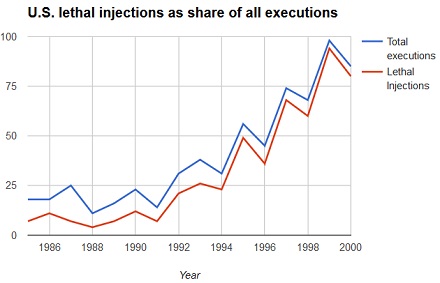
As executions surged in the 1990s, lethal injection was thoroughly displacing America’s previous humane technologies to become the overwhelmingly predominant method.
And the state of Oklahoma, which had been first with a lethal injection law back in ’77, finally started rolling out gurneys — when it put murder Charles Troy Coleman to death with the needle on September 10, 1990. It was Oklahoma’s first execution in 24 years.*
It was Oklahoma’s medical examiner Jay Chapman who had formulated the three-drug cocktail that for a long time comprised the definitive lethal injection protocol: the short-acting barbiturate sodium thiopental, followed by the paralytic drug pancuronium bromide, capped with potassium chloride to stop the heart. Why three drugs, Human Rights Watch later asked him? “Why not?” Chapman was not a pharmacologist and had little expertise with the drugs in question.
Nevertheless, his process “could not be construed as cruel and unusual punishment since it is merely the extreme of procedures done daily around the world for surgical procedures,” Chapman insisted when he proposed it. “It’s simply an extreme form of anesthesia.”
Extreme anaesthesia. Was it really?
Even at Coleman’s death, observers saw it differently.
“I saw him choke and gasp and struggle for air,” said Joe Ward, an investigator in the public defender’s office. “It looked like he was choking to death. He looked over … and mouthed the words, ‘I love you.’ Then he looked straight back up and started choking.” Reporter Art Cox, by contrast, viewed it as “a very easy death … a very cold death, very antiseptic.”
Oklahoma has executed well over 100 people since Charles Coleman but if anything the uncertainty about that “easy” and “antiseptic” death has only grown — in the Sooner state and elsewhere.
And the question has become quite urgent during the lifetime of this blog as political pressure on manufacturers has dried up the supply of sodium thiopental, forcing the many states using lethal injection to scramble for a variety of new drug sequences that are basically being invented on the fly and sussed out with live experimentation on the next death row prisoner in the queue.
Oklahoma’s version was to switch from sodium thiopental to pentobarbital; in January 2014, a man being executed with pentobarbital exclaimed, “I feel my whole body burning.”. Months later, the manufacturer of that drug also cut off the supply, unwilling to be party to the executions it facilitated.
So Oklahoma switched to a third anaesthetic, midazolam, a drug whose execution debut took place in Florida in 2013. The state has also tried to shield its suppliers from anti-death penalty campaigners with a secrecy law.
Proceeding on a mad catch-as-can basis, Oklahoma proceeded to horribly botch its midazolam executions, throwing its new procedure right back to the courts. Just this past June, a divided U.S. Supreme Court narrowly approved the continued use of its midazolam cocktail, which a dissenting justice savaged as “the chemical equivalent of being burned alive.”
It’s a story still being written before our eyes — a long quarter-century after Charles Coleman premiered Oklahoma’s modern era of executions on this date in 1990.
* The last previous execution in Oklahoma was that of James French in 1966.


 Dekanidze was born in Georgia, but had no citizenship anywhere. His father Georgy cashed in on the collapse of Soviet rule with businesses that, to survive and thrive in the 1990s, would be mobbed-up practically by definition. “When you have a collapse of government and total incompetence, people appear who can organize themselves and influence the lives of others,” Georgy
  At his trial, Bolton admitted he’d been to Zosha’s home and to the cab where her body was found, but denied any part in her murder. Instead, he said he’d planned to break into the Pickett residence with an accomplice named “Phil” but was scared away. Phil, he said, had come back later and taken and killed the little girl. Bolton had then murdered the man and buried his body in the desert.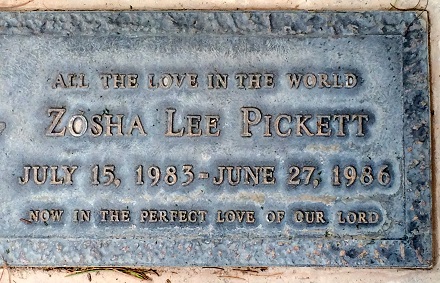
 Ten grand in the red on gambling debts, Lonchar in 1986 raided the home of the bookie he owed and gunned down that bookie, his female partner, and his two sons. (One of the sons survived by playing dead.)