1998: Twenty-four Sierra Leone rebels

Fifteen years ago today, thousands of Freetown residents piled into a stone quarry on the outskirts of the Sierra Leone capital to cheer the firing squad executions of two dozen soldiers linked to the previous year’s coup.

In an episode of Sierra Leone’s intractable 1990s civil war, the government of Ahmad Tejan Kabbah was overthrown in 1997 by a military clique in alliance with the murderous Revolutionary United Front (RUF).

This was the height of Sierra Leone’s “blood diamond” chaos, and the RUF had earned an international reputation for savagery in exploiting this lucrative trade — most vividly symbolized by thousands of civilians whose arms or legs were chopped off in an effort to induce population flight away from the diamond mines it intended to control.

The RUF lived down to its terrifying reputation when it marched into Freetown with its military allies in May 1997. Disorderly gangs brandishing AK-47s looted buildings in Freetown* as President Kabbah fled the country.

The oppressive putsch was short-lived: Nigerian-backed intervention reversed the coup early in 1998, causing the RUF to melt back into the bush.**

The Freetown populace’s enthusiasm for revenge against the rebels is to be understood in this light. Those shot at the quarry this date included some major figures in the coup, according to the New York Times: “Brig. Samuel Koroma, a former chief of defense staff and the elder brother of the junta leader, Johnny Paul Koroma, who is a fugitive, and Cpl. Tamba Gborie, the man who announced the coup. The junta secretary general, Col. Abdul Karim Sesay, was also executed.”

The African Commission on Human and Peoples’ Rights later found Sierra Leone in violation of the African Charter on Human and Peoples’ Rights for denying the soldiers a “right of appeal to competent national organs” which “falls short of the requirement of the respect for fair trial standards expected of such courts.” Sierra Leone was so little perturbed by the non-binding and unenforceable ruling that it didn’t even bother defending itself against the complaint.

* Dubbed “Operation Pay Yourself”.

** They weren’t done by a long shot. In January 1999, the RUF’s more systematically homicidal “Operation No Living Thing” attack on Freetown claimed 7,000 lives, half of them civilians.

On this day..

1997: Chiang Kuo-ching, Taiwan wrongful conviction

On this date in 1997, Taiwanese airman Chiang Kuo-ching was shot for the rape-murder of a five-year-old girl the previous September.

Chiang was nominated as a suspect by a fellow enlistee just a day after the little girl’s body was found in a privy gutter.

So, he and three other early suspects were given “lie detector” tests. Because Chiang was the only one of these who “failed” to acquit himself by this ludicrous mummery, he became the subject of implacable official tunnel vision.

The case was referred — illegally and arbitrarily — to the country’s intelligence services, who subjected Chiang to 37 hours of torture in order to extract a confession: beatings, threats, sleep deprivation, and private screenings of “his victim’s” autopsy.

Chiang broke, and admitted to the crime.

That admission was the star witness against him in his ensuing military trial. Chiang had retracted it by then — but that was much too late to help himself, especially since potentially exculpatory forensic evidence was intentionally withheld from his defense.

As it turned out, the bloody handprint and the DNA trace recovered from the scene didn’t match Chiang at all. No evidence connected him to the crime, except the evidence of truncheons.

Another airman, Hsu Rong-chou, eventually admitted to the killing. (He’d already been convicted in two other child molestation cases, in 1997 and 2003.) In 2011, Hsu received an 18-year prison sentence for the crime that took Chiang Kuo-ching’s life. Chiang was posthumously acquitted that same year.

The latter-day reversal of the sentence was so sensational that Taiwan’s legislature enacted a special law to increase the compensation Chiang’s family received. The family also got an extraordinary televised apology from President Ma Ying-jeou, who bowed three times before an image of the wrongfully executed man.

On this day..

1993: Joseph Paul Jernigan, Visible Human Project subject

On this date in 1993, Joseph Paul Jernigan died by lethal injection in Texas. Yet he lives on still.

A career burglar, Jernigan was surprised mid-robbery in 1981 by 75-year-old Edward Hale: the thief promptly shot the homeowner dead, then finished his looting. His life as a free man would be over within days.
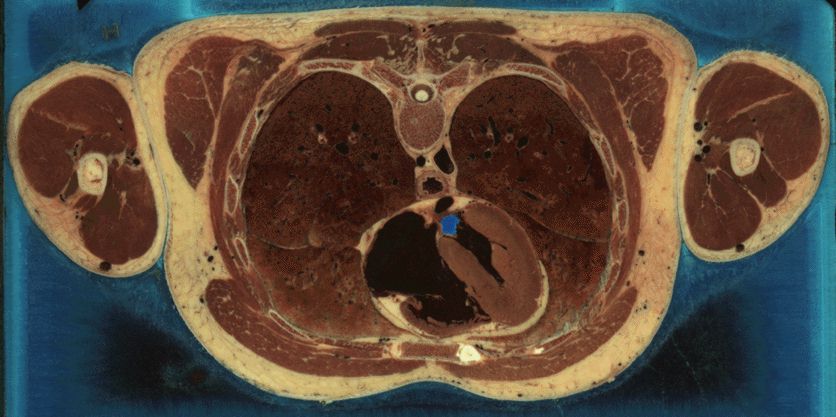
As a criminal you wouldn’t much notice Joseph Paul Jernigan — unless it was your house he was burgling, of course — and you wouldn’t exactly call his smash-and-grab act state-of-the-art. But little over a year after his death, Jernigan was making headlines for a groundbreaking scientific project.

Jernigan donated his body to science, joining an ancient tradition of condemned men and women whose bodies are “cadaverized” for whatever medical material is required of their own day and age.

But instead of serving as a med school’s pincushion, “science” in Jernigan’s case turned out to be — Jernigan had no idea of it while he lived — the Visible Human Project.

This National Library of Medicine initiative built a data set of digital images depicting the complete anatomy of a normal adult man and woman: Jernigan’s cadaver was selected for the male lead.

So, after his execution, Jernigan’s entire body was “sliced” from head to foot into 1,871 one-millimeter slides. (The “slicing” process ground away the body completely; it did not literally slice it like salami.)


Joseph Jernigan’s thorax, including the heart. (From here.)

The project is still online, and has never yet been replicated/surpassed with the the advancing technologies of the intervening decades. It’s a weirdly beautiful, unsettling, and ethically questionable artifact — a Smugglerius of the digital age — but it’s also inescapably awe-striking.

So here: take a tour down Joseph Jernigan at the, er, cutting edge of anatomization.

On this day..

1991: Li Xinming, fecund

We seem to lack an exact date to attribute the evocative action so economically described in this May 30, 1991 Reuters wire story:

BEIJING — A man in northwest China has been executed for hacking to death the children of an official who punished him for violating China’s strict birth control rules, the Xinjiang Legal News said.

Farmer Li Xinming murdered his village chief’s two sons and seriously injured his wife after the chief informed him of his punishment for having a third child, the newspaper said in a recent edition reaching Beijing on Thursday.

The execution was carried out immediately after a public trial, the newspaper said.

The world’s most populous country punishes violators of its strict birth control policies, which restrict most couples to one child, with heavy fines and administrative penalties.

On this day..

1996: Ravji Rao aka Ramchandra, on questionable jurisprudence

India’s recent re-entry into the death penalty club makes this an apt occasion to recall a past generation when that country was a somewhat more willing hangman than it has been in recent years.

Ravji was among India’s last hangings prior to the near-moratorium in India in the first years of the 21st century.

And considering India’s recent reputation for extreme deliberation, with death sentences routinely stuck in decades-long holding patterns, Ravji’s case was not at all typical. He hanged just two days shy of the third anniversary of his murder — the horrifying slaughter of his three children, his pregnant wife, and his neighbor, all for no discernible reason.

Death sentences in India have to be handed down only for the “rarest of the rare” crimes, but when a two-judge Supreme Court panel (India has a large high court which decides most cases without sitting en banc) heard the appeal in 1995, it had no trouble ruling this filicide easily qualified as rarest-rare. I mean, you’d think, right?

Funny thing.

The judgment in Ravji simply said that “it is the nature and gravity of the crime, but not the criminal, which are germane for consideration of appropriate punishment in a criminal trial.” If the crime is among the most awful murders known and creates “society’s cry for justice against against the criminal,” then it’s among the rarest of the rare: it doesn’t matter if the intent or mental state of the person who carried it out might have been in any way mitigated from full responsibility.

In 2009, the Supreme Court walked that interpretation back, acknowledging that Ravji aka Ramchandra v. State of Rajasthan flatly contravened pre-existing death penalty jurisprudence dating back to 1980* specifying that the characteristics of the criminal counted, too. “We are not oblivious that the Ravji case has been followed in at least six decisions of this Court in which death punishment has been awarded in [the] last nine years,” the judgment noted with some embarrassment. “But, in our opinion, it was rendered per incuriam (ignored the statute of law).”

Subsequent judgments have confirmed that re-reading, and a letter of retired justices even flatly called Ravji’s hanging (along with that of Surja Ram in 1997, under the same since-abandoned jurisprudence) “possibly the gravest known miscarriage of justice in the history of crime and punishment in independent India.”

* A case called Bachan Singh v. State of Punjab was the precedent Ravji erroneously ignored. Bachan Singh delineated several factors that should all be considered in weighing prospective “rarest of the rare” situations:

  1. the manner of the commission of the murder;
  2. the motive;
  3. the antisocial or socially abhorrent nature of the crime;
  4. the magnitude of the crime;
  5. the personality of the victim of murder

On this day..

1998: 22 for the Rwanda genocide

On this date in 1998, 22 people were tied to wooden stakes in five different cities around Rwanda, then shot dead for their participation in the horrific 1994 Rwanda genocide.

Rwanda had, only shortly before, reversed a ban on public executions — clearly with this date’s spectacle in mind.

A Washington Post reporter described the scene in the capital city of Kigali, where 7,000 to 10,000 witnesses saw the three men and a woman put to death on Nyamirambo Stadium‘s red clay football pitch.

dressed in pale pink uniforms, under a sun that had just driven away a covering of gray clouds.

Four masked police officers leaped from a truck and sprinted to within feet of the black-square targets on the criminals’ chests.

As bullets from AK-47s shredded the prisoners, a sudden sharp silence descended on the crowd. Then a fifth marksman shot each prisoner in the head at point-blank range. Twice.

One man sprinted and danced when the shooting stopped. Women ululated.

A man named Andrew, 45, clapped lustily. “God is great!” he cried.

(Here’s another first-person account of the same execution.)

Among those dying before their eyes that day was the politician Froduald Karamira, once the vice president of the Rwandan Republican Democratic Movement and a prime mover in the 1994 genocide.

Although Karamira was actually born a Tutsi, he “converted” into a Hutu* and how. He established himself as a leading exponent of “Hutu Power” — the chilling banner under which upwards of a million Rwandans were slaughtered — and had control of two of the radio stations inciting Hutu death squads to their bloody work.

According to Hands Off Cain, these are the last executions ever carried out in Rwanda before it abolished the death penalty in 2007.

“Our experience in Rwanda has demonstrated that abolishing the death penalty gave new lease on life and this has contributed to the healing of our society,” said long-serving Rwanda President Paul Kagame, a Tutsi. “Rwandans have achieved a degree of unity and reconciliation, unimagina­ble just a decade and a half ago because a culture of forgiveness — not vengeance — has taken root.”

* Rwanda’s ethnic categories are notoriously artificial.

On this day..

1996: Thomas Reckley, the first in Bahamas in 12 years

On this date in 1996, Thomas Reckley was hanged in the Bahamas for a 1989 Nassau drug murder.

This execution was noteworthy as the first in 12 years in the Bahamas.*

It was also notable as the first since the British Privy Council’s 1993 Pratt and Morgan ruling. That decision held that keeping a condemned prisoner awaiting the gallows for more than five years constituted “cruel and inhumane treatment” sufficient to invalidate the death sentence.

In an uncomfortable holdover from the Empire, the Privy Council was then and still remains today the court of last resort for Commonwealth countries in the region. Therefore, Pratt and Morgan had the effect of making death sentences extremely difficult to carry out: the Privy Council itself dilated appeals (or at least, this was what irritated tough-on-crime types said), and also asserted a human rights standard requiring expedited appeals. In 1994, Trinidad & Tobago squared the hemp circle by hanging Glenn Ashby six days before the deadline even though his last Privy Council appeal was still pending. (It was granted … but too late.)

Sentenced to death on November 7, 1990, Reckley was clearly past the five-year pole when the Bahamas decided to hang him. (He’d received five stays of execution in his time.) This execution appears to be the first in the Caribbean that would fail to meet the Pratt and Morgan test.

* The last previous was William Armbrister on April 10, 1984, capping a period in the 1970s and early 1980s when the Bahamas saw routine hangings every year or two.

On this day..

1997: Michael Carl George

(Thanks to Meaghan Good of the Charley Project for the guest post. -ed.)

On this date in 1997, 39-year-old Michael Carl George was executed by lethal injection at Greensville Correctional Center in Virginia. He’d been condemned for the murder of fifteen-year-old Alexander Eugene Sztanko in 1990.


Michael Carl George (top) and his victim, Alexander Sztanko.

The teenager’s death had been horrific by any standard: he was abducted while out riding his dirt bike, handcuffed to a tree and sexually abused. Before shooting him in the head, the killer applied a stun gun to his genitals. His body, fully clothed but shoeless, was found the following afternoon.

The boy had been killed so close to home that his unsuspecting father actually heard the gunshots. A few hours after Alex Sztanko’s body was found, George was seen loitering near the murder site by a police officer and stopped for questioning. He matched the description of a camouflage-clad man seen near the Sztanko residence the day before, and the suspicious officer asked him directly if he’d been there the previous day.

George admitted that he had, claiming he’d been turkey hunting in the woods. As he was being questioned he was standing directly in front of a “No Trespassing” sign, which gave the policeman an excuse to pick him up.

At the time of his arrest he was carrying, among other things, a knife, a handcuff key and a map, which had an “X” marking the site where Alex’s body turned up in the woods and an “O” where the boy’s dirt bike and helmet were ultimately located.

Inside George’s truck was a machete, a hacksaw, bolt cutters, a tear gas canister, leather gloves and a stun gun. A search of his parents’ home, where he lived, turned up more incriminating items: a pair of handcuffs that matched the key he carried, and a loaded 9mm pistol which turned out to be the murder weapon.

Blood, DNA and fiber evidence also pointed to George as the culprit. The case was pretty open-and-shut.

George had a reputation as a pedophile and Alexander Sztanko wasn’t the only person he killed. The first, as far as anyone knows, was Larry Wayne Perry, a mentally disabled nine-year-old who lived with his grandparents in Dumfries, Virginia.

Larry vanished without a trace on May 22, 1979 and was never found. George admitted to burying the child’s body but said his death was an accident. As the authorities lacked the evidence to prove intentional homicide, he was allowed to plead guilty to involuntary manslaughter and abduction.

A model prisoner, he served just two and a half years of a five-year sentence.

Four years later, he killed Alex Sztanko.

George would later claim he had murdered a third person, but he never named the alleged victim and his statements could not be verified. His appeals raced through the court system at top speed; his time on death row was less than five years, one of the shortest in the state since Virginia resumed executions in the early eighties.

Given the circumstances of the murder and his prior record, he had very few sympathizers and not much he could say for himself on appeal. His case went all the way up to the U.S. Supreme Court, but they voted 7 to 2 to deny a stay of execution, with Justices Ruth Bader Ginsburg and Paul Stevens dissenting.

Alex Sztanko’s parents were quoted as saying they were opposed to the death penalty generally, but as far as they saw it, George’s death was society’s gain.

George’s lethal injection took place without incident and he was pronounced dead at 9:18 p.m. He had no last statements for the press, but he did leave a letter for Mr. and Mrs. Sztanko, both of whom declined to witness his execution.

On this day..

1999: Sean Sellers

On this date in 1999, Sean Sellers became the last person put to death in the U.S. for a crime committed at the age of 16.

Sellers was just four months into his 17th year when he shot dead an Oklahoma City convenience store clerk in a haze of adolescent angst.

“When I was that person, that murderer, I felt superior,” he later wrote in a confession. “I looked down on people with the secret knowledge that I had killed and was capable of killing them too. When I was not that person I was just a confused teenager, going to school, working, learning to drive, still full of anger, and counting the days when I’d be 18 so I could move OUT of that house.”

Six months later, he moved OUT for good by killing his mother and stepfather as they slept. This killing did not stay secret.

The U.S. at the time still allowed the execution of juvenile offenders, a practice that was barred by the Supreme Court only six years after Sellers died.

But on trial for having avowedly killed as “an offering to Satan” during the height of the 1980s’ bizarre devil-worship panic, his age barely figured at all. A cash-strapped public defender tried to argue that he was possessed; later, a defense psychiatrist claimed that Sellers suffered from multiple personality disorder. It’s safe to say the young man wasn’t right in the head at some level, but this sort of thing is juridical grasping at straws.

Sellers later converted to Christianity, but this conversion wouldn’t help him any more than it had helped Karla Faye Tucker the year before. In Sellers’ case, quite a lot of people thought it was all more or less a scam — the manipulative killer’s ploy to avoid the needle.

One footnote to the much-hyped Satanism angle was the teenage Sellers’ interest in Dungeons & Dragons. (Just him and a few million other people.)

Once mainstream enough to have its own cartoon, the popular role-playing game came under hysterical fundamentalist Christian attack during the Reagan years as Lucifer’s very own sport, the gateway drug to erosion of family values and situational ethics.


(via)

A guy like Sean Sellers magic missile-ing a beholder one day and then wasting his parents the next — that was pretty much the Platonic ideal of the anti-D&D campaign. People magazine said the hobby “fueled his darkening fantasies”. (For his part, Sellers disputed the connection.)

Although this sort of thing looks pretty laughable, there are still some authorities who fail their saving throw against dumb when it comes to the infernal pastime.


Haven’t they seen the after-school special?

As an aside, this “rant” (author’s word) from a man whose ex-wife became involved in the Sellers clemency campaign is a pretty interesting snapshot of the prisoner himself, and of the relationships in close proximity to him.

On this day..

1996: Lem Tuggle, Tim Kaine client

Tim Kaine, who governed the Commonwealth of Virginia from 2006 to 2010 and was just last month elected to the U.S. Senate, had a different service to perform on this date in 1996.

Kaine saw his client, double-murderer Lem Tuggle, to the Virginia execution chamber on December 12, 1996.

In 1983, fresh off parole for a 1971 homicide, Tuggle raped and shot 52-year-old Jessie Geneva Havens.

“From past experience, I would like to talk to an attorney,” he told the officer who arrested him. “I’ll probably tell you the full story later.”

In this selfsame spring of 1983, 25-year-old Timothy Michael Kaine was receiving his J.D. from Harvard Law. He moved to Richmond, Va., with his classmate Anne Holton, daughter of the state’s former governor.

Kaine and Holton married in 1984.

This was also an eventful year for the now-twice-convicted killer Lem Tuggle: together with five other condemned inmates, Tuggle sensationally busted out of Mecklenburg Correctional Center — capturing several prison guards, making up a phony bomb threat, and simply strolling out the gates in their stolen uniforms during the confusion.

The “Mecklenburg Six”* cast a terrifying pall in the headlines of June 1984; it took weeks to recapture them all. Tuggle, sensibly, made a bid for Canada’s death-penalty-free soil, only sparing Ottawa a major diplomatic headache when he stopped to rob a Vermont diner for gas money and got arrested.

Kaine’s path was destined to cross with this notorious convict, but not for some years yet. In the meantime, the idealistic young J.D. in his first year at the bar was getting acquainted with death row when he accepted a pro bono legal appointment to represent condemned killer Richard Lee Whitley.

A lifelong Catholic who had spent a youthful finding-himself year working at a mission in Honduras, Kaine was (and remains) a death penalty opponent. This would later prove a sticky wicket, but mid-1980s Kaine didn’t have a career in politics on his radar, as evidenced by his distinctly impolitic remark that “murder is wrong in the gulag, in Afghanistan, in Soweto, in the mountains of Guatemala, in Fairfax County … and even the Spring Street Penitentiary.”

Later, when he was in politics, Kaine would tell a reporter profiling him during the 2005 gubernatorial campaign that he didn’t want the assignment but would have felt like a “hypocrite” to refuse it. The Commonwealth was less easily overcome than Kaine’s scruples, and Whitley died in Virginia’s electric chair on June 6, 1987.

“I just remember sitting on my back step late and just having a couple of beers and just staring out at my backyard,” Kaine recalled of the night he lost his client.

Having had this first taste of failing with a man’s life on the line while being publicly vilified for his work, Kaine signed on to represent Tuggle in 1989.

By the time Tuggle’s legal rope ran out in 1996, Tim Kaine was a 38-year-old Richmond city council member — the trailhead for his new and now-familiar career in politics.

As Kaine elevated himself into a statewide figure in the early 2000s, his death penalty position came in for some controversy which Kaine finessed by taking the position that while he himself opposed capital punishment, he would enforce the state’s death penalty law in his capacity as governor.**

Death penalty stuff has ample third-rail potential, but especially in Kaine’s gubernatorial race, his own personal legal work at the defense bar became fodder for some truly repellent attack ads by the mouthbreather lobby who tried to put Kaine personally on the hook for Tuggle’s crimes by virtue of having represented the man in court.

* The other five were Linwood Briley, James Briley, Earl Clanton, Willie Leroy Jones, and Derick Peterson. All of these men were also executed.

** That was indeed the case. Gov. Kaine commuted only one death sentence, that of Percy Walton, while allowing 11 others to go forward. D.C. sniper John Muhammad was the most notorious man with Kaine’s signature on his death warrant.

On this day..