On this date in 1874, William Udderzook was hanged in West Chester, Pennsylvania for an insurance scam gone horribly macabre — accidentally making judicial history in the process.
Udderzook and his brother-in-law Winfield Scott Goss had contrived to pick up some easy scratch by insuring Goss’s life and having him “burned to death” in a laboratory fire; Udderzook procured a medical cadaver for the purpose, and duly identified its charred remains the late lamented Goss, who was in fact laying low in Newark under an assumed name.
An amateurish stunt by today’s standards, but forensic science was still in its infancy. During the Civil War just a decade before, the majority of the dead had been buried unidentified. Personal recognition was still the best way available in most cases to tell who was who.
Udderzook and Goss’s wife therefore collected on their say-so, but insurance adjusters smelled fraud. It was through their pressure that the “Goss-Udderzook tragedy” unfolded, and became an object lesson and test case in the science of establishing identity.
Goss was the first hoisted on his own petard, for his faked death meant that Udderzook could not afford to have investigators find him alive. So Udderzook murdered Goss, this time for real — real gruesome, that is. When the body was discovered, it had been dismembered, disemboweled, and repeatedly stabbed.
When Udderzook faced trial, Goss’s identity with “Wilson” (his assumed name) was the central question, and it was established using photography. (The same way they identified the body, actually, per a contemporary New York Times account here. (pdf))
Udderzook fought the photographic identification all the way to the Pennsylvania Supreme Court — which turned aside the appeal with a landmark ruling whose embrace of the photographic science would unlock its forensic potential:
That a portrait or a miniature painting from life and proved to resemble the person may be used to identify him cannot be doubted, though, like all other evidences of identity, it is open to disproof or doubt, and must be determined by the jury. There seems to be no reason why a photograph, proved to be taken from life and to resemble the person photographed, should not fill the same measure of evidence. It is true that the photographs we see are not the original likenesses; their lines are not traced by the hand of the artist nor can the artist be called to testify that he faithfully limned [sic] the portrait. They are but paper copies taken from the original plate, called the negative, made sensitive by chemicals, and printed by the sunlight through the camera. It is the result of art, guided by certain principles of science. . . .
It is evident that the competency of the evidence in such a case depends on the reliability of the photograph of a work of art, and this, in the case before us, in which no proof was made by experts of this reliability, must depend upon the judicial cognizance we make of photographs as an established means of producing a correct likeness. The Daguerrean process was first given to the world in 1839. It was soon followed by photography, of which we have nearly a generation’s experience. . . . We know that its principles are derived from science; that the images on the plate, made by the rays of light through the camera, are dependent on the same general laws which produce the images of outward forms upon the retina through the lenses of the eye. The process has become one in general use, so common that we cannot refuse to take judicial cognisance of it as a proper means of producing correct likeness.
On this date in 1850, a 57-year-old Harvard professor expiated upon a gallows at Boston’s Leverett Square the murder of one of the university’s donors.
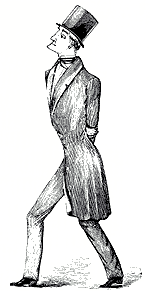
The buzz of Boston in 1849-50, the Parkman-Webster murder case began with the disappearance of one of the crimson’s great benefactors, George Parkman, a Boston Brahmin known for his Ministry of Silly Walks gait about town (see right). According to Oliver Wendell Holmes, Sr. (who appeared as a witness at the trial of Parkman’s accused murderer), “he abstained while others indulged, he walked while others rode, he worked while others slept.”
Also, he inherited a ridiculous sum of money, and was tight with the debtors to whom he lent it.
Back before collection agencies, Parkman disappeared in November 1849 while making the rounds to shake down his borrowers. Within days, suspicion settled on Harvard anatomy and geology professor John Webster, who had squandered his own pile of money buying rock collections and maintaining appearances and such, and sank into desperate hock to the jutting-chinned ambulator who had helped him land the Ivy League appointment in the first place.
A weighty circumstantial case soon formed against Webster, with the invaluable aid of a snoopy janitor who turned up human remains in the office and testified to incriminating-sounding conversations.
Elites-on-elite crime epidemics always churn the scandal mills. Henry Wadsworth Longfellow’s wife Fanny wrote a friend,
You will see by the papers what dark horror overshadows us like an eclipse. Of course we cannot believe Dr. Webster guilty, bad as the evidence looks. … Many suspect the janitor, who is known to be a bad man and to have wished for the reward offered for Dr. Parkman’s body. … I trust our minds will be soon relieved, but, meanwhile, they are soiled by new details continually.
Boston high society was about to see a whole different side of Harvard.
Although perhaps individually explicable — anatomists had plausible reasons to have human remains at work, and other anatomists than Webster could have had access to his office — the cumulative weight of Webster’s ham-handed attempts to declare that he had paid up his debts to Parkman just before the latter’s mysterious disappearance, of the discovery of what (disputed) dental forensics declared to be Parkman’s dentures, of the ghastly appearance of a torso (disputedly) declared to be Parkman’s stuffed in a tea chest at Webster’s offices started to really make the man look guilty.
In view of a mediocre defense, the jury convicted Webster of whacking his own professional benefactor, in the university building erected on said benefactor’s donated plot of land.
While the prof’s seeming post-conviction acceptance of guilt — in a plain strategem to secure clemency — and generally shifty demeanor have cemented him as the definitive perpetrator in the standard historical reading,* Fanny’s snobbish take on the “bad man,” janitor (and moonlight body-snatcher) Ephraim Littlefield, has not been entirely lost to the tradition.
At the end of the day, everything about the case is circumstantial — indeed, besides being historically noteworthy for the first use of dental forensic evidence in a murder trial (forensics we might find rather speculative and unconvincing today), Webster’s case generated a landmark ruling from the judge’s jury instruction establishing “reasonable doubt” as the threshold for criminal conviction rather than the “absolute certainty” Webster’s prosecutors had no hope of attaining; that ruling influences American jurisprudence down to the present day.
And one cannot but notice how many of the circumstances — creepily playing Sherlock Holmes with a freelance dig into the professor’s furnace to discover charred bones, for instance — were provided by the fellow-suspect-turned-star-witness Littlefield, who niftily reaped the $3,000 reward for his offices in substituting Webster for himself under the pall of suspicion.
According to peripatetic crime blogger Laura James, a forthcoming (2009) book promises to revisit the sensational trial, “to examine all the intricacies for ourselves — not aided by the eager voice of the janitor.”
* Bemis, one of the prosecutors, wrote the go-to source on the Webster trial, available from Google Books; another contemporaneous account is here.
Polling data reveals interesting things about U.S. public opinion and the death penalty. If you ask an open-ended question about the death penalty –- for example, “Do you feel the death penalty is appropriate for certain egregious crimes?” –- then you usually see somewhere around a 65 to 35 percent split in favor. On the other hand, if you ask which is preferred – the death penalty or life in prison without parole, the results tend to be closer to 50-50.
Upon occasion, another question is asked: Do you feel an innocent person has been put to death in the U.S.? The results are pretty emphatic: Americans don’t trust their government to get it right, and they do believe innocent people have been executed, by a ratio of about three to one.
So the question fairly arises: Have innocent people been executed in the U.S. in what we sometimes refer to as the “modern era,” i.e., since executions were allowed to resume in 1976?
Enter Cameron Todd Willingham.
On Feb. 17, 2004, Cameron Todd Willingham was strapped to a gurney in a Texas death chamber as he declared his innocence for the last time. Minutes later, he was executed by lethal injection. In December of the same year, the Chicago Tribune uncovered secrets behind the Willingham case, addressing questions left unanswered and raising doubts left unacknowledged.
The Fatal Fire
Cameron Todd Willingham with one of his purported victims — his daughter, Amber.
On Dec. 23, 1991, Willingham was at home with his three daughters. His wife, Stacy, left their home in the morning to pay the bills and shop for Christmas gifts at a Salvation Army store. The family had been struggling that year; Todd, as everyone called him, had recently been laid off, and Stacy was supporting the family with her wages from a bar. The Willinghams were two months behind on rent, and they had even stopped paying some bills in order to save money for Christmas.
Willingham recalled waking up briefly as his wife was leaving the home around 9 a.m. When he heard their one-year-old twins, Karmon and Kameron, crying, he woke up to feed them and went back to sleep. About an hour later, his two-year-old daughter Amber woke him with her cries, and the house was already full of smoke. Willingham remembers not being able to see “anything but black” toward the front of the house.
The circuits were popping throughout the home as Willingham frantically went to his daughters’ bedroom. At this point, his hair caught on fire, and he was able to see little more than the glowing of the ceiling. Willingham called out for his children and felt along the floor and bed for them, but he could not find them. This is when debris began falling from the ceiling, causing him to burn his shoulder. He fled the home through the front door.
After fleeing his house, he asked his neighbors to call the fire department and screamed to them, “My babies is in there and I can’t get them out.” A neighbor, Mary Barbee, then asked other neighbors to place the call because her own telephone was disconnected. Willingham reported that, while this was happening, he tried to re-enter his home, but it was too hot. Then, he knocked out two bedroom windows with a pool cue, but could not get into the bedroom.
Buvin Smith arrived on the scene after hearing the neighbor’s call over a radio scanner. Smith remembered restraining Willingham from going onto the porch, and heard him yelling that his “babies were in the house” and noticed that he was “acting real hysterical.”
A Circumstantial Case
Almost immediately, Willingham became a suspect. According to the Chicago Tribune, prosecutors often are able to rely on circumstantial evidence in cases when a child dies and the parent survives. In this case, the prosecution convinced the jury that Willingham killed his children because they interfered with his beer-drinking, dart-throwing lifestyle. The jury believed it.
Neighbors told investigators that they did not believe Willingham tried hard enough to save his children. In fact, Barbee said that she saw Willingham standing by the fence as heavy smoke came out of the windows. Also, she told investigators that Willingham seemed more concerned with moving his car away from the burning house as the windows blew out than with saving his children.
Willingham’s wounds were treated shortly after the fire. Firefighters did not think that his burns were severe enough had he indeed searched for his daughters in the manner he described. His shoulder, back, and hair were burned, but his bare feet were not burned at the bottom.
Police stated that, the day after the fire, Willingham complained about not being able to find a dartboard in the wreckage of his home. Others mentioned hearing loud music and laughter in the following days as the couple attempted to salvage their belongings.
A police chaplain grew suspicious that Willingham’s hysterics during the fire were not genuine. The chaplain, George Monaghan, noted that Willingham seemed “too distraught.”
In addition to these evaluations of Willingham’s behavior, fire investigators reported over 20 indicators of arson. These include the “crazed glass,” or the web-like cracks in the glass. Until more recent research was completed, arson specialists believed this to be a clear indication that an accelerant had been used in the fire. The fire experts also noted that the fire had reached a stage known as flashover, when a fire reaches such a high temperature that an explosion results. This further supported their reasoning that an accelerant had been used.
Willingham was charged with murder on Jan. 8, 1992, just two weeks after the fire. In August of the same year, his trial began, after Willingham turned down a deal from the prosecution and insisted that he was innocent. During the trial prosecutors presented inmate Johnny E. Webb as a witness. He testified that Willingham confessed at the county jail to killing his children in order to cover up the fact that his wife, Stacy, had been physically abusing them. Webb, a recovering drug addict, was taking psychiatric medication to relieve post-traumatic stress syndrome. The prosecution also presented as witnesses the neighbors who claimed that Willingham should have done more. Fire investigators Doug Fogg and Manuel Vasquez also testified at Willingham’s trial. Both of these investigators testified in court that the fire was caused by arson.
Both of these investigators testified to assumptions about fire that have been scientifically proven to be wrong.
Forensic Evidence Reconsidered
When the Chicago Tribune investigated the case, several experts reviewed documents, trial testimony, and video documentation of the fire scene and concluded that the original investigation was terribly flawed. Gerald Hurst, a Cambridge University-educated chemist, and John Lentini, John DeHaan, both private consultants specializing in fire investigation, along with Louisiana fire chief Kendall Ryland, examined the materials. They suggest that this fire may have been simply accidental.
After the Chicago Tribune investigation, Lentini worked with the Innocence Project to assemble an independent, peer-review panel of arson experts. The five-member panel –- with a combined 138 years in high-level fire investigation experience –- issued a 44-page report (.pdf) on the case.
They determined that “each and every one” of the forensic interpretations made by the state’s experts at Willingham’s trial was not scientifically valid. For example, the original investigators determined that an accelerant was used because wood cannot burn hot enough to melt aluminum. In fact, according to these leading experts, it can.
The 1991 investigators also claimed that the brown rings on the Willingham’s front porch indicated accelerant usage. Experts called this “baseless speculation,” explaining that fire-hose water often leaves brown rings on surfaces after evaporation.
Was it Known Before the Execution?
This information didn’t only come to light recently. Shortly before Willingham was executed, Hurst reviewed the case and issued a report that dismissed every single indicator of arson Fogg and Vasquez had originally cited. What was done with this report? Texas judges and Gov. Rick Perry turned it aside, confident of Willingham’s guilt.
Jury members are less confident now. One jury member asked, “Did anybody know about this prior to his execution? Now I will have to live with this for the rest of my life. Maybe this man was innocent.”
There has not been “a single case—not one—in which it is clear that a person was executed for a crime he did not commit. If such an event had occurred in recent years, we would not have to hunt for it; the innocent’s name would be shouted from the rooftops.”
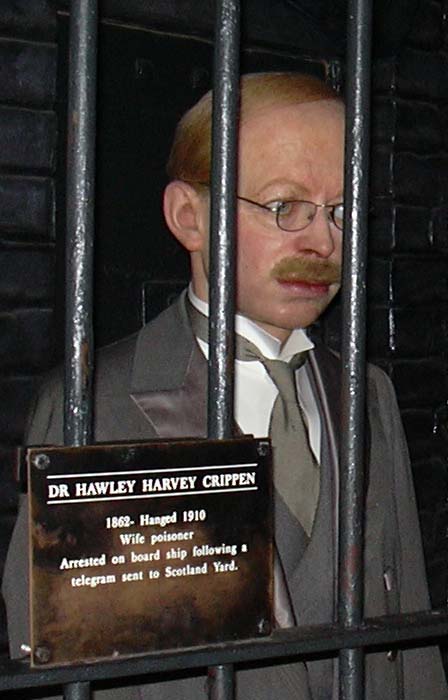
On this date in 1910, the notorious wife-murdering doctor Hawley Harvey Crippen was hanged at London’s Pentonville Prison.
The sensational trial, which saw the American-born homeopath convicted for dismembering his shrewish and unfaithful wife Cora in an attempt to take up with his young mistress, fitted Crippen for both a noose and a likeness at Madame Tussaud’s. (More trial background here.) It has also made his case twice a landmark in the history of crime and technology: once at the time of his arrest, and again just last month as of this writing.
The core of a case a jury found so open-and-shut as to require just 27 minutes to convict was the poorly explained disappearance of Crippen’s wife, followed by the discovery of a considerably mutilated female corpse under the Crippens’ home.
Although much of the crown’s evidence was speculative and circumstantial — to say nothing of the bodice-ripping gossip of nymphomania and infidelity — a corpse under the floorboards tends to be a compelling circumstance to a jury.
Presumably that anticipation prompted Crippen to flee the Scotland Yard investigation with his mistress Ethel le Neve under assumed names on an ocean liner bound for Canada. The case made criminological history as the first use of wireless communication to apprehend a suspect when the ship’s alert captain telegraphed Crippen’s presence to land as the ship steamed away — enabling a policeman to board a faster boat and arrest the pair as they docked in Quebec.
Given his suspicious behavior, scant had been the credence given Crippen’s protestation of innocence.
Until now.
In a meeting of Edwardian crime and cutting-edge technology, two scientists from Crippen’s home state of Michigan stunningly announced in October that DNA testing proves the body was not Cora Crippen after all.
If true, it would appear to void Crippen’s conviction in its particulars without quite exonerating the hanged man from the natural question: whose was the corpse? The manufacture of clothes on the body dated it to the Crippens’ occupancy of the house.
One of Crippen’s modern sleuths, in a wholly speculative vein, thinks it might harken to an altogether different sort of crime: a botched back-alley abortion, just the sort of thing a financially struggling physician might have been involved in.
Maybe.
But if the test invites a modern investigator to look 97 years backwards, it also suggests a posture of epistemological humility. It’s just possible that the light this test casts on our own time is as searching as that it shines on 1910.
The Prejudice of Science
The Crippen case was a classic 19th century-style detective job — the inspector who made the arrest cut his teeth as a younger man on a Jack the Ripper murder — but it took place on the brink of a revolution in forensic science.
Just a few years before, fingerprinting had been embraced by British and American law enforcement and begun its march towards total institutionalization. On the heels of fingerprinting came a multiplicity of biometric approaches to crime scenes — hair and fiber analysis, blood typology, and most recently and dramatically, DNA.
And they, in turn, have brought a rising faith in science to adjudicate the law.
In short, for all its undoubted contributions to criminal justice, forensic science packs along its own set of pitfalls, caveats and blinders reflexively privileging evidence of the laboratory.
This is not a reflex to indulge uncritically. History grants the benefit of hindsight, but rarely the luxury of certitude.
A waxwork Dr. Crippen at Madame Tussaud’s. Image used with permission.
So if the prospect of Crippen’s innocence intrigues, that unexplained body — that sudden flight for Canada — that (permanent) failure of Cora Crippen to resurface — nevertheless remain. They might lead us to question our implicit faith in the finality of DNA’s verdict on history rather than the other way around.
Are we certain that an unbroken line of blood relations really connects Cora Crippen to the modern DNA donors of her “family”?
Are we certain that a reliable chain of custody has preserved the original tissue samples unsullied across a century?
And if we are certain, what do we make of that body after all?
It is humans who must ultimately interpret and contextualize even the firmest forensic science. Whatever we might believe of Dr. Crippen we retain the burden of that belief, with all its intrinsic potential for grievous wrong.
The tales Hawley Crippen has yet to unfold from the grave might or might not shed still another different light on our understanding of what happened at 39 Hilldrop Crescent a century ago.
The gentleman’s place as a continuing attraction at Madame Tussaud’s, however, seems assured.

 The buzz of Boston in 1849-50, the
  Although perhaps individually explicable — anatomists had plausible reasons to have human remains at work, and other anatomists than Webster could have had access to his office — the cumulative weight of Webster’s ham-handed attempts to declare that he had paid up his debts to Parkman just before the latter’s mysterious disappearance, of the discovery of what


 The
The