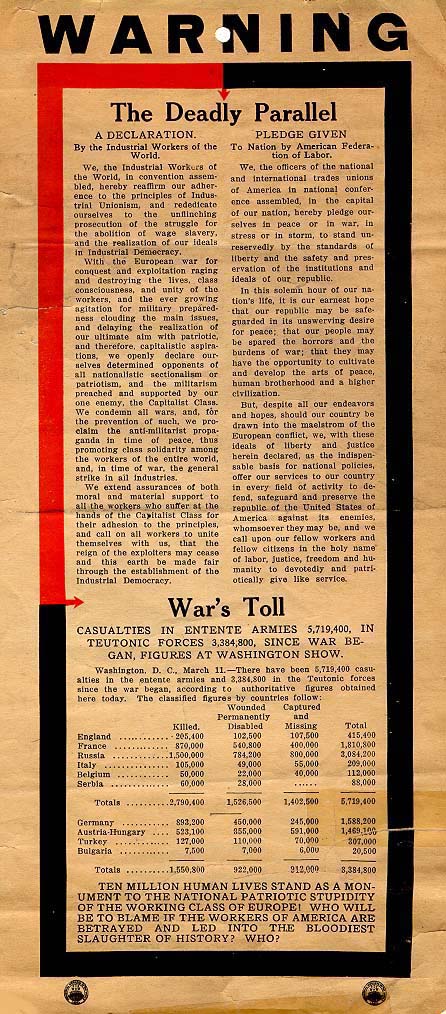
A century ago today, an Armistice Day parade turned the Pacific Northwest logging town of Centralia, Washington into a battlefield. By the time night fell on the Centralia Massacre* four American Legionnaires had been shot dead … and then the cover of darkness was used to revenge them with the lynching that evening of Wobbly labor agitator Wesley Everest.
Before Amazon and Starbucks and Microsoft and even before Boeing, the economic engine of early Washington state consisted of cutting down its mighty ancient trees.
The spruce and fir trees were torn from the verdant Northwest by rough men working dangerous jobs in brutally exploitive conditions. “Loggers dealt with adulterated food, fleas and other vermin in their overcrowded housing, straw for bedding, the smell of disgusting wet socks drying near the bunkhouse’s one heater, latrines located directly next to the dining hall so that they could smell feces when they sat down to eat, etc.,” writes labor historian Erik Loomis. “They were paid next to nothing for their work and frequently ripped off by a collusion of timber operators and employment agencies.”
Small wonder that this part of the world yielded ready soil for radical labor organizers. The syndicalist labor union Industrial Workers of the World (IWW, familiarly nicknamed “Wobblies”) made notable inroads there.

Section of the map of the Northern Pacific rail network (rail lines in red), circa 1900.
In the town of Centralia, inland and convenient to the continent-straddling Northern Pacific Railway which whisked away the produce of her logging camps, Wobblies’ presence dated back at least as far as 1914.
They’d been the locus of violence previous to the events in this post: in 1918, a Red Cross parade addled on wartime jingoism turned into the sack of the IWW’s union hall. Vowing that they’d not suffer invasion again the Wobblies armed themselves, and they were on guard for the large parade Centralia had scheduled for the first anniversary of the Great War’s end — suspiciously routed to pass right in front of the new IWW hall.
|
|
Every history of the Centralia Massacre says at this point that the facts are in dispute as to who started what on that day, but it can be fairly said that a deliberate provocation deliberately provoked and before you knew it war veterans of the then-newformed American Legion were storming the Wobblies, under gunfire.
Ere the hive of radicalism was overrun, three Legionnaires had been shot dead.
Meanwhile, fleeing via an adjacent alley as he reloaded his .44 pistol went one of the hall’s armed defenders, Wesley Everest. The enraged mob pursued him, and as the IWW’s (obviously partisan) official site observes, this fact likely saved other Wobblies in the hall from summary execution. Instead they were bundled into jail where they’d soon be joined by Mr. Everest.
Running pell-mell down the alley the mob gave a shout of exaltation as Everest slowed his pace and turned to face them. They stopped cold, however, as a number of quick shots rang out and bullets whistled and zipped around them. Everest turned in his tracks and was off again like a flash, reloading his pistol as he ran. The mob again resumed the pursuit. The logger ran through an open gateway, paused to turn and again fire at his pursuers; then he ran between two frame dwellings to the open street. When the mob again caught the trail they were evidently under the impression that the logger’s ammunition was exhausted. At all events they took up the chase with redoubled energy. Some men in the mob had rifles and now and then a pot-shot would be taken at the fleeing figure. The marksmanship of both sides seems to have been poor for no one appears to have been injured.
DALE HUBBARD
This kind of running fight was kept up until Everest reached the river. Having kept off his pursuers thus far the boy started boldly for the comparative security of the opposite shore, splashing the water violently as he waded out into the stream. The mob was getting closer all the time. Suddenly Everest seemed to change his mind and began to retrace his steps to the shore. Here he stood dripping wet in the tangled grasses to await the arrival of the mob bent on his destruction. Everest had lost his hat and his wet hair stuck to his forehead. His gun was now so hot he could hardly hold it and the last of his ammunition was in the magazine. Eye witnesses declare his face still wore a quizzical, half bantering smile when the mob overtook him. With the pistol held loosely in his rough hand Everest stood at bay, ready to make a last stand for his life. Seeing him thus, and no doubt thinking his last bullet had been expended, the mob made a rush for its quarry.
“Stand back!” he shouted. “If there are ‘bulls’ in the crowd, I’ll submit to arrest; otherwise lay off of me.”
No attention was paid to his words. Everest shot from the hip four times, — then his gun stalled. A group of soldiers started to run in his direction. Everest was tugging at the gun with both hands. Raising it suddenly he took careful aim and fired. All the soldiers but one wavered and stopped. Everest fired twice, both bullets taking effect. Two more shots were fired almost point blank before the logger dropped his assailant at his feet. Then he tossed away the empty gun and the mob surged upon him.
The legionaire who had been shot was Dale Hubbard, a nephew of F.B. Hubbard, the lumber baron. He was a strong, brave and misguided young man — worthy of a nobler death.
“LET’S FINISH THE JOB!”
Everest attempted a fight with his fists but was overpowered and severely beaten. A number of men clamoured for immediate lynching, but saner council prevailed for the time and he was dragged through the streets towards the city jail. When the mob was half a block from this place the “hot heads” made another attempt to cheat the state executioner. A wave of fury seemed here to sweep the crowd. Men fought with one another for a chance to strike, kick or spit in the face of their victim. It was an orgy of hatred and blood-lust. Everest’s arms were pinioned, blows, kicks and curses rained upon him from every side. One business man clawed strips of bleeding flesh from his face. A woman slapped his battered cheek with a well groomed hand. A soldier tried to lunge a hunting rifle at the helpless logger; the crowd was too thick. He bumped them aside with the butt of the gun to get room. Then he crashed the muzzle with full force into Everest’s mouth. Teeth were broken and blood flowed profusely.
A rope appeared from somewhere. “Let’s finish the job!” cried a voice. The rope was placed about the neck of the logger. “You haven’t got guts enough to lynch a man in the daytime,” was all he said.
At this juncture a woman brushed through the crowd and took the rope from Everest’s neck. Looking into the distorted faces of the mob she cried indignantly, “You are curs and cowards to treat a man like that!”
There may be human beings in Centralia after all.
Wesley Everest was taken to the city jail and thrown without ceremony upon the cement floor of the “bull pen.” In the surrounding cells were his comrades who had been arrested in the union hall. Here he lay in a wet heap, twitching with agony. A tiny bright stream of blood gathered at his side and trailed slowly along the floor. Only an occasional quivering moan escaped his torn lips as the hours slowly passed by.
Dead in the fray outside the union hall were three World War I soldiers: Arthur McElfresh, Ben Cassagranda, and Warren Grimm, the last of whom had the distinction of participating in the unsuccessful American invasion of Bolshevik Russia — plus Dale Hubbard, the man shot dead while attempting to apprehend Everest. All four were Legionnaires who have been honored as martyrs by that organ ever since.**
The IWW, conversely, says the same for Everest, for once night fell he was hauled from his cell and lynched to Mellen Street Bridge: “Hangman’s Bridge” as it was later known — although the present-day bridge dates only to 1958, replacing Everest’s gallows.
And even though anyone involved is long dead by now the affair has remained a charged topic for the hundred years from that day to this; a local newspaper marked the centennial by noting that memorial events by the respective factions’ descendants brought “confrontation even now, even about how to memorialize the dead and imprisoned.” (Although Everest was the only Wobbly lynched, a number of his comrades tossed into prison for years on trumped-up charges, prey to the Red Scare run amok in those years; even the union’s lawyer was prosecuted, albeit unsuccessfully. It goes without saying that nobody ever answered for the lynching.)
There has been for many decades a memorial in Centralia’s George Washington Park commemorating the dead Legionnaires; more recently, Centralia’s cityscape was also enhanced by a rival mural celebrating Everest.

“The Resurrection of Wesley Everest” by activist muralist Mike Alewitz (1997). (cc) image by Richard Colt.
* Also sometimes called the “Centralia Tragedy”. It’s not to be confused with the U.S. Civil War’s Centralia Massacre — which occurred in 1864 in a town of the same name in the bloody border state of Missouri. North America has numerous settlements called Centralia including several with no massacre at all, yet.
** Four Legionnaires plus Wesley Everest make five victims for Armistice Day. There’s a sixth man whose death can be attributed to the affair: a sheriff’s deputy who was mistakenly shot dead a couple of days later when he was unable to give the countersign to a paranoid posse.
On this day..
- 2009: Ehsan Fatahian, Iranian Kurdish activist
- 1779: Robert Young
- 1942: Ernst Schrämli, Swiss traitor
- 1807: Ephraim Blackburn, low roller
- 1954: Karli Bandelow and Ewald Misera, in the Gehlen-Prozess
- 1674: Guru Tegh Bahadur
- 1806: Fra Diavolo, royalist guerrilla
- 1328: Na Prous Boneta, Beguine heresiarch
- 1880: Ned Kelly
- 1761: John Perrott, bankrupt debtor
- 1909: Will James, "the Froggie", lynched in Cairo
- 1887: Parsons, Spies, Fischer and Engel, the Haymarket Martyrs
- 1831: Nat Turner
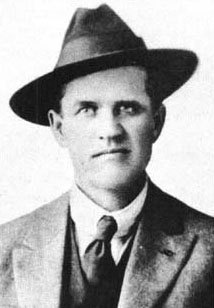 An executive board member of the radical Industrial Workers of the World, the half-Cherokee


 Even before his execution,