1952: Nikos Beloyannis, the man with the carnation

Before dawn on this date in 1952, four Greek Communists were shot outside Athens for treason.

Nikos (Nicholas) Beloyannis (or Mpeloyannis), the most prominent among them, spent a goodly portion of his adult life in prison for his subversive opinions — first at the hands of the interwar Greek nationalist government, then the Nazi occupation, then the British.

His many years’ service to communism was, unbeknownst to him, even then being horse-traded away as Stalin and Churchill carved up post-World War II spheres of influence.

Uncle Joe ceded Greece to the West — so the reds were left dangling during the Greek Civil War, and guys like Nikos got fitted for left martyrology.


The Execution of Beloyannis, by Peter de Francia.

“The man with the carnation” — it was his signature prop at the mass show trial where he drew a death sentence for “conspiring to overthrow by force the present regime in Greece.”

The trial, and the outcry that greeted its swift and questionable resolution, helped establish an enduring international reputation among fellow-travelers.

(From The Man With The Carnation, released after the fall of the Papadapoulos dictatorship.)

On this day..

1937: Alexander Yulevich Tivel

On this date in 1937 — probably — one of the numberless obscurities consumed by Stalin’s purges was convicted and presumably shot for “preparing to commit a terrorist act against [NKVD head] Yezhov.”

Alexander Yulevich Tivel, a Jewish bureaucrat who had the misfortune to have been in a party organ too close to Zinoviev, was disappeared by the NKVD one day in 1936.

His fate forms the opening hook for J. Arch Getty’s The Road to Terror: Stalin and the Self-Destruction of the Bolsheviks, 1932-1939 — “the story of the Stalinist terror writ small.” (Here’s a review)

We do not know whether he was physically tortured by his interrogators, but there is ample evidence that countless others were. Even high-ranking officials under arrest were beaten or, as Molotov would put it, “worked over.” Ten years later, a high-ranking police official described interrogation procedures in a letter to Stalin. First, prisoners were offered better conditions — better food, mail, and so on — in return for a confession. If that failed, appeals to the prisoner’s conscience and concern for his family followed. The next step was a solitary-confinement cell without exercise, a bed, tobacco, or sleep for up to twenty days … Finally, the use of “physical pressure” was authorized …

Tivel was probably executed on the same day [of his conviction]. Unlike many others who were badgered and tortured by the NKVD, he had not confessed.

His wife and mother-in-law to internal exile. His son would suffer the stigma of being the child of an executed traitor.

The widow Eva Tivel, reports Getty, grappled for years with the unresponsive bureaucracy until she finally cleared Sasha Tivel’s name.

On 23 May 1957, twenty years after Tivel’s execution and after Eva’s many letters and appeals, Tivel’s sentence and party expulsion were overturned … [as] “based on contradictory and dubious materials.”

On this day..

1613: Ivan Susanin, a life for the tsar

On an uncertain date in February (perhaps) 1613 — so says a cherished Russian national legend — a villager met a Polish army intent on deposing the Russian tsar, offered to guide it on a “shortcut,” and proceeded to lead it into a forest or fen where it succumbed to the elements.

A monument to Ivan Susanin in Kostroma. Image courtesy of Barbara Partee (Barbara adds: to help prevent future executions of the wrongly convicted, check out the Innocence Project.)

That peasant, Ivan Susanin, is supposed to have been put to death as the army realized its folly and imminent doom — the fate one would expect, although also not the sort that would leave a lot of corroborating witnesses.

Though the particulars are of doubtful veracity, Susanin’s son-in-law was awarded estates for the man’s tortures by enemy armies seeking the tsar — so the story is not completely baseless.

It was tsarist public relations, however, that gave us Susanin in his dramatic, familiar* form with the trackless wilderness.

This Susanin embodies the Russian people’s sacrificial love for their autocrat … and more specifically, since this was the Time of Troubles when the Russian crown’s succession was contested, for the Romanov dynasty whose first scion chosen in February 1613 would have been the Poles’ target.**

Thus, Glinka’s 19th century opera A Life for the Tsar.

But Glinka and Ivan proved up to the shifting needs of authority as the tsar gave way to the Politburo, and that to the post-Soviet state.

In a fascinating 2006 academic disquisition,† Marina Frolova-Walker dissects A Life for the Tsar‘s transmutation into Ivan Susanin, a Stalin-era opera with the same score but a libretto altered to expunge the tsar — and the success this adaptation of a national classic enjoyed vis-a-vis Soviet artists’ original creations under the impossible aesthetic and political restrictions of official censorship.

Not only did this now-nationalist composition thrive in the USSR, it has been successfully re-staged in its Soviet form, or as a fresh amalgamation of Stalin and Glinka, in the Putin era.‡

From the days of serfdom via the days of the gulag past the fall of the Iron Curtain, here’s Ivan Susanin‘s stirring finale performed by the Russian army at the Vatican, and broadcast on Russian television.

* Familiar to Russians, certainly, and you can call one who gets you lost “susanin”.

** And we all know how they left the throne.

† Marina Frolova-Walker, ‘The Soviet opera project: Ivan Dzerzhinsky vs. Ivan Susanin’, Cambridge Opera Journal (2006), 18:2:181-216

‡ In the Yeltsin era, the opera was staged in its pre-Soviet form. Frolova-Walker argues that the version incorporating Stalinist edits actually speaks to contemporary Russia more aptly than the original, an operatic mirror of the state’s re-adopting the Stalinist national anthem after having used a tsarist piece (written by Glinka!) during the 1990’s.

The reappearance of these cultural tokens is occurring because high Stalinism provides the most easily assimilable model for Russian nationalism today: it is less remote than its nineteenth-century counterpart … The eclectic and confident nationalist of the new Susanin contains the appropriate message for those Russian citizens wealthy enough to attend the Bolshoi today.

On this day..

1938: Nikolai Kondratiev, purged economist

On this date in 1938, Stalin’s purges claimed Soviet economist Nikolai Kondratiev.

Not the most recognizable name in the Soviet Union’s 1930’s bloodletting, Kondratiev — also transliterated Kondratieff — was a pre-Keynesian economist of some note, who had a prominent hand in the fledgling USSR’s early agricultural direction.

Thus far goes the portfolio of many a forgotten academic or bureaucrat shot by Stalin.

But Kondratiev made a contribution still much remembered — and one that might just be due to re-emerge from its occult hibernation.

In a series of 1920’s papers, Kondratiev worked out the theory that capitalism had 50-to-60-year economic supercycles. Though not strictly the first to so hypothesize, he put the idea on the map; the (alleged) pattern still bears the name “Kondratiev wave” or “Kondratiev cycle”.

His belief that the intermittent major crises punctuating capitalism were not building towards systemic implosion but clearing the economic debris of bygone ages and allowing new growth were not the least of what got him into hot water with Stalin.

“Creative destruction,” as Joseph Schumpeter would call it, adapting the idea.

Though sidelined from mainline economics for much of the 20th century, Kondratiev waves have never gone entirely out of fashion. Congenial to any number of collateral theoretical hobbyhorses — technological innovation, entrepreneurship, generational psychology, statecraft, and the eternal bracing for end times right around the corner — Kondratiev waves are a niche player in economic theory both conventional and otherwise.

Here’s a site that lovingly describes them.

Its problem, even if you happen to buy into the concept, is its near uselessness as a predictive tool: half-century cycles don’t just arrive like clockwork, and the timing and very existence of particular cyclical epochs is highly dependent on the interpreter’s choice of data. The margins of error run out to decades. You never know at any given moment what you’re looking at — so you can find the supercycle crashing in 1998, or beginning its springtime of growth in this decade.

That very uncertainty accounts for Kondratiev’s intermittent mainstream resuscitation during economic crisis: when worried about Where Things Are Headed, some version of a Long Wave theory is almost sure to have a story to tell.

According to the New York Times‘ database of past articles, the word “Kondratieff” (its preferred transliteration; “Kondratiev” yields stories about New York Rangers prospect Maxim Kondratiev) went essentially unmentioned in the post-World War II paper before appearing in 20 articles from 1973 through 1984 — the period when the capitalist core was buffeted by energy crisis, stagflation, and the punishing Paul Volcker recession of the early Eighties.

And then Kondratiev/Kondratieff faded from the Grey Lady; after a few appearances during Wall Street’s woes in the late 80’s, it doesn’t seem to have appeared in print there since an offhanded reference in a 1992 William Safire column.

Have you seen the news lately? It’s mighty Kondratiev-friendly. His cycle of exclusion has probably just about run its course, and if you’re the wagering type, I’ll take Thomas Friedman against the field.

Behind the theorems, of course, there was the flesh-and-blood man; it so happens that not many dismal scientists went as poignantly as our principal.

Initially imprisoned in 1930, Kondratiev served eight years before he was re-sentenced and executed; he ached for the separation with his family. Kondratiev’s daughter, Elena — Alyona or Alyonushka in the Russian diminutive — preserved his correspondence to her, the only remnants of her father in her life.

The last letter — as it turned out; plainly the writer had no inkling of it — was dated August 31, 1938.

My sweet darling Alyonushka.

Probably your holidays are over now and you are back at school. How did you spend the summer? Did you get stronger, put on weight, get tanned? I very much want to know. And I would like very, very much to see you and kiss you many, many times. I still do not feel well, I am still ill. My sweet Alyonushka, I want you not to get sick this winter. I also want you to study hard, as you did before. Read good books. Be a clever and a good little girl. Listen to your mother and never disappoint her. I would also be happy if you managed not to forget about me, your papa, altogether. Well, be healthy! Be happy! I kiss you without end.

Your papa.

(From Orlando Figes’ The Whisperers: Private Life in Stalin’s Russia.)

On this day..

1937: Mikhail Tukhachevsky and seven other Soviet commanders purged

Early this date in 1937,* Soviet Marshal Mikhail Tukhachevsky was executed by a gunshot to the head for allegedly plotting a coup d’etat against Stalin.

One of the most infamous trials** of the Soviet Union’s Great Purge, which would strip the Red Army of much of its officer corps on the eve of its existential test against the Wehrmacht, the Case of the Trotskyist Anti-Soviet Military Organization has always offered fodder for debating the whys and wherefores.

The bare facts are that nine extremely high-ranking members of the military brass were suddenly arrested and within a few weeks (except the one who committed suicide first) shot on the staggering charge of counterrevolutionary conspiracy. Foremost among the victims was Marshal of the Soviet Union Mikhail Tukhachevsky, notable in the annals of military history for pioneering (along with several other Soviet officers, notably Triandafillov) the military doctrine of “deep battle” or “deep operations”.

Deep Battle

Reflecting on the grinding, indecisive struggles of attrition that characterized World War I and the Russian Civil War (both conflicts Tukhachevsky served in), he sought a theory of offensive warfare for modern armies fighting in large and complex engagements — the operational art. In an early (1923) formulation, Tukhachevsky noted

the impossibility in the presence of modern wide fronts to destroy an enemy army by a single blow compels us to achieve this by a series of successive operations … A series of annihilating operations, introduced successively and combined by continuous pursuit, can replace the annihilating engagement, which in former armies was a better type of combat. (Cited here.)

Deep operations would require sophisticated application of technology to strike an opposing army’s entire support structure behind its lines in coordinated operations, rather than the unproductive World War I tactic of throwing waves of cannon fodder across No Man’s Land in the hope of achieving a breakthrough by sheer mass alone. It ripened into official Red Army doctrine in the 1930’s, decreeing

[s]imultaneous assault on enemy defenses by aviation and artillery to the depths of the defense, penetration of the tactical zone of the defense by attacking units with widespread use of tank forces and violent development of tactical success into operational success with the aim of the complete encirclement and destruction of the enemy. The main role is performed by the infantry, and the mutual support of all types of forces are organized in its interests. (Cited here.)

What Happened?

The mystery has always been exactly why Stalin should shoot Tukhachevsky, even if any question beginning “why should Stalin shoot …” nearly answers itself.

Explanations particular to Tukhachevsky range from rivalries within the army (early blocs of officers appointed by Trotsky and Stalin formed professional rivalries; Trotsky had given Tukhachevsky his first Soviet command) to purely personal enmity between the two men. Many have speculated that a genuine “plot” of some sort — whether a coup or assassination, or more mundane political scheming — was indeed afoot against the Soviet dictator. Tukhachevsky’s (officially sanctioned) links with a German military then developing its own similar operational concepts have told against him in some readings.

Author Robert Conquest put about the theory that Heinrich Himmler’s intelligence operatives had contrived to pass the Soviets forged documents pointing to Tukhachevsky’s German collaboration, the better to weaken the Bolshevik defenses. Conversely — and in his diary, Goebbels attributed this riff on the Dolchstosslegende to Hitler himself — a contrarian take has long defended at least this particular purge as a judicious one by Uncle Joe, insuring that wartime Russia would not be hamstrung by “defeatist” elements or other players who might develop both the means and motive for ending the war on German terms.

Inquiries along these lines, of course, expand beyond the particular case into the larger questions of why Stalin purged the army as a whole, and what ultimate effect that purge had on the Soviets’ military readiness in 1941.

Legacy

With Tukhachevsky’s fall, accompanied by other military reformers, the “deep operations” school acquired sufficient taint to abjure the company of the judicious officer. Nevertheless, Tukhachevsky’s influence would play its part in the Great War: his onetime associate Georgy Zhukov, who may have only accidentally avoided being purged himself, deployed Tukhachevskian mobile tactics to crush Japan’s Siberian aspirations at the Battle of Khalkhin-Gol in 1939; duly elevated for this victory to the precarious post of Marshal of the Soviet Union, Zhukov was a crucial commander in the defeat of Nazi Germany.

Tukhachevsky, along with all those shot this day, was rehabilitated during the Khrushchev era.

Sorry about shooting you in the head. Here’s a commemorative stamp.

* The condemned received their death sentence at 23:35 on June 11, the sentence to be carried out “immediately” — it seems likely but not completely certain that it had become the 12th by the time the executions actually took place, and different sources report different different dates of death. According to the contemporaneous New York Times report, Soviet authorities announced that the executions had taken place on the 12th. (As an interesting side note, the Times that day also blurbed exiled Stalin rival Leon Trotsky reading in the tea leaves of Tukhachevsky’s death “the beginning of the end for the Stalinist dictatorship.”)

** Not, however, a show trial — Tukhachevsky et al were tried in secret.

On this day..

1939: Georgy Nikolayevich Kosenko (aka Kislov), NKVD spy

(Thanks to Dmitri Minaev of De Rebus Antiquis Et Novis for the guest post.)

One thing about the first years of Soviet history that always puzzled me is how the Bolsheviks managed to create a wide and reliable network of foreign intelligence and counter-intelligence so fast. Below is a history of life and death of a typical spy from the early Soviet years.

Georgy Nikolayevich Kosenko was born on 12 May 1901 in Stavropol. He was a smart schoolboy. Foreign languages, especially French, were among his favorite subjects. He graduated from school when the Russian Civil War began and his parents became active Bolsheviks.

Stavropol was a region of fierce struggle between the Whites and the Reds. On the one hand, the anti-Bolshevik Volunteer Army had good support in Southern Russia, but on the other hand, the factory workers who concentrated in the cities tended to support the Bolsheviks.

Georgy’s father participated in the revolt in Stavropol and in 1918 he was executed by the Whites. Georgy’s sister was a Bolshevik since 1914 and actively worked for the revolutionary underground. Soon after the death of their father she too was caught and hanged. I don’t know what was her crime, but most probably it was sabotage.

So, choosing sides in the civil war was not difficult for young Georgy. In 1920 he became a secret agent of Cheka in Stavropol; in 1921 he joined the RCP(b) (Russian Communist Party, bolsheviks) and became a private in the OGPU military detachment. From 1924 he was a full-fledged officer of OGPU (the new name of Cheka) and continued his work in Stavropol and other cities: Novorossiysk, Vladikavkaz, Rostov, Sverdlovsk and Moscow.

A Lethal Career

In 1933 the Foreign department of OGPU noticed the young officer with good command of French and offered him a post in Soviet foreign intelligence. On 30 April 1933 he was appointed the deputy of the chief agent of OGPU in Kharbin in Manchuria, then occupied by the Japanese. According to the usual practice of the OGPU, he received false documents and became Georgy Nikolayevich Kislov. He became the secretary of the Soviet embassy in Kharbin. In June 1935 he was promoted to the chief agent and, automatically, to the vice-consul of the USSR.

Anti-communist forces were still active in Siberia in the 1930s and the main task of Soviet agents in Kharbin was identifying organized groups of Whites. There was a large colony of Russian emigrants in Manchuria and many of them eagerly helped the anti-Soviet fighters. By the end of 1935 Kosenko-Kislov and his colleagues had identified about 180 members of this movement. The gathered information helped to intercept three armed groups on the border of the USSR. Another important target of Soviet counter-intelligence was Japanese spies. Kosenko identified about 300 of them. He also helped to prevent an operation of Japanese saboteurs who planned to destroy a railroad tunnel.

In the end of 1935 Kosenko fell ill and was evacuated to Moscow. Having spent some months in a hospital he got better and in May was sent to Paris.

The French Connection

France played a crucial role in international politics and the main goal of Soviet intelligence was to learn more about the position of the French government toward Germany and USSR. The network led by Kosenko received information from government sources, from the president’s office and from the French army and intelligence. They also gathered important information on new models of tanks, aeroplanes and handguns.

Another target of Soviet intelligence was the so called Russian All-Military Union (ROVS, Rossiyskiy Obshche-Voinskiy Soyuz). This organization united the soldiers and officers of the Russian army who were forced to leave Russia in 1920 but who still hoped to return. The organization was then headed by General Yevgeny Miller. NKVD thought that if they could make Miller disappear, the leadership would go to General Skoblin, who was an agent of Soviet intelligence. Miller was kidnapped to the USSR in an operation assisted by Alexander Orlov — remember that name — the head of Soviet intelligence in Spain and by Georgy Kosenko.

Kosenko was awarded the order of the Red Banner — but the most important operation of his life was still to come.

Another anti-Soviet organization also located in Paris was the international secretariat of the Fourth International, founded by Leo Trotsky. The secretariat was managed by Leo Sedov, Trotsky’s son. An agent of Soviet intelligence, Mark Zborovsky, became Sedov’s personal secretary and transferred to NKVD the letters of Trotsky and Sedov. In August 1936 Sedov left Paris and left all his papers to Zborovsky. Zborovsky got access to the list of Trotsky’s correspondents in many countries and immediately sent it to NKVD. He also informed Soviet intelligence that Trotsky sent a large part of his personal archive to the Institute of Historical Research in Paris. Stalin ordered the archive captured. A special NKVD group headed by Yakov Serebryansky was sent to Paris and Kosenko organized the operation. On 6-7 November 1936 Kosenko received the archive — about 80 kilograms of documents, articles and letters — and sent it to Moscow with the diplomatic mail.

In February 1937 Kosenko received a report from Mark Zborovsky that Sedov had asked Zborovsky to organize Stalin’s assassination. When Kosenko sent this information to Moscow, Stalin was infuriated and ordered Trotsky and his top aides killed. Among other operations to this end, Moscow sent Trotsky’s eventual murderer Ramon Mercader from Spain to France. Kosenko had to help him to enter the circle of Trotsky’s close friends.

Although this intrigue turned out to be a success, it would claim Kosenko’s life before Trotsky’s.

Purged

In July 1938, Kosenko’s Spanish opposite number and sometime collaborator Alexander Orlov fled to the USA, guaranteeing his own safety (and that of the mother he left in the USSR) by threatening to reveal Soviet intelligence secrets if pursued. Orlov sent a letter to Trotsky warning him that a Soviet agent named Mark had penetrated his son’s circle, and that the NKVD was preparing the assassination of Trotsky at the hands of either Mark or an unknown Spaniard. (Trotsky thought the tip was a provocation, and fatefully ignored it.)

Stalin went mad. He ordered the new head of NKVD Lavrentiy Beria to punish all spies involved in the debacle. Kosenko was one of them. In November 1938 Kosenko received an order to return to Moscow and on 27 December he was put to the same jail where General Miller was still imprisoned. Kosenko was accused of participation in a counter-revolutionary organization and on 20 February he was sentenced to death. That same night of 20-21 February 1939 he was shot and his body was buried in an tomb without any name or date.

So, this story does not answer the question I asked in the beginning, but rather dismisses it by proving that the Soviet intelligence network was wide but far from reliable and that eventually these spies either eagerly got rid of each other or simply fled as far as they could.

On this day..

1952: Rudolf Slansky and 10 “conspirators”

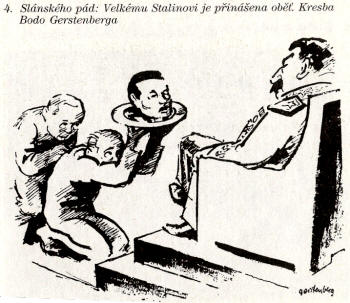
On this date in 1952, eleven high-ranking Czechoslovakian politicians were hanged at Prague’s Pankrac Prison two weeks after a show trial purging unreliable elements from the Communist party.

One of the most infamous show trials in Czechoslovakia saw 14 high-ranking Communists — eleven of them Jews — railroaded for a “Trotskyite-Titoist-Zionist activities in the service of American imperialism”. Three received life sentences. The other eleven went to the gallows.

While the roots of the persecution, especially the undertones of anti-Semitism, sink into the id of the Stalinist Eastern bloc, the most evident proximate cause was the USSR’s assertion of control over its satellite states at a time when Josip Tito was successfully charting a course of independent communism. Purges in Poland, Bulgaria and Hungary had taken place in the years before.

The Soviet agents rounding up suspects for Stalin did not trifle with small game. Rudolf Slansky was General Secretary of the Communist Party and therefore the second-most powerful man in the country; by the time he was tried, after a year in prison under torture, he was publicly denouncing himself.

Otto Sling, whose name became synonymous with forbidden heterodoxy, did likewise — “I was a treacherous enemy within the Communist Party … I am justly an object of contempt and deserve the maximum and the hardest punishment.”

And Vladimir Clementis, the Slovak Minister of Foreign Affairs, was erased from a photo taken with the Czechoslovakian President, a circumstance Milan Kundera reflected upon in The Book of Laughter and Forgetting:

In February 1948, the Communist leader Klement Gottwald stepped out on the balcony of a Baroque palace to harangue hundreds of thousands of citizens massed in Old Town Square … Gottwald was flanked by his comrades, with Clementis standing close to him.

The propaganda section made hundreds of thousands of copies of the photograph taken on the balcony where Gottwald, in a fur hat and surrounded by his comrades, spoke to the people. On that balcony the history of Communist Bohemia began. Every child knew that photograph, from seeing it on posters and in schoolbooks and museums.

Four years later, Clementis was charged with treason and hanged. The propaganda section immediately made him vanish from history and, of course, from all photographs. Ever since, Gottwald has been alone on the balcony. Where Clementis stood, there is only the bare palace wall.

The hanged were rehabilitated in 1963.

Artur London, who received a life sentence and was released after rehabilitation, wrote about his experiences in The Confession, subsequently a 1970 Costa-Gavras film. The wife and son of Deputy Minister of Foreign Trade (and Auschwitz survivor) Rudolf Margolius have also both written memoirs covering the trial.

The younger Margolius in particular, who has staunchly defended his father as an essentially apolitical man and not a Communist apparatchik, has been in the thick of present-day disputes in Czechoslovakia’s successor states over whom is due sympathy and recognition for bygone political crimes.

On this day..

1944: Richard Sorge and Hotsumi Ozaki

On the day of the USSR’s October Revolution holiday in 1944, Stalin’s greatest spies were hanged in Japan.

Renowned among espionage aficionados for supposedly forewarning Moscow of the exact date of Germany’s planned surprise attack in 1941, Richard Sorge‘s work in the pregnant years leading up to World War II produced multiple intelligence coups and could lay claim to the uncommon distinction of having materially affected the course of the war.

His signal achievement was establishing, as a foreigner in a highly xenophobic Japan, a spy ring that for years penetrated the highest levels of the Japanese government and the German embassy, giving Moscow an inside look at Axis planning.

Working under the cover of journalism in the German expat community — he had grown up in a mixed German-Russian household in Berlin and won the Iron Cross for his service in the Kaiser’s army in World War I before embracing communism — Sorge struck Hitler from half a world away. His access to the German embassy was untrammeled — indeed, he had an affair with the ambassador’s wife. His lead Japanese collaborator Hotsumi Ozaki was a major public intellectual similarly privy to sensitive information through his contacts.

The two, along with several other Japanese and foreign collaborators, produced a steady diet of top-shelf intelligence, including the (ignored) forecast of Operation Barbarossa. But the ring’s most important coup — arguably a decisive one in the history of the war as a whole — was to inform Moscow in September 1941 that Japan did not intend to attack the Russian Far East. Relieved of the nightmare prospect of a two-front war, Stalin transfered desperately needed Siberian divisions to help throw back the German advance on Moscow.

Japan by 1941 was a dangerous place to operate, however, and the nerve-rattling work — and the alcoholism to which it contributed — were taking its toll on the master spy just as the authorities were closing in. Sorge and his ring were arrested in October 1941.

Sorge’s decisive communique regarding Japanese intentions in the East had not yet borne its fruit. The war had nearly four years yet to run, and Sorge would languish in prison for most of them — long enough to leave fellow detainees with recollections of the captured operative jubilant at Red Army victories. Soviet tanks were at Germany’s doorstep by the time the two went to the gallows, one after the other, with the few minutes’ notice still customary for Japanese hangings to this day.

The spies in history who can say from their graves, the infomation I supplied to my masters, for better or worse, altered the history of our planet, can be counted on the fingers of one hand. Richard Sorge was in that group.

Spy novelist Frederick Forsythe

Sorge’s personal role in the crucible of world-shaping politics have proven a compelling topic for biographers. Among the notable works:

The Soviet government did not officially acknowledge Sorge until 1964, but the case had immediate and widespread interest in Japan. Ozaki inspired an early Kurosawa film, No Regrets for Our Youth:

The espionage ring’s operations were also the subject of a recent multilingual Japanese epic, Spy Sorge:

Part of the Themed Set: Spies.

On this day..