1868: Thomas Wells, the first private hanging in England

The hanging this date at Kent’s Maidstone Prison of Thomas Wells for the murder of the Dover postmaster stamped the understated debut of England’s era of private executions.

It was a shift almost a century in the making; in 1783, Albion had eliminated London’s traditional, disorderly procession to Tyburn in favor of public hangings just outside the walls of the prison — to the chagrin of traditionalists like Samuel Johnson.

As the 19th century unfolded, even this compromised spectacle attracted increasing criticism, noticeably from literary types who decried the aesthetics, effectiveness, and/or morality of public execution.

Eventually, on May 29, 1868,* Parliament passed the Capital Punishment Amendment Act of 1868, also known as the Capital Punishment within Prisons Act. The public hanging was no more.

Our day’s otherwise mundane murderer became the first to answer for his crime in this brave new behind-prison-walls world. And if the objective was to banish the spectacle and theater of the scaffold — well, the report in next day’s London Times of Thomas Wells’ hanging would suggest the measure achieved its purpose.

Yesterday morning Thomas Wells, aged 18, who was found guilty at the last Kent Assizes of the wilful murder of Mr. Walsh, the master of the Priory Station on the London, Chatham, and Dover Railway, by shooting him in revenge for a reprimand which that gentleman, under whom he served as a porter, had given him for some misconduct, suffered the extreme penalty of the law. This was the first execution under the new Act requiring executions in future to be inflicted within the prison walls.

It was, of course, generally known that the execution would be conducted in private, and that the only sign would be the hoisting of a black flag outside the prison wall. At the moment of the falling of the drop there were very few, if any, strangers in the vicinity of the prison, and the town presented quite its ordinary appearance, presenting a marked and extraordinary contrast to that which it has hitherto exhibited on the occasion of a public execution. The scaffold was erected in a small yard adjoining the debtors’ portion of the gaol, which had at one time been used as an exercise yard for the prisoners. It is enclosed by four high walls. The apparatus is the same that was formerly used, with some slight alterations. The drop is on a level with the stone paving of the yard, and the executioner has to descend several steps to remove the bolt which supports the platform, and the latter then drops into a recess prepared for it. No one was present at the execution but the undersheriff, governor, sergeant, chaplain, and the representatives of the Press.

After his trial the culprit seemed to have been fully aware that there was no hope for him, but he expressed remorse for the act he had committed, and wrote a very penitent letter to Mrs. Walsh, the widow of the deceased, entreating her forgiveness. No efforts appear to have been made in any quarter to obtain a remission of the capital sentence.

The culprit prayed fervently with the Rev. Mr. Frazer, the chaplain, for a few seconds, and as the drop fell he was singing with a loud clear voice the 486th hymn. He appeared to die after two or three convulsive struggles.

Of course, not everything old can be new overnight; this hanging was carried out by longtime public hangman William Calcraft, who’d had his start in the trade back in 1829 and was renowned for unpleasantly strangling his charges with his itty-bitty drops. Though the Times report downplays the climax, other press attendees agreed that Wells died hard.

This day’s milestone, nevertheless, was a way station en route to further innovations, the decisive transition from an ancient form of public corporal discipline to the rational, calculated, mechanistic procedure meet for an industrial empire.

Behind prison walls, Calcraft would yield his own place to William Marwood’s precisely measured drops, and then to the 20th century’s coolly efficient Albert Pierrepoint. The changes may have been incremental, but by the end, little save the rope remained of England’s storied hanging era.

The natural end of that evolution, some would have us believe, is disposing the rope altogether. If Wells’s private hanging held the seed of capital punishment’s eventual abolition, it sprouted quite neatly indeed: it was this same date in 1964 that England conducted its last private hangings — or executions of any kind.

* The act was passed only three days after the last public hanging in England.

On this day..

1952: Night of the Murdered Poets

As night fell this evening in Moscow, 13 prominent Soviet Jews were shot in Lubyanka Prison on trumped-up charges of treason and espionage.

“The Night of the Murdered Poets”, as it’s come to be remembered, wasn’t so much about the poetry; “only” five of the victims fit that description.

But as Joshua Rubenstein put it, “only the martyred Yiddish writers are mentioned at August 12 commemorations; the other defendants who lost their lives, as well as the sole survivor Lina Shtern, are rarely if ever remembered, perhaps because their careers as loyal Soviet citizens do not fit comfortably into an easy category for Westerners to honor … Stalin repaid their loyalty by destroying them.”

Falling victim to Stalin was such a particularly tragic fate because they were, in the main, good Communists:* good enough to have been part of the Jewish Anti-Fascist Committee, a World War II organ dedicated to rallying support for the Soviet Union against Nazi Germany.

Such national particularism — any port in a storm! — was all well and good when Moscow had the Wehrmacht at its gates and a short supply of friends, but it increasingly ran dangerously afoul Soviet officialdom as the 1940’s progressed. It was a bastion of sectarian identity rather than socialist universalism; its celebration of the Jewish soldier and of Jewish wartime travails cut against the narrative of Soviet sacrifice and heroism; its overseas links to the United States (where it toured in wartime) and the new state of Israel made it suspect, or at least vulnerable.

Thin excuse for mass execution, to be sure, but in a structure of generalized antisemitism run by a trigger-happy dictator …

In 1948-49, fifteen JAC members were arrested. One would die in prison; the aforementioned Lina Stern, a scientist, would receive a term of exile and return to Moscow when this purge’s victims were rehabilitated after Stalin’s death.

The thirteen others were tortured and condemned by a rigged (but secret, since many of the accused wouldn’t cop to public self-denunciations) trial

Years before his arrest, Markish would write words to make a eulogy for many a disillusioned Soviet citizen … and literally so in his case, since the verse was cited at his trial as evidence of his “pessimism”:

Now, when my vision turns in on itself,
My shocked eyes open, all their members see
My heart has fallen like a mirror on
A stone and shatters, ringing, into splinters.

Piece by piece I’ll try to gather them
To make them whole with stabbed and bleeding fingers.
And yet, however skillfully they’re glued,
My crippled, broken image will be seen.

* Naturally, being a good Communist did not keep one safe from Uncle Joe.

On this day..

1997: Zoleykhah Kadkhoda survives stoning

On this date in 1997, Zoleykhah Kadkhoda was tried, condemned, and immediately stoned in the West Azerbaijan (Iran) city of Bukan.

Less commonly used but still to this day among the execution methods in Iran, stoning involves burying the victim in a hole — a man to his waist, a woman to her chest — and pelting him or her with rocks until dead. Plainly a horrible way to go, stoning is typically associated with adultery, which was Kadkhoda’s crime.

Kadkhoda made international headlines by surviving her attempted execution, either (accounts differ) because of popular intervention in the heavily Kurdish town, or by reviving at the morgue after being taken for dead.

International pressure caused the death sentence to be lifted; Kadkhoda was released later in that year.

On this day..

1922: Joseph O’Sullivan and Reginald Dunne, helping spark the Irish Civil War

(Thanks to Rob at Another Nickel In The Machine, a delectable blog about 20th century London, for this post. It originally ran on Another Nickel October 4, 2008.)

“I do not approve, but I must not pretend to misunderstand” – Eamon de Valera

The arrest of Reginald Dunne and “James Connolly” (Joseph O’Sullivan) in 1922

On December 1921 at 22 Hans Place in Knightsbridge, a treaty was signed between a provisional Irish Government and the British to create what was called the Irish Free State. However only six months later, a few hundred yards away in Eaton Place, an assassination occurred, the reverberations of which could be said to have helped start the Irish Civil War in 1922.

Sir Henry Hughes Wilson in 1918

Sir Henry Hughes Wilson in 1921

At around midday of 22 June 1922, Field-Marshall Sir Henry Wilson unveiled a war memorial at Liverpool Street Station. He made a speech, quoted some relevant Kipling poetry and soon after returned by taxi to his home at 15 Eaton Place in Knightsbridge. Two 24 year old men, Reginald Dunne and Joseph O’Sullivan, were surreptitiously waiting for his arrival. They watched while Wilson paid for his taxi before running up to him and killing him in cold blood on the footsteps leading up to his front door. In Dunne’s words:

I fired three shots rapidly, the last one from the hip, as I took a step forward. Wilson was now uttering short cries and in a doubled up position staggered towards the edge of the pavement. At this point Joe fired once again and the last I saw of him he (Wilson) had collapsed.

Joseph O’Sullivan

Reginald Dunne

The Field Marshall had half withdrawn his sword in a futile effort to protect himself but after being shot seven times he fell face first on to the pavement with blood running profusely from his body and mouth. Dunne and O’Sullivan started to run but O’Sullivan had been seriously wounded at Ypres during WW1 (both men had fought for the British) and his wooden leg severely hindered their escape. Dunne and O’Sullivan both attempted to shoot their way out of trouble and shot and injured two policemen and a civilian in the process but were soon surrounded by an angry and hostile crowd and the two men were quickly arrested. They actually had to be protected by the police from a mob who wanted instant revenge for Wilson’s death.

The steps of 36 Eaton Place where the Field Marshall fell fatally wounded.

The killing of Field-Marshall Wilson in Eaton Place turned out to be pivotal in an extraordinarily complex political period of Ireland’s history when a national liberation struggle turned into a civil war. However much of Britain was outraged with the murder and The Times wrote:

Field-Marshall Sir Henry Wilson, the famous and gallant soldier, was murdered yesterday upon the threshold of his London home. The murderers were Irishmen. Their deed must rank among the foulest in the foul category of Irish political crimes.

Six months earlier at 2.20 am 6th December 1921 the Anglo-Irish Treaty was signed between an Irish delegation, led by Michael Collins, and the British Government at 22 Hans Place. Incidentally, there is nothing on the outside of the building commemorating the historical event and today, in what is probably one of the most expensive property areas of London, seems to be unused and empty with security boards up in the windows.

22 Hans Place in Knightsbridge and where the Anglo-Irish Treaty was negotiated

Signing the Anglo-Irish treaty in 1922

Michael Collins in London October 1921

11th October 1921

Collins outside Downing Street 1921

The treaty envisaged an independent Ireland that would be known as the Irish Free State but the agreement was hugely controversial, especially back in Ireland. For a start, de Valera, the President of the Irish Republic and who had a difficult relationship with Collins at the best of times, was angry that the treaty was signed without his authorisation (although it was at his insistence that Collins went, with de Valera considering it wrong to be involved in the negotiations if Britain’s King George V wasn’t either). Also controversial was both the British insistence that they continued to control a number of ports, known as the Treaty Ports, for the Royal Navy and that Northern Ireland (which had been created in the Government of Ireland Act 1920) was able to leave the Irish Free State within one month, which of course it duly did.

In April 1922 a group of 200 anti-treaty IRA men had occupied the Four Courts in Dublin in defiance of their Government. Collins, wanting to avoid Civil War at all costs, decided to leave them alone. However after the Field Marshall’s assassination and the subsequent Fleet Street outrage this all changed. It was assumed by the British that Dunne and O’Sullivan were anti-treaty IRA men and after the shock of the Field Marshall’s murder Winston Churchill wrote to Collins threatening that unless he moved against the Four Courts anti-treaty garrison he (Churchill) would use British troops to do so for him. After a final attempt to persuade the men to leave the Courts, Collins borrowed two 18 pounder Artillery guns from the British and bombarded the Four Courts until it’s garrison surrendered. A surrender which almost immediately led to the Irish Civil War with fighting breaking out over Dublin and subsequently the rest of the country.

The Four Courts siege, Dublin 1922

Sackville Street, Dublin 1922

Meanwhile back in London at the Old Bailey, and before Mr Justice Shearman, Dunne and O’Sullivan were both tried together for the murder of Sir Henry Wilson on 2 July 1922. Dunne stood with his arms folded while the charge was being read while O’Sullivan stood stiffly at attention. When Dunne was asked, “Are you guilty or not guilty?” he replied “I admit shooting Sir Henry Wilson.” “Are you guilty or not guilty of the murder?” the Clerk of Arraigns repeated. “That is the only statement I can make,” was the response. O’Sullivan made a similar reply and after some discussion the plea was treated as one of “Not guilty.”

Towards the end of the trial, which lasted just three hours, the defence Counsel handed the judge a double sheet of blue official paper given to him by Dunne. After perusing the contents Mr Justice Shearman said – “I cannot allow this to be read. It is not a defence to the jury at all. It is a political manifesto…I say clearly, openly, and manifestly it is a justification of the right to kill.”*

Dunne’s hand written statement

Dunne and O’Sullivan were sentenced to death by hanging and sent to Wandsworth gaol where they were both hanged together by the executioner John Ellis on the 10th August 1922.

Less than two weeks later Michael Collins was ambushed and shot dead in his home county of Cork by anti-treaty IRA members.
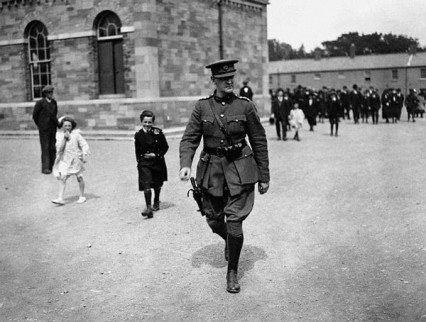
Commander in Chief Michael Collins in July 1922, two or three weeks before he was assassinated in Cork.

Michael Collins' funeral, O'Connell Street August 1922
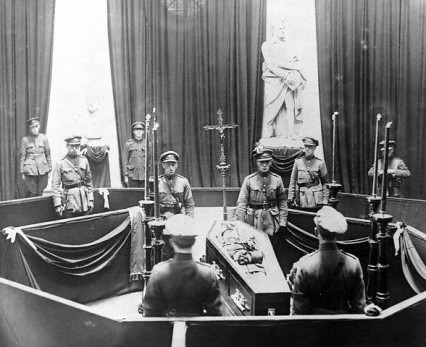
The coffin bearing the body of Michael Collins lying in state in the City Hall, Dublin. September 2, 1922 Dublin, Ireland

Michael’s brother Sean Collins

It was never really established whether Dunne and O’Sullivan acted on their own (the assassination seemed pretty badly organised for an official assassination so this was likely) or with the approval and help of Michael Collins. Collins had been a friend of Dunne’s while Sir Henry Wilson was responsible for establishing the Cairo Gang (a group of experienced British Intelligence agents who met frequently at Dublin’s Cairo Cafe) twelve of whom were murdered by the IRA acting under Collins command in 1920. The Cairo Gang killings provoked the British Auxiliaries in Dublin to shoot trapped innocent civilians at Croke Park in not the bloodiest but perhaps the nastiest of the various historical Bloody Sundays.

The infamous Cairo gang

Perhaps the ironic aspect to the story of the murder of Sir Henry Hughes Wilson was that Reginald Dunne and Joseph O’Sullivan were both born and bred in London, whereas Field-Marshall Wilson was born smack bang in the middle of Ireland at Ballinalee in County Longford.

A letter sent to O'Sullivan while waiting for his execution

Sinéad O’Connor – She Moves Through The Fair

* The text of Dunne’s intended last statement, as transcribed from the images in this post.

Lord and Members of the Jury. My friend and I stand here before you today charged with the offense of murder; and I have no doubt that, from the evidence placed before you by the prosecution, you will find us both guilty. With respect to the charges of attempted murder, we merely tried, as everyone must know, to try and escape arrest.

The offence of murder is a very serious matter; so much so, that any act which results in loss of human life requires very grave and substantial reason. We have never until now been charged with any crime. As you have heard from the Police Officer, who gave evidence as to our character and our previous records, we have both been in the British Army. We both joined voluntarily, for the purpose of [making Europe safe?] in order that the principles for which this country stood, should be upheld and preserved. These principles, we were told, were Self-Determination and Freedom for Small Nations. We both, as I have said, fought for these principles, and were commended for doing so; and I imagine that several of you gentlemen of this jury did likewise. We came back from France to find that Self-Determination had been given to some Nations we had never heard of, but that it had been denied to Ireland, We found, on the contrary that our Country was being divided into two Countries; that a Government had been set up for the Belfast district, and that under that Government outrages were being perpetrated, that are a disgrace to civilization — many of the outrages being committed by men in uniform and in the pay of the Belfast Government. We took our part in supporting the aspiration of our fellow Countrymen, in the same way as we took part in supporting the nations of the world who fought for the right of small nationalities.

Who was Sir Henry Wilson? What was his policy? And what did he stand for? You have all read in the newspapers lately, and been told, that he was a great British Field Marshal; but his activities in other fields are unknown to the men of the British public. The nation to which we have the honour to belong, the Irish nation, knows him, not so much as the British Field Marshal, but as the man behind what is known in Ireland as the Orange Terror. He was at the time of his death the Military Advisor to what is colloquially called the Ulster Government, and as Military Advisor he raised and organized a body of men known as the Ulster Special Constabulary, who are the principle agents in his campaign of terrorism.

My Lord and Members of the Jury, I do not propose to go into details of the horrible outrages committed on men, women and children of my race in Belfast and other places under the jurisdiction of the Ulster Government. Among Irishment it is well known that about 500 men, women and children have been killed within the past few months, nearly two thousand wounded, and not one offender brought to justice. More than 9000 persons have been expelled from their employment; and 23,000 men, women, and children driven from their homes. All the big cities of this country and even those of Northern France are now receiving these refugees. Sir Henry Wilson was the representative figure and the organiser of the system that made these things possible.

At his suggestion and advice the Ulster Parliament passed an Act authorising the [purging?] of political opponents and this power is now exercised and enforced by the Courts in Ulster.

There is and can be no political liberty in a country where one political party outrages, oppresses, and intimidates not only its political opponents, but persons whose religious opinion differ from those of the party in power. The same principle for which we shed our blood on the Battle Field of Europe led us to commit the act we are charged with.

My Lord and Members of the Jury, you can condemn us to death today, but you cannot deprive us of the belief that what we have done was necessary to preserve the lives, the homes, and the happiness of our countrymen in Ireland. You may by your verdict find us guilty, but we will go [to] the scaffold justified by the verdict of our own Conscience.

Dunne truncated his statement to “cut out the patriotic adjectives I feel inclined to use under the present circumstances” (as well as his specific delineation of the atrocities of Henry Wilson and the Ulster government). -ed.

On this day..

1943: Blessed Franz Jagerstatter, conscientious objector

On this date in 1943, an Austrian farmer was beheaded in Berlin’s Plotzensee Prison for refusing to fight for the Third Reich.

Franz Jägerstätter, who lost his own father in World War I, was anschlussed right into the Third Reich when Germany absorbed Austria in 1938.

In Solitary Witness is the aptly-titled biography of the man; though his fatal refusal of mandatory military service (and his critique of Nazi Germany) sprang from his deep-rooted Catholicism, it was far from the norm for his German-Catholic neighbors.

“We must go courageously on the way of suffering,” he wrote, “whether we begin sooner or later.” Somewhat oddly neglected as a martyr figure in the immediate postwar period, Jagerstatter was recently beatified by Pope Benedict XVI — a German himself, of course, who did not refuse his tiny measure of youthful service to the Wehrmacht in those years, and who assuredly grasps the untapped public relations potential of this compelling figure.


An icon of Franz Jagerstatter, and a naked Nazi imp.

Jagerstatter’s widow is still alive; she and her children movingly keep Franz’s memory to this day — and his example continues to inspire Catholics who go the way of suffering today against war and injustice.

On this day..

1812: Daniel Dawson, for the integrity of sport

On this date in 1812, Daniel Dawson “suffered the awful sentence of the law, at the top of Cambridge Castle, amidst a surrounding assemblage of at least twelve thousand spectators, it being market-day.”

The crowd was an appropriate ornament to the condign punishment of the most famous horse-poisoner in English history — and perhaps the most severely-punished sports cheat in all of modernity.

A tout scrabbling his living about the storied Newmarket tracks of Cambridge, Dawson killed the favorite for a high-profile race (and three other horses besides) by poisoning their trough, intending only to hamper the beasts enough to make good a variety of bookies’ bets against the fair Pirouette.

Although acquitted for that crime, Dawson was promptly returned to the dock for a previous, and previously unsolved, horse-poisoning, and convicted under a “black act” statute to punish livestock-killing.

According to the inevitable trial pamphlet, freely available from Google Books,

DAWSON behaved with a sullen and impudent levity during the trial, and he frequently abused the witnesses whilst giving their testimony, loud enough to be heard throughout the court … with horrid imprecations, ill becoming his unhappy situation, and at other times he was nodding at and saluting with his hand different persons in court. The verdict of GUILTY had not the slightest effect on him, and his general conduct was altogether depraved. On his return to the castle, his conduct, at times, bordered on insanity, and he appears too illiterate to feel a consciousness of wrong, although he has confessed his guilt to the full extent.

(Katherine Watson adds that although Pirouette’s owner sought a reprieve for the poisoner, Dawson “spoke bitterly of the hypocrisy of the Jockey Club, few of the members of which were above cheating.”)

On this day..

1859: Ormond Chase, casus belli not quite

Every foreign policy adventure needs its pretexts, even adventures that never happen.

Quite marvelously, this illustration appeared in the same issue of Harper’s as Sydney Carton’s beheading in the last installment of Dickens’ Tale of Two Cities serial.

On this date in 1859, forces of Mexican General Miguel Miramon provided the United States such a pretext by executing American Ormond Chase in Tepic during the Mexican War of Reform.

This incident, said to have ensnared the luckless Portland (Me.)-born sawyer “for reasons entirely unknown,”* became elevated into the foreign policy calculation of U.S. President James Buchanan.

Buchanan rates as one of America’s worst chief executives for fiddling as the conflagration of Civil War began, but he kept himself busy eyeballing other dark-skinned folk in the hemisphere over whom America ought to claim suzerainty.**

So, in December of 1859, Ormond Chase was name-checked in a State of the Union address further to pressing Buchanan’s case for Mexico as a (to use a modern coinage) failed state — “a wreck upon the ocean, drifting about as she is impelled by different factions.”

“Little less shocking,” the Chief Executive intoned, crowning a litany of injuries “upon persons and property,” “was the recent fate of Ormond Chase, who was shot in Tepic, on the 7th August … not only without a trial, but without any conjecture by his friends of the cause of his arrest.”

And, of course, we know what happens to failed states.

Mexico ought to be a rich and prosperous and powerful Republic. She possesses an extensive territory, a fertile soil, and an incalculable store of mineral wealth. She occupies an important position between the Gulf and the ocean for transit routes and for commerce. … Can the United States especially, which ought to share most largely in its commercial intercourse, allow their immediate neighbor thus to destroy itself and injure them? Yet without support from some quarter it is impossible to perceive how Mexico can resume her position among nations and enter upon a career which promises any good results. The aid which she requires, and which the interests of all commercial countries require that she should have, it belongs to this Government to render, not only by virtue of our neighborhood to Mexico, along whose territory we have a continuous frontier of nearly a thousand miles, but by virtue also of our established policy, which is inconsistent with the intervention of any European power in the domestic concerns of that Republic.

The wrongs which we have suffered from Mexico are before the world and must deeply impress every American citizen. A government which is either unable or unwilling to redress such wrongs is derelict to its highest duties.

I recommend to Congress to pass a law authorizing the President under such conditions as they may deem expedient, to employ a sufficient military force to enter Mexico for the purpose of obtaining indemnity for the past and security for the future.

“The meaning of all this is clear enough,” observed the London Times, an ocean away and correspondingly less euphemistic.†

Before long another Mexican war will sever new provinces from the unhappy Spanish Republic, and give them to the Anglo-Saxon race. In one sense this is a gain to humanity. Beautiful and fertile regions, now desert, will pass under the hands of the cultivator, mines will be worked, harbours will be filled with shipping, and a new life will animate that vast region. It is not likely, however, that the Americans will seek to annex the whole Republic. The Mexicans are not the stuff to make citizens of, and another generation of discord and decay must elapse before their time comes to be improved off the face of the earth. Although we have not the slightest wish to interfere with the Americans, it is but right that an adequate force should be at hand to protect British interests in those quarters.

In the event, Congress actually turned down Buchanan’s use-of-force request — that actually used to happen! — and with Abraham Lincoln’s election the next year, poor Ormond Chase’s purchase on historical significance was dashed by the fierce urgency of the Civil War. His death was a wasted root of an intervention that never was.

As it happens, and as the London Times article’s closing allusion suggests, Buchanan’s suspicion of European interference in the New World was not without foundation. The Mexican Civil War that Buchanan here proposed to join evolved — while the Yankees were busy shooting one another — into a badly botched French‡ attempt to establish a foothold in Mexico.

We have met the most famous casualty of that affair in these pages before: imported Habsburg Emperor Maximilian I.

Shot along with him were two of his loyal generals: one of them was Miguel Miramon, whose men had put Ormond Chase to death eight years before.

* Per a deposition in the U.S. Consul’s investigation.

** More on Buchanan’s Mexican project in this 1883 biography.

† January 11, 1860

‡ Spain and Britain had made the initial foray with France to collect their own debts as well, but soon thought better of the project.

On this day..

1628: Johannes Junius “will never see you more”

On this date in 1628 was burned in Bamberg (former) Burgomaster Johannes Junius, a civic official caught up in the frenetic witch-hunts of Bavaria in the Thirty Years’ War.

Fellow townspeople under torture accused him; Junius eventually did the same, copping to the stock stuff witch trials knew just how to use:

there had come to him a woman like a grass-maid … And thereafter this wench had changed into the form of a goat, which bleated and said, “Now you see with whom you have had to do. You must be mine or I will forthwith break your neck”. Thereupon he had been frightened, and trembled all over for fear. Than the transformed spirit had seized him by the throat, and demanded that he should renounce God Almighty, whereupon Junius said, “God help me”, and thereupon the spirit vanquished through the power of these words. Yet it came straightway back, brought more people with it, and persistently demanded of him that he renounce God in Heaven and all the heavenly host, by which terrible threatening he was obliged to speak this formula: “I renounce God in Heaven and his host, and will henceforward recognize the Devil as my God”.

After the renunciation he was so far persuaded by those present and by the evil spirit that he suffered himself to be baptized by the devil in the evil spirit’s name. The Morhauptin had given him a ducat as dower-gold, which afterward became only a potsherd.

He was then named Krix. His succubus was called Vixen (Füchsin). Those present had congratulated him in Beelzebub’s name and said that they were now all alike.

Etc.

What survives of him among the thousands of similar unfortunates is the illicit letter in his own hand describing those tortures in detail … a reminder (regrettably current) of the reality of crippled limbs and ripped flesh and the meager limits of human hardiness that surround a word like “torture”.

July 24, 1628

Many hundred thousand good-nights, dearly beloved daughter Veronica. Innocent have I come into prison, innocent have I been tortured, innocent must I die. For whoever comes into the witch prison must become a witch or be tortured until he invents something out of his head and – God pity him – bethinks him of something.

I will tell you how it has gone with me.

When I was the first time put to the torture, my brother-in-law, Dr. Braun, Dr. Kotzendorffer, and two strange doctors were there. Then Dr. Braun asks me; “Kinsman, how come you are here?” I answer, “Through falsehood and through misfortune”. “Hear, you,” he retorts, “you are a witch. Will you confess it voluntarily? If not, we’ll bring in witnesses and the executioner for you”. I said, “I am no witch; I have a pure conscience in the matter. If there are a thousand witnesses, I am not anxious, but I’ll gladly hear them”.

Then the Chancellor’s son was set before me, who said he had seen me. I asked that he be sworn and legally examined, but Dr. Braun refused it. Then the Chancellor, Dr. George Haan, was brought, who said the same as his son. Afterward Höppfen Ellse. She had seen me dance on Hauptsmorwald, but they refused to swear her in. I said: “I have never renounced God, and will never do it – God graciously keep me from it. I’ll rather bear whatever I must”.

And then came also – God in highest Heaven have mercy – the executioner, and put the thumbscrews on me, both hands bound together, so that the blood spurted from the nails and everywhere, so that for four weeks I could not use my hands, as you can see from the writing.

Thereafter they stripped me, bound my hands behind me, and drew me up on the ladder. Then I thought heaven and earth were at an end. Eight times did they draw me up and let me fall again, so that I suffered terrible agony. I said to Dr. Braun, “God forgive you for thus misusing an innocent and honorable man”. He replied, “You are a knave”.

And this happened on Friday, June 30, and with God’s help I had to bear the torture. When at last the executioner led me back into the cell, he said to me, “Sir, I beg you, for God’s sake, confess something, whether it be true or not. Invent something, for you cannot endure the torture which you will be put to; and, even if you bear it all, yet you will not escape, not even if you were an earl, but one torture will follow another until you say you are a witch. Not before that,” he said, “will they let you go, as you may see by all their trials, for one is just like another”.

Then came George Haan, who said the commissioners had said the Prince-Bishop wished to make such an example of me, that everybody would be astonished.

And so I begged, since I was in wretched plight, to be given one day for thought and a priest. The priest was refused me, but the time for thought was given. Now, my dearest child, see in what hazard I stood and still stand. I must say that I am a witch, though I am not – must now renounce God, though I have never done it before. Day and night I was deeply troubled, but at last there came to me a new idea. I would not be anxious, but, since I had been given no priest with whom I could take counsel, I would myself think of something and say it. It were surely better that I just say it with mouth and words, even though I had not really done it; and afterwards I could confess it to the priest, and let those answer for it who compel me to do it . . . And so I made my confession, as follows; but it was all a lie.

Now follows, dear child, what I confessed in order to escape the great anguish and bitter torture, which it was impossible for me longer to bear.

Then I had to tell what people I had seen (at the witch sabbat). I said that I had not recognized them. “You old knave, I must put the torturer at your throat. Say – was not the Chancellor there?” So I said yes. “Who besides?” I had not recognized anybody. So he said: “Take one street after another. Begin at the market, go out on one street and back on the next”. I had to name several persons there. Then came the long street (die lange Gasse). I knew nobody. Had to name eight persons there. Then the Zinkenwert – one person more. Then over the upper bridge to the Georgthor, on both sides. Knew nobody again. Did I know nobody in the castle – whoever it might be, I should speak without fear. And thus continuously they asked me on all the streets, though I could not and would not say more. So they gave me to the torturer, told him to strip me, shave me all over, and put me to the torture. “The rascal knows one on the market-place, is with him daily, and yet won’t name him”. By this they meant Burgomaster Dietmeyer: so I had to name him too.

Then I had to tell what crimes I had committed. I said nothing. . . “Hoist the knave up!” So I said that I was to kill my children, but I had killed a horse instead. It did not help. I had also taken a sacred wafer, and had buried it. When I had said this, they left me in peace.

Now, dearest child, here you have all my acts and confession, for which I must die. And they are sheer lies and inventions, so help me God. For all this I was forced to say through dread of the torture beyond what I had already endured. For they never leave off with the torture till one confesses something; be he ever so pious, he must be a witch. Nobody escapes, though he were an earl. If God send no means of bringing the truth to light, our whole kindred will be burned. God in heaven knows that I know not the slightest thing. I die innocent and as a martyr.

Dear child, keep this letter secret, so that people do not find it, else I shall be tortured most piteously and the jailers will be beheaded. So strictly is it forbidden. . . . Dear child, pay this man a thaler. . . . I have taken several days to write this: my hands are both crippled. I am in a sad plight. . . .

Good night, for your father Johannes Junius will never see you more.

Junius adds, in the margin, a touching gesture towards posthumous healing by asking no bitterness be kept against his false accusers.

Dear child, six have confessed against me at once: the Chancellor, his son, Neudecker, Zaner, Hoffmaisters Ursel, and Hoppfens Elsse–all false, through compulsion, as they have all told me, and begged my forgiveness in God’s name before they were executed. . . . They know nothing but good of me. They were forced to say it, just as I myself was. . . .

Haan, Junius’s accuser, was also burned at the stake.

Their mutual inquisitor, Dr. Braun, was arrested in 1629 — tortured — confessed — and burned as well. (Source)

On this day..

1864: Romuald Traugutt and the January Uprising leaders

On this date in 1864, the leadership of Poland-Lithuania’s abortive January Uprising against the Russian tsar was hanged before 30,000 at Warsaw Citadel.


Romuald Traugutt depicted (somewhat ironically) on the 20-zloty note of Soviet bloc Poland.

Romuald Traugutt (English Wikipedia link | Polish) had been a decorated Lieutenant Colonel in the Tsarist army, and a heretofore apolitical man — but he resigned shortly after the outbreak of the doomed national uprising to take up sides against Russia.

This installment of the venerable Russians vs. Poles series was characteristically nasty.

In 1863 – Polonia by Jan Matejko, an allegory for the Polish nation is manacled by the Russians.

And it ended the way these affairs have ended these last 400 years or so: Russian victory.

The fallout was severe.

In addition to this day’s batch — Traugutt along with (all Polish Wikipedia links) Rafal Krajewski, Jozef Toczyski, Roman Zulinski and Jan Jezioranski — a further 391 were put to death after the war; tens of thousands were deported to Siberia or otherwise scattered in the vast Romanov empire; a war indemnity tax was imposed; and over three thousand estates in Poland and Lithuania were confiscated.

Traugutt has gained some latter-day support in the Catholic Church for beatification.

On this day..

1474: A cock and its eggs

“On the Thursday before St. Lawrence’s Day,” writes Gross in his Kurtze Basler Kronik, “they burned a cock on the Kolenberg, together with an egg which he had laid,* for they feared that a dragon might be hatched therefrom. The executioner cut open the cock and found three more eggs in him. For, as Vicentius saith in the sixth book of his Speculum Naturale, it hath always been held that a cock in his old age may lay an egg, whence ariseth a basilisk, if it be hatched out on a dungheap by the serpent called coluber. Wherefore the basilisk is half cock and half serpent. He saith also that certain persons declare they have seen basilisks hatched from such eggs. (Source)

* “The cock,” George Ives reassures, “was possibly an hermaphrodite or, more likely, a crowing hen.”

On this day..