1939: Howard Long, New Hampshire’s most recent hanging

As of today, it’s been 70 years since the U.S. state of New Hampshire carried out an execution, despite maintaining a death penalty statute almost continuously since.

“Craving for boys,” Long was condemned for molesting and beating to death a 10-year-old in 1937, evidently his second molestation/murder: in the first, he reportedly drove around for 10 hours with his prisoner before plucking up the heart to do the thing, the sort of mental picture to cast a child murder victim of a wannabe-serial killer in the unexpected aspect of boredom.

Long’s execution in the bicentennial of New Hampshire’s first legal hangings was itself the first in 21 years in the Granite State. Although a handful of cases since have potentially fit the steadily narrowing set of death penalty circumstances, none has actually come so far as the gallows (or, today, theoretically, lethal injection) before taking one of the many possible exits — plea bargain, sentence reduction, premature death — from the capital punishment system.

New Hampshire’s present-day death row consists of only one person, and earlier this year its legislature actually voted to abolish the death penalty, a measure spearheaded by State Rep. Renny Cushing, who is the son of a murder victim.* The measure was vetoed by Gov. John Lynch.

* Full disclosure: also a personal friend. Cushing founded Murder Victims Families for Human Rights (MVFHR).

On this day..

1971: Ten failed putschists in Morocco

On this date in 1971, four generals, five colonels and a major who had attempted a coup d’etat in Morocco less than three days before were shot without trial at the military barracks in Rabat.

The senior officers* had taken military cadets and stormed the palace where birthday celebrations for King Hassan II were taking place. They captured the monarch himself before the cadets themselves wavered, and loyal troops successfully counterattacked. Ninety-two people, including the Belgian ambassador, were killed in the affair; the king was at their state funeral on this date at the time the putschists were being shot.

This selection of the coup’s leadership gunned down this day in Rabat did not make an end to the reverberations; other trials followed later in the year, and some others who were implicated were simply “disappeared”.

Although we lack the testimony of any of the coup leaders themselves for their motivations, it occurred in the context of political and social upheaval in post-colonial Morocco. Frank H. Braun (“Morocco: Anatomy of a Palace Revolution That Failed”, International Journal of Middle East Studies, Vol. 9, No. 1 (Jan., 1978)) argues that it was rooted in an eclipse of the traditional prerogatives of the military — and especially of the Berber nobility, who can be said to be the authors of the attempt.

So too can its failure be ascribed to the scant support this parochial and backward-looking cause commanded; non-Berber officers didn’t join the plot. Even so, with one of his government’s traditional pillars of support so heavily compromised (and decimated by this day’s executions and other reprisals), the coup led Hassan II to somewhat liberalize Morocco’s constitution the following year.

Which did not exactly still the tumultuous power politics scene in Rabat.

Mohamed Oufkir, the general who had coolly suppressed the 1971 coup** to become the preeminent military officer in the country, mounted his own bid for power in 1972 and suffered the same fate as this date’s doomed rebels.

* Notably, Mohamed Medbouh (French link), “one of my closest collaborators” in the estimation of the king himself (but also of “the mentality of a jackal”). His surname actually meant “cutthroat,” and was earned by his father’s literally having his throat cut — and surviving — in the 1920’s.

** A Berber himself, Oufkir may have been aware of the earlier coup — and cunning enough not to commit himself until he saw which way the wind was blowing.

On this day..

1537: Robert Aske, for the Pilgrimage of Grace

On this date in 1537, Robert Aske was hanged for leading the Pilgrimage of Grace.

The year preceding had been among the most wrenching in British history, and when Henry VIII began shuttering Catholic monasteries, many an egg that would comprise the English Reformation‘s omelette would be shattered.

In the conservative and Catholic-leaning north, Thomas Cromwell‘s reforms (combined with various political and economic grievances) triggered an uprising that soon controlled York.

This fraught situation ended much easier for the English crown than it might have, with a royal negotiating strategy of nominally accepting the Pilgrimage’s terms inducing the massive rebel force to disband, allowing its leaders to be seized thereafter on the first pretext of renewed trouble.

[flv:https://www.executedtoday.com/video/Pilgrimage_of_Grace.flv 440 330]

Robert Aske, the barrister who had come to the fore of the Pilgrimage movement and had personally negotiated terms with Henry, was among about 200 to suffer death for their part in the affair. In Aske’s case, it was against the will of Jane Seymour, Henry’s demure third queen and also a Catholic-inclined traditionalist; she made an uncharacteristic foray into state policy by ask(e)ing for Aske’s life, summarily vetoed by the king’s reminding her the fate of her politically-minded predecessor.*

Here’s Aske hanged at York Castle in The Tudors:

And here’s an inscription on a Yorkshire church reminding one of Aske’s surviving brothers of the events of those pivotal months.

* In other wives-of-the-king developments, Henry’s future (sixth, and final) wife Katherine Parr was taken a hostage by the rebels during the Pilgrimage.

On this day..

1836: Louis Alibaud, failed regicide

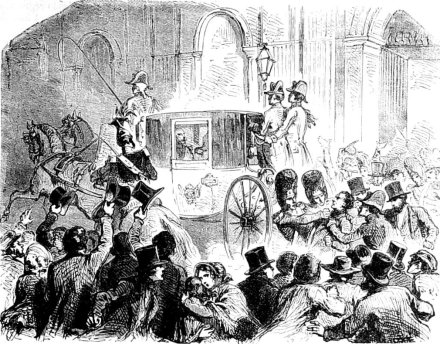
Early this Monday morning in 1836, Louis Alibaud — having been condemned to death by the Chamber of Peers at trial the preceding Friday and Saturday — lost his head for taking a shot at oftshotat French King Louis-Philippe.

As related by the London Times (July 6, 1836),

at half-past 6 in the afternoon of the 25th of June, 1836; the windows of the carriage were lowered, and it was passing through the gate [of the Tuileries palace] leading to the Pont Royale, when a man, who had been standing by a post in the court, raise [sic] a cane gun and discharged it against the King. By a miraculous chance the King was lowering his head to salute the National Guard under arms, and the ball passed just four lines above his head, and entered one of the angles of the carriage, settling about an inch deep in an oak beam.

The assassin was immediately arrested; he was a young man, of about 25 years of age, dressed in a dark coat, cloth pantaloons, and black hat, and wearing under his chin a thick brown beard.

The disabled former infantryman, “inspired by political fanaticism and a morbid satiety of life,” mounted no defense of himself save for a defense of tyrannicide — “I had the same right to his life that Brutus had to the life of Julius Caesar!” (Source)

Naturally, this line had neither the intent nor the effect of securing clemency, and he was repeatedly cautioned by the court against pursuing it; all concerned knew precisely where matters were headed, of course, and the state had no interest in providing a public forum for sedition.

On this day..

2000: Dmitry Chikunov, secretly

On this day in 2000, Russian national Dmitry (or Dmitri) Chikunov was secretly put to death* in Tashkent, Uzbekistan for the murder of two men.

A symbolic grave for Dmitry Chikunov; his actual resting place is unknown.

His mother, who had been shooed away from the prison on a previous visit with a demand that she come back later, only learned of the execution when she attempted to visit him two days later.** She has never learned where he was buried.

However, Tamara Chikunova turned out to be the type to turn grief into action.

She became a prominent human rights and anti-death penalty activist in Uzbekistan (and globally); her Mothers Against the Death Penalty and Torture organization was troublesome enough that the government blocked one of its conferences in 2003.

Well, Gandhi said it — “First they ignore you, then they laugh at you, then they fight you, then you win.” On January 1, 2008, Uzbekistan abolished the death penalty.

Tamara Chikunova discusses the rampant official corruption and malfeasance endemic in Uzbekistan’s (former) death penalty, and the issues still ahead for her organization, in this interview.

* Dmitry Chikunov’s execution by gunshot took place only nine months after trial; it’s hardly a surprise that Dmitry claimed to have been tortured into confession.

** In this French article, Chikunova says her son was actually shot while she herself was in the prison attempting to visit him.

On this day..

1294: Rane Jonsen, Marsk Stig conspirator

On an unknown date in 1294, the former page of the late Danish King Eric V was put to death for regicide outside Roskilde.

Rane Jonsen or Jonsson (here’s his short Danish Wikipedia page) had been present at the hunt during which the former monarch, more popularly known as “Erik Glipping”, was murdered by unknown assailants in 1286.

The convention — and the official verdict of state — have it that Jonsen contrived to admit marsk Stig Andersen Hvide and fellow conspirators to the vulnerable king’s presence for the purpose of murdering him, possibly revenging the king’s rape of Andersen’s wife. “Marsk Stig” and Rane both fled, and were condemned along with seven other men by the Danish Assembly in the spring of 1287.

Although there is little remaining primary documentation, it does seem that the guilt of these people was decided above all by political expedience. It was Stig Anderson’s opponents who got control of the government (and the regency of 12-year-old Erik Menved), conveniently declaring the guilty parties to be their own rivals, who had formerly been close to Erik Glipping.*

Our page, himself a noble, got the short end of the stick in all this; he energetically denied the story that he had stood aside to permit the murder of his liege, claiming that he fought back albeit unarmed and outnumbered.

But as an emblem of the perfidy of the king’s inner circle, you couldn’t do much better than Rane theatrically planting his sword into a table and standing aside to signify the king’s vulnerability. You can just picture that story being retold with a meaningful ahem to the boy-king Eric VI.

In fact, it was retold: wrongful conviction or no, this episode (in its official version, with Rane and Stig as evildoers) was the basis for a number of entries in the rich Danish ballad genre.

Though popularly cited as medieval ballads, disputed dating places different verses anywhere from Rane Jonsen’s own time to three centuries later.** In any era, they offer some lovely exemplars of the art.

This book reproduces several; topical for this entry is an imagining of the fugitive regicide’s plight, both sad (for his hopelessness) and menacing (for his violent seizure of a bride) — disconcertingly delivered in a repetitious lullaby singsong.

Ranild bade saddle his charger gray,
‘Twas told me oft before,
“I’ll be the Algrave’s guest today,
“Tho’ friends I have no more.”

Ranild rode up to his castle gate
‘Twas told him oft before
Where ermine-clad the Algrave sate,
Tho’ friends he had no more.

“Hail noble Algrave, here I come,
‘Twas told thee oft before
“To fetch my trothplight Kirstin home,
“Tho’ friends I have no more.”

Then up and spake her mother dear,
“‘Twas told thee oft before,
“For thee is bride no longer here,
“For friends thou hast no more.”

“I’ll either with the maid return,
“‘Twas told you oft before
“Or else your house and chattels burn,
“Tho’ friends I have no more.”

“Nay set not thou the house on flame,
“‘Twas told thee oft before,
“E’en take the bride thou ‘rt come to claim,
“Tho’ friends thou hast no more.”

In mantle wrapt the gentle maid,
‘Twas told her oft before,
On Ranild’s good gray horse was laid,
Tho’ friends he had no more.

No other bridal bed had they,
‘Twas told her oft before,
Than bush, and field, and new made hay,
For friends he had no more.

“The wood has ears, the mead can see,
“‘Twas told thee oft before,
“A wretched outlaw’d pair are we,
“For friends I have no more.”

“And had you not King Erick slain,
“‘Twas told you oft before,
“We still might in the land remain,
“But friends we have no more.”

“Stay, Kirstin, stay, such words forbear,
“‘Twas told thee oft before,
“Where strangers are, take greater care,
“For friends we have no ore.”

With that he slapp’d her cheek so red,
“‘Twas told thee oft before,
“It was not I, smote Erick dead,
“Tho’ friends I have no more.”

From the same source, our day’s principal meets his end:

Report is rife in all the land
Ranild at last is caught;
He surely had never gone from Hielm,
His doom had he bethought;
A death of torture he must die,
As he has long been taught.

Ranild he stepp’d within the door,
‘Good evening’ bade the king,
And all the guard of gentlemen,
Who round him stood in ring;
“Christ! may no son of loyal Dane
“Such trouble on him bring!

“But, O King Erick, noble liege,
“Remember you no more;
“The best was I of all the swains
“Your father’s livery wore;
“And you through wood and flowery mead
“In arms so often bore?”

“Full well I know thou servedst here
“For clothes and food and pay;
“And, like a vile and treacherous knave,
“My father didst betray;
“For which the stake thy carcase bears,
“If I but reign a day.”

“My hands and feet hack from my limbs,
“Tear from my head these eyes;
“With racking tortures martyr me,
“The worst you can devise;
“So much the wrong I’ve done your house
“For vengeance on me cries.”

“Thine eyes put out, that will we not,
“Nor lop thy hands or feet;
“But with a traitor’s hardest death
“The worst of traitors treat;
“And on our father’s murderer take
“Such vengeance as is meet.”

As forth from Roskilde he was led,
He wrung his hands anew,
And tears to see him go to die
Wept ladies not a few;
He turn’d him round, and bade them all
A thousand times Adieu.

They led him forth to where the rack
Stood ghastly on the plain;
“O Christ, from such a martyring death
“Protect each honest Dane!
“Had I but stay’d at Hielm this year,
“And there in safety lain!

“Now were there here one faithful friend,
“Who home for me would go,
“And would my sorrowing wife Christine,
“Her path of duty show!
“O Christ, look on my children dear!
“O comfort thou their woe!

“And you, I pray, good Christian folk,
“Who here are standing round,
“A pater noster read for me,
“That grace for me be found;
“And that this night I reach the land,
“Where heavenly joys abound.”

Marsk Stig, however, is the primary focus of these dramas; he raided shipping from his island base on Hielm (Hjelm), dying of natural causes in 1293. Some additional translated ballads about this character are available here.

But since this is poetry, take a moment to dig the original Danish,† which should be at least partially comprehensible to any English- or German-speaker.

Marsti ind aff dorren tren
med suerd i hoyre hend:
kongen sidder hannem op igien,
saa giorlig han hannem kende

>>Hor du, Ranil Ienssen!
oc vilt du verie mit liff:
jeg giffuer dig min soster
oc halff min rige in min tid.<< Det vor Ranil Iensson, han hug i borde oc balck; det vil ieg for sanden sige: hand veriet sin herre som en skalck De stack ham ind at skulder-bende, oc det stod ud aff halss; det vil ieg for sandingen sige: det vaar alt giort med falsk. De stack hannem ind at skulder oc ud aff venster side: >>Nu haffuer wi giort den gierning i dag,
all Danmarck baer for stor quide<<.

Stig burst through the door,
his sword in his right hand;
the king sat upright
and recognized him.

“Hear me, Rane Jonson!
If you defend my life
I will give you my sister
and half of my kingdom.”

Rane Jonson swung his sword
and stuck it in the table and in the wall;
in truth,
he betrayed his lord shamefully.

They stabbed him in the shoulderbone
and out through the neck;
in truth,
they did it all deceitfully.

They stabbed him in the shoulder
and out through the left side.
“Now we have done the deed today,
all Denmark bears too heavy a load”

* Discussed at length in “Killing Erik Glipping. On the Early Days of a Danish Historical Ballad” by William Layher in Song and Popular Culture, 45, 2000. Layher reports that the Norwegian government (which received the fugitives) and the Danish were still trading nastygrams over the propriety of the convictions in the early 1300s. On the instigation of the Archbishop of Lund, who supported the exiles, the Church interdicted sacraments to Denmark for several years around the turn of the century.

** See Layher again. At least one contemporaneous bard, minnesinger Meister Rumelant, is known to have composed on the famous murder.

† Extract and translation from Layher, once again.

Part of the Themed Set: The Ballad.

On this day..

1839: William John Marchant

On this date in 1839, a spooked 18-year-old servant was hanged at Newgate Prison for murdering fellow-servant Elizabeth Paynton.

A good Chelsea lad with no rap sheet, Marchant slashed Paynton’s throat with a razor when they were left alone, fled, but was so pursued by guilt that he gave himself up and pleaded guilty. Awaiting death, he lamely told his distraught parents

the upper house-maid and the cook went out, leaving [Marchant] with the deceased in the house by themselves. The cook, as she was leaving the house, dared him to get possession of a riband or pair of garters which the deceased had displayed before the servants in the kitchen in jest, and threatened to inflict some ludicrous punishment upon him if he did not … [Marchant] improperly endeavoured to obtain possession of the garters, but she resisted him, and at length slapped his face, called him some ill names, and said she would get him out of his situation for his rudeness. He then ran to fetch a razor to cut the garters and get them into his own possession, and he then had not the least intention of killing her or perpetrating any other offense … but when he did return with the razor in his hand he was seized, as he says, with a sudden and unaccountable impulse, which he could not define, and in a paroxysm of insanity in a moment, and without premeditation, he cut her throat.

(In a later telling, he dropped the garter cover story and copped to a more distinctly identifiable attempted rape, with the murder precipitated by its object’s threat to have him sacked.)

As the London Times remarked on the hanging,

It is difficult, perhaps, to hold him out as an example to other erring youth; for, as he neither appears to have been a drunkard, nor given up to licentious courses, his crime is of so extraordinary a character, that it is hardly possible any other, by following the same course, should terminate his career by the same shameful death … there [may] be no occasion to read a lesson to those who in ordinary cases might be seduced to commit a similar offence.

The dearth of instructional opportunity (and the fact that “the crowd was not great”) did not obstruct London’s enterprising gallows-foot entrepreneurs from cranking out multiple broadsides,* complete with cookie-cutter didactic poem. This sort of thing was standard fare for the day’s forgettable petty villains, not merely its crimes of the decade.

All ye who pity my sad fate,
With sorrow most sincere,
Unto the truth which I will state,
I pray you lend an ear.
Condemned in scorn and shame to die
My doom is most severe,
‘Tis but a few short days since I
Just reached my eighteenth year.

My face is all beset with woe,
My cheeks are worn with care,
My eyes are parch’d and sunk with Grief,
That once so sparkling were.
Strange horrors chill my every vein,
A voice most wild and true,
Whispers to this distracted brain,
Thy hand Elizabeth slew.

At this my very heart doth bleed
With grief, remorse, and guilt
To think upopn the ruthless deed,
The blood which I have spilt;
For never since that hour have I
One moment’s comfort knew,
And poor Elizabeth’s murdered corpse
Is ever to my view.

Behold my days are like a flower,
That blooms at break of day,
Cut down and withered in an hour,
And vanished away.
Lament, lament, to see me die
All ye who do me view,
A poor, heartbroken, wretched lad,
Must bid this world adieu.

Vain, are my lamentations, vain
These unavailing sighs,
Girm [sic] death is hastening apace,
I must prepare to die.
Heaven grant none may hereafter be
Like luckless me undone,
But always strive with humble mind,
The tempters snare to shun.

* From Harvard University’s collection.

Update: The Times Archive Blog flags another interesting bit of this story: the newspaper’s hectoring the doomed footman’s chaplain for excessive “enthusiasm.”

Part of the Themed Set: The Ballad.

On this day..

1896: Charles Thomas Wooldridge, of The Ballad of Reading Gaol

On this date in 1896, Royal Horse Guard trooper Charles Thomas Wooldridge was hanged by the neck until dead at Reading Gaol, for the crime of murdering his wife.

Celebrated playwright and wit Oscar Wilde had been clapped in that same prison the previous November after his sensational conviction for “gross indecency” — that is, homosexuality.

Wilde’s immortal poetic rendering of the “Hell” of prison, “The Ballad of Reading Gaol”, is written to Wooldridge’s memory, and about his hanging. Its dedication frontispiece reads:

In memoriam
C.T.W.
Sometime Trooper of the Royal Horse Guards.
Obiit H.M. Prison, Reading, Berkshire,
July 7th, 1896.

Having no words to improve on Wilde’s, we offer his “Ballad” in its entirety for the savoring (the audio file is a reading of the text). Find it on Gutenberg or Google Books.

[audio:http://ia311533.us.archive.org/3/items/ballad_of_reading_gaol_jg_librivox/ballad_of_reading_gaol_wilde.mp3]

I.

He did not wear his scarlet coat,
For blood and wine are red,
And blood and wine were on his hands
When they found him with the dead,
The poor dead woman whom he loved,
And murdered in her bed.

He walked amongst the Trial Men
In a suit of shabby grey;
A cricket cap was on his head,
And his step seemed light and gay;
But I never saw a man who looked
So wistfully at the day.

I never saw a man who looked
With such a wistful eye
Upon that little tent of blue
Which prisoners call the sky,
And at every drifting cloud that went
With sails of silver by.

I walked, with other souls in pain,
Within another ring,
And was wondering if the man had done
A great or little thing,
When a voice behind me whispered low,
“That fellows got to swing.”

Dear Christ! the very prison walls
Suddenly seemed to reel,
And the sky above my head became
Like a casque of scorching steel;
And, though I was a soul in pain,
My pain I could not feel.

I only knew what hunted thought
Quickened his step, and why
He looked upon the garish day
With such a wistful eye;
The man had killed the thing he loved
And so he had to die.

Yet each man kills the thing he loves
By each let this be heard,
Some do it with a bitter look,
Some with a flattering word,
The coward does it with a kiss,
The brave man with a sword!

Some kill their love when they are young,
And some when they are old;
Some strangle with the hands of Lust,
Some with the hands of Gold:
The kindest use a knife, because
The dead so soon grow cold.

Some love too little, some too long,
Some sell, and others buy;
Some do the deed with many tears,
And some without a sigh:
For each man kills the thing he loves,
Yet each man does not die.

He does not die a death of shame
On a day of dark disgrace,
Nor have a noose about his neck,
Nor a cloth upon his face,
Nor drop feet foremost through the floor
Into an empty place

He does not sit with silent men
Who watch him night and day;
Who watch him when he tries to weep,
And when he tries to pray;
Who watch him lest himself should rob
The prison of its prey.

He does not wake at dawn to see
Dread figures throng his room,
The shivering Chaplain robed in white,
The Sheriff stern with gloom,
And the Governor all in shiny black,
With the yellow face of Doom.

He does not rise in piteous haste
To put on convict-clothes,
While some coarse-mouthed Doctor gloats, and notes
Each new and nerve-twitched pose,
Fingering a watch whose little ticks
Are like horrible hammer-blows.

He does not know that sickening thirst
That sands one’s throat, before
The hangman with his gardener’s gloves
Slips through the padded door,
And binds one with three leathern thongs,
That the throat may thirst no more.

He does not bend his head to hear
The Burial Office read,
Nor, while the terror of his soul
Tells him he is not dead,
Cross his own coffin, as he moves
Into the hideous shed.

He does not stare upon the air
Through a little roof of glass;
He does not pray with lips of clay
For his agony to pass;
Nor feel upon his shuddering cheek
The kiss of Caiaphas.

II.

Six weeks our guardsman walked the yard,
In a suit of shabby grey:
His cricket cap was on his head,
And his step seemed light and gay,
But I never saw a man who looked
So wistfully at the day.

I never saw a man who looked
With such a wistful eye
Upon that little tent of blue
Which prisoners call the sky,
And at every wandering cloud that trailed
Its raveled fleeces by.

He did not wring his hands, as do
Those witless men who dare
To try to rear the changeling Hope
In the cave of black Despair:
He only looked upon the sun,
And drank the morning air.

He did not wring his hands nor weep,
Nor did he peek or pine,
But he drank the air as though it held
Some healthful anodyne;
With open mouth he drank the sun
As though it had been wine!

And I and all the souls in pain,
Who tramped the other ring,
Forgot if we ourselves had done
A great or little thing,
And watched with gaze of dull amaze
The man who had to swing.

And strange it was to see him pass
With a step so light and gay,
And strange it was to see him look
So wistfully at the day,
And strange it was to think that he
Had such a debt to pay.

For oak and elm have pleasant leaves
That in the spring-time shoot:
But grim to see is the gallows-tree,
With its adder-bitten root,
And, green or dry, a man must die
Before it bears its fruit!

The loftiest place is that seat of grace
For which all worldlings try:
But who would stand in hempen band
Upon a scaffold high,
And through a murderer’s collar take
His last look at the sky?

It is sweet to dance to violins
When Love and Life are fair:
To dance to flutes, to dance to lutes
Is delicate and rare:
But it is not sweet with nimble feet
To dance upon the air!

So with curious eyes and sick surmise
We watched him day by day,
And wondered if each one of us
Would end the self-same way,
For none can tell to what red Hell
His sightless soul may stray.

At last the dead man walked no more
Amongst the Trial Men,
And I knew that he was standing up
In the black dock’s dreadful pen,
And that never would I see his face
In God’s sweet world again.

Like two doomed ships that pass in storm
We had crossed each other’s way:
But we made no sign, we said no word,
We had no word to say;
For we did not meet in the holy night,
But in the shameful day.

A prison wall was round us both,
Two outcast men were we:
The world had thrust us from its heart,
And God from out His care:
And the iron gin that waits for Sin
Had caught us in its snare.

In Debtors’ Yard the stones are hard,
And the dripping wall is high,
So it was there he took the air
Beneath the leaden sky,
And by each side a Warder walked,
For fear the man might die.

Or else he sat with those who watched
His anguish night and day;
Who watched him when he rose to weep,
And when he crouched to pray;
Who watched him lest himself should rob
Their scaffold of its prey.

The Governor was strong upon
The Regulations Act:
The Doctor said that Death was but
A scientific fact:
And twice a day the Chaplain called
And left a little tract.

And twice a day he smoked his pipe,
And drank his quart of beer:
His soul was resolute, and held
No hiding-place for fear;
He often said that he was glad
The hangman’s hands were near.

But why he said so strange a thing
No Warder dared to ask:
For he to whom a watcher’s doom
Is given as his task,
Must set a lock upon his lips,
And make his face a mask.

Or else he might be moved, and try
To comfort or console:
And what should Human Pity do
Pent up in Murderers’ Hole?
What word of grace in such a place
Could help a brother’s soul?

With slouch and swing around the ring
We trod the Fool’s Parade!
We did not care: we knew we were
The Devil’s Own Brigade:
And shaven head and feet of lead
Make a merry masquerade.

We tore the tarry rope to shreds
With blunt and bleeding nails;
We rubbed the doors, and scrubbed the floors,
And cleaned the shining rails:
And, rank by rank, we soaped the plank,
And clattered with the pails.

We sewed the sacks, we broke the stones,
We turned the dusty drill:
We banged the tins, and bawled the hymns,
And sweated on the mill:
But in the heart of every man
Terror was lying still.

So still it lay that every day
Crawled like a weed-clogged wave:
And we forgot the bitter lot
That waits for fool and knave,
Till once, as we tramped in from work,
We passed an open grave.

With yawning mouth the yellow hole
Gaped for a living thing;
The very mud cried out for blood
To the thirsty asphalte ring:
And we knew that ere one dawn grew fair
Some prisoner had to swing.

Right in we went, with soul intent
On Death and Dread and Doom:
The hangman, with his little bag,
Went shuffling through the gloom
And each man trembled as he crept
Into his numbered tomb.

That night the empty corridors
Were full of forms of Fear,
And up and down the iron town
Stole feet we could not hear,
And through the bars that hide the stars
White faces seemed to peer.

He lay as one who lies and dreams
In a pleasant meadow-land,
The watcher watched him as he slept,
And could not understand
How one could sleep so sweet a sleep
With a hangman close at hand?

But there is no sleep when men must weep
Who never yet have wept:
So we–the fool, the fraud, the knave–
That endless vigil kept,
And through each brain on hands of pain
Another’s terror crept.

Alas! it is a fearful thing
To feel another’s guilt!
For, right within, the sword of Sin
Pierced to its poisoned hilt,
And as molten lead were the tears we shed
For the blood we had not spilt.

The Warders with their shoes of felt
Crept by each padlocked door,
And peeped and saw, with eyes of awe,
Grey figures on the floor,
And wondered why men knelt to pray
Who never prayed before.

All through the night we knelt and prayed,
Mad mourners of a corpse!
The troubled plumes of midnight were
The plumes upon a hearse:
And bitter wine upon a sponge
Was the savior of Remorse.

The cock crew, the red cock crew,
But never came the day:
And crooked shape of Terror crouched,
In the corners where we lay:
And each evil sprite that walks by night
Before us seemed to play.

They glided past, they glided fast,
Like travelers through a mist:
They mocked the moon in a rigadoon
Of delicate turn and twist,
And with formal pace and loathsome grace
The phantoms kept their tryst.

With mop and mow, we saw them go,
Slim shadows hand in hand:
About, about, in ghostly rout
They trod a saraband:
And the damned grotesques made arabesques,
Like the wind upon the sand!

With the pirouettes of marionettes,
They tripped on pointed tread:
But with flutes of Fear they filled the ear,
As their grisly masque they led,
And loud they sang, and loud they sang,
For they sang to wake the dead.

“Oho!” they cried, “The world is wide,
But fettered limbs go lame!
And once, or twice, to throw the dice
Is a gentlemanly game,
But he does not win who plays with Sin
In the secret House of Shame.”
No things of air these antics were
That frolicked with such glee:
To men whose lives were held in gyves,
And whose feet might not go free,
Ah! wounds of Christ! they were living things,
Most terrible to see.
Around, around, they waltzed and wound;
Some wheeled in smirking pairs:
With the mincing step of demirep
Some sidled up the stairs:
And with subtle sneer, and fawning leer,
Each helped us at our prayers.

The morning wind began to moan,
But still the night went on:
Through its giant loom the web of gloom
Crept till each thread was spun:
And, as we prayed, we grew afraid
Of the Justice of the Sun.

The moaning wind went wandering round
The weeping prison-wall:
Till like a wheel of turning-steel
We felt the minutes crawl:
O moaning wind! what had we done
To have such a seneschal?

At last I saw the shadowed bars
Like a lattice wrought in lead,
Move right across the whitewashed wall
That faced my three-plank bed,
And I knew that somewhere in the world
God’s dreadful dawn was red.

At six o’clock we cleaned our cells,
At seven all was still,
But the sough and swing of a mighty wing
The prison seemed to fill,
For the Lord of Death with icy breath
Had entered in to kill.

He did not pass in purple pomp,
Nor ride a moon-white steed.
Three yards of cord and a sliding board
Are all the gallows’ need:
So with rope of shame the Herald came
To do the secret deed.

We were as men who through a fen
Of filthy darkness grope:
We did not dare to breathe a prayer,
Or give our anguish scope:
Something was dead in each of us,
And what was dead was Hope.

For Man’s grim Justice goes its way,
And will not swerve aside:
It slays the weak, it slays the strong,
It has a deadly stride:
With iron heel it slays the strong,
The monstrous parricide!

We waited for the stroke of eight:
Each tongue was thick with thirst:
For the stroke of eight is the stroke of Fate
That makes a man accursed,
And Fate will use a running noose
For the best man and the worst.

We had no other thing to do,
Save to wait for the sign to come:
So, like things of stone in a valley lone,
Quiet we sat and dumb:
But each man’s heart beat thick and quick
Like a madman on a drum!

With sudden shock the prison-clock
Smote on the shivering air,
And from all the gaol rose up a wail
Of impotent despair,
Like the sound that frightened marshes hear
From a leper in his lair.

And as one sees most fearful things
In the crystal of a dream,
We saw the greasy hempen rope
Hooked to the blackened beam,
And heard the prayer the hangman’s snare
Strangled into a scream.

And all the woe that moved him so
That he gave that bitter cry,
And the wild regrets, and the bloody sweats,
None knew so well as I:
For he who live more lives than one
More deaths than one must die.

IV.

There is no chapel on the day
On which they hang a man:
The Chaplain’s heart is far too sick,
Or his face is far to wan,
Or there is that written in his eyes
Which none should look upon.

So they kept us close till nigh on noon,
And then they rang the bell,
And the Warders with their jingling keys
Opened each listening cell,
And down the iron stair we tramped,
Each from his separate Hell.

Out into God’s sweet air we went,
But not in wonted way,
For this man’s face was white with fear,
And that man’s face was grey,
And I never saw sad men who looked
So wistfully at the day.

I never saw sad men who looked
With such a wistful eye
Upon that little tent of blue
We prisoners called the sky,
And at every careless cloud that passed
In happy freedom by.

But their were those amongst us all
Who walked with downcast head,
And knew that, had each go his due,
They should have died instead:
He had but killed a thing that lived
Whilst they had killed the dead.

For he who sins a second time
Wakes a dead soul to pain,
And draws it from its spotted shroud,
And makes it bleed again,
And makes it bleed great gouts of blood
And makes it bleed in vain!

Like ape or clown, in monstrous garb
With crooked arrows starred,
Silently we went round and round
The slippery asphalte yard;
Silently we went round and round,
And no man spoke a word.

Silently we went round and round,
And through each hollow mind
The memory of dreadful things
Rushed like a dreadful wind,
An Horror stalked before each man,
And terror crept behind.

The Warders strutted up and down,
And kept their herd of brutes,
Their uniforms were spick and span,
And they wore their Sunday suits,
But we knew the work they had been at
By the quicklime on their boots.

For where a grave had opened wide,
There was no grave at all:
Only a stretch of mud and sand
By the hideous prison-wall,
And a little heap of burning lime,
That the man should have his pall.

For he has a pall, this wretched man,
Such as few men can claim:
Deep down below a prison-yard,
Naked for greater shame,
He lies, with fetters on each foot,
Wrapt in a sheet of flame!

And all the while the burning lime
Eats flesh and bone away,
It eats the brittle bone by night,
And the soft flesh by the day,
It eats the flesh and bones by turns,
But it eats the heart alway.

For three long years they will not sow
Or root or seedling there:
For three long years the unblessed spot
Will sterile be and bare,
And look upon the wondering sky
With unreproachful stare.

They think a murderer’s heart would taint
Each simple seed they sow.
It is not true! God’s kindly earth
Is kindlier than men know,
And the red rose would but blow more red,
The white rose whiter blow.

Out of his mouth a red, red rose!
Out of his heart a white!
For who can say by what strange way,
Christ brings his will to light,
Since the barren staff the pilgrim bore
Bloomed in the great Pope’s sight?

But neither milk-white rose nor red
May bloom in prison air;
The shard, the pebble, and the flint,
Are what they give us there:
For flowers have been known to heal
A common man’s despair.

So never will wine-red rose or white,
Petal by petal, fall
On that stretch of mud and sand that lies
By the hideous prison-wall,
To tell the men who tramp the yard
That God’s Son died for all.

Yet though the hideous prison-wall
Still hems him round and round,
And a spirit man not walk by night
That is with fetters bound,
And a spirit may not weep that lies
In such unholy ground,

He is at peace–this wretched man–
At peace, or will be soon:
There is no thing to make him mad,
Nor does Terror walk at noon,
For the lampless Earth in which he lies
Has neither Sun nor Moon.

They hanged him as a beast is hanged:
They did not even toll
A requiem that might have brought
Rest to his startled soul,
But hurriedly they took him out,
And hid him in a hole.

They stripped him of his canvas clothes,
And gave him to the flies;
They mocked the swollen purple throat
And the stark and staring eyes:
And with laughter loud they heaped the shroud
In which their convict lies.

The Chaplain would not kneel to pray
By his dishonored grave:
Nor mark it with that blessed Cross
That Christ for sinners gave,
Because the man was one of those
Whom Christ came down to save.

Yet all is well; he has but passed
To Life’s appointed bourne:
And alien tears will fill for him
Pity’s long-broken urn,
For his mourner will be outcast men,
And outcasts always mourn.

V.

I know not whether Laws be right,
Or whether Laws be wrong;
All that we know who lie in goal
Is that the wall is strong;
And that each day is like a year,
A year whose days are long.

But this I know, that every Law
That men have made for Man,
Since first Man took his brother’s life,
And the sad world began,
But straws the wheat and saves the chaff
With a most evil fan.

This too I know–and wise it were
If each could know the same–
That every prison that men build
Is built with bricks of shame,
And bound with bars lest Christ should see
How men their brothers maim.

With bars they blur the gracious moon,
And blind the goodly sun:
And they do well to hide their Hell,
For in it things are done
That Son of God nor son of Man
Ever should look upon!

The vilest deeds like poison weeds
Bloom well in prison-air:
It is only what is good in Man
That wastes and withers there:
Pale Anguish keeps the heavy gate,
And the Warder is Despair

For they starve the little frightened child
Till it weeps both night and day:
And they scourge the weak, and flog the fool,
And gibe the old and grey,
And some grow mad, and all grow bad,
And none a word may say.

Each narrow cell in which we dwell
Is foul and dark latrine,
And the fetid breath of living Death
Chokes up each grated screen,
And all, but Lust, is turned to dust
In Humanity’s machine.

The brackish water that we drink
Creeps with a loathsome slime,
And the bitter bread they weigh in scales
Is full of chalk and lime,
And Sleep will not lie down, but walks
Wild-eyed and cries to Time.

But though lean Hunger and green Thirst
Like asp with adder fight,
We have little care of prison fare,
For what chills and kills outright
Is that every stone one lifts by day
Becomes one’s heart by night.

With midnight always in one’s heart,
And twilight in one’s cell,
We turn the crank, or tear the rope,
Each in his separate Hell,
And the silence is more awful far
Than the sound of a brazen bell.

And never a human voice comes near
To speak a gentle word:
And the eye that watches through the door
Is pitiless and hard:
And by all forgot, we rot and rot,
With soul and body marred.

And thus we rust Life’s iron chain
Degraded and alone:
And some men curse, and some men weep,
And some men make no moan:
But God’s eternal Laws are kind
And break the heart of stone.

And every human heart that breaks,
In prison-cell or yard,
Is as that broken box that gave
Its treasure to the Lord,
And filled the unclean leper’s house
With the scent of costliest nard.

Ah! happy day they whose hearts can break
And peace of pardon win!
How else may man make straight his plan
And cleanse his soul from Sin?
How else but through a broken heart
May Lord Christ enter in?

And he of the swollen purple throat.
And the stark and staring eyes,
Waits for the holy hands that took
The Thief to Paradise;
And a broken and a contrite heart
The Lord will not despise.

The man in red who reads the Law
Gave him three weeks of life,
Three little weeks in which to heal
His soul of his soul’s strife,
And cleanse from every blot of blood
The hand that held the knife.

And with tears of blood he cleansed the hand,
The hand that held the steel:
For only blood can wipe out blood,
And only tears can heal:
And the crimson stain that was of Cain
Became Christ’s snow-white seal.

VI.

In Reading gaol by Reading town
There is a pit of shame,
And in it lies a wretched man
Eaten by teeth of flame,
In burning winding-sheet he lies,
And his grave has got no name.

And there, till Christ call forth the dead,
In silence let him lie:
No need to waste the foolish tear,
Or heave the windy sigh:
The man had killed the thing he loved,
And so he had to die.

And all men kill the thing they love,
By all let this be heard,
Some do it with a bitter look,
Some with a flattering word,
The coward does it with a kiss,
The brave man with a sword!

“Each man kills the thing he loves” … words that must have originated in a fathomless depth in the soul of our renowned poet, who signed the poem only with his cell number and died penniless in 1900.

Part of the Themed Set: The Ballad.

On this day..

1840: Francois Benjamin Courvoisier, for the murder of Lord Russell

On this date in 1840, a valet was hanged at Newgate Prison for the murder of his aristocratic employer, Lord William Russell.

This celebrity murder of a former Member of Parliament, septuagenarian patriarch of one of England’s august noble houses, by a member of his household activated all the crime-panic circuits still familiar a couple centuries later.

That of class, of course: the perpetual frisson of animosity between the respectable and those they held in economic servitude, bursting bloodily onto the front pages.

That of foreignness, since Courvoisier was Swiss.

And that ever-popular fear of youth amok, when the 23-year-old claimed inspiration from William Harrison Ainsworth‘s then-popular potboiler about the beloved underclass robber Jack Sheppard.*

Speedy Trial

The valet was quickly on trial for his life; the total time elapsed from Russell’s death to Courvoisier’s own was two months to the day.

But a less hasty schedule might have permitted better investigation, as Courvoisier was well on his way to acquittal with his lawyer’s deft rebuttal of the crown’s entirely circumstantial case.

When police discovered the decisively damning evidence of Russell’s stolen effects midway through the trial, the Swiss man made himself an milepost in the evolution of professional ethics at the bar. Summoning his lawyers, Courvoisier informed them that he was indeed guilty but that he had no intention of pleading guilty to a hanging crime and expected his defense to continue.

Attorney Charles Phillips reluctantly complied, implicating fellow-servant Sarah Mancer as the potentially guilty party. When it became publicly known after the trial that Phillips had become aware of his client’s guilt, he was publicly vilified for the vigor of his representation, e.g., contesting “with violent language the witnesses for the prosecution, whose evidence he [knew to be] true,” and a lively debate among legal types on professional propriety in such an instance ensued.**

Read All About It

None of this availed Benjamin Courvoisier aught. His celebrity was brief, but intense — he even signed an autograph for the sheriff, dating it “the day of my execution,” as he was being pinioned for hanging. Broadsides like these below (links to selections from Harvard Library’s extensive publication of execution broadsides) sold a reported 1.65 million copies. (Source)

Broadside 1

Broadside 2

Broadside 3

Broadside 4

Among the published broadsides are several popular ballads relating to the case — one written to lament the murder, before the apprehension of a suspect; others for the condemned’s execution. One certainly wouldn’t call these great literature, but they’re representative examples of broadside balladry, nearly de rigueuer for scandal-mongering Victorian crime coverage and therefore very relevant for these pages.

COURVOISIER’S LAMENT
(Written by Himself.)

You Christians all of every nation,
A warning take by my sad fate–
For the dreadful crimes that I’ve committed,
I, alas! repent too late.
Only think what I must suffer,
And the death which I must undergo–
I cannot rest by day or night,
My heart’s so full of grief and woe.

My parents they were poor — but honest —
And brought me up in virtuous ways;
And never, ’till this sad occurrence,
Did I embitter their fond days.
But now, alas! quite broken-hearted,
My friends and family must be,
To think that I soon must quit
This world for a long Eternity.

My Master was a Nobleman–
Lord William Russell was his name;
Beloved he was by all who knew him,
And well he did deserve the same.
Oh! how could I so basely murder
One that was so good and kind?
I hope the Lord above will pardon
Me, that I may mercy find.

Alas! my days they are all numbered.
When I must give up my last breath;
For the horrid crimes that I’ve committed,
Die an ignominious death.
Oh! while I’ve life, let me entreat you
All, take warning by my fate!
Shew the ways of evil-doers,
Or you’ll repent when ’tis too late.

Attend unto my true confession–
A lesson it may be to you;
Give not your mind too much to pleasure,
Act upright — be just and true.
Let not the sight of gold e’er tempt you
To act dishonest to your friend:
For that alone caused me to murder,
And brought me to this untimely end.

Let not the world blame those two Females
Who, fellow-servants were with me;
For of the murder and the robbery,
None whatever knew but me.
No other crimes have I committed,
Save one single robbery;
Tho’ it was said that Etiza Grimwood
Basely murdered was by me.

Charles Dickens attended this hanging, mining the scene for Barnaby Rudge.

William Thackeray came too — he was becoming publicly engaged as a man troubled by capital punishment, and it was the first execution he had witnessed. (Actually, he turned away at the decisive moment.) Thackeray published an article about the experience in Fraser’s magazine, reflecting doubt at the salutary value of public executions and empathy with the young man’s scrambled mental state as he was raced from condemnation to the gallows in a mere fortnight.

At first, his statements are false, contradictory, lying. He has not repented then. His last declaration seems to be honest, as far as the relation of the crime goes. But, read the rest of his statement — the account of his personal history, and the crimes which he committed in his young days; them “how the evil thought came to him to put his hand to the work.” It is evidently the writing of a mad, distracted man. The horrid gallows is perpetually before him; he is wild with dread and remorse. Clergymen are with him ceaselessly; religious tracts are forced into his hands: night and day they ply him with the heinousness of his crime, and exhortations to repentance. Read through that last paper of his. By heaven, it is pitiful to read it. See the Scripture phrases brought in now and anon; the peculiar terms of tract-phraseology (I do not wish to speak of these often meritorious publications with disrespect). One knows too well how such language is learned-imitated from the priest at the bedside, eagerly seized and appropriated, and confounded by the poor prisoner.”

* Courvoisier’s Jack Sheppard reference triggered thunderous indictments of this text in the popular press — “a publication calculated to familiarise the mind with cruelties,” howled the London Examiner “and to serve as the cut-throat’s manual” and caused the stage adaptation to be censored (pdf).

Though Ainsworth had decades of writing ahead of him, it’s been argued that his reputation never fully recovered from this case, and that’s why he’s not in the canon. What he lacks in posthumous celebration he garnered in contemporary buzz; Ainsworth’s “Newgate novels” valorizing highwaymen helped to feed an enduring popular craze for hanging broadsides and “penny dreadfuls” and to mainstream a (commercialized) version of thieves’ cant. See The Hanging Tree: Execution and the English People 1770-1868.

** See The Bar & The Old Bailey, 1750-1850. In a more unctuous vein, the bishop of London submitted a petition to the House of Lords demanding repeal of the right of defendants’ lawyers to make closing statements.

Part of the Themed Set: The Ballad.

On this day..

1600: Jean Livingston, Lady Waristoun

At 4 o’clock in the morning this day — as a favor to her powerful father to limit the public spectacle — Jean Livingston lost her head for arranging the murder of her husband just three days before.

Provoked by one beating too many, Lady Waristoun (or Lady Warriston) got a servant to murder him in his bed on the night of July 1.

Robert Weir blew town — he wouldn’t be apprehended until 1604, whereupon he suffered one of the very few instances of execution on the breaking-wheel to occur in the British Isles — but the Lady and her nurse Janet Murdo were “caught red-handed”, an actual juridical concept in Scottish law which means what it says on the tin.

They were condemned to death by burning, which dad’s pull was able to mitigate for his daughter (but not the nurse), so

scho wes tare to the Girth Crosse upon the 5 day of Julii, and her heid struk fra her bodie at the Cannagait fit; quha diet verie patiently. Her nurische wes brunt at the same tyme, at 4 houres in the morneing, the 5 of Julii.

In the exceedingly brief time — about a day and a half — between sentence and execution, Lady Waristoun was reported to have undergone a wonderous transformation. The not-uninterested report* of her confessor offers these mournful final words, a stark contrast to her defiant state just after condemnation.

The occasion of my coming here is to show that I am, and have been, a great sinner, and hath offended the Lord’s Majesty; especially, of the cruel murdering of mine own husband, which, albeit I did not with mine own hands, for I never laid mine hands upon him all the time that he was murdering, yet I was the deviser of it, and so the committer. But my God hath been always merciful to me, and hath given me repentance for my sins; and I hope for mercy and grace at his Majesty’s hands, for his dear son Jesus Christ’s sake. And the Lord hath brought me hither to be an example to you, that you may not fall into the like sin as I have done. And I pray God, for his mercy, to keep all his faithful people from falling into the like inconvenient as I have done! And therefore I desire you all to pray to God for me, that he would be merciful to me!

Then, she had her head lopped off by the maiden while at the same hour Janet Murdo, much less wept for, was burnt alive at Castlehill.

This sudden and sensational fall of an elite, and allegedly beautiful, woman obviously made quite a splash, with printed accounts feeding almost inevitably into the Scots ballad tradition.

My mother was an ill woman,
In fifteen years she married me ;
I hadna wit to guide a man,
Alas! ill counsel guided me.

O Warriston, O Warriston,
I wish that ye may sink for sin;
I was but bare fifteen years auld,
When first I enter’d your yates within.

I hadna been a month married,
Till my gude Lord went to the sea;
I bare a bairn ere he came hame,
And set it on the nourice knee.

But it fell ance upon a day,
That my gude lord return’d from sea;
Then I did dress in the best array,
As blythe as ony bird on tree.

I took my young son in my arms,
Likewise my nourice me forebye;
And I went down to yon shore side,
My gude lord’s vessel I might spy.

My lord he stood upon the deck,
I wyte he hail’d me courteouslie;
“Ye are thrice welcome, my lady gay,
Wha’se aught that bairn on your knee?”

She turn’d her right and round about,
Says, “Why take ye sic dreads o’ me?
Alas! I was too young married,
To love another man but thee.”

“Now hold your tongue, my lady gay,
Nae mair falsehoods ye’ll tell to me;
This bonny bairn is not mine,
You’ve loved another while I was on sea.”

In discontent then hame she went,
And aye the tear did blin’ her e’e;
Says, “Of this wretch I’ll be revenged,
For these harsh words he’s said to me.”

She’s counsell’d wi’ her father’s steward,
What way she cou’d revenged be;
Bad was the counsel then he gave, —
It was to gar her gude lord dee.

The nourice took the deed in hand,
I wat she was well paid her fee;
She kiest the knot, and the loop she ran,
Which soon did gar this young lord dee.

His brother lay in a room hard by,
Alas! that night he slept too soun’;
But then he waken’d wi’ a cry,
I fear my brother’s putten down.

O get me coal and candle-light,
And get me some gude companie;
But before the light was brought,
Warriston he was gart dee.

They’ve ta’en the lady and fause nouriee,
In prison strang they hae them boun’;
The nouriee she was hard o’ heart,
But the bonny lady fell in swoon.

In it came her brother dear,
And aye a sorry man was he;
“I wou’d gie a’ the lands I heir,
O bonny Jean, .to borrow thee.”

“O borrow me, brother, borrow me–
O borrow’d shall I never be;
For I gart kill my ain gude lord,
And life is nae pleasure to me.”

In it came her mother dear,
I wyte a sorry woman was she;
“I wou’d gie my white monie and gowd,
O bonny Jean, to borrow thee.”

“Borrow me, mother, borrow me,–
O borrow’d shall I never be;
For I gart kill my ain gude lord,
And life’s now nae pleasure to me.”

Then in it came her father dear,
I wyte a sorry man was he;
Says, “Ohon! alas! my bonny Jean,
If I had you at hame wi’ me.

“Seven daughters I ha’e left at hame,
As fair women as fair can be;
But I would gie them ane by ane,
O bonny Jean, to borrow thee.”

“O borrow me, father, borrow me,–
O borrow’d shall I never be;
I that is worthy o’ the death,
It is but right that I shou’d dee.”

Than out it speaks the king himsell,
And aye as he steps in the fleer,
Says, “I grant you your life, lady,
Because you are of tender year.”

“A boon, a boon, my liege the king,
The boon I ask, ye’ll grant to me.”
“Ask on, ask on, my bonny Jean,
Whate’er ye ask, it’s granted be.”

Cause take me out at night, at night,
Lat not the sun upon me shine;
And take me to yon heading hill,
Strike aff this dowie head o’ mine.

Ye’ll take me out at night, at night,
When there are nane to gaze and see;
And ha’e me to yon heading hill,
And ye’ll gar head me speedilie.

They’ve ta’en her out at nine at night,
Loot not the sun upon her shine;
And had her to yon heading hill,
And headed her baith neat and fine.

Then out it speaks the king himsell,
I wyte a sorry man was he;
“I’ve travell’d east, I’ve travell’d west,
And sailed far beyond the sea,
But I never saw a woman’s face
I was sae sorry to see dee.

“But Warriston was sair to blame,
For slighting o’ his lady so;
He had the wyte o’ his ain death,
And his bonny lady’s overthrow.”

* Snappily titled, “A Worthy and Notable Memorial of the Great Work of Mercy which God wrought in the Conversion of Jean Livingstone Lady Warristoun, who was apprehended for the Vile and Horrible Murder of her own Husband, John Kincaid, committed on Tuesday, July 1, 1600, for which she was execute on Saturday following; Containing an Account of her Obstinacy, Earnest Repentance, and her Turning to God; of the Odd Speeches she used during her Imprisonment; of her Great and Marvellous Constancy; and of her Behaviour and Manner of Death: Observed by One who was both a Seer and Hearer of what was spoken.”

Part of the Themed Set: The Ballad.

On this day..