1592: Roger Ashton

On this date in 1592, Roger Ashton was hanged, drawn and quartered at Tyburn.

Ashton is a minor martyr on the Catholic rolls, one of many in the age who (as Edmund Campion put it) were called by determinedly Protestant English crown to “enjoy your Tyburn.”

We’ll let the Catholic Encyclopedia take it from here.

He was hanged, drawn, and quartered at Tyburn, 23 June, 1592. His indictment is not preserved. Challoner says it was for procuring a dispensation from Rome to marry his second cousin. Later evidence, while confirming this, shows that it was not the only cause.

In 1585 he had gone to serve in the under the Earl of Leicester against the Spaniards. Sir William Stanley having been placed on guard over the town of Deventer, which had revolted from the Spaniards, he, with the assistance of Ashton, gave the town back to Spain and went over to their side (29 January, 1587).*

Cardinal Allen published a “Defence” of this act** in the form of a letter addressed to one “R.A.”, whose letter to the Cardinal prefixed and under these initials it seems natural to recognize our martyr. Stanley next entrusted to Ashton the difficult task of bringing over his wife from Ireland, but she was already under arrest, and he is said to have been sent Ashton to Rome. At the close of the year 1587 he returned to England and was apprehended in Kent with the marriage dispensation already mentioned. In January, 1588, he was in the Tower, where he lay ill towards the close of the year, when he was transferred to easier confinement in the Marshalsea. From this he managed to escape and fled to his brothers in Lancashire.

He was seized later, at Shields near Newcastle, while trying to escape over the seas. Transferred thence to Durham and York, he was tried and sentenced at Canterbury, and died “very resolute”, making profession of his faith and “… pitied of the people”, though the infamous Topcliffe tried to stir up ill-feeling against him by enlarging on his services to Spain.


Executions at Tyburn in the time of Elizabeth. From Tyburn Tree.

* This event — an English commander betraying a city to the enemy during wartime (in fact, two English commanders, as Rowland York (or Yorke) handed the Spanish the fortress of Zutphen on the same day) — naturally raised a scandal in 1587.

Although this treacherous William Stanley is not to be confused with the contemporaneous fellow-noble of the same name who has a horse in the “who really wrote Shakespeare?” race, Lily Bess Campbell argues that the imprint of events in Deventer and the subsequent volley of pamphleteering informs a discourse of royal prerogative in the Bard’s Henry V, when the disguised monarch goes slumming with the common soldiery on the eve of the Battle of Agincourt.

BATES

… wee
know enough, if wee know wee are the Kings Subiects:
if his Cause be wrong, our obedience to the King wipes
the Cryme of it out of vs

WILLIAMS

But if the Cause be not good, the King himselfe
hath a heauie Reckoning to make, when all those
Legges, and Armes, and Heads, chopt off in a Battaile,
shall ioyne together at the latter day, and cry all, Wee dyed
at such a place, some swearing, some crying for a Surgean;
some vpon their Wiues, left poore behind them;
some vpon the Debts they owe, some vpon their Children
rawly left: I am afear’d, there are few dye well, that dye
in a Battaile: for how can they charitably dispose of any
thing, when Blood is their argument? Now, if these men
doe not dye well, it will be a black matter for the King,
that led them to it; who to disobey, were against all proportion
of subiection

Henry replies that soldiers should look after their conscience on their own time and obey the prince of the realm in wartime. No doubt Queen Elizabeth approved.

if they dye vnprouided, no more
is the King guiltie of their damnation, then hee was before
guiltie of those Impieties, for the which they are
now visited. Euery Subiects Dutie is the Kings, but
euery Subiects Soule is his owne.

(As long as we’re digressing with Shakespeare and anti-Stratfordian candidates, here’s an argument that the jittery national mood post-Deventer and pre-routing the Spanish Armada — the time when Mary, Queen of Scots lost her head — makes a case for dating the Henry plays to that period, which in turn makes a case for Edward de Vere as their true author. Make of that what you will.)

** The obedience due a sovereign as opposed to the obedience due to an abstract standard of Right is a lasting modern question, so it’s no surprise that Cardinal Allen’s justification has a modern ring.

For that to revolt, is of itselfe, lawful or unlawful, honorable or otherwise, according to the justice, or injustice of the cause, or difference of the person, from or to whom the revolt is made … Whensoever thou art armed, & in readinesse for battayle, let this be thy first cogitation, that thy very corporal streingth itselfe, is the gift of God: whereby thou shalt stil be put in minde, never to use the gift of God, against God him selfe, that gave it thee.

Presumably he wouldn’t have supported the “only following orders” defense.

On this day..

1920: Dennis Gunn, hanged by a fingerprint

On this date in 1920, Dennis Gunn’s fingerprints made history by hanging their owner for murder.

“You’ll have a job to prove it,” said Dennis Gunn when police charged him with murder.

Use of the fingerprint in forensic science had been developing over the decades preceding, and already begun to earn its bones with criminal convictions.

Dennis Gunn’s conviction marked a watershed in the mainstreaming of the youthful science, especially in New Zealand and the British Empire/Commonwealth: the first execution that hung — so to speak — on a print.

The 25-year-old was tied to the murder of Ponsonby postmaster Augustus Braithwaite because a smudge left on a stolen cashbox matched the prints Gunn had contributed to the nascent New Zealand fingerprint library when he had been convicted of evading military service two years before.

Armed with this connection, a police search of Gunn’s environs turned up the apparent tools of the crime — a revolver (with yet another matching print), a thieves’ kit, and more pilfered proceeds of the postal strongroom.

Gunn attempted to indict the reliability of the fingerprint evidence at trial, and according to the London Times (Apr. 20, 1920) he had the support in this endeavor of “public demonstrations of sympathy, men and women rushing to shake hands with Gunn.”

But it didn’t fly with the jury.*

Gunn’s condemnation, read the official report,

disposes of all attempts to question the conclusiveness of this class of evidence, and proves the truth of the remark of the Chief Justice of Australia, that a man who leaves a clear fingerprint on an object leaves there an unforgettable signature.

Law enforcement organs around the world rapidly accepted the principle.

Too rapidly? Some think so; and, in the train of a new century’s bulletproof identification technology, DNA, wrongful convictions founded on purported fingerprint matches have drawn some renewed scrutiny (pdf) to the technique that put Dennis Gunn on the Mount Eden Prison gallows this date in 1920.

* Playing for time after conviction, Gunn copped to the robbery and tried to pin the murder on a supposed confederate. No dice.

On this day..

1749: Maria Renata Singer, theological football

On this date in 1749, an aged subprioress of the Unterzell nunnery was beheaded and burnt in Wurzburg for witchcraft … and for the principle of witchcraft.

Maria Renata Singer (or Singerin — here’s her German Wikipedia page) had been a reclusive denizen of the convent for half a century.

A dying nun accused her of working black magic, and everything snowballed in the usual way: other nuns got into the act, often in the throes of exorcism. Confinement and interrogation (torture is not recorded) eventually induced her to confess to having been a witch for more than 60 years. (Details of the unfolding procedure here, in German.)

On this morning 260 years ago, her sentence — moderated from burning alive — was carried out: Singer’s head was struck off and mounted on a pole, and her body burned to ashes.


Witnesses reported seeing a vulture appear when the body was burned.

Nothing so remarkable, really, in the annals of witchcraft. Nothing except the date. Witch-burnings in 1749! Voltaire was in his fifties. Thomas Jefferson was alive. Wurzburg itself hadn’t seen witchcraft executions since the madness of the Thirty Years’ War.

But even in the Age of Enlightenment, the benighted world got its licks in. And in this instance, the case of the witch-nun of Bavaria was bulletin-board material in an unfolding public debate over witchcraft.

Scholars and theologians were burdening the mid-18th century printing presses with treatises on the legitimacy of witchcraft persecutions. Singer herself, when first confronted with the accusation, had not simply denied it: she had denied there was any such thing as a witch.

That same year of 1749, Girolamo Tartarotti‘s influential Congresso notturno delle lammie skewered witchcraft jurisprudence.

Tartarotti’s work fit into a growing critique naturally animated by the rationalist spirit of the times.

Partly through Singer’s execution, the witchsniffers’ intellectual defenders mounted their last defense.

Jesuit Georg Gaar, who had been Singer’s confessor before death, preached a sermon at her cremation “praising the wise severity of laws against these crimes, and speculating that this might be God’s warning against the men of our time who do not believe in witches, or magic, or the devil, or God. Father Gaar plainly thought himself, and told the people, that they only needed to read the evidence from Unterzell to be persuaded of the justice of the sentence and the truth about witchcraft.”

Tartarotti reprinted this sermon with a critical commentary. But some theologians (and not only Bavarians*) were ready to go to bat for the traditional superstitions.**

According to Brian Copenhaver, writing in the Journal of the History of Philosophy (January, 1979):

The rigorist Dominican Daniele Concina [Italian link -ed] argued that God permits witchcraft “for the greater confirmation of faith,” and he disposed of the skeptical sections of the Canon episcopi as a forger’s work. In a variation on Pangloss’s reasoning about noses and spectacles, Benedetto Bonelli deduced the reality of witchcraft from the existence of laws against witches.

As another critic of Tartarotti fretted, “Does not the denial of the existence of demons open the way and lead directly to the denial of the existence of God?”

Interestingly, Tartarotti accepted the reality of “magic” while denying the existence of witches, ascribing the latter’s survival as folklore to incomplete Christianization. While (see Copenhaver once again) this tack could be read as a tactical choice of moderation on Tartarotti’s part to achieve the pragmatic end of eliminating witchcraft trials, it put him in the crossfire between more rigorously rationalist intellectuals and the likes of Georg Gaar.

This angle of Tartarotti’s, especially given his simultaneous interest in the occult, has led to his work’s subsequent adoption as an antecedent to the still-popular if academically disreputable theory that underground sects of pagan practitioners really did persist in Europe, and were the true targets of witch-hunts like the one that killed Maria Renata Singer.

A lengthy 19th-century treatment of the case is available in German in a public domain Google books entry here.

* 18th century English theologian John Wesley, feeling himself pinned by the Old Testament verses about not-suffering-a-witch-to-live and all that, insisted that “giving up witchcraft is, in effect, giving up the Bible” and “the credit of all history, sacred and profane.”

** Conversely, a German scholar sneered at the backward prejudices of “the common rabble, especially in our beloved Bavaria.”

On this day..

1962: Marthinus Rossouw, for services rendered

On this date in 1962, Marthinus Rossouw was hanged in Pretoria after an unusual defense strategy failed to repel a headline-grabbing murder charge.

Rossouw shot dead Baron Dieterich Joachim Gunther von Schauroth, a rich farmer (dude was born in a castle) who had been forced into city living by a long run of drought and was known for the life expectancy-compromising habit of toting around large sums of cash.

Rossouw insisted at trial that the killing had been at Von Schauroth’s own instigation, so freighted with care was the victim’s life that he implored his younger friend to end it. The defendant hoped thereby to mitigate the sentence as a case of murder by consent.*

Whether telling the truth or not, Rossouw didn’t make a very credible witness; caught in several lies and omissions, and naturally lacking any corroborating witness to the alleged murder pact, the jury gave him no slack.

Neither did the noose.

* The proper legal handling of a case where the victim of a homicide has freely desired to die is a longstanding salami-slicing juridical problem — witness a whole chapter in an 1897 British primer on consent issues in the law.

On this day..

1867: Emperor Maximilian I of Mexico, “Archdupe”

On this date in 1867, a firing squad disabused a Habsburg heir of his pretensions to the throne of Mexico.

A little bit loopy, a little bit liberal, and fatally short of common sense, Ferdinand Maximilian Joseph* decamped from the easy life at his still-under-construction dream palace outside Trieste for an exalted title that really meant playing catspaw for Napoleon III‘s Mexican land grab.

(To assuage the pangs of imperial adventurism upon our tender-headed hero, Maximilian had been “invited” to assume the Mexican throne by a convention handpicked to do just that.)

There the puppet emperor with the silver spoon in his mouth found himself pitted in civil war against the Amerindian peasant from the school of hard knocks: Benito Juarez, one of Mexico’s great liberal statesmen.

As the tide turned in favor of Juarez and the liberals, and Napoleon’s attention increasingly fixated on problems closer to home, the French threw in the towel.

But Maximilian had too much honor or too little sense to heed his patron’s advice to get out while the getting was good; sticking it out with “his people,” he was captured in May, 1867.

Juarez desiring to give any future bored European nobles second thoughts about New World filibustering, Maximilian got no quarter.**

While Louis Napoleon emceed a world’s fair on the other side of the planet, Maximilian was shot with two of his generals, Miguel Miramon and Tomas Mejia.


Manet’s The Execution of Maximilian, showing an obvious compositional debt to Goya’s Executions of the Third of May. Further analysis: written English; video Spanish.

Maximilian’s widow Charlotte — “Carlota”, when trying to blend with her adoptive subjects — descended into a long-lived madness back in the Old World, but was rumored to have borne with one of Maximilian’s French officers an illegitimate child who would go on to become an infamous Vichy collaborator.

Books about Emperor Maximilian

This sensational affair attracted plenty of coverage in the ensuing years; as a result, there is a good deal of topical material from near-contemporaries now in the public domain. Maximilian in Mexico: A Woman’s Reminisces of the French Intervention 1862-1867 (Gutenberg | Google Books) is a zippy read.

* Brother to Austrian Emperor Franz Joseph.

** Spanish trial records are here. European appeals for clemency poured in, but Maximilian had doomed himself with the “Black Decree” of 1865, ordering summary executions of captured Republicans.

The time for indulgence has gone by: it would only encourage the despotism of bands of incendiaries, of thieves, of highwaymen, and of murderers of old men and defenseless women.

The government, strong in its power, will henceforth be inflexible in meting out punishment when the laws of civilization, humanity, or morality demand it.

Juarez answered the clemency appeal of Princess Salm-Salm with solemn words:

If all the Kings and Queens in Europe [pled for Maximilian] I could not spare that life. It is not I who take it; it is the people and the law, and if I should not do their will the people would take it and mine also.

On this day..

1947: Shigematsu Sakaibara, “I obey with pleasure”

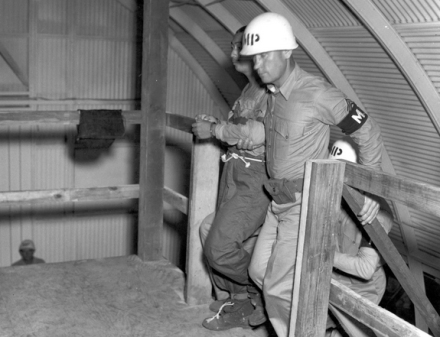
In the evening of June 18, 1947,* six convicted Japanese war criminals were hanged** by the U.S. Navy War Crimes Commission on Guam.


An unidentified Japanese prisoner ascends the gallows on Guam.

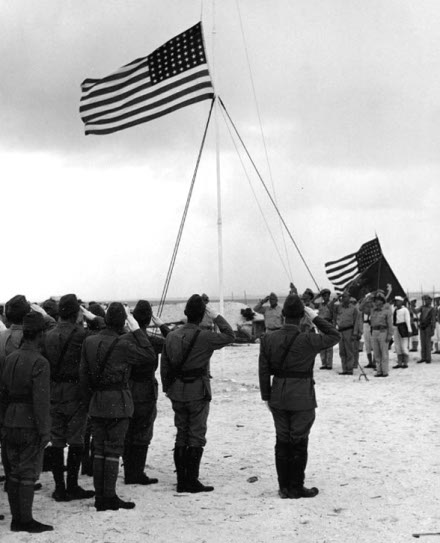
The most lastingly notable of the six was Rear Admiral Shigematsu Sakaibara, who was hanged for ordering (and perhaps in one instance, personally conducting) an infamous mass execution on Wake Island that has already appeared in these pages.

According to Judgment at Tokyo:

For some, the hanging of one of these six men had been a horrible tragedy and perhaps even a mistake. Rear Adm. Shigematsu Sakaibara had enjoyed the reputation of “gentleman soldier” and protector of the common man. Hailing from a wealthy family near Misawa in Tohokhu province, some 450 miles north of Tokyo, Sakaibara never forgot his roots. Forever poking fun at the fast-paced Tokyo lifestyle, the rear admiral touted the value of rural living, the integrity and honesty of those who lived in Japan’s rugged north country, and Tokyo’s need to recognize their great contributions to the war effort. Contemplating a postwar political future, he would be following in the footsteps of his politically influential family in northern Japan. That future was linked to championing the rights of returning veterans and other have-nots. Misawa had indeed had a heroic reputation as an important navy town and base for years. Sakaibara had assisted in the training exercises held there for the Pearl Harbor attack plan in late 1941. His future seemed golden no matter who won the war. But what some in his command called “The 1943 Incident” changed all that.


Shigematsu Sakaibara (right foreground) surrendering Wake Island on September 4, 1945.

These events, Sakaibara admitted in his trial, had taken place in an atmosphere of near starvation and impending doom. The defense counsel especially emphasized that point, asking the commission to understand and respect the pressures and strains on Sakaibara at the time of the incident. But the commission was not in a forgiving mood. In the chaos of retreat or not, innocent civilians had been murdered.

… Unfortunately for Sakaibara, several members of his former command expressed surprise on the witness stand when asked about the desperate situation on Wake in 1943. These men insisted that Sakaibara and his defense team’s description of a starving, chaotic Wake was an exaggerated one. There had been no unexpected miseries, confusion, or sense of peril, they said. Sakaibara’s fate was sealed.

True to form, defendant Sakaibara offered a very literate final statement to the commission. In contrast to so many of his colleagues on trial in Tokyo, on Guam, or elsewhere, Sakaibara, albeit with carefully picked words, admitted he was guilty of rash and unfortunate actions. He appeared especially convincing when he noted that he wished he had never heard of Wake Island. But his most memorable comments involved his own view of morality in war. A nation that drops atom bombs on major cities, the rear admiral explained, did not have the moral authority to try so many of his countrymen. With Hiroshima and Nagasaki in mind, Sakaibara claimed there was little difference between himself and the victors over Japan. With that statement a legend grew, particularly in his home town, of Sakaibara, the victim of American revenge.

… As late as the 1990s, some people there, not necessarily of the World War II generation, still bowed in reverence to Sakaibara family members out of respect for the “sacrificed” gentleman soldier.

His last words:

I think my trial was entirely unfair and the proceeding unfair, and the sentence too harsh, but I obey with pleasure.

* Some sources places the executions on June 19; the U.P. wire story, dated June 19th, referred to the hangings occurring “last night,” and the preponderance of evidence I have been able to locate appears to me to support the 18th rather than the 19th.

** An interesting bit of interservice-rivalry color on proceedings in Guam, courtesy of Prisoners of the Japanese:

The United States Navy had hanged fewer than a handful of men in more than a hundred years … Now on Guam they had all kinds of Japanese to try and sentence to death … They had to requisition an Army executioner to show them how to hang. He was a lieutenant with silver-rimmed glasses, a leading-man moustache, and a paunch. He used the traditional British drop formula, but he was an innovator as well: He invented a method of lowering the dead body to the stretcher without having to cut the rope.

On this day..

1795: The last Montagnards

On this date in 1795, the Mountain that had so recently dominated revolutionary France was destroyed by the blade.

This largely forgotten date is actually a significant milestone of those years’ imbroglio: the date on which the French bourgeoisie achieved its revolution by slaying the last sans-culottes-affiliated deputies in punishment for the last sans-culottes uprising.

In the year since the fall of Robespierre, a White Terror had purged his former adherents — or in class terms, had put Madame Guillotine to work pushing the Paris working class out of its former political authority.

The latter’s last hurrah of resistance was the Prairal Rebellion of May 20, 1795, when a mob stormed the Convention.

In the florid narration of Thomas Carlyle,

[I]t billows free through all Corridors; within and without, far as the eye reaches, nothing but Bedlam, and the great Deep broken loose! … Insurrection rages; rolls its drums; will read its Paper of Grievances, will have this decreed, will have that.

… National Representation, deluged with black Sansculottism, glides out; for help elsewhere, for safety elsewhere; here is no help.

About four in the afternoon, there remain hardly more than some Sixty Members: mere friends, or even secret leaders; a remnant of the Mountain-crest, held in silence by Thermidorian thraldom. Now is the time for them; now or never let them descend, and speak! They descend, these Sixty, invited by Sansculottism: Romme of the New Calendar, Ruhl of the Sacred Phial, Goujon, Duquesnoy, Soubrany, and the rest. Glad Sansculottism forms a ring for them; Romme takes the President’s chair; they begin resolving and decreeing. Fast enough now comes Decree after Decree, in alternate brief strains, or strophe and antistrophe, — what will cheapen bread, what will awaken the dormant lion. And at every new decree,* Sansculottism shouts “Decreed, decreed!” and rolls its drums.

Fast enough; the work of months in hours, — when see, a Figure enters … And then Gilt Youth, with levelled bayonets, countenances screwed to the sticking-place! Tramp, tramp, with bayonets gleaming in the lamp-light: what can one do, worn down with long riot, grown heartless, dark, hungry, but roll back, but rush back, and escape who can? The very windows need to be thrown up, that Sansculottism may escape fast enough. Money-changer Sections and Gilt Youth sweep them forth, with steel besom, far into the depths of Saint-Antoine. Triumph once more! The Decrees of that Sixty are not so much as rescinded; they are declared null and non-extant. Romme, Ruhl, Goujon and the ringleaders, some thirteen in all, are decreed Accused. Permanent-session ends at three in the morning. Sansculottism, once more flung resupine, lies sprawling; sprawling its last.

The so-called Cretois were hailed before a tribunal; six were condemned to death on this date.**

They dramatically attempted to cheat the headsman by stabbing themselves after the trial, somehow passing down the line without intervention a single knife smuggled by Goujon.

Three of them died of their self-inflicted injuries. The other three went immediately to the guillotine.

“They were,” Carlyle concludes, “the Ultimi Romanorum … Sansculottism sprawls no more. The dormant lion has become a dead one; and now, as we see, any hoof may smite him.”

* According to A Popular History of France from the First Revolution to the Present Time, one of the decrees was abolition of the death penalty “except in the case of emigrants and forgers of assignats.”

** Other less treasonably culpable former Montagnards who had not cast their lot squarely with the Thermidorians were proscribed or otherwise cut off from power in the aftermath of the Prairal rebellion.

On this day..

1944: Marc Bloch, French historian

On this date in 1944, the Gestapo shot French historian Marc Bloch among a batch of Resistance members.

When war broke out between France and Germany in 1939, the 52-year-old professor spurned advice to get out of the country. Driven by his love of France, he resigned his post at the Sorbonne to join the reserves.

I was born in France, I have drunk the waters of her culture. I have made her past my own. I breathe freely only in her climate, and I have done my best, with others, to defend her interests.

(Bloch had won the Legion of Honor for his brilliance and bravery in World War I, “always ready to March and give example.”)

High-profile intellectuals of Resistance proclivities and Jewish extraction, needless to say, had a problem in those terrible years.

The remarkable Bloch almost made it through the whole of the war in the French Resistance, but was arrested a few weeks before the Allied landing at Normandy, tortured, and shot. Comrades in arms remembered his death as an unusually sobering loss.

We couldn’t, no we couldn’t bear that image: Marc Bloch, our “Narbonne” of clandestine life, turned over to the Nazi beasts; this perfect exemplar of French dignity, of exquisite and profound humanism, this spirit become a prey of flesh in the vilest hands. We were there, a few of us, in Lyons, his friends, his comrades in the clandestine struggle, when we learned of the arrest, when we were immediately told that, “They tortured him.” A detainee had seen him in the offices of the Gestapo, bleeding from the mouth (that bloody trail in the place of the last malicious smile he had left me with on a street corner before being caught up in the horror). I remember: at those words, “He was bleeding,” we broke out in tears of rage. The most hardened lowered their heads despondently, as we do when things are just too unfair.

For months we waited, hoped. Deported? Still in Montluc? Transferred to another city? We didn’t know anything until the recent day when we were told, “There’s no more hope. He was executed at Trévoux on June 16, 1944. His clothes and papers were recognized.” They killed him, alongside a few others who he inspired with his courage.

For we know how he died. A kid of sixteen trembled not far from him. “This is going to hurt.” Marc Bloch affectionately took his hand and simply said, “No, my boy, it doesn’t hurt,” and fell first, crying out: “Vive La France!”

Marc Bloch, commemorated at this French site, bequeathed 20th century scholarship one of its great intellectual legacies. His The Historian’s Craft,* a composition halted short of completion by the Nazi firing squad, was posthumously published and remains one of the classic texts of historiography; the journal he co-founded in 1929 gave its name to a whole school of thought in the field. (Bloch’s own name also adorned a school in a more literal sense, the Marc Bloch University, now subsumed by the University of Strasbourg.)

Works By and About Marc Bloch

* The blog To The Roots is in the midst of a series of posts exploring The Historian’s Craft.

On this day..

1389: Saint Tsar Lazar, after the Battle of Kosovo

On this date (by the Julian calendar then in use) in 1389, Stefan Lazar Hrebeljanovic — that’s Tsar Lazar to you — led the armies of Moravian Serbia against the expanding Ottoman Empire at the Battle of Kosovo.

The Serbs were defeated — thereby plunging, in the national mythology, into a half-millennium of Turkish domination. Lazar was supposedly* captured and beheaded.

For a generation, Lazar had firmed up his authority as the most significant Serbian autocrat outside the Ottoman orbit. The gravity of that orbit, however, grew more powerful with each passing year; soon, it would devour Byzantium.

Here in the 14th century, the Turkish expansion took on vassals in southeastern Europe. For a prince in the marches, a reckoning had to come due.

Of course, some Serbian lords and other Christian rulers were prepared to owe fealty to the Turks.

In the national epic poem The Battle of Kosovo, our day’s hero receives divine visitation charging him to choose between the treasures of earth and those of eternity, perhaps the author’s critique of European nobles who joined the infidel.

‘Lazar! Lazar! Tsar of noble family,
Which kingdom is it that you long for most?
Will you choose a heavenly crown today?
Or will you choose an earthly crown?
If you choose the earth then saddle horses,
Tighten girths- have your knights put on
Their swords and make a dawn attack against
The Turks: your enemy will be destroyed.
But if you choose the skies then build a church-
O, not of stone but out of silk and velvet-
Gather up your forces take the bread and wine,
For all shall perish, perish utterly,
And you, O Tsar, shall perish with them.”

Lazar built the church.

This particular battle grew into one of mythic importance in the national memory of Serbia: the sacred apogee of national honor, even the bulwark of Christendom upon which the Islamic wave broke.**

Its site, “Kosovo Polje” or the “Field of Blackbirds” near Pristina, is a monument to the Serbian and Orthodox cause; that it is located, as its name suggests, in the province forcibly detached from Belgrade by NATO during the Kosovo War makes it a politically touchy bit of topography. Nationalist outfits like the Tsar Lazar Guard are violently displeased with Albanians having say-so about the place.

Not surprisingly, the record of the time suggests less a Balkan Thermopylae than that old historical standby — shifting relationships of collaboration, resistance, and negotiated boundaries amid Ottoman advances and (sometimes) reverses.

Lazar’s own son and heir Stefan Lazarevic became an Ottoman ally; when the Ottomans were themselves invaded, he shifted his alliance to a different regional power, Hungary. His successor, Durad Brankovic, became estranged from that alliance and eventually fought against the Hungarians in the Second Battle of Kosovo … as an Ottoman vassal.†

Be that as it may, St. Vitus’ DayVidovdan in Serbo-Croatian — which is now observed on its Gregorian calendar date of June 28th, remains one of the most sacred days on the Serbian calendar (it’s also the feast day of Lazar, a saint in the Orthodox tradition).

Vidovdan obtained another layer of meaning in 1914, for it was June 28 that Yugoslav nationalists then under the heel of a Christian empire assassinated Austro-Hungarian Archduke Ferdinand and ignited the First World War.

* It’s the predominant version of legend but not a settled historical fact that Lazar was actually beheaded as a prisoner. He may have simply died in battle, or of wounds taken sustained in the fight.

** Subject, like all good myths, to opposing interpretations.

† At the Second Battle of Kosovo, Serbian forces captured the fleeing Hungarian ruler, John Hunyadi, and his eldest son, Laszlo.

On this day..

2008: Anandrao Sainu Koram, Naxalite informer

Last year on this date, India’s Maoist “Naxalites” publicly beheaded a former comrade who had surrendered and collaborated with police.

Naxalites.

The incident that occurred in village Murgaon of Dhanora sub district has the entire Maoist-affected region in the grip of tension because of the manner in which the reprisal has been carried out.

A group of 40 to 50 Maoists went to the village Saturday night, called out Anandrao Sainu Koram from his house, tied him to a tree and beheaded him in full view of the villagers who had gathered at the spot, deputy superintendent of police Anant Rokde said Sunday.

“They also warned Anandrao’s colleague Shantaram Gawde, who too had surrendered to the police in April this year along with three others, that he would meet the same fate if he did not desist from acting as an informer,” Rokde told IANS on the basis of the complaint lodged by Anandrao’s wife.

The 23-year-old Koram was reportedly the fourth surrendered Naxalite slain by insurgents in as many months of the long-running and escalating conflict … which, needless to say, has been dire for civilians.

On this day..