On this date in 1980, the former intelligence chief of South Korea was hanged for assassinating President Park Chung-hee.*
In this surreal affair — known after its date as the “10.26 incident” in South Korea — the head of the Korean Central Intelligence Agency popped the autocratic head of state during a private dinner party at a secret KCIA compound.
He then returned to another dinner party at the compound and, without disclosing what he had done, reported an “accident” and started dropping suggestions to a general that this might be an opportune moment to arrange martial law. Instead, the two repaired to a bunker. There, several hours’ confused wind-gauging by a hastily assembled cross-section of the country’s power brokers (not knowing their own chief spook had pulled the trigger) gave illustration to the Ovid maxim that “treason doth never prosper: what’s the reason? If it prosper, none dare call it treason.”
Only two participants, Kim Chae Kyu and Kim Kye Won, had witnessed the assassination, and neither disclosed the killer … Without an explanation from these two, the others present were left to speculate whether the killings were truly accidental, organized by North Koreans, or perpetrated as part of a South Korean conspiracy, large or small. They could not rule out the possibility that some among them … were part of a plot. Without knowing the balance of power, both civilian ministers and military officers worried about making a wrong move … (Source)
The truth, eventually, would out. But the reason for this shocking internecine turn by a supposed confidante of the president? The murder was too well-planned to square with initial reports of an argument gone out of control. It seems a coup, but if so, our assassin disastrously — almost delusionally — miscalculated the post-Park lay of the land. Maybe we have to entertain the defendant’s own far-out claim to have struck against the authoritarian concentration of presidential power.
I shot the heart of Yusin Constitution like a beast. I did that for democracy of this country. Nothing more nothing less.
The controversial 2005 flick The President’s Last Bang offers a darkly comic look at the twisted mise en scene in the intelligence compound that fateful 10.26 … and doesn’t find a lot of participants worth admiring.
Whatever its cause, South Korea’s unanticipated transition was a wobbly one. Even as the spymaster who had set it in motion was hanged this date with some of his conspiring security men, successor dictator Chun Dwoo-hwan was crushing a student uprising in Gwangju.**
* Park had survived previous assassination attempts, often authored by North Korea — including one that slew his wife in 1974.
** This uprising resulted in a death sentence against future South Korean president Kim Dae-jung — obviously not carried out. Under Kim’s administration years later, Chun was himself condemned to die for the massacre; Kim returned the gesture of clemency.
On this date in 1832, Jamaican national hero Samuel Sharpe died upon the gallows for instigating the slave revolt that would (help to) end slavery.
Samuel Sharpe, an educated slave who was also a Baptist deacon, was the moving spirit behind the attempted general strike that became the Christmas Rebellion.
That time of year was less than festive for Jamaica’s enormous slave population, for Saint Nick opened the short window for harvesting the island’s sugar cane.
Samuel Sharpe and collaborators had the wit to realize that being depended upon to bring in the cash crop that made life comfortable for their owners put the slaves’ hands upon a potent economic lever. In the last few days of 1831, they pressed it.
The “passive resistance” thing didn’t last long, however, and the “strike” transmuted into a rebellion — the cause swiftly taken up by thousands of slaves around the island who torched crops. Given the small (less than 20) white body count,* the “violence” appears to have been directed against the instruments, rather than the perpetrators, of their enslavement.
Not so the reprisals.
The rebellion was suppressed within days, and over 300 put to death for it (in addition to 200 slave casualties during the pacification itself). There’s an absorbing BBC Witness episode about this affair available as a podcast here.
Sharpe was the last of those executed.
But his revolt is widely thought to have given impetus to the British parliament’s deliberations over the ensuing months that ultimately led to the Slavery Abolition Act (1833).
What [abolitionist MP William] Wilberforce was endeavoring to win from the British senate by his magic eloquence the slaves themselves were endeavoring to gain by outbreaks and violence. The combined action of one and the other wrought out the final result. While one showed that slavery was wrong, the other showed that it was dangerous as well as wrong. Mr. Wilberforce, peace man though he was, and a model of piety, availed himself of this element to strengthen his case before the British Parliament, and warned the British government of the danger of continuing slavery in the West Indies. There is no doubt that the fear of the consequences, acting with a sense of the moral evil of slavery, led to its abolition. The spirit of freedom was abroad in the Islands. Insurrection for freedom kept the planters in a constant state of alarm and trepidation. A standing army was necessary to keep the slaves in their chains. This state of facts could not be without weight in deciding the question of freedom in these countries … I am aware that the insurrectionary movements of the slaves were held by many to be prejudicial to their cause. This is said now of such movements at the South. The answer is that abolition followed close on the heels of insurrection in the West Indies, and Virginia was never nearer emancipation than when General Turner kindled the fires of insurrection at Southampton.
Sharpe, today, is an official national hero of Jamaica. The place in Montego Bay that he hanged is known as Sam Sharpe Square, and his face adorns the currency.
* Contrast with the much smaller, much bloodier rebellion of Nat Turner in the U.S., which preceded the Christmas Rebellion by a few months.
On this date in 1946, the Sudeten German whose fifth column had paved the way for the Nazi conquest of Czechoslovakia expiated his war crimes at Prague’s Pankrac Prison.
The onetime Czechoslovakian MP did well by the Anschluss, gaining the rank of Obergruppenführer and becoming one of Bohemia and Moravia’s top evildoers.
The Lidice operation formed a war crimes charge against Herr Frank after the war, and Frank’s own lasting badge of infamy: the systematic destruction of the entire male population of an arbitrarily chosen village remains the emblematic crime of the Nazi occupation to this day.
Thousands of spectators came to see the former “Protector of Bohemia and Moravia” executed in Prague’s Pankrac Prison by the Austro-Hungarian “pole hanging” method, as depicted in the film above.
Those of Lidice’s widows who were able to come — and widows of some of the 30,000 other Czechs for whose executions Frank had been adjudged indirectly responsible — occupied the second row of seats. …
Not the slightest gleam of compassion could be seen in that long row of unforgiving eyes as Frank, garbed in a ragged Nazi Elite Guard uniform, walked quietly between two guards. …
As the noose was adjusted about his neck, Frank muttered: “Deutschland wird leben auch wenn wir nicht leben” (“Germany will live even if we do not live.”)
The spectators, admitted by special cards, watched quietly in the bright sunshine. (New York Times)
A bourgeois youth who, disgusted at the gross economic exploitation of the Gilded Age, had turned against his class with the fury only the apostate can command, Émile Henry had chucked a bomb into the chic cafe of the Parisian Gare Saint-Lazare a week after the execution of Auguste Vaillant.
Henry’s act killed only one, but electrified the country.
The Terminus bombing stood out in an era of violent anarchist ferment for its target selection: not a prince or president or parliamentarian, but the faceless multitudes of the bourgeoisie (formerly) secure in their metropolitan repose — who, in their indifference to the misery of workers assented to and profited from the more infamous repressions wrought by their plenipotentiaries.
Henry was completely explicit about his intent: “there are no innocent bourgeois.”
Recognizing the hopelessness of his legal position, he proudly admitted the charges against him and mounted an eloquent defense for the wider world of his version of anarchist terror.
I had returned to Paris at the time of the Vaillant affair, and I witnessed the frightful repression that followed the explosion at the Palais Bourbon. I saw the draconian measures which the government decided to take against the anarchists. Everywhere there were spies, and searches, and arrests. A crowd of individuals were indiscriminately rounded up, torn from their families, and thrown into prison. Nobody was concerned about what happened to the wives and children of these comrades while they remained in jail.
The anarchist was no longer regarded as a man, but as a wild beast to be hunted everywhere while the bourgeois Press, which is the vile slave of authority, loudly demands his extermination.
…
But, gentlemen of the bourgeoisie, you have reckoned a little too much without your host. You arrested hundreds of men and women, you violated scores of homes, but still outside the prison walls there were men unknown to you who watched from the shadows as you hunted the anarchists, and waited only for the moment that would be favourable for them in their turn to hunt the hunters.
… The bomb in the Cafe Terminus is the answer to all your violations of freedom, to your arrests, to your searches, to your laws against the Press, to your mass transportations, to your guillotinings. But why, you ask, attack these peaceful cafe guests, who sat listening to music and who, no doubt, were neither judges nor deputies nor bureaucrats? Why? It is very simple. The bourgeoisie did not distinguish among the anarchists. Vaillant, a man on his own, threw a bomb; nine-tenths of the comrades did not even know him. But that meant nothing; the persecution was a mass one, and anyone with the slightest anarchist links was hunted down. And since you hold a whole party responsible for the actions of a single man, and strike indiscriminately, we also strike indiscriminately.
Perhaps we should attack only the deputies who make laws against us, the judges who apply those laws, the police who arrest us? I do not agree. These men are only instruments. They do not act in their own name. Their functions were instituted by the bourgeoisie for its own defence. They are no more guilty than the rest of you. Those good bourgeois who hold no office but who reap their dividends and live idly on the profits of the workers’ toil, they also must take their share in the reprisals. And not only they, but all those who are satisfied with the existing order, who applaud the acts of the government and so become its accomplices, those clerks earning three or five hundred francs a month who hate the people even more violently than the rich, that stupid and pretentious mass of folk who always choose the strongest side — in other words, the daily clientele of Terminus and the other great cafés.
That is why I struck at random and did not choose my victims! The bourgeoisie must be brought to understand that those who have suffered are tired at last of their sufferings; they are showing their teeth and they will strike all the more brutally if you are brutal with them. …
We will not spare the women and children of the bourgeois, for the women and children of those we love have not been spared. Must we not count among the innocent victims those children who die slowly of anaemia in the slums because bread is scarce in their houses; those women who grow pale in your workshops, working to earn forty sous a day and fortunate when poverty does not force them into prostitution; those old men whom you have made production machines all their lives and whom you cast on to the waste heap or into the workhouse when their strength has worn away?
At least have the courage of your crimes, gentlemen of the bourgeoisie, and grant that our reprisals are completely legitimate.
…
In that pitiless war which we have declared on the bourgeoisie, we ask for no pity. We give death, and we know how to endure it. So it is with indifference that I await your verdict. I know that my head is not the last you will cut off; yet others will fall, for the starving are beginning to know the way to your great cafes and restaurants, to the Terminus and Foyot. You will add other names to the bloody list of our dead.
You have hanged in Chicago, decapitated in Germany, garotted in Jerez, shot in Barcelona, guillotined in Montbrison and Paris, but what you will never destroy is anarchy. Its roots are too deep. It is born in the heart of a society that is rotting and falling apart. It is a violent reaction against the established order. It represents all the egalitarian and libertarian aspirations that strike out against authority. It is everywhere, which makes it impossible to contain. It will end by killing you.
Clemenceau, who witnessed the beheading at the Place de la Roquette, saw in the ghastly white 21-year-old crying “long live anarchy!” in the predawn gloom this morning in 1894 “the face of a tormented Christ, terribly pale, implacable in expression, trying to impose his intellectual pride upon his child’s body … let those for the death penalty go, if they dare, to smell the blood of La Roquette.”
Five weeks later, the French president who had refused to spare Henry was himself assassinated by another anarchist.
The clip above uses an actual 1893 anarchist hymn to dynamite, that fruit of the chemical science whose pyrotechnics were held to catalyze social change. Henry, who probably hummed the song a few times in his life, must have approved the songwriter’s philosophy.
Tant mieux s’il éclate parfois en faisant beaucoup de victimes
Chez nos ennemis les bourgeois cela nous venge de leurs crimes
On this date in 2001, an infamous crime lord and 13 members of his gang were put to death in two Hunan Province cities.
Suave serial bank robber Zhang Jun had a reported 28 deaths on his conscience, including such underworld classics as forcing a lover to execute someone in order to prove her loyalty, in a years-long spree of robbery and mayhem. He was a major catch early in China’s execution-rich “strike hard” crime crackdown.
Despite-slash-because of the body trail, the cool Zhang — who appeared in court dressed modishly and flaunting such indifference to death that he disdained to defend himself — attracted a strain of fandom for his “gangland chic”.
He’s kind of like the gangsters in the movies, really likable.
The authorities, and his many victims, liked him less.
A still shot from the broadcast of Zhang Jun’s trial.
Zhang Jun’s trial was notable for its ripples in other media as well. The Committee to Protect Journalists reported that several writers and editors were demoted or fired after publishing a story in Nanfang Zhoumo (Southern Weekend) exploring the gang’s roots in poverty and inequality … a take deemed inimical to the dialectical historical march of the Peoples’ Republic. (See here for some of the more approved commentary angles.)
The day before I left Rome* I saw three robbers** guillotined. The ceremony — including the masqued priests; the half-naked executioners; the bandaged criminals; the black Christ and his banner; the scaffold; the soldiery; the slow procession, and the quick rattle and heavy fall of the axe; the splash of the blood, and the ghastliness of the exposed heads — is altogether more impressive than the vulgar and ungentlemanly dirty ‘new drop’, and dog-like agony of infliction upon the sufferers of the English sentence. Two of these men behaved calmly enough, but the first of the three died with great terror and reluctance, which was very horrible. He would not lie down; then his neck was too large for the aperture, and the priest was obliged to drown his exclamations by still louder exhortations. The head was off before the eye could trace the blow; but from an attempt to draw back the head, notwithstanding it was held forward by the hair, the first head was cut off close to the ears: the other two were taken off more cleanly. It is better than the oriental way, and (I should think) than the axe of our ancestors. The pain seems little; and yet the effect to the spectator, and the preparation to the criminal, are very striking and chilling. The first turned me quite hot and thirsty, and made me shake so that I could hardly hold the opera-glass (I was close, but determined to see, as one should, see every thing, once, with attention); the second and third (which shows how dreadfully soon things grow indifferent), I am ashamed to say, had no effect on me as a horror, though I would have saved them if I could.
— Venice, May 30, 1817
* The date is not stated directly in Byron’s missive, but his movements are known in some detail — for instance, this timeline.
** According to the notes of executioner Mastro Titta, the three criminals “‘decapitati’ al Popolo, per omicidi e grassazioni” this day were Giovanni Francesco Trani, Felice Rocchi and Felice De Simoni.
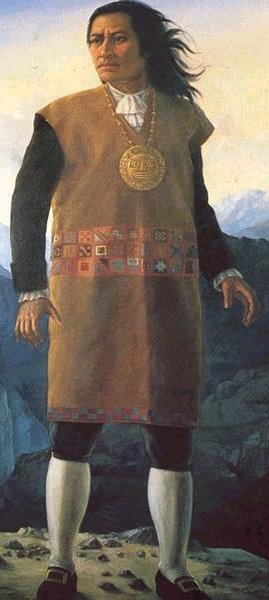
On this date in 1781, the last name in Incan rebellion met a horrible end in the ancient Incan capital of Cusco.
José Gabriel Condorcanqui — rechristened Tupac Amaru II, as he was a distant descendant of the last Incan king — was a member of the privileged indigenous population depended upon by the Spanish to administer the forced and extorted labor that made its New World empire worth having.
“From this day, no longer shall the Spanish feast on your poverty!”
This attention-grabbing entry onto the political chessboard was followed with an exemplary victory over Spanish forces. His revolt rapidly metastasized into an ethno-religious crusade, with all the accumulated bitterness of the Indians’ two-plus centuries maltreatment ferociously visited upon the Spanish.
It was a heady moment — but only a moment; within a few months, the Spanish had rallied and Tupac Amaru was betrayed into their hands.
The rebel had seized Incan symbology for his own purposes — speaking at ancient shrines, for instance — and the Spanish sentence against him included not only the inevitably horrific execution (of both Tupac Amaru and his wife and family) but a comprehensive and explicit programme of cultural annihilation to consign the Incan identity to the past. This lengthy sentence is well worth the read. (Sourced here, a pdf file; the bolded sections are my highlights.)
I must and do condemn José G. Túpac Amaru to be taken out to the main public square of [Cuzco], dragged out to the place of execution, where he shall witness the execution of the sentences imposed on his wife, Micaela Bastidas [Spanish link]; his two sons, Hipólito and Fernando Túpac Amaru; his uncle, Francisco Túpac Amaru; and his brother-in-law, Antonio Bastidas, as well as some of the principal captains and aides in his iniquitous and perverse intent or project, all of whom must die on the same day.
And once these sentences have been carried out, the executioner will cut out his tongue, and he will then be tied or bound by strong cords on each one of his arms and feet in such a way that each rope can be easily tied or fastened to others hanging from t he saddle straps of four horses, so that, in this position, each one of these horses, facing opposite corners of the square, will pull toward his own direction; and let the horses be urged or jolted into motion at the same time so that his body be divided into as many parts and then, once it is done, the parts should be carried to the hill or high ground known as “Picchu,” which is where he came to intimidate, lay siege to, and demand the surrender of this city; and let there be lit a fire which shall be prepared in advance and then let ashes be thrown into the air and a stone tablet placed there detailing his main crimes and manner of his death as the only record and statement of his loathsome action.
His head will be sent to the town of Tinta where, after being three days on the gallows, it shall be placed on a stake at the most public entrance to the town, one of his arms will go to the town of Tungasuca, where he was chief, where it will be treated in like manner, and the other in the capital of the province of Carabaya; one of the legs shall likewise be sent for the same kind of demonstration to the town of Libitaca in the province of Chumbilcas, while the remaining one shall go to Santa Rosa in the province of Lampa along with the affidavit and order to the respective chief magistrates, or territorial judges that this sentence be proclaimed publicly with the greatest solemnity as soon as it arrives in their hands, and on the same day every year thereafter; and they will give notice in writing of this to their superiors in government who are familiar with the said territories.
Since this traitor managed to arm himself and form an army and forces against the royal arms by making use of or seducing and leading with his falsehood the chiefs who are the second in command in the villages, since these villages, being of Indians, are not governed by such chiefs but rather by mayors who are elected annually by the vote or nomination of the chiefs: let these same electoral communities and the chief magistrates that care to give preference to candidates who know Spanish, and who are of the best behavior, reputation, and customs so that they will treat their subjects well and lovingly, honoring only those who have demonstrated honestly their inclination and faithfulness, eagerness, respect, obedience, submission, and gratitude to the greater glory of our great Monarch through the sacrificed of their lives, properties, or ranches in deference of their country or religion, receiving with brave disdain the threats and offers of the aforesaid reel leader and his military chiefs, yet taking care that these elected leaders are the only ones with the right to the title of chief or governor of their ayllus [communities] or towns, and that they cannot transmit their position to their children or other family members.
To this same end, it is prohibited that the Indians wear heathen clothes, especially those who belong to the nobility, since it only serves to symbolize those worn by their Inca ancestors, reminding them of memories which serve no other end than to increase their hatred toward the dominant nation; not to mention that their appear is ridiculous and very little in accordance with the purity of our relics, since they place in different parts images of the sun, which was their primary deity; and this prohibition is to be extended to all the provinces of this southern America, in order to completely eliminate such clothing, especially those items which represent the bestialities of their heathen kings through emblems such and the unco, which is a kind of vest; yacollas, which are very rich blankets or shawls of black velvet or taffeta; the macapaycha, which is a circle in the shape of a crown from which they hand a certain emblem of ancient nobility signified by a tuft or tassel of red-colored alpaca wool, as well as many other things of this kind and symbolism. All of this shall be proclaimed in writing in each province, that they dispose of or surrender to the magistrates whatever clothing of this kind exists in the province, as well as all the paintings or likenesses of their Incas which are extremely abundant in the houses of the Indians who consider themselves to be nobles and who use them to prove their claim or boast of their lineage.
These latter shall be erased without fail since they do not merit the dignity of being painted in such places, and with the same end in mind there shall also be erased, so that no sign remains, any portraits that might be found on walls or other solid objects; in churches, monasteries, hospitals, holy places or private homes, such duties fall under the jurisdiction of the reverend archbishops or bishops of both viceroyalties in those areas pertaining to the churches; and in their place it would be best to replace such adornments with images of the King and our other Catholic sovereigns should that be necessary. Also, the ministers and chief magistrates should ensure that in no town of their respective provinces be performed plays or other public functions of the kind that the Indians are accustomed to put on to commemorate their former Incas; and having carried out the order, these ministers shall give a certified account to the secretaries of the respective governments. In like manner shall be prohibited and confiscated the trumpets or bugles that the Indians use for their ceremonies and which they call pututos, being seashells with a strange and mournful sound that celebrate the mourning and pitiful memorial they make for their antiquity; and there shall also be prohibited the custom of using or wearing black clothing as a sign of mourning, a custom that drags on in some provinces in memory of their deceased monarchs and also of the day or time of the conquest which they consider disastrous and we consider fortunate since it brought them into the company of the Catholic Church and the very loving and gentle domination of our Kings.
With the same goal it is absolutely forbidden that the Indians sign themselves as “Incas,” since it is a title that anyone can assume but which makes a lasting impression on those of their class; and it is ordered, as is required of all those who have genealogical trees or documents that prove in some way their descent, that they produce them or send them certified and without cost by mail to the respective secretaries of both viceroyalties so that the formalities may be observed by those persons responsible to their excellencies the viceroys, consulting His Majesty where necessary according to each case; and the chief magistrates are charged to oversee the fulfillment of such requirements, to seek out and discover anyone who does not observe them correctly, in order to have it done to collect the documents with the aim of sending them to the proper authorities after giving their owners a receipt.
And so that these Indians renounce the hatred that they have conceived against the Spaniards, and that they adhere to the dress which the laws indicate, adopting our Spanish customs and speaking Castilian [Spanish], we shall introduce more vigorously than we have done up to now the use of schools, imposing the most rigorous and fair penalties on those who do not attend once enough time has passed for them to have learned the language; the duties and responsibilities involved in this plan going to the very reverend ecclesiastical prelates so that, in the opposition between parishes and doctrinas, they take care that those candidates bring affidavits from the provincial judges as to the numbers of people who speak the Said Castilian in those provinces … it being left up to the sovereign discretion of His Majesty to reward and honor those towns whose inhabitants have rendered, under the present circumstances, their due loyalty and faithfulness.
Finally, the manufacture of cannons of all kinds shall be prohibited under the penalty that any noble found manufacturing such items will be sentenced to ten years of prison in one of the presidios in Africa and any commoner will receive two hundred lashes as well as the same penalty for the same time period; reserving for a future time a similar resolution with regards to the manufacture of powder. And since there cannons of almost every caliber in the many ore-crushing mills and timber yards in these provinces, they will be gathered up by the magistrates once of the pacification of this uprising has been completely terminated in order to give account of them to the respective captaincy general so that he may determine whatever use he deems proper for them. Thus have I visualized, ordered, and signed: this is my final judgment.
José Antonio de Areche.
Tupac Lives.
The Spanish campaign to eradicate his name and identity didn’t exactly have legs.
The savagery of the crackdown helped generate Incan support for the rebellions that would shake off Spanish authority in the generations to come. He entered the official iconography of the post-colonial state, and can be found on Peruvian currency.
On this date in 1972, Jaime Jose, Basilio Pineda and Edgardo Aquino were electrocuted* in Muntinlupa for the gang-rape of actress Maggie de la Riva (or dela Riva) five years before.
The rising young actress had scarcely wavered after the assault before courageously making the always-fraught rape charge against a quartet** of attackers themselves from elite families. (The particulars are recounted in the Supreme Court ruling.)
J’accuse! Maggie de la Riva identifies two of the culprits just five days after her gang rape. Talk about facing your accuser; according to the accompanying article, “the frail-looking mestiza was a picture of righteous indignation as she extended her arms, showed her bruises, and asked Pineda, pointedly: ‘Do you remember these?'”
The case was a media sensation from day one. The Philippine film blog Video 48 republished a three-part series on the rapists’ capture (parts 1 and 2) and execution (part 3), complete with the desperate efforts of the offenders’ families to save them.
The victim herself continued her acting career.
Decades later, she’s still a public personality, and seems to have made peace with and moved on from her famous ordeal with impressive equanimity.
When that misfortune happened to me, I realized that although my body was raped my true self was never defiled and that there’s another person in me that’s beautiful, strong and true. The old Maggie has faded away. I look at my experience as something that happened to someone else who is no longer the person I am today. (Source)
* The Philippines adopted use of the electric chair in the early 20th century from the U.S., its colonial ruler at the time. It’s the only country besides the United States to have used the chair.
** One of the four condemned to death for the rape, Rogelio Canial, died in prison of a drug overdose several months before the executions.
On this date in 1975, black revolutionary Michael X was hanged for murdering an insubordinate follower.
Born Michael de Freitas to a mixed-race parentage, the future Michael X immigrated to London from his native Trinidad in 1957.
There, he quickly established a criminal niche — drugs, racketeering, prostitution. “They’ve made me the archbishop of violence in this country,” he joked. It was a background noticeably parallel to that of Malcolm X, whose naming convention he took after a 1965 meeting.
By then, our day’s subject had been swept into the contradictory whirl of the 1960’s, emerging as Britain’s “authentic voice of black bitterness”, whose networks ran the gamut from the criminal underbelly to the rich and powerful.
Michael’s chameleon-like identity — he was raised to pass as white, and known as “Red Mike” by black nationalist compadres — meshes well with the Rorschach-blot times he lived in. Certainly there was the eloquent spokesman of black militancy. There was also, ever more predominant, the violent avatar of social breakdown.
Michael X skipped bail in England to bolt for Trinidad and an agricultural commune with an increasingly creepy bent. Eventually, two bodies turned up: Joseph Skerritt, personally murdered by a machete-wielding Michael X for refusing to attack a police station and/or general disillusionment; and (sensationally) the socialite daughter of a Tory M.P. evidently buried alive.
Michael X — now Michael Abdul Malik — still had the cachet to draw celebrity support for his clemency campaign; Angela Davis, William Kunstler and John Lennon (who had put up Michael de Freitas’s bail in some previous legal scrapes) backed the “Save Malik” committee, but to no avail.
On this day in 1381, probably the most infamous robber baron in Germany was flogged, done in on the breaking wheel, and beheaded in Postbauer, near Nürnberg.
Eppelein von Gailingen (or Egkelein Geyling, or some variation thereof) has been dramatized across the ages, but little is known of the man’s life. His death, certainly, but his life is clouded in myth and folklore. What’s clear is that von Gailingen met his grisly end for robbery and a subsequent escape from incarceration. The rest is a tad murky (German link).
Von Gailingen belonged to the class of original robber barons, who supplemented their income with unauthorized tolls and, sometimes, flat-out theft. While the term is more popularly known for its application to the so-called industrial robber barons, it derived from a literal description from centuries past — Raubritter, in German, “men of birth who elected to live, in a lawless age, by saddle and by sword; who sought gain by masterful spoliation, and strove for glory by despiteful deeds of arms.” (Source)
A combination of factors led to the slow and steady dissolution of the former feudal system in favor of a money-based economy during the Middle Ages, and after the Plague swept through Europe around 1350, the accumulated changes and decimated population left much of the continent short on labor and, as a result, short on production. This really was a spot of bother for barons who, unlike their monarchical brethren, had no way to draft extra manpower. With resources thinning and a social lifestyle to keep up, many of these former lords turned to theft and exploitation. Although Rome established the rules governing tolls and trade, many local lords, now charged with obeying distant regulations, opted for a more convenient route: they stopped ships at unauthorized points, shook down the merchants, and sometimes seized wares to stock their own shelves.
Eppelein von Gailingen (German link), a lord in the castle at Gunzenhausen, near Illesheim, was of this group, but apparently one of its more bold and populist members.
He was often felt to be a kind of Robin Hood, and the earliest celebrations of the man were largely in this vein: a knight’s knight, fighting against an out-of-control state disregarding its people. Eppelein got away with his skulduggery until 1369, when he was captured by a political rival and imprisoned in Nürnberg. Von Gailingen was sentenced to death, but shortly before his hanging, an accomplice managed to sneak him a horse, on which he rode out the tower gates and hurdled the enclosing wall and moat.
Now the leader of a loyal band of brigands flouting the Roman Catholic Church, Eppelein went on the run for six years, eventually making his way back near his home. It was there that, after six more years, his minimal forces finally yielded to the Count of Nürnberg, who carried out a much more unpleasant version of the death sentence.
Eppelein’s rise to prominence began in the 16th century, when he was immortalized by a folk song, a medium that continues to be kind to him. Locals still tell a variety of tales of his exploits, and a rendition of these classics is vaguely effected through the film Ekkelins Knecht.
As if all that attention weren’t enough, von Gailingen’s run from the law lives on through the legend of Nürnberg: locals pushing the town on tourists claim that two hoofprints from his daring escape are imprinted in the stonework near the the castle’s five-pointed tower.* And perhaps most indicative of his endurance as a cultural icon, a neighboring town has devoted a festival to him, which is more than most robber barons of any day can claim.
* Not surprisingly, the tower was destroyed and rebuilt at least once — just five decades after Eppelein’s alleged leap. But the new sandstone structure does bear the marks of what could conceivably be a horse’s hooves.

 In this surreal affair — known after its date as the “10.26 incident” in South Korea — the head of the Korean Central Intelligence Agency popped the autocratic head of state during a private dinner party at a secret KCIA compound.
 Karl Hermann Frank (
 The day before I left Rome* I saw three robbers**
 José Gabriel Condorcanqui — rechristened

 Born Michael de Freitas to a mixed-race parentage, the future
