1521: The Comuneros of Castile

On this date in 1521, the day after winning the decisive battle in the Castilian War of the Communities, royalist forces beheaded its three principal leaders in Villalar.

Even while the Spanish Empire was burgeoning in the New World, its home peninsula remained a house divided.

The Iberian Kingdoms of Aragon and Castile had joined in a personal union with the marriage of Ferdinand and Isabella in the late 15th century.

When the couple passed, it was not a given that their conjoined territory would become, as it did, the germ of a unified Spain.

Instead, the royal power couple’s crazy daughter was kept under lock and key while her infant son grew into the redoubtable Emperor Charles V. To exacerbate the local annoyance, Chas had continent-spanning territories, and ambitions; Spain was not his base, merely one of his provinces. (He’d grown up in Flanders. Ah, dynastic politics.)

The Emperor was only a teenager when his Castilian subjects rose against his levies, and against the paradoxical perception that the first true King of Spain was a foreign ruler.

A riot in Toledo mushroomed into a revolt, and everyone started drawing up sides. (Spanish link) Things went south when the commoner rebels started adopting an unwelcome radicalism (beyond rebelling against the king, that is), enabling the imperial rep (and future pope) Adrian of Utrecht to pull back into the royalist camp rebellious nobles increasingly fearful of expropriation at the hands of the firebrands.

After the balance of forces decided in Charles V’s favor, all that remained was to give the chop to the primary troublemakers. Juan Lopez de Padilla, Juan Bravo and Francisco Maldonado were obligingly captured after the Battle of Villalar.


The Execution of the Comuneros of Castile, by Antonio Gisbert. Segovian Juan Bravo allegedly asked to die first, so as not to witness the death of so good a knight as Padilla.

The demise of the “Caballeros Comuneros” pretty much squelched the revolt — although Padilla’s widow Maria Pacheco defended the rebel ground zero of Toledo for several months more.

The comuneros have lived on ever since as a symbol in literature and propaganda, among monarchists (for whom they are a symbol of perfidy), liberals (rather the reverse) and Castilian nationalists. Though “comuneros” was for a period an all-purpose smear against agitators in the Spanish dominions, April 23 (the date of the fateful battle) has been Castile and Leon Day, a public observance, since 1986.


This monolith in the Villalar town plaza commemorates the Comuneros. Image (c) Julio Alvarez, and used with permission.

On this day..

1992: Billy Wayne White, after 47 minutes

On this date in 1992, longtime heroin user Billy Wayne White waited 47 minutes while his executioners probed for a vein suitable to inject the lethal cocktail he incurred for a 1976 robbery-murder in Houston.

On this day..

1997: Hostage-takers in Lima

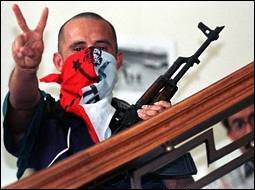
On this date in 1997, Peruvian paramilitaries stormed the Japanese ambassador’s residence held hostage for 126 days by leftist rebels.

Peace out.

All 14 of the Tupac Amaru Revolutionary Movement (MRTA) were slain in the raid,* along with two of the commandos and one hostage. Officially, there were no “executions” at all.

Unofficially?

It’s pretty well-documented that some — perhaps most — of the terrorists were taken alive, and thereafter summarily executed. (pdf of Defense Intelligence Agency cable hosted by the National Security Archive)

However untoward the outcome and however unimpressive the foe, the operation was a master stroke for then-President Alberto Fujimori. Peru’s neoliberal taskmaster had introduced the world to the auto-golpe, the “self-coup”, a Cromwellian maneuver of shuttering parliament in order to rule as dictator, and he thereafter made ruthless suppression of Peru’s ruinous internal conflict the calling card of his presidency.

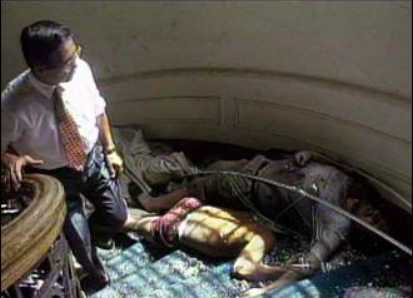
The DIA cable linked above claims Fujimori himself ordered the commandos to take no prisoners. He did not scruple to show himself in the middle of the bloodbath.


Alberto Fujimori made sure to get himself snapped standing over the bodies of the guerrillas, including MRTA leader Nestor Cerpa Cartolini.

El Presidente banked the political capital from having restored civic order, but it wasn’t the only capital he was banking. Three and a half years later, with a corruption scandal darkening his door, Fujimori absconded to Japan, faxed in his resignation, and became a fugitive.

Even there, he continued to justify his authoritarian governance.

Many Peruvians have always agreed with Fujimori’s self-assessment, even many who regret his well-publicized disregard for human rights.

But human rights researcher Michael Baney calls this day’s executions “pointless.”

“The MRTA was a spent force by the time of the embassy takeover,” said Baney. “The takeover was an act of total desperation, which is evidenced by the fact that the leader of the movement, Nestor Cerpa Cartolini, personally participated in it.”

After spending the best part of a decade in exile, Fujimori returned to the headlines by boldly returning to the hemisphere — to Chile, specifically, which arrested him and extradited him on a Peruvian warrant.

Just days ago as of this writing, Fujimori was convicted in his own former courts of authorizing death squads,** and sentenced to 25 years in prison. (Here’s some legal analysis.)

In the court of public opinion, it’s a different matter.

Fujimori’s daughter Keiko, a Peruvian congresswoman, figures to be a leading contender for the presidency in 2011, and has said she would pardon her father if given the opportunity.

“A majority of Peruvians think that Fujimori was guilty of serious human rights violations, but a majority also believe that he was a good president,” Baney observed. “And Fujimori really does believe that he single-handedly saved his country from economic and political collapse, and that Peru needs him around.”

* “Operation Chavin de Huantar”, profiled in several Spanish-language documentary videos available online. (Such as this one.)

** Not specifically related to this day’s MRTA killings, although these could be prosecuted in the future.

On this day..

1868: Henry James O’Farrell, would-be assassin

On this date in 1868, the first Australian known to have attempted a political assassination received the short drop and sudden stop that often constitutes the wages of that distinguished profession.

It was March 12 — less than six weeks before — that Henry James O’Farrell, Dublin-born alcoholic vegetable merchant fresh from the asylum, had shot the visiting Prince Alfred, Duke of Edinburgh at a picnic in the Sydney suburb of Clontarf.

Someone was smiling down on Alfred that day, because the shot was deflected by a metal buckle and inflicted only a flesh wound. Onlookers tackled the assailant before he could finish the job.

O’Farrell claimed affiliation with the Irish nationalist Fenian brotherhood, which inflamed anti-Irish passions (some cynically whipped up by New South Wales Prime Minister Henry Parkes). Paranoia redoubled when a Fenian assassin killed a Canadian politician a few weeks later.*

Under the circumstances, it was a hopeless struggle for O’Farrell’s attorney, who strove to demonstrate (probably accurately) that his charge was not so much a terrorist as a madman. Even the Duke of Edinburgh’s own intercession for clemency did not secure it, eager as the populace was to make an offering of its loyalty.**

* Irish convicts transported to Australia, especially after the 1798 uprising, formed a significant demographic among early New South Wales settlers. (Source)

** Another offering was a still-extant hospital in Sydney named for Prince Alfred.

On this day..

1994: Rwandan Queen Dowager Rosalie Gicanda, and six attendants

When the Rwandan genocide erupted following the April 6, 1994 assassination of President Juvenal Habyarimana, the southern province of Butare went initially unscathed. Its large and powerful Tutsi population had limited the foothold of violent Hutu paramilitaries.

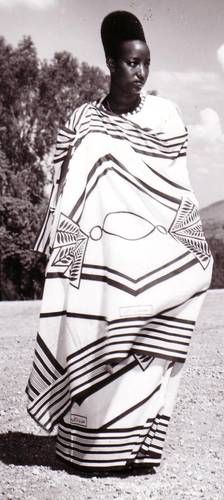
That calm lasted a mere fortnight, however, and was shattered this date in 1994 when the aged widow of Rwanda’s last monarch was hauled to Butare city’s national museum and shot along with several of her caregivers.

Taken in marriage in 1942 (French link) by King Mutara III, Rosalie Gicanda had stayed out of politics after he died mysteriously and Rwanda became a republic.

Being an emblematic Tutsi in April 1994, however, was all the political involvement needed to doom her. According to Human Rights Watch.

At 11 a.m. … a detachment of soldiers commanded by Lt. (jg) Pierre Bizimana, acting under the orders of Capt. Nizeyimana, invaded the modest home of Rosalie Gicanda … About eighty years old, she lived a quiet life as a devout Catholic, sharing her home with her bed-ridden mother and several women and girls who cared for them both. Because she eschewed any involvement in politics and behaved with discreet dignity, even the most anti-Tutsi politicians had left her largely undisturbed throughout the thirty years of Hutu rule…. The soldiers passed through the wooded enclosure that protected the house from the main street and entered the little house with its air of faded respectability. They seized the former queen and six others, leaving her bed-ridden mother and one girl to care for her. The soldiers passed by the ESO and then took Gicanda and the others to a place behind the national museum where they shot them. One teenaged girl, left for dead, survived to recount the murders. The soldiers returned to pillage Gicanda’s home in the afternoon and, two days later, they killed her mother. …

The news that this gracious lady and others from her household had been taken away by soldiers in the back of a pickup truck spread rapidly and alarmed Tutsi and all others who opposed the genocide. They concluded that if soldiers dared to seize even this revered person, then no one was safe.

That conclusion, of course, was well-founded. Over 200,000 Butare Tutsis are thought to have suffered Gicanda’s fate (or worse) in the ensuing months, making it the Rwandan genocide’s bloodiest province.

Pierre Bizimana was sentenced to death for Gicanda’s killing in 1998; I have been unable to document whether that sentence was ever carried out. His commanding officer, Idelphonse Nizeyimana, was arrested in October 2009.

On this day..

1945: Gen. Charles Delestraint

On this date in 1945, French general and Resistance figure Charles Delestraint was hastily disposed of, ten days before the liberation of Dachau.

Delestraint, who also spent the First World War as a POW, was among those who noticed the hidebound military dogmas of the past needed updating.

With de Gaulle, Delestraint was a forceful advocate in the interwar period for mechanized warfare.

He didn’t get far enough, certainly not as far as the soon-to-be-vaunted Wehrmacht.

In 1940, just months after retirement, Delestraint was recalled to lead a mechanized division against the Germans, which of course turned out to be a spectacular triumph of tank warfare … for the Germans. While the French distributed armor units throughout their forces, the Germans massed them at a schwerpunkt aiming to break through the French line and speedily conquer in the rear.

Delestraint later remarked of the doctrinal difference,

We had 3,000 tanks and so did the Germans. We used them in a thousand packs of three, the Germans in three packs of a thousand.

Recruited subsequently into the French Resistance and thence betrayed, Delestraint enjoined the hospitality of many concentration camps and the tender mercies of one of their more infamous torturers.

Uncertainty remains over exactly how the Germans killed Delestraint, or even why the Dachau commandants wanted to finish off him in particular, although he was a primo catch in the anti-Resistance operation. The body was immediately cremated, camp records of the execution order disappeared if they ever existed, and eyewitness testimony at variance.

But dying in Dachau for the French Resistance? By any standard, that’s a passport to hero status, as attested by any number of Rue General Charles Delestraints to be found in his native land.

On this day..

1859: Tantia Tope, Indian independence hero

This is the sesquecentennial of Tantia Topi’s hanging for what is sometimes called India’s First War of Independence.

Tantia Topi — there are many variations of the name — commanded Indian troops when a mutiny mushroomed into outright revolt.

Putatively in the service of a rebellious lord, Topi immediately established himself as the cause’s most capable commander. His forces bloodily seized Cawnpore (Kanpur) in a heady surprise victory during the conflict’s opening stages.

A British counterattack overturned that promising development. The Indian lord was captured, but “all the capacity for resistance that he ever displayed” had been supplied by Topi. Now, Topi found a more impressive liege in Rani Lakshmibai, and deployed his genius for soldiery in a fast-evolving war — harrying the occupiers in both conventional and (increasingly) guerrilla-style combat.

The rebels were outclassed; the time was not yet ripe — but Topi’s was the model of anticolonial guerrilla insurgency that would figure so prominently in the next century.

Topi’s exploits and elusiveness, maintaining his freedom in the field long after every other pillar of the uprising had collapsed, made him a domestic hero, and formed a continuing theme in the British press in 1858 and 1859. He was genuinely admired by his enemies as a soldier, however much his cause was abhorred. (The stiff-upper-lippers dinged him for inadequate personal courage, however.)

Topi was taken, at last, by betrayal, and dead at the order of a drumhead military court within days.

But the day after the London Times published its report of the popular hero’s hanging (“a great scramble was made by officers and others to get a lock of hair, &c”), it editorially eulogized* Topi with the gusto of victor catching, perhaps, the foreshadow of Indian resistance awaiting in generations still to come.

He raised armies as fast as we could disperse them, took up one position after another to our infinite annoyance, and led us a chace which, despite of unexampled efforts on the part of our soldiers, seemed to be really endless. Our troops pursued him without intermission, contrived more than once to surprise him, repeatedly captured his artillery and scattered his troops, but could never deprive him entirely of followers or guns. He seemed to summon forces from the earth as if by magic. As the pursuit grew hotter and hotter he mounted his men on ponies and camels, and marched, it is said, at the average rate of 60 miles a-day. Wherever we found him he had always cavalry and guns, and these he posted with remarkable skill.

Be it remembered that for half a century we had been training soldiers, and that in Bengal alone there were 150,000 natives under arms when this revolt broke out. Now, in all this enormous host there was not a single man who, when the bonds of allegiance and discipline were abruptly removed, displayed the intuitive capacities of a military commander. … The two years of the revolt, with all their opportunities, never produced one native General. … One man alone reproduced the old Indian character, and that man was TANTIA TOPEE — an obscure civilian, without place or power. He, by the light of nature alone, discerned the strong points of the rebels’ position and our own weak points. By the exercise of that faculty with which heroes are gifted he could always, even in his most desperate straits, draw followers to his standard. …

Nothing could more forcibly illustrate the reputation which this man had acquired than the fact that his fate has been attended with some regret … if he had not met his match in those opposed to him he might have founded a dynasty.

* May 21, 1859. Information moved a little slower.

On this day..

1355: Marino Faliero, Doge of Venice

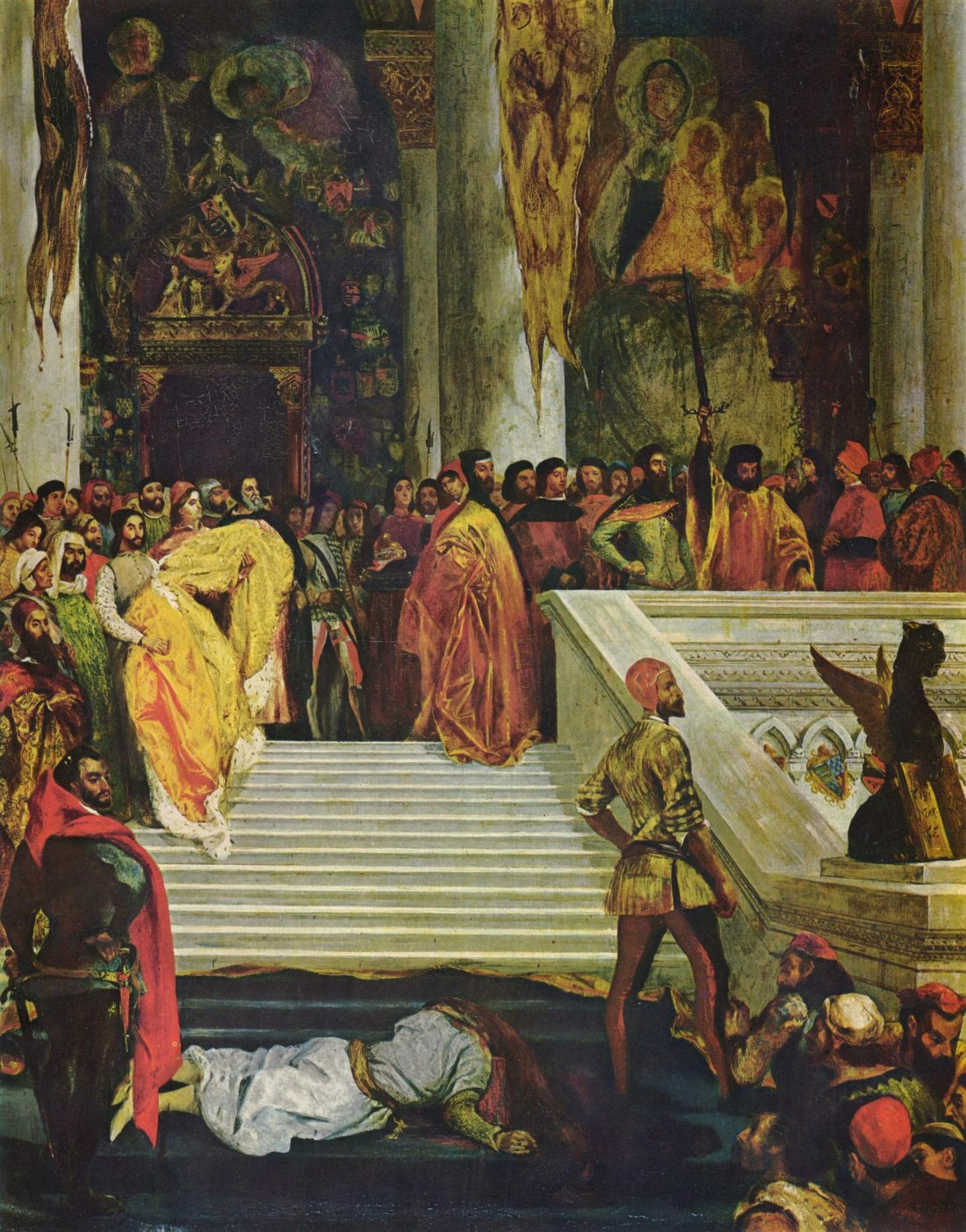
On this date in 1355, Marino Faliero* was escorted to the spot where he had been crowned Doge of Venice scant months before. There, he was ceremoniously relieved of his robes of state … and then his head.


The Execution of Marino Faliero, by Eugene Delacroix (1827).

Some fog surrounds the day’s proceedings, product not only of time but of the Doge’s executioners’ damnatio memoriae upon their victim. What was written was circumspect; even Faliero‘s portrait in the great hall of the Doge’s Palace was veiled.

What is known — or at any rate, was admitted by the elderly first citizen — is that the ruler attempted a coup against the overweening power of Venice’s great families.

The putsch was supposed to occur on April 15, with the bell of St. Mark’s Cathedral tolling on a fabricated hue and cry. In the tumult, the Doge’s supporters meant to cut down the nobles who flexed the real political muscle in the maritime republic and consolidate ducal power.

Why?

The salacious version has the old goat in a tiff with a noble, who made fun of his May-December marriage —

Marino Faliero of the beautiful wife,
Others enjoy her while he maintains her

A tribunal of fellow-nobles let the rascal off with a slap on the wrist.

Power being what it is, and princes and nobilities being born for conflict with one another across the centuries in Europe, one may as well discern a straightforward political intent — heightened, perhaps, by the then-dire state of Venice’s naval contest with Genoa.

Downright Byronic under either scenario … and Byron wrote a play about Faliero. The doomed ruler gives throat to quite a magnificent curse upon his city, with all the foresight of Byron’s half-millennium of hindsight:

I perish, but not unavenged; far ages
Float up from the abyss of time to be,
And show these eyes, before they close, the doom
Of this proud city, and I leave my curse
On her and hers for ever! —

          — She shall be bought
And sold, and be an appanage to those
Who shall despise her! — She shall stoop to be
A province for an empire, petty town
In lieu of capital, with slaves for senates,
Beggars for nobles, panders for a people!

Amidst thy many murders, think of mine!
Thou den of drunkards with the blood of princes!
Gehenna of the waters! thou sea Sodom!
Thus I devote thee to the infernal gods!
Thee and thy serpent seed!
[Here the Doge turns, and addresses the executioner.]
          Slave, do thine office!
Strike as I struck the foe! Strike as I would
Have struck those tyrants! Strike deep as my curse!
Strike — and but once!

This sort of thing knocking about among litterateurs in the 19th century practically guarantees an opera.

* Or simply “Marin Falier”, in the Venetian dialect.

On this day..

1178 B.C.E.: Penelope’s suitors, by Odysseus

On this date in 1178 B.C.E., according to some enterprising astronomers, the Greek hero Odysseus returned home to Ithaca from a 20-year absence and slaughtered the suitors who had taken up lodgings in his palace.

The date was asserted in 2008 based on astronomical clues in the text of Homer’s Odyssey.

This sort of putative historical specificity extracted from what could as well be read as literary devices — e.g., an eclipse — for a literary episode might gratify an advocate of “the higher naivete”, but the reader is well entitled to doubt.

Similarly, and more specifically for this venue, is the problem of whether the summary justice exacted by a Bronze Age chieftain meets the definition of an “execution”. This dubious case is resolved here by the unique subject matter.

Crafty quasi- (or altogether) mythical hero Odysseus (aka Ulysses), having left a generation before for the decade-long Trojan War which he finally resolved with the famous Trojan Horse strategem, then spent the next decade wandering about the sea en route to his home island.

When he gets there, he finds that 108 ill-mannered suitors have moved in, dissipated his fortune in merrymaking, and have ceaselessly dogged his faithful wife (and presumed widow) Penelope to remarry one of them.*

Together with his now-grown son Telemachus, Odysseus punishes them terribly .

“Dogs, did you think that I should not come back from Troy? You have wasted my substance, have forced my women servants to lie with you, and have wooed my wife while I was still living. You have feared neither God nor man, and now you shall die.”

They turned pale with fear as he spoke, and every man looked round about to see whither he might fly for safety, but Eurymachus alone spoke.

“If you are Ulysses,” said he, “then what you have said is just. We have done much wrong on your lands and in your house. But Antinous who was the head and front of the offending lies low already. It was all his doing. It was not that he wanted to marry Penelope; he did not so much care about that; what he wanted was something quite different, and Jove has not vouchsafed it to him; he wanted to kill your son and to be chief man in Ithaca. Now, therefore, that he has met the death which was his due, spare the lives of your people. We will make everything good among ourselves, and pay you in full for all that we have eaten and drunk. Each one of us shall pay you a fine worth twenty oxen, and we will keep on giving you gold and bronze till your heart is softened. Until we have done this no one can complain of your being enraged against us.”

Ulysses again glared at him and said, “Though you should give me all that you have in the world both now and all that you ever shall have, I will not stay my hand till I have paid all of you in full. You must fight, or fly for your lives; and fly, not a man of you shall.”

The suitors fight back, and most of the resulting deaths occur in the fray. But it’s about as one-sided as the contest on any proper scaffold.

As eagle-beaked, crook-taloned vultures from the mountains swoop down on the smaller birds that cower in flocks upon the ground, and kill them, for they cannot either fight or fly, and lookers on enjoy the sport — even so did Ulysses and his men fall upon the suitors and smite them on every side. They made a horrible groaning as their brains were being battered in, and the ground seethed with their blood.

And if many of the doomed die with their boots on, there are at least a couple of specific instances that clearly have a summary-execution character.

Leiodes then caught the knees of Ulysses and said, “Ulysses I beseech you have mercy upon me and spare me. I never wronged any of the women in your house either in word or deed, and I tried to stop the others. I saw them, but they would not listen, and now they are paying for their folly. I was their sacrificing priest; if you kill me, I shall die without having done anything to deserve it, and shall have got no thanks for all the good that I did.”

Ulysses looked sternly at him and answered, “If you were their sacrificing priest, you must have prayed many a time that it might be long before I got home again, and that you might marry my wife and have children by her. Therefore you shall die.”

With these words he picked up the sword that Agelaus had dropped when he was being killed, and which was lying upon the ground. Then he struck Leiodes on the back of his neck, so that his head fell rolling in the dust while he was yet speaking.

The minstrel Phemius, whose services had been procured by force, has better luck pleading for clemency when Telemachus intervenes before Odysseus can give him the chop. But the explorer’s son has no use at all for twelve corrupt handmaids who have abetted the suitors’ predations. I like this version in the chilling verse form quoted by Dr. Samuel Haughton in an 1866 paper on hanging that weirdly goes on to produce the physics necessary to demonstrate the intuitively obvious point that this must have required the main rope to anchor to pillars between each suspended noose, rather than all twelve on a single line.

…leading forth
The women next, they shut them close between
The lofty wall and scullery, narrow, straight,
And dreadful, whence no prisoner might escape.
Then, prudent, thus Telemachus advised:
 The death of honour would I never grant
To criminals like these, who poured contempt
On mine and on my mother’s head, and lay
By night enfolded in the suitors’ arms.
 He said, and noosing a strong galley rope
To a huge column, led the cord around
The spacious dome, suspended so aloft,
That none with quivering feet might reach the floor.
As when a flight of doves entering the copse,
Or broad-winged thrushes, strike against the net
Within; ill rest, entangled, there they find;
So they, suspended by the neck, expired
All in one line together. Death abhorred!
With restless feet awhile they beat the air,
Then ceased.

On whatever date imagined, or strictly as fiction, this whole bloodbath fixes the climax of one of seminal works of the western literary canon.

The excerpts quoted here are from the Internet Classics Archive; multiple versions of both The Odyssey and The Iliad are available on Gutenberg.org … they’ve even done The Odyssey as a TV miniseries.

* This site claims that there’s at least one alternate tradition in which the famously virtuous Penelope — wasn’t.

On this day..

1881: The assassins of Tsar Alexander II

On this date* in 1881, five members of the Russian terrorist organization Narodnaya Volya were publicly hanged in St. Petersburg, where they had slain the tsar Alexander II a few weeks before.

“The People’s Will” etched in blood its place in the dangerous late 19th century ferment of Russian revolutionaries. In time they would read as the politically immature forerunners of the Bolsheviks, whose turn into terrorism was a political dead end.

But as of this date, they were at the top of their arc.

Every St. Petersburg tourist sees the place Alexander II died: the spot received a picturesque church that is now one of the city’s principal attractions.

On March 13, 1881, Narodnaya Volya assassinated the former tsar with a suicide bombing on the streets of St. Petersburg. With the death of the monarch who had emancipated the serfs, and was on the very day of his murder tinkering with plans to introduce an Assembly, liberalism arguably lost its weak purchase on Russia’s future.

The Nihilists** — who immediately sent an open letter to the new tsar demanding amnesty and a representative political body† — did not prevail in any direct sense.

Their dramatic gesture failed to ignite a social revolution or topple the autocracy, and they would find in Alexander III an implacable foe.

But while this spelled the end for the old man’s five assassins,‡ and even the end of Narodnaya Volya as an effective organization as the 1880’s unfolded, Alexander III’s efficacious repression was a Pyrrhic victory for the Romanov dynasty.

By depending on police operations rather than political reforms, Alexander III bequeathed his doomed successor a hopelessly backward political structure … and a considerably more dangerous revolutionary foe.


Refusal of Confession (Before Execution), by Ilya Repin, 1879-1885. (Via)

Alexander II’s death in the context of the times and its effect for Russia’s fate receive diverting treatment in a BBC In Our Times broadcast

* April 15 was the date on the Gregorian calendar; per the Julian calendar still in use in Russia at the time, the date was April 3.

** A quick summary of the strains of Russian revolutionary thought of the time here.

† Despite their dramatic tyrannicide, the Nihilists’ letter was angled for the consumption of mainstream post-Enlightenment Europeans. Karl Marx noted its “cunning moderation,” and its call for freedom and civil rights commonplace in more developed countries drew considerable support in the west. The Nihilists even took care to underscore their reasonableness a couple months later by condemning the senseless assassination of American President James Garfield. (See Inside Terrorist Organizations.)

Andrei Zhelyabov, Sophia Perovskaya, Nikolai Kibalchich, Nikolai Rysakov and — though he had backed out of the plot — Timofei Mikhailov, whose noose broke twice in the attempt to hang him. A sixth condemned assassin, Gesya Gelfman, escaped hanging due to pregnancy … but she and her child both died shortly after the birth.

Perovskaya gets adulatory treatment in this 1910 New York Times retrospective (pdf) on Russian political violence and repression.

On this day..