1957: Burton Abbott, reprieved too late

On this date in 1957, the phone outside San Quentin’s gas chamber rang with a governor’s reprieve for Burton Abbott … but the execution was already underway.

Abbott was convicted of abducting and murdering 12-year-old Stephanie Bryan — a notorious crime that poet Sharon Olds, then a San Francisco teenager about the same age as the victim, memorialized in verse.

Then dirt scared me, because of the dirt
he had put on her face. And her training bra
scared me—the newspapers, morning and evening,
kept saying it, training bra,
as if the cups of it had been calling
the breasts up—he buried her in it,
perhaps he had never bothered to take it
off. They found her underpants
in a garbage can. And I feared the word
eczema, like my acne and like
the X in the paper which marked her body,
as if he had killed her for not being flawless.

Strong though ultimately circumstantial evidence connected Abbott to the crime, and the accused coolly maintained his own innocence at trial and thereafter. (The Oakland Museum has an extensive collection of photographic negatives from the trial.)

Abbott convinced his mom, but not many others — see this comment thread, for instance.

His last hours on March 15 were a rush of activity for a defense team that had fought for any possible angle to avert his death. A flurry of communications to Gov. Goodwin Knight delayed the execution once, and then secured a second stay just as the Abbott was being prepared for his fate.

By the time the phone rang, Abbott was already shrouded in cyanide fumes.

Goodwin’s Secretary Joseph Babich: Has the execution started?
Warden Harley O. Teets: Yes, sir, it has.
Babich: Can you stop it?
Teets: No, sir, it’s too late.

On this day..

1551: Alice Arden, husband killer

On this date in 1551, Alice Arden was put to death for one of 16th century England’s most shocking crimes.

Stuck in what one gathers was a dull marriage of political convenience, Alice Arden took up with a lover, Richard Mosby.

Although the whole scene was tolerated by her husband, Alice and Richard conspired to have Thomas murdered, because nobody would ever suspect the vivacious wife and her paramour to be behind the unexplained death of her husband. (And, Alice reckoned, Thomas “was so evil beloved that no man would make inquiry after his death.”) Holinshed‘s chronicle saw fit to include this tabloid-esque crime in its narrative of English history.

Arden’s wife, Mistress Alice, young, tall, and well favoured of shape and countenance, formed a criminal connection with a paramour, named Mosbye, a black, swart man. Mosbye had been servant to Sir Edward North, Alice’s father in law; and then settled as a tailor in London. The infatuated wife, lost to all sense of duty and morality, conspired with Mosbye to put an end to her husband’s existence, in order that she might marry the profligate black, swart man.

They employed as their confederates one John Green, a Faversham tailor; George Bradshaw, a goldsmith of the same town; and one Black Will, of Calyce (Calais), a murderer, which murderer was privily sent for to Calyce by the earnest sute, appoyntment, and confederate of Alice Arden and Thomas Mosbye.

The conspirators watched Master Arden walking in Poule’s (St. Paul’s Cathedral, the nave of which was a public promenade in those days), but could not find an opportunity to murder him; they then lay in wait for him on Rainham Down, and a second time in the Broomy Close (two places near Faversham), but on all these occasions failed in obtaining an opportunity.

The wicked wife then laid a plot for murdering her husband in his own house. She procured the services of Mosbye’s sister, Cicely Pounder, and of two of Arden’s domestic servants, Michael Saunderson and Elizabeth Stafford. On a particular day selected Sunday, too Black Will was hidden in a closet at the end of Arden’s parlour. After supper, Arden sat down to play some kind of game with Mosbye; Green stood at Arden’s hack, holding a candle in his hand, to shaddowe Black Will when he should come out; and the other conspirators had their cue. At a given signal in the game, Black Will came with a napkyn in his hand, and sodenlye came behind Arden’s back, threw the said napkyn over his hedd and face, and strangled him; and forthwith Mosbye stept to him, and strake him with a taylor’s great pressing iron upon the scull to the braine, and immediately drew out his dagger, which was groat and broad, and therewith cut the said Arden’s throat.

Having failed to convincingly position the body, and thereby leading police straight back to her house, Alice was immediately implicated in the crime. The conspiracy unraveled and the various people involved were brought to swift and merciless justice, including one poor bastard who had known nothing of the plot but had inadvertently supplied the credentials of that colorful assassin “Black Will” by decrying him as a murderous villain.

Alice Arden herself was burned in Canterbury while her confederates suffered various executions in various places around a country duly scandalized by the bold crime.

Six lives were taken for that of a worthless miser who connived at his wife’s infidelity. It was a sign of the horror inspired by husband murder among the Elizabethans. (Source*)

Indeed, the homicide and resulting executions kept as public scandal so long that the tale was reproduced as an Elizabethan tragedy, Arden of Faversham, in the 1590’s.

A possible uncredited Shakespeare play, it can be read for free in The Shakespeare apocrypha

Gentlemen, we hope youle pardon this naked Tragedy,
Wherin no filed points are foisted in
To make it gratious to the eare or eye;
For simple trueth is gratious enough,
And needes no other points of glosing stuffe.

FINIS.

Intriguingly, Richard Helgerson argues in Adulterous Alliances: Home, State, and History in Early Modern European Drama and Painting that this play restores some relevant political context to the Arden crime that Holinshed, perhaps deliberately, obscures. The Arden of Faversham victim is an apparatchik of the Duke of Somerset, a connection perhaps exaggerating Thomas Arden’s rank but not his position as the king’s man, with some important sponsors. Alice Arden and Richard Mosby, too, were national-level elites, Helgerson says.

The very (still-standing) Arden house was obtained through the English Reformation‘s dissolution of the monasteries; the London transplant Arden apparently used his (some must have felt) ill-gotten lands and power to impinge upon the prerogatives of his neighbors.

Helgerson doesn’t quite have an ah-ha conclusion to the tale, but the suggestion of a more layered meaning lurking behind what typically plays as straight Tudor police blotter throws a different light on the affair.

Arden’s appropriation of the abbey lands in Faversham finds its counterpart in Mosby’s appropriation of Alice Arden’s body … Seen this way, adultery is no longer a purely private crime … [but] rather a vehicle for thinking about history, for thinking, in particular, about that “improvement in the sovereignty” that was responsible both for the emergence of politic history and for the dissolution of the English monasteries, including Faversham Abbey.

* This source also supplies the date of March 14. However, the date is difficult to come by generally, and it may not be fully dependable.

On this day..

1858: Felice Orsini, Italian revolutionary

On this date in 1858, Italian revolutionary Felice Orsini calmly lost his head for the nation.

Something of a celebrity revolutionary, Orsini joined the independence movement of Giuseppe Mazzini and embarked on a generation’s worth of conspiracy, covert operations and prison spells and prison breaks which he himself voluptuously recounted in hot-selling autobiographical tomes.

Orsini became convinced that French ruler Louis Napoleon* was the chief obstacle to Italian unification, and accordingly chucked a bomb at the dictator’s carriage on January 14, 1858.

Ever theatrical, the condemned Orsini addressed a letter to Louis Napoleon while awaiting execution. In it, he urged the emperor to take up the Italian cause.

Whether mindful of the prospect of another Orsini waiting for his carriage, remembering his own youthful plotting with the Italian carbonari, or simply for reasons of French statecraft, Napoleon did just that. His alliance with the Piedmont state in northwest Italy (for which France received Savoy and the French Riviera in exchange) helped it absorb most of what now constitutes the Italian state.

Within three years of Orsini’s death, only a reduced papal enclave around Rome and the Austrian holdings around Venice separated the peninsula from unification.

In life, Orsini had been a prominent advocate of the Italian cause and played to packed houses in England. In death, he was felt further afield than that.

Tacking to a moderate stance on slavery abolition ahead of his presidential campaign, Abraham Lincoln condemned the late radical abolitionist John Brown as another Orsini — “an enthusiast [who] broods over the oppression of a people till he fancies himself commissioned by Heaven to liberate them. He ventures the attempt, which ends in little else than his own execution.”

Among Lincoln’s officers in the coming Civil War would be Charles DeRudio, the anglicized name of Orsini co-conspirator Carlo di Rudio.

Di Rudio had drawn a death sentence himself for the Orsini plot but was spared (pdf) by the clemency of his intended victim. He would go on to fight in the Battle of the Little Bighorn where he once again managed to cheat death.

* aka Napoleon III. He was the grandson of Josephine’s guillotined first husband.

On this day..

1960: Hoang Le Kha, NVA cadre

On this date in 1960, the former French colony of Vietnam made its last use of that most characteristically Gallic killing-machine: the guillotine.

Communist cadre Hoang Le Kha of the Vietnam People’s Army — the insurgent force also known at different times, in different manifestations, and through different eyes as the Viet Minh, the North Vietnamese Army (NVA) and the Vietcong* — earned the unpleasant distinction. According to a disappointingly truncated article (.pdf) from the Texas Tech University Vietnam Archive, the beheading took place notwithstanding an appeal pending before the International Control Commission, the multinational body charged with overseeing the supposedly temporary partition of Vietnam.

So, six years after Dien Bien Phu, what was independent Vietnam using this hated machine for?

Why, the same thing the French used it for: Terror.

The demonstrative device was redeployed in 1959 by Ngo Dinh Diem — a man whose obliviousness to blowback would soon land him in these pages — for exacting frightful, visible justice on subversive types.

According to that troubled former Secretary of Defense Robert McNamara,

On May 6, 1959, Diem signed Law 10/59, which, in an ironic bow to the former French colonial masters, inaugurated the era of death by beheading, as Diem’s lieutenants traveled the countryside with mobile guillotines and platforms, looking for “communists.” Article 1 of Law 10/59 called for “sentence of death, and confiscation of the whole or part of his property” for anyone convicted of crimes ranging from murder to stealing farm implements and water buffalo. Article 3 proclaimed that anyone belonging to “an organization designed to help to prepare or to perpetrate” such crimes “will be subjected to the sentences provided for” — that is, they will also be beheaded. … Article 16 announced: “The decisions of the special military court are not subject to appeal, and no appeal is allowed to the High Court.”

He then cites Hanoi historian Tran Van Giau’s recollection of the period.

“In 1959, the most difficult period of the revolution in South Vietnam, the Ngo Dinh Diem puppet regime dragged the guillotine everywhere and carried out a bloody fascist repression.”

Though officially downplayed overseas, all-but-summary beheadings were intentionally publicized in Vietnam in an effort to cow rebels.

The Diem government had many public executions. A lot of people in the West denied that it happened but Diem made no bones about it. They advertised the executions and there were pictures in the paper of people getting their heads chopped off by a guillotine. … In 1959, when I went around with the map teams there were many military outposts where they summarily chopped off the heads of people they thought were Communists. They put the heads on stakes right in front of their outposts, sometimes with two cigarettes up the nostrils. They even invited people to take pictures of it. They were very proud of themselves.

It didn’t work.

As a result, the guillotine itself, an archaic French model, can be seen among other dreadful mementos of that horrific war at Ho Chi Minh City’s War Remnants Museum.

Right alongside it is a picture of Hoang Le Kha.

(Many images — some of them graphic or disturbing — available at this Vietnamese page.)

* This is a very hasty lumping-together; the terms are not synonymous.

On this day..

859: St. Eulogius of Cordoba

On this date 1,150 years ago, Eulogius of Cordoba was beheaded for blasphemy in Muslim Spain.

Islamic rule in Spain was a century and a half old at this time; a period of relative comity among the Abrahamic faiths, it was nevertheless far from painless for Christians.

Islamic law exerted some (usually) non-lethal pressure on subject Christians by tolerating them as second-class citizens, subject to restricted civic privileges and additional taxes. With apostasy from Islam to Christianity punishable by death, it engineered a steadily increasing Muslim proportion of the populace.

Around 850, and continuing for the ensuing century, some Christians’ resistance to this arrangement would provoke periodoc repressions and a regular supply of martyrs.

Eulogius, a priest renowned for his eloquence and education, became a prominent exponent of the emerging trend of missionary martyrdom — Christians intentionally blaspheming Mohammad to a Muslim judge for purposes of drawing an exemplary death sentence.

We can readily infer that Eulogius’s support for such behavior was controversial; surely missionary martyrdom escalated tensions between the comingling communities in ways potentially troublesome for the go-along, get-along crowd. And Christians had good reasons to go along and get along: they could enjoy positions of wealth, influence and comfort, along with unencumbered worship.

Bishop Reccafred of Cordoba attempted to squelch any appearance of official support for these fire eaters, and threw Eulogius and other priests in prison after promulgating a decree against the martyrdoms in 852. Naturally, this made him a sellout in the eyes of the militants; Eulogius took a firm line against any attempt to derogate the martyrs of a fellow monotheism as unequal to the ancient martyrs of pagan Rome.

Those who assert that these [martyrs] of our own day were killed by men who worship God and have a law, are distinguished by no prudence … because if such a cult or law is said to be valid, indeed the strength of the Christian religion must necessarily be impaired. (Cited here)

The Cordoban martyrs’ movement claimed a few dozen lives over the 850’s — a hagiography records 48 — some taking inspiration from Eulogius’ Exhortation to Martyrdom. The author of that tract eventually followed his own advice.

Caught sheltering an apostate Muslim (she was executed a few days after Eulogius), the priest got into it with the Islamic judge, denounced the Prophet, and earned himself a death sentence. The story says he even literally “turned the other cheek” when struck by a guard en route to his decapitation.

In all the time since, Eulogius’s words have had a resonance for at least some segment of Christendom: when martyrdom has waxed popular, or confrontation with Islam loomed large. As his entry in Medieval Iberia: An Encyclopedia puts it,

Eulogius’s apologetic treatises are important, then, not only as evidence of the wide spectrum of Christian responses to life under Muslim rule — from outright rejection to almost complete assimilation — but also as one of the earliest extant sources for Western views on Islam.

St. Eulogius’s life gets a somewhat more detailed treatment (from an apologetic perspective) in The Lives of the Fathers, Martyrs, and other Principal Saints, a Google books freebie.

Part of the Themed Set: The Church confronts its competition.

On this day..

1615: St. John Ogilvie

On this date in 1615, Scotland’s only post-Reformation Catholic martyr was hanged at Glasgow Cross.

The Protestant-born Ogilvie had been educated in Europe and there fallen under the sway of the Catholic faith forbidden in his homeland. He converted, trained as a Jesuit, and at his own request returned to minister to the secret Catholic population in Glasgow.

Within a year he was in irons, awaiting a death sentence he refused to spurn with a timely submission to King James‘ spiritual supremacy. Ogilvie greeted his conviction for treason — and like most Catholic martyrs in the British Isles, he protested his loyalty in vain — with the words,

God have mercie upon mee! … if there bee heere anie hidden catholikes, let them pray for me, but the Prayers of Heretickes I will not have.


John Ogilvie? (See Update below)

There’s a multilingual Jesuit text celebrating Ogilvie available free from Google books.

Glaswegians can watch for more demonstrative tribute at St. Andrew’s Cathedral, which is poised to produce a monumental mural by Peter Howson.

Part of the Themed Set: The Church confronts its competition.


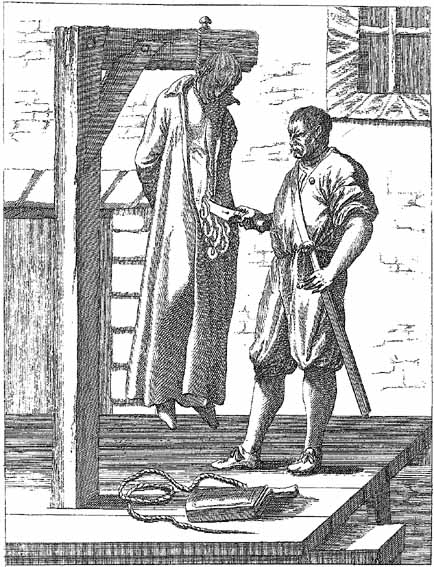
Update: Friend of the blog Louise Yeoman, whose guest post on a witchcraft execution remains one of the best pieces in this humble space, has an interesting correction to offer on Saint J.O. According to Yeoman, disemboweling “was not part of Scots law until 1708, when the British government wanted to hang draw and quarter some of those involved in the abortive Jacobite uprising of that year and were shocked to find that Scotland had no such penalty.” She’s backed by this contemporaneous account of Ogilvie’s death, which observes that even the “quartering” part of the sentence was not carried out.

So, what gives with the image, if Ogilvie’s corpse wasn’t carved up?

It’s from this (U.S.) Library of Congress page which marks it as a representation of Ogilvie in a late 17th-century text of Bohemian Jesuit propagandist Matthias Tanner. That provenance, of course, would be consistent with a bit of sanguinary exaggeration. It’s also possible that it’s mislabeled on the Library of Congress page, whose identification of it seems a bit oblique.

Working as I am from secondary sources, I tread cautiously here and welcome further clarification or correction.

On this day..

1009: St. Bruno of Querfurt

We have the rare privilege this date* to salute 1,000 years since the martyrdom of St. Bruno of Querfurt.

St. Bruno — also Brun or Boniface — had his head chopped off, and 18 companions were allegedly simultaneously hung or hacked to pieces, by a chieftain who did not appreciate the bishop’s efforts to Christianize the Baltics. The wherefores, and even the wheres (different sources locate it in Prussia, Rus’, or Lithuania) of this missionary’s end are permanently obscure to us.

But this relatively forgotten saint has something to tell us about the fluid area of contact between the Latin and Greek Christian spheres in the decades before their schism.

Lithuanian Institute of History scholar Darius Baronas argues** that although Bruno’s missions were conducted independently under papal authorization, he received support from the courts of both the Polish king Boleslaw the Brave and the Grand Prince of Kievan Rus’ Vladimir the Great.†

Both rulers hoped to extend their influence among the still-pagan lands of Europe, a secular incarnation of the rivalry between eastern and western rites.

So why is he so little-known to posterity? Baronas observes that St. Bruno

is a supreme example of a missionary saint and his activities ranged almost from the Baltic to the Black Sea. Yet despite his activities, let alone his glorious death, he did not receive much praise from his contemporaries and still less from later generations. His subsequent cult was rather circumscribed and was largely forgotten.

Precisely because of his ambiguous place between these two competing powers, and because his mission did not conform precisely with either’s policies of statecraft, neither Boleslaw nor Vladimir promoted a cult of Bruno: each realm was uncertain which side Bruno was on, and which side would profit most from his inroads among the pagans.

* February 14, 1009 is also cited as a date for St. Bruno’s martyrdom — for instance, by the Catholic Encyclopedia; the source of this may be the chronicle of Thietmar of Merseburg. In the absence of a determinative reason to prefer that earlier date, and allowing that 1,000-year-old executions are prone to shaky dating, I’m placing it on March 9 based on the Annals of Quedlinburg.


This text, reading “St. Bruno, an archbishop and monk, who was called Boniface, was beheaded by Pagans during the 11th year of this conversion at the Rus and Lithuanian border, and along with 18 of his followers, entered heaven on March 9th,” also happens to be the earliest surviving written reference to Lithuania.

** Darius Baronas, ‘The year 1009: St. Bruno of Querfurt between Poland and Rus”, Journal of Medieval History (2008), 34:1:1-22

† Vladimir the Great is himself a saint, too — in the Catholic tradition as well as the Orthodox.

Part of the Themed Set: The Church confronts its competition.

On this day..

305: Feast Day of St. Philemon the Actor

This is the feast day for St. Philemon the actor, supposed to have been hurled into the sea at Alexandria, Egypt, during the persecutions under Diocletian.

The fate of this otherwise obscure saint — he’s not to be confused with the first-century prelate to whom St. Paul addressed the shortest of his canonical epistles — is, of course, a byproduct of Christianity’s centuries-in-coming overthrow of the pagan world in which it incubated.

And in fact, Philemon the Actor’s martyrdom would have occurred towards the very end of the reign which saw the very last major anti-Christian persecutions. Already by this time, the young man whose sword arm would bear Christianity to its political triumph was a major political figure in the Empire.

The very next year, Constantine received the imperial purple, and over the ensuing years overcame his partners and rivals in that station to win unchallenged hegemony over the Roman World.

Laurels for Philemon and many others of his ilk would soon be policy for the empire that had put him to death, as celebration (perhaps exaggeration) of such travails cemented the newfound legitimacy of the formerly illicit religion elevated by Constantine.

Part of the Themed Set: The Church confronts its competition.

On this day..

1937: Alexander Yulevich Tivel

On this date in 1937 — probably — one of the numberless obscurities consumed by Stalin’s purges was convicted and presumably shot for “preparing to commit a terrorist act against [NKVD head] Yezhov.”

Alexander Yulevich Tivel, a Jewish bureaucrat who had the misfortune to have been in a party organ too close to Zinoviev, was disappeared by the NKVD one day in 1936.

His fate forms the opening hook for J. Arch Getty’s The Road to Terror: Stalin and the Self-Destruction of the Bolsheviks, 1932-1939 — “the story of the Stalinist terror writ small.” (Here’s a review)

We do not know whether he was physically tortured by his interrogators, but there is ample evidence that countless others were. Even high-ranking officials under arrest were beaten or, as Molotov would put it, “worked over.” Ten years later, a high-ranking police official described interrogation procedures in a letter to Stalin. First, prisoners were offered better conditions — better food, mail, and so on — in return for a confession. If that failed, appeals to the prisoner’s conscience and concern for his family followed. The next step was a solitary-confinement cell without exercise, a bed, tobacco, or sleep for up to twenty days … Finally, the use of “physical pressure” was authorized …

Tivel was probably executed on the same day [of his conviction]. Unlike many others who were badgered and tortured by the NKVD, he had not confessed.

His wife and mother-in-law to internal exile. His son would suffer the stigma of being the child of an executed traitor.

The widow Eva Tivel, reports Getty, grappled for years with the unresponsive bureaucracy until she finally cleared Sasha Tivel’s name.

On 23 May 1957, twenty years after Tivel’s execution and after Eva’s many letters and appeals, Tivel’s sentence and party expulsion were overturned … [as] “based on contradictory and dubious materials.”

On this day..

1836: The defenders of the Alamo, much remembered

On this date in 1836, Mexican forces commanded by President Antonio Lopez de Santa Anna overran the Alamo — and executed those few of its defenders who survived the day’s battle.

“Remember the Alamo!”

This most memorable battle of the Texas Revolution has since retained its place in the founding mythology of Texas and its draw as a tourist destination in San Antonio, no matter the complexities on the ground. (You can watch the earliest surviving film treatment, The Martyrs of the Alamo, free online. D.W. Griffith made it the same year he made Birth of a Nation.)

That Alamo of blood and legend, and the countervailing interpretations it eclipses, are much beyond our scope here, but we are attracted to notice the reputed summary execution of five to seven defenders who had surrendered or otherwise been captured during the fight. (A few dozen mostly civilian noncombatants in the former mission also survived, and were not executed.)

According to Robert Scott, Santa Anna was empowered by a Mexican resolution holding (not without cause) that

“foreigners landing on the coast of the Republic or invading its territory by land, armed, and with the intent of attacking our country, will be deemed pirates.”

Who counted, at this moment, as “foreigners” among the Anglo settlers trying to break away from Mexico and their supporters among from the United States to which Texas would eventually attach poses a historiographical riddle. But then, Santa Anna wasn’t there to write a dissertation, but to win a war — and he was said to be sorely annoyed at the defenders having tied him down for a week and a half.

King of the Wild Frontier

Covered by most any definition of “foreigner” would have been the Alamo’s most famous defender, Tennessee frontiersman and former U.S. Congressman Davy Crockett. He had arrived in Texas just a few months before, on a rendezvous with destiny.*

It’s a matter of dispute whether Crockett was among those last few executed; in an event this emotionally remembered, every version of the Crockett death scene — from “found dead of injuries amid a heap of Mexican casualties” to “cravenly bargained for his life” — gores someone’s ox.

Even if the account of Crockett’s presence among the executed derives from a disputed source — well, this blog has not scrupled to highlight the fictional and the mythological, those executions whose resonance transcends factual accuracy.

And even if Davy Crockett was not among those anonymous souls put to death this day, it is by his name that they have their tribute, as in the 2004 film** The Alamo:

* Destiny by way of Walt Disney.

** This Disney film diddles with the Crockett legend that Disney helped to inflate in the 1950’s — to the annoyance, of course, of traditional-minded Alamo partisans.

On this day..