1940: Three saboteurs and a spy, “Fusilles et oublies”

On this date in 1940, the collapsing French state “shot and forgot” four subversives at Pessac. These cases are heavily covered by the French-language blog Histoire penitentiaire et Justice militaire; many links in this post point to well-illustrated articles on that site, which make recommended reading for those inclined to delve deeper.

Late June finds France in the dark weeks after Dunkirk — the very day, in fact, when Marshall Petain’s government formally surrendered to the German blitz.

Elsewhere, the remains of the Third Republic had fled west to Bourdeaux, taking along its death row prisoners. The state that condemned them did not mean to let its imminent disappearance cheat it of their blood.

Jean Amourelle, a stenographer in the French Senate whose duties included shorthanding the secret proceedings of its military commissions, was caught routing intelligence to Germany.

Set to join him for this date’s execution were two pairs of brothers: Roger and Marcel Rambaud, and Leon and Maurice Lebeau. Seventeen-year-old Maurice Lebeau had his sentence commuted to hard labor, however, and was spared from the firing detail.

The Rambauds and Lebeaus were factory workers sentenced as saboteurs for compromising the engine of a French military plane, causing it to explode mid-flight: strange behavior for Communist proletarians explained by the temporary peace between Germany and the Soviet Union that (for the moment) positioned the Comintern-directed French Communist Party as an opponent of the war.

Despite the sacrifice of the Rambauds and Lebeaus, this posture was short-lived. Just one year later — June 22, 1941, in fact — Germany’s invasion of the USSR thrust Europe’s Communist movements into common fronts with anti-fascist parties, and France’s Communists into the forefront of French Resistance martyrs.

On this day..

1691: Mark Baggot, Jacobite spy

On May 20, 1691, Captain Mark Baggot was hanged as a spy in Dublin.

Baggot had maintained loyalty to King James II when that sovereign was deposed in the 1688 Glorious Revolution that elevated William of Orange to the English throne.

Though deeply unpopular in England, the Catholic James — still to this day England’s last Catholic monarch — had sympathetic subjects to flee to in Ireland. Apart from the religious sympatico, the Irish were still smarting from ravages dating back to Cromwell and before, authored in the main by factions who were direct ancestors of the Whigs, King James’s staunchest domestic foes.

In 1689, James landed in Ireland backed by the French and kicked off the Williamite-Jacobite War between the rival kings. This war was so nasty it even survived the flight of King James himself in 1690:* William refused to guarantee amnesty for a wide swath of the Jacobite leadership, who consequently saw no odds in laying down their weapons.

The latter months of 1690 and the early months of 1691 had the now-outnumbered Jacobites girding the defenses of the cities they held against the coming Williamite attacks that were sure to come. Intelligence was critical under such conditions, and here our man Mark Baggot enters the stage.

Baggot was dispatched from the Jacobite stronghold of Limerick to Williamite-held Dublin to scout the enemy, but there had the embarrassment of being captured trying to escape notice in women’s clothes.** (You may be certain that the Williamite press included this emasculating detail on every available occasion.)

A court-martial condemned Baggot to hang the very next day, March 25.†

But the secret agent bought himself two months’ respite by cooperating with his captors — making the whole mission a clear intelligence win for the Williamites, especially since they still got to hang their spy in the end.

The resulting document has copy nearly as long as its unwieldy title …
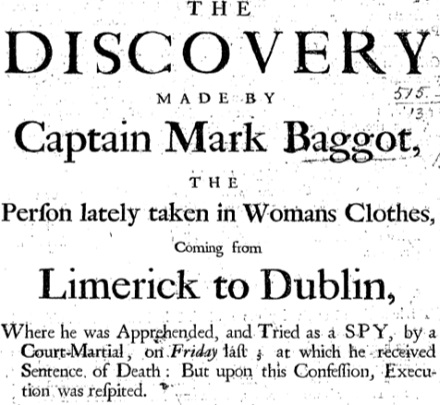
The Discovery Made by Captain Mark Baggot, the Person Lately Taken in Womans Clothes, Coming from Limerick to Dublin, where He was Apprehended, and Tried as a Spy, by a Court-Martial ... at which He Received Sentence of Death: But Upon this Confession, Execution was Respited.

That the Irish army consists of forty thousand men of all sorts; that Tyrconnel was reducing them to thirty thousand; but SarsfieldSir Richard Nagle are pensioners of France.

That there is no good understanding between Tyrconnel and Sarsfield, having great jealousies of one another.

That King James has correspondence with, and intelligence from some persons in considerable places of trust here in England every ten days.

That the French fleet is hourly expected with thirty pieces of cannon, ammunition, provisions and arms; a French general, some marine men, but none of the army; they resolve to maintain their greatest force against the confederates in Flanders next campaign.

That the Irish army intends to move towards the frontiers, their greatest design being against Cork more than ny other place; what is left of the suburbs they intend to burn; they expect a great many deserters at their approach to the town. The commanders of the parties for this service are Colonel Dorrington and Colonel Clifford.

A spy, taken at Limerick, was hang’d here [Dublin], and confess’d that Major Corket was in particular favour, and held correspondence with the English, who was carried prisoner to Limerick, and suppos’d to have suffer’d death.

That the contributions paid to the new Irish are one peck of wheat or meal, 12 pound of butter every fortnight out of each plow lands.

That there is express order that no guns be removed from Limerick; that the English deserters are only paid and encouraged, but no pay given to the Irish.

That they are still fortifying Limerick.

That Ballyclough and Castletown, with some other places, were to be made garrisons by the Irish; that Sir Michael Creagh’s regiment of foot, under command of Colonel Lacy, are at Ballyclough, which places they are fortifying; that Strabane’s regiment of horse are at Charleveel and Buttifant, &c.

Baggot’s less than flattering report of the Jacobite forces’ condition proved bang-on: that July, the Williamites dealt a fatal blow to the Jacobite cause at the Battle of Aughrim — thanks to forcing a defile that the dug-in Jacobites ought to have held but for want of ammunition.‡ Shortly thereafter, Limerick capitulated to Williamite siege — its last Jacobite garrison escaping into exile, never to stir in Ireland again.

* He’s remembered in Ireland as “James the Shit” (Seamus a Chaca) because he ditched his supporters mid-war.

** Not the only Jacobite with a cross-dressing escapade to his name.

London Gazette, March 26-30, 1691, which calls the spy Baggot “a Person very well known.”

The Baggot(t)s (Bagods, Baggetts) were an English family that could trace lineage back to the age of William the Conqueror, with a very longstanding branch in Ireland. (Dublin still has streets that bear that name.) The 17th century Irish Baggots took it on the chin for their loyalty to the Stuarts, several dying in that service or being dispossessed. The family’s Baggotstown Castle in County Limerick was seized and razed by the Williamites months after the events in this post.

The date of Baggot’s execution is reported in the Gazette for May 25-28, 1691.

‡ “All the day, though he was sincking in his center and on his left, [the Williamites] yett durst not once, for his relief, attempt to traverse the cawsway, till despayr at the end compelled him to trye that experiment at all hazards … they confidently ventured to goe through, notwithstanding the fire from the castle on their right, which fire was insignificant; for it slew but a few in the passage. The reason of it was given, because the men had French pieces, the bore of which was small, and had English ball, which was too large. Here is a new miscarriage thro’ heedlessness. Why was not this foreseen and the dammage prevented?” (Source)

On this day..

1777: James Molesworth, in the words of the Founding Fathers

John Adams to Abigail Adams

Philadelphia
March 31, 1777

I know not the Time, when I have omitted to write you, so long. I have received but three Letters from you, since We parted, and these were short ones. Do you write by the Post? If you do there must have been some Legerdemain. The Post comes now constantly once a Week, and brings me News Papers, but no Letters. I have ventured to write by the Post, but whether my Letters are received or not, I dont know. If you distrust the Post, the Speaker or your Unkle Smith will find frequent Opportunities of conveying Letters.

I never was more desirous of hearing frequently from Home, and never before heard so seldom. We have Reports here, not very favourable to the Town of Boston. It is said that Dissipation prevails and that Toryism abounds, and is openly avowed at the Coffee Houses. I hope the Reports are false. Apostacies in Boston are more abominable than in any other Place. Toryism finds worse Quarter here. A poor fellow, detected here as a Spy, employed as he confesses by Lord Howe and Mr. Galloway to procure Pilots for Delaware River, and for other Purposes, was this day at Noon, executed on the Gallows in the Presence of an immense Crowd of Spectators. His Name was James Molesworth. He has been Mayors Clerk to three or four Mayors.

I believe you will think my Letters, very trifling. Indeed they are. I write in Trammells. Accidents have thrown so many Letters into the Hands of the Enemy, and they take such a malicious Pleasure, in exposing them, that I choose they should have nothing but Trifles from me to expose. For this Reason I never write any Thing of Consequence from Europe, from Philadelphia, from Camp, or any where else. If I could write freely I would lay open to you, the whole system of Politicks and War, and would delineate all the Characters in Either Drama, as minutely, altho I could not do it, so elegantly, as Tully did in his Letters to Atticus.

We have Letters however from France by a Vessell in at Portsmouth — of her important Cargo you have heard. There is News of very great Importance in the Letters, but I am not at Liberty. The News, however, is very agreable.


John Hancock to George Washington

Philada
April 4[-8], 1777

Sir,

The enclosed Resolves of Congress, which I have the Honour of transmitting, will naturally claim your Attention from their great Importance.

The Regulations relative to the Payment of the Troops and the Department of the Paymaster General, will I hope be the Means of introducing Order and Regularity into that Part of the Army; where, it must be confessed, they were extremely wanted.

General Gates having laid before Congress the Proceedings and Sentence of a Court Martial on a certain James Molesworth who was accused and found guilty of being a Spy, they immediately approved the same. He has since suffered the Punishment due to his Crime. From his repeated Confession, it appears, that Mr Galloway was extremely active in engaging him to undertake this infamous Business, and was the Person employed to make the Bargain with him. He says indeed, Lord Howe was present: but from the Description he gave of his Person, it is supposed he must be mistaken.

The Congress have directed Genl Gates to take Genl Fermoy with him to Ticonderoga, and such other french Officers as he may think proper. Genl St Clair being ordered to Ticonderoga, but previously to repair to this City to wait the further Order of Congress, you will please to direct him to repair here accordingly as soon as possible. I have the Honour to be with the most perfect Esteem & Respect Sir Your most obed. & very hble Serv.

John Hancock Presidt

On this day..

1988: Dmitri Polyakov, Cold War spy

Although it would not be publicly known until two years later, the retired Soviet Gen. Dmitri Polyakov was on March 15, 1988 executed for treason.

A World War II artillerist, Polyakov (English Wikipedia entry | Russian) was a military intelligence officer working as an embassy attache when he made contact with American agents in New York in 1961. For the next quarter-century — across assignments to Burma, India, the U.S., and back in Moscow — he would ship to the CIA and FBI some of its choicest morsels of the Cold War.

“Polyakov was the jewel in the crown,” former CIA chief James Woolsey lamented of his loss. Polyakov-supplied documents underscoring the extent of Russia’s split with China have been credited with spurring Richard Nixon’s overtures to Beijing.

The spy code-named Bourbon, Roam, and Top Hat had idiosyncratic motivations; he was not an ideological true believer like a Sorge nor a man afflicted by demons like a Vetrov. He accepted only a little bit of money from his handlers, mostly to support an innocuous wordworking hobby.

This Russian article indulges a variety of hypotheses — contempt for Khrushchev, the death of a son, an appetite for risk-taking — but nothing his U.S. contacts could learn of him rebutted the presentation he made of himself as a Russian patriot chagrined at the prospect that the corrupt Communist state could win the Cold War.

His revelations did much to check that possibility.

Polyakov retired as a general in 1980, having operated under the Kremlin’s nose for a phenomenally long period of time. (His U.S. contacts made sure to feed him some career-advancing secrets, too.) But he was betrayed in the 1980s by the USSR’s own moles, Robert Hanssen and Aldrich Ames and arrested in 1986.

His fate, imposed by the Military Collegium of the Soviet Supreme Court, thereafter was a mystery to his former handlers. Two months after his secret execution, U.S. President Ronald Reagan sought Polyakov’s pardon or his exchange for a captured Soviet mole at his May-June 1988 arms control summit with Mikhail Gorbachev. The solicitation was politely deferred.

On this day..

1968: Two Jordanians, a sergeant and a civilian

Soldier and Civilian Hanged By Jordan as Spies for Israel

AMMAN, Jordan, Feb. 29 — Two Jordanians, an army sergeant and a civilian, were publicly hanged at dawn today after having been convicted by a military tribunal on charges of spying for Israel.

The authorities said they had been caught in April, 1966, when the civilian, Mahmoud el-Haihi, 30 years old, was crossing into Jordan from Israel near his home in Tulkarm. He was said to have been carrying a message and money from Israeli military intelligence officer to Sgt. Fawzi Abdullah, 32, also from the Tulkarm area.

The death sentence was pronounced in January, 1967, and approved last month by King Hussein.

-New York Times, March 1, 1968

On this day..

1943: Mildred Fish-Harnack, an American in the German Resistance

On this date in 1943, the Milwaukee-born translator and historian Mildred Fish-Harnack was beheaded at Plotzensee Prison — the only American woman executed by Hitler’s order.

A graduate student at the University of Wisconsin Milwaukee,* she met German jurist Arvid Harnack when the latter was a visiting scholar at the university’s sister campus in Madison.

In 1929, the couple moved to Germany where they worked as academics: Mildred, a teacher of language and literature; Arvid, of economics and foreign policy.

Both watched the rise of Third Reich with growing horror, and soon began converting their circles of academics, artists, and expats into a hive of opposition doing what they could to aid the many classes of excommunicate humans Berlin was busily proscribing. As the Nazi enterprise intensified, that opposition demanded ever more dangerous — more treasonable — extremities.

Good friends with American diplomats, the Harnacks for a time used Arvid’s placement in the Reich economic ministry to pass information to the United States. In 1940, they made contact with Soviet intelligence and from that time until the Gestapo snatched them in September 1942 the so-called** Red Orchestra sent furtive coded radio transmissions to Moscow reporting war preparations, economic data, and whatever else their circle could lay hands on among their various posts.

We have treated the fate of the Red Orchestra elsewhere in these pages; Mildred Harnack did not go to the meathook-nooses with her husband Arvid and others on December 22 because she was sentenced initially only to a term of years. These judgments came down at just the same time as the USSR was drowning the Wehrmacht in blood at Stalingrad, so there might have been a bit of personal pique when the Fuhrer personally quashed Mildred’s lenient sentence and demanded a, ah, reconsideration.

“And I have loved Germany so much,” she murmured as she was thrown under the fallbeil.

There’s a Mildred-Harnack-Schule in Berlin (also a Mildred-Harnack-Straße); her birthday, September 16, is observed every year in Wisconsin schools — although Mildred’s red associations meant that widespread recognition in her native country had to await the end of the Cold War.


Trailer for a Wisconsin Public Television documentary that can be viewed in full here.

* Then known as the Milwaukee State Normal School.

** Though this is the name history remembers them by, Red Orchestra (Rote Kapelle) was conferred by the German intelligence working to stop them. Confusingly, the name was applied to multiple different, and unrelated, spy networks.

On this day..

1940: Mikhail Koltsov, Soviet journalist

On this date in 1940, Soviet writer Mikhail Koltsov was shot at Lubyanka Prison.

Maybe the premier journalist of the early Bolshevik state, Koltsov (English Wikipedia entry | Russian) founded several magazines in the 1920s — including the still-extant Ogoniok.* His stylistic flair set him apart in an age oppressed by leaden, censorious prose. “If Pravda featured a readable piece in the 1930s, Koltsov was probably the author,” Donald Rayfield puts it in Stalin and His Hangmen. And the man’s charisma didn’t end with pen; he was the lover of (among others) the wife of security chief Nikolai Yezhov.

A convinced communist who had participated in the revolution, his reliability led Stalin to dispatch him to the Spanish Civil War — as a Pravda correspondent but also, of course, a Soviet agent. His role and his many fraught relationships are treated at some length in We Saw Spain Die; one officer of an international brigade wrote that Koltsov and his fellows seemed to breathe freer amid the wild danger of the front — “Here there was none of the slavish terror of the Moscow intellectual. Under the hail of Fascist bullets they forgot the bullet in the back of the neck, the secret executions of the GPU. Their talk was relaxed, uncharged with double meanings, un-Asiatic.”

Be that as it may, Koltsov as Kremlin vizier to a dirty war was on the other end of the death warrant often enough; he also cultivated Ernest Hemingway, and was rewarded with a thinly veiled role in For Whom The Bell Tolls (the character Karkov). His memoir Spanish Diary is a sort of team-Soviet counterpart to Orwell’s Homage to Catalonia.

But Koltsov lived ever in the shadow of Stalin’s terror, and to hear his friend, English correspondent Claud Cockburn tell it, Koltsov too knew it very well: a man for his time who could be a true believer by day and by night crack gallows humor at the creeping purges among friends. “I cannot say I was surprised” by his fall, Cockburn wrote when his onetime comrade disappeared. “And, oddly, I doubt if he was much surprised either. He had lived — and talked and joked — very dangerously, and he had absolutely no illusions so far as I know about the nature of the dangers … He would not, I thought, have been otherwise than satirically amused by some of the almost hysterically sentimental outcries which greeted his removal.” Though difficult to establish with certainty, it is thought that Stalin and Beria broadly suspected their Spanish Civil War emissaries of exposure to Trotskyite machinations, western spies, and other indulgences characteristic of men too far removed from that bullet in the back of the neck. Veterans of this conflict who retured to the USSR were a heavily purged demographic.**

Arrested as a Trotskyite at the end of 1938, he had a year to savor the terrors of interrogation and was made to denounce as western agents former friends like director Vsevolod Meyerhold — who was eventually executed on the same Feb. 1-2 night as Koltsov himself.

His brother, the cartoonist Boris Yefimov,† tried to inquire about him in March 1940 and was told that Koltsov had been interned in the gulag for ten years “without right of correspondence” … a secret police euphemism for a man who would in fact never correspond with anyone again.

* In 1923; this was a re-founding of a periodical dating to 1899, and the magazine naturally claims the earlier vintage for itself.

** Koltsov’s fall also corresponds to Moscow’s pre-World War II rapprochement with Berlin; one of the people his tortured denunciations helped bring down was the Jewish pro-western foreign minister Maxim Litvinov, for whom an anti-fascist alliance had been the policy. Litvinov was succeeded by Molotov — he of the Molotov-Ribbentrop non-aggression pact with Nazi Germany.

† Their surname by birth was Fridlyand; their father was a Jewish cobbler in Kiev.

On this day..

1970: Nineteen in Baghdad

From the Jan. 23, 1970 Times of India:

Damascus, January 22.

Iraq’s execution mill worked without let-up today with 36 people put to death in 24 hours — all but seven of them accused of plotting to overthrow the Government.

Seven of the men, not connected with the plot, were convicted in November of spying for the U.S., Radio Baghdad said.

It identified one of them, Albert Nounou, as a Jew.

The 29 people who were accused of trying to overthrow the leftist regime of President Ahmed Hassan al Bakr on Tuesday night and early yesterday faced firing squads or hangmen.

Mr. Bakr addressed crowds outside the Presidential palace, saying that any plot against his Government would “only lead to the cutting of the plotters’ throats,” Radio Baghdad said.

DETAILS GIVEN

The executioners worked past midnight yesterday, carrying out death sentences given to 22 persons convicted of the coup attempt.

Then at dawn, the seven people convicted in November were put to death. A few hours later, Radio Baghdad said six Army officers and a civilian were doomed by a special court for taking part in the attempted coup. Shortly thereafter, the military men were shot by firing squad and the civilian was hanged.

The Government newspaper, “Al Thawra,” said firing squads were using the plotters’ own weapons for the executions.

The Baghdad broadcast said that in addition to the six military men and civilians executed this morning, the court had sentenced three other people to life imprisonment. –U.N.I.

From the Jan. 23, 1970 London Times, under the headline “Toll of executions in Iraq reaches 41”:

Baghdad, Jan. 22. — The abortive coup d’etat in Iraq on Tuesday was engineered with the assistance of the Israel, American, and Iranian secret services, the Iraq news agency said tonight. It made the accusation after the executions of two more soldiers and three civilians, bringing to 41 the total number of alleged plotters executed in Baghdad either by firing squads or hanging since yesterday morning.

Two more men were waiting execution after sentence.

Some 3,000 sub-machineguns, 650,000 rounds of ammunition, and a mobile radio transmitted had been seized, the agency stated.

Earlier today Iraq accused the Iranian Ambassador and four members of his Embassy staff of being implicated in the coup attempt, and ordered them to leave the country within 24 hours.

In Teheran, Iran retaliated by giving the Iraq Ambassador, the military attache, and his three assistants 24 hours to leave Iranian soil. It also ordered the closure of all Iraq consulates in Iran. — Agence France Presse and Reuter

Part of the Daily Double: Saddam Hussein crushes a coup.

On this day..

1864: James Utz, St. Louis spy

Confederate agent James Morgan Utz had a blue Christmas indeed in 1864, awaiting his December 26 execution for espionage.

The Missourian had been captured traveling with a small band out of St. Louis disguised in Union uniforms and carrying supplies and ciphered messages for the invading Confederate army of General (and former governor) Sterling Price.

The federals handled Utz as a spy and a military court sentenced him to hang — a sentence that had already been carried out by the time President Lincoln’s grant of executed clemency arrived.

Tuesday morning last I was horrified at the announcement by a friend that Jas. Utz, Paul’s companion and leader in their attempt to go South, had been executed, being hung on Monday, the day after Christmas, in the jail yard.

It plunged me in a stupor or excitement from which my mind was not free for the entire day. The sentence barely issued and the punishment instantly carried out! The hurry, the suddenness was most revolting. No time given for taking leave of family, friends! No time for appealing for mercy or for a reprieve. No time allowed for composing himself for death!

Diary of a family member of Paul Fusz, one of Utz’s secret party. (Fusz, only 17 when captured, was pardoned after serving six months at hard labor.)

On this day..

1954: Karli Bandelow and Ewald Misera, in the Gehlen-Prozess

On this date in 1954, railway official Ewald Misera and civil engineer Karli Bandelow were beheaded in Dresden as West German spies.

They had been recruited to inform for the West German Gehlen Organization, an intelligence apparatus directed, as its name implied, by former Third Reich spymaster Reinhard Gehlen.

Gehlen had the honor to be dismissed by Hitler in the war’s closing days for his accurately defeatist reports on the overwhelming strength of the advancing Red Army, but for the western Allies — to whom he savvily surrendered — his expertise on and contacts in eastern Europe were very well worth having as the Cold War took shape.

His organization, the precursor to Germany’s present-day intelligence service, naturally set about penetrating East Germany — which was far simpler to do in those early years, before the East all but sealed the border.

East Germany, of course, was equally keen to undermine the Gehlen network’s moles and after the alarm of the June 17, 1953 rising it implemented a concerted effort to bring root out western spies known as Operation Arrow (Pfeil). Mass arrests beginning in October of 1953 swept up hundreds of suspected agents not only for Gehlen but for British, French, and American intelligence.

The consequent trials, or more particularly those targeting West German assets, are collectively known as the Gehlen-Prozess. We have indeed encountered some of its victims already: Elli Barczatis and Karl Laurenz, who would be executed a year after the principals in this post for their own work in Gehlen’s service.

Barczatis and Laurenz had alarmingly close access to the Prime Minister himself, and their trial was a secret one. Bandelow and Misera, by contrast, were civil servants fit for the sort of show trial that the Communist bloc was in these years raising to an art form.

In an orchestrated juridical performance piece from November 1 through 9, Communist Germany aimed “to expose the Gehlen organization as a gang of war criminals, fascists and revenge-seekers that threaten the peace of Germany and the world.”* Five other Gehlen informants besides Bandelow and Misera were convicted at the same proceedings, and sentenced to various prison terms.

Vainly playing for the mercy of the court, Bandelow offered to the spectacle that classic Stalinist flourish, the auto-denunciation of the doomed.

My Judge! I do not wish to speak a last word on my behalf … only to remark that I deeply regret my actions and I am ready for the harshest punishment. …

I call upon all those who like me have betrayed the nation and state to put an end to their criminal activity which threatens to unleash an insane war — call upon them to accept the leniency offered by the government and turn themselves in at once. I wish to cry out to them, take this generous offer so it does not go for you like has gone for me! (Source, in German)

Having done their last duty by the state, Bandelow’s frightened, penitent lips were closed by the fallbeil within 48 hours.

* The words of Anton Plenikowski.

On this day..