1863: Not Nathaniel Pruitt, reprieved deserter

On this date 150 years ago, according to Larry Daniel’s Soldiering in the Army of Tennessee, a middle-aged man was all set to be shot for deserting the Army of Tennessee, and the much-resented command of Gen. Braxton Bragg.

In a well-documented incident, a soldier received a reprieve as a result of a dramatic incident. Forty-seven-year-old Nathaniel Pruitt of the Nineteenth Tennessee was found guilty of desertion and on June 10, 1863, was taken to a field beside his regimental camp, his coffin placed beside an open grave. A minister cut a lock of hair to give to Pruitt’s wife. The firing squad was positioned and ordered to take aim, but just then an officer came galloping up with a special order to suspend the sentence. The prisoner began crying. “I was truly glad [of the reprieve], but must say some of the boys were disappointed,” a Mississippi diarist noted. Incredibly, the very next day, Pruitt again deserted and was never heard from again.

One takes the author’s point here about Pruitt’s risk-seeking second flight, but even so it might not really be all that “incredible” that one would desert the company of armed men who had recently shown open disappointment about being prevented from shooting one dead.

On this day..

1863: Lawrence Williams and Walter Peters, bold CSA spies

From the July 4, 1863 issue of Harper’s, as digitized by sonsofthesouth.net.

THE EXECUTION OF WILLIAMS AND PETERS.

We are indebted to Mr. James K. Magie, of the 78th Illinois Regiment, for the sketch of the execution of the two rebel spies, WILLIAMS and PETERS, who were hanged by General Rosecrans on 9th inst. The following account of the affair is from a letter written by the surgeon of the 85th Indiana:

HEADQUARTERS POST, FRANKLIN, TENNESSEE

Last evening about sundown two strangers rode into camp and called at Colonel Baird’s head-quarters, who presented unusual appearances. They had on citizens’ overcoats, Federal regulation pants and caps. The caps were covered with white flannel havelocks. They wore sidearms, and showed high intelligence. One claimed to be a colonel in the United States Army, and called himself Colonel Austin; the other called himself Major Dunlap, and both representing themselves as Inspector-Generals of the United States Army. They represented that they were now out on an expedition in this department, inspecting the outposts and defenses, and that day before yesterday they had been overhauled by the enemy and lost their coats and purses. They exhibited official papers from General Rosecrans, and also from the War Department at Washington, confirming their rank and business. These were all right to Colonel Bayard, and at first satisfied him of their honesty. They asked the Colonel to loan them $50, as they had no coats and no money to buy them. Colonel Baird loaned them the money, and took Colonel Austin’s note for it. Just at dark they started, saying they were going to Nashville, and took that way. Just so soon as their horses’ heads were turned the thought of their being spies struck Colonel Baird, he says, like a thunder-bolt, and he ordered Colonel Watkins, of the 6th Kentucky cavalry, who was standing by, to arrest them immediately. But they were going at lightning speed. Colonel Watkins had no time to call a guard, and only with his orderly he set out on the chase. He ordered the orderly to unsling his carbine, and if, when he (the Colonel) halted them they showed any suspicious motions, to fire on them without waiting for ano rder. They were overtaken about one-third of a mile from here. Colonel Watkins told them that Colonel Baird wanted to make some further inquiries of them, and asked them to return. This they politely consented to do, after some remonstrance on account of the lateness of the hour and the distance they had to travel, and Colonel Watkins led them to his tent, where he placed a strong guard over them. It was not until one of them attempted to pass the guard at the door that they even suspected they were prisoners. Colonel Watkins immediately brought them to Colonel Baird under strong guard. They at once manifested great uneasiness, and pretended great indignation at being thus treated. Colonel Baird frankly told them that he had his suspicions of their true character, and that they should, if loyal, object to no necessary caution. They were very hard to satisfy, and were in a great hurry to get off. Colonel Baird told them that they were under arrest, and he should hold them prisoners until he was fully satisfied that they were what they puported to be. He immediately telegraphed to General Rosecrans, and received the answer that he knew nothing of any such men, that there were no such men in his employ, or had his pass.

Long before this dispatch was received, however, every one who had an opportunity of hearing their conversation was well satisfied that they were spies. Smart as they were, they gave frequent and distinct evidence of duplicity. After this dispatch came to hand, which it did about 12 o’clock (midnight), a search of their persons was ordered. To this the Major consented without opposition, but the Colonel protested against it, and even put his hand to his arms. But resistance was useless, and both submitted. When the Major’s sword was drawn from the scabbard there were found etched upon it these words, “Lt. W.G. Peter, C.S.A.” At this discovery Colonel Baird remarked, “Gentlemen, you have played this damned well.” “Yes,” said Lieutenant Peter, “and it came near being a perfect success.” They then confessed the whole matter, and upon further search various papers showing their guilt were discovered upon their persons. Lieutenant Peter was found to have on a rebel cap, secreted by the white flannel havelock.

Colonel Baird immediately telegraphed the facts to General Rosecrans and asked what he should do, and in a short time received an order “to try them by a drum-head court-martial, and if found guilty hang them immediately.” The court was convened, and before daylight the case was decided, and the prisoners informed that they must prepare for immediate death by hanging.

At daylight men were detailed to make a scaffold. The prisoners were visited by the Chaplain of the 78th Illinois, who, upon their request, administered the sacrament to them. They also wrote some letters to their friends, and deposited their jewelry, silver cups, and other valuables for transmission to their friends.

The gallows was constructed by a wild cherry-tree not far from the depot, and in a very public place. Two ropes hung dangling from the beam, reaching within eight feet of the ground. A little after nine o’clock A.M. the whole garrison was marshaled around the place of execution in solemn sadness. Two poplar coffins were lying a few feet away. Twenty minutes past nine the guards conducted the prisoners to the scaffold — they walked firm and steady, as if unmindful of the fearful precipice which they were approaching. The guards did them the honor to march with arms reversed.

Arrived at the place of execution they stepped upon the platform of the cart and took their respective places. The Provost Marshal, Captain Alexander, then tied a linen handkerchief over the face of each and adjusted the ropes. They then asked the privilege of bidding last farewell, which being granted, they tenderly embraced each other. This over, the cart moved from under them, and they hung in the air.

What a fearful penalty! They swung off at 9:30 — in two minutes the Lieutenant ceased to struggle. The Colonel caught hold of the rope with both hands and raised himself up at 3 minutes, and ceased to struggle at 5 minutes. At 6 minutes Dr. Forester, Surgeon 6th Kentucky Cavalry, and Dr. Moss, 78th Illinois Infantry, and myself, who had been detailed to examine the bodies, approached them, and found the pulse of both full and strong. At 7 minutes the Colonel shrugged his shoulders. The pulse of each continued to beat 17 minutes, and at 20 minutes all signs of life had ceased. The bodies were cut down at 30 minutes and encoffined in full dress. The Colonel was buried with a gold locket and chain on his neck. The locket contained the portrait and a braid of hair of his intended wife — her portrait was also in his vest pocket — these were buried with him. Both men were buried in the same grave — companions in life, misfortune, and crime, companions in infamy, and now companions in the grave.

I should have stated in another place that the prisoners did not want their punishment delayed; but, well knowing the consequences of their acts, even before their trial, asked to have the sentence, be it by hanging or shooting, quickly decided and executed. But they deprecated the idea of death by hanging, and asked for a communication of the sentence to shooting.

The elder and leader of these unfortunate men was Lawrence Williams, of Georgetown, D.C. He was as fine-looking a man as I have ever seen, about six feet high, and perhaps 30 years old. He was [a] son of Captain Williams, who was killed at the battle of Monterey. He was one of the most intellectual and accomplished men I have ever known. I have never known any one who excelled him as a talker. He was a member of the regular army, with the rank of captain of cavalry, when the rebellion broke out, and at that time was aid-de-camp and private secretary to General Winfield Scott. From this confidence and respect shown him by so distinguished a man may be judged his education and accomplishments. He was a first cousin of General Lee, commanding the Confederate army on the Rappahannock. Soon after the war began he was frank enough to inform General Scott that all his sympathies were with the South, as his friends and interests were there, and that he could not fight against them. As he was privy to all of General Scott’s plans for the campaign, it was not thought proper to turn him loose, hence he was sent to Governor’s Island, where he remained three months. After the first Bull Run battle he was allowed to go South, where he joined the Confederate army, and his subsequent history I have not been able to learn much about. He was a while on General Bragg‘s staff as Chief of Artillery, but at the time of his death was his Inspector-General. When he joined the Confederate army he altered his name, and now signs it thus: “Lawrence W. Orton, Col. City P.A.C.S.A.” — (Provisional Army Confederate States of America). Sometimes he writes his name “Orton,” and sometimes “Anton,” according to the object which he had in view. This we learn from the papers found on him. These facts in relation to the personal history of Colonel Orton I have gathered from the Colonel himself and from Colonel Watkins, who knows him well, they having belonged to the same regiment of the regular army — 2d U.S. Cavalry. Colonel Watkins, however, did not recognize Colonel Orton until after he had made himself known, and now mourns his apostasy and tragic fate.

The other victim of this delusive and reckless daring was Walter G. Peter, a lieutenant in the rebel army, and Colonel Orton’s adjutant. He was a tall, handsome young man, of about twenty-five years, that gave many signs of education and refinement.

Of his history I have been able to gather nothing. He played but a second part. Colonel Orton was the leader, and did all the talking and managing. Such is a succinct account of one of the most daring enterprises that men ever engaged in. Such were the characters and the men who played the awful tragedy.

History will hardly furnish its parallel in the character and standing of the parties, tne boldness and daring of the enterprise, and the swiftness with which discovery and punishment were visited upon them. They came into our camp and went all through it, minutely inspecting our position, works, and forces, with a portion of their traitorous insignia upon them; and the boldness of their conduct made their flimsy subterfuges almost successful.

On this day..

1935: May Hitchens Carey and Howard Carey, mother and son

(Thanks to Meaghan Good of the Charley Project for the guest post. -ed.)

On this date in 1935 in Georgetown, Delaware, a mother and son were hanged for the murder of Robert Hitchens, May Carey’s brother and Howard’s uncle.

The execution of May, 52, attracted some attention as it was the first time in living memory that a woman had faced capital punishment in Delaware. The last time a woman was executed there had been in the 1860s.

On November 7, 1927, May enlisted the help of her two oldest sons, Howard, then 20, and James, 16, to murder their uncle Robert. May had taken out a $2,000 insurance policy on his life and promised to buy her boys a car if they helped her. After Robert got home from work, the three of them jumped him, beat him with a club and sledgehammer, and then finished him off with a gunshot to the head. They poured alcohol over his body and down his throat and rummaged through his belongings in an attempt to make the murder look like a robbery.

The police fell for the robbery gambit and thought Robert had been slain by bootleggers. For a long time it appeared the trio had gotten away with it.

But murder will out. The homicide went unsolved until December 1934, when May’s youngest son, Lawrence, was arrested on an unrelated charge of burglary. He told the police everything he knew about his uncle’s murder, which was enough to put his mother and brothers behind bars.

Lawrence testified against his family at the ensuing trial. (Not that his cooperation in the murder case helped with his own legal difficulties; he got seven years for the burglary.) May tried to shoulder all the blame — “I drove my children to do it. It was all my fault. They killed him but they would not have done it, if I hadn’t made them do it.”

May, James and Howard were all convicted but the jury recommended mercy for the two young men. In the end, James was sentenced to life in prison but Howard, who had sired a family of three children, got a death sentence, as did his mother.

During the time period between the trial and the time the sentence was carried out, both Howard and May turned to religion for solace and read their Bibles “cover to cover.” Their last meal was cake and ice cream.

Authorities erected the gallows behind a high fence to conceal it from prying eyes. They even stretched a piece of canvas overhead to prevent aerial photography. A single rope was used for both hangings, and May was first in line. She wore a new black dress with white ribbon around the throat. Her son was dressed in a formal suit and tie. Mary died at 5:30 a.m. and Howard followed her at 6:08.

As for James, he outlived his mother and brother by only nine years, dying in prison of natural causes at the age of 34.

On this day..

1886: A day in the death penalty around the U.S. South

From the New Orleans Times-Picayune, June 5, 1886.


Execution of Alfred Taylor at Opelousas.

Opelousas, La., June 4. — [Special.] — In accordance with Gov. McEnery‘s proclamation, Alfred Taylor, colored, was executed at 1:30 o’clock, P.M., to-day, by Sheriff Duson, the condemned man dying of strangulation about fifteen minutes after the springing of the trap.

He preserved a very firm and unconcerned mien until he saw the gallows, not seeming to realize or to believe that he would be hanged. He protested his innocence of the crime to the last. Once when the supreme moment arrived, he lost his usual stolidity and called on God to have mercy upon him and begging [sic] the Sheriff not to hang him.

Taylor was 23 years years old, griff in color, of medium height and weighing about 145 pounds. He was tried at the March term of our District Court, and the jury was composed of nine white and three colored men. He was defended by able counsel, and after an impartial trial was found guilty as charged on the indictment.

On Monday, Feb. 8, 1886, at about 11 o’clock in the morning, Taylor called at the residence of Mrs. Latreuille, a white lady, residing on the old Dr. Moore place, near Moundville, some four miles above Washington, and asked if her husband was at home. Not suspecting anything wrong, she replied that he was not. The negro then told her that some one was trying to steal her chickens in the woods near by and that she had better see about it.

The unfortunate woman went to the place to look after her fowls, when the negro followed her, and drawing a pistol threatened to shoot her if she made any outcry. She fainted away through fright, when he accomplished his diabolical purpose. He fled, and a posse was immediately organized and began searching for him. Had he been caught then he would undoubtedly have been lynched. He evaded arrest, however, until the week before his trial and conviction. The evidence adduced at the trial was crushing, and the jury promptly returned a verdict as above.

Since his conviction he has manifested no sighs of contrition, but, on the contrary, has always affected the most stoical indifference, and constantly indulged in the most revolting profanity.


A Double Execution.

Winchester, Va., June 4. — Wes Honesty and Tabby Banks were hanged at 9:22 A.M., for the murder on the night of Nov. 14, 1884, of Joseph McFaul, a youth of 18 years. A large Democratic procession took place here on that night, and the prisoners walked through the streets making threats that they would crack the skull of some Democrat before morning.

McFaul was a slightly built, peaceable young man, while Honesty and Banks were powerfully grown negroes.

They waylaid McFaul at the mouth of an ally on Main street. He had nothing with which to protect himself but a light walking stick. The negroes pressed upon him and he ran from them, ordering them to keep away. They then rushed upon him. Honesty collared him and pushed him against a house at the mouth of the alley, and Banks cried out, “stick it to him.”

McFaul defended himself as best he could with his walking-stick. Honesty was facing McFaul, and Banks got behind him. Honesty drew back and hurled a rock at McFaul, striking him in the left temple. As he reeled and staggered across the street Banks struck him with some weapon he held in his hands. McFaul went to his boarding-house, and was found dead in his bed next morning, with his skull crushed.

As the criminals marched to the scaffold Banks began to tremble violently, but Honesty stood firm on the trap. The Moody hymn, “There is a Light in the Valley,” was sung by request, both joining in loudly.

Honesty said: “I thank God I am converted. I am going to heaven. No man’s blood rests on my soul. I have not to answer for it. I thank all the officers and ministers for their kindness.”

Banks said I am not guilty of what is put on me. I want to meet all my friends in heaven.

Their arms were then pinioned, the black cap drawn over their heads, and in a loud voice, both cried out “good-bye,” “good-bye.” The trap was then sprung.


John Davis Hanged in Assumption.

Napoleonville, La. — [Special.] — At 12:30 o’clock to-day a colored man, named John Davis, was hung at Napoleonville for the murder of his wife, two years ago, on the Jones plantation, three miles above the town. He confessed the crime, and said he was willing to die for what he had done. The execution was without incident.


Launched from Lebanon.

Lebanon, Tenn., June 4. — Jim Baxter, colored, was hanged at 11:32 this morning. His last utterances were: “I did not kill Mrs. Lane. Dat’s the God’s truth.” His neck was not broken. He was dead in fifteen minutes.

On this day..

1660: Mary Dyer, Quaker

Mary Dyer was hanged in Boston on this date in 1660 — the most famous of that city’s four “Quaker martyrs”.

Monument in Boston to Mary Dyer as “witness for religious freedom”. (cc) image by Andrea Schwartz.

By the time of her last ordeal, Dyer already had a quarter century-old reputation for religious misbehavior in the New World.

She’d ditched England with her husband in 1635, part of that decade’s great outmigration of Puritan dissidents — “A Comely Grave Woman, and of a goodly Personage, and one of a good Report, having a husband of an Estate, fearing the Lord, and a Mother of Children,” according to an admiring account. Opinions varied: the colony’s governor found her “very censorious and troublesome, (she being of a very proud spirit, and much addicted to revelations).”

She brought with her a proclivity for the heretical: in Massachusetts, where the Puritan majority delivered the persecuting, Mary quickly fell foul of right-thinking folk by backing Anne Hutchinson in a theological controversy.* When Hutchinson was convicted by a church trial and banished, Mary Dyer cinematically walked hand-in-hand with her out of church. On top of everything else, she was known to have stillborne a deformed monstrosity (“a woman, a fish, a bird, & a beast all woven together”) which was the kind of thing these people understood as deadly serious.

Mary and her husband went to exile with Hutchinson, and were among the first English settlers of Rhode Island, before returning to spend most of the 1650s back in England. There, Mary Dyer converted to one of the new entrants to the Commonwealth’s welter of novel sects, Quakerism.

This new faith’s emphasis on egalitarian personal religious experience ungoverned by ordained clergymen met an instant ban once Massachusetts caught wind of it, with a statute imposing mutilated tongues and trips to the pillory for expounding the outlaw doctrine. To these would be added the threat of the gallows for repeat offenders with the temerity to return from banishment … and Mary Dyer is only the most famous of four Quakers who actually suffered this penalty.


The Heart of N-England Rent at the Blasphemies of the Present Generation: Boston Rev. John Norton‘s 1659 anti-Quaker tract advocates their execution.

Dyer’s defiance of the law was straightforward, keeping with the bold tradition of martyrdom in witness. Jailed in Boston in 1657, her husband (who had not yet followed his wife’s conversion) managed to arrange her release; she returned in 1659 to visit other imprisoned Quakers and they were all banished for their trouble. Shortly after, she returned to Boston with William Robinson and Marmaduke Stevenson: these were the first two Quakers put to death by the Puritans, but Mary Dyer was spared at the foot of the gallows and again expelled, finding temporary refuge in Rhode Island.

Edward Burrough’s A Declaration of the Sad and Great Persecution and Martyrdom of the People of God, called Quakers, in New-England, for the Worshipping of God, which also catalogues the many brutal punishments inflicted on Quakers up until 1661, preserves an account of Mary’s final return to Boston in May 1660 and her immediate arrest for same: it was enough for her to acknowledge her identity to reinstate her former sentence.

“I came in Obedience to the Will of God the last General Court, desiring you to Repeal your unrighteous Lawes of Banishment upon pain of Death; and that same is my work now, and earnest Request,” she told the court that doomed her. “If ye refused to Repeal them, the Lord will send others of his Servants to Witness against them.”

The very next day, she was drummed — to prevent her preaching — on a mile-long walk a gallows on Boston Common. This time there was no reprieve waiting: only immortality.

* This controversy drove the short-term governor Henry Vane back to England, and martyrdom during the interregnum.

On this day..

1791: Thomas Mount of the Flash Company

On this date in 1791, two Rhode Island thiefs named Thomas Mount and James Williams were publicly hanged in Little Rest (present-day Kingston).

A lifelong thief who plundered up and down the Atlantic coast and had the floggings to show for it, Thomas Mount told all about it — and not only his picaresque career but also, once he was knocked down upon the crap and ready to be topped on his way to the crimson ken, I say also the organization and underworld cant of his gang, the Flash Company.

Swells and fine blowens, kick off your crabs and leg-bags, grab a suck, and viddy (okay, that one’s from A Clockwork Orange) … but not here. Friend of the site Anthony Vaver (author of Bound with an Iron Chain and Early American Criminals) has Thomas mounted in a fascinating three-part series on his site, Early American Crime:

Alternatively, peruse the source material, here:

On this day..

1878: A day in the death penalty around the U.S.

From the Jackson (Mich.) Weekly Citizen:

A WOMAN’S DEATH AVENGED

NEW ORLEANS, May 24. — To-day, between the hours of 1 and 2 o’clock p.m., at the parish seat of Union parish, Louisiana, Jesse Walker, a colored man, was executed for the murder of Violet Simmons.

On the 12th of April last he was convicted. The evidence against him was circumstantial. At the time of his arrest, however, he made a confession of the crime, which he afterward claimed was forced from him.

A reporter, in company with Sheriff Pleasant, Rev. Mr. Parvin, Judge Ruthland and Capt. Raburn, visited the doomed man on yesterday evening. Walker was 22 years old, weighed 175 pounds, was very black, rather sullen and stupid. He appeared perfectly composed.

After visitors had expressed their sympathy and informed him of their mission, he made a

STATEMENT.

I know I must die to-morrow. They are punishing me for something I did not do. God knows I am as innocent as the angels of heaven, and I do not know who killed Violet.

About three years ago I drew my gun on Mr. John Simmons for trying to shoot my father. He has been mad at me ever since. I think that is the reason he swore so hard against me.

On the night Violet was killed, at the request of my brother and Noah Gandes, I started over to Aunt Wine’s to tell the girls that there would be a party that night.

It was about dark. I had gone two hundred yards when I saw Violet lying in the road.

We lived in the same yard, were cousins, and as we were often playing with each other, I went up to her and called her. She did not answer. I then ran back to the house, and called her mother. I was arrested.

At an early hour this morning

THE CROWD

began to gather from this and adjoining parishes, and by noon 3,000 people, the majority of whom were colored, assembled to witness the execution.

The sheriff had taken every precaution to preserve the peace and order. All of the saloons were closed and forty deputies were sworn in.

On Friday, at 12 m., the writer entered the jail in company with the parties named, and a sister of the prisoner. The meeting between

THE DOOMED MAN AND HIS SISTER

was very sad. She told him how often she had talked to him and prayed for him. He still protested his innocence, and said he was going to meet his mother in heaven. He inquired after his kinsfolks, and gave instructions with reference to his burial.

After giving his ring to his sister he bade her good bye, and was conducted to the debtor’s room and there very quietly dressed.

He then stated that he had evidence that he was

AT PEACE WITH GOD.

He appeared perfectly cool and collected. At 10 minutes to 1 o’clock p.m., the prisoner ascended the platform, which was erected about two hundred yards from the jail.

Rev. Mr. Britt offered up an earnest prayer, and the sobs and groans of women and children were heard from every direction.

The sheriff addressed the audience, appealing to them to keep order. The prisoner then came to the front of the platform and said:

None but me and my God knows that I am innocent. If the man who prosecuted me would have told the truth, I think he would have known something about the killing of Violet. I do not blame my lawyer. I do not blame the jury; they believe the prosecution, and have murdered me. I tried to get Lawyer Ellis to defend me. If he had defended me I would have been acquitted, but I do not blame him. I do not blame the sheriff or jailor, or the men who built the gallows. I have been wrecked, but have been praying for one week. I expect to be in heaven in less than a half hour. I want all my friends to pray for me as I have prayed for myself. I advise all young people to

QUIT GOING TO PARTIES, AND SERVE THE LORD.

I have never killed any one, but if I had my pistol when Simmons accused me of killing Violet and arrested me I would have killed him; but I thank God I did not, for then I would have never entered the kingdom of heaven.

Prince Jones (colored) then ascended the platform, and prayed fervently for the doomed man. The lips of the prisoner moved as in prayer, and tears come in his eyes.

The Sheriff then read the death warrant, during which time the prisoner retained his self-possession. At twenty minutes to 2, the rope was cut, the drop fell, and Jessie Walker was no more on earth.


Henry Roberts.

A PUBLIC EXECUTION.

SHELBY, N.C., May 24. — Henry Roberts (colored) was hanged here, publicly, to-day, at 1 p.m. There were four thousand persons present. The drop fell three feet, and his neck was unbroken. He hung thirty minutes.

Roberts reiterated his innocence, and said: “Jesus will gather me in his arms, and heaven will be my home. Chris died; so must I. I love all the world, and forgive all my enemies.”

He said all of the witnesses swore falsely, and that they have to answer for it hereafter. Roberts spoke ten minutes. His last words were: “I bid you all farewell.”

HIS CRIME.

On Feb. 1, 1877, the body of Gus Ware, a well-to-do colored farmer, living near King’s Hill, in Cleveland county, was found on the Charlotte and Atlanta Air-Line railroad, near htat point, mutilated in a horrible manner.

The deceased was in the habit of drinking too freely, and it was at first supposed that while drunk he had fallen on the track and thus met his fate, but subsequent developments did not sustain this theory.

Suspicion at once pointed Henry Roberts, another negro, who had been intimate with the murdered man, and, as was afterwards discovered, of whom the accused had become

MADLY JEALOUS,

although he had taken every pains to conceal it.

For several months prior to the murder Roberts had been living with a white woman in South Carolina [obscure] miles from King’s mill. About January he carried Ware over to the house of his mistress and introduced him. The man, it seems, conceived a passion for the woman, and determined to possess himself of her at the earliest opportunity.

Roberts visited the woman almost every night, affording no opportunity for his rival to make an appointment with her. About a month after Ware met Roberts’ mistress, he was called away to work in the upper part of Cleveland county.

His rival seized this opportunity to make love to the white charmer, which he did with such success that he was allowed all the privileges of his predecessor.

One night, about a fortnight before the murder, Roberts came to King’s mill unexpectedly. Hearing that his victim was away from home, and doubtless gessing [sic] his whereabouts he went to the woman’s house.

Creeping upon the back porch of the building, he was enabled to see at a glance all that transpired in her chamber, the night was a bright moonlight one, and the hour about 11 o’clock. A glance through the window confirmed Robert’s suspicion as to the

INFIDELITY OF HIS FRIEND AND THE WOMAN.

Ware occupied her bed and she sat near by. He crept down from his post of observation, and returned to his home at King’s mill without allowing anyone to know of the discovery that he had made.

A few days after this occurred, while under the influence of liquor, Roberts became garrulous and related to some of his friends the position in which he had detected his rival, and swore that he intended to be revenged if it took him a life time. No one regarded his drunken threats, and he was allowed to go unmolested.

On the 1st of January the body of Ware was

FOUND ON THE RAILROAD,

as related.

The supposition was that Roberts and Ware had met near that point the night before, and the jealous negro caught his rival and threw him on the railroad track, or, it might have been, tied him down to the rail, as bits of rope were found near the body when it was discovered next day, the ravellings of hemp, showing very clearly that rope had been used for some purpose connected with the murder of the deceased.

Two trains had passed over the body before it was discovered.

Henry Roberts was arrested[,] charged with the crime, committed to jail and tried before the April term of the superior court of Cleveland.

The evidence was entirely circumstantial, but the chain presented itself to the mind of the jury so complete that after a short absence they returned a verdict of guilty of murder in the first degree, and the court sentenced Roberts to be hanged on Friday the 24th of May.


Simon Robinson.

EXECUTION OF A NEGRO BRUTE.

PENSACOLA, Fla., May 25. — On the night of the 11th of last March, a negro named Simon Robinson, alias Simon Johnson, alias John Simons, entered the house of Mrs. Amanda Dawson (colored), during her absence, and outraged the person of her child, aged 5 years, using a knife to accomplish his purpose.

The following day he was arrested, and at his examination was identified by the child, which died that night, and Robinson was committed to await his trial at the April term of court, March 13.

Handbills were circulated, calling upon colored people to remember and avenge Amanda Dawson’s child, and asking what white people would do under similar circumstances.

That night the jail was attacked by a crowd, who were warned away by the sheriff, but soon returned with an increased force and demanded Robinson.

Upon the sheriff’s refusal to give him up the mob began firing upon the sheriff, and in the melee, two colored men were killed outright, another mortally wounded, and several others slightly.

At the April term of the circuit Robinson was found guilty of rape and murder, either crime of which is punishable in Florida by death, and sentenced by Judge Maxwell to be hanged.

The Governor fixed the date for May 24th. On yesterday the scaffold in the jail-yard was completed, and at half-past 11 this morning Sheriff Hutchinson led the prisoner onto the scaffold, where he was asked if he had anything to say.

He talked for about twenty minutes, his remarks consisting chiefly of supplications for mercy from heaven, and declarations that he was ready and glad to go home, etc. Upon being asked if he was guilty of the crime, he steadfastly maintained his innocence to the last.

At 12:04 p.m. the black cap was placed over his head, and at 12:08 the trap was sprung and the body of Robinson shot downward, having a fall of seven and a half feet. His neck was instantly broken, and at 12:15 he was pronounced dead.

The gallows was high enough above the jail-yard fence to allow a full view of the proceeding to the crowd, numbering from fifteen hundred to two thousand people present.

Robinson was a negro of no character whatever, his wife having left him about four years ago, after detecting him in an unmentionable crime. Since his execution it is reported he made a full confession last night, immediately after being baptized by his attending clergymen.

On this day..

1920: Rickey Harrison, Hudson Duster

On this date in 1920, Rickey Harrison of the Greenwich Village “Hudson Dusters” went to the electric chair for a murder committed in the course of an armed robbery.

As befits a gaggle of old time New York hoodlums this crowd was rife with colorful nicknames — Goo Goo Knox, Circular Jack, Ding Dong — and hired out its thrashings in service of Tammany Hall‘s rude electoral manipulations. Their signal achievement was earning a popular doggerel tribute that rang in the streets in its day, by beating senseless a beat cop who’d had the temerity to arrest some of their number.

Says Dinny [patrolman Dennis Sullivan], “Here’s me only chance
To gain meself a name;
I’ll clean up the Hudson Dusters,
And reach the hall of fame.”*
He lost his stick and cannon,
and his shield they took away.
It was then he remembered,
Every dog had his day.

At their peak the Hudson Dusters could rank as one of the brighter stars in the dizzying constellation of Big Apple crooks. Herbert Asbury’s classic The Gangs of New York notes that “perhaps fifty small groups … operated south of Forty-second street [and] owed allegiance to the Gophers, Eastmans, Five Pointers, Gas Housers, and Hudson Dusters … Each of these small gangs was supreme in its own territory, which other gangs under the same sovereighty might not invade, but its leader was always responsible to the chieftain of the larger gang, just as a prince is responsible to his king.” Allegedly future Catholic social justice activist Dorothy Day, then a teenage radical journalist just moved to New York City, enjoyed carousing with the Dusters in the 1910s.

Despite political pull through Tammany (and heavenly pull through Dorothy) arrests and gang wars dusted the Dusters over the first two decades of the 20th century.

Our man Rickey Harrison, a pipsqueak Irishman with a substandard nickname (“Greenwich Village Terror” … lame), led a gangland raid on a high-stakes poker game at the Knickerbocker Waiters Club on September 7, 1918, and shot dead a Canadian soldier who refused to give up his boodle. Harrison would go to his grave insisting that it was not he who fired the fatal shot, although he was markedly less scrupulous about accounting the undetected and unprosecuted crimes of his career.

As a last indignity, Harrison and another murderer named Chester Cantine — who preceded the gangster to the electric chair — had to brace themselves for eternity within earshot of a raucous Sing Sing vandeville show where prisoners and 800 visitors were “applauding and roaring with laughter in an improvised theatre a few feet away … comic sketches [and] jazz music resounded throughout the prison.” (New York Times, May 14, 1920)

Harrison’s last sentiment — “Let us hope and pray they will never do this thing to another man, innocent or guilty” — still awaits fulfillment a century later.

* The apparent allusion is to the Hall of Fame for Great Americas, a civic pantheon opened in 1900 that is now part of Bronx Community College. This outdoor colonnade, still extant but largely forgotten, imported its busts-of-great-men concept from Bavaria; the Hall’s popularity in its time makes it the ancestor of the innumerable Halls of Fame that have since come to litter the North American civic landscape.

On this day..

1775: William Pitman, for murdering his slave

(Thanks to Meaghan Good of the Charley Project for the guest post. -ed.)

On this date in 1775,* plantation owner William Pitman was hanged for murder in King George County, Virginia.

Pitman had a reputation as a brutal man and was no stranger to the Virginia courts; he had been making appearances since the 1750s. So perhaps it was not surprising that he got strung up eventually.

Virginia Gazette, Apr. 21, 1775

What is surprising, indeed perhaps unprecedented, is that the murder victim was one of his own slaves.

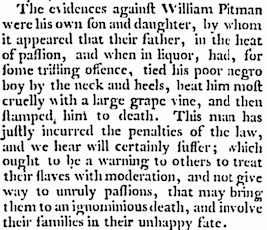
The Virginia Gazette, which published the sole surviving account of the incident, says that Pitman, “in liquor” and “in the heat of passion” lost his temper, “tied his poor negro boy by his neck and heels,” and beat him with a large grapevine before stomping him to death.

Pitman can hardly have been the first, or the last, slaveowner to slaughter his own “property” but it was usually impossible to get a conviction because blacks were not allowed to testify against whites in court. In this case, however, two white people — Pitman’s own son and daughter — sealed the case by giving evidence against their father.

The Gazette, writing on April 21, said Pitman had “justly incurred the penalties of the law” and said hopefully that the story might be “a warning to others to treat their slaves with moderation, and not give way to unruly passions, that my bring them to an ignominious death, and involve their families in their unhappy fate.”

* Pitman’s hanging “yesterday” is reported in the Saturday, May 13 issue of the Virginia Gazette — a different Virginia Gazette from the one quoted in this post, as it happens: three competing papers used this same branding; the report in this post’s body on the circumstances of Pitman’s conviction comes from Dixon and Hunter’s Gazette, while the May 13 item establishing the hanging date is from Alexander Purdie’s Gazette.

Purdie’s May 13 edition further adds that when the sheriff came to fetch him on the fatal day, “Pitman made some resistance, but was soon overpowered; he behaved with decency at the place of execution, and attributed his unhappy fate to the effect of intemperate drinking.”

On this day..

1900: James Nettles

From the St. Louis Republic, July 9, 1898

James Nettle has Partly Confessed.

Suspect in the Mann Murder Case Admits All but the Shooting.
Caused the Arrest of His Double in Order to Confuse the Several Witnesses.

James Nettle, the negro who is accused of the murder of Conductor Edward Mann of the Suburban Railway, on the night of July 4, after emphatically declaring his innocence and even going so far as to bring about the arrest of his “double,” Esbree Manley, a negro ventriloquist, as a suspect in the case, yesterday began to show signs of weakening, and at a late hour last night had confessed everything but the firing of the three shots which proved fatal to Mann.

The arrest of Manley on Nettle’s statement that he had overheard a conversation in the calaboose that a ventriloquist had a hand in the shooting, proved to be Nettle’s undoing. When confronted by Manley, Nettle was unable to carry out his well-laid plans. The striking similarity in the physique of the two negroes would have rendered it almost impossible to pick out the real culprit, but Manley met Nettle and the police with such a straight story of his whereabouts at the time of the tragedy that the former burst into tears and admitted after a little coaxing that he was in the street car fight in which Conductor Mann was slain.

He told his story between sobs, for he broke down completely under the strain. He declared that Mann had ordered him off the car and had returned his fare, in order to hasten his departure, when the fight started. He did not recall how they began fighting, but he said the conductor and motorman tackled him and forced him off the platform, threatening to do him violence.

Even after he had left the car, he said, the conductor followed him several steps. At this point the shooting was done, but all efforts to make the negro Nettle relate these further details have proven futile. In order to avoid the cross-fire of questions from Chief Desmond, the negro complained of being ill and had to be given medicine by the Dispensary physicians. Afterward he said he would not talk further on the murder until to-day.

The negro Manley was released last night after he had established an alibi.


From the St. Louis Republic, Dec. 16, 1898

Testimony Finished.

James Nettles’ Fate Will Be Decided To-Day.

To-day the fate of James Nettles, colored, charged with murder in the first degree, probably will be decided in Judge Tally’s court, after 10 hours’ argument by the attorneys for the State and the prosecution. At 11 a.m. yesterday the State rested and the defense was through at 6 p.m., having tried to establish an alibi.

Thomas L. Brown, the motorman of the car on which Conductor Samuel W. Mann was mortally wounded on the night of July 4 last, was the first witness for the State. He told how the negro boarded the St. Louis and Suburban car at Jefferson avenue, quarreled over car fare, and at Garrison avenue shot the conductor as he retreated from the car. He identified Nettles. Others testified that they were sure Nettles was the assassin.

For the defense, Michael White, a negro, with whom Nettles lived at No. 1321 Linden street, was the main witness. His testimony was that he and the defendant were together all day on July 4, and that Nettles was not at any time near the scene of the murder. He testified that they went to Kirkwood in the morning, returning to their home about 7 p.m., where there was an entertainment, at which both Nettles and White were present until 11:30 p.m. In corroboration of this testimony many witnesses were introduced.

In rebuttal, the State introduced Frederick Brunesman of No. 2641 East Prairie avenue, the motorman of the car which immediately preceded Conductor Mann’s car on the night of the killing. Brunesman identified Nettles as the negro who tried to board his car that night at Jefferson avenue, but was so drunk he fell off. Detective John Gallagher and Policeman Thomas Mahon told of an interview they had with Nettles on the day following his arrest. On that occasion, they testified, Nettles said he assaulted Conductor Mann because Mann rebuked him for misconduct.


From the St. Louis Republic, Dec. 17, 1898

Nettles Found Guilty

Jury Decides That the Negro Murderer Must Hang.

Had James Nettles, a negro, been informed that his dinner was ready, he could not have displayed less concern than when told the jury had found him guilty of murder in the first degree and that he must be hanged. Death seems to have no terrors for him and he smiled at his fate in the same indifferent manner with which he greeted the onslaught of the State’s witnesses. Never through the long trial has he ever manifested even a moderate interest in the proceedings. If he is guilty of the foul murder of Conductor Mann before his wife and children on July 4, he did not show it yesterday.

The cases on both sides were rested on Thursday evening and for four hours yesterday the attorneys for the State and the defense fought an oratorical battle before the jury. Finally, a few minutes before 2 o’clock, the case was given to the jury.

Then, for three hours the jurors debated the case, finally coming to a decision at 5 o’clock. Several of the jurors, it was learned, stood for a life sentence, but were converted to capital punishment on the ground that executive clemency might intervene to cut short the term.

The State had many witnesses who were on the car and identified Nettles as the assassin; while, on the other hand, the defense had nearly a score of negroes to establish an alibi. The State’s attorneys held that it was an alibi for the occasion and made efforts to break it down. One of the defense’s witnesses, who said he was with Nettles at a dance on the night of July 4, testified that there was a roaring fire in the parlor. Other similar statements served to weaken the alibi.

When the verdict had been rendered, Attorneys Van Patten and Morroll, for the defense, declared they would ask for a new trial, and in case it were refused, would appeal.


From the St. Louis Republic, April 5, 1900

Respite for Nettles

Governor Grants the Condemned Man Another Thirty Days

Governor Stephens last night granted a thirty day’s respite to James Nettles, the negro who has been condemned to be hanged for the murder of Conductor Samuel W. Mann on a St. Louis and Suburban car, near Leffingwell avenue, on the night of July 4, 1898. He was to have been hanged a month ago, but a reprieve of thirty days was granted in order to give the Governor time to examine into the merits of the appeals for clemency.

The death watch was placed on Nettles yesterday morning at 6 o’clock and has not yet been removed, as Sheriff Pohlmann has not received official notification of the respite. He expects a letter from the Governor to-day.

Nettles was not in the least perturbed yesterday. When the Reverend Mr. Hurzburger of the German Evangelical Church called at the jail last night with Sheriff Pohlmann and notified the condemned man that the Governor had granted a respite of thirty days, the negro, without any apparent emotion, thanked him for what he had done in the matter and reiterated his assertion of innocence.


From the St. Louis Republic, April 26, 1900

A QUESTION OF WHISKERS — Another attempt is being made to get Governor Stephens to commute the death sentence of James Nettles, the negro who was convicted of the murder of Conductor Sam W. Mann on the night of July 4, 1898. Governor Stephens has granted two stays of execution to allow himself time to investigate the application and petitions. At the trial some of the witnesses testified that Mann’s assailant wore side whiskers. Attorney Maurer had several barbers examine Nettles’s face, and he says that they will make affidavit that he could not raise side whiskers.


From the St. Louis Republic, May 6, 1900

To Be Hanged To-Morrow

Death Watch Placed on the Negro James nettles.

Chief Deputy Sheriff Pohlman yesterday for the third time placed the death watch on James Nettles, the negro who is under sentence of death for the murder of Conductor Samuel W. Mann. Nettles will be hanged at 6 o’clock to-morrow morning unless Governor Stephens stays the execution. Twice Nettles has been within the shadow of the gallows, with the death watch set, when each time the Governor granted reprieves that he might look further into the applications for clemency.

Nettles has all but lost hope. When Deputy Sheriffs Parcel and Hoefer escorted him from his cell on the second tier to cell No. 46 on the round floor, he said he guessed this was the last time. The cell to which he was transferred is the one occupied by all St Louis murderers during the last hours before their execution. Nettles was restless Friday night, alternately reading the Scriptures, praying and singing. When the deputies came in he seemed somewhat relieved. He walked between them up and down the exercise yard until 7 o’clock, when he went into his new cell, where he ate a hearty breakfast. At dinner and supper it was the same way; he seemed to take a last pleasure in ordering what he wanted to eat. He still protests his innocence.

He was convicted of the murder of Conductor Sam W. Mann on the night of July 4, 1898. Nettles got on Mann’s car at Jefferson and Franklin avenues. He refused to pay his fare and Mann ordered him from the car. A scuffle followed and Nettles fired a shot which struck Mann in the abdomen, causing his death a few hours afterwards. Mrs. Mann and two little daughters of the conductor were on the car at the time and witnessed the killing.


From the St. Louis Republic, May 8, 1900

James Nettles, the negro convicted of the murder of Conductor Samuel W. Mann of the Suburban Street railway, was hanged yesterday morning. The drop fell at 6:07 o’clock, and nineteen minutes afterwards the doctors pronounced him dead. Nettles met his death bravely and declared his innocence with almost his last breath.

The execution was conducted with precision and dispatch, but without unnecessary haste. About 250 spectators were present, but they were more orderly than those present at previous hangings.

Nettles was restless throughout the night preceding his execution, and did not sleep any. A number of friends called to bid him good-by early in the night. The Reverend Mr. Sachs, Nettles’s spiritual adviser, the Deputy Sheriffs on the “death watch,” and a few newspaper men remained with him throughout the night. At 3 o’clock in the morning the Century Quartet called at the jail and sang several favorite hymns.

Early in the morning Nettles retired to his cell with the Reverend Mr. Sachs, where they read the Scriptures and prayed until the arrival of Sheriff Pohlman.

At 6 o’clock Sheriff Pohlman read the death warrant to Nettles. The prisoner’s arms were then bound and he was led to the scaffold. Nettles did not falter, although he was a trifle nervous. After his legs and arms had been securely bound Sheriff Pohlman asked him if he had anything to say before he died. In a clear, resonant voice he said,

I am about to die for another man’s crime. The Lord knows I am innocent, and I go to meet him with a clear conscience. I love you and I hope to meet you above. I am innocent!

Then the black cap was pulled down over his head, the noose adjusted and Chief Deputy Sheriff Pohlman sprung the lever. Nettles’s body, after the drop, hung perfectly still. Nineteen minutes later the physicians pronounced him dead and his body was cut down and taken into the morgue. An examination revealed that his neck was broken.

Nettles shot and killed Conductor Mann on his car in Franklin avenue near Leffingwell avenue on the night of July 4, 1898. The negro got on the car and refused to pay his fare. While Mann was ejecting him he pulled a revolver and fired. Mrs. Mann and two little children were on the car and witnessed the murder.

On this day..