
On this date in 1997, Peruvian paramilitaries stormed the Japanese ambassador’s residence held hostage for 126 days by leftist rebels.
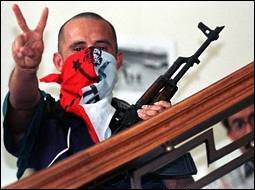
All 14 of the Tupac Amaru Revolutionary Movement (MRTA) were slain in the raid,* along with two of the commandos and one hostage. Officially, there were no “executions” at all.
Unofficially?
It’s pretty well-documented that some — perhaps most — of the terrorists were taken alive, and thereafter summarily executed. (pdf of Defense Intelligence Agency cable hosted by the National Security Archive)
However untoward the outcome and however unimpressive the foe, the operation was a master stroke for then-President Alberto Fujimori. Peru’s neoliberal taskmaster had introduced the world to the auto-golpe, the “self-coup”, a Cromwellian maneuver of shuttering parliament in order to rule as dictator, and he thereafter made ruthless suppression of Peru’s ruinous internal conflict the calling card of his presidency.
The DIA cable linked above claims Fujimori himself ordered the commandos to take no prisoners. He did not scruple to show himself in the middle of the bloodbath.
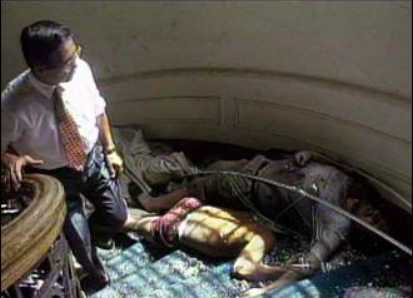
Alberto Fujimori made sure to get himself snapped standing over the bodies of the guerrillas, including MRTA leader Nestor Cerpa Cartolini.
El Presidente banked the political capital from having restored civic order, but it wasn’t the only capital he was banking. Three and a half years later, with a corruption scandal darkening his door, Fujimori absconded to Japan, faxed in his resignation, and became a fugitive.
Even there, he continued to justify his authoritarian governance.
Many Peruvians have always agreed with Fujimori’s self-assessment, even many who regret his well-publicized disregard for human rights.
But human rights researcher Michael Baney calls this day’s executions “pointless.”
“The MRTA was a spent force by the time of the embassy takeover,” said Baney. “The takeover was an act of total desperation, which is evidenced by the fact that the leader of the movement, Nestor Cerpa Cartolini, personally participated in it.”
After spending the best part of a decade in exile, Fujimori returned to the headlines by boldly returning to the hemisphere — to Chile, specifically, which arrested him and extradited him on a Peruvian warrant.
Just days ago as of this writing, Fujimori was convicted in his own former courts of authorizing death squads,** and sentenced to 25 years in prison. (Here’s some legal analysis.)
In the court of public opinion, it’s a different matter.
Fujimori’s daughter Keiko, a Peruvian congresswoman, figures to be a leading contender for the presidency in 2011, and has said she would pardon her father if given the opportunity.
“A majority of Peruvians think that Fujimori was guilty of serious human rights violations, but a majority also believe that he was a good president,” Baney observed. “And Fujimori really does believe that he single-handedly saved his country from economic and political collapse, and that Peru needs him around.”
* “Operation Chavin de Huantar”, profiled in several Spanish-language documentary videos available online. (Such as this one.)
** Not specifically related to this day’s MRTA killings, although these could be prosecuted in the future.
On this day..
- 1986: David Funchess, Vietnam War veteran
- 1939: Jose Aranguren, Civil Guard general
- Feast Day of Saint Leonides of Alexandria
- 1947: Garlon Mickles, the last hanged in Hawaii
- 1803: Cato, slave of Elijah Mount
- 1815: George Lyon, career thief and possible poltergeist
- 1831: Charles Gibbs, the pirate
- MMI: Two thousand and one days, a dystopia
- 1705: The Camisards Catinat and Ravanel
- 1945: Wilhelm Cauer, but not Helmuth Weidling
- 1930: William Henry Podmore, inculpated
- 1846: The last civil executions in Portugal
- 1980: Thirteen deposed Americo-Liberian officials
 Gonzalo Pizarro (