1898: The Six Gentlemen of the Hundred Days’ Reform

This afternoon in 1898, six liberals got the chop for their hopeless attempt to give a tottering empire the reforms it desperately needed.

The Hundred Days’ Reform — actually 103 days, from June 11 to September 21 — marked the attempt by China’s Guangxu Emperor to implement a far-reaching modernization programme backed by forward-thinking officials with a mind to correct China’s supine position vis-a-vis the West, and even vis-a-vis its neighbors.

“Reform has never come about in any country without the flow of blood. No one in China in modern times has sacrificed himself for the cause of reform, and because of this China is still a poor and backward country. Therefore, I request that the sacrifices begin with myself.” –Tan Sitong

The Wuxu Constitutional Reform still stands as the great attempt made by Chinese progressives who tried to follow the example of the modern powers in order to save China from extinction. Represented by Kang Youwei and Liang Qichao, the bourgeois reformists were imbued with the spirit of national salvation; they carefully set about designing a blueprint for a constitutional monarchy based on the example of Western countries. They advocated the establishment of parliament and a national conference, and wanted to see honest and fair-minded people with the courage to criticize authority installed in a position of power. National policies should be discussed by the monarch and the people. They also wanted a constitution to stipulate the rights and obligations of the monarch, officials, and the people. The constitution was to be the highest code for all people in the country. They also wanted to establish a system featuring a tripartite balance of forces: parliament was to legislate, the magistracy to deal with issues of justice, the government with administration. All of these would be under the monarch.

The constitutional reform was to take place with radical intellectuals submitting their memoranda to Emperor Guang Xu, who alone had the power to promulgate them. The feudal diehards being in a position of strength and the national bourgeoisie being weak, however, the new politics survived no more than 100 days or so. When the forces of reaction inevitably clamped down on the movement, the six reformists who had inspired the movement for constitutional reform met their deaths like heroes.

Although sincere in its aspirations, the reform movement was bound to fail, as it depended on a reform “from top to bottom”, which ultimately had to be enacted by the emperor. The Hundred Days’ Constitutional Reform, however, remains a landmark event in the modern history of China, its failure notwithstanding. The Chinese bourgeoisie in fact succeeded in spreading democratic and constitutionalist ideas widely, and this had a significant effect on future generations. The political and legal theory of the Western bourgeoisie could now take root in the soil of China.*

The emperor’s Machiavellian conservative aunt, the Empress Dowager Cixi, who had been the power behind the Chinese throne since 1861, made the sure reform didn’t see two hundred days with a “coup” that didn’t formally overthrow the Emperor — just made him irrelevant.

Troublemakers further down the food chain didn’t get off so easily.

Kang Youwei, the reform movement’s chief exponent, escaped to Japan. Six others suffered the wrath of the Dowager Empress: Kang Guangren (Kang Youwei’s brother), Lin Xu, Yang Shenxiu, Yang Rui and Liu Guangdi … along with the young reformer Tan Sitong, who notably refused imprecations to flee arrest.

The sword’s blade across my neck,
I look toward heaven — laughing.
-Etched on a prison wall, allegedly by Tan Sitong
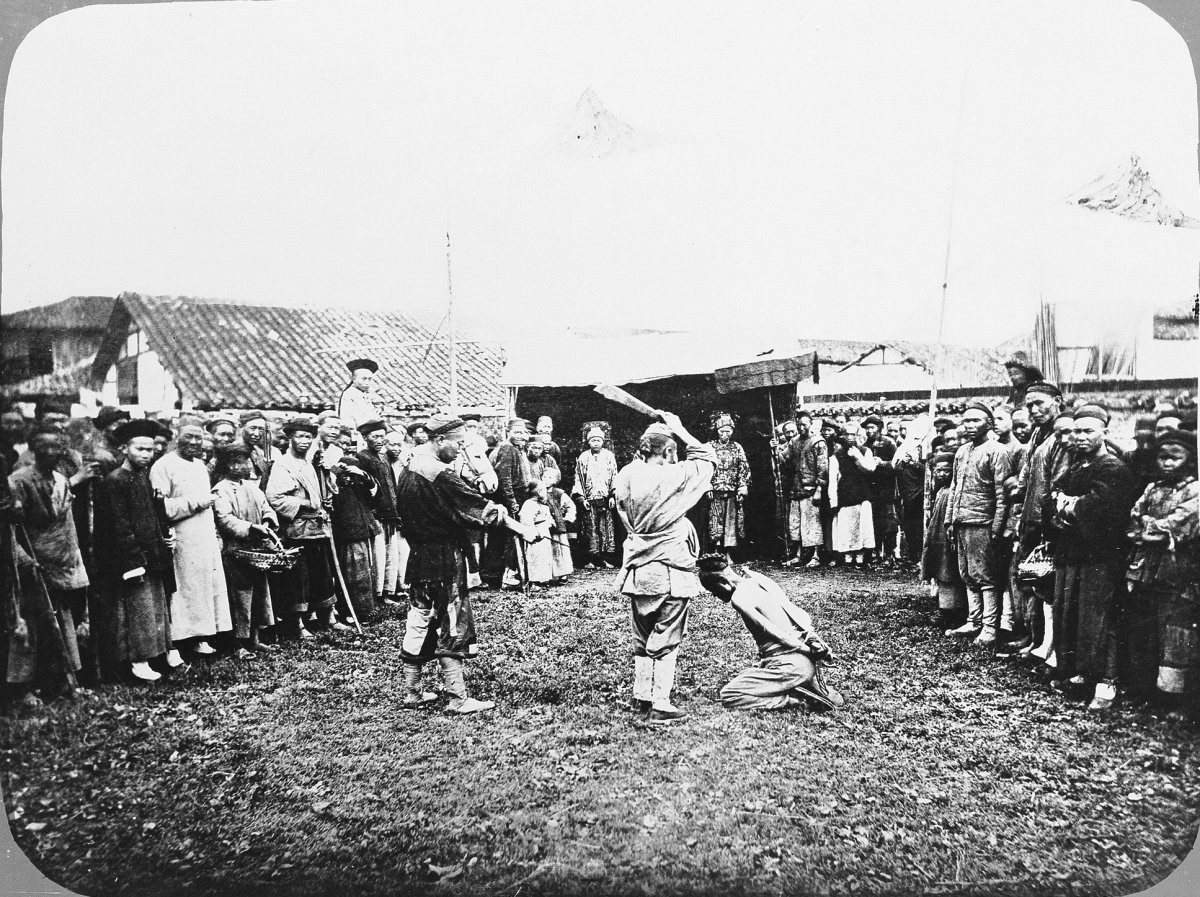

Photo of an unspecified 1867 Qing beheading in Canton.

* “The Chinese Legal Tradition and the European View of the Rule of Law” by Wu Shu-Chen in The Rule of Law History, Theory and Criticism, Part VI.

On this day..

1402: False Olaf

On this date in 1402, a Prussian commoner was put to death on the road between Falsterbo and Skanor in Sweden for masquerading as the long-dead King Olaf IV.

The real Oluf IV Haakonsson — or Olav, or Olaf — had inherited the crowns of Denmark and Norway and a claim to that of Sweden’s but died at the age of 17 in 1387. His mother, Margaret I (or Margrethe I), the real power behind the teenager, ruled outright upon her son’s death.

She proved an able hand and far-sighted ruler, cautiously welding Denmark, Sweden and Norway into the Kalmar Union that would hold until the 16th century. They called her “the Semiramis of the North,” centuries before Catherine the Great nicked the nickname.

But her son’s youthful demise had set persistent rumors abroad — that he was poisoned, for instance, and more to the point for our purposes, that he wasn’t dead at all.

So when his spitting image was recognized, and hailed as the prince of the realm … well, back in the day, equally audacious identity theft was attempted for much smaller stakes than a throne.

Anyway, “Olaf” got some robes befitting Olaf’s station and banged out some letters to Margaret demanding his kingdom back, and Margaret said, come on down.

That goes to show how far looks will take you in life.

Unfortunately for Olaf, his regal jawline wasn’t capable of enunciating Danish speech … so the jig was up as soon as he got to Margaret. One hopes he got a good ride out of his brief masquerade, because he was burned to ashes — possibly after being broken on the wheel — along with those presumptuous letters.

The date of False Olaf’s death comes from Horace Marryat’s 19th century Scandinavian travelogues, One Year in Sweden; including a visit to the isle of Gotland and A Residence in Jutland, the Danish Isles, and Copenhagen (both free reads at Google Books). In both volumes, Marryat identifies the date as the morning before Michaelmas.

The traditional last day of the harvest season celebrated on September 29, Michaelmas was once a four-star holiday on the medieval calendar.

There’s a fair amount of commentary online saying that an “Old Michaelmas” used to be celebrated on October 10 or 11. But that looks to this writer like an interesting inversion stemming ultimately from the celebration’s fall into obscurity as the entity once known as Christendom has become more secular and less agrarian — although it’s admittedly nothing to do with the fate of False Olaf, or Semiramis for that matter.

In 1752, when England finally switched to the Gregorian Calendar, the switch took place in early September.*

For logistical pragmatism (the harvest wasn’t going to come in 11 days earlier just because the calendar changed), the then-imminent Michaelmas got pushed back 11 days to October 10. October 10 then became known as “Old Michaelmas,” no longer Michaelmas by the church calendar but the 365-day interval from when it used to be celebrated, and more importantly, the real end of the harvest season.**

In the next century, the difference between Julian and Gregorian calendars would have advanced to 12 days, placing Old Michaelmas on the 11th; by this present day, it’d be 13 days in principle, but the original meaning of the holiday and the host of cultural traditions associated with it have fallen away … so “Old Michaelmas” is a footnote still pinned to October 10th or 11th, and moderns rediscovering it suppose from the name that it’s the former date of the feast.

* People inclined to think of their death dates as foreordained in heaven’s celestial notebook protested the switch: “give us back our 11 days!” This reform, incidentally, also moved the official beginning of the New Year to January 1 from Michaelmas’ springtime “Quarter Day” counterpart, March 25; winter dates from years prior are often written with both years, e.g. 1738/9. “Old Lady Day“, April 6, is still the beginning of the fiscal year in England, and Thomas Hardy uses its traditional contractual character in Tess of the D’Urbervilles (Aside: Tess’s hanged real-life inspiration) when the title character takes a farm job running through that date:

Tess was so wrapt up in this fanciful dream that she seemed not to know how the season was advancing; that the days had lengthened, that Lady-Day was at hand, and would soon be followed by Old Lady-Day, the end of her term …

At length it was the eve of Old Lady-Day, and the agricultural world was in a fever of mobility such as only occurs at that particular date of the year. It is a day of fulfilment; agreements for outdoor service during the ensuing year, entered into at Candlemas, are to be now carried out. The labourers — or “work-folk”, as they used to call themselves immemorially till the other word was introduced from without — who wish to remain no longer in old places are removing to the new farms.

… With the younger families it was a pleasant excitement which might possibly be an advantage. The Egypt of one family was the Land of Promise to the family who saw it from a distance, till by residence there it became it turn their Egypt also; and so they changed and changed.

** Residents of the former Soviet Republics who switched to the Gregorian calendar in the 20th century still celebrate both the familiar January 1 New Year’s and “Old New Year’s” 13 days later, and the same trick with the (lesser, there) holiday of Christmas too … packing four party occasions into a three-week span.

Part of the Themed Set: Semiramis.

On this day..