1916: Mary the Elephant

On this date in 1916 — true story — this happened.
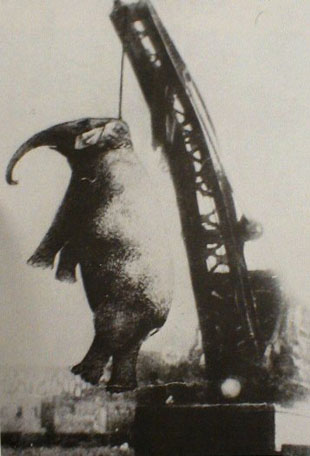
The circus elephant Mary hanged Sep. 13, 1913 in Erwin, Tennessee

Five-ton circus elephant Mary (yes, she has her own Wikipedia page) was in Kingsport, Tennessee on the chintzy fairgrounds touring circuit with Sparks World Famous Circus.

Billed as as “The Largest Living Land Animal on Earth,”* this exotic creature was a prime draw for the circus — and also a beloved pet of the Sparks family.

Unfortunately, this valuable asset was placed in the temporary stewardship of an inexperienced “under keeper” whom the circus had had to scoop up at a recent stop to cover staff turnover. Between shows on September 12, that fellow somehow (accounts conflict) enraged Mary, and (again according to one version among several) she

“collided its trunk vice-like [sic] about [the under keeper’s] body, lifted him 10 feet in the air, then dashed him with fury to the ground … and with the full force of her biestly [sic] fury is said to have sunk her giant tusks entirely through his body. The animal then trampled the dying form of Eldridge as if seeking a murderous triumph, then with a sudden … swing of her massive foot hurled his body into the crowd.”

It’s apparent in this report that the facts of an already-sensational event almost instantly began disappearing into its spectacle. See the largest land animal on earth! See it maul its handler to death! But what happened next lifted Mary all the way to legend.

The owners knew they had to euthanize the “mankiller,” or if they didn’t know they were soon persuaded by mushrooming press attention and towns threatening to ban the Sparks circus.

But how? They couldn’t shoot Mary to death — she apparently survived gunshots from the vengeful crowd in the immediate aftermath of the trampling; firearms just didn’t pack the wallop to put down a pachyderm in 1916. The area didn’t have the sort of electrical juice available that Thomas Edison had once used to drop a circus elephant during his weird campaign for the electric chair.

The choice for the baleful logistical task of killing a 10,000-pound evildoer was hanging, selected over “crushing it between railroad cars.”

And for stringing up “Murderous Mary”, you need no ordinary gallows. No, for this job, you’re using the hoist on a train derrick and an industrial-strength chain for a noose.
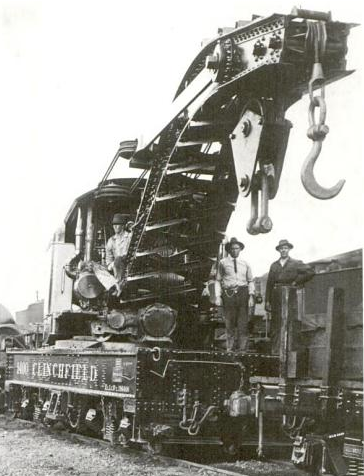

The actual train derrick that hanged Mary the elephant. The leftmost man, seated on the machine, is the “executioner” who worked the controls, according toThe Day They Hung the Elephant.

The railroad was game for the operation, provided the circus would come to it. So on this date, the circus train cars loaded up for the nearest usable train derrickscaffold at Erwin, Tennessee.

There, a procession of all five Sparks elephants — the routine was supposed to keep Mary compliant, and it did the trick even though some observers later remembered the condemned creature behaving unusually skittishly — marched to the railyard.

There Mary was noosed with a 7/8″ chain and hoisted up. The chain broke, and the animal shattered its hip crashing to the ground; another, still larger, chain, did the trick on the second try.

Talk about a spectacle. Talk about scary clowns.

There’s something about this event abidingly piteous, even shameful. It may be for that reason that it’s also abidingly mysterious. The particulars about what happened on the day they hanged the elephant and what became of the body (a steamshovel dug a grave, but the exact location was never marked and there’s a wild story that it was dug up later for ivory) are the topics of conflicting, nth-hand rumors. Some in Erwin don’t to this day want to discuss the matter. Others, just the opposite.


Image (c) John Pugh of SourceToSea.net and used with permission.

* Sparks evidently kept the “largest living land animal” marquee in use for Mary’s successor, as indicated by this 1919 poster (pdf) for the show.

Part of the Themed Set: Americana.

On this day..

1862: An unknown Confederate deserter

From a letter written by one Private Thomas Warrick of Alabama, cited in The Life of Johnny Reb: The Common Soldier of the Confederacy by Bell Irvin Wiley:

I saw a site today that made me feel mity Bad I saw a man shot for deserting there was twenty fore Guns shot at him thay shot him all to pease … he went home and thay Brote him Back and then he went home again and so they shot him for that Martha it was one site that I did hate to see it But I could not helpe my self I had to do Jest as thay sed for me to doo.

This unknown soldier shot “all to pease” had just run afoul of Gen. Braxton Bragg‘s draconian anti-desertion policy meant to crack down on soldiers going AWOL for casual leave, often to help the families they had left behind keep up the farm.

As Wiley points out, our letter-writer Private Warrick was himself planning to do just that.

Bragg’s little salutary bloodbath evidently had its effect, because he didn’t go AWOL. Wiley quotes Warrick, now in a more Joe Friday mode than when he had promised to “come home Eny how”, writing his parents in 1864,

I would be glad to see you all now but I recon that I have bin home my last time till this war closes.

On this day..

1864: Two Dodds, as two spies, in two states, and twice botched

On January 8, 1864, young David Owen Dodd was hanged in Little Rock for spying on federal troops … and cavalryman Ephraim Dodd (no known relation) suffered the same fate for the same crime in Knoxville.

Just one of those strange coincidences.

Ephraim Dodd

Ephraim Shelby Dodd is the subject of an outstanding HistoryNet profile whose contents this blog can not so much improve upon as summarize.

A member of Terry’s Texas Rangers (“men who ride like Arabs and fight like devils”) Dodd was captured in December 1863 and convicted by his diary — a particularly harsh reading of his diary in which a reference to having passed himself off as a Yankee was interpreted as evidence of espionage. (The diary is available online and as part of a book on Terry’s Rangers.)

Knoxville worthies rallied to save him and Ephraim Dodd insisted upon his innocence, but not so vociferously that he displayed any terror of his fate.

Do not grieve for me, my dear parents, for I am leaving a world full of crime and sin for one of perfect bliss.

The hanging itself wasn’t bliss, exactly, despite a well-planned soundtrack.

From the “Death March” the music gradually slid into “Mary’s Dream,” and then we were carried back by the magic of the plaintive notes to juvenile days; to visions of “Sandy far at Sea,” and to the sad cadence of that fading refrain,

“When, soft and low, a voice she heard
Saying, Mary, weep no more for me.”

The solemn march, the wailing notes of the fife, and perhaps above all the calm, unmoved, manly bearing of the prisoner — so we thought — produced a mournful impression upon the spectators.

Points earned on artistic merit, however, were deducted for technique.

At a signal the bolt was now withdrawn, the culprit fell, but the cotton rope broke by the sudden tension, and the man lay stretched and stunned upon the frozen ground below. A mummer of horror, mingled with expressions of pity, ran through the assembled crowd. Recovering for an instant from the shock — for his neck was not broken — he said — perhaps incoherently: “Release me quick, if you please.” For some ten minutes the unfortunate man lay thus upon his back, without moving a muscle. Meantime the officers and men, whose painful duty it was to see to the execution of the law, adjusted this time two parts of the same rope instead of one, and the half-conscious man was borne up the fatal steps a second time, being partly supported upon the drop until the double noose had been adjusted. Not a word or sign of suffering all this time escaped his lips. In another moment the drop fell, and prisoner’s form now hung by the neck — the knot behind the head. Death finally ensued by strangulation. In ten minutes, Dr. Cogswell, the officiating surgeon, pronounced life extinct, and the body was taken down and buried.

David Owen Dodd

A few hours later and 500 miles down the way, the entirely unrelated hanging of David Owen Dodd proceeded in Little Rock, Ark.

David Dodd’s final resting place at Mount Holly cemetery. Image courtesy of Richard Theilig.

Only 17 at his hanging and not physically robust enough to get his brains blown out at Gettysburg, Dodd was sent by his father on a business trip across Union lines — everything legit, and carrying a pass — but got busted with morse code notations of Union troop strength in the city.

Unlike Ephraim, who was basically a normal soldier thrust into incriminating-looking circumstances by the chance of war, young David Dodd was rightly accused.

He didn’t bother protesting his innocence, but he also kept mum about his contacts. (Suggestively, a teenage girl and her father were whisked out of town and kept under guard in Vermont for the rest of the war.) That proud silence has won him quite a reputation in Arkansas as the Boy Hero of the Confederacy.

But similarities between the condemned men extended beyond their names. David’s parting filial reassurance could pass for a paraphrase of Ephraim’s.

[D]o not weep for me for I will be better off in heaven. I will soon be out of this world of sorrow and trouble.

And the hanging itself, conducted in a tense atmosphere, was likewise a botched job. In this case, the slight young man didn’t fall hard enough to break his neck, but did fall far enough to get his tiptoes on the ground, initiating an agonizingly protracted strangulation which the soldiers on detail expedited by (accounts differ) pulling on David Dodd’s legs and/or pulling up on the rope.

On this day..

1862: Asa Lewis, Confederate deserter

On this date in 1862, a 19-year-old Confederate infantryman became the tragic victim at Murfreesboro, Tenn., of his army’s need to shore up military discipline.

Kentuckian Asa Lewis was shot for desertion, for having returned home after his enlistment expired in order to help his family plant the season’s crops.

“French leave”,* it’s sometimes called — an illicit but temporary and often unpunished absence from the unit.

According to Mark Weitz’s More Damning Than Slaughter: Desertion in the Confederate Army, it was a pervasive phenomenon — as were more permanent desertions which menaced the small Confederate army, fighting amid the soldiers’ own farms, whose languishing from the conscription of able-bodied men presented a constant temptation to depart.**

[The South’s] white population combined with its preferred form of agriculture to create a potential pool of men who could hardly be called disposable … To find the Southern soldier one must go down the food chain into that vast sea of men referred to as yeomen and poor whites. These men and their sons would form the backbone of the Southern army, an army of farmers, men whose lives were as governed by the seasons as the lives of their fathers and grandfathers before them. These men could not be spared in the same way as their Northern counterparts without affecting the quality of their families’ lives — and often those families’ very survival.

Under less urgent circumstances, Lewis would be the poster child for the guy who would sort of deserve to slide for the odd spell of French leave.

He’d fought with distinction, earning decorations and promotions, and his mother and sisters were reportedly starving without his help. He was only being kept in the army after his term of engagement by the 19th-century equivalent of a stop-loss policy.

But Lewis had the bad fortune to go AWOL — it seems he did intend to return — right when the urgency of the army-wide desertion situation was becoming apparent to Confederate brass … and while serving under the general who Weitz says took it most seriously.

Gen. Braxton Bragg had issued an amnesty earlier that fall to clear the decks, and then declared pitiless treatment of desertion going forward.

Bragg understood something that his superiors, peers, and colleagues did not: the Confederacy had an army of farmers … Bragg knew that these men were fighting at home, that they would [sic] were being drawn back there, and that he had to take immediate steps to close off the avenues of departure.

Bragg tightened the screws on soldiers who straggled on the march (a common strategy to slink away), on grunts seeking medical furloughs (already establishing themselves as a halfway house towards a discharge), and on Confederate prisoners obtained by exchange for Union POWs (who were no longer paroled back home, but kept with the army).

Asa Lewis was hardly the only man shot under the policy. But construing mere French leave as capitally punishable “desertion” gave the general a chance to put the fear of a Confederate firing squad into other potential stragglers and malingerers — and the Kentuckian campaign to obtain clemency for the poor kid probably only helped Bragg’s purpose.

The next day’s Rebel Banner (cited in this free Google books offering) ran this item:

[A]midst a drenching rain-storm, Asa Lewis, member of Captain Page’s company, Sixth Kentucky regiment, was shot by a file of men. He was executed upon a charge of desertion, which was fully proven against him. The scene was one of great impressiveness and solemnity. The several regiments of Hanson’s brigade were drawn up in a hollow square, while Generals Breckinridge and Hanson, with their staffs, were present to witness the execution. The prisoner was conveyed from jail to the brigade drill-ground on an open wagon, under the escort of a file of ten men, commanded by Major Morse and Lieut. George B. Brumley. Lewis’s hands were tied behind him, a few words were said to him by Generals Brekinridge and Hanson, and word fire was given, and all was over. The unfortunate man conducted himself with great coolness and composure. He was said to have been a brave soldier, and distinguished himself at the battle of Shiloh.

Official journos may have been approving — Weitz says a contemporary newspaper report approvingly claimed that “when Bragg saw his army melting away from desertion he began shooting every man convicted by a court-martial, and that as a result his army had become ‘well disciplined'” — but less charitable interpretations of Bragg would hew more to the line that the man was simply being a petty, vindictive tyrant.

The aforementioned execution witness Breckinridge, for instance, was a Kentuckian himself and hated Bragg’s guts. (A week later, Bragg would waste 10,000 Confederate lives at the Battle of Stones River, and the rift became irreparable.)

* The French call it “English leave”.

** Other able-bodied farm laborers in the South, of course, were better inclined to back the Union.

On this day..

1865: Champ Ferguson, Confederate guerrilla

On this date in 1865, Champ Ferguson was controversially hanged at Nashville for the “murders” he committed as a Confederate guerrilla.

There seems to be some slight difference of opinion (and do click that link) over Champ‘s role in the War Between the States.

Had the Confederate cause prevailed, he probably would have been a hero. Since history is written by the winners … here he is instead.

For reasons that lie in the uncertain junction between personal enmity and sectional loyalty, the war’s start saw Ferguson terrorizing Union supporters in the Kentucky-Tennessee borderlands, operating primarily around Sparta, Tenn.

These were not only state borders, but borders between the rival federal and Confederate territories. Civil War borders, obviously, were hazy and violently contested affairs: Kentucky was northern-controlled but claimed by both sides (it had rival governments); Tennessee seceded only after Fort Sumter.

Loyalties within Kentucky and Tennessee were divided as well. Ferguson’s own brother died fighting for the Union, and his cousin was killed by Ferguson’s own men. But the main battles were fought far away, leaving the conflict to play out locally.

In many cases … guerrillas identifying with the Confederacy operated well outside Confederate lines and Confederate control, leading to a certain ambiguity in official attitudes, since they did have their uses.

Guerrilla activity was … a feature of those up-country or back-country areas of states like North Carolina, Georgia, Alabama, Tennessee and Kentucky, in which there were significant internal divisions in terms of sympathy for Confederacy or Union … guerrilla conflict was the only direct face of war experienced by many in Tennessee and Kentucky, since the movements of the main armies remained distant from them throughout. Unionist guerrillas, for example, controlled many of the counties of eastern Tennessee, while Confederate guerrillas disputed Union control of western Kentucky and middle Tennessee. One of the ironies of the situation in the Appalachians, the Cumberlands and the Ozarks was that, while these areas of rugged terrain were favoured by Confederate guerrillas, they were also the very areas within the Confederacy which most Union sympathisers inhabited

-Ian Beckett, Modern Insurgencies and Counter-Insurgencies

That was Ferguson — a “legendary Confederate partisan and guerrilla” or little better than a bandit, depending on your point of view. Either way, he was feared by area Unionists and renowned for killing prisoners. Stories of his savagery — severing heads and the like — made the rounds. Ferguson would argue (and did) that he did nothing his enemies weren’t also doing. (The New York Times printed a lengthy account (.pdf) of Ferguson’s versions of the many killings he was accused of — disputing some, frankly acknowledging many.)

That brings us back to winners and losers.

Ferguson, of course, got the losers’ treatment after the war; while vendettas against rank and file Confederate officers were not on the agenda, Ferguson’s irregular status and unbecoming reputation set him up for a war crimes trial. All attempts to claim wartime protections were rejected.

The Times account of his hanging this day — witnessed by his wife and 16-year-old daughter; their alleged rape is sometimes given as the reason for Ferguson’s campaign — is picturesque. (.pdf)

He stood composedly on the drop some twenty minutes, while the charges, specifications and sentence were read by Col. Shafter. He nodded recognition to several persons in the crowd, and shifted his position in an impatient manner while the sentence was being read. To some specifications he inclined his head in assent. To others he shook his head. That about Elam Huddleston caused him to say, “I can tell it better than that.” When the speaker read, “To all of which the prisoner pleads not guilty,” he said, “I don’t now.”


An 1865 Harper’s illustration of the hanging. See the way the troops surround the scaffold? There’s a bit of folklore that the military did that in order to fake the hanging and cut him down still alive.

Along with Henry Wirz, commandant of the notorious Confederate prison Andersonville, Ferguson was the only Confederate executed for Civil War “war crimes.”

Arguably somewhat neglected as a Civil War figure, Ferguson still has a few books detailing his life. An interview with the a author of the newly-published Cumberland Blood: Champ Ferguson’s Civil War is here.

A few books about Champ Ferguson

On this day..