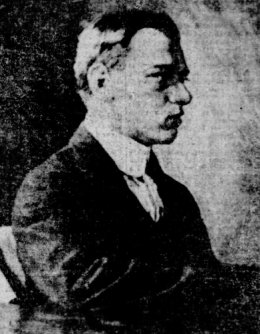
1912: Thomas Jennings, fingerprinted

One hundred years ago today, Thomas Jennings was ushered the scaffold … while Thomas Jennings’s fingerprints ushered in a new age of policework (pdf).

Hegemonic authority had been on a long march towards a forensic regime that could affix an oft-ephemeral identity to the profoundly corporeal body.

In the late 19th and early 20th century, investigative techniques and jurisprudence marched double time to keep pace with new techniques — from photography to the unwieldy system of Bertillonage.

A variety of American institutions — the U.S. Army, a number of prison systems — had begun systematically cataloging their respective inmates’ fingerprints in the preceding years, but it was in the Jennings case that the system really earned its whorls. It was the first U.S. murder case pinned on fingerprint evidence.
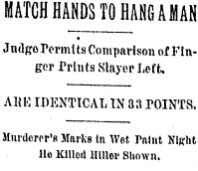
In September 1910, a Chicago homeowner in the present-day Beverly neighborhood surprised an intruder, and was shot dead. (pdf) In the course of the fight or the flight, the prowler splooshed his left hand into some wet paint on a railing.

Thomas Jennings, a paroled burglar, was arrested near the scene, and his fingerprints shown to match those left in the grieving Hiller household. A prosecution expert even gave a courtroom demonstration of dusting for prints.

This was as novel to judges as to jurymen, and given the dearth of other positive evidence against Jennings, the Illinois Supreme Court was called upon to deliberate upon the humble dactylogram. In the summer of 20111911, it stopped Jennings’ hanging just hours before it was to take place.

But its final word in December 20111911 only fitted the homebreaker’s noose.

We are disposed to hold from the evidence of the four witnesses who testified, and from the writings we have referred to on this subject, that there is a scientific basis for the system of fingerprint identification, and that the courts cannot refuse to take judicial cognizance of it …

Such evidence may or may not be of independent strength, but it is admissible, with other proof, as tending to make out a case. If inferences as to the identity of persons based on voice, the appearance or age are admissible, Why does not this record justify the admission of this fingerprint testimony under common law rules of evidence.

Courtrooms all around the world soon agreed, and within a generation the awesome investigative power of the fingerprint had fugitives going so far as to slice or burn off those incriminating little pads of flesh — the crime scene gold standard until the advent of DNA testing.

Jennings was hanged this date in a state-record five-man batch (the others, Ewald and Frank Shiblawski, Philip Sommerling, and Thomas Schultz, had all committed an unrelated murder together).

On this day..

1912: Albert Wolter, white slaver

A century ago today, 20-year-old Albert Walter strolled the 15 feet from the death cell to the Sing Sing electric chair, calling out “Good-bye boys” to his fellow-prisoners as he died for the murder of 15-year-old Ruth Wheeler in a possible white slavery crime two years earlier.

Wolter left a note steadily — all the reports remark on the youth’s sangfroid; he took a nap while the jury went to deliberate with his life in its hands — avowing his innocence, and indulging the “hope there may come a time when the conscience of the perpetrator will overpower him, and he will come to the front and acknowledge his guilt.” He charitably added for “those who have maliciously prosecuted and killed me, for them I pray God’s forgiveness.”

Lots of New Yorkers would have had to ask it.

Despite his cool under fire, Wolter was overwhelmingly acclaimed the guilty party, the evidence against him being as close to airtight as circumstantial gets.

Newsmen ravenous for virginals despoiled by outlanders instantly sunk fangs into the story of the layabout 18-year-old German immigrant — idle lifestyle the product of parasitism upon the drudgery of a young countrywoman toiling 12-hour days at a bakery — who lured the “saintly” stenographers’ school graduate to his apartment with the promise of work and had her charred and headless trunk bundled up on the fire escape by morning. (Other charred remains, and Wheeler’s monogrammed signet ring, were retrieved from inside the apartment.)

Reporters soon sketched the persona of a burgeoning little pimp who had already routed several girls into prostitution. In amid the decadence and displacement of fin de siecle industrialization, you couldn’t ping a more heart-racing (pdf) moral panic than white slavery.*


Sale in a Roman Slave Market, by Jean-Leon Gerome (1883).

Congress was at that very moment in the process of legislating the (still-extant) Mann Act named for the Illinois legislator who sponsored it after a notorious 1909 Chicago case.

But the Big Apple, as the country’s largest city and its gateway for Europe’s polyglot huddled masses, was the reputed center of the whole reputed business.

This illustration from Fighting the Traffic in Young Girls is outstandingly captioned:

“THE FIRST STEP. Ice cream parlors of the city and fruit stores combined, largely run by foreigners, are the places where scores of girls have taken their first step downward. Does her mother know the character of the place and the man she is with?”

The men and the women who engage in this traffic are more unspeakably low and vile than any other class of criminals. The burglar and holdup man are high-minded gentlemen by comparison. There is no more depraved class of people in the world than those human vultures who fatten on the shame of innocent young girls. Many of these white slave traders are recruited from the scum of the criminal classes of Europe.

And in this lies the revolting side of the situation. On the one hand the victims, pure, innocent, unsuspecting, trusting young girls — not a few of them mere children. On the other hand, the white slave trader, low, vile, depraved and cunning, — organically a criminal.

-Chicago U.S. District Attorney Edwin Bell, prefacing the bodice-ripping 1910 Fighting the Traffic in Young Girls**

While the Empire State enacted its own Wolter-inspired law charging schools with vetting the employers who recruit their graduates, Wolter entered the criminal justice system on greased lightning (just like he left it). He was a condemned murderer within five weeks of Ruth Wheeler’s death.†

Wolter himself (evidently surprised to learn that he was old enough for the death penalty; that may not have been the case where he was from) tried to put the blame on a phantom Teuton, one “Frederick Ahner” who was the mastermind in Wolter’s own fall and who must have done the Wheeler business while Wolter was out at the park. That’s “the perpetrator” to whom Wolter’s last letter refers: his conscience never led Ahner to so much as materialize, much less to confess.

The fate of Wolter’s bakery-girl cohabitant — and, one might think, prospective accessory — Katchen “Katie” Mueller was very different. She precipitously aligned herself with her lover’s prosecutors, urged “My dear Al” to confess (almost successfully), and got respectable patronage “to break away from the life she had been leading”. A year after Wolter’s electrocution, Mueller’s redemptive next marriage made the society pages.

* Wolter may have been (pdf; see p. 61 footnote) a specific inspiration of the 1919 Theodore Dreiser play “The Hand of the Potter”, which is all about the era’s white slavery panic.

** Similar dubious (pdf) vice-crusader porn is to be had in (among many other period pieces) a 1911 tract by another Chicago prosecutor, Clifford Roe. Though The Great War on White Slavery is in the public domain, I haven’t been able to locate a complete text online — only this excerpt.

† On the other hand, the then-protracted period of 22 months required to proceed from conviction to execution made Wolter “dean of the death house” by the time he died.

On this day..

1912: Bertram Spencer

On this date in 1912, a prolific Springfield thief died in the electric chair.


No, not Snake.

This fellow was Bertram G. Spencer, whose Boston Brahmin name belied a deceptively modest station.

A brakeman by day, Spencer lived a double life as Massacusetts’ boldest burglar in the evenings, when he would raid homes around Springfield at times when he was likely to be caught. (Hey, he did have a day job.) He frequently was intercepted, but for two years nobody ever got the drop on him and the numerous conversations he had with his victims were not enough to crack the case.

This villain comes up short of positively Moriartyesque by virtue of his amateurish chops in acquisition; one of the mystery burglar’s noted characteristics was the frequency with which he passed over the most valuable booty in the house in favor of some inconsequential bauble.

With his penchant for brandishing a weapon at the folks he bumped into, it was only a matter of time before somebody died for one of those inconsequential baubles. On March 31, 1910, schoolteacher Martha A. Blackstone became that somebody when in a panicking reaction to Spencer’s home invasion she failed to pipe down and let him rob — and he shot her dead.

Forensics then languishing in a primitive state, Spencer kept getting away with his larcenous (and then murderous) spree with little more than the expedient of wearing a kerchief and hat to hide his face. How were they ever going to find the guy — unless he did something ridiculous like drop a monogrammed locket on the scene?

Wait. No way. You cannot be serious.


Period
postcard shows images connected to the Spencer crimes centered around the “B.G.S.” locket he dropped at one site, leading to his detection. Just to really make sure he hung himself, the locket contained pictures of his mother and sister.

Upon arrest, police tossed his home and discovered (quoth the New York Times) “black masks, slouch hats,” and “a big revolver, fully loaded” under his pillow. No word on whether he was twirling his mustache, too.

Where the relieved well-to-do of Springfield perhaps saw only a somewhat preposterous villain — inspired, according to the Springfield Republican, by “a daredevil bravado, a love of the spectacular and a lack of pecuniary calculation which strongly suggested either the monomania of an unbalanced mind or a romantic vanity fed on by penny dreadfuls” — other practitioners in the emerging field of psychiatry saw a systemic breakdown.

Indeed, Spencer became the topic of an open tug-of-war over handling defendants with putative mental disorders in the criminal justice system. The district attorney at the time had Spencer committed without trial, and his doing so — rather than contesting Spencer’s sanity in court — contributed to his loss at the polls in 1910. (The new guy, in his remarks on the case, reclassified Spencer from “insane” to the more prosecutable “moral imbecile.”)

If the public was certain enough about Bertram Spencer’s sanity to elect a guy just to try him, it will come as no surprise that the testimony about Spencer’s abusive childhood and manic-depression cut no ice with a jury of his peers.

While our burglar went to his juridical death (last words: “good night”), a Massachusetts psychologist named Lloyd Vernon Briggs took up the man (alongside more luminous criminals like presidential assassin Leon Czolgosz) as one of his case studies for a 1914 book, The Manner of Man That Kills. A lengthy pdf of the Spencer material — it’s all public domain — is available here.

Briggs viewed mentally disordered prisoners as people who were ill-served by the criminal justice system: more than that, as instances where a society failed itself by failing to recognize potentially criminal mental illness before it metastasized into actual crime, and the adversarial judiciary as a factor in that dysfunction.

Dr. L. Vernon Briggs … made it his goal to end the courtroom spectacle of dueling psychiatrists. …

Briggs was an indefatigable advocate of the psychological links between mental illness and murder. He believed that mental illness and moral degradation were the root causes of crime and violence. … Briggs insisted that the “real offender is society and not the children in the form of men, not the mentally diseased” who commit violent crime.

When mentally ill people landed in court, Briggs believed that the law’s adversary procedures undermined scientific truth and the legal protection provided a defendant. He wanted to bridge the gulf between law and psychiatry by intervening in the process before a mentally ill defendant appeared in court. He was especially critical of the “spectacle in our courts of two or more physicians pitted against one another, testifying to diametrically opposite opinions as to the mental condition and responsibility” of the defendant. Such a procedure, he said, not only humiliates the mentally ill defendant but increases the likelihood that a mentally ill capital defendant will be sentenced to death and executed … Briggs lobbied the public and the legislature for a law that required all capital defendants to undergo a psychiatric examination by neutral experts as son as they were taken into police custody.

Briggs was appalled [at Spencer’s case]. He contended that all of the psychiatrists who examined Spencer knew he was insane at the time of the murder and at the trial. Some thought he was medically insane but not legally insane. Briggs denounced the distinction between medical insanity and legal insanity as without a difference. The awful result of the confusion between psychiatry and the law was the unnecessary execution of an insane person. “The whole legal machinery of the State,” he wrote angrily, “had been put in motin to crush this defective and uphold the Majesty ofthe Law and so it came about that Bertram G. Spencer, a defective from birth, with the mind of a child, was tried for his life and sentenced to death and executed with a smile upon his lips.”

-From Alan Rogers, Murder and the Death Penalty in Massachusetts

Part of the Themed Set: Americana.

On this day..