2009: Khristian Oliver, Bible basher

(Thanks to John Temple, author of The Last Lawyer: The Fight to Save Death Row Inmates and journalism professor at West Virginia University, for the guest post. -ed.)
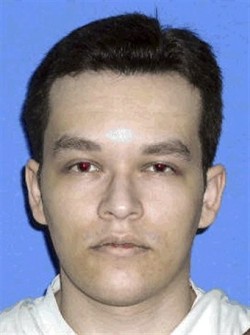
Barring a last-minute stay of execution, Khristian Oliver will be put to death late this afternoon.

(Update: Khristian Oliver has indeed been executed as scheduled. His likeness lives on in an altarpiece made by his father, an artist.)

In 1998, Oliver, now 32, shot and killed a man whose home he was burglarizing. Oliver’s guilt isn’t being questioned. The argument his attorneys and supporters are using to stave off his upcoming execution has to do with how the jurors in his case handled his sentencing.

An Oct. 15 story in The Guardian described the scene in the jury room this way:

A clutch of jurors huddled in the corner with one reading aloud from the Book of Numbers: “The murderer shall surely be put to death” and “The revenger of blood himself shall slay the murderer.”

Another juror highlighted passages which she showed to a fellow juror: “And if he smite him with an instrument of iron, the murderer shall surely be put to death.” (Apparently one of the same passages, Numbers 35:16, in fuller context.)

Juries debating this most difficult decision often reach for Biblical guidance, and there are no shortage of verses that relate to capital punishment, including the famous “eye for an eye” passage(s). Courts have ruled this improper, not because the Bible is a religious document, but because it is extrinsic evidence, meaning it was not properly introduced as evidence.

The same issue arose in the central case in my new book, The Last Lawyer: The Fight to Save Death Row Inmates.

To write the book, I shadowed a North Carolina legal team for four and a half years as they fought to overturn the death sentence of a man named Bo Jones. The attorneys crisscrossed the back roads of North Carolina to track down and interview most of the jurors from the trial, two of whom chased them off their property. In the end, the attorneys found one woman who claimed that a Baptist minister on the jury had brought a Bible into the room and quoted passages from it.

In the end, this claim didn’t help Bo Jones. A federal appeals judge threw it out, saying his lawyers hadn’t proved that the Bible-quoting had influenced the jury’s verdict. But Jones’s attorneys had plenty of other arguments up their sleeves, while Oliver’s supporters seem to be putting most of their emphasis on the Bible argument.

It remains to be seen whether this will bewas not enough to spare his life.

Update: Prolific death penalty defense attorney David R. Dow (author of Autobiography of an Execution) on his client, Khristian Oliver.


On this day..

1941: Arndt Pekurinen, conscientious objector

On this date in 1941, Finnish pacifist Arndt Pekurinen was executed at the front for refusing to fight.

Initially conscripted in the 1920’s, Pekurinen had refused to serve under arms and spent 1929-31 in prison for his troubles. He was a minor cause celebre; British MPs and big international names like Einstein and H.G. Wells pressed for his release.

A change in the Finnish conscription law — the bill was called the “Lex Pekurinen” — finally saw him freed to civilian life, but he was drafted anew to fight the Soviet Union in the “Continuation War”. When he again refused, he was shot at Suomussalmi without trial — though two men refused to do it before someone finally agreed to be the executioner.

“Kun ihmisiä ei syödä, on niitä turha teurastaa.”
(“As people are not eaten, butchering them is of no use.”)

A neglected figure during the Cold War, he’s enjoyed a latter-day rediscovery since the 1998 Erno Paasilinna book Courage: The life and execution of Arndt Pekurinen. In the decade since, Pekurinen has become a household name and a widely-admired figure. (The link is in Finnish.) A park in Helsinki was recently named for him. (Finnish again.)

Tangentially, the Nordic stock of our day’s victim and his era of militarism call to mind the hero of e.e. cummings’ “i sing of Olaf glad and big”. The allusions of this poem are American, and there’s no reason to associate it directly with Pekurinen — but it so happens that it was published in 1931, the year international pressure forced the end of Pekunin’s first prison stint:

i sing of Olaf glad and big
whose warmest heart recoiled at war:
a conscientious object-or

his wellbelovéd colonel(trig
westpointer most succinctly bred)
took erring Olaf soon in hand;
but–though an host of overjoyed
noncoms(first knocking on the head
him)do through icy waters roll
that helplessness which others stroke
with brushes recently employed
anent this muddy toiletbowl,
while kindred intellects evoke
allegiance per blunt instruments–
Olaf(being to all intents
a corpse and wanting any rag
upon what God unto him gave)
responds,without getting annoyed
“I will not kiss your fucking flag”

straightway the silver bird looked grave
(departing hurriedly to shave)

but–though all kinds of officers
(a yearning nation’s blueeyed pride)
their passive prey did kick and curse
until for wear their clarion
voices and boots were much the worse,
and egged the firstclassprivates on
his rectum wickedly to tease
by means of skilfully applied
bayonets roasted hot with heat–
Olaf(upon what were once knees)
does almost ceaselessly repeat
“there is some shit I will not eat”

our president,being of which
assertions duly notified
threw the yellowsonofabitch
into a dungeon,where he died

Christ(of His mercy infinite)
i pray to see;and Olaf,too

preponderatingly because
unless statistics lie he was
more brave than me:more blond than you.

On this day..

1925: Sidney Reilly

On this date in 1925, legendary British spy — and subsequent James Bond inspiration — Sidney Reilly was shot in a forest outside Moscow for his efforts to overthrow the Soviet government.

Fact blends insensibly into fiction in Reilly‘s biography; much of what is known or believed about him is conjectural or colored by his posthumous valorization, such the 1967 book Reilly: Ace of Spies written by [the son of] his onetime cloak-and-dagger collaborator Robin Bruce Lockhart — who was himself a close friend of Bond author Ian Fleming.

However, even at the word of less sensational biographers — such as Andrew Cook — Reilly lived a life almost too extraordinary for belief.

A Jewish child of tsarist Russia born in what is now the Ukraine, Reilly claimed to have escaped Odessa by faking his death and hopping a ship bound for Brazil. Like much of Reilly’s life, the story is unverifiable, but by hook or by crook — and possibly by way of a murder in France — he arrived in London in 1895, hitched himself to a wealthy woman a few months after the suspicious death of her husband (discarding the inconvenient surname Rosenblum in the process), and became entangled with British intelligence.

In the first decade of the 20th century, he apparently spied promiscuously on England’s imperial rivals Germany and Russia, though the particulars are disputed. He arrived in Port Arthur, Russia, shortly before the outbreak of the Russo-Japanese War and may have provided the Japanese fleet intelligence enabling it to navigate the mined harbor — in addition to a copious side business in war profiteering. He may also have had a hand in capturing British oil concessions in Persia and reconnoitering behind German lines during World War I.

Like his fictional heir 007, he gambled often and left a string of lovers and mistresses in his wake. His true allegiances, and the extent to which his exploits were inflated or outright fabricated, are debated to this day.

The adventures that brought both death and fame were his machinations to overthrow the Bolshevik government in the fraught early months after Lenin took power. A planned coup d’etat in September 1918 came to grief and Reilly fled Russia steps ahead of the authorities, who subsequently condemned him to death in absentia.

Notwithstanding the sentence, which had been ruthlessly visited on his less-fortunate conspirators, Reilly was lured back to the USSR in 1925 by the Soviet counterintelligence project Operation Trust. Intending to meet anti-Bolshevik agitators, he was instead arrested at the border and tortured at the infamous Lubyanka Prison, where he kept notes on cigarette papers about enemy interrogation techniques for the eventuality of an escape or release that never came.

Part of the Themed Set: Spies.

On this day..