Feast Day of St. Barnabas

June 11 is the feast date of St. Barnabas, St. Paul‘s New Testament wingman.

A Cypriot Jew named Joseph, “Barnabas” (“Son of Encouragement”) was so christened in the fourth chapter of the New Testament’s Acts of the Apostles because upon his conversion he sold his land for a donative to the Galileans.
After that, Barnabas reappears throughout Acts as one of the most important of the early Christian missionaries, usually joining St. Paul — whom Barnabas himself introduced to the Christians after Paul got religion — as emissary to the non-Jews, for which purpose the Holy Spirit itself demanded him by name. (Acts 13:2: “Set apart for me Barnabas and Saul for the work to which I have called them.”)

They’re frequently paired thereafter in the narrative although it’s invariably Saint Paul’s honeyed tongue that does the confounding before the companions flee this city or that ahead of a furious mob.* Evidently the Holy Spirit’s labor policies could have used some updating: Barnabas also features in a whinge by Paul in 1 Corinthians 9 against the excess sacrifices the Jesus sect is exacting from its most successful envoys, who get no wages and no sex and (so it seems) have to hustle side jobs to keep up their proselytizing.

Don’t we have the right to food and drink? Don’t we have the right to take a believing wife along with us, as do the other apostles and the Lord’s brothers and Cephas [St. Peter]? Or is it only I and Barnabas who lack the right to not work for a living?

Who serves as a soldier at his own expense? Who plants a vineyard and does not eat its grapes? Who tends a flock and does not drink the milk? … whoever plows and threshes should be able to do so in the hope of sharing in the harvest. If we have sown spiritual seed among you, is it too much if we reap a material harvest from you? If others have this right of support from you, shouldn’t we have it all the more?

But we did not use this right. On the contrary, we put up with anything rather than hinder the gospel of Christ.

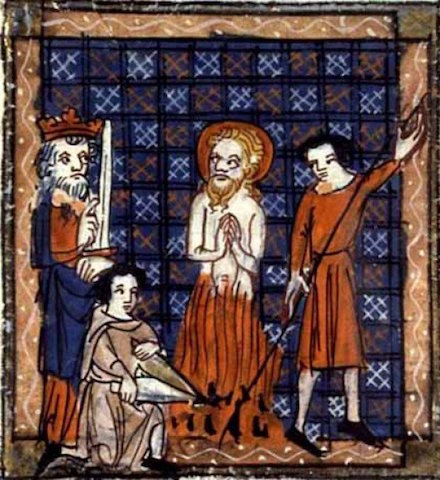
Barnabas eventually parted ways with Paul, proceeding to Cyprus with the mysterious John Mark (possibly Mark the evangelist, author of the Gospel, or possibly a different guy) where hagiography holds that Jews angered by his preaching fell on Barnabas and stoned him to death, perhaps around the year 61.

Although obviously a consequential figure in early Christianity, Barnabas’s many Biblical appearances do not capture his voice. The apocrypha preserves at least two tracts** further animating this important character: the Epistle of Barnabas dating to the late first century or early second century; and, the Acts of Barnabas, a 5th century creation which purports to arise from the hand of John Mark and describes a martyrdom by fire, not stone:

And Barjesus, having arrived after two days, after not a few Jews had been instructed, was enraged, and brought together all the multitude of the Jews; and they having laid hold of Barnabas, wished to hand him over to Hypatius, the governor of Salamis. And having bound him to take him away to the governor, and a pious Jebusite, a kinsman of Nero, having count to Cyprus, the Jews, learning this, took Barnabas by night, and bound him with a rope by the neck; and having dragged him to the hippodrome from the synagogue, and having gone out of the city, standing round him, they burned him with fire, so that even his bones became dust. And straightway that night, having taken his dust, they cast it into a cloth; and having se cured it with lead. they intended to throw it into the sea. But I, finding an opportunity in the night, and being able along with Timon and Rhodon to carry it, we came to a certain place, and having found a cave, put it down there, where the nation of the Jebusites formerly dwelt. And having found a secret place in it, we put it away, with the documents which he had received from Matthew. And it was the fourth hour of the night of the second of the week.

Because June 11 formerly fell on/near Midsummer, ere the Gregorian reforms skipped the calendar 10-11 days forward, St. Barnabas’s Day has a festive agrarian history commemorated by the proverb, “Barnaby bright, Barnaby bright, the longest day and the shortest night.” The saint is also the patron of Cyprus, and may be invoked to protect against hailstorms or in service of peacemaking. Numerous schools, churches, and monasteries around the world bear his name.

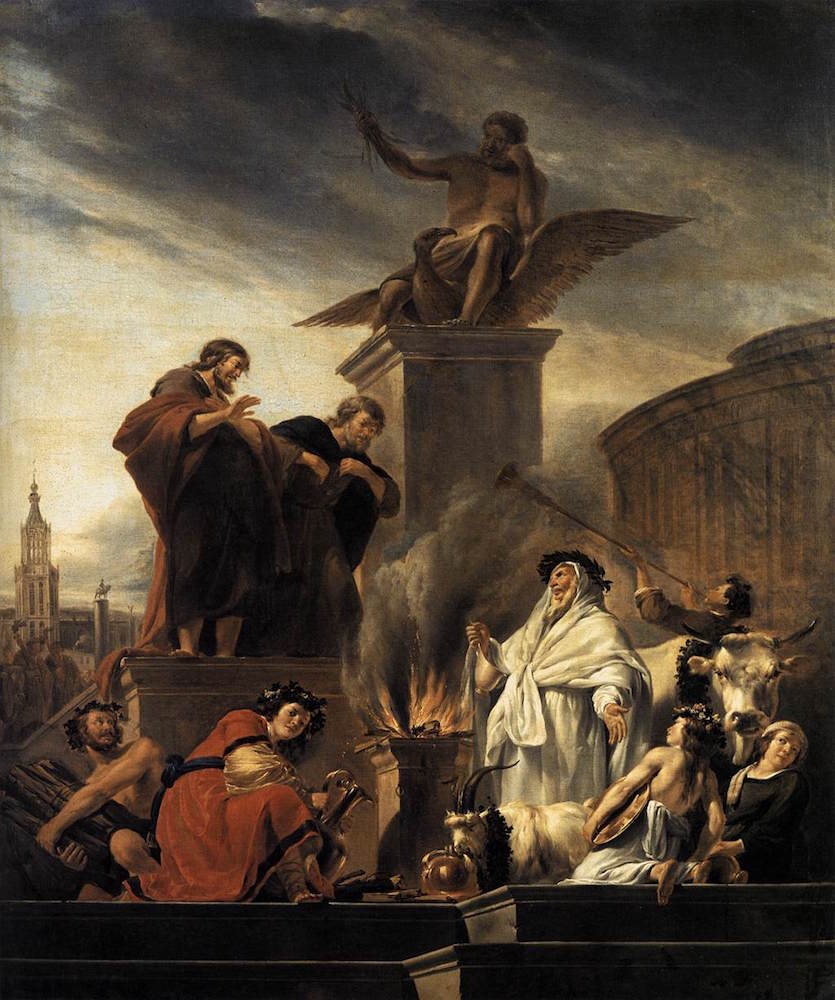
* There’s a comic touch to their preaching travails, too: in one exciting episode (Acts 14), Paul (of course) heals a cripple while the dynamic duo preaches in Lystra, leading excited witnesses to take them for Hermes and Zeus and start sacrificing to them.


No tips, please: Paul and Barnabas refusing the sacrifices of Lystrans in this detail (click for the full image) of a 1650 painting by Nicolaes Berchem.

** Beyond the Epistle and the Acts, there is also a very much later Gospel of Barnabas.

On this day..

1863: Not Nathaniel Pruitt, reprieved deserter

On this date 150 years ago, according to Larry Daniel’s Soldiering in the Army of Tennessee, a middle-aged man was all set to be shot for deserting the Army of Tennessee, and the much-resented command of Gen. Braxton Bragg.

In a well-documented incident, a soldier received a reprieve as a result of a dramatic incident. Forty-seven-year-old Nathaniel Pruitt of the Nineteenth Tennessee was found guilty of desertion and on June 10, 1863, was taken to a field beside his regimental camp, his coffin placed beside an open grave. A minister cut a lock of hair to give to Pruitt’s wife. The firing squad was positioned and ordered to take aim, but just then an officer came galloping up with a special order to suspend the sentence. The prisoner began crying. “I was truly glad [of the reprieve], but must say some of the boys were disappointed,” a Mississippi diarist noted. Incredibly, the very next day, Pruitt again deserted and was never heard from again.

One takes the author’s point here about Pruitt’s risk-seeking second flight, but even so it might not really be all that “incredible” that one would desert the company of armed men who had recently shown open disappointment about being prevented from shooting one dead.

On this day..

1863: Lawrence Williams and Walter Peters, bold CSA spies

From the July 4, 1863 issue of Harper’s, as digitized by sonsofthesouth.net.

THE EXECUTION OF WILLIAMS AND PETERS.

We are indebted to Mr. James K. Magie, of the 78th Illinois Regiment, for the sketch of the execution of the two rebel spies, WILLIAMS and PETERS, who were hanged by General Rosecrans on 9th inst. The following account of the affair is from a letter written by the surgeon of the 85th Indiana:

HEADQUARTERS POST, FRANKLIN, TENNESSEE

Last evening about sundown two strangers rode into camp and called at Colonel Baird’s head-quarters, who presented unusual appearances. They had on citizens’ overcoats, Federal regulation pants and caps. The caps were covered with white flannel havelocks. They wore sidearms, and showed high intelligence. One claimed to be a colonel in the United States Army, and called himself Colonel Austin; the other called himself Major Dunlap, and both representing themselves as Inspector-Generals of the United States Army. They represented that they were now out on an expedition in this department, inspecting the outposts and defenses, and that day before yesterday they had been overhauled by the enemy and lost their coats and purses. They exhibited official papers from General Rosecrans, and also from the War Department at Washington, confirming their rank and business. These were all right to Colonel Bayard, and at first satisfied him of their honesty. They asked the Colonel to loan them $50, as they had no coats and no money to buy them. Colonel Baird loaned them the money, and took Colonel Austin’s note for it. Just at dark they started, saying they were going to Nashville, and took that way. Just so soon as their horses’ heads were turned the thought of their being spies struck Colonel Baird, he says, like a thunder-bolt, and he ordered Colonel Watkins, of the 6th Kentucky cavalry, who was standing by, to arrest them immediately. But they were going at lightning speed. Colonel Watkins had no time to call a guard, and only with his orderly he set out on the chase. He ordered the orderly to unsling his carbine, and if, when he (the Colonel) halted them they showed any suspicious motions, to fire on them without waiting for ano rder. They were overtaken about one-third of a mile from here. Colonel Watkins told them that Colonel Baird wanted to make some further inquiries of them, and asked them to return. This they politely consented to do, after some remonstrance on account of the lateness of the hour and the distance they had to travel, and Colonel Watkins led them to his tent, where he placed a strong guard over them. It was not until one of them attempted to pass the guard at the door that they even suspected they were prisoners. Colonel Watkins immediately brought them to Colonel Baird under strong guard. They at once manifested great uneasiness, and pretended great indignation at being thus treated. Colonel Baird frankly told them that he had his suspicions of their true character, and that they should, if loyal, object to no necessary caution. They were very hard to satisfy, and were in a great hurry to get off. Colonel Baird told them that they were under arrest, and he should hold them prisoners until he was fully satisfied that they were what they puported to be. He immediately telegraphed to General Rosecrans, and received the answer that he knew nothing of any such men, that there were no such men in his employ, or had his pass.

Long before this dispatch was received, however, every one who had an opportunity of hearing their conversation was well satisfied that they were spies. Smart as they were, they gave frequent and distinct evidence of duplicity. After this dispatch came to hand, which it did about 12 o’clock (midnight), a search of their persons was ordered. To this the Major consented without opposition, but the Colonel protested against it, and even put his hand to his arms. But resistance was useless, and both submitted. When the Major’s sword was drawn from the scabbard there were found etched upon it these words, “Lt. W.G. Peter, C.S.A.” At this discovery Colonel Baird remarked, “Gentlemen, you have played this damned well.” “Yes,” said Lieutenant Peter, “and it came near being a perfect success.” They then confessed the whole matter, and upon further search various papers showing their guilt were discovered upon their persons. Lieutenant Peter was found to have on a rebel cap, secreted by the white flannel havelock.

Colonel Baird immediately telegraphed the facts to General Rosecrans and asked what he should do, and in a short time received an order “to try them by a drum-head court-martial, and if found guilty hang them immediately.” The court was convened, and before daylight the case was decided, and the prisoners informed that they must prepare for immediate death by hanging.

At daylight men were detailed to make a scaffold. The prisoners were visited by the Chaplain of the 78th Illinois, who, upon their request, administered the sacrament to them. They also wrote some letters to their friends, and deposited their jewelry, silver cups, and other valuables for transmission to their friends.

The gallows was constructed by a wild cherry-tree not far from the depot, and in a very public place. Two ropes hung dangling from the beam, reaching within eight feet of the ground. A little after nine o’clock A.M. the whole garrison was marshaled around the place of execution in solemn sadness. Two poplar coffins were lying a few feet away. Twenty minutes past nine the guards conducted the prisoners to the scaffold — they walked firm and steady, as if unmindful of the fearful precipice which they were approaching. The guards did them the honor to march with arms reversed.

Arrived at the place of execution they stepped upon the platform of the cart and took their respective places. The Provost Marshal, Captain Alexander, then tied a linen handkerchief over the face of each and adjusted the ropes. They then asked the privilege of bidding last farewell, which being granted, they tenderly embraced each other. This over, the cart moved from under them, and they hung in the air.

What a fearful penalty! They swung off at 9:30 — in two minutes the Lieutenant ceased to struggle. The Colonel caught hold of the rope with both hands and raised himself up at 3 minutes, and ceased to struggle at 5 minutes. At 6 minutes Dr. Forester, Surgeon 6th Kentucky Cavalry, and Dr. Moss, 78th Illinois Infantry, and myself, who had been detailed to examine the bodies, approached them, and found the pulse of both full and strong. At 7 minutes the Colonel shrugged his shoulders. The pulse of each continued to beat 17 minutes, and at 20 minutes all signs of life had ceased. The bodies were cut down at 30 minutes and encoffined in full dress. The Colonel was buried with a gold locket and chain on his neck. The locket contained the portrait and a braid of hair of his intended wife — her portrait was also in his vest pocket — these were buried with him. Both men were buried in the same grave — companions in life, misfortune, and crime, companions in infamy, and now companions in the grave.

I should have stated in another place that the prisoners did not want their punishment delayed; but, well knowing the consequences of their acts, even before their trial, asked to have the sentence, be it by hanging or shooting, quickly decided and executed. But they deprecated the idea of death by hanging, and asked for a communication of the sentence to shooting.

The elder and leader of these unfortunate men was Lawrence Williams, of Georgetown, D.C. He was as fine-looking a man as I have ever seen, about six feet high, and perhaps 30 years old. He was [a] son of Captain Williams, who was killed at the battle of Monterey. He was one of the most intellectual and accomplished men I have ever known. I have never known any one who excelled him as a talker. He was a member of the regular army, with the rank of captain of cavalry, when the rebellion broke out, and at that time was aid-de-camp and private secretary to General Winfield Scott. From this confidence and respect shown him by so distinguished a man may be judged his education and accomplishments. He was a first cousin of General Lee, commanding the Confederate army on the Rappahannock. Soon after the war began he was frank enough to inform General Scott that all his sympathies were with the South, as his friends and interests were there, and that he could not fight against them. As he was privy to all of General Scott’s plans for the campaign, it was not thought proper to turn him loose, hence he was sent to Governor’s Island, where he remained three months. After the first Bull Run battle he was allowed to go South, where he joined the Confederate army, and his subsequent history I have not been able to learn much about. He was a while on General Bragg‘s staff as Chief of Artillery, but at the time of his death was his Inspector-General. When he joined the Confederate army he altered his name, and now signs it thus: “Lawrence W. Orton, Col. City P.A.C.S.A.” — (Provisional Army Confederate States of America). Sometimes he writes his name “Orton,” and sometimes “Anton,” according to the object which he had in view. This we learn from the papers found on him. These facts in relation to the personal history of Colonel Orton I have gathered from the Colonel himself and from Colonel Watkins, who knows him well, they having belonged to the same regiment of the regular army — 2d U.S. Cavalry. Colonel Watkins, however, did not recognize Colonel Orton until after he had made himself known, and now mourns his apostasy and tragic fate.

The other victim of this delusive and reckless daring was Walter G. Peter, a lieutenant in the rebel army, and Colonel Orton’s adjutant. He was a tall, handsome young man, of about twenty-five years, that gave many signs of education and refinement.

Of his history I have been able to gather nothing. He played but a second part. Colonel Orton was the leader, and did all the talking and managing. Such is a succinct account of one of the most daring enterprises that men ever engaged in. Such were the characters and the men who played the awful tragedy.

History will hardly furnish its parallel in the character and standing of the parties, tne boldness and daring of the enterprise, and the swiftness with which discovery and punishment were visited upon them. They came into our camp and went all through it, minutely inspecting our position, works, and forces, with a portion of their traitorous insignia upon them; and the boldness of their conduct made their flimsy subterfuges almost successful.

On this day..

1658: John Hewett and Henry Slingsby, royalists

On this date in 1658, two royalist conspirators were beheaded at Tower Hill for plotting against Oliver Cromwell‘s Protectorate.

At this very late date, conflicts within the Lord Protector’s state raised the hopes of the exiled royal claimant Charles Stuart for a successful invasion. (Little did the imminent King Charles II suspect that Cromwell himself would die suddenly three months hence, collapsing the revolutionary government.) Plots and counterplots, spying and betrayal, were the order of the day; it was the bad luck of our men to set theirs in motion just a shade too early, but perhaps it was Charles Stuart’s good luck that Team Cromwell smashed it before it could ripen into a premature commitment of forces.

For the particulars, we turn to parliamentarian cavalryman and politician Edmund Ludlow, a regicide who had thirty-odd years cooling his spurs in continental exile during which to scribble his memoir of the grand experiment.

Another plot much more dangerous was about the same time carried on by the Royalists, and discovered to him by his spies. The persons concerned in it he used with more severity, because he accounted them to be of a more formidable party, and therefore referred them to be tried by those persons whom his last Assembly had nominated to be a High Court of Justice.

The prisoners were Dr. Hewet [John Hewett, onetime chaplain to King Charles I and an open royalist], Sir Henry Slingsby [a Yorkshire politician and Royalist veteran of the civil wars], and Mr. Mordaunt [eventually made a viscount by Charles II in recognition of his efforts on behalf of restoration], with some others of the meaner sort. The general charge against them was for endeavouring to levy war against the Government on the behalf of Charles Stuart.

The particular charge against Dr. Hewet was for dispersing commissions from the son of the late King, and perswading divers to raise forces by virtue of the same. That against Sir Henry Slingsby was for attempting to debauch some of the garison of Hull to the service of Charles Stuart, and delivering a commission from him to them. The prisoners of less note were charged with a design of firing the city in several places, at the time appointed for their party to be in arms.

Dr. Hewet being brought before the Court, moved that he might be tried by a jury, and demurred to the jurisdiction of the Court. But the Court over-ruled his demurrer, and told him, that unless he would plead to his charge, they would cause his refusal to be entred, and proceed against him as if the fact were confessed. This being twice said to him, he was required the third time to plead: to which he answered, that if the Judges would declare it to be according to law for him to plead, he would obey: but he was told that the gentlemen then present were his Judges, and that if he would not plead they would register his contempt the third time, and upon his refusal did so.

Mr. Mordaunt admonished by his example, pleaded not guilty; and after a full hearing of the witnesses on both sides, the Court acquitted him by one voice. Then Sir Henry Slingsby was called to the bar, and the witnesses on each side being heard, he was pronounced guilty, tho in the opinion of many men he had very hard measure. For it appeared that he was a prisoner at the time when he was charged to have practised against the Government; that he was a declared enemy, and therefore by the laws of war free to make any such attempt; besides it was alledged that the persons, whom he was accused to have endeavoured to corrupt, had trapan’d him by their promises to serve the king in delivering Hull, if he would give them a commission to act for him, which commission was an old one that had long lain by him. But all this being not thought sufficient to excuse him, he was adjudged to die.

The rest of the prisoners were also condemned, and sentence of death being pronounced, Sir Henry Slingsby and Dr. Hewet had the favour of being [June 8] 1658 beheaded; and the others, being men of a lesser figure, were hanged.

Cromwel’s daughter and favourite Mrs. Cleypole [Elizabeth Claypole, who was reputed to intercede frequently with her father on behalf of royalists], laboured earnestly with her father to save the life of Dr. Hewet, but without success: which denial so afflicted her, that it was reported to have been one cause of her death, which happened soon after with the concurrence Aug. 6. of an ulcer in her womb.

We have also an account of the dying behavior of both Slingsby and — much more detailed — Hewitt, each of whom slated the injustice of their sentence as having greatly exaggerated their “treasonable” designs.

On this day..

1797: Martin Clinch and Samuel Mackley

Say’s Weekly Journal, May 13, 1797:

On Sunday evening, between eight and nine o’clock, as Mr. Fryer, of Southampton Buildings, Holborn, was returning home, accompanied by a young Lady, in passing through the fields near White Conduit-house, he heard the screams of a woman in distress. He hastened to her assistance, and perceived her in the hands of three footpads, who, on seeing him approach, shot him through the head.

Some of the Bow-street patrols, who go that road, hearing the report of the pistol, made up to the place, where they found Mr. F. lying, not quite dead, but who expired in a few minutes afterwards; he appeared to have been robbed of his watch and money, and near the spot lay a stick with a sword in it.

The young Lady, who was in company with him, it is supposed, ran away on the villains first attacking him.

Three men were last night taken up on suspicion of the above murder.

General Evening Post, May 11-13, 1797:

Mr. Fryer, who was murdered on Sunday evening last, in Islington fields, was a young man of some property, and had been brought up to the law.

The young Lady, who accompanied him at the time, was his intended bride. They had been to spend the day at the house of a Mrs. P. in Paradise-row, Islington, and were returning home when the murder took place.

Mrs. P. had come a short distance from her own house with them, and after they had bid her good night, and had got about 100 yards from her, she was attacked by three villains, who robbed her of her cloak and money.

Her cries alarming Mr. F. he ran back to her assistance, which being perceived by the robbers, one of them advanced and shot him through the head, and then robbed him.

The young Lady was a distant spectator of this shocking scene.

London Evening Post, May 16-18, 1797:

Yesterday evening three men were examined at Bow-street, for the murder of Mr. Fryer, in Islington Fields, but, after a long investigation, they were discharged.

London Star, May 25, 1797:

Tuesday Martyn Clynch and James Mackley were committed to Newgate by John Floud and William Brodie, Esqs. charged with the oath of Ann Fryer and others, on suspicion of being the persons guilty of the wilful murder of Sydney Fryer on Sunday the 7th inst. in the fields near the Work-house, in the black road, Islington.

London Chronicle, June 1-3, 1797:

OLD BAILEY.

Yesterday, 14 prisoners were tried at the Old Bailey, two of whom were capitally convicted, viz. Samuel Mackley and Martin Clinch, for the wilful murder of Mr. Fryer in the parish of St. Mary, Islington.

It appeared by the evidence, that the deceased and his cousin, Miss Fryer, were walking across the fields in their way from Southampton Buildings, Holborn, towards Islington: that when they arrived at the field called the Cricket field, near White Conduit House, they heard a noise as of some person in distress; this induced the deceased to go to the spot.

At this time, Miss Fryer, the principal witness on this occasion, was at some distance from him. By the time she came to the stile, which he had crossed in his way to the place, she saw Clinch fire, when the deceased fell into a small pond. Clinch then took his watch out of his fob, and a sum of money out of his pocket.

By this time Miss Frye [sic] had got on the other side of the stile, when the prisoner, Mackley, held a pistol to her head, and took her cloak from her. They then went away, and Mr. Fryer was taken to a house at a short distance from the spot, where he died at eleven o’clock the same evening.

The evidence in support of the above statement, as given by Miss Fryer, was clear, artless, and unembarrassed. When asked if she really believed Clinch to be the man who shot Mr. Fryer, she said she believed from her soul he was; with respect to Mackley she seemed not quite so positive; several witnesses, however, proved his being seen in the same field within a few minutes of the time the murder happened, who all had noticed him on account of his having red hair.

The prisoners being called on for their defence, they only said they were innocent, but could give no account where they were at the time the murder was committed.

The jury went out for about half an hour, and returned with a verdict — Guilty. They were both ordered for execution on Monday next.

Five were convicted of felony, and seven acquitted.

Hereford Journal, June 7, 1797:

This morning were executed at the front of Newgate, Clinch and Mackley, for the robbery and murder of Mr. Frye, in Islington Fields.

An extremely disagreeable circumstance happened. The floor of the scaffold, from some previous misarrangement gave way, and precipitated into the area of the apparatus, Messrs. Vilette and Gaffy, the latter a Catholic Priest, who attended Clinch, and the two executioners. Mr. Sheriff Staines had a very narrow escape.

Mr. Gaffy was very severely hurt, as were both the executioners; Mr. Villette escaped with a slight bruise.

The two malefactors swung off with their distorted features exposed to the view of the distressed spectators. Their bodies were removed for the purposes of dissection and exposure.

Lloyd’s Evening Post, September 11-13, 1797:

Burton Wood and William Harlington, the two persons executed a few days ago on Kennington Common, for highway-robbery and sheep-stealing, made voluntary confessions of the various depredations in which they had been concerned.

Burton Wood positively declared, that Clinch and Mackley, who were hanged for the murder of Mr. Fryer, in Islington Fields, were totally innocent of that crime, it having been committed by himself and two others.

Harling made a similar confession respecting the murder of Mrs. Gray at Waltham-Abbey, for which two men, of the names of Harold and Upsham, were taken up; but who, he averred, had no connection in that shocking transaction. The robberies mentioned in their confessions were very numerous.

Whitehall Evening Post, September 12-14, 1797:

The following is a copy of a Letter sent from Burton Wood (who was hanged a short time since on Kennington Common, for a footpad robbery) to Mr. Carpenter Smith, in the Borough, from which it appears that he was the person concerned in the murder of Mr. Fryer, in Islington-fields, and that Clinch and Mackley, who were hanged for that murder, died innocent; also the copy of another letter which was sent from William Harling, a person that was hanged with Wood for sheep-stealing, to a friend of his, in which it appears is a confession of the robberies that he has been guilty of.

Honoured Sir,

I confess to robbing Mr. Francis, near Dulwich; I was mounted a grey horse. To stopping the Chatham coach the other side of Shooter’s-hill: I was dressed in a blue great-coat: I was mounted on a brown crop mare; it was between four and five in the afternoon; and to the robbing and murder of Mr. Fryer, in Islington-fields; the two men, Clinch and Mackley, was innocent of it; and to breaking open the house of Mr. Emery, brass-founder, in Shoe-lane, Fleet-street, and taking away Bank notes, cash, and other articles to the amount of 130 l.: and to robbing the waggon of Mr. Newport and Sons, of Crayford, in Kent, on Blackheath, last Easter Wednesday night, about ten o’clock — the man that was tried at Maidstone for it in the name of George Rhodes, was innocent of it; and I was the person that stopped and robbed the carriage on the night of Thursday the 25th of May last near Ball’s Pond turnpike; and to breaking open the house of Mr. Parkes, the brewer, in Baldwin’s Gardens, Gray’s-inn-lane, Holborn; I was the person that broke open the iron chest in Mr. Parke’s Counting-house; and to breaking open the house of Mr. Sewell, Seward-street, Goswell-street, St. Lukes, and taking away two Bank-notes, one of 5 l. and one of 10 l. and cash to the amount of 15 l. on Sunday night the 14th of last February; I as by myself; and to robbing a Mr. Robert Morris, belonging to the Custom-house, of his watch and fourteen shillings in Locks Field’s; and to the robbery that I now suffer for; and to robbing the Fishman near Sutton, when I robbed George May, of Banstead, in Surrey, of 2 l. 16 s. 6 d. for which I now suffer.

The Lord have mercy upon my sinful soul!

Honoured Sir, I hope the robberies that I have confessed I hope will be the means of many innocent men’s escaping to be brought to justice for the same, for I am the transgressor thereof. It would have been a good thing if I had suffered while Clinch and Mackley were under confinement in Newgate, for the robbery and murder of Mr. Fryer, in Islington-fields; for they died innocent. I confess to being one of the party, but they was not with me; I might have been the saving of their two lives had I have suffered sooner, but now it is too late; but I hope they are happy, I hope my soul will meet them in Heaven.

These are the confessions of your long-lost and unfortunate

Humble servant,
Burton Wood
August 21, 1797


Dear Charles,

The following names are them that I have robbed, and therefore I hope that nobody else may be brought to justice when I am dead and gone concerning them, for nobody but me did them, except Alderson, that suffered last Thursday at Maidstone, rob robbing Mr. Robinson, at Sydenham.

1st. Mr. Polton, of his horse.

2nd. Mr. Spinks, the bricklayer, of his horse.

3rd. And broke open the house of Mr. Mason.

4. Mr. John Hudson, the shopkeeper; Mr. Pinner, butcher, of nine sheep and two beasts; to taking the eleven sheep off Mitcham Common; Mr. Mills, of Mordon, of eleven fat weathers; breaking open the house of Mr. Marriot, of Mitcham; Newton and Leache’s callico-grounds twice; Mr. John Waggoner’s callico-grounds once; Mr. Groves, of his ten hogs; Mr. Blink, last Easter Monday; the Epsom Fisherman, Easter Tuesday; the two Gentlemen that had been to Ewill with their children to a boarding-school, near the turnpike, in a single-horse chaise: and Mr. Robinson, at Sydenham; a Gentleman in a single-horse chaise, on Mordon Common, going to Ewill.

I am sorry that Robert Harrold and Frederick Upham was taken up for the murder of Mrs. Gray, at Waltham Abbey, for they were innocent: I was one that was concerned in it, and these sheep that I now suffer for; therefore I wish to let you know, that they may not give themselves any more trouble to take any body else into custody, for it was only me and Alderson, for that robbery at Mr. Robinson’s at Sydenham, which robbery I was concerned with.

Give my remembrance to Mason, and ask him if he has hanged that great black dog of his, that laid upon the basket of clothes; if not, it is high time he had, for he was a very neglectful servant, for he lay as still as a mouse while I and my Pall drank a bottle of peppermint over his head. But now they have got what they longed for, and it is to be hoped they will sleep in peace when I am dead.

William Harling.

On this day..

1886: A day in the death penalty around the U.S. South

From the New Orleans Times-Picayune, June 5, 1886.


Execution of Alfred Taylor at Opelousas.

Opelousas, La., June 4. — [Special.] — In accordance with Gov. McEnery‘s proclamation, Alfred Taylor, colored, was executed at 1:30 o’clock, P.M., to-day, by Sheriff Duson, the condemned man dying of strangulation about fifteen minutes after the springing of the trap.

He preserved a very firm and unconcerned mien until he saw the gallows, not seeming to realize or to believe that he would be hanged. He protested his innocence of the crime to the last. Once when the supreme moment arrived, he lost his usual stolidity and called on God to have mercy upon him and begging [sic] the Sheriff not to hang him.

Taylor was 23 years years old, griff in color, of medium height and weighing about 145 pounds. He was tried at the March term of our District Court, and the jury was composed of nine white and three colored men. He was defended by able counsel, and after an impartial trial was found guilty as charged on the indictment.

On Monday, Feb. 8, 1886, at about 11 o’clock in the morning, Taylor called at the residence of Mrs. Latreuille, a white lady, residing on the old Dr. Moore place, near Moundville, some four miles above Washington, and asked if her husband was at home. Not suspecting anything wrong, she replied that he was not. The negro then told her that some one was trying to steal her chickens in the woods near by and that she had better see about it.

The unfortunate woman went to the place to look after her fowls, when the negro followed her, and drawing a pistol threatened to shoot her if she made any outcry. She fainted away through fright, when he accomplished his diabolical purpose. He fled, and a posse was immediately organized and began searching for him. Had he been caught then he would undoubtedly have been lynched. He evaded arrest, however, until the week before his trial and conviction. The evidence adduced at the trial was crushing, and the jury promptly returned a verdict as above.

Since his conviction he has manifested no sighs of contrition, but, on the contrary, has always affected the most stoical indifference, and constantly indulged in the most revolting profanity.


A Double Execution.

Winchester, Va., June 4. — Wes Honesty and Tabby Banks were hanged at 9:22 A.M., for the murder on the night of Nov. 14, 1884, of Joseph McFaul, a youth of 18 years. A large Democratic procession took place here on that night, and the prisoners walked through the streets making threats that they would crack the skull of some Democrat before morning.

McFaul was a slightly built, peaceable young man, while Honesty and Banks were powerfully grown negroes.

They waylaid McFaul at the mouth of an ally on Main street. He had nothing with which to protect himself but a light walking stick. The negroes pressed upon him and he ran from them, ordering them to keep away. They then rushed upon him. Honesty collared him and pushed him against a house at the mouth of the alley, and Banks cried out, “stick it to him.”

McFaul defended himself as best he could with his walking-stick. Honesty was facing McFaul, and Banks got behind him. Honesty drew back and hurled a rock at McFaul, striking him in the left temple. As he reeled and staggered across the street Banks struck him with some weapon he held in his hands. McFaul went to his boarding-house, and was found dead in his bed next morning, with his skull crushed.

As the criminals marched to the scaffold Banks began to tremble violently, but Honesty stood firm on the trap. The Moody hymn, “There is a Light in the Valley,” was sung by request, both joining in loudly.

Honesty said: “I thank God I am converted. I am going to heaven. No man’s blood rests on my soul. I have not to answer for it. I thank all the officers and ministers for their kindness.”

Banks said I am not guilty of what is put on me. I want to meet all my friends in heaven.

Their arms were then pinioned, the black cap drawn over their heads, and in a loud voice, both cried out “good-bye,” “good-bye.” The trap was then sprung.


John Davis Hanged in Assumption.

Napoleonville, La. — [Special.] — At 12:30 o’clock to-day a colored man, named John Davis, was hung at Napoleonville for the murder of his wife, two years ago, on the Jones plantation, three miles above the town. He confessed the crime, and said he was willing to die for what he had done. The execution was without incident.


Launched from Lebanon.

Lebanon, Tenn., June 4. — Jim Baxter, colored, was hanged at 11:32 this morning. His last utterances were: “I did not kill Mrs. Lane. Dat’s the God’s truth.” His neck was not broken. He was dead in fifteen minutes.

On this day..

1594: Michael Renichon, impoverished assassin

Confession of Michael Renichon of Templeu, Parson of Bossier, in the County of Namours

Concerning, The bloudy enterprise, which by him should have bene committed upon the person of County Maurice, Prince of Orange, as also, The sentence denounced against hym for that déede, in the Haghe on the third of June 1594.

Printed at Utrecht, by Salomon de Roy, ordinary Printer of the Estates, in their language, and now truely translated into english by R. R.

LONDON Imprinted by John Wolfe. 1594.

Michael Renichon of Templeu, and Parson of Bossier in the County of Namur aforesaid (dispatched with Letters of the Earle of Barlaymont, in the habite of a Souldier, from Brussel, the tenth day of March last:) was by Convoy conducted thence to Louen, Diest, Herentals, and Tuernoult: from whence accompanied onely with one of the garrison of the sayd Towne, he was guided to the Towne of Bredau: where being entred, he delivered certaine close sealed Letters, unto the Governour there, which were addressed from the Earle of Barlaymont unto Captayne Larigon Commaunder of the Castle of Tuernoult, importing, that the bringer thereof, was sent thither by expresse commaundement of Archduke Ernestus of Austria, to communicate unto him a certaine enterprise, to be done upon the towne of Bredau.

The Gouernour desirous to be by him further instructed, as well of the cause of his comming thither, as of the particularities of the said enterprise: Renichon first humbly besought him, that it would please him to entertaine him into his service, and then, persisting (though differing and dubling in his assertions, which savored of manifest untruethes) that his matter was just and perfect: Affirmed, that for certaine yeares, he had bene Secretary to the Abbot of Malonne, and for his knowledge and experience, he was by him advaunced to the same place, with the Earle of Barlaymont: from whome hee had after thys manner withdrawen himselfe, onely for the fervent desire hé had to doe him service, with such other the like accomplements.

The Governour finding small probability in hys filed speeches, feared greatly some pretence of waightier matter: and for that cause, caused him forthwith to be conveighed to the Haghe: Where, upon the first of Aprill, (fearing what would ensue) he attempted to strangle himselfe with a corde made of points and stringes of his Armes, fastened to a certayne iron in the Gaole, under which he was found all be blouded, and speechlesse.

Revived now, and come to his speech agayne, one demaunded for what cause he would have committed this acte upon himselfe: whereunto replying, hee confessed volontarily, without proffer of any torture or constraint, as well by word of mouth, on the second of Aprill, as also afterward by his owne hand writing at sundry times, as namely on the twentieth day of Aprill, and last of May, the very absolute trueth of hys comming thither: affirming the speeches uttered by him and fathered uppon the Abbot of Malonne, and Earle of Barlaymont, to bee false and forged, acknowledging further.

That having had long processe in Law against his Parishioners of Bossier, touching the revenues of his Parsonage: as also endamaged through the dayly incursions of the unbrideled souldiours: he was enforced by meere necessity about some two yeares sithence, to abandon his Parsonage, and committing the cure thereof unto a Chaplaine, retired himselfe unto the Towne of Namours, where he supplied the roome of a Scholemaster.

The Earle of Barlaymont, having had some intelligence of my being there, entreated me by some of hys gentlemen, on an Evening to suppe with him: supper being ended, the Earle retired himselfe into hys Chamber, and commaunded me to bee brought in to him: where (his people withdrawen) he asked me how I could with so small allowance content my self, and spend my time, to so little proffite, adding further, that hee knew the meanes how to advaunce my estate, if eyther I would seeke it at his handes, or rouse and plucke up my appaled spirites, for which his honourable courtesies, humbly thanking him, I presented him my best service.

The which now presented, hee tooke occasion to send for me in February last past, by his Chaplaine after supper, falling in discourse with me, in the presence of some other, of an enterprise to be done upon the Towne of Bredau.

Likewise at an other time being entred into his Chamber, he sent for me againe, at which time he tolde mee, that hee was to communicate unto me a matter of greater consequence and importance, and that if I would employ my selfe in the service of the king, he would richly and royally recompence me. Uppon which promise, I vowed my service to him againe.

Not long after this, I was by him commaunded to follow him to Brussels, where the sayd Earle divers and sondry times frequenting the Court, at length commanded me to attend on him thither: with whome passing from chamber to chamber, at last, the Earle entred the chamber of the Archduke Ernestus: whom I then beheld, minding to follow after hym: at which tyme I was partly hindered by the suddaine falling too of the doore: which not fully shut, (listening what might passe betwéene the Archduke and the sayd Earle,) I easely heard them speake Spanish and Latine: and at sundry times, make repetition of recompence and reward: The Earle ready to take hys leave of the Duke, who brought him to the chamber doore: the Duke at his last farewell, sayd, Cumulate & largo foenore satisfaciam. When the Earle returned, he told mee, that they had all that time, conferred about my matters: and that the Archduke had ordained two hundred Phillips Dollors to be delivered me.

Retired now to his lodging, he gave me further to understand that the Archdukes pleasure and full intention was, to roote out, or by a third hand violently to murther the Counte Maurice of Nassau: and for that end and purpose, he had already dispatched certaine other persons, assuring me, that if I would likewise undertake the like action, it should be great advauncement for me and all my fréendes: saying further, that there were allready fiftéene thousand crownes gathered together, to bee disbursed to him, that first should bring to passe the foresaid massacre or murther.

Uppon this point I aunsweared the Earle, that it was an action méerely impertinent to my profession, who had never borne armes: he replied that it was the will and pleasure of the king, and the commaund of the Archduke, and therewithall, fell to perswading me agayne wyth many vehement reasons, in such sort, as I promised to do my uttermost endevor to that ende.

Thereuppon I desired the said Earle, to instruct mee how I might behave my selfe in this enterprise: hee aunsweared, that the Counte Maurice being a yong noble man, very familiar and popular, it were a very easie matter to insinuate himselfe in hys favor: that it must not bee wrought in hast or rashly, but wyth great advise and leysure, That he was to make hys repaire into the Haghe, or such other place where the Counte were most restant: that there, he should under the coullour of teaching a common schoole, expect and waight for the comming of such other as were assigned to the like ende and purpose (whereof there were six and he was the seaventh, who taking advise and councell together uppon one observation made, might easely woorke the depth of their desire: advising me further, that I was to provide my selfe of a paire of good Pistols, with firelockes, the which (biting carefully and clenly kept) I should charge with two or thrée bullets, and upon the first occasion proffered, should shoot through the said Counte, or otherwise murther hym by what devyse or practise I either best could my selfe: or the other which yet were to repayre unto me. In conclusion affirming, that hee who best and first behaved himselfe in this action, should be best and first rewarded.

That there were also other, which were to be made away by like practise, videlicet, Barnevelt, Longolius, and S. Allegonde: of whome, or any of them, if he could procure their death and destruction: he should bee richly likewise recompenced, charginge him especially to alter his name, and to apparell himselfe souldiorlike for this purpose.

These and such other exhortations ended, the Counte Barlaymont caused certayne other persons to bee brought into my presence: of whome, he said that one of them, was of the six above mentioned: to whome he declared that I was lately adopted into their fellowship: upon which spéech, the said party embracing me, called me his Camerado: assuring me that in short time, he would follow me into Holland, for and upon the like occasions.

The said Countie further declared, that the sayde sixe persons are, and have bene ever since the death of the Prince of Parma, and before, notorious murtherers, and that they are allowed gentlemens pay in the Court there, by the King, and uppon any such desperate action, are onely and ever employed against the ennemy.

Thus retyring himselfe from our company, he dispatched hys Secretary incontinently to Stephen de Narra, of whome he received in sundry kindes of quoyne, the foresayde somme of two hundred Dollars, the which was presently by him delivered me.

Being now furnished of all things expedient for my iourney, and ready to depart from Brussels to Andwerpe, I was by one of the sixe persons above mencioned, conducted to the Schuite, who at my very departure signified unto mee, that hee assuredly hoped to have borne me company to Leiden: of whom demaunding where that was, and to what ende: hee aunsweared me, that Leiden was a Towne and an University in Holland, wher the younge Prince of Orange studied, whether hee should likewise be employed, to the intent that insinuating himselfe into his favor, he might with better conveniency bereave hym of hys life.

Thus resolved to obey the Counte of Barlaymonts pleasure and commaund, I first cloathed my selfe souldierlike, named my selfe Michil de Triuier, and arrived at Andwerpe with the forsaid Letters of the County of Barlaymont, addressed to Largion, where (understanding that he was upon occasions departed from Tuernault) I was enforced to alter my course, and returned to Brussels againe: where receiving other Letters of the foresaide County, tooke my way to Louen, Diest, Herentals, and Tuernault, from whence as aforesaid, I came to Bredau.

The generall Estates of the united Provinces of the Low-Countries, duely examining the state of this cause, finding it a matter of very evill example, as also, that in a Country of Justice, where all daungerous and perillous actions and eventes ought to be prevented, and the peace and tranquillity of the same highly preferred and advaunced, estéemed it in their wisedomes a matter not onely not tollerable, but rather severely to bee punished, to the terror and example of all other: and thereuppon have condemned and adjudged, and doe by these presentes condemne and judge the Author of this intended murther, to be presently conveighed from hence to the ordinary place of execution, and there to be beheaded with the sword: and afterwardes, hys body to be quartered, his head to bee put uppon a pole, and the quarters hanged on the foure corners of the Haghe, declaring further his goods to be confiscated.

This was pronounced in the Audience of the Court of Holland, the third of June 1594. And Signed

Nievelt.

Under that was written, The Decree of the foresaid Councel. And was subscribed.

J. van Zuilon.

On this day..

1660: Mary Dyer, Quaker

Mary Dyer was hanged in Boston on this date in 1660 — the most famous of that city’s four “Quaker martyrs”.

Monument in Boston to Mary Dyer as “witness for religious freedom”. (cc) image by Andrea Schwartz.

By the time of her last ordeal, Dyer already had a quarter century-old reputation for religious misbehavior in the New World.

She’d ditched England with her husband in 1635, part of that decade’s great outmigration of Puritan dissidents — “A Comely Grave Woman, and of a goodly Personage, and one of a good Report, having a husband of an Estate, fearing the Lord, and a Mother of Children,” according to an admiring account. Opinions varied: the colony’s governor found her “very censorious and troublesome, (she being of a very proud spirit, and much addicted to revelations).”

She brought with her a proclivity for the heretical: in Massachusetts, where the Puritan majority delivered the persecuting, Mary quickly fell foul of right-thinking folk by backing Anne Hutchinson in a theological controversy.* When Hutchinson was convicted by a church trial and banished, Mary Dyer cinematically walked hand-in-hand with her out of church. On top of everything else, she was known to have stillborne a deformed monstrosity (“a woman, a fish, a bird, & a beast all woven together”) which was the kind of thing these people understood as deadly serious.

Mary and her husband went to exile with Hutchinson, and were among the first English settlers of Rhode Island, before returning to spend most of the 1650s back in England. There, Mary Dyer converted to one of the new entrants to the Commonwealth’s welter of novel sects, Quakerism.

This new faith’s emphasis on egalitarian personal religious experience ungoverned by ordained clergymen met an instant ban once Massachusetts caught wind of it, with a statute imposing mutilated tongues and trips to the pillory for expounding the outlaw doctrine. To these would be added the threat of the gallows for repeat offenders with the temerity to return from banishment … and Mary Dyer is only the most famous of four Quakers who actually suffered this penalty.


The Heart of N-England Rent at the Blasphemies of the Present Generation: Boston Rev. John Norton‘s 1659 anti-Quaker tract advocates their execution.

Dyer’s defiance of the law was straightforward, keeping with the bold tradition of martyrdom in witness. Jailed in Boston in 1657, her husband (who had not yet followed his wife’s conversion) managed to arrange her release; she returned in 1659 to visit other imprisoned Quakers and they were all banished for their trouble. Shortly after, she returned to Boston with William Robinson and Marmaduke Stevenson: these were the first two Quakers put to death by the Puritans, but Mary Dyer was spared at the foot of the gallows and again expelled, finding temporary refuge in Rhode Island.

Edward Burrough’s A Declaration of the Sad and Great Persecution and Martyrdom of the People of God, called Quakers, in New-England, for the Worshipping of God, which also catalogues the many brutal punishments inflicted on Quakers up until 1661, preserves an account of Mary’s final return to Boston in May 1660 and her immediate arrest for same: it was enough for her to acknowledge her identity to reinstate her former sentence.

“I came in Obedience to the Will of God the last General Court, desiring you to Repeal your unrighteous Lawes of Banishment upon pain of Death; and that same is my work now, and earnest Request,” she told the court that doomed her. “If ye refused to Repeal them, the Lord will send others of his Servants to Witness against them.”

The very next day, she was drummed — to prevent her preaching — on a mile-long walk a gallows on Boston Common. This time there was no reprieve waiting: only immortality.

* This controversy drove the short-term governor Henry Vane back to England, and martyrdom during the interregnum.

On this day..

1996: Four militants, ahead of the Khobar Towers bombing

On this date in 1996, Saudi Arabia beheaded four Muslim militants for a car bomb attack on the Office of Program Management for the Saudi Arabian National Guard (OPM-SANG) military facility at Riyadh, killing five U.S. nationals and two Indians. All four prisoners were Sunni veterans of the Afghan War against the USSR, but they were beheaded in great haste, the Saudis having refused U.S. investigators permission to interview them.

The Kingdom’s Interior Ministry remarked at the time that the executions ought to assure that “such repulsive acts would not be repeated.”

This fanciful aspiration was conclusively nullified 25 days later when a huge truck bomb blew apart an apartment complex being used by the U.S. military, killing 19 U.S. Air Force servicemen along with a Saudi: the Khobar Towers bombing,* a bin Laden operation which might have opened an opportunity to prosecute the terrorist back before 9/11 was a twinkling in his salt-and-pepper beard, had the U.S. FBI not expediently attributed Khobar Towers to Iran-backed Shia militants.

* The 1996 truck bombing is not to be confused with the 2004 Khobar massacre.

On this day..

1942: Jacques Decour

The last letter of French Resistance fighter Jacques Decour (an alias for Daniel Decourdemanche) to his family on the morning of his execution, May 30, 1942. (From here.)

Saturday, May 30, 1942 — 6:45 am

My dear parents,

You have been expecting a letter from me for a long time. You did not expect to receive this one. I, too, hoped I would not cause you this grief. Say that I have remained up to the very end worthy of you, of our country, which we love.

You see, I might very well have died in war, or even in the bombardment of that night. So I do not regret having given meaning to this end. You know very well that I have committed no crime, you have no reason to blush at me, I have done my duty as a Frenchman. I do not think that my death is a catastrophe; remember that at this moment thousands of soldiers from all countries die every day, swept along, in a great wind that carries me away too. You know that I had been expecting this morning for two months, so I had time to prepare myself, but since I have no religion, I did not fall into the Meditation of death; I consider myself a little like a leaf that falls from the tree to make potting soil. The quality of the soil will depend on the quality of the leaves. I speak of the French youth, in whom I place all my hope.

My beloved parents, I shall doubtless be at Suresnes; you can if you wish request my transfer to Montmartre. You must forgive me for this sorrow. My only concern for three months has been your anxiety. At this moment, it is to leave you thus without your son, who has caused you more sorrows than joys. You see he is content, however, with the life he has lived, which has been very beautiful.

And now here are some commissions. I would send word to the one I love. If you see her, soon I hope, give her your affection, it is my dearest wish. I would also like you to take care of her parents who are in trouble. Excuse me for leaving them thus; I console myself by thinking that you will want to replace their “guardian angel”. Give them things that belong to me and belong to their daughter: the Pleiades editions, the Fables of La Fontaine, Tristan, the 4 Seasons, the little chickens, the two watercolors (Vernon and Issoire) the map of the 4 Paves du Roy. I would like my friend Michel to have my personal belongings (pen, pencil, wallets, watch, lighter). Embrace them all for me.

I have imagined, lately, the good meals we would share when I was released. You will have them without me, as a family, but not sadly, I beg of you. I do not want your thoughts to dwell on the beautiful things that could have happened, but on all those we have experienced. I have been reborn during these two months of isolation, without reading, without all my travels, all my experiences, all my meals. I even planned a novel. Thoughts of you have not left me, and I wish you much patience and courage, and especially no rancor. Give all my affection to my sisters, to the indefatigable Denise, who has devoted herself so much to me, and to the pretty mother of Michael and Denis. I had a great dinner with Sylvain on February 17, I often thought of it with pleasure as well as the famous meal of New Year’s Eve with Pierre and Renée. It was because the question of food had become more important! Give Sylvain and Pierre all my affection and also to Jean Bailly, my best comrade, say that I thank him very much for all the good times I have spent with him. If I had gone home on the evening of the 17th, I would have ended up arriving here, so there is no regret. I will write a note for Brigitte at the end of this letter, you will copy it to her. God knows how I thought of her. She has not seen her dad for two years …

That I thank him very much for all the good times I have spent with him. If I had gone home on the evening of the 17th, I would have ended up arriving here, so there is no regret. I will write a note for Brigitte at the end of this letter, you will copy it to her. God knows if I thought of her. She has not seen her dad for two years … That I thank him very much for all the good times I have spent with him. If I had gone home on the evening of the 17th, I would have ended up arriving here, so there is no regret. I will write a note for Brigitte at the end of this letter, you will copy it to her. God knows if I thought of her. She has not seen her dad for two years …

If you have the opportunity, have my students in Première* tell my substitute that I thought of the last scene of Egmont and the letter of Th. Körner to his father under any reserve of modesty. .. All my friendships to my colleagues and friend for whom I translated Goethe without betraying.

It is eight o’clock, it will be time to leave. I ate, smoked, drank coffee. I do not see any business to settle. If there are objects belonging to Madame Politzer, 170 bis, rue de Grenelle, (books, especially those of the lycee, phono, etc.) try to recover them. There is also your Memorial of St. Helena.

My dear parents, I embrace you with all my heart. I am near you and thoughts of you do not leave me.

Your Daniel

My beloved little Brigitte

Your daddy has not seen you much for some time but he has thought of you. Tell your mom that I trust her to make you a good, firm, cheerful girl who stands strong on her own two legs. Work hard and try to become a good pianist. Often think of your father and friend and all the good times we have shared together.

I embrace you with all my heart as I love you and embrace your mother.

Your Daniel

* The school he taught at — which, after the war, was renamed College-lycee Jacques-Decour.

On this day..