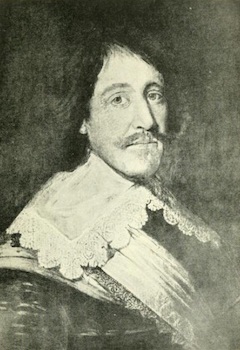
1806: Dominic Daley and James Halligan, hated foreigners

On this date in 1806, immigrants Dominic Daley and James Halligan were hanged at Northampton, Massachusetts. In the words of one widely reproduced report, “They persisted in their innocence to the last moment, although there were perhaps not a single one of the numerous spectators present, which was presumed to amount to nearly 15,000, who entertained a doubt of their guilt.”

Today, nearly everyone thinks them innocent.

The case began, as many wrongful convictions do, with a particularly outrageous crime — a young farmer, Marcus Lyon, found dead in a Massachusetts creek en route to his home in Connecticut. He’d been shot through the chest and his brains battered out of his skull. The motive: robbery.

In the absence of substantive evidence, some witnesses with vague reports of strangers on the fatal turnpike furnished tissue for an entire theory of the case, and through the misapprehended focus of tunnel vision the strangers became Irishmen, and the Irishmen became Dominic Haley and James Halligan.

In the close aftermath of American independence, New England was still overwhelmingly Anglo-Saxon and Protestant. Most of the Irish people about at this moment were also Protestants: large-scale Irish Catholic immigration into the region only began in the 1820s and it panicked the normies when it came, with preachers and politicians railing against the insidious incursions of idolatrous papists.

So in 1805, when the hunt for strangers settled on two Irish-born Catholic immigrants … well, what was left to know? Just days later, a North Wilbraham Congregationalist minister thundered from the pulpit,

We see the evil attending a continued influx of vicious and polluted foreigners in this country. Many of the outrages we suffer proceed from this source. Who break open our homes in the unsuspecting hours of sleep? Who set fire to our large cities and towns for the sake of plunder? And who rob and commit murder on our highways? We are far from exculpating all of our own native citizens; we regret, indeed, that so many of them disgrace themselves and injure society by evil deeds. But these things notwithstanding, we are doubtless justified in saying, that a great proportion of the crimes above mentioned, together with many others which might be named, are committed by foreigners. And that atrocious deed which has so recently congealed all our blood with horror, in this place, is supposed to have been perpetrated by foreigners. Look at the annual reports of the overseers of the prisons and you will find them be principally occupied by foreigners

The first planters of this country were, generally speaking, men of pure lives and good morals and they were induced to come here for the sake of religion. And, for a long time, they maintained a wholesome and orderly state of society. But since the rapid increase of our commerce with other nations, and the great ingress of foreigners, many of whom are said to come here for the sake of escaping the retribution of justice in their own country; we have ripened apace in all the arts of vice and depravity. Some, who come among us from abroad, we readily acknowledge to be worthy and good men, and we cordially welcome their approach. But the number of these is comparatively small. The best and most useful citizens are cautiously retained, while the worst are readily parted with. Hence the rapid influx upon us, of late, of the most violent and abandoned of the human race. The late and present disturbances in foreign countries have greatly increased the calamity. The prisons of Europe and the West Indies are now disgorging themselves upon our shores; and this country is thus becoming the general asylum of convicts. This is a sore evil, and will furnish an increasing number of inhabitants for our prisons and victims for the halter.

The case in court would comprise 24 witnesses not one of whom had witnessed the crime; at most they could suggest that two strangers had taken the same well-trafficked public road on the same day as the victim, who was also a stranger in these parts. Even this much was not certain among the witnesses; their renderings were vague, tentative, contradictory — but witness recollections and prejudicial readings of circumstance soon shaped themselves around the shared understanding of events, and from so much smoke they wove the hemp.

The friendless immigrants’ court-appointed attorney, Francis Blake, who had been tasked with this first capital case of his life a bare 48 hours before the trial opened, made a vehement, eloquent, and futile address to the jury against “this illiberal, this inhuman prejudice” closing around the throats of his clients.

That the prisoners have, however, been tried, convicted, and condemned, in almost every bar-room, and barber’s-shop, and in every other place of public resort in the county, is a fact which will not be contested. That the sentence of the law has not been anticipated, and that they have not already suffered the penalty of death, may be ascribed rather to defect of power, than to lenity of disposition, in many of their accusers …

There is yet another species of prejudice, against the influence of which it is my duty to warn you. I allude to the inveterate hostility against the people of that wretched country, from which the Prisoners have emigrated, for which the people of New-England are peculiarly distinguished …

Pronounce then a verdict against them! Condemn them to the gibbet! Hold out an awful warning to the wretched fugitives from that oppressed and persecuted nation! Tell them that although they are driven into the ocean, by the tempest which sweeps over their land, which lays waste their dwellings, and deluges their fields with blood; — though they float on its billows upon the broken fragments, of their liberty and independence; — yet our inhospitable coast presents no Ararat upon which they can rest in safety; that although we are not cannibals, and do not feast upon human flesh, yet with all our boasted philanthropy, which embraces every circle on the habitable globe, we have yet no mercy for a wandering and expatriated fugitive from Ireland. That the name of an Irishman is, among us, but another name, for a robber and an assassin; that every man’s hand is lifted against him; that when a crime of unexampled atrocity is perpetrated among us, we look around for an Irishman; that because he is an outlaw, with him the benevolent maxim of our law is reversed, and that the moment he is accused, he is presumed to be guilty, until his innocence appears! …

The lives of the prisoners are now consigned to your disposal. Before you proceed to the performance of this awful duty, let me borrow the language of one of their countrymen, not degraded by the ignominious reproaches against his nation, but elevated to the highest rank among the orators of the elder world by the most splendid talents, the purest patriotism, and the most unsullied integrity. Let me beseech you to “remember that there is another than a human tribunal, where the best of us, will, on one day, have occasion to look back on the little good we may have done. In that solemn trial may your verdict on this day give assurance to your bones and afford you strength and consolation in the awful presence of an adjudging God!”

The words fell on deaf ears.

Daley and Halligan maintained their innocence from arrest to execution, but in the end they would require the offices of another foreign refugee, Father Jean-Louis de Cheverus, a French-born priest in Boston, who had fled the anti-clerical paroxysms of his own homeland. (Later, he would become the first Catholic Bishop of Boston.) It’s said that he stayed in jail with his charges, as no one in Northampton would suffer the papist priest to sleep under their own roof — and that his ministrations to them included the first Catholic mass said in that city.

Folklore cropped up around the 1830s to the effect that a local man had given a deathbed confession exonerating the hanged Irishmen … and that this murderer was the kinsman of one of the witnesses against Daley and Halligan. I cannot establish that this is any more than a just-so story, a fable, but even so it speaks to the continuing injury done by this execution to the now-growing Irish Catholic community. In time that demographic’s maturing numbers and political muscle flipped the story of Daley and Halligan from one of foreigners ripened in depravity to a sobering caution against bigotry and rush to judgment.

We have no real way, now, to access a definitive assessment of guilt or innocence; we can certainly say with confidence that the evidence was appallingly flimsy to hang a man even for the time. Both Daley and Halligan were posthumously exonerated by a writ of Massachusetts Gov. Michael Dukakis in 1984. Dukakis discussed that action, and history’s view of the Daley-Halligan railroading, in a 2011 panel available in podcast form here.

For additional resources, check this Historic Northampton page (already linked several times within this post). Below, you can read the entirety of an 1806 publication reporting the trial, from which the defense lawyer’s remarks have been drawn.

On this day..

1718: A horse thief and two travelers, “the worst rideing that ever I rid”

This date’s post brings us back to one of our regular wells, James Kelly’s Gallows Speeches From Eighteenth-Century Ireland … and the days when a life was cheaper than a horse.

The three men hanged together on this date all concurred in their stories that only one of them stole the horses in question and the other two merely thumbed rides on his extra mounts as passing travellers. Whether or not this is true or was simply their common play for a potential ⅔ pardon posterity obviously has no way of determining.

The Last Speech and Dying Words of
Daniel O Neal, Edmond Mc. Guire, and Henery Graham

who was Executed near St. Stevens Green, on Wednesday June the 4th 1718.

Good Christians,

I was Born in the North of Ireland, of very good honest Parents, who brought me up very Tenderly, and never speard any Cost to Instruct and bring me up in the fear of God, Alas! all was in vain, for tho’ I took all the care that I could to attain to Learning but at the end I prov’d very Careless of the fame, for I neglected both the laws of God and Man, or else I had never been brought to this shameful End, it is true I was taken up for the Stealing of three Horses, and two Mares, and these my fellow Sufferers along with me, but as I shall Answer the great God, they Die Innocently, for as I was Riding along the Road, I overtook these my fellow Sufferers who seeing me leading 4 Horses asked me if I would let them ride, I tould them they should, now as I am a dying Man this is all they knew of it, which grives me to the Heart, and indeed I am more sorry for their Death, than my own.

I freely forgive all the World, and I beg forgiveness of all those whom I ever offended, I am now about six and thirty Years of Age, I die a [sic] of the Church of England, and the Lord have mercy on my Soul, Amen.

This is my true Speech and no other

Daniel O Neal

The Speech of Edmond M’Guire.

Good Christians,

I Was born in the North of Ireland, of Poor, but honest Parents, who with their Industry, Care and Labour, brought me to these Years, during which time, I behav’d my self true and honest in the World, and endeavour’d very hard for my Bread; but I being born to hard Fortune, I was taken up by one Mr. Legg, for being concern’d in stealing of three Horses and two Mares; ‘tiw true I had one of the aforesaid Beasts under me, but the way I came by it was in the manner following: I having been in Dublin for some time, was willing to return home to my Wife and Children, and overtaking Daniel O Neale, my fellow Sufferer; he having the Cattle abovemention’d, I ask’d him if he wou’d let me Ride, he said he wou’d oblige any Traveller as much as he could, and so bid me Mount one of the Horses, which I did, and was very thankful to him for his kindness; but to my great Sorrow, it has prov’d the worst rideing that ever I rid in my life: Now as I am a dying Man, I was never guilty of Stealing the value of two Pence in all my Life: nor had I any Hand in stealing those Beasts which I am to Dye for. I forgive all the World, as I hope to be forgiven. I am about 40 Years of Age, and Dye a Roman Catholik, and the Lord have Mercy on my Poor Soul. Amen, Amen.

The Speech of Henry Graham.

Good Christians,

I was born in the North of Ireland, of very honest Parents, who was very tender over me, and brought me up in the fear of GOD as much as in them Lay; but Fortune has been very Cruel to me, or else I had never came to this Place, for I liv’d with my Parents will I came to get a Wife; and indeed it was my Fortune to get a poor honest Girl, who endeavour’d very honest for her Bread as well as I, but the World frowning upon me, I went and listed in the Army, where I behav’d myself as became a good Subject, at lenth [sic] I was broak, and so return’d home to my Wife again, but my Business calling me home to Dublin, to my great Sorrow I went there, but having finish’d my Business, I was going home again, where unfortunately I met with Daniel O. Neal, and Edmond M’Guire a Riding along the Road, to whom I said, pray let me Ride, and indeed, they freely comply’d, but I had not Rid long before we were all taken and committed to Goal, and from that brought to Dublin, so Try’d and found Guilty of the same, and now brought to [t]his Place to end my life, now as God is my Judge, before whom I hope to appear in short time, I had neither Art nor Part in stealing of the said Horses, or any of them, and I die in Charity with all Men, and do freely forgive those who Swore away my Life as I hope to be forgiven, I am about 30 years of Age. I die a Protestant and the Lord have mercy on my Soul.

Henry Graham.

On this day..

1946: Chen Gongbo, puppet president

On this date in 1946, Chen Gongbo, president of China under the Japanese occupation, was shot for treason.

Briefly a Communist in his youth, Chen was Kuomintang state minister, then was pulled into the Japanese puppet government.

He served from 1940 as Mayor of Shanghai and speaker of the legislature, and late in 1944 became Acting President and soon actual President when ailing President Wang Jingwei traveled to Japan for medical treatment and died.

It was not long before Chen too had to relocate to Japan — in his case, as a fugitive. He was arrested and extradited back to China, where he defended himself from charges of collaboration arguing that he had acted only out of personal loyalty to his friend Wang. “Soon I will be reunited with Wang Jingwei in the next world,” was his tragic and filial sentiment upon learning his fate.

On this day..

1453: Alvaro de Luna, Spanish favorite

On this date in 1453, the man who was once the power behind Castile’s throne became its foremost cautionary metaphor.

The greatest privado — royal favorite — in Spain’s annals, Alvaro de Luna (English Wikipedia entry | the far more detailed Spanish) sprang from noble albeit illiterate stock. He came to the Castilian court in 1410 as a witty and talented young page and adroitly got his hooks into the five-year-old crown prince, the future Juan II.

Quite uncommonly for a royal favorite, Don Alvaro held his king’s affection for many decades, and even while enriching himself into the mightiest subject in the land, he energetically served his prince’s interest.

Chief among these was managing the truculent nobility who would surely have dominated the weak-willed Juan but for his capable lieutenant — who was known from 1423 as the Constable of Castile and Count of San Esteban de Gormaz in 1423. Don Alvaro proved a consummate politico, scheming to deflect the ambitions of Juan’s rivals and to consolidate the power of the throne … which meant his own power, too. To a very great degree the favorite was the real sovereign, until he suddenly wasn’t.

“Alvaro de Luna would probably not be particularly consoled by the judgement of modern historians,” observes a wry James Boyden in The World of the Favourite** — for they “praise his efforts on behalf of Juan II for opening the way to royal absolutism in Castile, citing his own arbitrary death sentence as the clinching proof of the newfound powers of the crown.”

Don Alvaro’s downfall from his post of seemingly unassailable preeminence satisfied every literary device imaginable, beginning with poetic justice.

When Juan’s first wife, Maria of Aragon, died in 1445 — and Don Alvaro’s own hand has been suspected in that death — the Constable managed Juan’s pivot to 19-year-old Portuguese princess Isabella as the successor queen.

From her advantageous position in the king’s bed, Isabella soon began to work against Don Alvaro. She resented his intrusions into even their most intimate chambers, and she surely feared sharing the fate of her predecessor, Maria. Eventually, her arguments carried the day. Boyden once again:

It is difficult to imagine a more striking illustration of the transitory nature of earthly fortune than the spectacle of the constable’s execution in a public square of Valladolid on 2 June 1453. Certainly the event caught the imagination of contemporary poets. ‘Look then to that great Constable,’ wrote Jorge Manrique, ‘the Master whom we knew so deeply favoured by the king / And yet even of him nothing more need be said than that we saw him beheaded. / His limitless treasures, his towns and villages, his power of command / What did they bring him but tears? / What were they to him except sorrows at the leaving?’

According to Juan II, Don Alvaro’s principal crime was that he ‘has for a long time held and usurped a chief position near me and in my household and court’, and despite having been admonished about his excessive pride and effrontery ‘he has persevered in it … grasping more power to himself each day, excessively, without temperance or measure, so that there remains to me no more room to rule and administer my kingdoms personally, nor to maintain my towns in justice and truth and law …’

Not surprisingly, the constable saw matters in another light. While the king alleged usurpation of his royal authority, Don Alvaro responded with a charge of ingratitude, levelled in a tone meant to convey the sadness and resignation of a loyal servant stripped at last of his illusions. Rather than withdraw into a well-deserved retirement after forty-five years of service, he wrote,

I chose … to serve as I was in duty bound and as I felt the situation demanded; I deceived myself, for this service has been the cause of my misfortune. How bitter that I should find myself deprived of liberty who more than once have risked life and fortune to preserve your highness’s freedom! I am well aware that for my great sins I have angered God, and I will consider it a boon if I can placate his rage through these travails.

This appeal to justice was accompanied by an offer of treasure, but neither swayed the king, who was so intent upon Don Alvaro’s destruction that he would finally order his execution despite the failure of a hand-picked tribunal to render a clear sentence of death.

Although it cut no ice with his king, Alvaro de Luna’s posture of betrayed fidelity — his courage and dignity on the scaffold, ere his throat was cut and his severed head mounted on a hook — helped to salvage what might easily have become a hateful reputation among Spaniards. The annalist Pedro de Escavias recorded that Don Alvaro “struck terror into all who saw him” but “he died with a good countenance and good courage, as a knight and a faithful Christian should. May God forgive him, for he handled many great matters in the days when he enjoyed the king’s favour.” (Quoted in the out-of-print volume The Greatest Man Uncrowned: A Study of the Fall of Don Alvaro de Luna) This respectful epitaph is evident in the numerous artistic treatments around the Constable’s corpse.


Collection to Bury the Body of Alvaro de Luna, by Ramirez Ibanez Manual (1884)

Collection to Bury the Body of Alvaro de Luna, by Jose Maria Rodriguez de Losada (1867)

Burial of Alvaro de Luna, by Eduardo Cano de la Pena (19th century).

Juan’s rancor did not extend to denying his favorite an ornate tomb in Toledo Cathedral. Like all the best sovereign-favorite pairs — Richelieu comes to mind — Juan II soon followed to the grave his secret-sharer, dying in July 1454 allegedly stricken with remorse.† His daughter was Isabella of Castile, famed of Christopher Columbus sponsorship.

* There appears to be some ambiguity among sources between June 2 and June 3 whose resolution lies beyond the reach of myself and perhaps of any human. I tentatively prefer June 2 based on a preponderance of citations, and because June 3 was a Sunday.

** There’s also a fine essay on our principal to be found in The Emergence of León-Castile c.1065-1500: Essays Presented to J.F. O’Callaghan.

† However, Juan’s knowledge of his own failing health and a desire to disencumber his successors of this overmighty minister have also been suggested as reasons for Don Alvaro’s destruction. The favorite treads a very treacherous road indeed.

On this day..

1813: A Nez Perce thief, by the Pacific Fur Company

On this date in 1813, Anglo-American fur trader John Clarke had an indigenous Nez Perce summarily hanged for stealing a goblet … dangerously poisoning relations between the respective communities in the Pacific Northwest.

We lay our day’s scene in the Oregon Territory, far frontier of then-only-prospective American continental expansion, beyond even the fathomless reaches of the Louisiana Purchase. The Stars and Stripes had penetrated there courtesy of the Lewis and Clark Expedition, but British, Spanish, and Russian expeditions had planted their own flags too, to say nothing of the claims of its native inhabitants.

And all these claimants had one common desire: the pelts of the beavers swarming that verdant sector.

The New York businessman John Jacob Astor bought a stake in the fur trade in the form of the Pacific Fur Company, and set down the outpost of Astoria, Oregon. (Astor was destined to become one of the republic’s early homegrown plutocrats, a fact which is merely incidental for our purposes. It was the fur business that propelled him to wealth.)

One agent of the P.F.C. was a singularly undiplomatic trader aged about 31 summers, John Clarke. Calling on a mixed Nez Perce-Palouse village to trade his canoes for horses to make an overland journey, Clarke was irritated to find that prices weren’t to his liking and the locals enjoyed pilfering his baubles.

American scribbler Washington Irving recorded the ensuing events:

[Clarke] was a tall, good-looking man, and somewhat given to pomp and circumstance, which made him an object of note in the eyes of the wondering savages. He was stately, too, in his appointments, and had a silver goblet or drinking cup, out of which he would drink with a magnificent air, and then lock it up in a large gardevin, which accompanied him in his travels, and stood in his tent. This goblet had originally been sent as a present from Mr. Astor to Mr. M’Kay, the partner who had unfortunately been blown up in the Tonquin. As it reached Astoria after the departure of that gentleman, it had remained in the possession of Mr. Clarke.

A silver goblet was too glittering a prize not to catch the eye of a Pierced-nose. It was like the shining tin case of John Reed. Such a wonder had never been seen in the land before. The Indians talked about it to one another. They marked the care with which it was deposited in the gardevin, like a relic in its shrine, and concluded that it must be a “great medicine.” That night Mr. Clarke neglected to lock up his treasure; in the morning the sacred casket was open—the precious relic gone!

Clarke was now outrageous. All the past vexations that he had suffered from this pilfering community rose to mind, and he threatened that, unless the goblet was promptly returned, he would hang the thief should he eventually discover him. The day [May 31st, 1813] gassed away, however, without the restoration of the cup. At night sentinels were secretly posted about the camp. With all their vigilance a Pierced-nose contrived to get into the camp unperceived, and to load himself with booty; it was only on his retreat that he was discovered and taken. At daybreak the culprit was brought to trial, and promptly convicted. He stood responsible for all the spoliations of the camp, the precious goblet among the number, and Mr. Clarke passed sentence of death upon him.

A gibbet was accordingly constructed of oars; the chief of the village and his people were assembled and the culprit was produced, with his legs and arms pinioned. Clarke then made a harangue. He reminded the tribe of the benefits he had bestowed upon them during his former visits, and the many thefts an other misdeeds which he had overlooked. The prisoner especially had always been peculiarly well treated by the white men, but had repeatedly been guilty of pilfering. He was to be punished for his own misdeeds, and as a warning to is tribe.

The Indians now gathered round Mr. Clarke and interceded for the culprit, They were willing he should be punished severely, but implored that his life might be spared. The companions, too, of Mr. Clarke, considered the sentence too severe, and advised him to mitigate it; but he was inexorable. He was not naturally a stern or cruel man; but from his boyhood he had lived in the Indian country among lndian traders, and held the life of a savage extremely cheap. He was, moreover, a firm believer in the doctrine of intimidation.

Farnham, a clerk, a tall “Green Mountain boy” from Vermont, who had been robbed of a pistol, acted as executioner. The signal was given, and the poor Pierced-nose, resisting, struggling, and screaming, in the most frightful manner, was launched into eternity. The Indians stood round gazing in silence and mute awe, but made no attempt to oppose the execution, nor testified any emotion when it was over. They locked up their feelings within their bosoms until an opportunity should arrive to gratify them with — a bloody act of vengeance.

Having made his grand gesture, Clarke quickly realized that he had enacted it while his small party was alone in an Indian village where they were at the mercy of their far more numerous hosts. Fearing a backlash, the white traders accordingly hightailed it back to Astoria, and then evacuated Astoria itself.

On this day..

1431: Beaumont and Vivonne

From The Law of Treason and Treason Trials in Later Medieval France:

Little is known about the prosecution of treason during the first fifteen years of Charles VII‘s reign. A few minor cases only came before the Parlement of Poitiers. Struggling to consolidate his position against the Anglo-Burgundians, Charles VII appears to have tacitly approved of, even to have subtly encouraged, court intrigues. But when political machinations went beyond certain limits, as was the case with Louis d’Amboise, vicomte of Thouars, Andre de Beaumont, baron of La Haye, and Antoine de Vivonne, Charles VII did not hesitate to act with the full authority at his disposal. During the winter of 1429-30 Amboise, Beaumont and Vivonne plotted not only to seize Georges de La Tremoille, the most powerful lord at court, and to kill him if necessary, but also to take the king into custody. Amboise was one of Artur de Richemont‘s staunchest allies, and one does not have to look very hard to see the hand of the constable, then fallen from grace, in this conspiracy to take control of the government. Amboise, Beaumont and Vivonne were arrested in mid-November 1430, but it seems that not all the details of their treason were known to the king at that time. When Charles VII decided to take Amboise with him from Loches to Saint-Aignan, Amboise managed to send word to his intimates and advised them to ambush the royal party in order to free him. It was the king’s discovery of this communication that sealed Amboise’s fate. He, Vivonne and Beaumont were subsequently imprisoned at Poitiers. Charles VII then commissioned the presidents and lay councillors of the Parlement there, along with several members of the grand conseil, to conduct their trial. On the advice of his commissioners Charles VII himself then condemned the three traitors to death, with confiscation of their property. This procedure was a compromise between the king’s personal act of justice and condemnation by a court, and was to be a regular feature of the prosecution of treason in the reigns of Charles VII and Louis XI. On 31 May 1431 Beaumont and Vivonne were executed, but Charles VII commuted Amboise’s death sentence to a term of imprisonment ‘at our good pleasure’; and Amboise’s children were spared the penalty of complete disinheritance that would ordinarily have ensued. In not having Amboise executed Charles VII demonstrated for the first time the clemency towards members of the higher nobility that was a distinct characteristic of his rule. In 1434, at the intercession of Yolande d’Aragon and Charles d’Anjou — La Tremoille had since fallen from power and the Angevins were now in the ascendants at court — Charles VII released Amboise from prison and restored to him all of his property except for the castellanies of Chaumont, Chateau-Gontier and Amboise.

On this day..

1916: The Zainuco Massacre

On this date in 1916, eight convicts were summarily executed by Argentine police after a prison break in an affair known as the Zainuco Massacre.

Almost all the information about this event available online appears in Spanish and this also applies to the links in this post.

Jose Cancino, Nicolas Ayacura, Fructuoso Padin, Jose Lopez, Antonio Stradelli, Transito Alvarez, Francisco Cerda and Desiderio Guzman were among the last escapees among over 100 inmates who had overpowered their guards and fled the overcrowded Nequen prison on May 23.

Most of these men would be trapped and re-arrested in the coming days, but a large body of them forged rapidly westward, hoping to cover the 500 kilometers to the Chilean border. Not until a week later did police catch up with them, at a place called Zanaicuo south of the city of Zapala.

Bivouaced at a ranch there, the fugitives* were awakened from their rest during the dark early hours of May 30 by a fusillade; they had looted where possible during their flight, but their ammunition was not plentiful and quickly exhausted itself, forcing the escapees’ surrender.

At this point, their captors divided their prizes, either 15 or 16 souls, into two halves. The first of these halves, the lucky half, marched away to Zapala, destined to return to their irons. The other eight were brought to a lagoon, putatively to freshen up … and there they were shot dead, to a man. The cops’ story was that a couple of them tried to grab guns, though a resident of the parts who found the bodies reported that all eight had been shot execution-style in the head. They were consigned to a mass grave.

A few months later, nosy Neuquen journalist Abel Chaneton, who evinced an unwanted degree of interest in this incident, was also shot dead by police, permitting the quiet closure of the case.

And there it has rested ever since — mostly in obscurity, although a human rights consortium recently marked the centennial of the killings by placing a sculpture and marker, reading:

100 years after the Zainuco massacre, we rise up against oblivion and the impunity of this and all the crimes of the state authorities.

* A South African named Martin Bresler had separated from the main body of prisoners and did indeed manage to reach Chile — allegedly surviving a freezing night by nesting inside his horse, tauntaun style. He moved to the United States, fought in World War I, and wound up dying in a Buenos Aires mental asylum in 1942.

On this day..

1503: A banderaio and an executioner

Courtesy of Emotions in the Heart of the City (14th-16th century), we travel to Florence during its between-Medicis republican interim* for a very emotional execution:

On the morning of 29 May 1503, outside the city’s great Gate of Justice,** a young flag-maker (banderaio) was put to death for having murdered another banderaio. In a scene that struck the throng of spectators as an outrage, the executioner had failed to cut off his head even after three blows of his sword. The sight must have been grisly, for the attending mounted captain was next forced to move in and club the flag-maker to death. The compassion of the crowd now pivoted into incandescent rage. A tumult broke out, as men and boys directed a cannonade of rocks at the executioner. There was, in addition, something oddly religious about the event, because rocks were also thrown at the men hooded in black, the members of the religious confraternity who were there to offer comfort to the unfortunate banderaio. They had to flee for their lives. The executioner was killed, and children then lugged his corpse around, worked their way back into the city, and dragged the body all the way up to the Franciscan Church of Santa Croce. Were they sending a message to Savonarola‘s great local enemies, the Franciscans? There was a possible religious subtext to this episode : some contemporaries claimed that the hangman had been punished — he was the very same man — for having first insulted and then hanged Savonarola five years previously. It goes without saying that he had died without last rites, and the dragging about of his body again touched on something religious in being subject to a ‘ceremony’ of desecration.

Although I cannot locate an online version of this document, it appears to me that a primary source for this incident is the chronicle of Simone Filipepi. This historian is a bit less famous than his little brother Alessandro Filipepi … who is inscribed in the annals of art’s history by his nickname (meaning “Little Barrel”) as Sandro Botticelli.

Tangentially, readers might also enjoy this 1625 instance of a clumsy executioner being lynched: in that case, his proposed prey actually survived the scaffold. A similar fate nearly befell notorious English hangman Jack Ketch, after his maladroit butchering of the Duke of Monmouth in 1685.

* This period prior to the restoration of the Medici was also Machiavelli’s political heyday. (He wrote his classics of statecraft after Giuliano de’ Medici subsequently recaptured Florence from the pie-eyed republicans and retired Machiavelli to countryside exile.)

** This public domain English translation of Guido Carocci‘s classic Firenze Scomparsa (Bygone Florence) illuminates some of the relevant topography.

A tower which now only consists of four stone walls, plain and undecorated, but which some day must have been much higher and surmounted by battlements, rises at the end of the Lungarno apposite the viale Carlo Alberto.

It is the sole remnant, the only souvenir of a number of ancient buildings which were situated in this position, and were known as the old mint (Zecca Vecchia).

Previous to the demolition of the walls the tower reared its massive proportions on the river bank in the midst of the ramparts of a dismantled fortress, near a mill race and buildings next the walls which at this point showed traces of a walled up gate.

The buildings next to the tower seemed a mixture of old and modern construction with large arched rooms, long corridors and balconies overhanging the canal from the Arno — which gave motive power to the wheels of various cloth mills.

These houses, which grouped en masse were of singular picturesqueness, completed the view of green banks and vine covered hills lining the river and were full of interesting historical associations.

A postern gate was situated here, flanked by a tower on the river bank to defend the city from a water attack; this was called the Gate of Justice, and its name calls up painful and melancholy memories. Outside the walls at the end of a meadow beyond the moat was a small low church whose facade was frescoed with sad subjects. In this meadow was placed the gallows and executionary scaffold. The Gate of Justice was generally closed for the better security of the city and was only thrown open for the passage of religious companies accompanying condemned criminals to the place of execution.

The street through which they passed to the gate was very appropriately known as Via Malcontenti, (Street of the Discontented).


Via dei Malcontenti, Florence (c. 1880) by Telemaco Signorini.

In 1346 criminals condemned to death were brought to a chapel, still in existence, next to the church of San Giuseppe in Via Malcontenti were tied to an iron ring which may still be seen in the pavement, but afterwards the little church outside the walls was built for this last grim service. [If this artifact still exists, I would be indebted to anyone who can supply a picture of it. -ed.]

The church was used as a resting place where the penitent might offer his short and final prayer before being handed over to the executioner.

The victims’ bodies remained suspended on the gallows for days in order to act as a wholesome warning to all evil disposed persons, but the Florentines, who must have their little joke even on the most solemn subjects, called these meadows which formerly belonged to the Nemi family, the paretaio of the Nemi (bird-catching place of the Nemi).

The gate of Justice was walled up during the great siege, and after that the lugubrious procession passed through the Porta alla Croce. In our times traces of this gate, partly buried in the raised soil, could still be seen previous to the destruction of the old walls and above it the hole through which every defensive missile might be hurled on attacking parties below.

On this day..

1753: George Robertson, prick

We are indebted to the redoubtable medical historian Dr. Lindsey Fitzharris for the substance of this post, which she brought to our attention on her blog, The Chirurgeon’s Apprentice. Fans of the macabre, and particularly of the recurring medicinal theme here at Executed Today, are sure to enjoy her book The Butchering Art: Joseph Lister’s Quest to Transform the Grisly World of Victorian Medicine — or her “Under the Knife” video series.

We (and Dr. Fitzharris) enter these sensitive parts via a bit of junk preserved at the Royal College of Surgeons: the severed penis which long ago inhabited, along with the bacterium Neisseria gonorrhoeae, the trousers of a highway robber named George Robertson.

Neither bacterium nor reader will be surprised to discover that when Robertson and a couple of other hard men knocked down James Holland in Mansfield Street to dispossess him of his hat and his wig, the pestilential thief resided at “a bawdy-house” (per the evidence of his perfunctory trial).

We don’t know the ins and outs of what this specimen got up to when Robertson had his liberty — only that its condition was so obvious that it interested the doctors. With nary a care for patient privacy, the Ordinary of Newgate emitted to the public that Robertson felt “so ill with the foul Disease, as not to be able to walk, and wished himself dead, because he had no Money or Friend to put him in the Hospital.”*

Agony though it might have been to our dissolute footpad, such cocks excited the physicians.

Dr. Fitzharris directs our attention to A Treatise on the Venereal Disease, by Robertson’s contemporary, the surgeon John Hunter. Hunter might well have fondled this very todger in his own day; as we learn from this turgid treatise, he and his colleagues found in the engorged members of the hung a penetrating scientific tool. The eightfold execution in the spring of 1753 that Hunter references below might be a previous Tyburn hanging date, of February 12, 1753. (That hanging included Robertson’s accomplice John Briant or Bryant: no word on the condition of John Briant’s John Thomas.)

Till about the year 1753 it was generally supposed, that the matter from the urethra in a gonorrhoea arose from an ulcer or ulcers in that passage; but from observation it was then proved that this was not the cafe. It may not be improper to give here a short history of the discovery of matter being formed by inflammation without ulceration.

In the winter 1749, a child was brought into the room used for dissection, in Covent Garden, on opening of whose thorax a large quantity of pus was found loose in the cavity, with the surface of the lungs and the pleura furred over with a more solid substance similar to coagulable lymph. On removing this from those surfaces they were found intire. This appearance being new to Dr. Hunter, he sent to Mr. Samuel Sharp, desiring his attendance, and to him it also appeared new. Mr. Sharp afterwards in the year 1750, published his Critical Enquiry, in which he introduced this fact, “That matter may be formed without a breach of substance;” not mentioning whence he had derived this notion. It was ever after taught by Dr. Hunter in his lectures ; we however find writers adopting it without quoting either Mr. Sharp or Dr. Hunter. So much being known, I was anxious to examine whether the matter in a gonorrhoea was formed in the same way. In the spring of 1753 there was an execution of eight men, two of whom I knew had at that time very severe gonorrhoeas. Their bodies being procured for this particular purpose, we were very accurate in our examination, but found no ulceration, the two urethras appeared merely a little blood-shot, especially near the glans. This being another new fact ascertained, it could not escape Mr. Gataker, ever attentive to his emolument, who was then attending Dr. Hunter’s lectures, and also practising dissection under me. He published, soon after in 1754, a treatise on this disease, and explained fully, that the matter in a gonorrhoea did not arise from an ulcer, without mentioning how he acquired this knowledge; and it has ever since been adopted in publications on this subject. Since the period mentioned above, I have constantly paid particular attention to this circumstance, and have opened the urethra of many who at the time of their death had a gonorrhoea, yet have never found a fore in any ; but always observed that the urethra near the glans was more blood-shot than usual, and that the lacunae were often filled with matter.

* As usual, the Ordinary plied the condemned while they languished in Newgate. However, he broke with his usual practice and did not make the trip to Tyburn for this triple execution, “because as they all three died Roman Catholicks, I did not choose to attend, to give them the Opportunity of turning their Backs upon me, as a Protestant Minister, which I knew they must do if I did.”

On this day..

1661: Archibald Campbell

On this date in 1661, Presbyterian lord Archibald Campbell, the first Marquess of Argyll, lost his head at Edinburgh.

Once a privy councilor to King Charles I, “Red Argyll” had been in the 1640s a great champion of Scottish national liberty and a leader of the Presbyterians in the many-sided wars that tore apart the British Isles.
Scotland’s Presbyterians — who favored bottom-up church governance as opposed to the crown-controlled selection of bishops that’s known as episcopacy — made an initial alliance with English Parliamentarians to support one another in their mutual hostilities with King Charles I. And in Scotland’s civil war in the mid-1640s, Argyll’s Presbyterians defeated the Earl of Montrose‘s royalists.

But the failure of Oliver Cromwell‘s similarly victorious Parliament to deliver on its covenant fractured the Presbyterian party and drove Argyll to the political sideline.

Argyll’s own opposition to other Presbyterians’ attempted engagement with the imprisoned Charles I became untenable when, to the horror of his countrymen, Charles was beheaded by Parliament. As his entry in the Dictionary of National Biography notes, Charles’s execution “completely upset his calculations, which had all along been founded on a close union between the parliaments of Scotland and of England … the results of his safe and prudent policy were ruthlessly annihilated … [and] Argyll lost his presence of mind, and therefore his control of events in this stupendous conjuncture, and became as much a puppet in the hands of contending factions as was Charles II.” His growing ranks of foes derisively nicknamed him the “Glaed-Eyed Marquis”, attributing an obvious metaphorical import to his imperfect eyesight.

“Myself encountered so many difficulties that all remedies that were applied had the quite contrary operation,” he later wrote of those years when his influence waned. “[I was] a distracted man of a distracted subject in a distracted time wherein I lived.” It did not wane all at once: Argyll had the honor of crowning King Charles II at Scone on the first of January, 1651, and even tested the king with dynastic marriage inquiries for his daughter. (No dice.)

But as events ran away from him he fell into debt, disgrace, and irrelevancy.

When Charles II resumed the throne in 1660, Argyll presented himself at the court of his would-be father-in-law, and was surprised to find himself immediately thrown in the Tower. Like the Presbyterian cause itself, he was permanently and tragically alienated from both factions of the English Civil War: Cromwell always suspected Argyll a royalist for that whole crowning-the-king thing, and Charles always resented Argyll for his part in the destruction of his father.

The Glaed-Eyed Marquis found himself shipped off to Edinburgh to stand trial for treason. Although records of the trial are lost, it’s said that he was on the verge of total acquittal when Cromwell’s former commander in Scotland, George Monck, delivered a packet of incriminating letters. This story might be apocryphal but Argyll lost his head all the same, on Edinburgh’s distinctive Maiden.

Peruse here Argyll’s tart and downright comical last will and testament, satirizing many of the surviving figures of the day and bidding his heirs to lay his body “so shallow, that at the next trump of sedition, it may by the same raise-devil directory [i.e., Parliament] be conjured up again, and meet my exalted head, that bound-mark of Presbytery, its ne plus ultra, ‘Hitherto shall you go and no further.'”


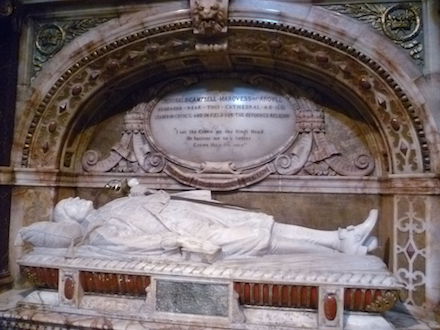
Memorial to Archibald Campbell in Edinburgh’s St Giles’ Cathedral with the epitaph “I set the Crown on the King’s Head. He hastens me to a better Crown than his own.” (cc) image from Kim Traynor.

Argyll’s son and heir, also named Archibald Campbell, was himself executed in 1685 for organizing a Scottish “Argyll’s Rising” against King James II in alliance with the Duke of Monmouth. Their descendants still maintain the rank of Duke of Argyll to this day.

On this day..