602: Emperor Maurice and all his heirs

On this date in 602 (although some sources prefer November 23, but that’s close enough for ancient history) the 20-year reign of Byzantine Emperor Maurice came to a most unpleasant conclusion.

No gangster of love, Maurice made his bones (and other bones) as a military commander in a running war with the Sassanids unproductively engaged by the forgettable successors of Justinian.

So successful was the progress of his arms that Emperor Tiberius II Constantine married his daughter to Maurice and set him up as the official heir, a sage expedient considering that Roman commanders had once been known to take the succession into their own hands.

In fact, that’s exactly what happened to Maurice.

As a reward for his many victories in the field, Maurice got to take charge of a badly stumbling state: war both east and west (Maurice made peace with the Persians and brought the Slavs and Avars to heel in the Balkans), the intractable intra-Christian Monophysite controversy (Maurice extended a politic religious toleration), the bankruptcy of his state (Maurice cleaned up the reckless prodigality of his predecessors). For twenty years Maurice managed as well as anyone a very messy situation that in clumsier hands might easily have consumed the state entirely.

In the end this might be his legacy, for good and ill: a manager, not a visionary. Byzantium maybe doesn’t even survive without Maurice, but he was not fated to be familiar to posterity’s every schoolchild like Octavian Augustus — merely to lose his job to office politics.

Maurice, says Charles William Previte-Orton, “was a better judge of policy than of men.” And while the emperor “saw the dire need of economy,” he “forgot that the army did not” and so fatally disregarded “the ferment among the overtried soldiery.”

Maurice had already irritated his Dacian legions by refusing to pay an Avar ransom for their captured brethren — that fiscal rectitude thing, always a dangerous virtue to exercise in proximity to armed men. Now, he provocatively dialed back their pay and then tried to keep them beyond the frontier in Avar territory rather than retiring to home winter quarters.

The legions mutinied, thrusting a mere centurion named Phocas (or Phokas) to their fore. As Maurice commanded neither love nor fear in his home precincts, Constantinople itself yielded readily to the rebels while the enervated erstwhile emperor crossed the Bosphorus and there resigned to his fate not only himself but the several sons he had been designating to succeed him on thrones East and West. Gibbon:

Phocas made his public entry in a chariot drawn by four white horses: the revolt of the troops was rewarded by a lavish donative; and the new sovereign, after visiting the palace, beheld from his throne the games of the hippodrome. … The ministers of death were despatched to Chalcedon: they dragged the emperor from his sanctuary; and the five sons of Maurice were successively murdered before the eyes of their agonizing parent. At each stroke, which he felt in his heart, he found strength to rehearse a pious ejaculation: “Thou art just, O Lord! and thy judgments are righteous.” And such, in the last moments, was his rigid attachment to truth and justice, that he revealed to the soldiers the pious falsehood of a nurse who presented her own child in the place of a royal infant. The tragic scene was finally closed by the execution of the emperor himself, in the twentieth year of his reign, and the sixty-third of his age. The bodies of the father and his five sons were cast into the sea; their heads were exposed at Constantinople to the insults or pity of the multitude; and it was not till some signs of putrefaction had appeared, that Phocas connived at the private burial of these venerable remains. In that grave, the faults and errors of Maurice were kindly interred. His fate alone was remembered; and at the end of twenty years, in the recital of the history of Theophylact, the mournful tale was interrupted by the tears of the audience.

Maurice’s widow Constantina and his daughters were suffered to live, but only for a few years more: they too were eventually put to death for plotting. It was the perfect way to kick off a calamitous century for the Byzantines.

Phocas wore the purple from 602 to 610. Just guess how his term in office ended.

The History of Byzantium podcast covers Maurice’s rough go at the top in episode 34, 35, and 36.

On this day..

1698: Old Believer popes and Princess Sophia’s petitioners

This entry in our Corpses Strewn series on the October 1698 extirpation of the Streltsy is courtesy of the diaries of Austrian diplomat Johann Georg Korb, an eyewitness to the events.

Today was assigned for the punishment of the popes — that is to say, of those who by carrying images to induce the serfs to side with the Strelitz, had invoked the aid of God with the holy rites of his altars for the happy success of this impious plot. The place selected by the judge for the execution was the open space in front of the church of the most Holy Trinity, which is the high church of Moscow. The ignominious gibbet cross awaited the popes, by way of reward in suit with the thousands of signs of the cross they had made, and as their fee for all the benedictions they had given to the refractory troops. The court jester, in the mimic attire of a pope, made the halter ready, and adjusted it, as it was held to be wrong to subject a pope to the hands of the common hangman. A certain Dumnoi struck off the head of another pope, and set his corpse upon the ignominious wheel. Close to the church, too, the halter and wheel proclaimed the enormity of the crime of their guilty burden to the passers by.

The Czar’s Majesty looked on from his carriage while the popes were hurried to execution. To the populace, who flood around in great numbers, he spoke a few words touching the perfidy of the popes, adding the threat, “Henceforward let no one dare to ask any pope to pray for such an intention.” A little while before the execution of the popes, two rebels, brothers, having had their thighs and other members broken in front of the Castle of the Kremlin, were set alive upon the wheel: twenty others on whom the axe had done its office lay lifeless around these wheels. The two that were bound upon the wheel beheld their third brother among the dead. Nobody will easily believe how lamentable were their cries and howls, unless he has well weighed their excruciations and the greatness of their tortures. I saw their broken thighs tied to the wheel with ropes strained as tightly as possible, so that in all that deluge of torture I do believe none can have exceeded that of the utter impossibility of the least movement. Their miserable cries had struck the Czar as he was being driven past. He went up to the wheels, and first promised speedy death, and afterwards proffered them a free pardon, if they would confess sincerely. But when upon the very wheel he found them more obstinate than ever, and that they would give no other answer than that they would confess nothing, and that their penalty was nearly paid in full, the Czar left them to the agonies of death, and hastened on to the Monastery of the Nuns, in front of which monastery there were thirty gibbets erected in a quadrangular shape, from which there hung two hundred and thirty Strelitz. The three principal ringleaders, who presented a petition to [Peter’s half-sister and rival] Sophia, touching the administration of the realm, were hanged close to the windows of that princess, presenting, as it were, the petitions that were placed in their hands, so near that Sophia might with ease touch them. Perhaps this was in order to load Sophia with that remorse in every way, which I believe drove her to take the religious habit, in order to pass to a better life.

On this day..

1698: 350 Streltsy by the boyars’ own hands

This entry in our Corpses Strewn series on the October 1698 extirpation of the Streltsy is courtesy of the diaries of Austrian diplomat Johann Georg Korb, an eyewitness to the events.

This differed confiderably from those that preceded. The manner of it was quite different, and hardly credible. Three hundred and thirty at a time were led out together to the fatal axe’s stroke, and embrued the whole plain with native but impious blood: for all the Boyars, Senators of the realm, Dumnoi, Diaks, and so forth, that were present at the council constituted against the rebel Strelitz, had been summoned by the Czar’s command to Bebraschentsko, and enjoined to take upon themselves the hangman’s office. Some struck the blow unsteadily, and with trembling hands assumed this new and unaccustomed task. The most unfortunate stroke among all the Boyars was given by him whose erring sword struck the back instead of the neck, and thus chopping the Strelitz almost in halves, would have roused him to desperation with pain, had not Alexasca* reached the unhappy wretch a surer blow of an axe on the neck.

Prince Romadonowski, under whose command previous to the mutiny these four regiments were to have watched the turbulent gatherings in Poland on the frontier, beheaded, according to order, one out of each regiment. Lastly, to every Boyar a Strelitz was led up, whom he was to behead. The Czar, in his saddle, looked on at the whole tragedy.

* Alexasca was a nickname for the (future) Gen. Aleksandr Menshikov, one of young Peter’s loyal boon companions.

Peter scornfully reproached many of the nobles who trembled at being compelled to behead some rebels; adding in a strain of sanguinary justice, “No victim is more acceptable to the Deity than a wicked man.” Mentchikof, however, did not labour under such delicate feelings; for as a prelude to the execution of one hundred and fifty Strelitz, he drove through the streets of Moscow in a sledge, brandishing a naked sword, and boasted of his adroitness in cutting off twenty heads. (Source)

On this day..

1698: 250 Streltsy from the walls of Moscow

This entry in our Corpses Strewn series on the October 1698 extirpation of the Streltsy is courtesy of the diaries of Austrian diplomat Johann Georg Korb, an eyewitness to the events.

To prove to all the people how holy and inviolable are those walls of the city [of Moscow], which the Strelitz rashly meditated scaling in a sudden assault, beams were run out from all the embrasures in the walls near the gates, on each of which two rebels were hanged. This day beheld about two hundred and fifty die that death. There are few cities fortified with as many palisades as Moscow has given gibbets to her guardian Strelitz.

On this day..

1998: Twenty-four Sierra Leone rebels

Fifteen years ago today, thousands of Freetown residents piled into a stone quarry on the outskirts of the Sierra Leone capital to cheer the firing squad executions of two dozen soldiers linked to the previous year’s coup.

In an episode of Sierra Leone’s intractable 1990s civil war, the government of Ahmad Tejan Kabbah was overthrown in 1997 by a military clique in alliance with the murderous Revolutionary United Front (RUF).

This was the height of Sierra Leone’s “blood diamond” chaos, and the RUF had earned an international reputation for savagery in exploiting this lucrative trade — most vividly symbolized by thousands of civilians whose arms or legs were chopped off in an effort to induce population flight away from the diamond mines it intended to control.

The RUF lived down to its terrifying reputation when it marched into Freetown with its military allies in May 1997. Disorderly gangs brandishing AK-47s looted buildings in Freetown* as President Kabbah fled the country.

The oppressive putsch was short-lived: Nigerian-backed intervention reversed the coup early in 1998, causing the RUF to melt back into the bush.**

The Freetown populace’s enthusiasm for revenge against the rebels is to be understood in this light. Those shot at the quarry this date included some major figures in the coup, according to the New York Times: “Brig. Samuel Koroma, a former chief of defense staff and the elder brother of the junta leader, Johnny Paul Koroma, who is a fugitive, and Cpl. Tamba Gborie, the man who announced the coup. The junta secretary general, Col. Abdul Karim Sesay, was also executed.”

The African Commission on Human and Peoples’ Rights later found Sierra Leone in violation of the African Charter on Human and Peoples’ Rights for denying the soldiers a “right of appeal to competent national organs” which “falls short of the requirement of the respect for fair trial standards expected of such courts.” Sierra Leone was so little perturbed by the non-binding and unenforceable ruling that it didn’t even bother defending itself against the complaint.

* Dubbed “Operation Pay Yourself”.

** They weren’t done by a long shot. In January 1999, the RUF’s more systematically homicidal “Operation No Living Thing” attack on Freetown claimed 7,000 lives, half of them civilians.

On this day..

1698: Six Streltsy of rank

This entry in our Corpses Strewn series on the October 1698 extirpation of the Streltsy is courtesy of the diaries of Austrian diplomat Johann Georg Korb, an eyewitness to the events.

Only six were beheaded today, who had the advantage of rank over the others, if rank be a distinction of honour in executed criminals.

On this day..

1757: The Tipplers Revolt leaders

On this date in 1757, 17 people went to the scaffold over wine prices in Portugal.

The seeds of these hangings had been sown back in 1703 when the Methuen Treaty gave Portuguese wines favorable tariff treatment in exchange for reciprocal advantages exporting English wool to Portugal.* “The Portugal Wines,” Daniel Defoe noted, “became our general Draught all over England” with this arrangement, since the deal enabled those libations to undercut French claret.

A nearly thirtyfold boom in wine shipments in the first half of the 18th century brought conflict over the proceeds. Struggling to keep up with demand, some growers adulterated the product, causing friction between the English export “Factors”** and the Portuguese producers.

With this profitable but acrimonious relationship at its most tense point, the authoritarian Marquis de Pombal introduced a royal agency charged with quality control — an act that also made Portugal’s Douro wine region the world’s first demarcated regional appellation. Pombal’s quality control regime, in turn, caused prices for the now-unadulaterated wine to spike.

While this triggered more complaints from the unappeasable British Factors, price changes also hit much closer to home: everyday Portuguese also found the price of regular table wine suddenly rising to their considerable consternation. Take away the wine from your populace at your peril.

On the morning of February 23, 1757, taverngoers and -keepers in Porto marched the streets of Porto in opposition to the royal monopoly, and the protests turned violent: a judge was roughed up, and some property vandalized.

Pombal suppressed ruthlessly this “Tipplers’ Riot” or “Tipplers’ Revolt” (the term “revolt” seems like an overstatement).

On October 14 of that same year, 13 men and four women involved in the mob were put to death in a Porto clapped under martial law. Dozens of others were sent to the galleys, exiled to Portugal’s colonies, or stripped of their property. Pombal, as was his wont, got his way … and the lucrative Methuen Treaty impressively persisted until 1840.

* Part of a larger strategic arrangement joining England, Holland and Austria against Spain and France.

** British exporters of the general Draught were collectively known as the “Factors”; their 1790 trade association and gentleman’s club building, the Factory House, is still to be seen in the city of Porto. “Adulterations” included the addition of grape brandy to stabilize the wine shipment, a practice that subsequently became accepted — and indeed, characteristic of port wine.

On this day..

1944: Six German POWs, for Stalingrad’s Dulag-205

On this date in 1944, Wehrmacht Oberst Rudolf Körpert, his deputy Hauptmann Carl Frister, and officers Fritz Müsenthin, Otto Mäder, Richard Seidlitz and Kurt Wohlfarth, were shot in the Soviet Union for their treatment of Russian prisoners of war at Stalingrad.

This was nearly two years on since the Germans had surrendered the eastern front’s horrific signature battle.

The six captured men were principals at the little-known Dulag-205, a transit camp the Wehrmacht erected at Stalingrad for Soviet prisoners of war pending westward deportation to less extemporaneous prisons. (And less extemporaneous mistreatment.)

A minuscule 10 acres, the camp was eventually crammed with up to 3,400 prisoners, triple its anticipated capacity. There was nowhere to send them once the Germans were fatally encircled, and as supplies failed in the last terrible weeks of the besieged Kessel (“cauldron”), the subsistence prisoner rations of putrefying-horseflesh soup were cut off entirely.

Several dozen dropped dead of starvation, overwork, and summary execution each day thence until the merciful end. When the Red Army finally took control of the camp on Jan. 22, 1943, it discovered corpses with obvious signs of cannibalism.

Frank Ellis has the definitive treatment of this affair in “Dulag-205: The German Army’s Death Camp for Soviet Prisoners at Stalingrad” (Journal of Slavic Military Studies, March 2006), and the facts in this posts are drawn from Ellis’s examination of the Dulag-205 interrogation and trial records.*

Our captured men enjoyed the company of NKVD and SMERSH interrogators for a number of months, under what duresses one shudders to imagine.

The rescued Soviet soldiers — who were themselves suspect in the eyes of Stalinist authorities merely for having been captured — provided ample firsthand corroboration of Dulag-205’s miserable conditions.

“The guards were allowed to shoot without any warning at prisoners who approached the barbed wire barrier, who tried to jump the queue for food and at prisoners who tried to have a piss in the wrong place,” one POW told his Soviet interrogators. “Hardly any water or bread was given to the prisoners. The prisoners slept in the dugouts without any bedding, jammed tight. The prisoners were never able to rest since they had to sleep standing and sitting. … There were no baths in the camp. During my whole time in the camp — about 5 months — I did not wash once.”

Moscow had by this time already begun rolling out war crimes trials relating to the German invasion. The guys who were captured with starving Red Army prisoners cannibalizing one another were going to be a prime target.

The subaltern officers, according to Ellis, generally tried to put the blame on Körpert and further up the chain of command, and understandably so. Mäder was a mere adjutant. Siedlitz was the director of camp construction. They weren’t the ones who got the Sixth Army encircled or cut prisoner rations or even made camp-specific decisions like when to set the dogs on a disobedient captive. They had no ability to transfer the prisoners back to the Soviets or to any less horrible detention on their side of the lines. Otto Mäder:

My service in the Dulag was a great spiritual torment for me. It was dreadful to see the terrible condition of Russian prisoners.

I stand before the court at that time when the main culprits responsible for the death of 3,000 Soviet prisoners — Field Marshall Paulus, the army’s chief-of-staff, General Schmidt, Lieutenant-Colonel Kunowski and the army quartermaster — do not stand before the court. They are not only guilty of the death of Soviet prisoners-of-war, but have put us on the accused’s bench!

You’d expect the guy to say that to a Soviet tribunal, certainly — especially a lawyer, which Mäder was also — but that doesn’t make it untrue. This case was actually evaluated in post-Soviet Russia for possible posthumous rehabilitation. (No dice.)

Intriguingly, the Wehrmacht officers were not tried for violations of the Geneva Conventions; indeed, the USSR had not ratified all of the Geneva Conventions, and this put Germany (which had ratified them) in an ambiguous position relative to its non-ratifying belligerent. (A less kind way to say it might be that the difference served to rationalize dreadfully inhumane treatment.)

Rather, Körpert et al were charged under Soviet laws promulgated only after the Battle of Stalingrad, a sketchy maneuver which Ellis thinks suggests that prosecutors hoped to avoid setting a precedent that could be cited by Germany relative to the USSR’s none-too-gentle treatment of its own prisoners of war.

* Ellis also has a topical recent book out, The Stalingrad Cauldron: Inside the Encirclement and Destruction of the 6th Army.

On this day..

1698: The Streltsy executions begin

This entry in our Corpses Strewn series on the October 1698 extirpation of the Streltsy is courtesy of the diaries of Austrian diplomat Johann Georg Korb, an eyewitness to the events.

To this exhibition of avenging justice the Czar’s Majesty invited all the ambassadors of foreign fovereigns, as it were to aflert anew on his return that fovereign prerogative of life and death which the rebels had disputed with him.

The barracks in Bebraschentsko end in a bare field which rises to the summit of a rather steep hill. This was the place appointed for the executions. Here were planted the gibbet stakes, on which the foul heads of these confessedly guilty wretches were to be fet, to protract their ignominy beyond death. There the first scene of the tragedy lay exposed. The strangers that had gathered to the spectacle were kept aloof from too close approach; the whole regiment of guards was drawn up in array under arms. A little further off, on a high tumulus in the area of the place, there was a multitude of Muscovites, crowded and crushing together in a dense circle. A German Major was then my companion; he concealed his nationality in a Muscovite dress, besides which he relied upon his military rank and the liberty that he might take in consequence of being entitled by reason of his being in the service of the Czar to share in the privileges of the Muscovites. He mingled with the thronging crowd of Mufcovites, and when he came back announced that five rebel heads had been cut off in that spot by an axe that was swung by the noblest arm of all Muscovy. [i.e., Peter’s own] The river Jaufa flows pall the barracks in Bebraschentsko, and divides them in two.

On the opposite fide of this stream there were a hundred criminals set upon those little Muscovite carts which the natives call Sbosek, awaiting the hour of the death they had to undergo. There was a cart for every criminal, and a soldier to guard each. No priestly office was to be seen; as if the condemned were unworthy of that pious compassion. But they all bore lighted tapers in their hands, not to die without light and cross. The horrors of impending death were increased by the piteous lamentations of their women, the sobbing on every fide, and the shrieks of the dying that rung upon the sad array. The mother wept for her fon, the daughter deplored a parent’s fate, the wife lamenting a husband’s lot, bemoaned along with the others, from whom the various ties of blood and kindred drew tears of sad farewell. But when the horses, urged to a sharp pace, drew them off to the place of their doom, the wail of the women rose into louder sobs and moans. As they tried to keep up with them, forms of expression like these bespoke their grief, as others explained them to me: “Why are you torn from me so soon? Why do you desert me? Is a last embrace then denied me? Why am I hindered from bidding him farewell?” With complaints like these they tried to follow their friends when they could not keep up with their rapid course. From a country seat belonging to General Schachin [Shein] one hundred and thirty more Strelitz were led forth to die. At each side of all the city gates there was a gibbet erected, each of which was loaded with six rebels on that day.

When all were duly brought to the place of execution, and the half dozens were duly distributed at their several gibbets, the Czar’s Majesty, dressed in a green Polish cloak, and attended by a numerous suite of Muscovite nobles, came to the gate where, by his Majesty’s command, the imperial Lord Envoy had flopped in his own carriage, along with the representatives of Poland and Denmark. Next them was Major-General de Carlowiz, who had conducted his Majesty on his way from Poland, and a great many other foreigners, among whom the Muscovites mingled round about the gate. Then the proclamation of the sentence began, the Czar exhorting all the bystanders to mark well its tenor. As the executioner was unable to dispatch so many criminals, some military officers, by command of the Czar, came under compulsion to aid in this butcher’s task. The guilty were neither chained nor fettered; but logs were tied to their legs, which hindered them from walking fast, but still allowed them the use of their feet. They strove of their own accord to ascend the ladder, making the sign of the cross towards the four quarters of the world; they themselves covered their eyes and faces with a piece of linen (which is a national custom); very many putting their necks into the halter sprang headlong of themselves from the gallows, in order to precipitate their end. There were counted two hundred and thirty that expiated their flagitious conduct by halter and gibbet.

On this day..

1943: Yitskhok Rudahevski and family

(Thanks to Meaghan Good of the Charley Project for the guest post. -ed.)

Sometime in early October 1943, fifteen-year-old Yitskhok Rudashevski and his entire family were rousted out of their hiding place in the Vilna Ghetto, taken to nearby Ponary, shot to death and buried in a mass grave.

The Rudashevski family were among the last remnants of a once-vibrant Jewish community in the city once known as “the Jerusalem of the north” for its culture and scholarship. People came there from as far away as the United States to study in its highly regarded yeshivas.
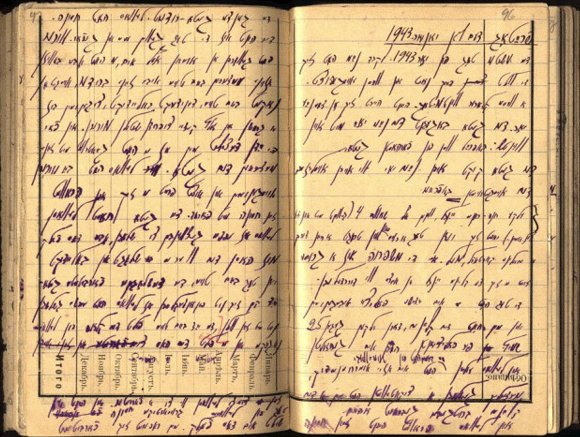
After the start of World War II, Vilna was annexed by the Soviet Union. It became a sanctuary to Jews fleeing from the Nazis, who occupied western Poland.

All of that changed on June 22, 1941, when Operation Barbarossa began. On the day Germany invaded the USSR, there were approximately 80,000 Jews living in Vilna, many of them refugees from the Nazi terror. By the time the Red Army arrived and kicked the Nazis out three years later, Vilna’s Jewish population had been reduced –through starvation, disease, deportation and executions — to zero.

Yitskhok (also spelled Yitzhak, Yitzak, etc., or anglicized to Isaac), was thirteen years old at the time his city was occupied by the Germans.

An only child, he was the son of a typesetter and a seamstress. Talented in writing, history and languages, he was also a faithful Communist and a member of the Pioneers, the Communist youth organization.

From June 1941 to April 1943 he kept a diary in Yiddish. Yitskhok had a sense of the significance of his account; at one point he wrote, “I consider that everything must be recorded and noted down, even the most gory, because everything will be taken into account.”

He not only wrote about his own life and his family and friends, but about the wider community events and the devastation the Germans wrought on his people. The historian Allan Gerald Levine called him “an astute and passionate observer of the times,” and compared him to Anne Frank.

Nor was the diary Yitskhok’s only writing project.

When one of his teachers, a beloved figure in the ghetto, died, he wrote a eulogy for the man and read it out before a large audience. He was a member of a literary group and was also attached to the ghetto’s history project, for which he interviewed ghetto residents about their lives:

I got a taste of the historian’s task. I sit at the table and ask questions and record the greatest sufferings with cold objectivity. I write, I probe into details, and I do not realize at all that I am probing into wounds … And this horror, this tragedy is formulated by me … coldly and dryly. I become absorbed in thought, and the words stare out of the paper crimson with blood.

The Vilna Ghetto, whose population initially numbered 40,000, had a rich cultural life, just like prewar Jewish Vilna had. There were theaters, cabarets, the symphony, art exhibits, a library, public lectures, and underground schools for both children and adults.

Vilna Jews saw art, music, literature and the pursuit of knowledge as a form of resistance. As Jacob Gens, head of the “ghetto’s Judenrat, put it, cultural activity gave a person “the opportunity to free himself from the ghetto for a few hours … We are passing through dark and difficult days. Our bodies are in the ghetto, but our spirit has not been enslaved.”

Reality intruded, however, and in the final analysis the Vilna Jews were doomed to extinction.

Yitskhok’s final diary entry was dated April 7, 1943, two days after five thousand Vilna Jews had been rounded up and shot at Ponary. He was understandably in a very grim mood. His prophetic last line was, “We may be fated for the worst.”

On September 23, 1943, the Nazis began the final liquidation of the Vilna Ghetto, which had by then been reduced to about 10,000 people. After a selection, those who could work were sent off to labor camps in Estonia and Latvia, where almost all of them died due to the brutal conditions there.

Children, the elderly, and the sick were shot at Ponary or sent to the extermination camp Sobibor and gassed.

Yitskhok, his parents and his uncle’s family chose to go into hiding rather than take their chances at the selection. In hiding he sank into apathy and said very little. After about two weeks in the hideout, they were discovered and taken to their deaths.

The only surviving member of Yitskhok’s family was his teenage cousin, Sarah “Sore” Voloshin. Somewhere on the route to Ponary she was able to escape. She joined a partisan group in the forest and survived until the Red Army liberated the area in the summer of 1944. After the war was over, she returned to the family’s hiding place and found Yitskhok’s diary. As of 2010, Sore Voloshin was still alive in Israel.

And the diary she retrieved had become one of the major sources on day-to-day life in the Vilna Ghetto.

Yitskhok Rudashevski suffered and died in just the same way as hundreds of thousands of others, but unlike them he did not remain anonymous: he is one of the ghetto’s most famous inhabitants. His writings have been published in their original Yiddish and in Hebrew, German and English translations. Extracts of his diary can be found in several anthologies, and it’s available in its entirety under the title The Diary of the Vilna Ghetto.

On this day..