1943: 1,196 Jewish children from Bialystok

(Thanks to Meaghan Good of the Charley Project for the guest post. -ed.)

On this date in 1943, a special transport of 1,196 children and 53 adults arrived at Auschwitz and were gassed shortly thereafter. Thus ended one of the lesser-known tragedies of the Holocaust.

The children were very nearly the last survivors of the Bialystok Ghetto, which had been liquidated in August 1943. Almost all of the inhabitants of the ghetto wound up being sent to the Treblinka Extermination Camp and killed, but over a thousand children were mysteriously separated from their parents and taken away for some as-yet-unknown purpose. (The transport list can be found here.)

At the time, there were tentative negotiations between the Red Cross and the Nazis to trade Jewish children for either German prisoners of war or cold, hard cash. The exact details are unclear, and there’s a great deal of contradictory information about the entire event.

In any case, the Germans selected children from Bialystok, one of the few places in Nazi Europe where there were any Jewish children left alive.

The children, all of them under 16, spoke only Yiddish and Polish. They were in terrible shape, both mentally and physically. One witness later described them:

Suddenly, a column of bedraggled children appeared, hundreds of them … holding each other’s hands. The older ones helped the small ones, their little bodies moving along in the pouring rain. A column of marching ghosts, with wet rags clinging to their emaciated bodies, accompanied by a large number of SS men …

The children, looking like scarecrows, refused to undress. They held on to their dirty clothing, the older stepping in front of the young ones, protecting them with their bodies, clutching their hands and comforting those that were crying. Their clothing permeated with lice, their bodies full of sores, these children refused to wash.

Their first stop was Theresienstadt in Czechoslovakia, the so-called “model ghetto” which was used by the Nazis as a propaganda tool to show that they weren’t mistreating their Jews.

Theresienstadt was in fact a horribly overcrowded, disease-ridden city and its inhabitants were all dying of starvation, but it was the best there was available. There were no gas chambers there, and the Theresienstadters knew nothing about the kinds of horrors the Bialystok children had been through.

To keep knowledge of said horrors from leaking out, once in Theresienstadt the children were placed in isolation and weren’t allowed to leave their barracks. 53 doctors and nurses were recruited from the local population to take care of them, and they were locked up with the children.

In spite of these security measures, some of the adults were able to make contact with people from the outside. Theresienstadt youth leader Fredy Hirsch got caught making an unauthorized visit to the children’s barracks, for example, and as punishment he was sent to Auschwitz on the next train.

A child thought to be Deborah Klementynowska, possibly the only surviving photo of one of these lost Bialystok children.

The adults — one of whom was Franz Kafka‘s sister, Ottilie — didn’t know what to make of the children’s behavior at first.

For instance, why, when they were invited to take a shower, did they start crying and screaming about gas? The children started to talk about their experiences, and their caregivers were horrified by their stories.

The Nazis intended to quite literally fatten up the children before they were sent off into the world, so the group was treated very well. Everyone got enough to eat, and they were given baths, clean clothes, medical treatment and even toys. Anyone who got seriously ill was taken away “to the hospital” and, ahem, never returned.

Slowly, assisted by their kind caregivers, the children got their equilibrium and began to act like normal kids again.

Meanwhile, negotiations continued …

The Allies wanted to send the children to British Mandate Palestine. The Germans, however, were against this plan because they didn’t want the children growing up there, strengthening the Palestinian Jewish community and possibly establishing a Jewish state someday. (The Mufti of Jerusalem, whom the Nazis were quite friendly with, didn’t like the idea either.)

The Germans wanted the children sent to Great Britain instead.

The UK, however, had already accepted many Jewish refugees, including 10,000 German, Austrian and Czech children with the Kindertransport, and were unwilling to take in any more.

And there was another problem, relating to the prospect of exchanging the children for money.

This money would have to be provided by the American Joint Distribution Committee and other Jewish welfare agencies, and they flat-out refused to give anything to the people who had promised to wipe them off the face of the earth.

In the end, the negotiations collapsed, through what one witness later called “an ill-applied sense of ‘correctness'” on the part of the Allies. Of course, given the Nazis’ track record, one wonders if they ever seriously intended to release the children no matter what they were given in return.

The plan was discarded and the Germans were left with 1,196 useless Jewish children on their hands. They dealt with them in the usual manner.

None of the Bialystok group or their caregivers had any idea what was coming up for them when they were sent away from Theresienstadt. They’d been told the negotiations had been successful and they were on their way to Switzerland, and thence to Palestine. They were told to take off their yellow stars and the adults had to sign a statement promising not to say anything bad about the Germans.

The transport set off in high spirits, rejoicing at their upcoming freedom.

But their train went not to Switzerland but to Poland, marked for “special treatment” on arrival at its destination. Apart from a few of the adults who were selected to work, there were no survivors.

On this day..

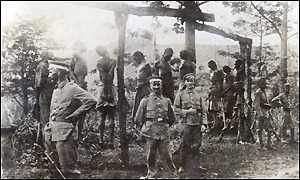
1904: Herero prisoners, at the command of Lothar von Trotha

My initial plan for the operation, which I always adhered to, was to encircle the masses of Hereros at Waterberg, and to annihilate these masses with a simultaneous blow, then to establish various stations to hunt down and disarm the splinter groups who escaped, later to lay hands on the captains by putting prize money on their heads and finally to sentence them to death.

-German General Lothar von Trotha (pdf source)

On this date in 1904, von Trotha did a little of that executing bit, further to doing a whole lot of genocide. It was the very day after von Trotha’s Vernichtungsbefehl, or extermination order, against the Herero people.

We give the narrative here to Jan-Bart Gewald’s “Colonization, Genocide and Resurgence: The Herero of Namibia 1890-1933”, from a collection of papers at a German symposium. Gewald’s complete text is available in scanned pdf form here.

Gewald:


Pocketed by the desert and the German patrols the Herero chiefs and their followers congregated along the Eiseb river. Around the first of October 1904, General Lothar von Trotha, who was actively taking part in the pursuit, and his retinue had reached the waterhole Osombo-Windimbe. During the afternoon of the following day, Sunday 2 October 1904, after the holding of a field service, General von Trotha, addressed his officers. In his address Trotha declared that the war against the Herero would be continued in all earnestness, and read out the following proclamation:

I the great General of the German troops send this letter to the Herero people.

The Herero are no longer German subjects. They have murdered and stolen, they have cut off the ears, noses and other bodyparts of wounded soldiers, now out of cowardice they no longer wish to fight. I say to the people anyone who delivers a captain will receive 1000 Mark, whoever delivers Samuel will receive 5000 Mark. The Herero people must however leave the land. If the populace does not do this I will force them with the Groot Rohr [cannon]. Within the German borders everyHerero, with or without a gun, with or without cattle, will be shot. I will no longer accept women and children, I will drive them back to their people or I will let them be shot at.* These are my words to the Herero people.

The great General of the mighty German Kaiser.

At dawn the following morning, Herero prisoners, who had been sentenced to death by a field court-martial, were hung in the presence of about 30 Herero prisoners, women and children amongst them. After the hanging, Trotha’s proclamation was read out to the prisoners in Otjiherero. Printed copies of the text in Otjiherero were distributed amongst the Herero prisoners. The prisoners were then turned loose and driven out into the Omaheke. [i.e., the western Kalahari desert -ed.]


In a letter the next day, Oct. 4, to the general staff, von Trotha reported on his order the day’s executions, in the context of a detailed tactical and philosophical justification of destroying the entire Herero nation. It’s quoted at length in Absolute Destruction: Military Culture and the Practices of War in Imperial Germany:

For me, it is merely a question of how to end the war with the Herero. My opinion is completely opposite to that of the governor and some “old Africans.” They have wanted to negotiate for a long time and describe the Herero nation as a necessary labor force for the future use of the colony. I am of an entirely different opinion. I believe that the nation mustbe destroyed as such, or since this was not possible using tactical blows, it must be expelled from the land operatively …

Because I neither can treat with these people, nor do I want to, without the express direction of His Majesty, a certain rigorous treatment of all parts of the nation is absolutely necessary, a treatment that I have for the present taken and executed on my own responsibility, and from which, as long as I have command, I shall not detour without a direct order. My detailed knowledge of many Central African tribes, Bantu and others, has taught me the convincing certainty that Negroes never submit to a contract but only to raw force. Yesterday before my departure, I had the warriors who were captured in the last several days [and who were] condemned by court-martial, hanged, and I have chased all the women and children who had gathered here back into the desert, taking with them the proclamation to the Herero people. This proclamation (enclosed), which will unavoidably bcome known, will be attacked … accepting women and children, who are mostly ill, is an eminent danger to the troops, and taking care of them is impossible. Therefore, I think it better that the nation perish rather than infect our troops and affect our water and food. In addition, the Herero would interpret any kindness on my side as weakness.They must now die in the desert or try to cross the Bechuanaland border. This uprising is and remains he beginning of a race war, which I already predicted in 1897 in my reports to the chancellor on East Africa … Whether this uprising was caused by poor treatment [of the Africans] remains irrelevant to its suppression.


It should be added that this explicitly genocidal policy was neither unique to German colonies, nor, as von Trotha himself notes, uncontested within Germany itself.

German Christian missionaries logged a piteous catalog of horrors, “skeletons with hollow eyes, powerless and hopeless,” and their reports of same to their home offices led to church pressure to brake the atrocities.

Gewald also quotes one of von Trotha’s subalterns, undisguisedly revolted at what he was involved in.

Cattle which had died of thirst lay scattered around the wells. These cattle had reached the wells but there had not been enough time to water them. The Herero led ahead of us into the Sandveld. Again and again this terrible scene kept repeating itself … the water became ever sparser, and wells evermore rare. They fled from one well to the next and lost virtually all their cattle and a large number of their people. The people shrunk into small remnants who continually fell into our hands, sections of the people escaped now and later throug the Sandveld into English territory. It was a policy which was equally gruesome as senseless, to hammer the people so much, we could have still saved many of them and their rich herds, if we had pardoned and taken them up again, they had been punished enough. I suggested this to General von Trotha but he wanted their total extermination.

Technically, complete destruction of the Herero was reversed as German policy a few months after von Trotha began implementing it, and the general himself recalled from South West Africa before the end of 1905 — leaving only a “softer” genocide of disease-ridden concentration camps through 1908. Although firm numbers are hard to come by, it’s thought that well over half the Herero population died during this period.

Yet neither was von Trotha a lone butcher. Diary entries of settlers and regular soldiers well before the extermination order record many instances (pdf) of the most cavalier slaying of Herero prisoners and noncombatants, abuses which continued long after von Trotha’s departure.

It’s difficult not to see in the racial ideology and the eliminationist military doctrine prefiguring (pdf) later and better-publicized brutalities. Indeed, even some of the personnel are the same:

  • Hermann Goering‘s father Heinrich was Germany’s first Reichskommissar in South West Africa, plopping his home down right on a Herero burial site.
  • Eugen Fischer, a eugenicist who availed the Namibian concentration camps’ ready supply of subjects to produce career-making research that would influence German race law and make Fischer a big brain in Nazi intellectual circles
  • Franz Ritter von Epp, one of von Trotha’s officers, formed in the aftermath of World War I one of the far-right Freikorps paramilitaries, with many subsequently-influential Nazis among its membership, including Ernst Roehm (who may have cribbed the SA “brown shirt” look from colonial Schutztruppe khakis) and Adolf Hitler himself

* He meant, shooting over their heads to run them off. “I assume absolutely that this proclamation will result in taking no more male prisoners, but will not degenerate into atrocities against women and children,” Lothar explained. “The latter will run away if one shoots at them a couple of times. The troops will remain conscious of the good reputation of the German soldier.”

On this day..

1893: Scuffletonians in Mt. Vernon, Georgia

From the Crittenden Press, Marion, Ky., Oct. 5, 1893, page 1 (pdf).

ON ONE SCAFFOLD.

Five Murderers Executed In Public at Mt. Vernon, Georgia

Three Killed a Merchant, the Fourth a Child and the Fifth a Companion.

Mt. Vernon, Ga., Sept. 29. — Five murderers were executed upon one scaffold at this place at 2:05 p.m. today. They were Hiram Jacobs, Hiram Brewington, Lucien Manuel, Purse Strickland and Weldon Gordon. All were commonly called negroes, but the first four named were descendants of the Crowatan Indians of North Carolina, and locally were known as “Scuffletonians,” from the name of the community from which they came. Three of them murdered Alexander Peterson, a rich merchant, last July, the fourth killed a five-year-old child and the fifth murdered a negro companion.

Over ten thousand people, white and black, witnessed the executions. Every incoming train deposited its load of human freight and steamboats on the Oconce and Attamba rivers ran a daily schedule. Thousands of women viewed the spectacle without a shudder.

The condemned men spent their last night on earth without any perceptible dread. This morning in the jail several colored ministers offered prayer for their spiritual salvation, exhorting them to be firm and courageous. At 1:30 p.m. the march to the scaffold was begun. The sheriff and prisoners were seated in a hack surrounded by a score of armed guards. They stood side by side on the scaffold. They were requested to make a statement if they desired.

Manuel said: “I have every reason to believe that I am going to meet the angels above. I fear nothing, my sins are forgiven and I shall go to heaven. I tell you my friends, to put your trust in God — good-bye.”

The others followed in the same strain. Strickland shed tears, while the vast throng sang, “A Charge to Keep I Have.” The Rev. Mr. Ross, a colored minister, prayed fervently. Then Sheriff Dunham adjusted the black caps and a photographer took their pictures.


Image from here, which appears to misdate the execution.

At this moment Sheriff Dunham bid them farewell, shaking each other by the hand, saying: “May God have mercy on your souls.”

At 2:05 p.m. the trap was sprung. There were no signs of a struggle, and the bodies hung straight and motionless. Half an hour later the bodies were cut down and deposited in pine coffins.

Update: Here’s a lovely wrap-up of the whole sordid affair.

On this day..

1939: Six assassins of Armand Calinescu

On this date in 1939, Romanian Prime Minister Armand Calinescu was gunned down on a Bucharest street in an ambush by the Iron Guard. (Romanian link)

Before the day was out, six of members of the hit squad were lined up and machine-gunned on the very same spot.

Armand Calinescu

Calinescu was a conservative politician trying to fight off the rising fascist movement in his country — that aforesaid Iron Guard — and preferred to keep Romania in politic neutrality and friendly with England and France rather than hitching its fate to Nazi Germany.

This entailed an increasingly acrimonious struggle throughout the 1930s against the fascists. Calinescu once called the Guard “an association of assassins,” and the prospect of taking a bullet from them can’t have been far from his mind. Calinescu’s fingerprints were all over press closures, pre-emptive arrests, and still worse offenses to outrage the far right. After years in the cabinet working hand-in-glove with the hated-by-fascists King Carol II, Calinescu finally became Prime Minister in March of 1939. Carol hoped he could be the bulwark against a Legionary takeover.

If by his enemies ye may know a man, know that Calinescu was taken seriously enough for a multilateral meeting between representatives of the Iron Guard, fascist Italy, and Nazi Germany in order to make the arrangements for his murder. But Calinescu would probably have just as soon have preferred his life to this tribute of his foes.

Upon news of the assassination, Calinescu’s place was immediately filled by Gen. Gheorghe Argesanu, whose one week as head of government was distinguished by a ruthless crackdown on his country’s homegrown terrorists.* The very next day’s British papers, in the same stories reporting the assassination, carried news “of an exemplary punishment” delivered within hours: “Last night, under the glare of powerful arc lamps, the murderers were publicly executed by machine-gun on the spot where the crime had been committed.” (London Times, September 22, 1939)

Nor was that the last exemplar.

The Times reported on September 25th that the ensuing days had seen “more than 300 former Iron Guards were shot” all around the country, including many “in the open street as a public example, on the pattern of the machine-gun executions in public at the scene of the crime.”

The “example” did not have the intended effect: in the span of another year, a fascist-aligned government had control of Bucharest and King Carol had hightailed it to Mexico, never to return.

* The Iron Guard would pay back Argesanu a year later by killing him during the Jilava massacre of its political prisoners.

On this day..

1942: Henryk Landsberg, Lvov Judenrat

[Adolf Eichmann] did not expect the Jews to share the general enthusiasm over their destruction, but he did expect more than compliance, he expected — and received, to a truly extraordinary degree — their cooperation. This was “of course the very cornerstone” of everything he did … Without Jewish help in administrative and police work — the final rounding up of Jews in Berlin was, as I have mentioned, done entirely by Jewish police — there would have been either complete chaos or an impossibly severe drain on German manpower …

To a Jew this role of the Jewish leaders in the destruction of their own people is undoubtedly the darkest chapter of the whole dark story.

-Hannah Arendt in Eichmann in Jerusalem

Among the many horrors of the Holocaust were the Judenräte, Jewish administrative councils set up under the aegis of Nazi Germany’s occupation of Eastern Europe.

Typically recruited from local elites and granted special privileges by the Germans, these collaborators managed the day-to-day operations of the ghettos, up to and including the horrible sharp end of Final Solution: confiscating Jewish property for the Germans, registering and organizing Jews destined for slave labor or extermination, and even managing deportations with the desperate hope that willingly engaging a sacrifice they could never prevent might enable them to save some others. Once all the deportations were done, the Judenrat itself would be executed or deported: Faust had nothing on this bargain.

Chaim Rumkowski, perhaps the most (in)famous Judenrat administrator, issued posterity the definitive howl of a collaborator’s agony when he was forced by the imminent Lodz Ghetto children’s action to implore Lodz’s families to peaceably surrender their young people to certain death: “I never imagined I would be forced to deliver this sacrifice to the altar with my own hands. In my old age, I must stretch out my hands and beg. Brothers and sisters: Hand them over to me! Fathers and mothers: Give me your children!”

Rumkowski, a deeply checkered figure who fended off liquidation of his ghetto until the very late date of 1944, well knew that Judenrat personnel were entirely disposable. After all, he delivered this plaintive speech on September 4, 1942 — just three days after his counterpart in the Lvov Ghetto had been publicly strung up on a balcony.


Six Jews (including Henryk Landsberg) hanged in the Lvov Ghetto, September 1, 1942 (via). The US Holocaust Memorial Museum also identifies this clearly distinct execution as a picture of Lvov Jewish Council members being hanged in September 1942.

The city of Lwow/Lvov (or to use its present-day Ukrainian spelling, Lviv) had had a centuries-old Jewish population when the Soviet Union seized it from Poland in consequence of the Molotov-Ribbentrop pact. That population almost immediately doubled as Jewish refugees fleeing the half of Poland that Germany got in the deal poured into the city.

Practically on the frontier of the German/Soviet border, Lvov was captured in the opening days of Germany’s June 1941 surprise invasion of the USSR. In November-December 1941, the 100,000-plus Jews* still surviving in Lvov (after several post-conquest massacres) were crammed cheek to jowl into the new Lvov Ghetto. There they endured the usual litany of privations for World War II ghettos: starvation rations, routine humiliation, periodic murders. forced labor at the nearby Janowska concentration camp.

The ghetto’s first chairman, Dr. Josef Parnas, didn’t live to see 1942 before he was killed in prison for non-cooperation. Dr. Adolf Rotfeld followed him, and died of “natural” causes in office a few months later.

Dr. Henryk Landsberg, a lawyer, succeeded Rotfeld. He had been a respected community figure before the war, but was disposable to the Nazis as his predecessors; during a large-scale Aktion to cull the camp and further reduce its boundaries, a Jewish butcher resisting the SS killed one of his persecutors. Landsberg and a number of the Jewish policemen employed by the Judenrat were summarily put to death.

“I have gladly accepted the nomination,” Landsberg’s successor remarked. “Maybe they will shoot me soon.” He was indeed shot (or perhaps committed suicide to avoid that fate) in the first week of January 1943. (All this from Judenrat: The Jewish Councils in Eastern Europe Under Nazi Occupation)

The Lvov Ghetto was liquidated June 1, 1943; a bare handful of its former inmates escaped into the sewers or managed to avoid death in the camps before the war ended. After the Red Army took back the city, a 1945 survey of the Jewish Provisional Committee in Lvov tallied just 823 Jews. Today, there are all of 5,000.

* Among the Lvov Ghetto residents was Simon Wiesenthal.

On this day..

1814: John Ashton, Lord Wellington, at Horace Cotton’s first hanging

This isn’t exactly the most historically important execution, but as the Newgate Calendar says, “The circumstance which attended the execution of this unfortunate man alone entitles him to a place in our pages, for otherwise his case is void of interest.”

What follows is the Calendar’s entry, which comes verbatim from the Aug. 23 London Times.

He was apprehended for a highway robbery, and convicted at the Old Bailey, when he received sentence of death. From the time of his conviction, he either affected, or suffered, complete insanity; but this did not release him from the consequence of his sentence; and, on Monday, August 22d, 1814, he was executed in front of Newgate, along with William Henry Lye, for burglary; John Mitchell, for forgery; Francis Sturgess, and Michael Mahoney, for highway robbery; and John Field, alias Jonathan Wild [not that one -ed.], for burglary. By half past six o’clock the Old Bailey, and houses adjacent, were crowded to great excess. At half past seven Mahoney was brought forward, for the purpose of being disencumbered of his irons. While his irons were knocking off, it was found necessary to search for a knife to cut some part of the cordage, which confined the irons. Mahoney, seeing this, stooped, and, with an Herculean effort, tore it asunder. This being the only Catholic, the Rev. Mr. Devereux attended him in constant prayer, in which he joined most fervently. Sturgess, Field, and Mitchell, conducted themselves with great propriety. The unfortunate Ashton had been in a state of insanity since the receipt of the awful warrant for his execution. In the Press Yard he distorted his countenance horribly. He was the fifth who mounted the scaffold, and ran up the steps with great rapidity; and, having gained the summit of the platform, began to kick and dance, and often exclaimed, ‘I’m Lord Wellington!’ The Rev. Mr. Cotton, who officiated for the first time as Ordinary, enjoined him to prayer, to which he paid little attention, and continued to clap his hands as far as he was permitted by the extent of the cord. Mitchell often invited him to prayer. All that could be done was ineffectual, and it was necessary to have two men to hold him during the awful ceremony. When they released him for the purpose of the Lord’s Prayer being said, he turned round, and began to dance, and vociferated, Look at me; ‘I am Lord Wellington!’ At twenty minutes past eight o’clock the signal was given, and the platform fell. Scarcely, however, had the sufferers dropped, before, to the awe and astonishment of every beholder, Ashton rebounded from the rope, and was instantaneously seen dancing near the Ordinary, and crying out very loudly, and apparently unhurt, ‘What do ye think of me? Am I not Lord Wellington now?’ then danced, clapped his hands, and huzzaed. At length the executioner was compelled to get up the scaffold, and to push him forcibly from the place which he stood.

Quite a baptism for the Rev. Horace Salusbury Cotton’s very first gig as the Ordinary. Cotton noted Ashton’s remarkable behavior in his execution diary; the relevant pages can be seen here.

Nothing daunted, Cotton enjoyed a 25-year run in the position (he was the cleric Charles Dickens saw at work when the writer visited Newgate in 1835), and “enjoyed” really does seem like the right word. “He was a robust, rosy, well-fed, unctuous individual, whose picture may be seen in Cruikshank‘s plate of the Press yard in Pierce Egan‘s ‘Life in London,'” wrote Horace Bleackley. “His condemned sermons were more terrific than those of any of his predecessors, and he was censured by the authorities for ‘harrowing the prisoner’s feelings unnecessarily’ in the case of Henry Fauntleroy, the banker.”


Dr Cotton, Ordinary of Newgate, Announcing the Death Warrant, by a prisoner named W. Thomson. This 1826 watercolor is at the Tate gallery.

On this day..

509 B.C.E.: The Sons of Brutus

August 21 is the harvest-time feast of Consualia, honoring the Roman god of grain storage, Consus.

We mark on this occasion the legendary capital punishment inflicted by Lucius Junius Brutus when he was consul of the ancient Roman Republic upon two rebels — his own sons, Titus and Tiberius.

The great Brutus had been one of the leaders of the revolt that expelled Rome’s last king, Lucius Tarquinius — reputedly after the king’s son raped Lucius’s kinswoman Lucretia. (Brutus was also Tarquin’s nephew.)

Upon completing his coup, Brutus immediately summoned the populace to swear an oath that no king would ever rule Rome again. So potent was the civic memory of this event that even centuries later when the Republic was well gone, Rome’s emperors dared not appropriate such an incendiary title as “King”.

But that was for a later time, after the winners wrote the history.

The exiled Etruscan king, subsequent Romans’ eternal watchword for tyranny, got the boot about 510 B.C.E., and in 509 was still hanging about looking for an opportunity to re-seat his dynasty. The plot he hatched is known as the Tarquinian conspiracy, and Brutus, to his grief, would discover that his own children had adhered to it. The statesman’s willingness to put his own flesh and blood to death for the security of Rome would long stand as a parable of manful patriotism.

Our account here is from Livy (line breaks have been added for readability), and the excuse to approximate this undated execution to summer’s harvest-time is bolded therein.

liberty was well nigh lost by treachery and fraud, a thing they had never apprehended. There were, among the Roman youth, several young men of no mean families, who, during the regal government, had pursued their pleasures without any restraint; being of the same age with, and companions of, the young Tarquins, and accustomed to live in princely style.

Longing for that licentiousness, now that the privileges of all were equalized, they complained that the liberty of others has been converted to their slavery: “that a king was a human being, from whom you can obtain, where right, or where wrong may be necessary; that there was room for favour and for kindness; that he could be angry, and could forgive; that he knew the difference between a friend and an enemy; that laws were a deaf, inexorable thing, more beneficial and advantageous for the poor than the rich; that they allowed of no relaxation or indulgence, if you transgress bounds; that it was a perilous state, amid so so many human errors, to live solely by one’s integrity.”

Whilst their minds were already thus discontented of their own accord, ambassadors from the royal family come unexpectedly, demanding restitution of their effects merely, without any mention of return. After their application was heard in the senate, the deliberation on it lasted for several days, (fearing) lest the non-restitution might be a pretext for war, and the restitution a fund and assistance for war. In the mean time the ambassadors were planning different schemes; openly demanding the property, they secretly concerted measures for recovering the throne, and soliciting them as if for the object which appeared to be under consideration, they sound their feelings; to those by whom their proposals were favourably received they give letters from the Tarquins, and confer with them about admitting the royal family into the city secretly by night.

The matter was first intrusted to brothers of the name of Vitellii and those of the name of Aquilii. A sister of the Vitellii had been married to Brutus the consul, and the issue of that marriage were young men, Titus and Tiberius; these also their uncles admit into a participation of the plot: several young noblemen also were taken in as associates, the memory of whose names has been lost from distance of time. In the mean time, when that opinion had prevailed in the senate, which recommended the giving back of the property, and the ambassadors made use of this as a pretext for delay in the city, because they had obtained from the consuls time to procure modes of conveyance, by which they might convey away the effects of the royal family; all this time they spend in consulting with the conspirators, and by pressing they succeed in having letters given to them for the Tarquins. For otherwise how were they to believe that the accounts brought by the ambassadors on matters of such importance were not idle?

The letters, given to be a pledge of their sincerity, discovered the plot; for when, the day before the ambassadors set out to the Tarquins, they had supped by chance at the house of the Vitellii, and the conspirators there in private discoursed much together concerning their new design, as is natural, one of the slaves, who had already perceived what was going on, overheard their conversation; but waited for the occasion when the letters should be given to the ambassadors, the detection of which would prove the transaction; when he perceived that they were given, he laid the whole affair before the consuls. The consuls, having left their home to seize the ambassadors and conspirators, crushed the whole affair without any tumult; particular care being taken of the letters, lest they should escape them.

The traitors being immediately thrown into chains, a little doubt was entertained respecting the ambassadors, and though they deserved to be considered as enemies, the law of nations however prevailed.

The question concerning the restitution of the tyrants’ effects, which the senate had formerly voted, came again under consideration. The fathers, fired with indignation, expressly forbad them either to be restored or confiscated. They were given to be rifled by the people, that after being made participators in the royal plunder, they might lose for ever all hopes of a reconciliation with the Tarquins. A field belonging to them, which lay between the city and the Tiber, having been consecrated to Mars, has been called the Campus Martius. It happened that there was a crop of corn* upon it ready to be cut down, which produce of the field, as they thought it unlawful to use, after it was reaped, a great number of men carried the corn and straw in baskets, and threw them into the Tiber, which then flowed with shallow water, as is usual in the heat of summer; that thus the heaps of corn as it stuck in the shallows became settled when covered over with mud: by these and the afflux of other things, which the river happened to bring thither, an island was formed by degrees. Afterwards I believe that mounds were added, and that aid was afforded by art, that a surface so well raised might be firm enough for sustaining temples and porticoes.

After plundering the tyrants’ effects, the traitors were condemned and capital punishment inflicted. Their punishment was the more remarkable, because the consulship imposed on the father the office of punishing his own children, and him who should have been removed as a spectator, fortune assigned as the person to exact the punishment.

Young men of the highest quality stood tied to a stake; but the consul’s sons attracted the eyes of all the spectators from the rest of the criminals, as from persons unknown; nor did the people pity them more on account of the severity of the punishment, than the horrid crime by which they had deserved it.

“That they, in that year particularly, should have brought themselves to betray into the hands of Tarquin, formerly a proud tyrant, and now an exasperated exile, their country just delivered, their father its deliverer, the consulate which took its rise from the family of the Junii, the fathers, the people, and whatever belonged either to the gods or the citizens of Rome.”

The consuls seated themselves in their tribunal, and the lictors, being despatched to inflict punishment, strip them naked, beat them with rods, and strike off their heads. Whilst during all this time, the father, his looks and his countenance, presented a touching spectacle, the feelings of the father bursting forth occasionally during the office of superintending the public execution.


Bummer: Jacques-Louis David‘s 1784 painting, Lictors Bring Home the Sons of Brutus.

This Brutus was an ancestor of the Brutus who helped assassinate Julius Caesar, and that later et tu, Brutus is commonly represented as having been convinced to turn against his friend and patron by, in part, the example of his legendary namesake.

O, you and I have heard our fathers say,
There was a Brutus once that would have brooked
The eternal devil to keep his state in Rome
As easily as a king.

-Cassius to Brutus in Shakespeare’s Julius Caesar (Act 1, Scene 2)

* “Corn” meaning not American maize, of course — which was not available before the Columbian exchange — but the word’s earlier meaning of whatever was the local grain: wheat, barley, and millet in Rome’s case. (The word corn derives from the Latin granum.)

On this day..

1941: 534 Lithuanian Jewish intellectuals

(Thanks to Meaghan Good of the Charley Project for the guest post. -ed.)

On this date in 1941, 534 Jewish intellectuals were lured out of the Nazi ghetto in the city of Kovno, Lithuania (also known as Kaunas), taken to Ninth Fort, and shot to death.

Over 5,000 Jews would die there during the Nazi occupation.

The Nazis had captured these people using a very clever ruse: on August 14, they had advertised for 500 Jews to help sort out the archives at City Hall, which were in disarray due to the chaos that followed the Germans’ conquering the city in June.

The workers had to be intelligent, educated types and fluent in German and Russian. They would be treated well and given three solid meals a day, in order that they could do the work properly and make no mistakes.

Most of the other jobs available for Jews at that moment involved manual labor under brutal conditions, on starvation-level rations.

More than the requested 500 showed up. The Nazis happily took them all.

Vilius “Vulik” Mishelski (later anglicized to William Mishell), who was 22 and had studied engineering in Vytautas Magnus University [Lithuanian link], was nearly victim no. 535. His mother told him about the job offer, because it upset her when he home from working at the airfield, “my clothes torn, my face covered with dust and sweat, my fingers bleeding, and I myself so exhausted I could hardly speak.” The archives job seemed like a gift from heaven to her.

Vulik wasn’t so sure.

Why, he asked, had the archives not been sorted out sooner? After all, the Germans had conquered Kovno a full two months earlier.

And why not get Lithuanians to do the job? It certainly wasn’t necessary to employ Jews.

He debated with himself for the next four days, then finally decided to go. Many of his friends were going, he wrote later on, and “this put me at ease. All of them could not be crazy.”

When he actually arrived at the gate, however, what he saw made him profoundly uneasy. The size of the guard was unusually large, and he witnessed Jewish police and Lithuanian partisans mistreating and beating people. Because it was taking long for the quota of 500 people to arrive, the Lithuanians started dragging people from their homes by force.

This struck me as odd. This was supposed to be a job where we were to be treated in a civilized manner; was this the treatment awaiting us? Oh, no, I would not be caught in this mess! Without hesitation, I turned around and rushed back home.

My mother was astounded. “What happened, why are you back?” she asked.

“Don’t ask questions,” I said, “move the cabinet, I’m going into hiding.”

Vulik was right not to trust the Nazis’ promises. He stayed in his hideout, a little cubbyhole behind the kitchen cabinet, all day.

The chosen 534 didn’t return that night, or the next night either, and no one believed the assurances that the work was taking longer than they thought, and they had spent the night at City Hall. Before long, the truth leaked out.

That same day, the men had been lead away in several smaller groups to an area containing deeply excavated holes in the ground. Then the Lithuanian guard, known as the Third Operational Group, had shot them all. Several men who tried to escape were killed on the run. Almost the entire intelligentsia of Jewish Kovno had thus been liquidated in one mass execution.

Mishelski stayed in the Kovno Ghetto until 1944, when he was sent to Dachau. He survived the war: 95% of the Lithuanian Jews, including most of his family, did not.

Mishelski moved to America, changed his name to William Mishell, got a master’s degree in engineering from New York University, and settled in Chicago. Following his retirement in the 1980s, he wrote a memoir titled Kaddish for Kovno: Life and Death in a Lithuanian Ghetto, 1941 – 1945. Mishelski died in 1994, aged 75.

On this day..

1480: The Martyrs of Otranto

On this date in 1480, Ottomans invading Otranto, Italy conducted a mass execution of prisoners.

Landing at the southern Italian city on July 28, the Ottoman force quickly overwhelmed Otranto. (Otranto rashly slew the messenger come to offer a merciful capitulation, only to find that its garrison began deserting within days.) On August 11, the Turks took the city by storm. Thousands died on that day’s bloodbath, including the Archbishop of Otranto.

Surviving women and children were sold into slavery. Men over age 15 had the choice of conversion — or death.

“Now it is time for us to fight to save our souls for the Lord!” a Christian shoemaker is said to have exhorted his 800 fellow prisoners. “And since he died on the cross for us, it is fitting that we should die for him.”

The acclaim greeting this call signaled inflammation ahead for the Turkish headsmen’s rotator cuffs. They had 800 faithful souls to dispatch to their eternal reward this date at the place still known as the Hill of Martyrs. (When in Otranto, visit it by taking the via Ottocento Martiri, just off via Antonio Primaldo — that’s the name of the militant shoemaker.)


The remains of the Otranto martyrs, arrayed as relics in the Otranto cathedral. (cc) image from Laurent Massoptier.

Historical novel set during these vents.

This, at least, is the most pious version of the story. The mass execution certainly did occur, but some latter-day historians like Francesco Tateo have argued that martyrdom is not attested by any of the contemporaneous sources, and the specifically religious understanding of events was only read in after the fact.

On whatever grounds one likes, Italy’s fractious city-states were deeply alarmed by the appearance on their shores of the all-conquering Turks. “It will always seem as if the funeral cross is borne before me while these barbarians remain in the boundaries of Italy,” wrote the Florentine humanist Poliziano.* (Source, a nonfiction book which covers Otranto in some detail.)

In the ensuing months, they rallied together vowing to expel the invaders.

Fortunately for this coalition, the Ottoman sultan Mehmed the Conqueror died in May 1481, and a brief period of internal conflict within the Ottoman empire over the succession perhaps led it to allow its Otranto outpost to wither on the vine. The Turks made peace and withdrew from their potential beachhead not long after, having held the city for just over a year. The bodies of the martyrs were said to have been found uncorrupted by decay.

The Catholic church beatified the 800 martyrs in 1771, but their final elevation to sainthood occurred only in 2013, just three months ago as I write this. They were in the very first group canonized by the new Pope Francis — although the canonization was approved by his predecessor Benedict XVI on the same day that Benedict resigned his pontificate. Considering current relations between the respective faiths, it was seen as a potentially impolitic move.

“By venerating the martyrs of Otranto, we ask God to protect the many Christians who in these times, and in many parts of the world, are still victims of violence,” Pope Francis said at the canonization Mass, diplomatically not naming any of those parts of the world.

* At the same time, Florence (in common with other Italian polities) had trade and diplomatic relations with the Ottomans.

On this day..

1979: Saddam Hussein’s Ba’ath party coup

On this date in 1979, Saddam Hussein executed a terrifying purge of the Ba’ath party.

Hussein had come to power just six days before by forcing out his cousin Ahmed Hassan al-Bakr.

On this date, some 400-plus Ba’ath party leaders were summoned to a pavilion near the Iraqi presidential palace. The secret police locked the doors behind them.

As film rolled, a man named Muhyi Abdel-Hussein came to the stage. Until just days prior, he had been the general secretary of the Revolutionary Command Council, the executive committee that ran the state. For opposing Saddam Hussein’s accession, he’d been arrested and endured God knows what. It was enough to break him, and make him the star in a drama worthy of the old Soviet show trials.

Speaking deliberately, Muhyi Abdel-Hussein* stood at the podium and accused himself of involvement in a Syrian plot against the regime. He had, moreover, been joined in his treason by a number of men in that very room. And then as the names were read off to the stunned audience, Mukhabarat men arrested them and dragged them out of the hall. Colleagues gaped as their ranks were culled around them, each paralyzed with the same panicked thought: am I next? Realizing their vulnerability, some began to chant feverishly their loyalty: “Long live Saddam Hussein!”**

All the while, the emerging dictator — younger and trimmer than we remember him at the end — sat steps away at a simple little table, coolly puffing his cigar. He would be the unquestioned master of Iraq for the next 24 years.

In all, 68 people were hauled out of the room; they were tried immediately and sentenced within minutes: 22 to die, the rest to the dungeons.† The condemned were shot that very day: in a diabolical twist, a number of their former, as-yet-unpurged Ba’ath Party colleagues were detailed for firing squad duty.

Nor was this the end. A wider purge of potential rivals with potential influence — party members, union leaders, intelligentsia, businessmen — unfolded throughout that week; by August 1, several hundred (the exact figure will never be known) had been condemned to die. Muhyi Abdel-Hussein, whatever they promised him, was among them.

* “Al-Khalil gives the last name of Muhyi Abdel-Hussein as Rashid. Matar gives it as Mashhadi. Since Mashhad is a place in Iran, one can only assume that this name was bestowed on the unfortunate Abdel-Hussein posthumously, after it had been discovered that ‘he had reached his position through devious means and that he was originally Persian.'” (Source)

** The entire liturgy of terror was stage-managed by Taha Yasin Ramadan, who became Iraq’s vice president (and, like his president, was eventually hanged for his trouble). Also making an appearance: Barzan al-Tikriti, who was likewise destined to hang during the American occupation; on July 22, 1979, he was one of the judges on the kangaroo court that issued the death sentences.

† Different sources produce slight variations on the counts of 68 arrests and 22 executions.

On this day..