1684: Baillie of Jerviswood

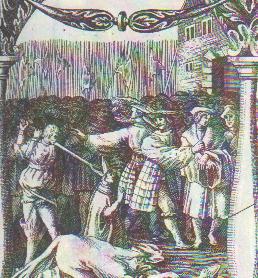
On this date in 1684, the Scottish patriot Baillie of Jerviswood was convicted of treason and immediately executed, for his part in the Rye House Plot against the Stuart King Charles II.

Baillie was a lesser player in the Protestant scheme — whose nature and extent, or even existence, are matters of historical debate — supposedly to do away with the Catholic-leaning ruler and his outright catechumen brother and heir James. Baillie was implicated under torture, and while disowning any part of a conspiracy declined — “with striking truthfulness” — to deny a design on Scottish rebellion.

His summary hanging would enter the pantheon of English depravities in the north country, but he achieved another sort of immortality as well.

During an earlier stint in prison, a proscribed fellow patriot’s 12-year-old daughter had smuggled him messages — becoming acquainted with Baillie’s own son, whom she would eventually wed. The girl gained fame in adulthood as Lady Grizel (or Grisel, or Griselle) Baillie.

“Werena my Heart’s licht I wad dee”
-Lady Baillie

THERE ance was a may, and she lo’ed na men;
She biggit her bonnie bow’r doun in yon glen;
But now she cries, Dool and a well-a-day!
Come doun the green gait and come here away!

When bonnie young Johnnie cam owre the sea,
He said he saw naething sae lovely as me;
He hecht me baith rings and mony braw things—
And werena my heart’s licht, I wad dee.

The legendary tableau of intrigue between Baillie and his future daughter-in-law was itself fruit for literature, given time enough to ripen into legend. Kinswoman Joanna Baillie, one of the great litterateurs of the early 19th century, made use of the episode to open a lengthy ballad to Lady Grizel in Metrical Legends of Exalted Characters:

I.
Within a prison’s hateful cell,
Where, from the lofty window fell,
Thro’ grated bars, the sloping beam,
Defin’d, but faint, on couch of stone,
There sat a pris’ner sad and lone,
Like the dim tenant of a dismal dream.
Deep in the shade, by low-arch’d door,
With iron nails thick studded o’er,
Whose threshold black is cross’d by those
Who here their earthly being close,
Or issue to the light again
A scaffold with their blood to stain,–
Moved something softly. Wistful ears
Are quick of sense, and from his book
The pris’ner rais’d his eyes with eager look,–
“Is it a real form that thro’ the gloom appears?”

II
It was indeed of flesh and blood,
The form that quickly by him stood;
Of stature low, of figure light,
In motion like some happy sprite;
Yet meaning eyes and varying cheek,
Now red, now pale, seem’d to bespeak
Of riper years the cares and feeling
Which with a gentle heart were dealing.
“Such sense in eyes so simply mild!
“Is it a woman or a child?
“Who art thou, damsel sweet? are not mine eyes beguiled?”

III
“No; from the Redbraes’ tower I come;
“My father is Sir Patrick Hume;
“And he has sent me for thy good,
“His dearly honour’d Jerviswood.
“Long have I round these walls been straying,
“As if with other children playing;
“Long near the gate have kept my watch
“The sentry’s changing-time to catch.
“With stealthy steps I gain’d the shade
“By the close-winding staircase made,
“And when the surly turnkey enter’d,
“But little dreaming in his mind
“Who follow’d him so close behind,
“Into this darken’d cell, with beating heart, I ventured.”

IV
Then from the simple vest that braced
Her gentle breast, a letter traced
With well-known characters, she took,
And with an eager, joyful look,
Her eyes up to his visage cast,
His changing countenance to scan,
As o’er the lines his keen glance past.
She saw a faint glow tinge the sicky wan;
She saw his eyes thro’ tear-drops raise
To heaven their look of silent praise,
And hope’s fresh touch undoing lines of care
Which stress of evil times had deeply graven there.
Meanwhile, the joy of sympathy to trace
Upon her innocent and lovely face
Had to the sternest, darkest sceptic given
Some love of human kind, some faith in righteous Heaven.

V
What blessings on her youthful head
Were by the grateful patriot shed,
(For such he was, good and devoted,
And had at risk of life promoted
His country’s freedom and her faith,
Nor reck’ning made of worldly skathe)
How warm, confiding, and sincere,
He gave to her attentive ear
The answer which her cautious sire
Did to his secret note require;–
How after this with ‘quiries kind,
He ask’d for all she left behind
In Redbraes’ tower, her native dwelling,
And set her artless tongue a-telling,
Which urchin dear had tallest grown,
And which the greatest learning shown,
Of lesson, sermon, psalm, and note,
And Sabbath questions learnt by rote,
And merry tricks and gambols play’d
By ev’ning fire, and forfeits paid,–
I will not here rehears, nor will I say,
How, on that bless’d and long-remember’d day,
The pris’ner’s son, deserving such a sire,
First saw the tiny maid, and did admire,
That one so young and wise and good and fair
Should be an earthly thing that breath’d this nether air.

On this day..

1974: Charles Dean and Neal Sharman

On or about this date in 1974, a young American traveler — or perhaps intelligence agent — named Charles Dean and his Australian friend Neal Sharman are believed to have been executed in Laos by the Pathet Lao guerrillas.

The 23-year-old Dean was in the midst of a protracted post-university globetrotting when he was apprehended with his friend traveling down the Mekong River in the war-torn country. They were held in captivity for three months — long enough for the family to learn they were detained, and Dean’s father to fly to Laos to negotiate in vain for his release.

Charles Dean’s older brother Howard, perhaps the most prominent death penalty survivor in the United States, subsequently became governor of Vermont and is now chairman of the Democratic Party’s chief national organ.

Coincidentally, it was also at about this point of the 2003-04 presidential election cycle that Howard Dean, then the frontrunner for his party’s presidential nomination, learned through DNA analysis that remains recovered in Laos were indeed those of his brother. Twenty-nine years after his execution, Charles Dean was repatriated and buried with military honors.

Dean had remembered the loss in his campaign autobiography:

[Charlie] wrote me a letter about what it was like to sit outside his bungalow [in Laos] at night, listening to the thump of distant artillery and the muffled explosions as the shells hit the ground. I almost wrote him back, saying, “What are you thinking? Get out of there — it’s not safe.” Then I reminded myself that he was a twenty-three-year-old who was capable of making these judgments himself. I’ve often wished I had written that letter, although I don’t think he would have changed his mind had he read it.

There was speculation that Charlie was in Laos because he was working for the CIA and I think my parents believed that to be the case. Personally, I don’t think he was employed by the U.S. government in any capacity, but we’ll probably never know the answer to that question.

Charlie’s capture and death were the most traumatic events of my life. They have eaten at me ever since. You never get over something like this; all you can do is live with it. It was awful for my two other brothers and me, and it was far worse for our mother and father. It was so painful for my father that he rarely spoke of it afterward.

One of the feelings that accompanies survivor’s guilt is anger at the person who was killed. You are angry because your loved one left you with this terrible loss. I had never understood why Charlie had gone to Laos and stayed there so long.

I often think about the courses our lives might have taken had Charlie been around. One thing is certain: I’m sure that, had he lived, he’d be the one running for president and not me.

Update: Gov. Dean’s December 2012 tweets on his family’s loss:

@executedtoday It was Dec 14. Charlie was my younger brother. He would have turned 63 on April 5, 2013. view original

@executedtodayHe was likely killed by North Vietnamese operating inside Laos. I have been to the site of his execution thanks to JTFA view original

Australian Neil Sharman was captured with him in September, 1973 and also died with him 38 years ago today view original

On this day..

1793: Sydney Carton posing as Charles Darnay

On an unspecified date in December 1793 is set one of literature’s immortal execution scenes, when ne’er-do-well Sydney Carton heroically goes to the guillotine in the place of his aristocratic doppleganger Charles Darnay at the climax of A Tale of Two Cities.

In Charles Dickens‘ classic 1859 novel of the French Revolution, Darnay, the good-hearted scion of the cruel Evremonde line, falls prey to the Revolutionary Terror.

The dissolute, tormented Carton is the respectable Darnay’s literary dark twin, whose appearance he also happens to strikingly resemble. Driven by an unrequited love for Darnay’s wife, who stands in danger not only of losing her husband but of following him to the scaffold, Carton contrives to switch places with the doomed noble.

While those saved by his sacrifice flee for England, Carton goes to the guillotine in a batch of 52 condemned prisoners,* one of them a sweet and frightened girl he comforts tenderly.

His prophetic thoughts as he awaits the blade form the conclusion of the novel, and the last sentence ranks among literature’s most recognizable lines.

“I see that I hold a sanctuary in their hearts, and in the hearts of their descendants, generations hence. I see her, an old woman, weeping for me on the anniversary of this day. I see her and her husband, their course done, lying side by side in their last earthly bed, and I know that each was not more honoured and held sacred in the other’s soul, than I was in the souls of both.

“I see that child who lay upon her bosom and who bore my name, a man winning his way up in that path of life which once was mine. I see him winning it so well, that my name is made illustrious there by the light of his. I see the blots I threw upon it, faded away. I see him, fore-most of just judges and honoured men, bringing a boy of my name, with a forehead that I know and golden hair, to this place — then fair to look upon, with not a trace of this day’s disfigurement — and I hear him tell the child my story, with a tender and a faltering voice.

“It is a far, far better thing that I do, than I have ever done; it is a far, far better rest that I go to than I have ever known.”

A Tale of Two Cities is one of thousands of public-domain books available for free at Project Gutenberg. Stanford’s “Discovering Dickens” community reading project guide annotates the novel here.

* Never one for understatement, Dickens crowds his mass execution tableau with far too many extras. “The Terror” is usually dated from September 1793 through July 1794, but only during its bloodiest last two months would so many as 52 have been guillotined together; at the time of Carton’s execution, half as many would have constituted a large group.

On this day..

1720: Captain John “Calico Jack” Rackham

On this date in 1720Nov. 18, 1720, the pirate captain “Calico Jack” Rackham was hanged together with his crew by the British governor of Jamaica.

Nicknamed for his flamboyant clothing, the Bristol-born buccaneer plundered the West Indies during the “Golden Age of Piracy”, having ousted his former captain Charles Vane. Rackham is chiefly remembered to history for two who were not hanged with the rest of his crew: Anne Bonny and Mary Read, rare female pirates who served aboard Rackham’s ship.

Immortalized by Daniel Defoe in his pseudonymous A General History of the Pyrates, Bonny and Read came to piracy by different paths but were both every bit the part and leaders aboard their ship — “very profligate, cursing, and swearing much, and very ready and willing to do any Thing on board.” Bonny, at least, was Rackham’s lover — having eloped with him from her husband.

Upon capture, both women “pleaded their bellies” to escape the gallows, and though it’s unclear whether either really was pregnant, it seems the gambit spared both from execution.

Read died in prison shortly after, while Bonny vanished from history — prompting speculation that she had escaped, secured a pardon, been ransomed by her wealthy father, and/or returned again to piracy under a different guise. Reportedly, she castigated Rackham at their last meeting in prison for lying drunk below decks while only the women resisted the capture of their ship: “I am sorry to see you here Jack, but if you had fought like a man, you need not be hanged like a dog.”

As the world’s best-known women pirates, Bonny and Read are recalled as anything from sexualized historical curios to action heroines to proto-feminists.

They feature in Disneyland’s “Pirates of the Caribbean” ride, the Witchblade comic book series, utopian theorizing, popular history … and the occasional action figure.

Update: A much more detailed foray into the lives of these daring women is at Scandalous Women.

Also, I posted this under the wrong date: it should be Nov. 18. Balls.

On this day..

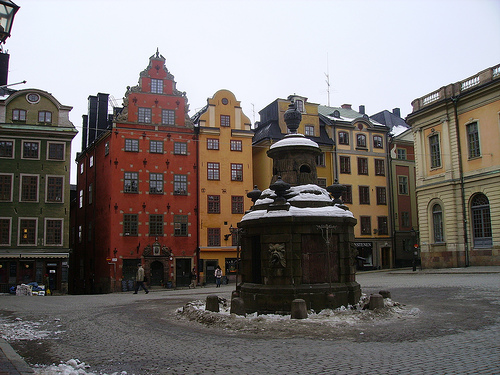
1520: Stockholm Bloodbath

On this date in 1520, four days after the Danish King Christian II gained the Swedish throne, nearly 100 prominent supporters of Swedish independence were executed en masse as a civil war’s apparent victors purged their enemies.

The Stockholm Bloodbath followed years of conflict between supporters of the Danish-dominated Kalmar Union and independence advocates under the banner of Sten Sture the Younger. With Sture’s death in battle earlier in 1520, the unionists had gained the upper hand. Stockholm, the last outpost of resistance, had held against four months’ siege before accepting a general amnesty in exchange for capitulation.

But with the city in hand, Christian — known to Swedish history as “Christian the Tyrant” — had its leaders charged for having deposed during the conflict the pro-union Archbishop Gustav Trolle, construed as an offense against the Church not in the temporal authority’s power to reprieve. Less than 24 hours after this legal maneuver was sprung, public beheadings of prelates, merchants and burgomasters were underway at Stortorget* — and Sture’s remains were exhumed and posthumously burnt at the stake.

Stortorget

It proved a Pyrrhic victory for the Danish party.

Inside of three years, Christian himself had been deposed with multiple lands and factions throughout his realm in open revolt. Gustav Vasa, whose father had been one of the Stockholm Bloodbath’s victims, would not only decisively break Denmark’s hold on Sweden but found the Vasa Dynasty under which Sweden would burgeon into one of Europe’s great powers.

*One Hans Brask survived the purge despite having endorsed the removal of Archbishop Trolle. Brask supposedly placed a note under his seal on this document saying “To this I am forced and compelled.” This cunning device gave the Swedish tongue the word Brasklapp — a secret reservation.

On this day..