1698: Old Believer popes and Princess Sophia’s petitioners

This entry in our Corpses Strewn series on the October 1698 extirpation of the Streltsy is courtesy of the diaries of Austrian diplomat Johann Georg Korb, an eyewitness to the events.

Today was assigned for the punishment of the popes — that is to say, of those who by carrying images to induce the serfs to side with the Strelitz, had invoked the aid of God with the holy rites of his altars for the happy success of this impious plot. The place selected by the judge for the execution was the open space in front of the church of the most Holy Trinity, which is the high church of Moscow. The ignominious gibbet cross awaited the popes, by way of reward in suit with the thousands of signs of the cross they had made, and as their fee for all the benedictions they had given to the refractory troops. The court jester, in the mimic attire of a pope, made the halter ready, and adjusted it, as it was held to be wrong to subject a pope to the hands of the common hangman. A certain Dumnoi struck off the head of another pope, and set his corpse upon the ignominious wheel. Close to the church, too, the halter and wheel proclaimed the enormity of the crime of their guilty burden to the passers by.

The Czar’s Majesty looked on from his carriage while the popes were hurried to execution. To the populace, who flood around in great numbers, he spoke a few words touching the perfidy of the popes, adding the threat, “Henceforward let no one dare to ask any pope to pray for such an intention.” A little while before the execution of the popes, two rebels, brothers, having had their thighs and other members broken in front of the Castle of the Kremlin, were set alive upon the wheel: twenty others on whom the axe had done its office lay lifeless around these wheels. The two that were bound upon the wheel beheld their third brother among the dead. Nobody will easily believe how lamentable were their cries and howls, unless he has well weighed their excruciations and the greatness of their tortures. I saw their broken thighs tied to the wheel with ropes strained as tightly as possible, so that in all that deluge of torture I do believe none can have exceeded that of the utter impossibility of the least movement. Their miserable cries had struck the Czar as he was being driven past. He went up to the wheels, and first promised speedy death, and afterwards proffered them a free pardon, if they would confess sincerely. But when upon the very wheel he found them more obstinate than ever, and that they would give no other answer than that they would confess nothing, and that their penalty was nearly paid in full, the Czar left them to the agonies of death, and hastened on to the Monastery of the Nuns, in front of which monastery there were thirty gibbets erected in a quadrangular shape, from which there hung two hundred and thirty Strelitz. The three principal ringleaders, who presented a petition to [Peter’s half-sister and rival] Sophia, touching the administration of the realm, were hanged close to the windows of that princess, presenting, as it were, the petitions that were placed in their hands, so near that Sophia might with ease touch them. Perhaps this was in order to load Sophia with that remorse in every way, which I believe drove her to take the religious habit, in order to pass to a better life.

On this day..

1698: 350 Streltsy by the boyars’ own hands

This entry in our Corpses Strewn series on the October 1698 extirpation of the Streltsy is courtesy of the diaries of Austrian diplomat Johann Georg Korb, an eyewitness to the events.

This differed confiderably from those that preceded. The manner of it was quite different, and hardly credible. Three hundred and thirty at a time were led out together to the fatal axe’s stroke, and embrued the whole plain with native but impious blood: for all the Boyars, Senators of the realm, Dumnoi, Diaks, and so forth, that were present at the council constituted against the rebel Strelitz, had been summoned by the Czar’s command to Bebraschentsko, and enjoined to take upon themselves the hangman’s office. Some struck the blow unsteadily, and with trembling hands assumed this new and unaccustomed task. The most unfortunate stroke among all the Boyars was given by him whose erring sword struck the back instead of the neck, and thus chopping the Strelitz almost in halves, would have roused him to desperation with pain, had not Alexasca* reached the unhappy wretch a surer blow of an axe on the neck.

Prince Romadonowski, under whose command previous to the mutiny these four regiments were to have watched the turbulent gatherings in Poland on the frontier, beheaded, according to order, one out of each regiment. Lastly, to every Boyar a Strelitz was led up, whom he was to behead. The Czar, in his saddle, looked on at the whole tragedy.

* Alexasca was a nickname for the (future) Gen. Aleksandr Menshikov, one of young Peter’s loyal boon companions.

Peter scornfully reproached many of the nobles who trembled at being compelled to behead some rebels; adding in a strain of sanguinary justice, “No victim is more acceptable to the Deity than a wicked man.” Mentchikof, however, did not labour under such delicate feelings; for as a prelude to the execution of one hundred and fifty Strelitz, he drove through the streets of Moscow in a sledge, brandishing a naked sword, and boasted of his adroitness in cutting off twenty heads. (Source)

On this day..

1698: 250 Streltsy from the walls of Moscow

This entry in our Corpses Strewn series on the October 1698 extirpation of the Streltsy is courtesy of the diaries of Austrian diplomat Johann Georg Korb, an eyewitness to the events.

To prove to all the people how holy and inviolable are those walls of the city [of Moscow], which the Strelitz rashly meditated scaling in a sudden assault, beams were run out from all the embrasures in the walls near the gates, on each of which two rebels were hanged. This day beheld about two hundred and fifty die that death. There are few cities fortified with as many palisades as Moscow has given gibbets to her guardian Strelitz.

On this day..

1946: Neville Heath, torture-killer

(Thanks to Meaghan Good of the Charley Project for the guest post. -ed.)

On this date in 1946, 29-year-old torture-murderer Neville George Clevely Heath was hanged at Pentonville Prison for the murder of Margery Aimee Brownell Gardner, 32, an aspiring film actress.

Heath was one of the most notorious British killers of the mid-twentieth century. Although his victims numbered only two (the other being 21-year-old Doreen Margaret Marshall), he stood out from the pack by his brutality and sheer sadism. The Murders of the Black Museum, 1870-1970 provides this graphic description of the terrible injuries he inflicted on Doreen:

She had been struck several times on the back of her head. There were also abrasions on her back, a bruise on her right shoulder and an area of redness around the left collar-bone, as if someone had knelt on her. The left side of her chest was bruised and a rib had fractured, piercing the left lung. Her left arm was bruised, as were both wrists, which appeared to have been tightly tied; they also bore finger-nail imprints of her assailant. The fingers of both her hands were badly cut on the inside, as if she had seized a knife in self-defence. All these injuries had been inflicted before she died, her death itself having been caused by a haemorrhage resulting from two deep knife-cuts across her throat.

After death a nipple had been bitten off and her body had been mutilated. A jagged series of slashes reached from her vagina vertically up to her chest, where they were joined by a deep diagonal cut from each nipple to the centre of her body, forming a Y. A rough instrument, possibly a branch, had also perforated and torn her vagina and anus.

Heath came from a respectable, lower-middle-class background. His parents scraped together enough money for him to attend a private Catholic school, where early on he developed as a reputation as a bully.

As an adult he fell into crime, but there was nothing on his record to suggest he was capable of such gruesome acts; his previous convictions had been for offenses such as fraud, forgery, burglary and deserting the military.

In between stints in jail, he married a woman from a wealthy, prominent family and they had a son. By 1945, however, they were divorced.

Margery, Heath’s first victim, was separated from her husband at the time of her death. She had a masochistic predilection for bondage and flagellation, but even so, Heath was too much for her. In May 1946, they checked into a hotel together and he was so violent that she got scared and had to be rescued by hotel security.

Incredibly, however, when Heath called her to ask her out on another date, she agreed and they met again on June 20. They got drunk at a nightclub and took a cab to a hotel. No one heard any unusual noises during the night, but the next morning Margery’s bound, gagged and mutilated corpse was found in her fourth-floor room.

She had horrific injuries, all inflicted while she still lived, including cuts on her face, arms and back in an unusual criss-cross pattern. The cause of death was suffocation.

There was no sign of Heath, but within a day or two he’d been identified as a possible suspect and was sought for questioning.

Heath’s fiancee read about the murder in the papers and asked him about it. He told her he’d stumbled across the scene after Mrs. Gardner was already dead, and promised to go to the police and make a statement. He never did, but he did send a letter to the chief inspector, saying he’d lent his hotel key to Mrs. Gardner because she had nowhere else to sleep. She went to bed with a man named “Jack” but told Heath to come to her room after 2:00 a.m. to spend the rest of the night with her.

When he did, he wrote, “I found her in the condition of which you are aware. I realized that I was in an invidious position, and rather than notify the police, I packed my belongings and left.” Heath said he had the murder weapon and was mailing it to the police station in a separate package. He never did.

Instead, he went to Bournemouth and checked into the Tolland Royal Hotel under the name Rupert Brooke, after one of Britain’s most famous poets.

There he met Doreen Marshall.

Doreen Marshall.

Heath encountered Doreen on July 3 and asked her to have tea with him. She agreed. Tea turned into dinner, and the date didn’t end until almost midnight. At this time Heath said he would walk Doreen home, although she wanted to take a taxi instead. She was never seen alive again.

On July 5 she was reported missing and the Tolland Royal Hotel staff, knowing she’d dined with Heath, asked him to get in touch with the police. He did so, identifying himself by his alias Rupert Brooke. He told the story about their date and saying he’d left her on the pier and walked back to the Tolland Royal alone.

One of the police officers interviewing him about Doreen Marshall recognized Heath as the man wanted for questioning about Margery’s murder and confronted him, saying, “Isn’t your real name Heath?”

“Rupert Brooke” denied this, and when the police said they were detaining him for further questioning, he asked to be allowed to go to the hotel and get his coat. He’d come back right away, he said.

The cops were not that stupid and sent one of their own officers to fetch the coat. Inside was half a train ticket in Doreen Marshall’s name, as well as a cloakroom ticket issued at a train station on June 23. The police went to the train station to fetch what their prisoner had stored there: it turned out to be a suitcase containing several incriminating items, including clothing monogrammed with Heath’s real name, a bloodstained scarf and handkerchief, and a bloodstained riding crop woven in a criss-cross pattern that, it turned out, matched the marks on Margery’s body.

On July 8, Heath was formally charged with Margery’s murder. At around the same time, Doreen’s body turned up: she’d been dumped, naked, in a clump of bushes about a mile from the Tolland Royal Hotel.

At his trial, none of Heath’s friends or family members came to testify on his behalf. Given the evidence against him, his defense attorney could hardly argue that their client was innocent. Instead they claimed he was insane: only a madman could have committed such acts.

But Heath’s calm, composed manner, and his obvious efforts to cover up his crimes, went against the insanity defense and the jury had no trouble convicting him.

In his final letter to his parents, he wrote, “My only regret at leaving the world is that I have been damned unworthy of you both.” Just before his hanging, he was offered the customary drink of whiskey. He agreed and added, “Better make it a double.”

On this day..

1698: The Streltsy executions begin

This entry in our Corpses Strewn series on the October 1698 extirpation of the Streltsy is courtesy of the diaries of Austrian diplomat Johann Georg Korb, an eyewitness to the events.

To this exhibition of avenging justice the Czar’s Majesty invited all the ambassadors of foreign fovereigns, as it were to aflert anew on his return that fovereign prerogative of life and death which the rebels had disputed with him.

The barracks in Bebraschentsko end in a bare field which rises to the summit of a rather steep hill. This was the place appointed for the executions. Here were planted the gibbet stakes, on which the foul heads of these confessedly guilty wretches were to be fet, to protract their ignominy beyond death. There the first scene of the tragedy lay exposed. The strangers that had gathered to the spectacle were kept aloof from too close approach; the whole regiment of guards was drawn up in array under arms. A little further off, on a high tumulus in the area of the place, there was a multitude of Muscovites, crowded and crushing together in a dense circle. A German Major was then my companion; he concealed his nationality in a Muscovite dress, besides which he relied upon his military rank and the liberty that he might take in consequence of being entitled by reason of his being in the service of the Czar to share in the privileges of the Muscovites. He mingled with the thronging crowd of Mufcovites, and when he came back announced that five rebel heads had been cut off in that spot by an axe that was swung by the noblest arm of all Muscovy. [i.e., Peter’s own] The river Jaufa flows pall the barracks in Bebraschentsko, and divides them in two.

On the opposite fide of this stream there were a hundred criminals set upon those little Muscovite carts which the natives call Sbosek, awaiting the hour of the death they had to undergo. There was a cart for every criminal, and a soldier to guard each. No priestly office was to be seen; as if the condemned were unworthy of that pious compassion. But they all bore lighted tapers in their hands, not to die without light and cross. The horrors of impending death were increased by the piteous lamentations of their women, the sobbing on every fide, and the shrieks of the dying that rung upon the sad array. The mother wept for her fon, the daughter deplored a parent’s fate, the wife lamenting a husband’s lot, bemoaned along with the others, from whom the various ties of blood and kindred drew tears of sad farewell. But when the horses, urged to a sharp pace, drew them off to the place of their doom, the wail of the women rose into louder sobs and moans. As they tried to keep up with them, forms of expression like these bespoke their grief, as others explained them to me: “Why are you torn from me so soon? Why do you desert me? Is a last embrace then denied me? Why am I hindered from bidding him farewell?” With complaints like these they tried to follow their friends when they could not keep up with their rapid course. From a country seat belonging to General Schachin [Shein] one hundred and thirty more Strelitz were led forth to die. At each side of all the city gates there was a gibbet erected, each of which was loaded with six rebels on that day.

When all were duly brought to the place of execution, and the half dozens were duly distributed at their several gibbets, the Czar’s Majesty, dressed in a green Polish cloak, and attended by a numerous suite of Muscovite nobles, came to the gate where, by his Majesty’s command, the imperial Lord Envoy had flopped in his own carriage, along with the representatives of Poland and Denmark. Next them was Major-General de Carlowiz, who had conducted his Majesty on his way from Poland, and a great many other foreigners, among whom the Muscovites mingled round about the gate. Then the proclamation of the sentence began, the Czar exhorting all the bystanders to mark well its tenor. As the executioner was unable to dispatch so many criminals, some military officers, by command of the Czar, came under compulsion to aid in this butcher’s task. The guilty were neither chained nor fettered; but logs were tied to their legs, which hindered them from walking fast, but still allowed them the use of their feet. They strove of their own accord to ascend the ladder, making the sign of the cross towards the four quarters of the world; they themselves covered their eyes and faces with a piece of linen (which is a national custom); very many putting their necks into the halter sprang headlong of themselves from the gallows, in order to precipitate their end. There were counted two hundred and thirty that expiated their flagitious conduct by halter and gibbet.

On this day..

1943: Yitskhok Rudahevski and family

(Thanks to Meaghan Good of the Charley Project for the guest post. -ed.)

Sometime in early October 1943, fifteen-year-old Yitskhok Rudashevski and his entire family were rousted out of their hiding place in the Vilna Ghetto, taken to nearby Ponary, shot to death and buried in a mass grave.

The Rudashevski family were among the last remnants of a once-vibrant Jewish community in the city once known as “the Jerusalem of the north” for its culture and scholarship. People came there from as far away as the United States to study in its highly regarded yeshivas.
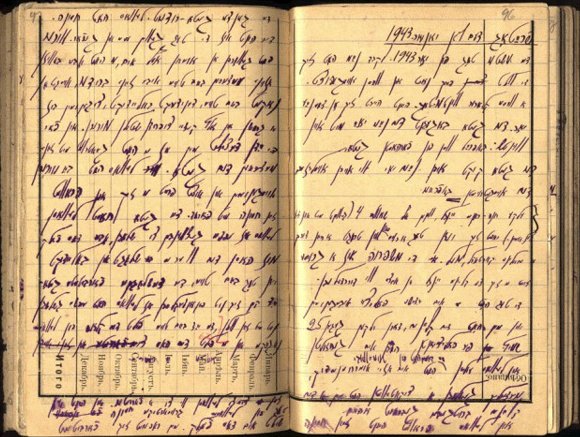
After the start of World War II, Vilna was annexed by the Soviet Union. It became a sanctuary to Jews fleeing from the Nazis, who occupied western Poland.

All of that changed on June 22, 1941, when Operation Barbarossa began. On the day Germany invaded the USSR, there were approximately 80,000 Jews living in Vilna, many of them refugees from the Nazi terror. By the time the Red Army arrived and kicked the Nazis out three years later, Vilna’s Jewish population had been reduced –through starvation, disease, deportation and executions — to zero.

Yitskhok (also spelled Yitzhak, Yitzak, etc., or anglicized to Isaac), was thirteen years old at the time his city was occupied by the Germans.

An only child, he was the son of a typesetter and a seamstress. Talented in writing, history and languages, he was also a faithful Communist and a member of the Pioneers, the Communist youth organization.

From June 1941 to April 1943 he kept a diary in Yiddish. Yitskhok had a sense of the significance of his account; at one point he wrote, “I consider that everything must be recorded and noted down, even the most gory, because everything will be taken into account.”

He not only wrote about his own life and his family and friends, but about the wider community events and the devastation the Germans wrought on his people. The historian Allan Gerald Levine called him “an astute and passionate observer of the times,” and compared him to Anne Frank.

Nor was the diary Yitskhok’s only writing project.

When one of his teachers, a beloved figure in the ghetto, died, he wrote a eulogy for the man and read it out before a large audience. He was a member of a literary group and was also attached to the ghetto’s history project, for which he interviewed ghetto residents about their lives:

I got a taste of the historian’s task. I sit at the table and ask questions and record the greatest sufferings with cold objectivity. I write, I probe into details, and I do not realize at all that I am probing into wounds … And this horror, this tragedy is formulated by me … coldly and dryly. I become absorbed in thought, and the words stare out of the paper crimson with blood.

The Vilna Ghetto, whose population initially numbered 40,000, had a rich cultural life, just like prewar Jewish Vilna had. There were theaters, cabarets, the symphony, art exhibits, a library, public lectures, and underground schools for both children and adults.

Vilna Jews saw art, music, literature and the pursuit of knowledge as a form of resistance. As Jacob Gens, head of the “ghetto’s Judenrat, put it, cultural activity gave a person “the opportunity to free himself from the ghetto for a few hours … We are passing through dark and difficult days. Our bodies are in the ghetto, but our spirit has not been enslaved.”

Reality intruded, however, and in the final analysis the Vilna Jews were doomed to extinction.

Yitskhok’s final diary entry was dated April 7, 1943, two days after five thousand Vilna Jews had been rounded up and shot at Ponary. He was understandably in a very grim mood. His prophetic last line was, “We may be fated for the worst.”

On September 23, 1943, the Nazis began the final liquidation of the Vilna Ghetto, which had by then been reduced to about 10,000 people. After a selection, those who could work were sent off to labor camps in Estonia and Latvia, where almost all of them died due to the brutal conditions there.

Children, the elderly, and the sick were shot at Ponary or sent to the extermination camp Sobibor and gassed.

Yitskhok, his parents and his uncle’s family chose to go into hiding rather than take their chances at the selection. In hiding he sank into apathy and said very little. After about two weeks in the hideout, they were discovered and taken to their deaths.

The only surviving member of Yitskhok’s family was his teenage cousin, Sarah “Sore” Voloshin. Somewhere on the route to Ponary she was able to escape. She joined a partisan group in the forest and survived until the Red Army liberated the area in the summer of 1944. After the war was over, she returned to the family’s hiding place and found Yitskhok’s diary. As of 2010, Sore Voloshin was still alive in Israel.

And the diary she retrieved had become one of the major sources on day-to-day life in the Vilna Ghetto.

Yitskhok Rudashevski suffered and died in just the same way as hundreds of thousands of others, but unlike them he did not remain anonymous: he is one of the ghetto’s most famous inhabitants. His writings have been published in their original Yiddish and in Hebrew, German and English translations. Extracts of his diary can be found in several anthologies, and it’s available in its entirety under the title The Diary of the Vilna Ghetto.

On this day..

1943: 1,196 Jewish children from Bialystok

(Thanks to Meaghan Good of the Charley Project for the guest post. -ed.)

On this date in 1943, a special transport of 1,196 children and 53 adults arrived at Auschwitz and were gassed shortly thereafter. Thus ended one of the lesser-known tragedies of the Holocaust.

The children were very nearly the last survivors of the Bialystok Ghetto, which had been liquidated in August 1943. Almost all of the inhabitants of the ghetto wound up being sent to the Treblinka Extermination Camp and killed, but over a thousand children were mysteriously separated from their parents and taken away for some as-yet-unknown purpose. (The transport list can be found here.)

At the time, there were tentative negotiations between the Red Cross and the Nazis to trade Jewish children for either German prisoners of war or cold, hard cash. The exact details are unclear, and there’s a great deal of contradictory information about the entire event.

In any case, the Germans selected children from Bialystok, one of the few places in Nazi Europe where there were any Jewish children left alive.

The children, all of them under 16, spoke only Yiddish and Polish. They were in terrible shape, both mentally and physically. One witness later described them:

Suddenly, a column of bedraggled children appeared, hundreds of them … holding each other’s hands. The older ones helped the small ones, their little bodies moving along in the pouring rain. A column of marching ghosts, with wet rags clinging to their emaciated bodies, accompanied by a large number of SS men …

The children, looking like scarecrows, refused to undress. They held on to their dirty clothing, the older stepping in front of the young ones, protecting them with their bodies, clutching their hands and comforting those that were crying. Their clothing permeated with lice, their bodies full of sores, these children refused to wash.

Their first stop was Theresienstadt in Czechoslovakia, the so-called “model ghetto” which was used by the Nazis as a propaganda tool to show that they weren’t mistreating their Jews.

Theresienstadt was in fact a horribly overcrowded, disease-ridden city and its inhabitants were all dying of starvation, but it was the best there was available. There were no gas chambers there, and the Theresienstadters knew nothing about the kinds of horrors the Bialystok children had been through.

To keep knowledge of said horrors from leaking out, once in Theresienstadt the children were placed in isolation and weren’t allowed to leave their barracks. 53 doctors and nurses were recruited from the local population to take care of them, and they were locked up with the children.

In spite of these security measures, some of the adults were able to make contact with people from the outside. Theresienstadt youth leader Fredy Hirsch got caught making an unauthorized visit to the children’s barracks, for example, and as punishment he was sent to Auschwitz on the next train.

A child thought to be Deborah Klementynowska, possibly the only surviving photo of one of these lost Bialystok children.

The adults — one of whom was Franz Kafka‘s sister, Ottilie — didn’t know what to make of the children’s behavior at first.

For instance, why, when they were invited to take a shower, did they start crying and screaming about gas? The children started to talk about their experiences, and their caregivers were horrified by their stories.

The Nazis intended to quite literally fatten up the children before they were sent off into the world, so the group was treated very well. Everyone got enough to eat, and they were given baths, clean clothes, medical treatment and even toys. Anyone who got seriously ill was taken away “to the hospital” and, ahem, never returned.

Slowly, assisted by their kind caregivers, the children got their equilibrium and began to act like normal kids again.

Meanwhile, negotiations continued …

The Allies wanted to send the children to British Mandate Palestine. The Germans, however, were against this plan because they didn’t want the children growing up there, strengthening the Palestinian Jewish community and possibly establishing a Jewish state someday. (The Mufti of Jerusalem, whom the Nazis were quite friendly with, didn’t like the idea either.)

The Germans wanted the children sent to Great Britain instead.

The UK, however, had already accepted many Jewish refugees, including 10,000 German, Austrian and Czech children with the Kindertransport, and were unwilling to take in any more.

And there was another problem, relating to the prospect of exchanging the children for money.

This money would have to be provided by the American Joint Distribution Committee and other Jewish welfare agencies, and they flat-out refused to give anything to the people who had promised to wipe them off the face of the earth.

In the end, the negotiations collapsed, through what one witness later called “an ill-applied sense of ‘correctness'” on the part of the Allies. Of course, given the Nazis’ track record, one wonders if they ever seriously intended to release the children no matter what they were given in return.

The plan was discarded and the Germans were left with 1,196 useless Jewish children on their hands. They dealt with them in the usual manner.

None of the Bialystok group or their caregivers had any idea what was coming up for them when they were sent away from Theresienstadt. They’d been told the negotiations had been successful and they were on their way to Switzerland, and thence to Palestine. They were told to take off their yellow stars and the adults had to sign a statement promising not to say anything bad about the Germans.

The transport set off in high spirits, rejoicing at their upcoming freedom.

But their train went not to Switzerland but to Poland, marked for “special treatment” on arrival at its destination. Apart from a few of the adults who were selected to work, there were no survivors.

On this day..

1648: Alice Bishop

(Thanks to Meaghan Good of the Charley Project for the guest post. -ed.)

On this date in 1648, 32-year-old Alice Bishop was hanged on the gallows in Plymouth Colony, Massachusetts for the murder of her young daughter — an apparently motiveless crime which must have shocked her fellow settlers.

Almost nothing is known about Alice’s early life. She probably, although not definitely, came over on the Mayflower. The prevailing theory is that her parents were Mayflower passengers Christopher Martin and Marie Prower. They died within a week of each other in January 1621, before the actual settlement of Plymouth even began.

If that’s the case, Alice had been an orphan for the better part of a year by the time the first Thanksgiving rolled around. She was presumably raised by one of the other families. She would marry twice and have three daughters: Abigail, Martha and Damaris.

By 1648, Alice was living with her second husband, the Plymouth newcomer Richard Bishop, who was Damaris’s father. The family seems to have been unexceptional, just another household trying to eke out a living in a harsh and unforgiving environment.

Somewhere along the line, something went very wrong.

On July 22, 1648, while Richard Bishop was away from home, family friend Rachel Ramsden dropped by the Bishops’ residence and spent some time with Alice. Alice’s four-year-old middle child, Martha Clark, was asleep in bed in the loft, which was accessible by ladder. (Where the other two children were has not been recorded.)

At some point, Alice gave Rachel a kettle and asked her to go fetch some buttermilk from a neighbor’s house.

When Rachel returned, she noticed blood on the floor beneath the ladder. Alice was “sad and dumpish,” and when Rachel asked her what was going on, she wordlessly pointed up at the loft.

Rachel climbed up to have a look: there was blood everywhere; Martha’s mattress was drenched in it.

Rachel fled the house in a panic, found her parents and told them she thought Alice had murdered her daughter. Her father rushed to find the colonial governor. A posse of twelve armed men assembled and went to the Bishop house. By the time the men arrived, Alice was in hysterics.

Ascending to the loft, they found Martha’s body. The child was lying on her left side, “with her throat cut with divers gashes crose wayes, the wind pipe cut and stuke into the throat downward, and the bloody knife lying by the side.” Nothing could be done for her.

Alice freely admitted she had murdered her daughter and said she was sorry for it, but she claimed she had no recollection of the crime. When they asked her why she’d done it, she had no answer for them.

She was the fifth person hanged in the Plymouth Colony, and the first woman.

We will never know why Alice Bishop killed her daughter Martha, and why she did it in such a ferocious manner. One of her descendants has a website about her that attempts to answer that question.

Severe mental illness, perhaps post-partum psychosis, is an obvious answer, but not the only one. The site notes another potentially significant fact: both of Alice’s parents died when she was four years old, and she killed her daughter at the same age.

Richard Bishop survived his wife by nearly a quarter-century. As for the children: youngest child Damaris Bishop grew up, married and had three sons, but Abigail Clark, Alice’s oldest child, vanishes from history after her mother’s execution.

On this day..

1901: James Edward Brady lynched for criminal assault

(Thanks to Meaghan Good of the Charley Project for the guest post. -ed.)

On this day in 1901, James Edward Brady was hauled out of his jail cell and hanged from a telephone pole on the corner of Main and Lawrence Streets at Haymarket Square in Helena, Montana. He had been arrested three days before in relation to his attack on Hazel Pugsley, a five-year-old girl.

On September 30, Brady, who had arrived in Helena from the city of Boulder, Montana only the day before, waylaid little Hazel while she was on her way to kindergarten. He convinced her to get on a streetcar with him and they didn’t get off until they were three miles outside town.

Hazel’s mother reported her missing after she didn’t arrive home from school, and a search was launched. Later that day, the police found her walking home alone. She was “a nervous wreck, and when the accused man was taken in front of her she began crying hysterically, at the mere sight of him.”

Brady was charged with “criminal assault,” a euphemism for rape.

He had once been a highly respected and influential man in the Yellowstone River area and was credited with bringing the first thoroughbred cattle into Montana, but he developed a drinking problem and somewhere along the line he fell from grace.

Brady had been in and out of trouble in Jefferson County before he moved to Helena, and in Boulder he had become overly familiar with several children. After the Hazel Pugsley incident, it came out that he’d lured at least four little girls to his cabin in Boulder and then molested them.

He was not criminally charged in that instance, but was warned to leave town or else. So he came to Helena.

Although Montana had a long tradition of lynchings and emotions were running high in the aftermath of Hazel’s attack, the sheriff wasn’t worried: Brady was housed in a secure stone jail with five locked doors between him and the outside. On the night of the lynching, the sheriff was asleep with his family as usual.

At 1:30 a.m. on October 2, a mob of thirty masked men pounded on the doors of the jail and demanded the prisoner. When they couldn’t get the jailer to answer the door, they stationed men around the building to keep watch while they started working on the door with a sledgehammer and a crowbar.

The mob easily broke open the outer wooden door, but the next door was barred. Jailer George Mahrt was awakened by the noise and mistakenly opened the barred inner door just as the lynch mob had broken through the outer door. Once inside the building, the men forced Mahrt to hand over his keys, unlocked the last three doors, and barged in on James Brady.

“What is it, gentlemen?” he asked.*

In spite of the early hour, a crowd of about 200 spectators gathered to watch as the vigilantes hustled the helpless Brady out of jail and force-marched him, already noosed, six blocks to Haymarket Square.

The spectators knew what it was.

The lynchers summoned a saloon-keeper who had witnessed Hazel’s abduction, to confirm for the assembling multitude that it was indeed Brady who took her. One of the masked lynchers then forced his way through the crowed and slugged Brady twice in the face; this may have been Peter Pugsley, Hazel’s father. (The same man would later go after Brady again, but the mob held him back.)

“Now, then,” the mob’s leader addressed his prey. “Brady, your time on earth is short. Have you any confession to make?”

Brady had little to say: only to reiterate his innocence, and ask that his last paycheck be sent to the Boulder School for the Blind where his niece was a student.

When asked if he wanted to say a prayer, Brady said he didn’t know how to pray and asked that someone pray for him instead. One of the mob said, “May the Lord help you, Brady; that is all I can say for you.”

Then his time was up.

Several people already positioned on top of the nearby telephone pole jerked Brady up from the ground violently, probably breaking his neck, and as Brady hung twitching and dying, the members of the lynch mob pulled off their masks and melted into the watching crowd.

In addition to the 200-some people who witnessed the lynching, another thousand or so viewed the body by moonlight before it was cut down.


Jackson (Mich.) Citizen Patriot, Oct. 2, 1901.

A coroner’s inquest was held later that day. Several people testified that they’d witnessed Brady’s death, but they all swore they were not part of the lynch mob and developed amnesia when asked if they recognized anyone who was.

The coroner’s jury ruled Brady’s death a homicide.

On October 3, Peter Pugsley — the father — was arrested and charged with murder. Investigators hoped he would provide them with other names, but Pugsley said he hadn’t been present at the lynching and produced an alibi, which friends backed up. He was released the next day on bail, his bond secured by several prominent members of the community.

Ultimately, a grand jury heard testimony from thirty-eight witnesses during an eighteen-day investigation. It then declined to indict Pugsley or any other suspect. Later, some of the jurors said it was impossible to name anybody connected with the crime because so many witnesses refused to answer questions, citing their Fifth Amendment right against self-incrimination.

However, someone did pay for what happened to Brady.

As amateur historian Tom Donovan writes of this case in volume two of book Hanging Around the Big Sky: The Unofficial Guide to Lynching, Strangling and Legal Hangings of Montana, “The Brady incident was the only case where an official was severely disciplined for losing a prisoner to a lynch mob. The Lewis and Clark County grand jury found that Jailer George Mahrt was incompetent and he was apparently fired.”

Not only had Mahrt, an experienced jailer, opened the inside door to the armed mob, he had also failed to notify the sheriff what happened until Brady had already been marched out of the jail. All he would have had to do to arouse the sheriff was press an electric panic button, which would have sounded an alarm at the sheriff’s residence.

In the aftermath of Brady’s death, officials in Butte, Montana announced he was also a suspect in the 1898 abduction and murder of nine-year-old Ethel Gill. She was missing for several days before her body was found in an outhouse.

Gill had been raped, beaten and strangled. Brady lived and worked in the same neighborhood where Ethel’s body was found. He quit his job and left Butte immediately after the murder, but wasn’t considered a suspect until after he was killed. Ethel Gill’s murder was never solved and Brady’s connection to the crime remains a matter of speculation.

* San Jose Evening News, Oct. 2, 1901.

On this day..

1953: Louisa May Merrifield, elder abuser

(Thanks to Meaghan Good of the Charley Project for the guest post. -ed.)

On this date in 1953, housekeeper Louisa May Merrifield, the so-called Blackpool Poisoner, was hanged at Machester’s Strangeways Prison for killing her employer.

She was the third-last woman hanged in Britain and the very last woman to be executed at that particular prison, which now houses only men; the job was performed by Albert Pierrepoint.

Born in 1906, Louisa had already served prison time for ration book fraud by the time of the murder, and she lost custody of her four children due to her excessive drinking and neglect.

She couldn’t seem to hold on to a man (she was married three times) or a job (she had 20 in three years).

She took her final position on March 12, 1953, after she and her husband of one month, 71-year-old Alfred Edward Merrifield, became housekeepers and live-in companions to Sarah Ann Ricketts, a spinster who was nearly eighty years old. Sarah Ricketts owned a bungalow at 339 Devonshire Road, North Shore, Blackpool.

The Merrifields indulged in elder abuse and neglect, and Sarah Ann complained she didn’t get enough to eat and that her housekeepers swilled rum on her dime. Meanwhile, Louisa was going around boasting that she’d inherited a £3,000 house.

When someone asked her who had died, she answered, “She’s not dead yet, but she soon will be.”

Louisa’s prophecy was eerily accurate: Sarah Ann Ricketts expired on the night of April 14, 1953, only a month after she’d hired the Merrifields and three days after Louisa’s prediction … but not before drafting a new will which left her bungalow to the Merrifields.

Louisa didn’t call a doctor until the next morning. She said that, as the old woman was clearly beyond help, she didn’t want to drag anyone out of bed in the middle of the night.

The suspicious GP refused to sign a death certificate and insisted on an autopsy, which revealed the cause of death as phosphorus poisoning, administered in the form of a rat poison called Rodine.

Although a police search of the bungalow didn’t turn up any Rodine, a check at the local pharmacy showed Louisa had recently purchased the stuff and signed the poison register.

The Merrifields found themselves charged with murder. Louisa was arrested first, two weeks after Sarah Ricketts died, and Alfred a few days later.

At their trial in July 1953, Louisa was convicted and sentenced to hang. The judge called her crime “as wicked and cruel a murder as I ever heard tell of.”

The jury couldn’t reach a verdict on Alfred, however, and the district attorney decided not to prosecute again. He was released and in due time inherited a half-share in Mrs. Ricketts’s bungalow. He died in 1962 at the age of 80.

Louisa Merrifield’s ghost is said to haunt the cell she once inhabited at Strangeways Prison.

On this day..