1939: Charles McLachlan

(Thanks to Meaghan Good of the Charley Project for the guest post. -ed.)

On this date in 1939, 57-year-old Charles Augustine McLachlan was gassed at San Quentin State Prison in California. He’d murdered a six-year-old neighbor girl at his home in Downey, California the previous year.

McLachlan was a widower who was half Irish-American and half Mexican by descent but described as white. A master painter and decorator, he owned a plot of land with a few houses he’d built himself.


Mugshot of perp; newspaper sketch of victim.

McLachlan lived alone in the smallest of the houses, an eight-by-twelve-foot shack; the largest building was occupied by his son and daughter-in-law, Joe and Carmen, and their child. The parents of the victim, Jennie Moreno (her name is spelled “Jenny” in many accounts), had known McLachlan for about thirty years. Although he was occasionally seen drunk, he had a reputation as a kind, likeable man.

That is, until April 14, 1938.

At 10:00 that morning, Jennie Moreno and her younger sister went to give a magazine to Carmen McLachlan.

Jennie’s parents last saw her at 11:00 a.m., while she was getting ready to go to church. When she didn’t return home at noon as expected, her parents began searching for her. At some point a neighbor smelled a strange odor and noticed smoke pouring out the windows of McLachlan’s shack, which had no chimney or flue.

The police were summoned. They arrived at his house at midnight and found bloodstained, partially burned clothing belonging to both Jennie and McLachlan lying on a sheet of metal on the floor of the shack. The floor had been washed and was still sopping wet.

A search of the premises turned up Jennie’s shoes and a bloodstained hammer. McLachlan’s mattress was saturated with blood and there was blood on the floor beneath the bed as well. He was arrested on the spot.

At the same time the sheriff’s deputies were arresting McLachlan, a search party that included Jennie’s father and uncle found her partially nude body concealed among the weeds in the vacant lot next to McLachlan’s property.

When they saw McLachlan being led away in handcuffs, they guessed he must be the murderer. Jennie’s uncle struck McLachlan in the face and several others in the crowd called out, “Lynch him!” But the police were able to disperse these aspiring vigilantes without too much difficulty.

McLachlan, who had been drinking wine and whiskey since 9:00 a.m., was quite drunk at the time of his arrest and at first said he had no memory of what happened. He ultimately made a confession to murder. McLachlan stated he’d been lying in bed resting with the door open when little Jennie wandered inside. He took her into the bed and began to fondle her, then struck her in the head with a hammer after she screamed. He waited until after dark, and then carried her body to where it was later found.

Jennie’s body showed evidence that she had in fact been violently raped, something McLachlan never admitted to.

He would go on to repudiate his entire statement, saying the police had kept him in jail without sleep or food and coerced the confession. He pleaded both not guilty and not guilty by reason of insanity, waived his right to a jury trial and was heard by a judge.

McLachlan claimed he heard “witches” speaking to him and said the voices “say most anything.” While in jail he would refuse to eat or speak for days at a time, and he refused to cooperate with his defense. A psychiatrist hired to examine him found “evidence of pre-senility and psychic pain” but believed he was feigning mental illness.

Found both guilty and sane, he was condemned to death. The judge to whom McLachlan had entrusted his fate called Jennie Moreno’s murder “one of the most brutal and horrible ever perpetrated in Los Angeles County.”

Charles McLachlan walked into the gas chamber at 10:10 a.m., eighteen months after his crime. “Twisting and straining against the straps that bound him,” he took seven minutes to die.

On this day..

1864: George Nelson, Indiana Jones rapist

(Thanks to Meaghan Good of the Charley Project for the guest post. -ed.)

On this day in 1864, Private George Nelson of Company F of the 13th United States Colored Troops was hanged for rape in Nashville, Tennessee.

He committed his crime on November 13, 1863. Nelson and two other men were on Nashville Pike outside of the town of Dickson when they encountered an unmarried white woman named, no lie, Indiana Jones.

They asked her where she lived and she said her house was about a mile away. The men claimed they’d been fighting with some rebels near her house and said she must go with them.

Miss Jones refused, and Nelson threatened to shoot her if she did not comply. She went with him for about 250 yards, begging him to release her. Private Nelson put a bayonet to her side and told her to come into the woods with him or he would run her through. Miss Jones started crying then, and he threatened to strangle her with a rope if she did not shut up. They went into the woods together while the other two men held the horse.

As Miss Jones later testified, “I again begged of him to let me go, when he cocked his gun and said if I did not be still he would blow my brains out. He then took hold of me, threw me down, and committed a rape on my person.”

When he was done he robbed her of $1.50, but the other soldiers made him give the money back. Then they let her go.

George Nelson’s accomplices were tried separately, and on cross-examination the victim was asked, “Did you use your utmost endeavors to prevent him from executing his desires, or did you simply cry out, thus yielding a tacit consent?”

As if she could have done anything else with a gun trained on her!

The three defendants were all court-martialed. President Lincoln approved the death sentence for Nelson in August 1864 and he hanged the following month. His partners-in-crime got twelve and ten years in prison respectively.

On this day..

1887: Josiah Terrill, “I ain’t guilty of this here charge”

From the out-of-print The palace of death, or, the Ohio Penitentiary Annex: A human-interest story of incarceration and execution of Ohio’s murderers, with a detailed review of the incidents connected with each case by H.M. Fogle (1908):


Chapter 4

Josiah Terrill
September 2, 1887

Hanged Sept. 2, 1887, for the murder of a Meigs County, Ohio, citizen. It is believed that he was innocent but lacked friends and finances to clear himself.

Died Brave, Proclaiming His Innocence


Josiah Terrill, serial number 18,872, a Meigs County murderer, was hanged September 2, 1887. He met his fate bravely and, as is said of college graduates, “acquitted himself with great honor.” Like nine-tenths of the men who die upon the gallows, Terrill denied all knowledge of the crime with which he was charged, and with a last breath declared that he suffered death as an innocent man.

A few hours before the time appointed for his execution, the condemned man awoke from a refreshing sleep and asked for something to eat. The request, of course, was granted. Someone unguardedly expressed surprise at the desire to eat, and Terrill said, “You ain’t going to choke me off that way are you, without anything to eat?”

While Terrill was eating, a Missouri Colonel conversed with him, urging him to unburden his mind if he had any guilty knowledge. The murderer reiterated his oft repeated declaration of innocence, and requested the Warden to give him a drink of whiskey. But the man’s nerve was so great that the Warden declined to give him a stimulant to raise his courage for the trying ordeal.

After the final administration of spiritual comfort, the Warden read the death warrant, and the condemned man was lead [sic] to the scaffold.

Terrill was perfectly cool and collected, and his features shone in their natural color. As he stepped to the trap, Warden Coffin asked him if he had anything to say, to which he replied, “I say I ain’t guilty of this here charge.” “You say you are guilty?” queried the Warden who, with others, misunderstood him. “I say I ain’t guilty of this here charge,” reiterated Terrill. “God in heaven knows I ain’t guilty. There are some people and lawyers in Pomeroy who think they have got satisfaction on me now. That’s all I’ve got to say.”

Warden Coffin then stepped over and shook hands with the condemned man, bidding him good-bye. The minister gravely followed his example, saying in a solemn tone: “Josiah, put your confidence and trust in the Lord.” “I have,” replied Terrill.

He was placed over the trap and, standing as if being measured for a suit of clothes, permitted Deputy Cherrington to adjust the ropes. There was some difficulty in fastening a strap, and he considerately moved his feet to facilitate operations. The black-cap–a rude bag–was placed over his head and the noose adjusted. At 12:34 A.M., before the audience realized that it had happened, Warden Coffin shot the lever from north to south. Rattle went the trap against the sides of the scaffold, and with a boom the body of the condemned man shot down seven feet, oscillated once or twice and then became quiet. There was not a twitch of the muscles or a movement of the body.

Instantly there was a plank placed across two chairs on the platform directly under the body of the hanging man, and two doctors sprang upon the plank to take note of the pulse and respiration. The heart beats were very rapid at first, but after six minutes began to lessen. In twelve minutes he was dead. The rope was lowered so the body could be placed on the plank, the knot was cut and the noose loosened, and then the black-cap removed, exposing the swollen and blackened face. His neck had been broken by the fall, but the rope had not cut the flesh. The body was placed in a coffin and shipped to Pomeroy, where it was buried by the dead man’s mother.

Strange to say, he expressed no desire to meet the aged woman before his death; on the contrary, he remarked at supper that the only person he cared to see was his child (illegitimate).

There has always existed grave doubts in the minds of some of Meigs County’s best citizens as to Terrill’s guilt. The evidence against him was purely circumstantial, but the jury evidently thought it strong enough to warrant a verdict of guilty.

He was accused of murdering an old man for whom he had previously worked. The opinion of the writer is that Josiah Terrill died an innocent man. This opinion is based upon evidence, and what could be learned from some of Meigs County’s best citizens. Certain it is that he was a poor illiterate man, without money and without influential friends.

Charles Phillips, the murdered man, was aged and decrepit. By frugality and hard toil he had accumulated quite a sum of money. Robbery was the motive of the crime, and a bludgeon and knife were the instruments of destruction.

Innocent or guilty, Terrill is in the hands of a just God, where he will remain until that great “Day of Judgment,” when all wrongs will be righted, and the innocent shown and the guilty punished according to the unerring judgement of an ETERNAL GOD.

On this day..

1876: Jesse Pomeroy’s sentence commuted

(Thanks to Meaghan Good of the Charley Project for the guest post. -ed.)

On this date in 1876, serial killer Jesse Pomeroy was reprieved by a 5-3 vote of the Governor’s Council of Massachusetts. Rather than hanging him, they elected to bury him alive instead.

With a “mere” two deaths to his name, at first glance Jesse Pomeroy may not seem like much of a serial killer. In fact, according to some definitions that require a higher body count, he wasn’t a serial killer at all. But give the kid some credit: he was only fourteen years old when he was caught. What’s more, his two murders were committed in a most brutal, sadistic manner.

Jesse was born in Massachusetts in 1860, the son of a violent and abusive father and a doting mother. He’d always been considered a “difficult” child and had tortured the family pets, but his known criminal career didn’t begin until he was twelve years old.

Over the course of nine months, he lured eight young boys between five and eight years old to remote areas and attacked them, beating them badly with a stick, a belt or his hands. In his later attacks he took to biting, and started using a knife as well. He tried to stick a needle into one child’s eyes, another boy, age six, was stabbed between the shoulders and had his penis nearly half cut off. Eventually Jesse would let his victims go, leaving them physically and mentally scarred for life.

Each attack was worse than the last, and each time the intervals between them got shorter. There were three months between the first assault and the second, and only five days between the seventh incident and the eighth (which was the last).

In his biography of Pomeroy, Fiend: The Shocking True Story of America’s Youngest Serial Killer, Harold Schechter described the assaults vividly:

The seventh attack occurred … on Wednesday, September 11. This time the “boy torturer” lured a seven-year-old named Joseph Kennedy to a vacant boathouse near the salt marshes of South Boston bay. Once inside the building, he slammed his victim’s head against the wall, stripped him naked, and administered a ferocious beating, breaking the little boy’s nose and knocking out several of his teeth. Then, pulling out his pocketknife, he forced the seven-year-old to kneel and ordered him to recite a profane travesty of the Lord’s Prayer, in which obscenities were substituted for Scripture.

When young Joseph refused to commit this blasphemy, his tormentor slashed him on his face, his back, his thighs. Then he dragged the bleeding child down to the marsh and — laughing delightedly at the little boy’s suffering — doused his wounds with salt water.

Most serial killers have a basically normal appearance, and some are downright handsome.

Jesse, however, actually did look pretty creepy. His head was too large for his body, he was blind in his right eye and the eyeball was covered by a whitish film that was deeply unsettling to look at. One of the boys he attacked said the eye looked like a “milkie,” a white marble. After that, the press often referred to the unknown assailant as “The Boy with the Marble Eye.”

On the day of his arrest on September 20, 1872, the police brought Joseph Kennedy, one of Pomeroy’s victims, around to various local schools to see if the child could find his attacker in the classrooms.

When little Joseph entered Jesse’s classroom, Jesse lifted his head when the teacher told him to but kept his gaze directed down at his desk. Joseph couldn’t see his deformed eye and didn’t recognize him. That afternoon, however, for some reason Jesse decided to pop in to the local police station on the way home from school. The boy was there and this time he recognized him.

Arrested and subjected to several hours of grilling, Jesse quickly confessed to his crimes, saying he “could not help himself” and wasn’t sure why he’d done such terrible things.

His victims identified him as the boy who had hurt them, and five of them testified against him in juvenile court. Jesse was sent off to the Lyman School for Boys, a juvenile reformatory.

The authorities were supposed to keep him locked up until he turned 18, but Pomeroy, who was no fool, read the fine print in his sentencing and discovered that if he “reformed,” he would be released early.

He immediately set about becoming an absolutely angelic inmate. He obeyed all the rules, did all the work assigned to him and didn’t talk back to the staff. When the other boys tried to bully him, he ignored them.

Before long, he was awarded the coveted position of dormitory monitor, with some responsibility over the other boys. On the outside, his devoted mom, who never believed in his guilt, kept up a letter-writing campaign, asking anyone with influence to help get her son released.

Jesse’s good behavior was rewarded and he was paroled to his mother’s custody in February 1874. He had been in custody for less than a year and a half. By then, his mother had left his father and was running a small store in South Boston.

On March 18 that year, six weeks after Jesse was released from the reformatory, ten-year-old Katie Curran disappeared. She was last seen when she went into the Pomeroy family’s store to buy a notebook for school. A neighbor boy saw her go into the store, where Jesse was manning the counter, but no one ever saw her come out.

Shockingly, in spite of his antecedents, the police at the time didn’t consider him a suspect in Katie’s disappearance, didn’t thoroughly search the store, and accepted his story that he hadn’t seen Katie at all that day.

This may have been because Jesse had never been known to attack little girls. In any case, over the ensuing six weeks the search instead concentrated on the Boston Wharf, on the theory that she’d accidentally fallen off a dock and drowned. Another theory was that she had been kidnapped.

The investigation went nowhere.

On April 22, Jesse accosted four-year-old Horace Millen while the child was on the way to the bakery with a few pennies to buy a sweet. Numerous witnesses saw them together, hand in hand, walking to the harbor; most of them assumed they were brothers out for an adventure.

What happened next is unprintable.

Suffice it to say that at 4:00 p.m., Horace’s body was found beyond a hill in a remote area near the shore. He’d been stabbed eighteen times in the chest, his throat was cut, and his face and genitals were mutilated. His fists were still clenched, the nails biting into his palms, indicating he’d been conscious during the attack and died in considerable pain.

As the police began their murder investigation, someone remarked that Horace’s injuries were remarkably similar to the attacks Jesse Pomeroy had committed before he was locked up two years ago.

As soon as the cops discovered Jesse was in fact on parole, they rushed to his house and took him into custody. His boots were caked with mud and grass was stuck to the soles, his face was scratched and his pocketknife was bloodstained.

At first, Jesse denied having done anything wrong. But when he was confronted with Horace Millen’s corpse, he cracked and started sobbing. “Please don’t tell my mother,” he pleaded. “Put me somewhere, so I can’t do such things.”

Unaccountably, more than a month passed from the time Jesse was arrested until Katie Curran’s body was found, and it was located by accident. Jesse’s mother and brother had to move out of their store in the wake of the murders. A new tenant moved in to the building and decided to refurbish the basement. Workers found Katie’s body. Her throat had been cut and her genitals mutilated.

When confronted with the news about Katie, Jesse denied any knowledge of her death and seemed indignant. “After all,” Harold Schechter noted, “aside from the fact that he was already in custody for child-murder and the little girl’s decomposed corpse had been found in the cellar of his family’s store, there was no reason in the world suspect him.”

Jesse ultimately confessed to killing the girl as well. He said he’d lured Katie down into the basement by saying there were some notebooks down there for her to look at. As soon as they reached the bottom of the steps, he took hold of her and cut her throat. He hadn’t even concealed her body very well, just tossing it in the ash heap.

The police search of the Pomeroys’ store must have been perfunctory indeed to have missed it.

(Jesse would later retract both confessions and claimed, to the end of his days, that he had never harmed a child in his life and was the victim of circumstances, coercive tactics by the police and a deliberate frame up.)

At his trial, his defense was one of insanity.

Three psychiatrists, or “alienists” as they were known in those days, examined him, one for the defense and two for the prosecution. Jesse told them he would get “a sudden feeling” that prompted his violence to small children and “I could not help doing it.”
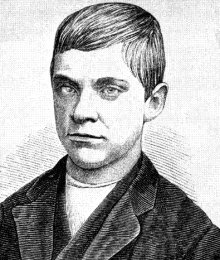

Jesse Pomeroy, young and old.

The doctors noted his lack of remorse or any sympathy for his victims. They believed Jesse would always be dangerous to society. His attorney argued that he should be found not guilty by reason of insanity and then locked away in a mental institution for good.

In the end, the jury convicted him of first-degree murder, for which the mandatory penalty was hanging. However, they issued a recommendation of mercy on account of his youth.

Although juveniles had been executed in the United States before and would be again, the state of Massachusetts had never hanged a boy of fourteen. On the other hand, Jesse had committed no ordinary crimes. By any standard he was a monster. His case was extremely controversial and the governor, William Gaston, was besieged with petitions both for and against clemency.

Gaston didn’t want to hang Jesse Pomeroy and stalled on the issue for as long as he could. It may well have cost him re-election. But his successor, Alexander Rice, didn’t want to hang Jesse either, campaign promises to the contrary.

So in August 1876, two years after Jesse’s murder conviction, by which time the furor in the press had died down, Rice commuted the now-sixteen-year-old’s sentence to life in prison. But there was a catch: the sentence had to be served in solitary confinement.

He would spend 41 years in a tiny cell, isolated from the world. His mother visited him once a month until her death. The only other people he saw were the guards. He was allowed to exercise alone in the prison yard and was allowed to read books. He wrote some bad poetry. Most of his efforts, however, were concentrated on escape. Schechter records:

Nothing — no amount of time locked in a dungeon, no beatings administered with a brass-tipped cane, no efforts at reinforcing his cell — discouraged Jesse for long. When plates of boiler-iron were bolted to his walls to keep him from digging at the stones, he set to work prying loose the bolts. When the walls were painted with a white preparation that would make even a pin-scratch conspicuous, he turned his attention to the floor, cutting loose one of the heavy boards, then digging at the ground underneath … Over the course of fifty years, virtually everything that fell into his hands became a potential implement of escape … He managed, over the decades, to fashion an amazing assortment of tools: awls, chisels, saws, drills, files, pry bars.

He never even came close to breaching the prison walls and his escape attempts mainly just made him a pain in the prison’s collective ass. Then again, a man needs a hobby.

In 1887, his ninth year in the solitary cell, he caused an explosion that blasted a hole in the ceiling and temporarily blinded him but didn’t get him anywhere. Only in 1912 was he ever able to actually make it out of the cell, something that took three years of work to accomplish — and he was caught within minutes. By then he was fifty-two.

His sentence was relaxed in 1917 and he was allowed into the general population. By then, Jesse’s health was failing, and his crimes were passing out of local memory. New inmates to the prison no longer recognized his name, something that deeply upset him. In 1929, he was transferred to the prison farm at Bridgewater. He took a car to get there, his very first automobile ride, but didn’t he didn’t seem interested in his surroundings. One reporter described him as “a deadened creature gazing with lusterless eyes upon a world that means nothing to him.”

He died at the Bridgewater Prison Farm on September 29, 1932, having spent sixty of his seventy-two years behind bars.

On this day..

1765: Three Burglarious Johns

(Thanks to Meaghan Good of the Charley Project for the guest post. -ed.)

On this date in 1765, John Fagan, John Grimes and John Johnson alias Cochran were hanged in Burlington County, New Jersey in a rare triple execution.

The three Johns were convicted of home invasion robbery.


Wrong Three Johns.

On July 18 in Northampton Township, the three men, with their faces painted, burst into the house of Joseph Burr. By “threats of violence” they convinced Burr’s wife to give up her keys to the locked cabinets and made off with the following:

  • 1 silver sauceboat
  • 8 silver tablespoons
  • 9 silver teaspoons
  • A sum of money
  • A considerable quantity of shirts, aprons, caps and handkerchiefs
  • A great parcel of “wearing apparel made in the manner of people called Quakers”

They also took three valuable horses from Burr’s stable and rode off on them.

Burr and his wife told the authorities they knew the robbers were Irish because “they all had the brogue upon their tongues,” and it turned out three Irish laborers had gone missing from a farm near Mount Holly.

The thieves’ trail was discovered and a posse caught them red-handed, as it were, riding the stolen horses and carrying the stolen goods.

Justice acted quickly and Fagan, Grimes and Johnson were executed a mere six weeks after their crime. The Burlington County Treasury compensated the jailer his expenses in feeding the three men for 39 days.

According to Burlington County this Gallows Hill “stood not far from the Burlington-Mt. Holly Road (Rte. 541)” — perhaps the present-day Laurel Hill Cemetery.

On this day..

1849: Rebecca Smith, to save her children from want

(Thanks to Meaghan Good of the Charley Project for the guest post. -ed.)

On this day in 1849, forgotten mass murderer Rebecca Smith was hanged before a large crowd outside Devizes Prison in Wiltshire, England. She’d been convicted of the murder of her one-month-old baby, Richard.

Smith was the fifteenth person executed in the UK that year, and she would be the last woman in British history to be put to death for the infanticide of her own child. (Not to be confused with infanticide in general.)

Lionel Rose, in his book Massacre of the Innocents: Infanticide in Great Britain 1800-1939, described Rebecca Smith as “an impoverished depressive and the wife of a drunkard.” In many ways she fit the profile for perpetrators of infanticide then and now: most women who commit these acts are desperate, often young, often impoverished, often unmarried, unable to take care of their babies and not knowing where to turn.

In many jurisdictions today, such women are treated leniently. 19th-century judges and juries did the same and rarely convicted the defendants of murder, which at the time entailed an automatic death sentence; they would usually try to go for an outright acquittal or, at worst, a manslaughter verdict.

As Rose notes in his book, “Between 1849 and 1864 there had been only 39 convictions of mothers for the willful murder of their children, almost all of them under 1 year and all but 5 illegitimate. From 1849 the Home Secretary invariably reprieved mothers who killed their own infants under twelve months … Between 1849 and 1877 only two more women were to be executed for child murder.”

One had slaughtered her four-year-old son; another killed not only her own child but also the child of her lover’s former mistress, to get him out of having to pay child support.

Rebecca’s case was something else altogether, though.

Her behavior before little Richard’s death was suspicious: she claimed the infant was “wasting away” when he was in fact the picture of health, and she went around in her home village of Bratton asking where she could buy arsenic.

When Richard died suddenly a short time later, the police launched a homicide investigation. On autopsy his body was found to be riddled with poison.

He had clearly been murdered in cold blood, but in spite of this the jury recommended mercy.

However, after her conviction Rebecca confessed that she had poisoned not just Richard but seven more of the eleven children born to her. Seven! All of them except Richard were killed only a day or so after birth. Her statements were confirmed when the authorities exhumed the children’s bodies and autopsied them.

Katherine D. Watson, in Poisoned Lives: English Poisoners and Their Victims, explains Rebecca’s motive:

Aged forty-three, ‘undernourished and in poor health, living in great poverty and almost illiterate’, she had borne eleven children during eighteen* years of marriage, but only one, the first-born, was still alive. […] Her husband was an alcoholic who never earned much money and frittered away the £100 that her father left to her; although a seemingly pious woman, Smith felt that murder was a kinder fate than slow starvation. […] Seen by her neighbors as inoffensive and industrious, she claimed that her only fear was that her surviving daughter would be neglected after her death.

Two of her non-murdered children also died of natural causes; only one daughter survived to adulthood.

A contemporary account described her demeanor as she awaited death:

[H]er conduct was most becoming. Mild and contented in her manner and deportment might be thought that she was totally incapable of the unnatural crime of which she was convicted. Free from guile or hypocrisy, she at once unhesitatingly confessed her crime, and acknowledged the justice of the punishment that awaited her, and frequently expressed a hope that others would take warning by her fate. At the same time she was extremely ignorant, and betrayed a want of any deep feeling.

The modern reader may be shocked that she was able to get away with it for so long, but it wasn’t necessarily all that unusual.

The infant mortality rate in 19th-century Britain was so high, particularly among the poor, and the methods for investigating murders and potential murders were so primitive, that a person could commit such crimes repeatedly with very little fear of being detected.

Rebecca Smith was certainly not the only mother of that time and place who killed several of her own children during infancy, and she was probably not the most prolific, either. The only thing that stands out about her is that she got caught.

In spite of what she did, when you look at her life, it’s difficult not to pity her. But as Watson explained, “A confession to eight murders made a reprieve impossible.”

* Some sources say she was married twenty-eight (not eighteen) years.

On this day..

1897: Harvey DeBerry, raving like a madman

(Thanks to Meaghan Good of the Charley Project for the guest post. -ed.)

On this date in 1897, a 23-year-old black man named Harvey DeBerry was hanged for sexually assaulting his employer’s daughter.

His offense, this sexual assault, was a new one under the Tennessee statutes, different from the crimes of rape and attempted rape, and DeBerry was the first person in Shelby County to be convicted of it.

DeBerry was a live-in laborer on the Eigiman farm in Frayser Station, Tennessee, and his wife was the farm’s cook. Mr. and Mrs. Eigiman had three children aged seven, five and two. It was the oldest child, Elenora, that DeBerry assaulted on October 8, 1896.

At the time of the crime, Mr. Eigiman was in the hospital in Memphis recuperating from a fractured skull and a broken leg. Mrs. Eigiman went to see him that day, leaving her children in the care of the DeBerrys. She left Elenora in bed in her nightgown, because the little girl said she wasn’t feeling well.

When Mrs. Eigiman returned at the end of the day, Elenora was still in bed, crying and acting as if she was in pain. She refused to tell her mother what was wrong, and cried and moaned all night.

The next morning, her mother stripped the bed and found blood on the sheets. Mrs. Eigiman confronted her daughter, and Elenora said Harvey DeBerry had come into her room, lain on top of her and hurt her. That same day, a doctor was called to examine the victim. His findings, according to court documents, were as follows:

He found the child highly excited, nervous, and trembling; that the person of the child was swollen, and very tender to the touch; that the parts showed acute inflammation and swelling; that he found a purulent discharge, and a slight rupture of the hymen; that penetration had been partial, but not complete; that the acute inflammation, purulent discharge, and swelling indicated that the injury was recent. During the course of the examination the physician asked the child who hurt her, and she replied that ‘Harvey hurt her.’ The mother was not present when the child made this statement.

Harvey DeBerry fled when Mrs. Eigiman and Elenora confronted him with their accusations.

He turned up soon enough, though, living in Arkansas under the alias Frank Berry, and was extradited to Tennessee for trial. He was represented by a father-and-son team of black lawyers and offered two witnesses in his defense: a washerwoman who said there was no blood on Elenora’s clothing, and someone who said he and DeBerry were harvesting corn together at the time of the crime.

However, the prosecution was able to prove that DeBerry’s alibi witness was mistaken about the date, and the washerwoman had laundered Elenora’ clothing a full month before she was attacked.

Elenora testified about her experience at the trial, saying the reason she hadn’t immediately told her mother about the attack was that Harvey had threatened to kill her if she breathed a word about what he had done. The defense tried to convince the court that another man had abused the little girl, but Elenora denied this on the stand.

A jury acquitted DeBerry of two counts of rape, but convicted him of “assault and battery upon a female under ten years of age, with intent to unlawfully and carnally know her.” What exactly constituted “rape” when there was scant to no penetration was a grey area in Anglo jurisprudence, but with the sexual assault law it was six of one and a half-dozen of the other: both rape and sexual assault were capital offenses.

On the scaffold DeBerry was sobbing and appeared terrified.

A newspaper said later that his last words were “the ravings of a madman. There was no connection of coherency in what he said.”

When he stood on the trap and the sheriff pulled the lever, nothing happened. After an agonizing moment, a deputy stepped forward and pulled it a second time. This time the trap worked and DeBerry fell, cleanly breaking his neck. He was pronounced dead within twelve minutes.

As to whether he confessed before he died, the sheriff and the minister refused to say.


For a bit of period context, the same date that DeBerry hung lawfully saw the summary lynching of an unknown tramp in Manheim, Illinois, outside Chicago. That man attempted to outrage a farmer’s wife but was fought off by the “muscular German woman,” then led a desperate chase through woods and cornfields for half an hour until one of the pursuing posse finally plunked him with a gunshot.

The wounded assailant was searched for identity papers (none turned up), then instantly strung up on the nearest sturdy tree. (Source: The News and Observer (Raleigh, NC), Aug. 20, 1897)

On this day..

1941: 534 Lithuanian Jewish intellectuals

(Thanks to Meaghan Good of the Charley Project for the guest post. -ed.)

On this date in 1941, 534 Jewish intellectuals were lured out of the Nazi ghetto in the city of Kovno, Lithuania (also known as Kaunas), taken to Ninth Fort, and shot to death.

Over 5,000 Jews would die there during the Nazi occupation.

The Nazis had captured these people using a very clever ruse: on August 14, they had advertised for 500 Jews to help sort out the archives at City Hall, which were in disarray due to the chaos that followed the Germans’ conquering the city in June.

The workers had to be intelligent, educated types and fluent in German and Russian. They would be treated well and given three solid meals a day, in order that they could do the work properly and make no mistakes.

Most of the other jobs available for Jews at that moment involved manual labor under brutal conditions, on starvation-level rations.

More than the requested 500 showed up. The Nazis happily took them all.

Vilius “Vulik” Mishelski (later anglicized to William Mishell), who was 22 and had studied engineering in Vytautas Magnus University [Lithuanian link], was nearly victim no. 535. His mother told him about the job offer, because it upset her when he home from working at the airfield, “my clothes torn, my face covered with dust and sweat, my fingers bleeding, and I myself so exhausted I could hardly speak.” The archives job seemed like a gift from heaven to her.

Vulik wasn’t so sure.

Why, he asked, had the archives not been sorted out sooner? After all, the Germans had conquered Kovno a full two months earlier.

And why not get Lithuanians to do the job? It certainly wasn’t necessary to employ Jews.

He debated with himself for the next four days, then finally decided to go. Many of his friends were going, he wrote later on, and “this put me at ease. All of them could not be crazy.”

When he actually arrived at the gate, however, what he saw made him profoundly uneasy. The size of the guard was unusually large, and he witnessed Jewish police and Lithuanian partisans mistreating and beating people. Because it was taking long for the quota of 500 people to arrive, the Lithuanians started dragging people from their homes by force.

This struck me as odd. This was supposed to be a job where we were to be treated in a civilized manner; was this the treatment awaiting us? Oh, no, I would not be caught in this mess! Without hesitation, I turned around and rushed back home.

My mother was astounded. “What happened, why are you back?” she asked.

“Don’t ask questions,” I said, “move the cabinet, I’m going into hiding.”

Vulik was right not to trust the Nazis’ promises. He stayed in his hideout, a little cubbyhole behind the kitchen cabinet, all day.

The chosen 534 didn’t return that night, or the next night either, and no one believed the assurances that the work was taking longer than they thought, and they had spent the night at City Hall. Before long, the truth leaked out.

That same day, the men had been lead away in several smaller groups to an area containing deeply excavated holes in the ground. Then the Lithuanian guard, known as the Third Operational Group, had shot them all. Several men who tried to escape were killed on the run. Almost the entire intelligentsia of Jewish Kovno had thus been liquidated in one mass execution.

Mishelski stayed in the Kovno Ghetto until 1944, when he was sent to Dachau. He survived the war: 95% of the Lithuanian Jews, including most of his family, did not.

Mishelski moved to America, changed his name to William Mishell, got a master’s degree in engineering from New York University, and settled in Chicago. Following his retirement in the 1980s, he wrote a memoir titled Kaddish for Kovno: Life and Death in a Lithuanian Ghetto, 1941 – 1945. Mishelski died in 1994, aged 75.

On this day..

2001: Jeffrey Doughtie, “It started with a needle and it is ending with a needle”

(Thanks to Robert Elder of Last Words of the Executed — the blog, and the book — for the guest post. This post originally appeared on the Last Words blog. Fans of this here site are highly likely to enjoy following Elder’s own pithy, almanac-style collection of last words on the scaffold. -ed.)

“For almost nine years I have thought about the death penalty, whether it is right or wrong and I don’t have any answers. But I don’t think the world will be a better or safer place without me. If you had wanted to punish me you would have killed me the day after, instead of killing me now. You are not hurting me now. I have had time to get ready, to tell my family goodbye, to get my life where it needed to be. It started with a needle and it is ending with a needle.”

— Jeffrey Doughtie, convicted of robbery and murder, lethal injection, Texas.
Executed August 16, 2001

Doughtie had a $400-a-day drug habit, which he financed by selling stolen property. He had once worked for the antique store in Corpus Christi where he sold much of his loot. One day, after shooting a mix of heroin and cocaine, Doughtie beat the store’s proprietors to death with a piece of metal tubing. He confessed to the murders.

On this day..

1786: Tom, “faithful, industrious, healthy slave”

(Thanks to Meaghan Good of the Charley Project for the guest post. -ed.)

On August 9, 1786, in the state of Franklin (in what is now eastern Tennessee), a black slave named Tom was hanged for murder.

Tom had poisoned John Fuller Lain, a white man. The circumstances of the murder and Tom’s motive for it have been lost to history; all we know is that Lain was not his owner. Tom’s owner, William Evans, actually hired counsel to defend him, but the court refused to hear it.

Tom was imprisoned in July of that year, tried and convicted on August 8 and put to death the next day.

Aptly for a man of Franklin, Evans was concerned about the Benjamins. He filed a lawsuit against the sheriff for wrongful destruction of his personal property, but this was dismissed. Doggedly, on May 2, 1799 — nearly thirteen years after Tom’s death — Evans petitioned the General Assembly asking to be reimbursed for the value of the dead man, whom he described as “faithful, industrious, healthy slave … in the prime of life.”

Edwards reckoned Tom was worth £100. A hundred people signed the petition, but the General Assembly — by now the Tennessee General Assembly, since “Franklin” had failed as an independent entity — refused to cough up the funds.

On this day..