1888: One Newfoundland, for Thomas Alva Edison

(Thanks to Meaghan Good of the Charley Project for the guest post. -ed.)

On this date in 1888, a 76-pound Newfoundland was electrocuted before a crowd in a lecture hall at the Columbia College School of Mines (now the School of Engineering and Applied Science at Columbia University) in New York City. The pooch was an innocent bystander who’d fallen victim to the War of Currents between Thomas Edison and his electrical adversary, George Westinghouse.

Edison was a proponent of direct current (DC), where the electricity flows in one direction from source to receiver. Westinghouse, one the other hand, favored AC, alternating current, where the electrical current will reverse direction from time to time and electricity doesn’t flow from the source to the receiver so much as in between them.

In the late 1800s, as electrical systems were spreading all over America, Westinghouse’s company and Edison’s company were duking it out as to which system would prevail over the other. Westinghouse’s AC, being far more efficient, was usually the system of choice for providing electricity to houses, businesses and streetlights, which was where most of the profits lay. (DC was better for things like batteries.)

Desperate to hold onto eroding market share, Edison saw an opportunity to do Westinghouse dirty when New York State adopted the electric chair as their means of execution. Some notable botches had rendered hanging unpalatable, but industrial electrification was still such a newfangled concept that at the time the law was passed, the chair had yet to be built. Edison figured that a propaganda blitz to make sure the device used AC would help convince the public that the rival current was too deadly to be used in private homes and city streets.

Edison hired Harold P. Brown to help him in his campaign to prove AC’s dangerousness: which brings us to this day’s event, as described in Craig Brandon’s detailed book The Electric Chair: An Unnatural American History.

In private experiments, Brown and his assistant, Arthur E. Kennelly, “attached electrodes to dozens of stray dogs and tried various combinations of volts and amperes before announcing that it took only 300 volts of alternating current to kill a dog, but 1,000 volts of direct current.”


Seriously?*

Satisfied that they were ready to go public, Brown scheduled a demonstration at Columbia on July 30, inviting electricians, scientists and the press to watch. Kennelly and Dr. Frederick Peterson, a member of the Medico-Legal Society of New York, assisted him.

Book CoverBrown opened his demonstration by insisting that he had been drawn into the controversy not out of any self-interest but because of his concern that alternating current was too dangerous to be used on city streets. He denied charges that he was in the pay of any electric light company and had “no financial or commercial interest” in the results of his experiments. Of course, the fact that he was using Edison’s equipment and was assisted by Edison’s chief of research spoke of itself.

Brown then brought in the first experimental subject: a 76-pound Newfoundland dog in a metal cage. The dog had been muzzled and had electrodes attached to one foreleg and one hind leg.


SERIOUSLY?! (cc) image from DanDee Shots.

Brown connected the dog to the DC generator that Edison had loaned him and starting with 300 volts gradually increased the voltage to 1,000 volts. As the voltage increased, the observers noted, the dog’s yelping increased but it remained alive.

Having proven the safety of DC current, Brown disconnected the suffering animal from the DC generator and connected it to the AC generator with the remark, “We shall make him feel better.” (No word on whether he was twirling his mustache as he said so.)

Brown turned the voltage to 330, and the dog collapsed and died instantly.

The viewers were impressed, but Brown wasn’t done yet and brought in another dog. He said he was going to connect this one to the AC generator first. This, he said, would prove that the animal didn’t die because the shocks from the DC generator had weakened it.

Before he could accomplish this, however, an agent from the American Society for the Prevention of Cruelty to Animals arrived and asked Brown to stop the experiment and spare the poor dog’s life. It took some convincing, but in the end Brown agreed to stay of execution. The second dog would die another day.

Although the regular newspapers loved this bit of theater, the trade magazine The Electrical Engineer claimed the experiment was unscientific. The magazine offered a terrible little poem about the proceedings:

The dog stood in the lattice box,
The wires around him led,
He knew not that electric shocks
So soon would strike him dead…
At last there came a deadly bolt,
The dog, O where was he?
Three hundred alternating volts,
Had burst his vicerae

Although the ASPCA might have brought his first experiment to a premature end, Brown was not deterred. He toured New York State for months, giving dog and pony shows before fascinated crowds, where he would electrocute cats, cows, calves, and well, dogs and ponies, using both direct and alternating currents. He paid young boys twenty-five cents apiece to round up stray animals to get fried.

The public watched — but wasn’t fooled, and continued to use alternating currents. Even the 1890 execution of William Kemmler in New York’s brand-spanking new AC electric chair failed to convince anyone that they were going to drop dead if they installed AC electricity in their homes. (Brown helped design the chair.) AC won the War of Currents hands-down.

The poor Newfoundland, having laid down its small life for the greater prosperity of Edison’s investors, died, unmourned, in vain.

* This shock-a-dog diagram is from “Death-Current Experiments at the Edison Laboratory,” an article that Harold Brown published in the New York Medico-Legal Journal, vol. 6, issue 4. He remarks therein, just by the by, on alternating current’s “life-destroying qualities,” and how the august committee carrying out these electrocutions “were not a little startled when I told of them results of recent tests for leakage made by me not long since on the circuit of one of the alternating current stations in this city.” Brown was, he said, indebted to “Mr. Thos. A. Edison, through whose kindness I was allowed the use of apparatus.”

As noted, the thorough Brown put said apparatus to use on a variety of fauna. In the interest of science, he also includes in this same article diagrams on the electrocution of a calf and a horse; we enclose them here for your edification.

On this day..

1879: Kate Webster, of the Barnes Mystery

(Thanks to Richard Clark of Capital Punishment U.K. for the guest post, a reprint of an article originally published on that site. (I’ve added some links and done a bit of minor reformatting.) The images accompanying this post are also provided by Mr. Clark. -ed.)

Kate Webster was a rather incompetent career criminal who had served several prison terms for various thefts and offences of dishonesty, both in her native Ireland and in England. These included a period of 12 months in 1877 in London’s Wandsworth prison, where she would ultimately die.

She was born Catherine Lawler in 1849 in Killane, Co. Wexford in what is now the Irish Republic and started her criminal career at an early age. She claimed to have a married a sea captain called Webster by whom, according to her, she had had four children. Whether this is true is doubtful, however.

She moved to Liverpool (stealing money for the ferry fare) and continued stealing once she arrived there. This was to earn her a four-year prison sentence at the age of 18. On release, she went to London and took work as a cleaner — often “cleaning out” her employer’s possessions before moving on.

In 1873, she settled at Rose Gardens in London’s Hammersmith area. Her next door neighbours were Henry and Ann Porter whom she got on well with and were to feature later in her story. She moved to Notting Hill to a new job as a cook/housekeeper to Captain Woolbest and whilst in his employ, met a man named Strong with whom she went to live and became pregnant by. She duly gave birth to a son on the 19th of April 1874 and was promptly abandoned by Mr. Strong. Without any means of support (there was no Social Security then), Kate resorted to her usual dishonest practices and served several prison sentences as a result.

On release from Wandsworth in 1877, she again sought domestic work — firstly with the Mitchell family in Teddington, of whom she was to say that they didn’t have anything worth stealing. She was constantly on the move at this time and used several aliases including Webster and Lawler.

Sarah Crease, another domestic servant, became friends with Kate somewhere around this period, and it was Sarah who found herself looking after Kate’s son during his mother’s spells in prison.

The murder.

On the 13th of January 1879, Kate entered the service of Mrs Julia Martha Thomas at No. 2 Vine Cottages, Park Road, Richmond. To begin with, the two women got on well and Kate recorded that she felt she could be happy working for Mrs. Thomas, who was comfortably off, although a rather eccentric woman in her mid 50’s.

Soon, however, the poor quality of Kate’s work and her frequent visits to local pubs began to irritate Mrs. Thomas and after various reprimands, she gave Kate notice with Kate’s dismissal to take effect on Friday, the 28th of February. This period of notice was a fatal mistake on the part of Mrs. Thomas and she became increasingly frightened of her employee during its period, so much so that she asked friends from her church and relatives to stay in the house with her.

Friday the 28th arrived and as Kate had not managed to find a new job or any accommodation, she pleaded with Mrs. Thomas to be allowed to remain in her house over the weekend. Sadly, Mrs. Thomas agreed to this — a decision that was to cost both women their lives.

On the Sunday morning (the 2nd of March 1879), Mrs. Thomas went off to church as usual. Kate was allowed Sunday afternoons off work but had to be back in time for Mrs. Thomas to go to the evening service. This Sunday afternoon Kate went to visit her son, who was as usual in the care of Sarah Crease, and then went to a pub on the way back to Vine Cottages. Thus she got back late which inconvenienced Mrs. Thomas, who again reprimanded her before rushing off so as not be late for the service. Fellow members of the congregation noticed that she seemed agitated, whether this was because she suspected Kate’s dishonesty and feared her home was being robbed, is quite possible.

Whatever the reason, Mrs. Thomas left church before the end of the service and went home, sadly without asking anyone to accompany her. Precisely what happened next is unclear. In her confession prior to her execution, Kate described the events as follows:

We had an argument which ripened into a quarrel, and in the height of my anger and rage I threw her from the top of the stairs to the ground floor. She had a heavy fall. I felt that she was seriously injured and I became agitated at what had happened, lost all control of myself and to prevent her screaming or getting me into trouble, I caught her by the throat and in the struggle choked her.

At her trial, the prosecution painted a rather different picture. Mrs. Thomas’ next door neighbour, Mrs. Ives, heard the noise of the fall followed by silence and at the time thought no more of it. Little was she to suspect what was to happen next.

Kate, of course, had the problem of what to do with the body but instead of just leaving it and escaping, she decided to dismember it and then dispose of the parts in the river.

She set about this grim task with a will, firstly cutting off the dead woman’s head with a razor and meat saw and then hacking off her limbs. She par-boiled the limbs and torso in a copper on the stove and burned Mrs. Thomas’ organs and intestines.

Even Kate was revolted by all this and the enormous amount of blood everywhere. But she stuck to the job and systematically burnt or boiled all of the body parts and then packed the remains into a wooden box, except for the head and one foot for which she could not find room. It has been said that Kate even tried to sell the fatty remains from boiling the body as dripping.

Mrs. Ives was later to report a strange smell from next door (which was caused by the burning).

Kate disposed of the spare foot on a manure heap but was left with the problem of the head, which she decided to place into a black bag.

She continued to clean up the cottage on the Monday and Tuesday and then “borrowing” one of Mrs. Thomas’ silk dresses went to visit the Porter family on the Tuesday afternoon, taking the black bag containing the head with her.

She told the Porters that she had benefited under the will of an aunt who had left her a house in Richmond which she wanted to dispose of, together with its contents, as she had decided to return to Ireland. She asked Henry Porter if he knew a property broker (estate agent) who might be able to assist her.

Later in the evening Kate excused herself and went off, ostensibly to visit another friend, returning later without the black bag which was never found. Both Henry Porter and his son Robert had carried the bag for Kate at various stages of their walk to the railway station and two pubs along the way and both noticed how heavy it was.

This still left Kate with the rest of the human remains in the box to dispose of and she sought the services of young Robert Porter to help her in this, taking the lad back home with her for the purpose. She and Robert carried the box between them to Richmond Bridge, where Kate said she was meeting someone who was taking the box and told Robert to go on without her. Robert was to hear a splash of something heavy hitting the water below a few moments before Kate caught up with him again.

The box was discovered the next morning by a coal man who must have had a horrible shock when he opened it. He reported his discovery to Inspector Harber at Barnes police station and the police had the various body parts examined by a local doctor who declared that they were from a human female and noticed that the skin showed signs of having been boiled. Without the head, however, it was not possible to identify the body.

Kate meanwhile was calling herself Mrs. Thomas and wearing the dead woman’s clothes and jewellery. She kept up pressure on Henry Porter to help her dispose of the property and he introduced her to a Mr. John Church, who was a publican and general dealer, who she persuaded to buy the contents of the house. Kate and Church seemed to rapidly become friends and went drinking together several times. The real Mrs. Thomas had not been reported missing at this stage and the papers referred to the human remains in the box as “the Barnes Mystery,” a fact known to Kate as she could read, as could the Porter family. Robert told his father about the box he had helped Kate carry which was like the one described in the papers.

Kate agreed a price for the furniture and some of Mrs. Thomas’ clothes with John Church and he arranged for their removal. Unsurprisingly, this was to arouse the suspicion of Mrs. Ives next door who questioned Kate as to what was going on. Mrs. Church was later to find a purse and diary belonging to Mrs. Thomas in one of the dresses. There was also a letter from a Mr. Menhennick to whom Henry Porter and John Church paid a visit.

Menhennick knew the real Mrs. Thomas and it became clear from the discussion that it could well be her body in the box. The three men, together with Menhennick’s solicitor, went to the Richmond police station and reported their suspicions. The next day a search was made of No. 2 Vine Cottages and an axe, razor and some charred bones were recovered, together with the missing handle from the box found in the river. Thus on the 23rd of March, a full description of Kate Webster was circulated by the police in connection with the murder of Mrs. Thomas and the theft of her effects.

Kate had decided to flee to Ireland taking her son with her — which was to be the first place the police looked for her. She was arrested on the 28th of March and kept in custody awaiting collection by two detectives from Scotland Yard. She was brought back to England and taken to Richmond police station where she made a statement on March 30th and was formally charged with the murder.

The statement accused John Church of being responsible for Mrs. Thomas’ death and he was subsequently arrested and charged with the murder too. Fortunately, he had a strong alibi and had also assisted the police in discovering the crimes. At the committal hearing, the charges against him were dropped while Kate was remanded in custody. She was transferred to Newgate prison to save the journey by horse drawn prison van across London each day for her trial.

Trial.

Kate Webster’s trial opened on the 2nd of July 1879 before Mr. Justice Denman at the Central Criminal Court (the Old Bailey) next door to Newgate. In view of the seriousness of the crime, the Crown was led by the Solicitor General, Sir Hardinge Giffard, and Kate was defended by Mr. Warner Sleigh.

A hat maker named Mary Durden gave evidence for the prosecution telling the court that on the 25th of February, Kate had told her she was going to Birmingham to take control of the property, jewellery, etc. that had been left her by a recently deceased aunt. This, the prosecution claimed, was clear evidence of premeditation, as the conversation had occurred 6 days before the murder.

One of the problems of the prosecution case, however, was proving that the human remains the police had found were actually those of Mrs. Thomas. It was a weakness that her defence sought to capitalise on, especially as without the head there was no means of positively identifying them at that time. Medical evidence was given to show that all the body parts had belonged to the same person and that they were from a woman in her fifties.

The defence tried to suggest that Mrs. Thomas could have died of natural causes, in view of her agitated state, when she was last seen alive leaving church on the Sunday afternoon. Both Henry Porter and John Church gave evidence against Kate describing the events of which they had been involved, and her defence again tried to point the finger of suspicion at them. In his summing up, the judge, however, pointed to the actions and previously known good characters of both of them. Two of Kate’s friends, Sarah Crease and Lucy Loder, gave evidence of her good nature.

Late on the afternoon of Tuesday, the 8th of July, the jury retired to consider their verdict, returning just over an hour later to pronounce her guilty. Before she was sentenced, Kate yet again made a complete denial of the charge but cleared Church and Porter of any involvement in the crime. As was normal, she was asked if she had anything to say before she was sentenced and claimed to be pregnant. She was examined by a panel of matrons drawn from some of the women present in the court and this claim was dismissed as just another of her lies. She went back to Newgate and was transferred the next day to Wandsworth to await execution. It has been suggested that Wandsworth did not have a condemned cell at this time although it would seem unlikely. In any event, Kate was guarded round the clock by teams of female prison officers.

Kate was to make two further “confessions” in Wandsworth, the first implicating Strong, who was the father of her child. These allegations were also found to be baseless.

Kate was informed by her solicitor that no reprieve was to be granted to her, despite a small amount of public agitation for commutation. So on the eve of her hanging, Kate made another confession to the solicitor in the presence of the Catholic priest attending her, Father McEnrey, which seemed somewhat nearer the truth. She stated that she was resigned to her fate and that she would almost rather be executed than return to a life of misery and deception.

Execution.

The actual execution of the sentence of death had changed a great deal over the 11 years between the ending of public hangings and Kate’s death, even though the words of the sentence had not.

No longer was it a public spectacle with the prisoner being given a short drop and allowed to die in agony. William Marwood had made great improvements to the process and had introduced the “long drop” method, designed to break the person’s neck and cause instant unconsciousness.

The execution was, as usual, to take place three clear Sundays after sentence and was set for the morning of Tuesday, the 29th of July at Wandsworth prison. Wandsworth was originally the Surrey House of Correction and had been built in 1851. It took over the responsibility for housing Surrey’s condemned prisoners on the closure of Horsemonger Lane Gaol in 1878.

Kate was to be only the second person and the sole woman to be hanged there.

At 8.45 a.m., the prison bell started to toll and a few minutes before 9.00 a.m. the Under Sheriff, the prison governor, Captain Colville, the prison doctor, two male warders and Marwood formed up outside her cell.

Inside, Kate was being ministered to by Father McEnrey and attended by two female wardresses. She would have typically been offered a stiff tot of brandy before the execution commenced. The governor entered her cell and told her that it was time and she was led out between the two male warders, accompanied by Father McEnrey, across the yard to the purpose built execution shed which was nicknamed the “Cold Meat Shed.” (See photo)

Having the gallows in a separate building spared the other prisoners from the sound of the trap falling, and made it easier too for the staff to deal with the execution and removal of the body afterwards. As Kate entered the shed, she would have been able to see the large white painted gallows with the rope dangling in front of her with its simple noose laying on the trapdoors. The idea of coiling up the rope to bring the noose to chest level came later, as did the brass eyelet in the noose. Marwood stopped her on the chalk mark on the double trapdoors and placed a leather body belt round her waist to which he secured her wrists, while one of the warders strapped her ankles with a leather strap. She was not pinioned in her cell, as became the normal practice later.

She was supported on the trap by the two warders standing on planks, (one is just visible in the bottom left hand corner of the photo) set across it. This had been the normal practice for some years in case the prisoner fainted or struggled at the last moment. Marwood placed the white hood over her head and adjusted the noose, leaving the free rope running down her back. Her last words were, “Lord, have mercy upon me.”

He quickly stepped to the side and pulled the lever, Kate plummeting down some 8 feet into the brick-lined pit below. Marwood used significantly longer drops than later were found to be necessary. Kate’s body was left to hang for the usual hour before being taken down and prepared for burial. The whole process would have taken around two minutes in those days and was considered vastly more humane than Calcraft’s executions.

The black flag was hoisted on the flag pole above the main gate, where a small crowd of people had gathered for her execution. They would have seen and heard nothing and yet these rather pointless gatherings continued outside prisons during executions until abolition.

As the criminal was female no newspaper reporters were been allowed to attend the execution but the Illustrated Police News did one of their famous drawings of the scene as they imagined it, with Marwood putting the hood over a pinioned Kate’s head.*

The Sheriff’s Cravings show that William Marwood received £11 for hanging Kate, presumably £10 plus £1 expenses.

Later in the day, her body was buried in an unmarked grave in one of the exercise yards at Wandsworth.** She is listed in the handwritten prison records as Catherine Webster, interred 29/07/1879. Although she was the second person to be executed at Wandsworth, she was buried in grave no. 3 as the graves were numbered 1, 3, 5, etc. on one side of the path, while on the other side they were numbered 2, 4, 6, etc. and it was decided to use those on one side first.

In all, 134 men and Kate were to be hanged at Wandsworth up till the 8th of September, 1961, when Henryk Niemasz became the last to suffer for the murder of Mr. and Mrs. Buxton.

Comment.

If the events of that Sunday evening were exactly as Kate described them, it is strange that Mrs. Ives did not hear the quarrel or any other noises from next door. Again why were there bloodstains at the top of the stairs if Mrs. Thomas’ injuries had occurred at the bottom?

It is generally held that Kate lay in wait for Mrs. Thomas and hit her on the head with an axe causing her to fall down the stairs, where she then strangled her to prevent any further noise. This would, of course, make the crime one of premeditated murder and is much more in line with the forensic evidence.

Whether Kate decided to kill Mrs. Thomas in revenge for her earlier telling off or whether it was because she saw a great opportunity to steal from Vine Cottage, or both, is unclear. It is not unknown for previously non-violent criminals to turn to violent murder. John Martin Scripps became, to date, the last British man to be hanged for murder when he was executed in Singapore in April 1996. He too had convictions for dishonesty.

But what turned Kate to such appalling violence? Did she just snap or had she spent two hours or so thinking about it? We will never know the answer to these questions because there was no psychiatric assessment carried out on murderers back then.

Postscript.

It was reported in October 2010 that Julia Martha Thomas’s skull has finally been discovered in the grounds of Sir David Attenborough‘s property in Park Road, Richmond by workmen excavating for an extension. He had purchased a former pub called “The Hole in the Wall” which was adjacent to his property and has had demolished the rear of the pub. It is highly likely that Kate Webster frequented “The Hole in the Wall”.

The coroners report stated that the skull had fractures consistent with falling down stairs and also had depleted collagen which suggested it had been boiled.

* Interesting sidelight on the popular circulation of crime news here, using a comparison of this case and that of another noteworthy 1879 hanging, Charles Peace. -ed.

** After the 90th Wandsworth execution, the authorities started to re-use some graves of previously hanged male prisoners. Nobody else was ever buried in Kate’s grave, however.

On this day..

1584: Balthasar Gerard, assassin of William the Silent

“If you succeed in your enterprise, the King will fulfill all his promises, and you will gain an immortal name besides.”

— Christoffel d’Assonleville, to Balthasar Gérard

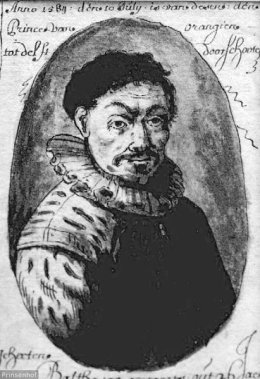
After 4 days of torture, on this date in 1584, Balthasar Gérard (Geeraerts) finally met his end by beheading on the wheel.

Gérard managed to be both historically important and wholly forgettable: an assassin working for Spain against the Netherlands, his regicide was met with a predictably stiff punishment. Then, no fault of his own, the subsequent course of history** pushed the assassin into obscurity while elevating his prey.
A lawyer by trade, Gérard was a fervent Catholic and supporter of the Spanish crown, which controlled the territory up the coast through the present-day Netherlands. At the peak of its power, Spain’s monarchy — led by King Philip II — had significant cause for concern at the rise in Protestantism.

The Spanish were Europe’s paladins of staunch Catholicism, and the sight of her troops did little to endear Spain to her colonized neighbors to the North.

For both religious reasons and political ones, the Dutch were looking for a way out from under the Spanish thumb, and a former noble named William, Duke of Orange, was a major instigator in the struggle. In his collected letters and addresses from the period, An apology or defence of William the First of Nassau, William states that, starting in 1559, he became increasingly concerned with plans against Protestants by the Spanish monarchy.

That also happens to be the year William was bestowed with stadtholdership of Holland, Zeeland, and Utrecht; in effect, he controlled the Dutch coast.

Though he was known as William the Silent, the Duke was endowed with both financial resources and widespread popularity, and he didn’t keep his mouth shut when it came to Inquisition courts in his realms.†

When the head enforcer of that policy, Cardinal Antoine Perrenot de Granvelle, left town, William got even noisier — declaring before the Council of State that Spanish policies were squelching religious freedom.

In 1566, the nobleman signed onto the Compromise of Nobles and began funding insurgencies across the northern provinces. As religious unrest grew, Calvinists and Protestants in the French and Germanic portions of Spain’s holdings quickly formed up behind William. An early attempt in 1568 to invade the Netherlands using German mercenaries and French Huguenots failed, but the resultant executions of Egmont and Hoorn put Spain on a long and winding road toward defeat.

The Dutch War was afoot, with William leading the way.

It would take and dozens of small-scale military victories over the next 15 years (during which William declared himself a Calvinist and fully broke his Spanish ties) for the Dutch to move to independence. The 1580 Union of Utrecht and 1581 Act of Abjuration officially ousted King Phillip II from the Netherlands and installed a new government.

Needless to say, Phillip reciprocated William’s love.

In 1580, Spain’s top man put a price on William’s head. Juan de Jáuregui tried to collect two years later by shooting the stadtholder, but the man holding the new title of Prince William I of Nassau recovered, while de Jáuregui was killed on the spot.

With 25,000 crowns at stake, there were bound to be other takers.

Our man Balthasar Gérard started looking for a close encounter with William the Target. At first, he joined the army in Luxembourg, which didn’t get him very far. It was time to gin up a real plot, which Gérard shopped to the Duke of Parma, Alessandro Farnese, in April 1584. Though the Duke offered no funding for the operation — Gérard ponied up the startup money he needed for the trip — and held out little hope that the lawyer would be successful, he gave Gérard assurances that his family would be taken care of in case of disaster.

Gérard first presented himself to William in June as the son of a martyred Calvinist from France. On 8 July, he returned and, badly in need of new clothes, managed to beg 50 crowns for a new set.

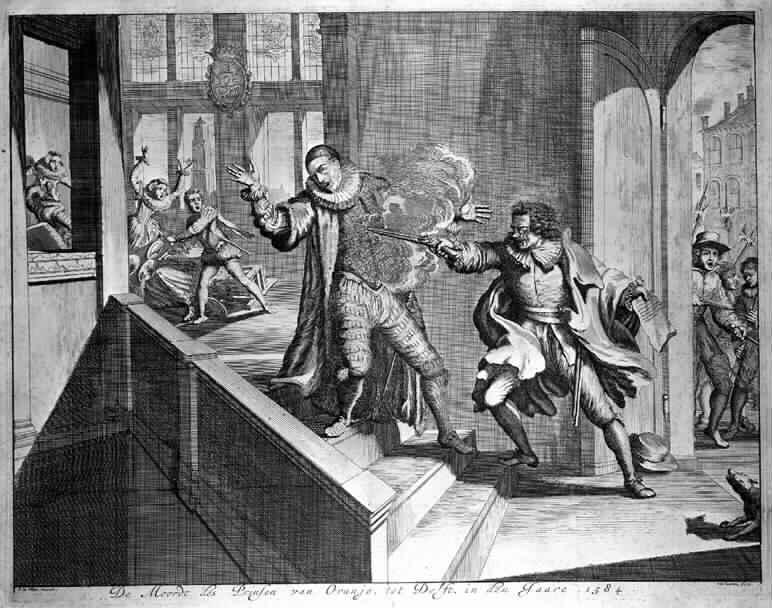
Instead, he bought a pair of pistols and, on 10 July, made history with a point-blank shot to William’s chest.


Detail view (click for the full image) of William the Silent’s 1585 assassination at the hands of Balthasar Gerard.

This assassination attempt didn’t fail. William became the second head of state to be killed by an assassin’s bullet,† — and his shooter the first such man to be juridically punished for the deed.

And, oh, how he was punished.

The regicide was beaten immediately after his capture, then subjected to a variety of cruelties, from wet leather boots which, when heated, both crushed and burned the feet, to daily floggings while hanging on a post outside the jail.

But on this day, his time of torture was up, and Gérard was finally put to death. You know, the usual:

It was decreed the right hand of Gerard should be burned off with a red-hot iron, that his flesh should be torn from his bones with pincers in six different places, that he should be quartered and disembowelled alive, that his heart should be torn from his bosom and flung in his face, and that, finally, his head should be taken off.


Gerard’s execution.

For all that he suffered as a regicide, Gérard left his family an impressive inheritance. Making good Parma’s assurances, King Phillip II gave them William’s former lands in three French provinces and took his siblings and their issue into his peerage.

Gérard’s cause carried on for another 60 years, until it was finally extinguished by the signing of the Peace of Münster by the Republic of the Seven United Netherlands and Spain.

* Foucault mistakenly identifies the torture as lasting 18 days, and the additional details he lays down for Gérard’s time on death row may be less-than-believable. However, all sources indicate that the tortures Gérard endured were quite spectacular, even by the standards of the day.

** See Dissident identities in the early modern Low Countries for a complete treatment of this period in The Netherlands and Belgium.

† For example, the city of Antwerp (Belgium), then under possession of the Spanish crown and considered the mercantile center of Europe for its vast sugar trade, featured over 100 executions for heresy from 1557-1562, twice as many as in all of Spain during that time.

‡ The first was James Stewart, 1st Earl of Moray, then Regent of Scotland. Stewart’s shooter, James Hamilton, escaped into exile, though others of the Hamilton clan answered for the murder.

On this day..

1955: Ruth Ellis, the last woman hanged in England

On this date in 1955, Albert Pierrepoint escorted the alluringly tragic Ruth Ellis to the gallows at Holloway Prison — the last woman ever hanged in Great Britain.

The former hostess had tracked her inconstant and abusive lover David Blakely to a Hampstead pub a few months before — getting the ride, and the murder weapon, from her unrequited hanger-on Desmond Cussen — and shot Blakely dead on the street. Five bullets: the last, a coup de grace. (Another missed entirely and winged a passerby.)

A bitterly controversial case from the moment it entered the public eye, Ellis’s hanging bolstered the movement to abolish Britain’s death penalty. Juridically, however, it was resolved in the blink of an eye when a crown’s attorney cross-examined the murderess:

Christmas Humphreys: Mrs. Ellis, when you fired that revolver at close range into the body of David Blakely what did you intend to do?

Ellis: It was obvious that when I shot him I intended to kill him.

Book CoverThe jury, which never heard that Blakely regularly beat his killer (including once to induce a miscarriage), needed 14 minutes to convict her.

We’re pleased to mark this anniversary with Carol Ann Lee, author of a recent biography A Fine Day for a Hanging: The Real Ruth Ellis Story. (Here’s a review. Also check out two long pieces Lee wrote about Ruth Ellis for the Daily Mail: 1, 2)

ET: I think at a certain point in time, everyone in Great Britain would have known who Ruth Ellis was, and quite a few abroad, too. How true is that still, nearing 60 years after her execution?

I think her name is still quite familiar, to be honest.

When I began researching the book, everyone I discussed it with either already knew the very basic facts of Ruth’s story, and at the very least that she was the last woman to be hanged in England. The 1985 biopic Dance with a Stranger left a big impression too, even though it wasn’t entirely faithful to Ruth’s character, making her seem much more hysterical a personality than she actually was, although I thought Miranda Richardson was brilliant in the role — as she always is!

What led you to the Ruth Ellis story?

I’ve always been interested in Ruth and that period in history — and I vividly remember going to see ‘Dance with a Stranger’ when it came out in the cinemas here. But it always struck me that her full story had never been told, particularly the last few months of her life after she shot David Blakely. And a couple of years ago there was quite an intense debate about bringing back capital punishment; Ruth’s name was always mentioned in relation to that particular argument, and I really felt it was time to explore her whole story.

What are the greatest misconceptions people have of her? Have her previous biographies and screen portrayals fed those misconceptions?

Without doubt, many people see Ruth as she was shown in ‘Dance with a Stranger’ — very screechy, out of control and violently jealous.

I think it’s true to say that she and David were both deeply jealous of each other (both giving the other reason to be so), but Ruth was not as hysterical as she was portrayed in the film. In fact, it was quite the opposite — the men were hysterical and it was Ruth who usually vented a sort of quiet fury. There is one scene in the film which shows her smashing the windows of David’s car and screaming in the street. Reading the original police statement about that night reveals a very different story; she was described as very calm and rational. There was no screaming, and although she did damage the vehicle, it was not remotely as it was shown in the film.

I think other adaptations have also done her a disservice. Ironically, probably the most accurate portrayal is in the film ‘Pierrepoint,’ where the character of Ruth appears for no more than a minute or two on screen.

I get the sense that Ruth was always running uphill against her class position, trying to climb a little higher than she could reach — right up to the end where her lover is a well-off cad and the rivals for the lover’s affection are his middle-class friends. What role did England’s class relations have in Ruth Ellis’s life and death, and in the way that others perceived her? Do they still shape the way we talk about her all these years later?

Class and politics played a huge role in Ruth’s life generally.

England was distinctly class-led at the time and when the case hit the headlines, she was described as a working-class floozie who attached herself to the upper-class David Blakely purely in order to hoist herself up the class ladder.

That couldn’t have been further from the truth; if she was only interested in using men to better herself socially, she would surely have married her sometime-lover Desmond Cussen, who was a much steadier prospect with money and property and who wanted very much to marry her. Ruth worked hard to better herself but she didn’t use the men she loved to do so.

And when it came to her trial, the class values of the time were heavy in the courtroom with the male barristers and judge and so on all very much men of the upper classes — and who viewed her accordingly. I hope we have got beyond all that nonsense now — but it does add a very distinct dimension to discussions of her case.

She was working as a hostess when she met David Blakely. What would a hostess do, who worked in this trade, and who were the clientele? Was it usual for “real” relationships to evolve? Do people still have this job in the same form as Ruth had it?

Hostessing in the clubs in which Ruth worked was quite straightforward — or it should have been, but there was Morris Conley to contend with, and he was quite a character.

Ruth’s basic job description was to look good and to chat to customers (mostly men) in the clubs, laugh at their jokes and keep them buying food and drink for as long as possible. Most hostesses were in their late teens and early twenties, working-class girls who thought the lifestyle was more glamorous than toiling in a factory or in a shop.

They were usually paid badly and relied on tips to make ends meet, but were given a dress allowance so that they could look as alluring as possible. The clientele mainly consisted of demobbed servicemen who suddenly seemed to have lost their attractiveness to women after the war — where once they had been heroes, by the late 1940s many of them were down on their luck and working as door-to-door salesmen, very lonely and eager to talk to pretty young girls about their war exploits.

The girls who worked for Morris Conley, like Ruth, were expected to sleep with the clients if that was asked of them, and often had to sleep with ‘Morrie’ and his less than respectable friends too. Many of them were very poor young women who lived in flats owned by Conley and his wife — and if they didn’t toe the line, they lost their jobs and their homes in one fell swoop.

Did real relationships evolve? Yes, they did, but very rarely. There are girls all over the world doing very similar jobs today — from London to Japan and everywhere in between too, no doubt.

You have this quote from Ruth about David Blakely: ‘I thought the world of him; I put him on the highest of pedestals. He could do nothing wrong and I trusted him implicitly.’ Ruth had an alcoholic, abusive father, and then she had two children from marriages with two different men that both fell apart — one from bigamy and abandonment, the second from alcoholism and domestic violence. Blakely himself cheated on her. Why wasn’t she more cynical about Blakely? If you take away the tragic ending to this particular relationship, was something like this a pattern she was doomed to keep repeating ad infinitum?

She loved him — it’s really as simple as that.

Although she obviously had a good degree of self-awareness and knew what David was and always would be, she truly loved him and for a time believed they had a future together. As for a pattern — I don’t know. Perhaps if she had met one good, steady man to whom she was attracted as much as she was to David, her life — and David’s too of course — might have been very different.

I’m going to phrase this inelegantly: what is the DEAL with Desmond Cussen?

Good question! I really think that he was as confused and tormented by everything that was happening as a result of Ruth’s and David’s relationship as Ruth herself.

I think he did love Ruth, and he tried hard to make things work with her, but he knew her heart was with David. His apparent lack of self-respect and backbone is baffling — quite why he kept ferrying her across London and out to Buckinghamshire in pursuit of David is a bit mystifying. I did question in the book why no one seemed to query his state of mind as much as Ruth’s — and as to whether he gave her the gun or not, knowing what she intended to do … I am sure he did, even though he must have known where it would end for Ruth herself.

Perhaps he hoped that with David out of the way, she would be reprieved and they could then have a life together. But I really don’t know!

Ruth’s legal defence was legendarily feeble. That said, I’m very interested in the barrister’s attempt to frame its insanity defense around feminine hysteria — “the effect of jealousy upon a female mind can so work as to unseat the reason and can operate to a degree in which a male mind is quite incapable of operating.” This was bound to be undermined by Ruth’s own calm and the statements about her intent to kill that she gave to police and in court. Was it the case that the law at the time didn’t have the instruments to situate Ruth’s context and state of mind, other than hysterical/not? Or could an abler barrister have presented a different story?

I think part of the difficulty is obviously that the defence of diminished responsibility was not introduced in the courts here until 1957 — largely as a direct result of this particular case.

Ruth’s lawyers tried to argue this as a defence for her to some extent, but it just wasn’t possible legally. That said, I think they served her quite badly and didn’t bring out so much that might have enabled the jury to see her crime in context. There was no mention of the abuse in her childhood, no mention of the violence she had suffered at the hands of her ex-husband and very little said about David’s own brutal treatment of her.

But Ruth herself did not seem to care much what happened in the courtroom, once it became evident that the story as she saw it — David’s friends having, in her view, deliberately destroyed the relationship between them — was not going to come to light. She gave up, and volunteered nothing that could have helped her, minimizing the violence to which she had been subjected and dismissing most of the questions put to her in a short sentence or two.

She also infamously replied to the prosecution’s question of what she intended to do when she set out to find David with the gun, “It is obvious when I shot him I intended to kill him.” That one line completely sealed her fate.

Despite all this, the public did seem to be shocked by Ruth Ellis’s hanging, and it’s supposed to have boosted the anti-death penalty campaign. If one may phrase it this way, were people shocked for the right reasons? How much did the symbolic “Ruth Ellis” that even her supporters among the general public had in view have to do with the real person as you understand her?

I think any case is always immeasurably more complex than it is presented in newspaper columns and headlines.

I think, again, the outcry at her execution has to be seen in context — people were becoming more and more opposed to the death penalty and there had been some very high-profile, contentious cases that really did cause a great deal of debate, anger, and distress: the hanging of Timothy Evans in 1950 and of Derek Bentley in 1953 for instance (both of whom were posthumously pardoned).

The fact that Ruth was a young, attractive, lively woman with two small children caused many people to question the validity of capital punishment. It was her death on the scaffold that gave the abolition movement its emotional spur.

What became of Ruth Ellis’s body after her hanging? And what became of her family and the others who were part of the story?

Ruth was buried in the confines of Holloway Prison after her execution, sharing her unmarked grave with four other women who had been hanged there. In 1971, when the prison was demolished and rebuilt, her body was released to her son for burial.

He had hoped to lay his mother to rest alongside David Blakely at the Holy Trinity churchyard in Penn but the vicar there would not allow it. Ruth was instead buried in the churchyard of St Mary’s in Amersham, a few miles away.

As to what became of her family: her son Andre (who was ten when Ruth was executed) was diagnosed with schizophrenia as a very young man and never came to terms with the loss of his mother. He committed suicide in 1982. Ruth’s daughter, Georgina, had quite a colourful life, becoming a successful model who was in the newspapers fairly often as part of the George Best ‘set.’ She married and had children and worked hard to win a posthumous pardon for her mother, of whom she spoke often. She died of cancer at the age of only 50.

As for Desmond Cussen: he emigrated to Australia and opened a flower shop there. He never married and became an alcoholic, dying in Perth on 8 May 1991 of pneumonia and organ failure following a fracture dislocation of the neck in a fall at his home.

On this day..

1920: Lee Monroe Betterton, three strikes and you’re out

(Thanks to Meaghan Good of the Charley Project for the guest post. -ed.)

On this day in 1920, Lee Monroe Betterton (addressed by his middle name) was electrocuted in Oklahoma for the murder of his wife, whose unusual name has been given variously as “Elzeana,” “Aldazia” and “Elzadah.” (This account will use the latter spelling, which was the one used in Betterton’s Oklahoma Court of Criminal Appeals syllabus.)

Little is known about Monroe Betterton’s background, other than that he was born in Missouri and was the seventh of twelve children, ten of whom survived to adulthood.

He was a heavy drinker and his violent nature was self-evident: Elzadah was, sadly, not the first wife Betterton killed. Nor was she even the second wife Betterton killed.

Betterton killed his first wife, Laura Elizabeth, in Barry County, Missouri in 1904. They had four young children together, two sons and two daughters. During an argument he beat her unconscious and she was taken to the hospital, where she soon died. For some reason, her husband was not prosecuted.

By 1908, Betterton had remarried and was living with Rosie, Wife #2, in Neosho, Missouri. They were walking to nearby Monett to visit some of his relatives when they started quarreling. Both of them had been drinking. About two miles outside of town, Betterton suddenly pulled out a knife and stabbed Rosie in the heart. She died instantly and he laid her body beside the railroad tracks.

This time he was arrested and charged with the crime. Betterton maintained that “I was guilty of that woman’s death, but it was an accident.” He got 99 years in prison, but served only ten before he was paroled in 1918.

He was 48 by then, and he returned to Monett and began courting Elzadah Lockwood, a widow close to his own age who was unfamiliar with the old adage that while once is a coincidence, twice is a trend. They got married, but their relationship turned rocky almost immediately and they argued constantly.

The couple separated after only a few months and filed for divorce. However, they reconciled after Betterton’s son Clifford married Elzadah’s daughter Mamie. In the first week of July 1919, a mere week after their divorce was final, Monroe and Elzadah remarried and settled in Vinita, Oklahoma.

Their previous problems resurfaced, however, and within days they were fighting like cats.

On July 9, 1919, Elzadah was preparing to leave her son-in-law Arthur Thomas’s house after yet another argument when Betterton shot her three times in the back. One of the bullets blew away the whole right side of her heart, and she was dead before authorities arrived at the scene.

When questioned, Betterton implicated everyone: the son Clifford; the son-in-law Arthur; even Elzadah herself as a phenomenally effective suicide. Mamie had been present at the scene, though. She and Elzadah’s eight-year-old son Raymond saw the whole thing, and both testified against their stepfather at his trial.

The case was pretty open-and-shut: As the Vinita Daily Journal noted, “The prisoner seems to be the least [a]ffected of the family and pays close attention to the testimony for or against him … There was practically no defense.”


Hobart (Okla.) Daily Republican, June 21, 1920.

Less than an hour before his execution, Betterton gave an interview in his cell and continued to assert his innocence: “I am not guilty of the crime with which I am charged. I am ready to die. I am ready to meet my God. I do not fear death, but I do not want to die for a crime which I did not commit.”

Approximately 100 people witnessed his execution. He had no final statement.

On this day..

1943: Willem Arondeus, gay resistance fighter

(Thanks to Meaghan Good of the Charley Project for the guest post. -ed.)

On this day in 1943, Willem Arondeus and eleven other Dutch resistance members were executed for sabotage and treason in connection with their anti-Nazi activities in the Dutch Underground.

Arondeus, an artist, novelist and biographer, was rather old for a resistance fighter; he was 48 at the time of his death.

He was the son of theater costume designers and one of six children, but became estranged from his family after he came out as gay at the age of seventeen. At a time when homosexuality was still illegal and deeply taboo, Arondeus spoke openly about it.

For seven years in the 1930s he lived with his lover and struggled to make a living. In 1940, after the Nazis invaded the Netherlands, he joined the resistance.

Arondeus utilized his artistic skills by forging identity papers for Dutch Jews. (Being himself part of a persecuted minority, perhaps he felt a special kinship with them.) He urged other artists to stand up against the Nazi invaders.

On March 17, 1943, he and other members of his resistance unit set the Amsterdam General Registry Office on fire, trying to destroy all the original records so the false identity papers couldn’t be checked. They successfully destroyed about ten thousand records, but five days later the entire unit was arrested. Their conviction was a foregone conclusion.

Arondeus said he hoped that by his life and death, he could prove that “homosexuals are not cowards.” Yad Vashem has honored him as Righteous Among the Nations. (pdf)

On this day..

1890: A quadruple hanging in Jim Crow America

(Thanks to Meaghan Good of the Charley Project for the guest post. -ed.)

Close to midnight on this date in 1890, four convicted murderers — three of them black and one white — were hanged on the gallows inside the Shelby County Jail in Tennessee. They were Edward Carr, 28, Parker Harris, 30, Hardy Ballard, 45, and Frank Brenish, 36.

Carr, who was half-black, had murdered his estranged wife Sallie in broad daylight on the street in Memphis on November 9, 1889. Edward Carr wanted to move to Mississippi and Sallie did not, and she had left him and moved in with a woman friend. When Edward saw his wife and her friend walking down the street, he said, “Sallie, I am going to kill you,” and then shot her.

She ran away, but he chased after her and shot her three more times. Sallie Carr died in her friend’s arms.

Edward surrendered to the police three days later, and his lawyer had to persuade him not to plead guilty to murder.

At his trial he said, “I do not know why I killed her. It was not because she offended me. We had lived happily together … I loved her so well, and she would not go with me.” Offering no defense, he was accordingly convicted on December 17, six weeks after his crime.

Harris had also killed his wife, Letha “Lettie” Harris, on the street in front of witnesses. Lettie was an “octoroon”, a now-outdated term for someone who is of mixed race and one-eighth black, seven-eighths white.

Like the Carrs, the Harrises were estranged and Lettie was living apart from her husband. On August 18, 1889, said husband encountered her riding in a buggy with several women and asked her to come home; Lettie replied that she never wanted to speak to him again.

In response, Parker Harris slashed her throat, then his own. He was able to run from the scene but collapsed several blocks away, weak from blood loss. He recovered sufficiently from his wounds to face trial; he too was easily convicted.

Hardy Ballard had killed a streetcar driver, G. Emmett Pinkston, on Christmas Day 1889 after an argument over the nickel fare. Ballard insisted he had paid; Pinkston said he hadn’t, and kicked him off the car. Both parties were armed in the ensuing fight, Ballard with a knife and Pinkston with an iron hook, and Ballard got the better of the streetcar driver and stabbed him to death.

His plea of self-defense at trial was not believed by the jury.

The sole white man, Frank Brenish, was a wife killer just like two of his co-condemned. Mary, his wife of two years, had left him because of his drinking and his failure to support her and his two stepchildren. Frank threatened to kill his wife if she didn’t come back to him, and Mary took these threats seriously enough to report them to the police. The cops had a talk with Frank and he promised to leave his wife alone.

Mary remained fearful, however, and when she went out she took her fourteen-year-old daughter, her sister and another man to protect her in case she encountered her husband. They were with her the night the murder was committed: they saw the whole thing.

Frank Brenish’s crime was so similar to Parker Harris’s that there was some speculation the two might have a joint trial: on July 5, 1889 he jumped out of a dark alley and slashed Mary’s throat, nearly decapitating her. Then he cut his own throat. Against the odds, a doctor was able to save Frank’s life, but Mary was beyond help: she had died almost instantly.

All four of the condemned were given copious amounts of alcohol while awaiting their execution, and Brenish got morphine as well. The wound on his throat hadn’t healed and it leaked from time to time. The night before his executed, he made a halfhearted attempt at suicide by slashing his wrist with a makeshift knife.

This was the era of racial apartheid in America, however, and even when men died together, they perhaps might not die together.

The gallows in this instance was built for two, so the natural idea was to hang the four men as two pairs.

Brenish, however, refused to suffer the indignity of being hanged alongside a Negro.

His jailers — and one hardly needs to mention their racial identity — honored his request for a segregated execution and modified the gallows so three people could be hanged at once.

The three black prisoners went first. Brenish died alone, fifteen minutes later. Harris, Ballard and Carr had “clean” hangings and died quickly, after making the usual final statements about their sins and their hope for redemption in Heaven.

When the time came for his racially unsullied death, Brenish was either so drunk or so scared he could barely stand, and he took several more swallows of whiskey while standing on the scaffold. He had severed his trachea when he slashed his throat and could only barely speak above a whisper. When he was asked for a final statement, the best he could come up with was, “They oughtn’t to hang a man when he ain’t in his right mind.”

It often happens that, when a person’s throat was previously cut, the wound will re-open during hanging. This didn’t happen to Harris, but it sure did during Brenish’s execution. Lewis Laska in Legal Executions in Tennessee: A Comprehensive Registry, 1782-2009 has a graphic description of what happened:

The officers had difficulty in placing the handcuffs because of his bandaged wrist. Blood trickled down his white gloves. With the noose and cap placed, he swayed to and fro and had to be held. When the lever was pulled and he dropped there was a pop (his neck was broken) and a hissing sound. The drop had opened the hole in his throat from the attempted suicide on the night of the killing. The hole was large enough to hold a cigar. As he hung, his wrist wound bled profusely.

Gruesome as his death may have appeared, though, Brenish didn’t suffer long. His heart stopped in less than a minute.

On this day..

1944: Jakob Edelstein and family

(Thanks to Meaghan Good of the Charley Project for the guest post. -ed.)

On this date in 1944, Jakob Edelstein, his wife Miriam, their twelve-year-son Arieh and his mother-in-law Mrs. Olliner were shot to death at the Auschwitz Concentration Camp in Poland. They had been inmates in Auschwitz since the previous December; Jakob had been in an isolation cell the whole time while the others stayed in the so-called “Family Camp.”

For two years prior they’d lived in Theresienstadt (also known by its Czech name, Terezin), a the former Czech fortress town that had been turned into a city just for Jews. Jakob Edelstein was named Eldest of the Jews and was nominally in charge of the place, but in practice he had no choice but to cater to the whims of the Nazis. He was assisted by a deputy and a council of twelve.

Edelstein, a Czech Jew born in 1903, had been a leader within the Jewish community in Prague and had had papers for himself and his family to emigrate to Palestine. But when the Nazis took over Czechoslovakia, Edelstein and the other Zionist leaders decided it was their duty to stay and do what they could for the community during this time of crisis.

He became a liaison between the Germans the Jewish community and tried to facilitate immigration to Palestine. From 1939 to 1941 he made several trips back and forth between Czechoslovakia and Palestine, with permission from the Germans, trying to find ways for more Jews to emigrate.

Theresienstadt was a strange place: neither concentration camp nor ghetto but something in-between, it was billed as a “paradise” and a “gift” from Hitler to the Jewish people.

Elderly Jews were sent there, as well as Jews who were “prominent” for some reason or had Aryan connections (such as Jews who had a non-Jewish spouse). It was advertised as a luxurious resort community where they could live out the rest of their lives in ease and plenty.

Residents were allowed to receive food packages from the outside, and send postcards (one per month, limited to 30 words, and censored).

Many people believed the propaganda and were persuaded to go there voluntarily, signing all their possessions and assets to the German government in exchange for what they thought would be a comfortable and peaceful retirement.

The 500-ish Danish Jews who weren’t evacuated to Sweden by the Danish Underground right after the Nazi invasion of Denmark were ultimately sent to Theresienstadt. Many talented artists, actors, musicians and scholars lived there. The Nazis would ultimately make a propaganda film about how wonderful life was in Theresienstadt, and a Red Cross delegation toured the place and came away satisfied.

As you might have guessed, living conditions within the fortress city didn’t exactly live up to what it said in the brochures.

It’s true that it was possible to survive in Theresienstadt for an extended time period, even for the duration of the war. There were no gas chambers and relatively few executions. Certainly it was worlds apart from, say, Auschwitz or Treblinka. But that was as close to “paradise” as it got.

Theresienstadt was, as George E. Berkley says in his book Hitler’s Gift: The Story of Theresienstadt, “a joke hatched in hell.”

Yes, there were stores, more than a dozen of them, but their stock consisted of “goods the Nazis had originally confiscated from the residents and later found they didn’t need or want.”

Theresienstadt, like the Lodz Ghetto, had a bank and its own money, but there was nothing to spend it on. “The ghetto crowns,” Berkley says, “were used mostly like Monopoly money in playing cards and other games. Still, the bank staff kept themselves busy balancing their books, and auditors arrived regularly from Berlin to ensure the accuracy of the bank’s essentially fictitious accounts.”

Theresienstadt’s population, at its peak, was 58,497, in a town which before the war had a population of less than 10,000. Nearly everyone had lice, toilets and taps were scarce, and disease was rampant.

Families were separated, with husbands, wives and children each residing in different barracks.

“Horrendous as Theresienstadt housing conditions may have been,” Berkley says, “they were not the residents’ chief source of daily suffering. Food, or rather, the lack of it, weighed on them much more heavily.” The menu, he explains,

consisted chiefly of bread, potatoes, and a watery soup. Some margarine and sugar — about two ounces a week of the former and less than one and one-half ounces of the latter — were sometimes included. The residents were also to receive up to four ounces of meat, mostly horseflesh, and up to eight ounces of skim milk a week, though many a week would see less or none of those foodstuffs available. No fruits were ever officially distributed, and turnips were the only vegetable to show up with any regularity.

Estimates of total per capita calories provided daily ranged from 1300 or less, to 1800, with the lower figure being more frequently mentioned. This should be compared with the “Special Regime” given the worst offenders in the Soviet labor camps which provided about 2,000 calories.

According to modern nutritional guidelines, to maintain a healthy weight, the average adult with an average level of physical activity needs 2,000 to 2,500 calories a day. At Theresienstadt all inmates between age 14 and 70 had to work long hours, many of them at strenuous jobs. In addition to being calorie-deficient, the Theresienstadt rations lacked essential vitamins and minerals. It’s no wonder that one survivor later recalled, “After three months in Theresienstadt, there was only one feeling left in my body: hunger.”

Six months after his arrival, Edelstein and the Council of Elders made a difficult decision about the food problem, as Berkley records:

It became apparent that an even distribution of the food supply would not allow the ghetto to survive. Those doing heavy work needed more than those doing normal work, and the latter needed more than nonworkers. In addition, children required extra rations, for they represented the Jewish future…

Thus, heavy workers … began to receive a little over 2,000 calories of food a day. Children were to get 1,800 and regular workers a little over 1,500. But the daily intake for nonworkers, which included most of the elderly, fell to less than 1,000 calories.

This terrible choice, however necessary to the population’s long-term survival, consigned thousands of people to death.

But even though starvation and disease took many lives, the most deadly aspect of life in Theresienstadt was deportation.

Contrary to what the propaganda messages said about people living out their lives in Theresienstadt, it was largely a transit camp. Most people who arrived would be sent on “to the east” sooner or later; some of them lasted only a few days in the fortress city before being deported.

Although certain classes of people, such as decorated World War I veterans, “prominent” people and those over 65, were in theory exempted from deportation, in practice anyone could be sent away and just about everyone ultimately was.

Approximately 145,000 denizens passed through Theresienstadt during the course of its existence, most of them from Czechoslovakia, Germany, and Austria. About a quarter of these inmates died within Theresienstadt itself. Another 88,000 were deported to Auschwitz and other camps in the East, almost all of them dying there. Out of about 15,000 children who passed through Theresienstadt, less than 2,000 survived, and some estimates put the number in the low hundreds.

When the camp was liberated, it had a population of about 17,000, and most of those had arrived in the during the final months of the war.

Jakob Edelstein didn’t know about the gas chambers when he became Eldest of the Jews at Theresienstadt in December 1941, but he knew that conditions in the East were very bad and realized that, in order for the community to sustain itself, as many people as possible had to remain within Czechoslovakia.

As a committed Zionist, he hoped that the young people in the camp would survive and go on to colonize Israel. Like most other leaders of Jewish communities throughout Nazi-occupied Europe, he made the decision to cooperate with the occupiers in hopes of saving lives.

And as far as that goes, he failed, as the numbers quoted above indicate. But if he failed, so did everyone else.

Unlike many Jewish officials in the Nazi ghettos, he wasn’t corrupt and he wasn’t a toady to the Germans. It’s worth noting that he had many opportunities to flee the country with his family, even after the war started: all he had to do was not come back to Europe after one of his trips overseas.

But he stayed, because he felt he had a responsibility to his beleaguered people.

Edelstein did the best he could with what he had to work with, which is all you can say for anybody. He worked tirelessly, making himself available at all hours, and under his leadership the camp developed a welfare system as well as many cultural and sports activities.

His job as Eldest of the Jews in Theresienstadt, trying to play the balancing act between advocating for his people and not pissing off the Germans, was always extremely stressful, difficult and dangerous.

But things really started to go downhill for him after the city’s first commandant, Siegfried Siedl, got reassigned to Bergen-Belsen in July 1943.

Siedl’s replacement, Anton Burger, hated Czechs and took an immediate dislike to Edelstein as a result. He replaced Edelstein with Paul Eppstein [German language link, as is the next], a German, and demoted Edelstein to first deputy to Eppstein. Benjamin Murmelstein, an Austrian, became second deputy.

This wasn’t enough for Burger, however, as George Berkley records:

As leader of the Czech Jews, [Edelstein] naturally bore the brunt of Burger’s hatred for them. The new commandant had not only deported many of his countrymen and his chief aide … but had also moved Germans and Austrians into key positions formerly held by Czechs. Burger had apparently also stirred up his own superiors against him for during the fall some bakery workers, looking out the window, saw and heard Eichmann sharply dressing down Edelstein and even threatening to have him shot.

The incident alarmed Edelstein’s many loyal followers and the next day the leaders of Hechalutz, the largest Zionist organization in the camp, met with him to urge him to flee. They said they could help him escape … But though he suspected a Nazi scheme to get rid of him, Edelstein refused to run away.

In the end, the Nazis didn’t need to trump up any charges of insubordination or sabotage against their former Eldest of the Jews: they found some real “crimes.” It seems that Edelstein had been saving people from deportation by allowing them to remain in Theresienstadt, off the books, and adding the names of dead people to the transport lists to make the numbers match up.

He was immediately arrested. It was November 9, 1943, the fifth anniversary of Kristallnacht.

Edelstein was kept in custody in Theresienstadt until December 18, when he and his mother-in-law, his wife, and his young son were sent to Auschwitz with a transport of 2,500 others. The transport became part of the Auschwitz “Family Camp”, joining 5,000 Czech Jews who’d arrived there from Theresienstadt in September.

Edelstein’s family was allowed to join the Family Camp. Edelstein himself was put in the punishment block and subjected to interrogation although not, apparently, tortured. He gave nothing away.

In March 1944, the residents of the Family Camp who’d arrived in September were gassed. The December group was allowed to stay alive for the time being.

On June 20, an SS officer went to Edelstein’s cell and told him he’d been sentenced to death. While the condemned man (who’d become quite popular in jail) was taking leave of his fellow inmates, the SS officer got impatient and snapped, “quickly, quickly.”

Edelstein replied, “I am the master of my last movements.”

He was driven to the execution site and then the car went away to fetch Miriam, Ariah and Mrs. Olliner. Miriam had measles and had to be brought on a stretcher. The Nazis forced Jakob Edelstein to watch as his wife, child and mother-in-law were shot to death. He was the last of them to die.

The remaining residents of the family camp were gassed in early July 1944.

Paul Eppstein was executed in Theresienstadt in September. Murmelstein became Eldest of the Jews in his place and actually managed to survive the war. Because he had lived, he spent the rest of his life under a cloud of distrust and suspicion as a possible collaborator.

Siegfried Siedl was hanged for war crimes in 1947. Anton Burger escaped Allied custody (twice) after the war, assumed a new identity and died of natural causes in Essen in 1991. His true identity wasn’t discovered for years after his death.

After the war, the city of Theresienstadt reverted to its former name of Terezin, and the fortress became an internment camp for ethnic Germans, who found themselves quite unpopular in the newly liberated Czechoslovakia and were expelled from the country in droves. The internment camp closed in 1948.

The modern town of Terezin has a population of 3,500 and is noted for its manufacture of knitwork and furniture. Tourists from all over the world come to learn about its important role in one of the most tragic events in modern history.

On this day..

1827: Isaac Desha pardoned by Gov. Joseph Desha

On this day in Kentucky in 1827, a plainly guilty murderer who was on to his third trial received an unconditional pardon. His name was Isaac Desha and his father, Joseph, was the state governor.

The murder was committed in 1824. Isaac Desha had separated from his wife, who was reportedly “terrified” of him, and was staying in Richard Dogget’s roadside tavern/inn on the border of Fleming County. On November 2 of that year, Francis Baker showed up and checked himself into the inn. A newspaperman from Mississippi, he was en route to New Jersey where he planned to get married. He was well-dressed and had a lot of luggage with him.

Baker wanted to visit a local man whom Desha also happened to know, and Desha volunteered to take him there. The two men set off together, Desha riding his bay horse and Baker on a gray mare, carrying two saddlebags.

They never arrived at their mutual acquaintance’s home.

Two hours later, a neighbor named Milton Ball noticed a gray mare, with saddle and bridle but no rider, wandering aimlessly on the highway. He caught it and was trying to find the owner when he encountered another riderless horse. This one he recognized as Desha’s. It had a saddle but no bridle.

Milton Ball got his brother, who took the horse to Desha’s residence. No one was home and he left it there.

As Ball was still trying to identify the gray horse’s owner, he came upon Isaac Desha walking down the road carrying two saddlebags. Desha identified the mare as his own property and took it from Ball, and they parted ways.

Awhile later, Francis Baker’s saddlebags were found empty and abandoned. The man never returned to the inn. The locals put two and two together and looked warily at Desha, but there was no hard evidence of foul play and he was the governor’s son, after all, so they said nothing.

That hard evidence turned up within a week, in the form of Francis Baker’s brutalized corpse — partially stripped, and hidden behind a fallen tree only yards from where Desha had been seen carrying the saddlebags. He’d been beaten with some blunt object and his throat was slit, and he had unusual stab wounds that were “four-square” shaped.

Fragments of a horse bridle and a whip were recovered from the scene; Desha owned a horse whip with a heavy handle that could have inflicted the injuries that killed Baker. Desha also owned a dagger that, it turned out, precisely matched the oddly shaped stab holes in Baker’s shirt.

The circumstantial evidence continued to pile up: the mare Desha had claimed as his own turned out to be Baker’s horse, and he also had Baker’s gold watch and the clothing and money that had been packed in Baker’s saddlebags. Desha claimed he’d randomly encountered two unknown men who’d sold the horse to him, and that he didn’t recognize it as stolen property, even though he’d been riding with Francis Baker only hours beforehand.

As for the watch, money and clothes, Desha didn’t even try to account for those.

He was arrested, and tried for murder in January 1825. The case was sensational and they had to move the trial elsewhere because the court determined Desha couldn’t get a fair trial locally. His father hired the finest defense attorney that there was, but the jury took only an hour to convict and recommended a death sentence.

Desha’s attorneys immediately appealed the verdict and sentence. One of the issues was that the sheriff had stayed with the jury during their deliberations, something Desha’s defense said was improper. The sheriff had presumably watched over the jury because a number of them got anonymous notes threatening to burn them in effigy if they voted to convict.

(Not threats to burn the jurors, mind. Threats to burn their effigies.)

The appeals court judge, one George “Peg Leg” Shannon, agreed with the defense and overturned the verdict. The fact that he was good friends with Desha’s father the governor had nothing to do with it, he said, and the outrage among the citizenry and angry editorials in the newspapers would never make him admit otherwise.

Desha got his second trial in September 1825 and got convicted and sentenced to death again. Once again the case was overturned on appeal, this time because the prosecution had not proved Francis Baker’s murder took place in Fleming County like the indictment said.

The local papers called the trial a “farce” and ranted about corruption within the judiciary. The Winchester Gazette editorialized, “It would seem that justice has either bade adieu to Kentucky, or that her judges are the most corrupt and desperate men living.”

But there was nothing to be done about it: Desha would have to be tried a third time. He was, in February 1826, well over a year after the murder, and the third jury convicted him too.

Desha despaired over his third conviction and attempted suicide in July of that year, slitting his throat in his cell. He very nearly succeeded, and the surgeon who brought him back from the brink had to put in a silver tube to reinforce his severed windpipe. For the rest of his life he could speak only in a whisper. The tube needed to be removed regularly for cleaning, and every time this happened Desha endured a terrible feeling of suffocation.

whereas the whole of the evidence against the said Isaac B. Desha being circumstantial, and from much of it being irreconcileable, I have no doubt of his being innocent of the foul charge; therefore is an object worthy of executive clemency.

Now, know ye, that in consideration of the premises, and by virtue of the power vested in me by the constitution, I have thought proper, and do hereby grant to the said Isaac B. Desha a full and free pardon for the supposed offence, as alleged against him in the bill of indictment …

Given under my hand at Frankfort, on the 18th day of June, A.D. 1827, and in the 36th year of the Commonwealth.

By the Governor.
Jos. DESHA.

Desha’s murder conviction was once more under appeal, but his suicide attempt had left him in such poor health that a sympathetic doctor signed an order saying keeping him in jail was endangering his life. He was released on bond pending the outcome of his appeal.

In March 1827, his lawyers tried to get the murder case dismissed on procedural grounds. Request denied. In June they filed for dismissal again, because the court had failed to seat a full panel of impartial jurors. (Desha used all his juror challenges to help keep the count down.)

Request denied again, and what’s worse, the court decided Isaac Desha’s health had improved enough that he could withstand the rigors of jail. He was remanded into custody.

Governor Desha still had one last card up his sleeve, and it was a trump. On June 18, the same day Isaac was ordered back behind bars, his father rose in court and issued him an unconditional pardon on the spot.

Joseph Desha committed political suicide when he pardoned his son. Isaac’s crime, and the obvious favors afforded him by the justice system, severely damaged the governor’s reputation.

Contrary to popular belief, Joseph didn’t resign after pardoning his son. He quietly finished out his term, retired to his farm and never entered politics again. He died in 1842.

As for Isaac Desha, there’s a legend that he moved to Honduras or Hawaii and has descendants still living there. In fact, although he did head west after his release from jail, he never made it further than Texas.

Like a lot of pioneers, he surely hoped he could put his former troubles behind him. But Isaac Desha carried trouble with him: in Texas, he allegedly robbed and killed a fellow traveler in a crime remarkably similar to Francis Parker’s murder. He was charged with murder yet again and this time he didn’t have an influential father to protect him.

Desha escaped the death penalty one last time, though, by dying of a fever on August 13, 1828, the day before his murder trial was supposed to start. He was twenty-six.

On this day..

1897: Choka Ebin, by his own relatives

(Thanks to Meaghan Good of the Charley Project for the guest post. -ed.)

On this day in 1897, Choka Ebin (Eben), a full-blooded Creek Indian, was executed in Perry, Oklahoma for the murder of Laura Anthony. He’d killed her just three weeks before, on May 23, and was arrested that same day. The law required Ebin’s own tribe to try and sentence him, and his own nearest kin to perform the execution — a precaution against the execution initiating a blood feud.

Ebin remained free between his conviction and his execution. He was supposed to die on June 4, but sent word that he was too sick to ride to town, and got a ten-day reprieve. On June 14 he dutifully appeared and turned himself in to the authorities.

He was placed on his knees on a chair, and his father and brother, Riley and Palko, took positions twelve paces back and fired their Winchester rifles.

The bullets hit the target dead center: shot in the heart, Ebin died within seconds. Riley and Palko then put his body in a coffin and took it home to bury. (Here’s a short contemporary newspaper blurb in a pdf)

On this day..