1517: Torben Oxe

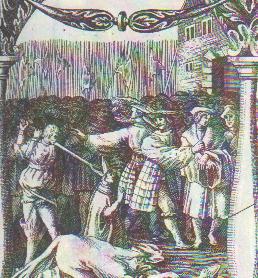
It was November 29, 1517, when the last Roman Catholic king of Denmark, the ambitious and possibly manic-depressive monarch Christian II, enforced the execution of a man whom he trusted for years. Torben Oxe was beheaded at St. Gertrude’s Hospital Cemetery for crimes against the throne.

Oxe was a subsidiary character during the tenure of one of the more intriguing Western European monarchs, and his hasty — and largely unsubstantiated — condemnation was a critical indicator in the governance of King Christian II.

Christian II of Denmark

Christian took the throne during a time of great disquiet in Scandanavia. His father, Hans of Denmark, fought for more than 30 years to restore the union across Norway, Sweden, and Denmark while harshly opposing the Hanseatic League. His efforts bore fruit in 1483 when Norway and Denmark came together to appoint him ruler of those two lands; 14 years later, he conquered Sweden and claimed kingship.

But his dominion over Sweden was short-lived: struggles to regain independent territory in Northern Germany resulted in a resounding defeat, and Sweden gave its new king the pink slip in 1501. Hans was eventually reinstated as an absentee ruler, awarded the title of king in 1509 but not allowed into Stockholm, nor re-crowned. His takeover was exclusively economic.

It was during this time that Christian stepped into his political future.

He took control of Norway as viceroy in 1506, and his rule was less than appreciated by the wealthy. The nobles in Norway maintained a sort of Privy Council called the Rigsraadet, which Christian was unwilling to cede any more power to than he felt was necessary.* Christian was known as a brutal man among the nobles even as he tried to cultivate a connection to the common people.

It was this connection that led to the downfall of Oxe. During his time in Norway, Viceroy Christian took a mistress named Dyveke Sigbritsdatter, a Norweigan peasant of Dutch descent.

At the death of Christian’s father early in 1513, the viceroy became King of Denmark and Norway and immediately set to bringing Sweden under heel. His father had made similar efforts which were supported by Eric Trolle, who was initially appointed regent to Sweden after Sten Sture (the elder) passed away; unfortunately for Christian II, in 1511, Sten Sture (the younger) convinced the high council to rescind its earlier appointment in his favor.

Sture was no friend to Christian II.

It is widely thought that the desires of Christian were eventually played out through Gustav Trolle, Eric’s son, who rose to the post of archbishop early in Christian II’s reign. Trolle threw his lot in with the Danish ruler and gained his ear, earning the promise that Trolle might rule over Sweden in Christian’s name. Trolle did everything he could to secure his place in history, demanding more autonomy for the church and, Sture claimed, attempting a backdoor coup. In 1515, Sture had Trolle imprisoned, the Catholic church condemned the Swedish government, and the Swedes and Danes squared off in a series of battles to decide its fate.

But Christian was obsessed with the expansion of his realm. He worked persistently to expand his power and reach, forming alliances that would help him gain control of what he considered the whole of Denmark. It was around this time that Christian II hitched the horse of the Holy Roman Empire to his team by marrying Isabella (Elizabeth I), granddaughter of Maximilian I.**

Which brings the story back to Torben Oxe.

Oxe was appointed Governor of Copenhagen Castle, a modest nobleman’s post that put him in close contact with the king’s court. Despite Christian’s marriage, he kept his mistress, openly housing her and her mother immediately adjacent to his residence. In summer 1517, Dyveke Sigbritsdatter fell ill and died; her mother pointed the finger at Oxe, who sent the girl a box of cherries two days earlier: apparently, Oxe was also enamored of Dyveke. Sigbrit alleged that Dyveke rebuked Oxe’s advances, and out of spite, he had murdered her.

History is awash with uncertainties, and there are plenty of those in the death of Dyveke. To begin, it’s not even clear that Dyveke was poisoned; she died suddenly and with severe stomach pain, so poisoning was assumed, but never really proven. In addition, it’s not clear whether Oxe was, indeed, courting Dyveke, as Sigbrit insisted. Last but not least, if Dyveke was murdered, there was nothing to suggest that the killer was not a member of the Rigsraad — the Privy Council in Denmark — or just someone seeking revenge on the king for one of his many cruel acts; instead of tracing these possibilities, Christian II condemned his friend Oxe on Sigbrit’s word alone.

But the farce was not complete without an equally farcical trial or two. Oxe’s post gave him a trial by the Council of the State: a dozen noblemen met, conferred, and delivered a rebuke to the king, declaring Oxe innocent of the crime. Christian was incensed at the verdict, allegedly asserting, “If I had as many kinsmen in the Rigsraad as he has, he would never have been acquitted.”

Not content with this form of justice, the king turned to the people, assembling a jury of peasants who were more than obliging in delivering the famed line, “We do not convict him, but his deeds convict him.” So, despite the pleadings of the king’s wife, Torben Oxe lost his head — and his corpse was burned for good measure.


Christian II underskriver Torben Oxes dødsdom, or Christian II Signs Torben Oxe’s Death Warrant (1874-76), by Eilif Peterssen. The queen sits at his side, imploring him not to do it.

In the great tradition of nepotism, Sigbrit was subsequently appointed chief adviser to the king and took over the role of management of the mercantile taxation system, the Sound Tolls; she was remarkably successful in these posts and formed a middle-class council which held far more sway over Christian than its “noble” counterpart, the Rigsraadet.

As he moved away from them, Christian’s rule became more and more unstable, and his desire to have Sweden almost insatiable. After a series of battles, he managed to claim the title of King of Sweden for a brief period around 1520, crowned by his friend Gustav Trolle shortly before putting on the Stockholm Bloodbath. It was this event which earned him the title in Sweden of Christian the Tyrant.

Peder Oxe

As if these connections weren’t enough, Oxe’s nephew, Peder Oxe (born in 1520), who was Steward of the Realm under Frederick II, became one of the players in an attempt to restore Christian II’s daughter, Christina, to the Danish throne — long after Christian himself was out of the picture. The attempt was unsuccessful.†

Dyveke’s story, and her impact on King Christian II, has been cast in a variety of literary formats.

* The Rigsraadet was the Norweigan instantiation of the Scandanavian sort of House of Lords, with members the noblemen of the time. New members could be appointed by kings and queens, or by other members of the council, and, until the Reformation, Roman Catholic bishops also maintained posts.

** This marriage also extended the reach of the Habsburgs into Denmark, a move that would have further consequences several hundred years hence.

Christina also has the distinction of turning down a marriage proposal by Henry VIII. According to legend, her witty response to the ambassador sent to arrange the marriage was, “If I had two heads, one should be at the King of England’s disposal.”

On this day..

1892: Jens Nielsen, the last in Denmark

On this date in 1892, serial arsonist Jens Nielsen was beheaded with an axe in the courtyard of Horsens prison — the last civil execution ever conducted in Denmark.

According to this Danish biography, Nielsen had incurred a long prison sentence for burning several farms in July 1883.

(He’d just returned from a fruitless stint in the New World, torching a warehouse in England on the return voyage.)

Apprehended immediately and sentenced to a long prison term, Jens confronted an age-old dilemma which was evidently noticeably acute among melancholy Danes: effecting state-assisted suicide on the scaffold.

These cases must have once been fairly frequent because Denmark, by an ordinance of December 18, 1767, deliberately abandoned the death penalty in cases where “melancholy and other dismal persons [committed murder] for the exclusive purpose of losing their lives.” The background for the provision was, in the words of Orste, “the thinking that was then current among the unenlightened that by murdering another person and thereby being sentenced to death, one might still attain salvation, whereas if one were to take one’s own life, one would be plunged into eternal damnation.”

The ordinance was ineffective in one case, at least, that of Jens Nielsen, who was born in 1862 and spent a most unhappy and unfortunate childhood. In 1884 he was sentenced to 16 years of hard labor for theft and arson. The following year he tried to kill a prison guard. He was tried, sentenced to death and received a commutation to life. He was then placed in solitary confinement. A year later he tried again to kill a guard, “realizing that he could not stand solitary confinement, did not have the nerve to commit suicide and wanted to force his execution.” He was again tried, sentenced to death and the sentence commuted. In 1892, having remained in solitary confinement all that time, he tried again to kill a guard. This time he got his wish, was sentenced to death and executed. (Source.)

He even managed to crack wise, “Thank you!” to the mayor who wished him God’s help on the way to the scaffold — envoy of the powers both temporal and ethereal that would finally loose his shackles.

Denmark’s death penalty law lingered into the 1930’s, but even the occasional death sentences were no longer carried out. Apart from a brief revival after World War II to punish war crimes committed during the Nazi occupation, nobody has been put to death in Denmark in — as of today — 116 years.

On this day..

1402: False Olaf

On this date in 1402, a Prussian commoner was put to death on the road between Falsterbo and Skanor in Sweden for masquerading as the long-dead King Olaf IV.

The real Oluf IV Haakonsson — or Olav, or Olaf — had inherited the crowns of Denmark and Norway and a claim to that of Sweden’s but died at the age of 17 in 1387. His mother, Margaret I (or Margrethe I), the real power behind the teenager, ruled outright upon her son’s death.

She proved an able hand and far-sighted ruler, cautiously welding Denmark, Sweden and Norway into the Kalmar Union that would hold until the 16th century. They called her “the Semiramis of the North,” centuries before Catherine the Great nicked the nickname.

But her son’s youthful demise had set persistent rumors abroad — that he was poisoned, for instance, and more to the point for our purposes, that he wasn’t dead at all.

So when his spitting image was recognized, and hailed as the prince of the realm … well, back in the day, equally audacious identity theft was attempted for much smaller stakes than a throne.

Anyway, “Olaf” got some robes befitting Olaf’s station and banged out some letters to Margaret demanding his kingdom back, and Margaret said, come on down.

That goes to show how far looks will take you in life.

Unfortunately for Olaf, his regal jawline wasn’t capable of enunciating Danish speech … so the jig was up as soon as he got to Margaret. One hopes he got a good ride out of his brief masquerade, because he was burned to ashes — possibly after being broken on the wheel — along with those presumptuous letters.

The date of False Olaf’s death comes from Horace Marryat’s 19th century Scandinavian travelogues, One Year in Sweden; including a visit to the isle of Gotland and A Residence in Jutland, the Danish Isles, and Copenhagen (both free reads at Google Books). In both volumes, Marryat identifies the date as the morning before Michaelmas.

The traditional last day of the harvest season celebrated on September 29, Michaelmas was once a four-star holiday on the medieval calendar.

There’s a fair amount of commentary online saying that an “Old Michaelmas” used to be celebrated on October 10 or 11. But that looks to this writer like an interesting inversion stemming ultimately from the celebration’s fall into obscurity as the entity once known as Christendom has become more secular and less agrarian — although it’s admittedly nothing to do with the fate of False Olaf, or Semiramis for that matter.

In 1752, when England finally switched to the Gregorian Calendar, the switch took place in early September.*

For logistical pragmatism (the harvest wasn’t going to come in 11 days earlier just because the calendar changed), the then-imminent Michaelmas got pushed back 11 days to October 10. October 10 then became known as “Old Michaelmas,” no longer Michaelmas by the church calendar but the 365-day interval from when it used to be celebrated, and more importantly, the real end of the harvest season.**

In the next century, the difference between Julian and Gregorian calendars would have advanced to 12 days, placing Old Michaelmas on the 11th; by this present day, it’d be 13 days in principle, but the original meaning of the holiday and the host of cultural traditions associated with it have fallen away … so “Old Michaelmas” is a footnote still pinned to October 10th or 11th, and moderns rediscovering it suppose from the name that it’s the former date of the feast.

* People inclined to think of their death dates as foreordained in heaven’s celestial notebook protested the switch: “give us back our 11 days!” This reform, incidentally, also moved the official beginning of the New Year to January 1 from Michaelmas’ springtime “Quarter Day” counterpart, March 25; winter dates from years prior are often written with both years, e.g. 1738/9. “Old Lady Day“, April 6, is still the beginning of the fiscal year in England, and Thomas Hardy uses its traditional contractual character in Tess of the D’Urbervilles (Aside: Tess’s hanged real-life inspiration) when the title character takes a farm job running through that date:

Tess was so wrapt up in this fanciful dream that she seemed not to know how the season was advancing; that the days had lengthened, that Lady-Day was at hand, and would soon be followed by Old Lady-Day, the end of her term …

At length it was the eve of Old Lady-Day, and the agricultural world was in a fever of mobility such as only occurs at that particular date of the year. It is a day of fulfilment; agreements for outdoor service during the ensuing year, entered into at Candlemas, are to be now carried out. The labourers — or “work-folk”, as they used to call themselves immemorially till the other word was introduced from without — who wish to remain no longer in old places are removing to the new farms.

… With the younger families it was a pleasant excitement which might possibly be an advantage. The Egypt of one family was the Land of Promise to the family who saw it from a distance, till by residence there it became it turn their Egypt also; and so they changed and changed.

** Residents of the former Soviet Republics who switched to the Gregorian calendar in the 20th century still celebrate both the familiar January 1 New Year’s and “Old New Year’s” 13 days later, and the same trick with the (lesser, there) holiday of Christmas too … packing four party occasions into a three-week span.

Part of the Themed Set: Semiramis.

On this day..

1002: St. Brice’s Day Massacre

On this date over a millennium past, according to the chronicle of John of Wallingford, King Ethelred the Unready of England conducted a massacre of Danes living in the realm.

The character of this sanguinary event — named after a fourth-century French bishop whose feast day Nov. 13 happens to be — lies half-buried in history’s shifting sands. Surely the slaughter of every Dane in a Britain then very much in the Scandinavian orbit would have been not only morally reprehensible but logistically unimaginable.

The accepted, albeit sketchy, story has it that to consolidate his own authority — or to check an actual or suspected plot against him — Ethelred ordered the surprise apprehension and summary execution of some sizable number of Danish lords and mercenaries. British historian Thomas Hodgkin characterizes it as a sort of coup d’etat.

On this date, it was the Danes who were unready for Ethelred.

But whatever its true extent or immediate object, it occurred within the context of intensifying conflict between the English crown and Scandinavian aspirants. Ethelred was to spend the better part of his life struggling — both militarily and through the ruinous tribute of Danegeld — to hold back the incursions of the Viking king Sweyn I.

The St. Brice’s Day Massacre exacerbated those tensions. Sweyn’s sister was apparently among those massacred, and — whether driven by vengeance or simply availing a pretext — Sweyn resumed harrying the English kingdom in the following years.

By 1013, Sweyn had driven Ethelred to Normandy and ruled all of England, welding together a Norse empire fringing the whole north of Europe.

But the empire — and England’s place in it — proved an historical cul-de-sac. Authority in England would be contested for another half-century, gradually sapping the crown’s strength until the Norman Conquest in 1066 swept aside Viking power and set England on a course that would redefine its history.

Update: The story of Ethelred, Normandy, and the Vikings told in Episode 3 of Lars Brownworth’s Norman Centuries podcast:

[audio:http://c4.libsyn.com/editions/58550/17915/03-richard-the-good.mp3]

The British History Podcast covers the St. Brice’s Day Massacre in episode 328.

On this day..

1520: Stockholm Bloodbath

On this date in 1520, four days after the Danish King Christian II gained the Swedish throne, nearly 100 prominent supporters of Swedish independence were executed en masse as a civil war’s apparent victors purged their enemies.

The Stockholm Bloodbath followed years of conflict between supporters of the Danish-dominated Kalmar Union and independence advocates under the banner of Sten Sture the Younger. With Sture’s death in battle earlier in 1520, the unionists had gained the upper hand. Stockholm, the last outpost of resistance, had held against four months’ siege before accepting a general amnesty in exchange for capitulation.

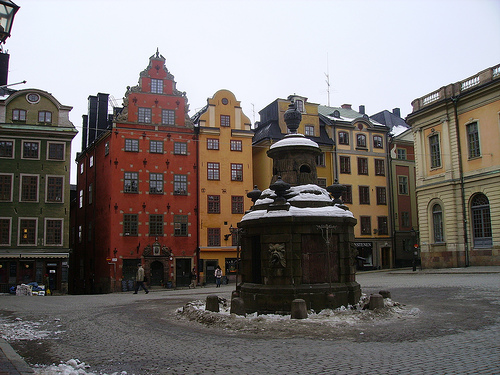
But with the city in hand, Christian — known to Swedish history as “Christian the Tyrant” — had its leaders charged for having deposed during the conflict the pro-union Archbishop Gustav Trolle, construed as an offense against the Church not in the temporal authority’s power to reprieve. Less than 24 hours after this legal maneuver was sprung, public beheadings of prelates, merchants and burgomasters were underway at Stortorget* — and Sture’s remains were exhumed and posthumously burnt at the stake.

Stortorget

It proved a Pyrrhic victory for the Danish party.

Inside of three years, Christian himself had been deposed with multiple lands and factions throughout his realm in open revolt. Gustav Vasa, whose father had been one of the Stockholm Bloodbath’s victims, would not only decisively break Denmark’s hold on Sweden but found the Vasa Dynasty under which Sweden would burgeon into one of Europe’s great powers.

*One Hans Brask survived the purge despite having endorsed the removal of Archbishop Trolle. Brask supposedly placed a note under his seal on this document saying “To this I am forced and compelled.” This cunning device gave the Swedish tongue the word Brasklapp — a secret reservation.

On this day..