On this date in 1584, Nuremberg executioner Franz Schmidt beheaded Anna Peihelsteinin (Peyelstainin) for “lewdness and harlotry.” (Despite the image above, Schmidt notes that she was beheaded standing, not sitting.)
The married woman had been intimate with 21 other men, even including a father and a son. But Anna’s own husband was more understanding of her than the cruel law of the time; as the executioner recorded in his diary, the lonely widower Jerome — whipped out of town for countenancing her whoredom — left behind a miserable reproach scrawled on the wall of a church:
Father and son should have been treated as she was, and the panderers also. In the other world I shall summon and appeal to emperor and king because justice has not been done. I, poor man, suffer though innocent. Farewell and good night.
On this date in 1655, Grete Adrian heard her final condemnation as a witch, then was ushered to the marketplace of Ruethen where she was beheaded and burned.
A remarried widow, Grete was the daughter of a woman who in her own day had been suspected of witchcraft; Grete had lost siblings to witch-hunts during the recent Thirty Years War.
The family history with devilry would help to implicate her when allegations arose that she had produced milk by conjuration and turned into a wolf to kill a neighbor’s horse. Grete didn’t stand up to the torture very long; within a couple of days she agreed that she had taken the devil as a lover, cast malevolent spells, attended witches’ covens, and all the usual Hexenprozesse stuff. All she asked was for quick execution.
In 2011, schoolchildren from Ruethen’s Friedrich-Spee-School — its namesake was a noted critic of torture and witch trials in the 17th century — successfully petitioned local authorities to issue a blanket posthumous pardon for 169 men, women and children executed for witchcraft between 1573 and 1660 … Grete Adrian included.
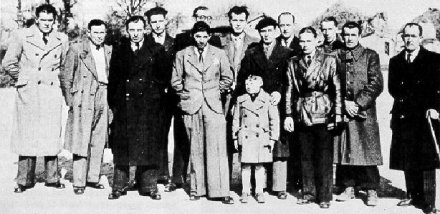
On this day in 1943, Willem Arondeus and eleven other Dutch resistance members were executed for sabotage and treason in connection with their anti-Nazi activities in the Dutch Underground.
Arondeus, an artist, novelist and biographer, was rather old for a resistance fighter; he was 48 at the time of his death.
He was the son of theater costume designers and one of six children, but became estranged from his family after he came out as gay at the age of seventeen. At a time when homosexuality was still illegal and deeply taboo, Arondeus spoke openly about it.
For seven years in the 1930s he lived with his lover and struggled to make a living. In 1940, after the Nazis invaded the Netherlands, he joined the resistance.
Arondeus utilized his artistic skills by forging identity papers for Dutch Jews. (Being himself part of a persecuted minority, perhaps he felt a special kinship with them.) He urged other artists to stand up against the Nazi invaders.
On March 17, 1943, he and other members of his resistance unit set the Amsterdam General Registry Office on fire, trying to destroy all the original records so the false identity papers couldn’t be checked. They successfully destroyed about ten thousand records, but five days later the entire unit was arrested. Their conviction was a foregone conclusion.
Arondeus said he hoped that by his life and death, he could prove that “homosexuals are not cowards.” Yad Vashem has honored him as Righteous Among the Nations. (pdf)
June 29, 1944, saw several noteworthy mass executions around Axis western Europe.
France: Seven Jewish hostages for the assassination of Philippe Henriot
Poet and journalist Philippe Henriot (English Wikipedia entry | French), the “French Goebbels”, was the Vichy government’s able chief propagandist.
On June 28, 1944, Henriot was assassinated by Maquis operatives disguised as milice paramlitaries.
Incensed, the real milice this morning gathered seven Jews already held in prison as hostages at Rillieux, drove them to the cemetery, and shot them one by one.
(Paul Touvier, who orchestrated this retaliatory execution, managed to stay underground until 1989. At his 1994 war crimes trial, he claimed that the Germans wanted 30 hostages killed, and therefore what he actually did was “save 23 human lives.” Touvier was convicted on the charge of crimes against humanity.)
Italy: Massacres in San Pancrazio, Cornia, and Civitella
As dawn broke this date, German soldiers retreating from liberated Rome fell upon several Tuscan villages.
German columns had been beset by partisans on the way, and standard operating procedure was to retaliate against partisans indirectly, by killing civilians — as in the notorious massacre in the Ardeatine caves. This vengeance was visited on the three towns: over 200 civilians were summarily executed on June 29, 1944.
“My mother later said she went to speak to my father,” remembered one San Pancrazio man. “A soldier turned her back and told her they were taking him to be tortured. She and my father both cried.” The father and those taken with him were shot in the basement of a farmhouse.
Caution: Graphic video.
The towns themselves have kept this date in remembrance, but the massacres were swept under the rug in the postwar settlement as Italy, Germany, and their former western enemies realigned for the Cold War. Only in the 21st century have they come to wider attention, when the discovery of secret archives documenting the atrocities enabled an Italian court to convict an aged German soldier in absentia.
There’s a CNN documentary on these events focusing particularly on San Pancrazio. Called “Terror in Tuscany”, it may be viewable here or here, depending on your location.
On this date in 1944, Jakob Edelstein, his wife Miriam, their twelve-year-son Arieh and his mother-in-law Mrs. Olliner were shot to death at the Auschwitz Concentration Camp in Poland. They had been inmates in Auschwitz since the previous December; Jakob had been in an isolation cell the whole time while the others stayed in the so-called “Family Camp.”
For two years prior they’d lived in Theresienstadt (also known by its Czech name, Terezin), a the former Czech fortress town that had been turned into a city just for Jews. Jakob Edelstein was named Eldest of the Jews and was nominally in charge of the place, but in practice he had no choice but to cater to the whims of the Nazis. He was assisted by a deputy and a council of twelve.
Edelstein, a Czech Jew born in 1903, had been a leader within the Jewish community in Prague and had had papers for himself and his family to emigrate to Palestine. But when the Nazis took over Czechoslovakia, Edelstein and the other Zionist leaders decided it was their duty to stay and do what they could for the community during this time of crisis.
He became a liaison between the Germans the Jewish community and tried to facilitate immigration to Palestine. From 1939 to 1941 he made several trips back and forth between Czechoslovakia and Palestine, with permission from the Germans, trying to find ways for more Jews to emigrate.
Theresienstadt was a strange place: neither concentration camp nor ghetto but something in-between, it was billed as a “paradise” and a “gift” from Hitler to the Jewish people.
Elderly Jews were sent there, as well as Jews who were “prominent” for some reason or had Aryan connections (such as Jews who had a non-Jewish spouse). It was advertised as a luxurious resort community where they could live out the rest of their lives in ease and plenty.
Residents were allowed to receive food packages from the outside, and send postcards (one per month, limited to 30 words, and censored).
Many people believed the propaganda and were persuaded to go there voluntarily, signing all their possessions and assets to the German government in exchange for what they thought would be a comfortable and peaceful retirement.
The 500-ish Danish Jews who weren’t evacuated to Sweden by the Danish Underground right after the Nazi invasion of Denmark were ultimately sent to Theresienstadt. Many talented artists, actors, musicians and scholars lived there. The Nazis would ultimately make a propaganda film about how wonderful life was in Theresienstadt, and a Red Cross delegation toured the place and came away satisfied.
As you might have guessed, living conditions within the fortress city didn’t exactly live up to what it said in the brochures.
It’s true that it was possible to survive in Theresienstadt for an extended time period, even for the duration of the war. There were no gas chambers and relatively few executions. Certainly it was worlds apart from, say, Auschwitz or Treblinka. But that was as close to “paradise” as it got.
Yes, there were stores, more than a dozen of them, but their stock consisted of “goods the Nazis had originally confiscated from the residents and later found they didn’t need or want.”
Theresienstadt, like the Lodz Ghetto, had a bank and its own money, but there was nothing to spend it on. “The ghetto crowns,” Berkley says, “were used mostly like Monopoly money in playing cards and other games. Still, the bank staff kept themselves busy balancing their books, and auditors arrived regularly from Berlin to ensure the accuracy of the bank’s essentially fictitious accounts.”
Theresienstadt’s population, at its peak, was 58,497, in a town which before the war had a population of less than 10,000. Nearly everyone had lice, toilets and taps were scarce, and disease was rampant.
Families were separated, with husbands, wives and children each residing in different barracks.
“Horrendous as Theresienstadt housing conditions may have been,” Berkley says, “they were not the residents’ chief source of daily suffering. Food, or rather, the lack of it, weighed on them much more heavily.” The menu, he explains,
consisted chiefly of bread, potatoes, and a watery soup. Some margarine and sugar — about two ounces a week of the former and less than one and one-half ounces of the latter — were sometimes included. The residents were also to receive up to four ounces of meat, mostly horseflesh, and up to eight ounces of skim milk a week, though many a week would see less or none of those foodstuffs available. No fruits were ever officially distributed, and turnips were the only vegetable to show up with any regularity.
Estimates of total per capita calories provided daily ranged from 1300 or less, to 1800, with the lower figure being more frequently mentioned. This should be compared with the “Special Regime” given the worst offenders in the Soviet labor camps which provided about 2,000 calories.
According to modern nutritional guidelines, to maintain a healthy weight, the average adult with an average level of physical activity needs 2,000 to 2,500 calories a day. At Theresienstadt all inmates between age 14 and 70 had to work long hours, many of them at strenuous jobs. In addition to being calorie-deficient, the Theresienstadt rations lacked essential vitamins and minerals. It’s no wonder that one survivor later recalled, “After three months in Theresienstadt, there was only one feeling left in my body: hunger.”
Six months after his arrival, Edelstein and the Council of Elders made a difficult decision about the food problem, as Berkley records:
It became apparent that an even distribution of the food supply would not allow the ghetto to survive. Those doing heavy work needed more than those doing normal work, and the latter needed more than nonworkers. In addition, children required extra rations, for they represented the Jewish future…
Thus, heavy workers … began to receive a little over 2,000 calories of food a day. Children were to get 1,800 and regular workers a little over 1,500. But the daily intake for nonworkers, which included most of the elderly, fell to less than 1,000 calories.
This terrible choice, however necessary to the population’s long-term survival, consigned thousands of people to death.
But even though starvation and disease took many lives, the most deadly aspect of life in Theresienstadt was deportation.
Contrary to what the propaganda messages said about people living out their lives in Theresienstadt, it was largely a transit camp. Most people who arrived would be sent on “to the east” sooner or later; some of them lasted only a few days in the fortress city before being deported.
Although certain classes of people, such as decorated World War I veterans, “prominent” people and those over 65, were in theory exempted from deportation, in practice anyone could be sent away and just about everyone ultimately was.
Approximately 145,000 denizens passed through Theresienstadt during the course of its existence, most of them from Czechoslovakia, Germany, and Austria. About a quarter of these inmates died within Theresienstadt itself. Another 88,000 were deported to Auschwitz and other camps in the East, almost all of them dying there. Out of about 15,000 children who passed through Theresienstadt, less than 2,000 survived, and some estimates put the number in the low hundreds.
When the camp was liberated, it had a population of about 17,000, and most of those had arrived in the during the final months of the war.
Jakob Edelstein didn’t know about the gas chambers when he became Eldest of the Jews at Theresienstadt in December 1941, but he knew that conditions in the East were very bad and realized that, in order for the community to sustain itself, as many people as possible had to remain within Czechoslovakia.
As a committed Zionist, he hoped that the young people in the camp would survive and go on to colonize Israel. Like most otherleaders of Jewish communities throughout Nazi-occupied Europe, he made the decision to cooperate with the occupiers in hopes of saving lives.
And as far as that goes, he failed, as the numbers quoted above indicate. But if he failed, so did everyone else.
Unlike many Jewish officials in the Nazi ghettos, he wasn’t corrupt and he wasn’t a toady to the Germans. It’s worth noting that he had many opportunities to flee the country with his family, even after the war started: all he had to do was not come back to Europe after one of his trips overseas.
But he stayed, because he felt he had a responsibility to his beleaguered people.
Edelstein did the best he could with what he had to work with, which is all you can say for anybody. He worked tirelessly, making himself available at all hours, and under his leadership the camp developed a welfare system as well as many cultural and sports activities.
His job as Eldest of the Jews in Theresienstadt, trying to play the balancing act between advocating for his people and not pissing off the Germans, was always extremely stressful, difficult and dangerous.
But things really started to go downhill for him after the city’s first commandant, Siegfried Siedl, got reassigned to Bergen-Belsen in July 1943.
Siedl’s replacement, Anton Burger, hated Czechs and took an immediate dislike to Edelstein as a result. He replaced Edelstein with Paul Eppstein [German language link, as is the next], a German, and demoted Edelstein to first deputy to Eppstein. Benjamin Murmelstein, an Austrian, became second deputy.
This wasn’t enough for Burger, however, as George Berkley records:
As leader of the Czech Jews, [Edelstein] naturally bore the brunt of Burger’s hatred for them. The new commandant had not only deported many of his countrymen and his chief aide … but had also moved Germans and Austrians into key positions formerly held by Czechs. Burger had apparently also stirred up his own superiors against him for during the fall some bakery workers, looking out the window, saw and heard Eichmann sharply dressing down Edelstein and even threatening to have him shot.
The incident alarmed Edelstein’s many loyal followers and the next day the leaders of Hechalutz, the largest Zionist organization in the camp, met with him to urge him to flee. They said they could help him escape … But though he suspected a Nazi scheme to get rid of him, Edelstein refused to run away.
In the end, the Nazis didn’t need to trump up any charges of insubordination or sabotage against their former Eldest of the Jews: they found some real “crimes.” It seems that Edelstein had been saving people from deportation by allowing them to remain in Theresienstadt, off the books, and adding the names of dead people to the transport lists to make the numbers match up.
He was immediately arrested. It was November 9, 1943, the fifth anniversary of Kristallnacht.
Edelstein was kept in custody in Theresienstadt until December 18, when he and his mother-in-law, his wife, and his young son were sent to Auschwitz with a transport of 2,500 others. The transport became part of the Auschwitz “Family Camp”, joining 5,000 Czech Jews who’d arrived there from Theresienstadt in September.
Edelstein’s family was allowed to join the Family Camp. Edelstein himself was put in the punishment block and subjected to interrogation although not, apparently, tortured. He gave nothing away.
In March 1944, the residents of the Family Camp who’d arrived in September were gassed. The December group was allowed to stay alive for the time being.
On June 20, an SS officer went to Edelstein’s cell and told him he’d been sentenced to death. While the condemned man (who’d become quite popular in jail) was taking leave of his fellow inmates, the SS officer got impatient and snapped, “quickly, quickly.”
Edelstein replied, “I am the master of my last movements.”
He was driven to the execution site and then the car went away to fetch Miriam, Ariah and Mrs. Olliner. Miriam had measles and had to be brought on a stretcher. The Nazis forced Jakob Edelstein to watch as his wife, child and mother-in-law were shot to death. He was the last of them to die.
The remaining residents of the family camp were gassed in early July 1944.
Paul Eppstein was executed in Theresienstadt in September. Murmelstein became Eldest of the Jews in his place and actually managed to survive the war. Because he had lived, he spent the rest of his life under a cloud of distrust and suspicion as a possible collaborator.
Siegfried Siedl was hanged for war crimes in 1947. Anton Burger escaped Allied custody (twice) after the war, assumed a new identity and died of natural causes in Essen in 1991. His true identity wasn’t discovered for years after his death.
After the war, the city of Theresienstadt reverted to its former name of Terezin, and the fortress became an internment camp for ethnic Germans, who found themselves quite unpopular in the newly liberated Czechoslovakia and were expelled from the country in droves. The internment camp closed in 1948.
The modern town of Terezin has a population of 3,500 and is noted for its manufacture of knitwork and furniture. Tourists from all over the world come to learn about its important role in one of the most tragic events in modern history.
You can read all about this hecatomb and its aftermath on this very thorough and impressive website dedicated to the atrocity, from which much of the information in this account is drawn.
The tiny village, which you could walk through in all of ten minutes, had been the victim of mistaken identity.
Twenty miles away was a somewhat larger town with a similar name, Oradour-sur-Vayres, which was known for its Resistance activity. Adolf Diekmann, commander of the SS battalion, had been informed that the French Resistance had captured an SS officer (possibly the kidnapped Waffen-SS Sturmbahnfuhrer Helmut Kampfe, who had been executed by the Resistance earlier that same day) in Oradour-sur-Vayres and decided reprisals were needed, but he got the two villages mixed up and went to Oradour-sur-Glane instead.
When the SS arrived in the village at lunchtime, they ordered all the inhabitants to assemble in the fairground to have their papers checked. Everyone had to come, including children and the sick. Six people who were not residents but happened to be in the village at the time were also sent to the fairground.
Twenty villagers who had some compelling reason to avoid the Nazis, or merely had a bad feeling about the whole thing, hid or left the village as soon as the SS division showed up. These twenty survived. One seven-year-old boy, Roger Godfrin, was spotted and shot at, but survived by playing dead. He was the only survivor in his family, and the youngest survivor from the town.
The women and children were locked in the village church, and the men were lead to barns and sheds where the machine guns were set up. They were shot in their lower bodies and legs, in order to prolong their deaths. One of the men, who’d lost a leg in World War I, supposedly cried out, “Those bastards! They have cut my other leg off!”
After the shooting, as the men of Oradour-sur-Glane lay helpless, the SS men locked the sheds and set them on fire.
Only six men were able to escape. They hid in some rabbit hutches for several hours before attempting to escape the village. Five of them made it, but Pierre-Henri Poutaraud was spotted later that day and shot dead. The SS man who shot him then tethered a horse to Poutaraud’s outstretched hand.
In all, 190 men were killed.
The SS division then went back to the church, set off a smoke bomb inside it, and set the building on fire. Anyone who tried to get out of the church was machine-gunned. One woman cried out that she was German, not French, and begged to be released, but the SS shoved her back into the flames.
47-year-old Marguerite Rouffanche was able to slip out the back window, and another woman followed her with her seven-month-old baby, but all three of them were shot and only Marguerite survived, hiding in a garden for more than 24 hours until help arrived. Her two daughters were killed. (Marguerite refused to leave Oradour after the massacre. She remained there for the rest of her ninety-one years and is now buried in the village cemetery.)
The church fire and shootings claimed the lives of 247 children and 205 women.
Children from the village’s girl’s school, in the 1942-1943 school year. All of these girls were killed in the massacre.
Unbeknownst to the Nazis, there were several Jews living in the village, among them five children between the ages of eight and fifteen. Twelve of them were killed. In the case of a Jewish family called Pinede, the parents decided to present themselves for inspection but told their three children to hide. The children survived; their parents did not. One of those three Jewish survivors was still alive as of 2004.
Several days passed for the 26 survivors were permitted to bury their dead. Only 52 of the bodies could be identified; the other ones were burned too badly to be recognizable.
Collective punishment in reprisal for the actions of others was par for the course in Nazi-occupied Europe, and Adolf Diekmann had directed his unit to commit a number of mass shootings. Even so, he didn’t have authorization for the bloody events at Oradour-sur-Glane and his commanding officer requested for a court-martial, saying, “I cannot allow the regiment to be charged with something like this.” Field Marshal Erwin Rommel supposedly volunteered to preside over the court-martial himself.
But before that could happen, the war took care of Diekmann: he was killed on the Normandy front on June 19, hit in the head with shrapnel, a mere nine days after his last atrocity. The front, in fact, took care of most of his unit: only 65 of the 200 members survived the war.
In 1953 in Bordeaux, a military tribunal convened to hear the case against the surviving members of the 2nd Panzer Division. Only 22 of them were present in the courtroom; the others were in East Germany, which refused to extradite them. All but one said they’d been conscripted into the SS; one of them admitted he’d joined voluntarily to fight Communism.
To further complicate matters, 15 of the defendants present were actually French nationals of German descent, from Alsace-Moselle, and 14 of them claimed they’d been drafted against their wishes.
(After they conquered France, Germany declared inhabitants of Alsace to be German citizens whether they wanted to be or not, and drafted the region’s men. The conscripts were known in France as Malgre-nous, meaning literally “despite ourselves.”)
In addition, eight of the French defendants had been under the age of 18 when they were drafted into the SS, making them minors under French law. Many French people, including some of the survivors of Oradour-sur-Glane, viewed the Alsatian conscripts as fellow-victims of Nazi Germany and didn’t believe they should be held responsible for their actions.
Most of the defendants were cagey.
They implicated each other, but not themselves, admitting to some specific offenses but denying other, far more serious ones. One man, for example, said he’d been part of an execution squad that shot 20 men, but insisted he’d only helped load the machine guns and hadn’t personally shot anyone. Another said he hadn’t been in Oradour-sur-Glane at all, but was stationed as a sentry outside the village to prevent escapes. Only one of the defendants had admitted to killing anyone at all prior to the trial.
Twelve members of the victims’ families came to watch the trial proceedings, including an eight-year-old girl whose father and grandfather had been killed. Marguerite Rouffanche was ill at the time of the trial and very weak, but she showed up anyway and testify about her experience. Roger Godfrin, the little boy who played dead, also testified.
The tribunal’s judge demanded the defendants view photographs of the charred corpses of the victims, saying, “Let them look at the glorious work of the valiant Third Company of Der Führer Regiment.”
When the prosecutor summed up the case, he referred to the defendants’ evasive statements and said, “You might as well say despite the heaps of ashes and ruins, that the massacre never took place. But the people of Oradour are dead.”
The tribunal deliberated for thirty-two hours before returning its verdicts. One of the defendants was able to prove he hadn’t been in Oradour-sur-Glane the day of the killings, and was acquitted. The rest were convicted.
The 46 members of the SS unit who hadn’t shown up for trial were sentenced to death in absentia, as was one of the German nationals and one of the French. The others got various prison sentences, mostly between five and eight years, none exceeding twelve years. The Germans tended to get longer prison terms than the French. In addition, the Germans were prohibited from residing in France for at least twenty years.
Survivors of the Oradour-sur-Glane massacre.
No one in France was happy with the tribunal’s ruling: some said the sentences were too harsh, others, too lenient. In the face of widespread protests from the Alsace area and threats to secede from France, the French National Assembly passed a bill granting amnesty to all Malgre-nous (at a vote of 319 to 211, with a whopping 83 abstentions) and 13 of the 14 Frenchmen were released only eight days after the verdict was rendered. (One of them, the one who had volunteered for the SS, got no sympathy from anyone and no such leniency.)
Germany was upset, saying it was unfair to pardon the French SS but not the Germans. But within five years, everyone had been freed. No one was actually executed.
In 1981, East German authorities tracked down Heinz Barth, a second lieutenant in the 2nd Panzer Division, and put him on trial in their country for his role in the Oradour-sur-Glane Massacre.
He never tried to deny his participation in the attack, and used the old “just following orders” defense, saying, “In war one acts harshly and with the means available.” Barth admitted he helped round up the village men and personally shot fifteen times into the crowd. He also acknowledged responsibility for the deaths of nearly 100 people in Czechoslovakia.
Barth was convicted in 1983 and sentenced to life in prison. In 1991, still behind bars, he was awarded a pension as a “war victim” because he’d been wounded in Normandy in August 1944 and lost a leg. The resulting howls of protest led the government of a newly reunited Germany to pass a law stripping convicted war criminals of their pensions.
Barth was released from prison in 1997, and managed to finagle his war pension back somehow. He died of cancer ten years later, at the age of 86.
Marguerite Rouffanche died in 1988. Her fellow-survivor Roger Godfrin died in 2004.
The survivors of Oradour-sur-Glane created a new village after the war, but the burned-out ruins of the old village remain, with rusted cars, sewing machines, bicycles and other personal items lying in plain sight on the street, a grim testimony to what happened there nearly seventy years ago.
This killer’s strange m.o. was to entice young women with the promise of divining their fortune in a magic mirror.
His victims were two young women unwise enough to accede to his request to bind their hands on the pretext that the wrong gesture would ruin the spell. With such lamblike naivete, what could Bichel do but clobber the poor maids over the head, strip them down, and butcher them still-living — slicing open their bowels, and cracking their breastbones open with a wedge.
Torture having recently been outlawed with the Napoleonic conquest, Bichel was pressured into coming clean by the novel expedient of moving his questioning ever-closer to the scenes of his crimes — to the Regendorf town hall, at first, and thence to his own home where the two exhumed bodies were stretched out before him.
Visibly affected, Bichel admitted all.
“I opened her breast and with a knife cut through the fleshy parts of the body,” Bichel said. “Then I arranged the body as a butcher does beef, and hacked it with an axe into pieces of a size to fit the hole which I had dug up in the mountain for burying it. I may say that while opening the body I was so greedy that I trembled, and could have cut out a piece and eaten it.”
It was not cannibalism but cupidity that cut Bichel’s spree short: he was foolish enough to sell the women’s distinctive stolen clothes. (An occasional petty thief before he turned Ripper, Bichel said he’d been seduced into homicide by the fine clothes of his first victim.)
The sentence of breaking on the wheel from the feet upwards, which had been pronounced in accordance with the laws still in force, was commuted to beheading. This was done, not for the sake of sparing the criminal, whose crimes deserved the extremest punishment, but out of regard to the moral dignity of the state, which ought not, as it were, to vie with a murderer in cruelty.
On this date in 1573, 19-year-old Frantz Schmidt — heretofore only an apprentice to his father’s craft — conducted his first solo hanging. As the body of the thief hung there, his father or perhaps another established Scharfrichter stepped forward and ritually slapped the teenage hangman three times, announcing his successful passage into the ranks of Germany’s master executioners.
“Leinhardt Russ of Zeyern, a thief. Executed with the rope at the city of Steinach. Was my first execution.” Those words begin Meister Frantz’s remarkable diary* of 361 hangings, beheadings, breakings-on-the-wheel, drownings, and burnings — as well as many other sub-capital punishments, primarily as the executioner of Nuremberg from 1578 to 1617.
Nuremberg executioner Frantz Schmidt at work in 1584.
Executioners occupied a strange outcast social niche, with charge not only of death sentences but of other dishonorable public tasks. Either as cause or consequence of this, the profession carried its own stigma for underworld less-than-respectable behavior; it was not unheard-of for a shady executioner to wind up climbing the scaffold as patient rather than hangman.
But in his 45-year career, the sober Meister Frantz operated with ahead-of-his-time dignity and sobriety, so much so that Schmidt was granted citizenship in Nuremberg and eventually had his civic honor officially restored. He freed himself and his heirs from the social pollution inherent to his life’s work.
ET: Your book is built around a sort of life’s mission by Frantz Schmidt to return himself and his family to respectable-ness. Certainly he accomplished this marvelously in the end, but I’m curious how firm do you feel is the inference that this was his specific intent from the start?
JH: I have no doubts that as a child, Frantz Schmidt was repeatedly told the tale of his family’s fall from grace, especially since he can still remember so many details even as an old man. We also know from his own words in his appeal to the emperor to restore that lost honor that his grandfather, father, and his own children all felt the sting of this stigma. Finally, the late-in-life struggles to assert that regain honor — against the challenges of his bitter successor — further underscore the centrality of this mission in Frantz Schmidt’s life.
Executioners often had a family trade at this point, but the Schmidts — specifically the father, Heinrich Schmidt — had a bizarre path into this business via the German nobility’s old prerogatives. Could you explicate the “ancient custom” that allowed Albrecht Alcibiades to force Frantz’s father Heinrich, who was not an executioner, to become one? And for that matter, the social customs that then led Heinrich’s neighbors in Hof to treat him as a dishonored untouchable after he was forced to carry out these three executions — rather than viewing him, as we might today, as himself a victim who ought to be helped to get back to his real life?
Most European laws in the early sixteenth century were customary and highly localized. Legal codification throughout jurisdictions was just getting underway. This meant that two villages only a few miles apart might have very different traditions regarding something like execution. In the larger cities, such as Nuremberg, and well organized territorial states, such as the prince-bishopric of Bamberg, standing executioners on salary were the norm. But in many of the hundreds of tiny German states during this period, execution by the victim’s oldest male relative or by another local male was still practiced.
In the case of Hof, the margrave intentionally invoked an ancient and outdated tradition because he was in a hurry to get the job done. The stigma around the job of executioner in general was, by contrast, nearly universal. There seems to have been a little less hostility in southern German states but nobody would have openly socialized with an executioner or his family. As I describe in the book, the severity of this stigma — like all social prejudices — would depend on the individual or occasion in question. So, while some people clearly had sympathy for Meister Frantz, there were still stark boundaries of propriety as to how they might express that sympathy.
Executioners had charge of a variety of disreputable tasks and spheres of civil live: refuse, prostitutes, lepers, torture, and so forth. I’m struck by the importance of Schmidt’s Nuremberg assistant, “the Lion”, in allowing the faithful executioner to (somewhat) separate some of the most visibly dishonorable tasks from Schmdit’s direct purview. Just as a realistic matter, could Frantz Schmidt have reached respectability had he himself had to handle everything personally?
You’re right, the Lion played a key role in this respect. The broader evolution of the job was also significant, from a kind of catch-all for various unpleasant tasks to a civic professional focused on interrogation and punishment. You can also see this in the clothing that executioners start to wear in the sixteenth and seventeenth centuries, usually either colorful bourgeois outfits or military garb.
Frantz Schmidt’s later entries have a great deal of detail, and you use that to tease out the executioner’s psychology, and the way he thinks about crime, sin, choice, and misfortune in his mature adulthood. It’s quite intriguing. Why, however, did Schmidt begin his journal in the first place? Is there something his shorter, earlier entries tell us about the younger man and the evolution of his views of the “poor sinners” he handled?
After a long time — and especially after I found the oldest version of the journal — I figured out that he started the journal upon his 1578 appointment in Nuremberg. This means that he reconstructed the executions of the previous five years from memory (and without dates).
Why then? The timing strongly suggested to me that he was already thinking about using the journal as a supporting document in his eventual appeal to have his honor restored.
As for changes over time, the most obvious ones are that his passages become much longer, more detailed, and more concerned with motivations and explanations than the earlier, bare-bones accounts. The main evolution in his thinking about poor sinners shows both harsher judgments of those who squandered countless chances to reform and greater pity for those who simply make a bad decision in the heat of the moment.
You have a fascinating chapter devoted to Schmidt’s sidelight as a healer, and to the important ways this practice intersected with executioners’ expertise in [harming] the body. I was amazed that Frantz Schmidt himself also took part in the era’s dissection trend. If one were a regular Nuremberger at this time, would one have any compunctions about a medical consultation with the executioner, a man one might otherwise shun? If a non-executioner physician were available too, would there be any intrinsic preference for the physician as a more respectable figure?
Yes, it’s quite a paradox. You would think that most people would be squeamish or embarrassed about consulting an executioner on medical matters, but by his own estimate Frantz Schmidt saw 15,000 patients over the course of 45 years — fifty times the number of individuals he executed. So he must have been doing something right.
This journal was (re-)discovered at an interesting point, at the beginning of the 19th century when public executions are ending but romantic German nationalism is beginning. How has “Frantz Schmidt” the present-day cultural figure been used and misused by we moderns? What’s the most important misapprehension that reading his diary ought to dispel for us?
This is really the focus of my epilogue, which discusses how “medieval” executioners have been used for the purposes of “enlightened” penal reform, nineteenth-century gothic fantasies, and in modern tourism to elicit disgust, amusement, or even the glorification of pain and suffering. My chief goal in writing the book was to get closer to understanding one such man in his own terms and in the context of his own society. To the degree that the book succeeds, parts of his world will look bizarre and alien, while other aspects (especially how people treat each other) will be strikingly familiar.
* Print-on-demand editions of Schmidt’s original diary are on the market. Although these derive from what I believe to be public domain translations, I have not been able to locate a free English copy online; German speakers can read it here.
There he became involved in the Strasserite anti-Hitler “Black Front”. To Hirsch’s grief, this organization had been thoroughly penetrated by pro-Hitler spies.
In December 1936, Hirsch embarked on a train. His mission was to bomb something in Germany. The details of the plan remain murky to this day; Hirsch’s subsequent trial was held in secret and his worried family only learned the whereabouts of their son three months missing when they heard a radio broadcast in March announcing his condemnation for “preparation of high treason and criminal use of explosives endangering the public.”
It seems that Hirsch was supposed to have disembarked in Nuremberg and there picked up some left luggage deposited by a fellow conspirator; he may have been meant to deliver this payload Nazi party headquarters in Nuremberg, or perhaps to the offices of Julius Streicher’s propaganda sheet Der Stürmer.
The young would-be terrorist would tell his family in prison letters that he had instead bypassed Nuremberg and kept going all the way to Stuttgart to meet a friend, hoping the latter would talk him out of his wavering commitment to the plot. Instead, he was arrested that night by the Gestapo.
This case made news in the United States during the spring of ’37 because Hirsch’s father, Siegfried, was a naturalized American. That made Helmut a U.S. citizen, too, even though the son had never set foot in the United States.* U.S. Secretary of State Cordell Hull and the American ambassador to Germany William Dodd lobbied the Nazi government to spare Hirsch** — but to no avail.
Hirsch’s sister Kaete Hirsch Sugarman later donated her brother’s papers — letters, photos, architectural drawings — to Brandeis University, which maintains them as the Helmut Hirsch Collection. They include this touching final letter the young man wrote to his family on the eve of his execution.
Dear Mother, dear Father,
I have just been told that my appeal for clemency was turned down. I must die then.
We need not say anything any more to each other. You know that in these last months I have really found the way to myself and to life. Real beauty must stand before unswerving honesty. You know that I have lived every moment fervently and that I have remained true to myself until the end. You must live on. There can be no giving up for you. No becoming soft or sentimental. In these days I have learned to say “yes” to life. Not only to endure it but to love life as it is. It is our own inner gravity, the force by which we have entered life.
It must help you in some way that I know I have finally reached my own inner image and feel complete. And in this feeling is much of our time and our world.
The only way I know how to thank you is by showing you until the last moment that I have used all your love and goodness towards becoming a whole being of my time and my heritage. Do not think of the unused possibilities, but take my life as a whole. A great search, a foolish error, but on its path to finding of final truth, final peace.
Please care for Vally [his girlfriend, Valerie Petrova] as for a child. I embrace you, dear mother and you, my father, once more for a long, long time. Only now have I realized how much I love you.
Yours forever,
Helmut.
* Siegfried Hirsch was a naturalized American who had lived in the U.S. for a decade prior to World War I. Siegfried’s U.S. citizenship had been revoked in 1926 because he had left to live abroad, but when the matter came to prominence in 1937 it was reinstated and Helmut Hirsch explicitly acknowledged as a U.S. national.
** The shoe has been on the other foot for death-sentenced German nationals in the present-day U.S.
On this date in 1945, five days after the Germans had surrendered to the Allies in World War II, two deserting sailors were shot at Amsterdam.
Dorfer (top) and Beck.
The strangest thing: Bruno Dorfer and Rainer Beck were deserters of the Wehrmacht’s Kriegsmarine … and they were shot by a court-martial conducted by the Wehrmacht itself.
This surprising and shameful story is told in full by Chris Madsen in “Victims of Circumstance: The Execution of German Deserters by Surrendered German Troops Under Canadian Control in Amsterdam, May 1945,” a 1993 Canadian Military History journal article available online in pdf form.
Basically, a pocket of fortified German resistance remained hunkered down in the Netherlands as the war approached its close. That force of 150,000 surrendered to a much smaller number of Canadians on May 5 on terms that maintained German responsibility for administering its armed forces and the civilian areas under its control — a highly anomalous situation in an occupied country as the Third Reich winked out of existence altogether.
Canadians and Germans, according to Madsen, enjoyed a collegial relationship as the Canadians gradually took German forces into custody … or received German forces who helpfully marched themselves into custody. But even under guard, these “imprisoned” Germans still retained significant autonomy and a German command structure that Canadians were loath to interfere with — an arrangement so expedient that it severely tested the bounds of propriety. So invested were the Canadians in maintaining their opposite numbers’ unit cohesion* that they handed some deserters (and plenty of men were deserting the German army) back over to the nominal prisoners!
Rainer Beck had been deserted for the best part of a year: the son of a Social Democratic father and a Jewish mother, he’d ditched harbor defense the previous September and had been laying low with his sister in Amsterdam. Bruno Dorfer was a more recent deserter. They naturally assumed that with the Canadian takeover, they’d be good to go: they turned themselves in to Canadian soldiers with an eye towards regularizing their status.
They were in for quite a surprise, as Madsen relates:
Major Oliver Mace, acting commanding officer of the Canadian regiment, ordered Major J. Dennis Pierce, the company commander in charge of the former factory [where the German prisoners were being held], to place the two deserters inside the compound because “they were certainly Germans and we had no other place to put them.” …
At 1005 hours on 13 May 1945, Pierce informed 2 Canadian Infantry Brigade of the intended German course of action: “German Marine deserters being tried this morning. German Commander intends [to] shoot them.” The German camp leadership established a Standgericht or a court martial within the camp … [and] brought Dorfer and Beck before three officers, a team of military lawyers “whom Pierce himself had ‘put in the bag’ in the streets of Amsterdam earlier in the week.” [Fregattenkapitan Alexander] Stein regarded the proceedings as a show trial for his authority. At the insistence of the German naval commander, the entire camp population witnessed the event. A parade state, taken earlier that morning, counted 1,817 German marines inside the camp. The two accused, represented by a German military lawyer, underwent rigorous cross-examination before this large staring crowd … Oberleutnantnginieur Frank Trmal, a young German officer present at the fifteen-minute trial, remembered Beck’s defense:
For some reason Beck, who was older, decided to defend himself and told the court that we (the Germans) all knew several weeks ago the war was all over for us and that it was a matter of time before we surrendered. He told the captain and the court that any further fighting by us against the Canadians would be senseless bloodshed. With this the captain jumped to his feet in a rage, screaming at Beck that he was calling all of us, his comrades, and his officers, murderers. It is something that I will never forget.
After the inevitable-yet-incredible conviction, Stein appealed to his Canadian guards for a bit of comradely assistance in carrying out the court-martial’s order.
The Seaforth Highlanders obligingly delivered up eight captured German rifles with ammunition, plus a heavy truck to help their “prisoners” execute their deserters. A Canadian military cable testifies in its clipped and plaintive language to the egregious moral vacuum afflicting the chummy occupation: “German marines in Amsterdam have picked up some of their own deserters. They have been tried by military law and sentenced to be shot. May they do this.”
The answer was determined not by any senior Canadian officer, but by the German high commander who had surrendered the Dutch pocket the week before, Johannes Blaskowitz. It was on his approval that Dorfer and Beck were shot against an air raid shelter wall at 1740, not eight hours after their bizarre public trial.
When the story surfaced publicly in 1966 as a result of Der Spiegel investigations, Stein was unrepentant. “Beck would never have been a credit to Germany anyway,” he told the Globe and Mail (Oct. 28, 1966). “Deserters only turn into criminals in civil life too.”
This execution is dramatized in the 1969 Italian-Yugoslav film Dio è con noi (The Fifth Day of Peace, also released as Gott mit Uns and The Firing Squad).
* Conceivably as part of a policy to have Wehrmacht troops in readiness in case the western allies segued directly into war with the Soviet Union. Jacques Pauwels writes in The Myth of the Good War: America in the Second World War:
it is a fact that many captured German units were secretly kept in readiness for possible use against the Red Army. Churchill, who not without reason had a high opinion of the fighting quality of the German soldiers, gave Field Marshall Montgomery an order to that effect during the last days of the war, as he was to acknowledge publicly much later in November 1954. He arranged for Wehrmacht troops who had surrendered in northwest Germany and in Norway to retain their uniforms and even their weapons, and to remain under the command of their own officers, because he thought of their potential use in hostilities against the Soviets. In the Netherlands, German units that had surrendered to the Canadians were even allowed to use their own weapons on May 13, 1945, to execute two of their own deserters!


 For two years prior they’d lived in