1856: Dr. William Palmer, the Rugeley Poisoner

On this date in 1856, the Victorian poisoner William Palmer stepped on the scaffold at Stafford prison, eyed the trap suspiciously, and asked, “are you sure it’s safe?”

It wasn’t.

One of the more notorious characters of 19th century crime, Palmer hanged for poisoning a gambling buddy with strychnine, but he was widely thought to have left many more bodies in the ground. The philandering physician certainly had a knack for having people turn up suddenly dead around him:

  • The last four of his five legitimate children;
  • His illegitimate child;
  • Two people to whom he owed money;
  • His mother-in-law;
  • His wife (after Palmer took out insurance on her);
  • His brother (ditto);
  • And John Parsons Cook, whom Palmer was finally convicted of killing.

Evidence against Palmer was completely circumstantial, the public mood was completely prejudicial, and the case was completely sensational. It didn’t help Palmer’s cause that future Lord Chief Justice Sir Alexander Cockburn was on the case, inflicting a withering cross on the defendant. Neither did it help his cause as much as one might think having the victim’s body come up negative for any lethal dose of poison. Robert Graves wrote a book about the case, and reckoned it a likely frame-up. Most other popular recollections — like Madame Tussaud’s, where Palmer stood until 1979 — have figured him for the same cold-blooded poisoner his public thought him. Gambling debts on the verge of burying him afforded him very plausible motivation (Cook was supposedly killed because Palmer had fraudulently borrowed a few hundred pounds against his name and was about to be found out).

How quickly “crimes of the decade” fade away. Palmer was the O.J. Simpson of the 1850’s, although his spell in the public eye was only a few months. Parliament had to intervene to move his case from Staffordshire to London for want of an unprejudiced jury; 35,000 people crammed the streets overnight in the rain to watch him swing; and time was you could get yourself the Unabridged Edition of The Times‘ minute-by-minute report on the Palmer trial or bone up on the case in the 19th century’s legal tomes, to say nothing of the requisite (and in this case, poetic) broadsheet and enough cultural ejecta to stock a museum exhibit.

Palmer earned a passing name check in Sherlock Holmes — “When a doctor does go wrong he is the first of criminals. He has nerve and he has knowledge.” His case is supposed to be the source of the pub idiom “what’s your poison?”

Legend — scurrilous, of course — has it that his hometown of Rugeley even petitioned the government to change its name for fear of never escaping its association, but that the change would only be permitted if the town named itself after the Prime Minister: Lord Palmerston. Rugeley it remains.

* Notably, Palmer was convicted of poisoning in the face of exculpatory toxicology evidence. He denied the poisoning to the end.

On this day..

1594: Rodrigo Lopez, Shylock inspiration?

On this date in 1594, a 70-year-old Portuguese physician was torn apart at Tyburn before a jeering London mob for attempting to poison Queen Elizabeth I.

Born around 1525 to a family of conversos — Jewish converts forcibly converted to Christianity — Rodrigo Lopez (alternatively, Lopes) went abroad because the Spanish Inquisition menacingly suspected him of secretly maintaining the faith of Abraham.*

For us, the man’s true doctrines might be a matter for his god. In the 16th century, Lopez never could outrun his Jewishness.

Establishing himself in London in 1559, nearly the precise midpoint of his life, Lopez built a thriving medical practice, eventually rising in 1586 to the attendance of Her Majesty herself. England in those days was scrapping with the mighty Spanish empire, one front of which was endlessly byzantine diplomatic intrigue. It happened that Elizabeth gave harbor to a Portuguese pretender (Lopez had attended him, too), whose circles the Spanish were naturally endeavoring to infiltrate.

Some nefarious machinations in this ambit that came to light in 1593 opened an investigation characteristically heavy on the torture, and Lopez’s name came up. Allegedly, the doctor was negotiating to take Spanish gold for slipping the Queen a mickey.

Lopez doesn’t seem to be any less capable of greed or intrigue than anyone else at court, but poison? It was doubted at the time, the prosecution itself a product of the courtly rivalry between Essex and Cecil.** Despite a confession (extracted by torture, like the accusations), even Elizabeth never seems to have really bought the charge: she held Lopez more than three months after his sentence before finally permitting the punishment to go forward, and pensioned his family when the treason conviction entitled her to confiscate their property.

The London mob entertained no such nuance. When Lopez was hauled to the scaffold this day for his public butchery — still protesting that he “loved the Queen as he loved Jesus Christ,” derisively taken as a backhanded confession by spectators who didn’t doubt the practicing Protestant was really a Jew — it elevated popular anti-Semitism to fever pitch.

Hath not a Jew eyes?

Lopez, or at least the popular mood of Jew-baiting current after his trial, is thought to have helped inspire William Shakespeare’s use of the Shylock character in The Merchant of Venice — one of the most controversial and captivating of all the Bard’s creations, a villain far more compelling (and sympathetic) than the play’s lightweight good guys and one whose place in the Shakespeare canon and the fabric of Elizabethan England is still vigorously debated.

Is Shylock a vicious caricature? A sublimely three-dimensional human? Both? Wherever the “real” William Shakespeare stood on the matter of religious equality, he put one of literature’s great apologias for it in Shylock’s mouth:

* Insincerely converted Muslims and Jews were a choice target of the Inquisition in the 16th century; many thousands were driven to emigrate. For the fate of some other crypto-Jews who fled to Spain’s possessions in the New World, see here.

** Lopez’s Javert, the Earl of Essex, lost the power struggle a few years later … and with it, his own head.

On this day..

1917: Dr. Arthur Waite, the Playboy Poisoner

On this date in 1917, a 29-year-old former dentist took a seat in Sing Sing’s electric chair — his poisoning career nipped in the bud by woman’s intuition.

Here’s the scenario, as sketched in the rip-roaring Criminal Poisoning: Investigational Guide for Law Enforcement, Toxicologists, Forensic Scientists, and Attorneys (I’ve added paragraph breaks for ease on the eyes):

The first dentist in our collection, Dr. Waite, was a good looking raconteur, who most likely preferred playing tennis to practicing dentistry. He grew up in Grand Rapids, Michigan, and after graduating from dental school went to South Africa to practice. Waite eventually left Africa under some suspicious accusations and returned to Michigan, where he wooed and married the daughter of John and Hannah Peck.

John Peck was a millionaire pharmacist who owned a reputable drug company in the city. The newlyweds were furnished with posh accommodations in New York City by the grateful Pecks. There, Arthur spent much of his time dabbling in the area of bacteriology, and also took on a mistress.

In January 1916, shortly after Hannah Peck arrived to visit the Waits in New York, she suddenly became ill and died. Her body was immediately cremated and returned to Michigan for burial. In March of the same year, John Peck also went to New York to console his daughter and her husband over the death of his wife. He too soon became ill and died. However, before his body could be cremated an anonymous telegram was received in Grand Rapids stating “suspicion aroused, demand autopsy.” Surprisingly, the autopsy indicated that John Peck was loaded with arsenic, and an investigation ensued.

The accusing finger eventually pointed to the playboy dentist, and he was taken in for interrogation. A search of his dwelling revealed numerous bacterial cultures, as well as texts dealing with toxicology. Under interrogation, Dr. Waite changed his story numerous times. First he stated that he had obtained arsenic for his father-in-law, who wanted to commit suicide to end his grief over the loss of his wife. Then Dr. Waite claimed his own body was inhabited by the spirit of an evil Egyptian priest, who had instructed him to kill his in-laws in order to gain their wealth. Eventually, Dr. Waite felt if he told what had actually happened the courts would find him insane, so he revealed the whole story of administering typhoid, pneumonia, diphtheria organisms, and arsenic while the Peck’s [sic] were undergoing work in his dental chair.

It did not take the jury long to see through the manipulations of Dr. Waite, and they convicted him of the murders. Dr. Waite was electrocuted at Sing Sing Prison on May 24, 1917.

That decisive anonymous tip, it emerged, came from a New Jersey schoolteacher named Elizabeth Hardwick, whose father, one Dr. Cornell, was cousin to the victim. Here’s how the New York Times reported it (pdf) a few years later, ruminating on the chancy breaks that sometimes solve criminal cases:

The day after Mr. Peck’s death, Dr. Cornell called at the Waite apartment to pay his respects. Waite, with the Peck millions almost in his hands, forgot his suavity for a moment and greeted his father-in-law’s cousin so rudely that Dr. Cornell was hurt. At home that night the doctor expressed his amazement at the demeanor of the erstwhile gracious Waite.

This set the seal on the suspicions which Miss Hardwick had always harbored. Saying nothing to any one she hurried to the telegraph office and sent a telegram to Percy Peck, the murdered man’s son, in Grand Rapids.

“This case,” said Commissioner Faurot, “was interesting because a woman’s intuition seized upon a moment’s carelessness on the part of one of the most fiendish murderers in police records to undo the criminal. Without her, the authorities never would have investigated the case. Waite certainly would have murdered his wife and perhaps others before he got through.”

Long forgotten now, Waite — who had smooth-talked his way into New York society seemingly with designs of cutting a swath of bodies through it* — made quite the infamous figure in his day. This Times article (pdf again) from days after his arrest suggests a whiff of the case’s sensation to contemporaries.

* The authorities, who naturally had no incentive to downplay the menace of their killer, figured his wife, his mistress and his mistress’ husband were next in line — though there was also no obvious way Waite could have cashed in on the latter two.

On this day..

1910: Hawley Harvey Crippen

On this date in 1910, the notorious wife-murdering doctor Hawley Harvey Crippen was hanged at London’s Pentonville Prison.

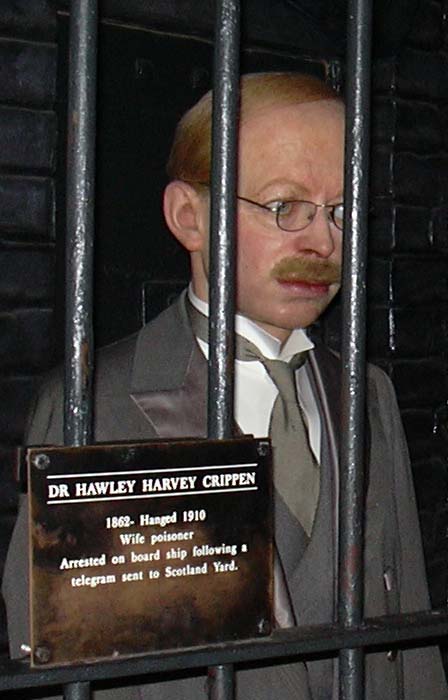
The sensational trial, which saw the American-born homeopath convicted for dismembering his shrewish and unfaithful wife Cora in an attempt to take up with his young mistress, fitted Crippen for both a noose and a likeness at Madame Tussaud’s. (More trial background here.) It has also made his case twice a landmark in the history of crime and technology: once at the time of his arrest, and again just last month as of this writing.

The core of a case a jury found so open-and-shut as to require just 27 minutes to convict was the poorly explained disappearance of Crippen’s wife, followed by the discovery of a considerably mutilated female corpse under the Crippens’ home.

Although much of the crown’s evidence was speculative and circumstantial — to say nothing of the bodice-ripping gossip of nymphomania and infidelity — a corpse under the floorboards tends to be a compelling circumstance to a jury.

Presumably that anticipation prompted Crippen to flee the Scotland Yard investigation with his mistress Ethel le Neve under assumed names on an ocean liner bound for Canada. The case made criminological history as the first use of wireless communication to apprehend a suspect when the ship’s alert captain telegraphed Crippen’s presence to land as the ship steamed away — enabling a policeman to board a faster boat and arrest the pair as they docked in Quebec.

In the century since Crippen went to the gallows still maintaining his innocence, the case has endured in popular notoriety. The killer’s life has been novelized, meditated upon and borrowed for fiction, offering a draught of inspiration to Alfred Hitchcock along the way.

Books inspired by the Crippen case …

Given his suspicious behavior, scant had been the credence given Crippen’s protestation of innocence.

Until now.

In a meeting of Edwardian crime and cutting-edge technology, two scientists from Crippen’s home state of Michigan stunningly announced in October that DNA testing proves the body was not Cora Crippen after all.

If true, it would appear to void Crippen’s conviction in its particulars without quite exonerating the hanged man from the natural question: whose was the corpse? The manufacture of clothes on the body dated it to the Crippens’ occupancy of the house.

One of Crippen’s modern sleuths, in a wholly speculative vein, thinks it might harken to an altogether different sort of crime: a botched back-alley abortion, just the sort of thing a financially struggling physician might have been involved in.

Maybe.

But if the test invites a modern investigator to look 97 years backwards, it also suggests a posture of epistemological humility. It’s just possible that the light this test casts on our own time is as searching as that it shines on 1910.

The Prejudice of Science

The Crippen case was a classic 19th century-style detective job — the inspector who made the arrest cut his teeth as a younger man on a Jack the Ripper murder — but it took place on the brink of a revolution in forensic science.

Just a few years before, fingerprinting had been embraced by British and American law enforcement and begun its march towards total institutionalization. On the heels of fingerprinting came a multiplicity of biometric approaches to crime scenes — hair and fiber analysis, blood typology, and most recently and dramatically, DNA.

And they, in turn, have brought a rising faith in science to adjudicate the law.

While the “CSI Effect” — jurors’ expectation of case-breaking scientific evidence — conventionally plays as a hindrance for prosecutors who usually have no such thing, the excess deference given to less-than-conclusive forensic evidence can likewise cut against the defense. Evidence mishandled at crime labs, even cooked outright, factors into numerous recent post-conviction exonerations. The once ironclad credibility of fingerprint evidence has itself been undermined by subsequent forensic advances.

In short, for all its undoubted contributions to criminal justice, forensic science packs along its own set of pitfalls, caveats and blinders reflexively privileging evidence of the laboratory.

This is not a reflex to indulge uncritically. History grants the benefit of hindsight, but rarely the luxury of certitude.

A waxwork Dr. Crippen at Madame Tussaud’s. Image used with permission.

So if the prospect of Crippen’s innocence intrigues, that unexplained body — that sudden flight for Canada — that (permanent) failure of Cora Crippen to resurface — nevertheless remain. They might lead us to question our implicit faith in the finality of DNA’s verdict on history rather than the other way around.

Are we certain that an unbroken line of blood relations really connects Cora Crippen to the modern DNA donors of her “family”?

Are we certain that a reliable chain of custody has preserved the original tissue samples unsullied across a century?

And if we are certain, what do we make of that body after all?

It is humans who must ultimately interpret and contextualize even the firmest forensic science. Whatever we might believe of Dr. Crippen we retain the burden of that belief, with all its intrinsic potential for grievous wrong.

The tales Hawley Crippen has yet to unfold from the grave might or might not shed still another different light on our understanding of what happened at 39 Hilldrop Crescent a century ago.

The gentleman’s place as a continuing attraction at Madame Tussaud’s, however, seems assured.

On this day..

1920: Kevin Barry

On this date in 1920, 18-year-old Irish Republican Army Section Commander Kevin Barry was hanged in Dublin’s Mountjoy Prison for the murder of English Private Harold Whitehead in an IRA ambush just six weeks prior to the execution.

Denying the authority of the British (civilian) court, the young medical student went undefended, insouciantly reading the newspaper in court as the government built its case against him. His was the first execution of the Irish War of Independence, and stoked Irish nationalist sentiment on the island and abroad.

Refused a request to be shot as a soldier, Barry nevertheless went jauntily to his fate, his bearing making great gains for IRA recruitment and fixing his own name in the firmament of Irish independence martyrs. Britain’s insistence on treating him as a murderer rather than a prisoner of war was widely received as an insult to the movement he represented.

It was not until 1989 that Barry’s short life received a biographical treatment, Kevin Barry and His Times, by the hanged man’s nephew. But a 1920’s song celebrating Barry has survived since that time as a popular hymn of Irish Republicanism.

On this day..