1903: Arthur Alfred Lynch condemned

On this date in 1903, Irish MP Arthur Alfred Lynch waited 26 minutes for a jury to convict him, then heard the sentence of a British court for having fought against the British Empire in the Boer War.

[T]he jury have found you guilty of the crime of high treason, a crime happily so rare that in the present day a trial for treason seems to be almost an anachronism — a thing of the past. There can be no doubt that in times gone by there was great abuse, and many persons were indicted, convicted, and punished for matters which would not now be thought worthy of serious or, perhaps, any notice. There has been a kind of national reaction by which many persons have been disposed to treat serious crimes against the State as if the name of treason, and as if the thing, no longer existed. One moment of reflection will show you how erroneous is such a conception …

Yes, even if the black cap gave away the ending, the judge was going to take his time getting to it.

The misdeeds which have been done in this case, and which have brought you to the lamentable pass in which you stand, must surely convince the most sceptical and apathetic of the gravity and reality of the crime. What was your action in the darkest hour of your country’s fortunes, when she was engaged in the deadly struggle from which she has just emerged? You joined the ranks of your country’s foes. Born in Australia, a land which has nobly shown its devotion to its parent country, you have indeed taken a different course from that which was adopted by her sons. You have fought against your country, not with it. You have sought, as far as you could, to dethrone Great Britain from her place among the nations, to make her name a byword and a reproach, a synonym for weakness and irresolution. …

Even allowing that this sentence was pronounced before either of the coming century’s world wars, calling the Boer War to conquer South Africa for the crown England’s “darkest hour” only underscores how very long Britannia had stayed in the sun. Were the early shadows of empire’s twilight visible from here … or was it just standard issue judicial showboating?

[Y]ou thought it safe, no doubt, to lift the parricidal hand against your country. You thought she would shrink from the costly struggle wearied out by her gigantic efforts, and that, at the worst, a general peace would be made which would comprehend a general amnesty and cover up such acts as yours and save you from personal peril. You misjudged your country and failed to appreciate that though slow to enter into a quarrel, however slow to take up arms, it has yet been her wont that in the quarrel she shall bear herself so that the opposer may beware of her, and that she is seldom so dangerous to her enemies as when the hour of national calamity has raised the dormant energies of her people — knit together every nerve and fibre of the body politic and has made her sons determined to do all, to bear all, to sacrifice all on behalf of the country that gave them birth.

The only — I will not say excuse, but palliation that I can find for conduct like yours is that it has been for some years past the fashion to treat lightly matters of this kind, so that men have been perhaps encouraged to play with sedition and to toy with treason, wrapt in a certain proud consciousness of strength begotten of the deep-seated and well-founded conviction that the loyalty of her people is supreme, and true authority in this country has slumbered or has treated with contemptuous indifference speeches and acts of sedition.

There’s some relish here, the kind you’d hear if Antonin Scalia had an opportunity to pass sentence on Cynthia McKinney.

This ponderous bombast was the culmination of a highly-anticipated, highly-publicized trial of a man who had returned to London and arrest as an elected Irish parliamentarian after upholding the Boer cause in print throughout Europe, and enrolling an Irish unit in the fight.*


Col. Lynch’s Irish Brigade, from this South African military history page.

Incidentally, this is the same judge who sentenced Oscar Wilde for the love that dare not speak its name, intoning on that occasion that “people who can do these things must be dead to all senses of shame, and one cannot hope to produce any effect upon them.” (Mr. Justice Wills’ update of his father’s classic treatise on circumstantial evidence is available from Google books, as is Wanderings Among the High Alps, which he wrote in his capacity as mountaineering hobbyist.)

But had you and those with whom you associated yourself succeeded, what fatal mischief might have been done to … that inheritance of power which it must be our work to use nobly and for good things; an inheritance of influence which will be of little effect even for good unless backed by power, and of duty which cannot be effectually performed if our power be shattered and our influence impaired. He who has attempted to do his country such irreparable wrong must be prepared to submit to the sentence which it is now my duty to pronounce upon you … that you be taken hence to the place from which you came and from thence to a place of execution there to be hanged by the neck until you are dead.

For all this sound and fury, one would hardly know that it was generally and publicly understood the sentence would be swiftly commuted — as it was, a few days later.

Arthur Lynch received a free pardon in 1907, and in 1909 was returned to parliament as an Irish nationalist delegate to resume his remarkable career as writer, physician, engineer and all-around polymath.

* Lynch’s part in the war is included in The Boer Fight for Freedom, another century-old tome in the public domain and available on Google Books.

On this day..

1758: Francois Macandal, forgotten black messiah

(Thanks to Mark Davis of macandal.org for the guest post on a remarkable historical parallel to today’s inauguration of Barack Obama. -ed.)

The world was astounded when Barack Obama was elected to the Presidency in 2008 knowing the cultural barriers minorities have faced for hundreds of years. The date of inauguration, January 20, also happens to be the anniversary of the burning at the stake of a virtually unknown man, Francois Macandal,* whose epic war against cultural barriers has been buried for centuries.

Read some of his story and judge if the historic election of Barack Obama could have occurred without the man they called “Macandal.”

The parallels with Barack Obama’s journey are numerous, but the life of Macandal was perhaps even more remarkable, reaching great heights and falling into the darkest chasms of despair, yet succeeding in spite of staggering odds. Macandal’s travails may be about finding one’s purpose and dreaming of victory even when condemned by a majority, as he was relentlessly pursued by soldiers and hounded by countless naysayers.

251 years ago on January 20, 1758, Macandal was chained to a post on a platform before thousands of slaves brought together to witness his brutal torture and execution. Because of his importance, the French gathered slaves from hundreds of plantations throughout the colony of St. Domingue (now Haiti and the Dominican Republic). They believed such a horrific spectacle would quash Macandal’s Revolution, which he began to end French rule and abolish slavery, 12 years before.

Around 1746 Macandal escaped his plantation, united thousands of escaped slaves along with many still enslaved, and proclaimed that he would lead them all to independence and freedom. This declaration, from someone who had only six years before been taken from his home in the Congo, was unprecedented, since no slave colony had ever defeated a European nation. Then Macandal mobilized tens of thousands and may have inspired millions to end slavery and defeat colonial hegemony in the Haitian Revolution consummated decades after his death.

But ironically even the famous, black Marxist writer C.L.R. James, attributed one of the greatest revolutions in history to something akin to ‘spontaneous rioting’ by 500,000 black slaves in 1791. Since 1791 almost every historian has reduced the “Haitian Revolution,” the only successful overthrow of a colonial power by black slaves, to a ‘collective rage,’ inspired by the whites of the “French Revolution.” Yet it may have been Macandal’s Revolution, not the starving peasants of France, that inspired their uprising in 1789.

The true story of Macandal represents obscure but recorded testimonies about his life and explains why the slave revolt of 1791 was in fact, “Macandal’s Revolution,” almost 50 years in the making. Macandal foretold the end of slavery, then planned it, plotted it and began it. His story shatters a myth that has gone unchallenged for over 200 years: that the Haitian Revolution of 1791 was a spontaneous slave uprising inspired by the French peasants who had charged the Bastille Prison in Paris two years earlier.

The Haitian Revolution ultimately ousted the French, defeating Napoleon and numerous French generals. It also succeeded against the vaunted British army and established a new government run by former slaves. It was the first domino in a series of colonial defeats and changes in law that led to the end of institutional slavery; and Macandal started it all.

Correcting the Historical Record

Macandal is rarely the focus of historians and when mentioned only his insignificance is noted. But the popular version of his story was immortalized by the original French writers themselves, in the interest of bolstering a self-image of innate superiority as a nation and a race. To have recognized Macandal’s brilliance would have acknowledged slavery’s illegitimacy, so Macandal’s real story had to be trivialized and buried.

This telling of Macandal’s journey from a free child in Africa to slavery and then revolution, relies less on popular writings and more on a review of all of the records in context. For example French writers claimed Macandal broke free because he was tied with ropes and the post was made of rotted wood that fell apart when he was set ablaze. Historians have repeated this without scrutiny. The French on St. Domingue regularly burned slaves to death at the town square of the capital, “Cap Francais.” At Macandal’s execution they gathered thousands of slaves as witnesses, to insure a humiliating defeat and halt his widely supported rebellion. Yet, despite this grandiose staging, we are supposed to believe Macandal was insignificant. And we must accept that the French military was so inept they forgot how to execute and did not know that ropes burn and untreated, rotted wood is flammable. Many such dubious “facts,” are still repeated blithely about Macandal and few Westerners grant him his bravery, genius or impact.

Interestingly, the U.S. Bill of Rights guaranteeing equality for all was also adopted in 1791, but it would be more than seven decades before slavery was outlawed in the U.S. and almost two centuries before equal opportunity laws were passed and enforced. For one tiny nation, Macandal enabled this to occur over 200 years ago.

Background

I began researching the life of Macandal 20 years ago, startled and inspired by one chapter in Wade Davis’ popular book The Serpent and the Rainbow, which focused on secret societies, Voodoo and Zombification. His version of Macandal’s story was dictated to him by Rachel Bouvoir-Dominique, a Haitian Anthropologist I interviewed in 1997, at her office in Cap Haitien. Working under the tutelage of well-known author and expert on Haitian history Michel Laguerre, a professor at U.C. Berkeley, I received grants for a field study and documentary on the subject of Macandal.

Anthropologists often allocate greater weight to oral history, informal observer accounts, burial remains, maps and gravures, re-evaluating more accepted published works historians rely on, and so this account reflects my perspective and research as an Anthropologist. I examined European gravures (illustrations) and colonial records cited commonly more skeptically, because they were clearly burdened by religious, sexist and racial paradigms of the day. For example illustrations portrayed slaves with happy smiles and sanguine facades, enjoying their lives in idyllic settings on the plantations. Yet slaves faced torture, rape, separation of family and death from over-work, every day. Blacks were often drawn with monkey features (toes, ears etc.) and other demeaning caricatures.

Western writers were fiercely loyal to provincial rhetoric, including the gender and racial bias then considered crucial foundations of Christian theology. Western scholars dehumanized natives and women to rationalize slavery, prejudice and justify the infamous “hierarchy of being,” which granted “white men” a closeness to God that no one else could approach. This endowed them with the right to use others as they saw fit.

There were many reasons colonial authorities destroyed or buried the noteworthy exploits of slaves. Few accounts of courageous acts from among the ranks of millions of Africans during 400 years of slavery were recorded and preserved, primarily to maintain the perception that slavery was justified, necessary and Nubian Africans were not truly human but beasts of burden. There are literally thousands of articles, books and films about individuals among the six million Jews who died during the holocaust but only a scant few from among the 100-200 million indigenous peoples killed during the colonial expansion; all the more reason to re-evaluate slaves like Macandal.

A Brief History of Macandal

During the early 18th century, around the age of 12, Macandal was taken from the west coast of Africa, probably the Loango Kingdom in the Congo. I claim the date of his birth was 1728 primarily because oral historians in Haiti I interviewed believed him to be 30 when he was fastened to a post before thousands and set on fire in 1758.

The French called him Macandal which may derive from a city in the Congo called “Makanda.” The town of Makanda no longer exists due to civil war but could have ancient roots and slaves were often named after the places they came from. His name may have been taken from the term makanda (plural form of “kanda”) referring to African societal groups. Some written accounts report that Macandal claimed to be descended from a ranking societal group and the son of a Chief or King.

Amazingly, Macandal could speak, read and write Arabic fluently. Some believe this is because he was raised Muslim, yet the Congo was Christianized long before Macandal was born. Portuguese mercenaries, missionaries and armies had combed every square inch of the Congo beginning in the late 1400’s, searching for gold, diamonds and slaves, forcing conversion to Christianity. However Macandal’s words and actions reveal a unique knowledge of both Christianity and Islam. His ancestors may have emigrated from the east coast where Muslims and Asians had allied with Swahilis to build beautiful cities and schools before the Portuguese invasion. His family may have then hidden themselves for centuries.

Conversion to Christianity was also a requirement for slaves on colony plantations but Macandal defied the French by learning the underpinnings of Christianity, to understand the roots of slavery and challenge newly acquired doctrines. Despite many influences the adult Macandal claimed no affiliation with Christianity, Islam, Voodoo or Animism.

As a child Macandal was educated and known to be accomplished in both music and art, including painting and sculpture. His dedication to learning was apparent throughout his life. He displayed a vast knowledge of plants, became a doctor on the plantation he was taken to and was sought by even the French themselves for treatment of diseases and ailments. Yet the vegetation on St. Domingue was completely different from that of the Congo; therefore, Macandal had to study his new environment and learn the properties of perhaps hundreds of plants. He secretly taught himself French and became so eloquent that the French aristocrats remarked that he could speak it better than they themselves, though education was strictly forbidden for slaves.

Based on historical records and interviews, it appears that Macandal was first sentenced to death on his plantation, around 1746 at the age of 18, for falling in love with the plantation owner’s favorite lover, a young and beautiful house slave. He underwent a scene of heinous torture intended to culminate in his death in front of many witnesses, but escaped mysteriously and fled into the hills. The French replaced this account with a tale about Macandal becoming handicapped from losing a hand in a sugar mill and then being left unguarded. His escapes were always attributed to poor guard oversight.

Though Macandal probably began his new life of freedom with the intention of bringing vengeance to his former owner Lenormand de Mezy and rescuing his true love, for some reason his objective evolved. Perhaps because of the totality of his traumatic experiences or because of the influence of Maroons (ex-slaves already living in the distant mountains) Macandal met after escaping, he began working for a new goal of freedom for all.

Macandal led a sweeping and unwavering revolution during the 12 years after his escape from the plantation. Unlike other escaped slaves, Macandal actually made the end of slavery his stated mission. He became the first to unite thousands of disparate Maroons who were living free but divided by tribal affiliation and known to be ardently dedicated to the destruction of each other. His uniting of these groups was an extraordinary accomplishment and he is the first known black leader and ex-slave to do so.

He began calling himself the “Black Messiah” and gave rousing speeches in secret locations to recruit slaves. He made dangerous and daring appearances on plantations during the night to urge loyalty and inspire hope. The name “Black Messiah” had great meaning to Macandal as evidenced by one of his famous speeches at a secret recruitment meeting. The words exposed Macandal’s understanding of Islam and Christianity and their link to institutional slavery. The term was a powerful catalyst he used to preempt religious and ethical indoctrination of blacks and free them from the ideological bonds of slavery. He had to usurp the authority of the Church and French government to convince slaves they deserved equality, freedom, family sanctity, education and self-government.

Macandal became a brilliant strategist and had a large, organized camp with lieutenants, captains and other ranks. He led countless attacks and escaped capture mysteriously many times. His tactics were unique and devastating. They were known to be carried on after his disappearance despite the brutal efforts of the French to extinguish illegal grassroots activity. During his reign as a Maroon leader he may have recruited half or more of the 100,000 slaves living on the plantations as secret agents of his revolution.

Maroons and slaves apparently employed his tactics for decades after his disappearance in 1758. During the decade before the final thrust for overthrow in 1791, and despite harsh measures to thwart rebellion, Maroon activity greatly increased. This activity was so secret that virtually nothing is known about this period and is one reason historians assume the war for independence was unplanned, even though the first massive attack was led by Boukman Dutty, formerly a cruel black overseer who was a contemporary of Macandal. His gathering, which launched the war, was convened at a hidden location where Macandal formerly gave his speeches, the symbolism of which cannot be denied.

Generals that followed Boukman used ingenuity and unique strategies to win the 13-year war and Toussaint L’Ouverture is given most of the credit for the victory. But Toussaint refused to support the war until after it had begun; its inevitability certain. He was 13 when Macandal was sentenced to death in 1758. A voracious reader and student of warfare he was well aware of Macandal but content as a slave under a liberal planter.

It is my thesis the “Macandal Revolution” continued through the three decades preceding the Haitian Revolution. No other slave is known to have prophesied and promised the end of slavery yet Macandal predicted that blacks would defeat the French, become free and independent of colonial rule and control the colony of St. Domingue. His rally cry and pronouncement repeatedly rang throughout the colony despite opposition and betrayal from many slaves who greatly feared the French and did not believe victory was possible.

The Haitian Revolution remains the only successful movement by black slaves to defeat a colonial power and achieve complete independence. It stands alone as a towering victory against incalculable odds. Though it is characterized as a ‘riot’ that generated its own momentum, 500,000 slaves and free blacks mysteriously rose up in unison, using sticks and stones, against over 50,000 heavily armed soldiers, landowners and henchmen.

The Fall of Colonialism

As Macandal’s victories mounted I propose that word of his revolution spread to Europe and bolstered many anti-colonial movements. For example one of his closest secret allies was a French Jesuit priest and the Jesuits along with other religious leaders in Europe began fomenting rebellion during this period. Before news of Macandal’s revolt spread, many in Europe believed the slave trade was not only profitable but philanthropic. It had long been heard in the churches that slaves were heathens being brought to Christ and treated well in the process. His uprising no doubt made many Europeans aware that slaves were not being treated well and were desperate. Macandal’s shocking victories may have provoked Europeans to finally condemn colonialism and slavery. His fearless attacks and disregard for colonial might may have also seeded the French Revolution.

What really happened on January 20, 1758? Macandal endured great agony during an intense and excruciating punishment. He did this so that slaves everywhere might become free. The French claim Macandal was burned alive at the town square in Cap Francais.** Admitting he broke free and leaped out of the fire, they wrote that soldiers reclaimed Macandal and threw him back in. However some observers claimed Macandal broke his chains and fled, never to be seen again. How he broke free during any of his escapes despite being surrounded by guards and soldiers, is not known. It is interesting to note that his remains were never found and there is no burial site. Given the French proclivity for making examples of slaves to increase fear and enforce discipline, a successful execution should have been commemorated by another French monument.

For most historians, January 20, 1758, came and went with barely a mention in official memorandums. Yet a detailed search of documents reveals a massive cover-up, confusion and consternation. Macandal’s Revolution was not quashed or even slowed; instead it was impelled and sent wildly rumbling down a path of manifest destiny. Plantation owners later discovered their most trusted slaves were working for the revolution. New restrictions were put on all blacks throughout the colony and 4-5 rebels were burned at the town square every month to strike fear into the rest. Intense interrogation and torture revealed ever more depth to the conspiracy. Macandal’s execution day inflamed slaves and intensified their commitment to him and they became more united and fervently bent on winning freedom. Jesuits were banned from St. Domingue five years later.

As the first U.S. President with African roots is inaugurated on January 20, no one will speak of Macandal or Macandal’s Revolution, which led to equal rights in 1804 for one small nation. January 20, 1758, the day the French sought to secure colonialism and slavery in perpetuity, became a day of victory for Macandal and a watershed event which brought colonialism down. Though Macandal has been denied his place, his actions may have ended slavery and paved the way for people like Barack Obama to make history.

Mark Davis received his Bachelor of Arts degree in Anthropology from U.C. Berkeley and a Master’s in Anthropology from the University of Hawaii. He is the foremost authority on Macandal and his one hour documentary The Black Messiah was broadcast on PBS in 1997. He publishes information through his website at www.macandal.org.

* The man’s true name is lost to us; the one he was given by the French can be alternately spelled “Mackandal” or “Makandal” or “Mackendal”.

** Renamed Cap Haitien after Haiti won its independence.

On this day..

1896: Dr. Jose Rizal, father of the independent Philippines

December 30 is Rizal Day (Araw ng Kabayanihan ni Dr. Jose Rizal in Tagalog) in the Philippines, for the execution that date in 1896 of the great martyr of Philippine independence.

Also available free at gutenberg.org (the HTML version is very well-illustrated).

At Jose Rizal’s birth in 1861, it had been 340 years since Magellan had reached (and died at) the Philippines under the Spanish flag.

In Rizal’s century of romantic nationalism, independence movements stirred abroad in the Spanish Empire … too weak yet in the Philippines and elsewhere during the mid-1800s, but unmistakably prefiguring those national destinies that this day’s victim would come to embody.

Oddly, Jose Rizal was not even the most “revolutionary” of his farming family’s 11 children. That distinction went to older brother Paciano, who was under an official cloud before Jose hit adolescence for his relationship with the Gomburza priests, and would later serve as a brigadier general in the revolutionary army of Emilio Aguinaldo.

Jose was less strident — and more brilliant.

Though reputedly an adept fencer and crack shot with a pistol, the renaissance man’s gifts ran more to the life of the mind.

At the Universidad Central de Madrid, the University of Paris, and the University of Heidelberg, Jose Rizal studied ophthalmology and anthropology, and pursued the variegated artistic interests of his youth.

His two novels published from Europe, Noli Me Tangere and El Filibusterismo*, both criticized colonial authorities and their Vatican adjutants and struck nationalist chords that put him on the Spanish government’s watch list.

“I die without seeing the dawn brighten over my native land! You, who have it to see, welcome it — and forget not those who have fallen during the night!” -From Noli Me Tangere

Rizal also penned essays and editorials in a less symbolic vein, like this one skewering the stereotype of the lazy native by turning the mirror upon colonial agents who were waiting to prey on the fruit of native labor:

How is it strange, then, that discouragement may have been infused into the spirit of the inhabitants of the Philippines, when … they did not know whether they would see sprout the seed they were planting, whether their field was going to be their grave or their crop would go to feed their executioner? What is there strange in it, when we see the pious but impotent friars of that time trying to free their poor parishioners from the tyranny of the encomenderos by advising them to stop work in the mines, to abandon their commerce, to break up their looms, pointing out to them heaven for their whole hope, preparing them for death as their only consolation?

Man works for an object. Remove the object and you reduce him to inaction The most active man in the world will fold his arms from the instant he understands that it is madness to bestir himself, that this work will be the cause of his trouble, that for him it will be the cause of vexations at home and of the pirate’s greed abroad. It seems that these thoughts have never entered the minds of those who cry out against the indolence of the Filipinos.

(This essay and both novels are available in the original Spanish and in English at gutenberg.org, along with various translations of Rizal’s various fiction and non-fiction work.)

Fire-eating stuff in the eyes of the Spanish crown, but Rizal wasn’t the bomb-throwing type himself.

As the Philippine Revolution that would break the Spanish yoke on the islands took shape in the summer of 1896, Rizal applied to go to Spanish Cuba to treat victims of the yellow fever, and even explicitly disavowed the revolution.

Countrymen: I have given proofs, as well as the best of you, of desiring liberty for our country, and I continue to desire it. But I place as a premise the education of the people, so that by means of instruction and work they may have a personality of their own and that they may make themselves worthy of that same liberty. In my writings I have recommended the study of the civic virtues, without which there can be no redemption. I have also written (and my words have been repeated) that reforms, to be fruitful, must come from _above_, that those which spring from _below_ are uncertain and insecure movements. Imbued with these ideas, I cannot do less than condemn, and I do condemn, this absurd, savage rebellion, planned behind my back, which dishonors the Filipinos and discredits those who can speak for us. I abominate all criminal actions and refuse any kind of participation in them, pitying with all my heart the dupes who have allowed themselves to be deceived. Go back, then, to your homes, and may God forgive those who have acted in bad faith.

This stance on the revolution — the fact that he thought and wrote but never struck a blow — has engendered some controversy over the rightfulness of Rizal’s place in the national pantheon, as has his anti-clericalism and a disputed Vatican claim that Rizal retracted his criticisms of the Church before his death. One Spanish contemporary called Rizal “the Tagalog Hamlet.”

But mostly he is seen as the Spanish government at the time saw him, and as many revolutionaries did as well: as the lodestar of the Philippines’ national aspirations.

Rizal was arrested en route to his humanitarian assignment in Cuba and returned to Manila to face trial for sedition, rebellion and conspiracy, by which point, of course, the verdict was quite preordained. He was shot in the back by a firing squad, uttering the Christ-like last words “consummatum est” — “it is finished.”

Rizal’s execution, and the events preceding it, are depicted in this long excerpt of a 1998 film:


Jose Rizal’s execution.


Near the spot Rizal was actually executed, his martyrdom depicted in statuary.

There are any number of Jose Rizal tribute sites online. JoseRizal.ph and JoseRizal.info are two good places to delve deeper.

* A filibuster is a private military expedition, and more typically associated with Anglo American campaigns against the Spanish-speaking lands to the south, like those of William Walker.

On this day..

1871: Eight Cuban medical students

On this date in 1871, eight first-year medical students, aged 16 to 19, were shot in Havana Place de la Punta by Spanish colonial authorities in one of the most notorious episodes of that island’s independence struggle.

Cuba was three years into the Ten Years’ War, the first of three major 19th century insurrections that would eventually throw off Spanish rule, but popular support for independence was far from universal.

This book is the English translation of the classic Cuban text written by their schoolmate.

A vocal pro-Spanish element opposed the rebels to the extent of mobilizing right-wing volunteer goon squads to rough up demonstrators and menace the government into dealing with them only at bayonet-point … proto-brownshirts, albeit from a more well-heeled class position.

Mostly middle- or upper-class peninsulares, they were able by sheer force of numbers to cow [liberally inclined Captain-General Domingo] Dulce into acceptance of their views … Their journal, La Voz de Cuba, accused Dulce of working for the rebels …

The volunteers were a foretaste of those twentieth century lower middle-class mobs of young men who often protest violently against the end of empire. Shouting Viva Espana! in the Villanueva Theatre, foreshadowing the pieds noirs of Algeria, they bridge the gap between Carlism and Fascism. (Cuba, Or, The Pursuit of Freedom by Hugh Thomas)

The Volunteers would make themselves felt this day.

The editor of that Volunteer paper La Voz de Cuba was assassinated in 1870. The fatal accusation against the students was that they had desecrated the grave of that editor.

In Cuba in 1871, vandalism with the wrong politics was good enough to get you shot … four days after the supposed crime. In that environment, it’s practically beside the point that one of the eight wasn’t even in town at the time and the “desecration” was so exaggerated (the link is a Spanish backgrounder) as to be essentially fabricated.

The procedural rigging dignified with the word “trial” wasn’t going to get hung up on that detail, but it was also on the verge of an acquittal or a light sentence when a Caribbean Brooks Brothers riot steamrolled it (Spanish again) into sentencing eight to death and most of the others to significant prison terms.

Defense attorney Frederico Capdevila alone distinguished himself (more Spanish) at this circus with an indignant and energetic defense, despite being attacked at one point by the Volunteer mob. At its appalling conclusion, he drew his sword and theatrically broke it over his knee — a gesture of contempt for the military tribunal that cost him his military career and made his reputation to posterity.

Radical writer Jose Marti, 18 years old at the time of this execution, summoned the image frequently and helped raise 27 Noviembre de 1871 into an enduring emblem of the worst of colonialism.

Che Guevara would say of the martyrs, “El único delito era el de ser cubano” — “Their only crime was to be Cuban.”

On this day..

1553: Michael Servetus, but not to defend a doctrine

On this date in 1553, Calvinist Geneva showed it could keep up with the Inquisition by burning the theologian Michael Servetus as a heretic.

A generation or two into the Protestant Reformation, and the ministers of Rome were in full-throated I-told-you-so. The splintered religious authority had set all manner of alien doctrine afoot in the land. Adult baptism! No original sin!

Servetus believed all this queer stuff. He also believed in a unitarian — that is, not trinitarian — deity.

Catholics and Protestants both hunted him from pillar to post for heresy.

After busting out of the Inquisition’s clutches in France, Servetus fled towards Italy, but made an unaccountable stopover in John Calvin’s Geneva. He well knew that capture here would be fatal: he had had an acrimonious correspondence with Calvin. Was he seeking thrills? Martyrdom? A place in this blog?

“I will burn, but this is a mere event. We shall continue our discussion in eternity.”

He quaffed all those bitter cups when he was recognized hanging out at a church service and condemned to death for sundry heresies after a sensational trial heavy with theological artillery, personal vituperation, and municipal politics. Calvin, gracious in victory, requested beheading rather than burning. He was scorned as needlessly merciful.

Of course, all manner of Christian fauna were being martyred by other Christians in the 16th century. Still, the Spanish physician is an interesting dude.

His rejection of the Trinity has secured him honored consideration from various latter-day sects, from Jehovah’s Witnesses to Oneness Pentecostals to general humanists to Unitarian Universalists:

Besides all that stuff, in his day-job capacity as doctor, Servetus was apparently the first European to understand pulmonary respiration. Nobody even noticed that until decades after his death.

“To kill a man is not to defend a doctrine, but to kill a man.”*

The execution of this smart, odd duck for non-violent heresy is not generally considered the highlight of Mr. Predestination’s career, but you can get some of Calvin’s side of the story in this collection of his letters. It’s worth allowing that heretics were being burned by the thousand elsewhere in Europe at this time; Servetus is noticeable in part because what was routine in England or Spain was exceptional in Geneva.

Servetus’ ashes will cry out against [Calvin] as long as the names of these two men are known in the world. –Walter Nigg

* This observation, sometimes attributed to Servetus himself, was in fact uttered by Sebastian Castellio.

On this day..

1915: Nurse Edith Cavell, “patriotism is not enough”

Early this morning in 1915, the German military occupying Belgium shot aid worker Edith Cavell at Brussels for aiding the British war effort.

The matronly nurse had been condemned only the day before by a German military court for helping Allied soldiers escape from behind German lines — charges Cavell readily admitted. The British chaplain who attended her the night before her death reported her saying (not actually her last words, but recalled as her parting sentiment, as it were):

But this I would say, standing as I do in view of God and eternity, I realize that patriotism is not enough. I must have no hatred or bitterness toward any one.

So naturally, she immediately became the Entente’s bloody banner of the barbarous Hun, helping dramatically ramp up recruitment for the other team’s set of moral cretins.

The thing is, the Germans actually had a point. Cavell ran a nursing school in Brussels, and courageously stuck around when the Germans smashed through Belgium as World War I opened. She’s sometimes remembered as getting in hot water for treating the wounded regardless of nationality, but she did a lot more than that: she got involved with an underground railroad funneling Allied soldiers back to enemy countries.

It was one of those impossible trials of conscience that wartime brings: Cavell, whose hospital was subsumed by the Red Cross during the war, should technically have remained neutral; her actions did bring material aid to Germany’s foes.

However, Belgian, French and English troops caught behind lines by the Germans’ lightning advance were in danger themselves of summary execution, as were civilians who harbored them. Neutrally treating them and handing them over as POWs might have been tantamount to killing many of them, especially in the first few months of the war. Though Edith Cavell said that “I am happy to die for my country,” her actions look more humanitarian than nationalistic — the best choice to be made when no good ones are available. Patriotism of a higher order, if you like.

Probably Cavell’s was a case tailor-made for executive clemency, but Germany was keen to send one of those proverbial messages: civilians in occupied countries had best stay out of the war. Despite the frantic lobbying of England’s ambassadors (and, ominously for Germany, those of the United States), the sentence was carried out on both Cavell and a fellow-traveler in her network, Belgian Philippe Baucq.

Clumsy propagandists, the Kaiser’s boys badly misjudged the message so sent.

In the face of intense international outcry, Germany soon found itself defending its actions (.pdf), and then commuting the sentences (.pdf again) of Cavell’s other collaborators.

None of this abated Cavell’s stupendous propaganda value to Germany’s enemies. And — holy wow, the graying 49-year-old gets made over into quite the heartbreaker in most of these.

The nurse’s repute — and she was said to have struck a Joan of Arc-like chord in those parts — caused a renaissance for the name “Edith” among French and Belgian newborns, most notably singer Edith Piaf (born in December 1915). While Cavell’s sacrifice did nothing to stem her name’s declining Anglo (or at least American) popularity, there is a Mount Edith Cavell named for her in Canada, and a plethora of monuments and public spaces dedicated to her throughout the Allied powers’ lands. (Here are just a handful.) And she still packs enough symbolic punch for the current British Prime Minister Gordon Brown to deploy her in the propagandist’s subtler modern arts.

There’s plenty more about her online, but world headquarters (with information about the Cavell Festival) is edithcavell.org.uk. There’s also a stupendous collection of text and images (several already used in this post) at the sometimes slow-loading but endlessly fascinating site The Great War in a Different Light.

Dutch speakers might enjoy this podcast:

[audio:http://veertienachttien.web-log.nl/mijn_weblog/files/068_va_edith_cavell.mp3]

On this day..

1967: Ernesto “Che” Guevara

As of 1:10 p.m. Bolivia time this date in 1967, Ernesto “Che” Guevara was no longer a man: he was only a god.

The Argentinian-born doctor turned Cuban revolutionary icon and the man who wrote the book on guerrilla warfare had put abroad to foment insurgency. His efforts in the Congo foundered; his bid to replicate the Cuban revolution in Bolivia was doing likewise when he was captured.

After holding him overnight, the government sent a coded order to execute him in the field. Che had done the same thing with his own hands to several who betrayed the Sierra Maestra guerrillas.

Soldier Mario Teran drew the short straw for a footnote to destiny; when he hesitated, Che chastised him with the legendary parting words “that someone invented or reported”:

“Shoot, coward, you’re only going to kill a man.”

Maybe so, but the man looked Christ-like when they put his body on display for the press. As certain as they made his death, still Che lives.

CIA asset (and George Bush Sr. confidante) Felix Rodriguez took his watch as a trophy. The rest of Che Guevara belongs to the world.*

This site could hardly attempt a definitive rendering of such a towering and controversial figure, a task fit for two, three, many biographies.

Lengthy video documentaries are here and here. Many of Che’s own words are collected here. Declassified U.S. National Security Archive documents relating to his capture and death are here.

And highly recommended is SovMusic.ru’s huge library of Che Guevara mp3 files — like this Francesco Guccini song:

[audio:Che_Guevara_Francesco_Guccini.mp3]

“We cannot be sure of having something to live for unless we are willing to die for it.”

-Che Guevara

* Especially, of course, its marketers.

On this day..

1860: (William) Walker, Nicaragua Ranger

On this date in 1860, a kid from Tennessee who had made himself President of Nicaragua got his grateful subjects’ comeuppance in the form of a fusillade.

It was westward the wagons that first bestirred the pioneering blood of William Walker, a scion of privilege with an Ivy League medical degree, who uprooted for San Francisco in 1849.

But the “grey-eyed man of destiny” had an altogether grander gold rush in mind, as he stared pensively into the middle distance.

The air was fervid with Manifest Destiny, and most Americans reckoned that the entire hemisphere was its rightful Manifestation. In a time when private settlers effected the statecraft of conquering the Great Plains, was it really any crazier for Walker to fancy privately conquering some distracted European power’s American colonies?

Walker was one of — soon to be the most famous of — a whole class of such characters: filibusters, a word etymologically rooted in piracy but now claimed by the bustling ranks of soldiers of fortune with private militias bent on detaching some parcel of land from south of the border, for money or glory or what have you.*

Oh, and “what have you”? That means slavery.

Nicely dovetailing the individual spur to derring-do, the South’s structural impulsion to expand slaveholding territories to maintain political parity encouraged — and often bankrolled — filibuster adventuring.

It is to these unwholesome fellows that the United States likely owes its sovereignty over Texas, which was pelted with Anglo filibustering expeditions in the early 19th century, helping set the table for the revolution that severed the Lone Star state from Mexico; arguably, the Texas Revolution itself was a (fantastically successful) filibuster.

So Walker had the glittering destinies manifest before his grey eyes when he put off the white collar career to play soldier. After an abortive 1853 attempt to set up his own country in Mexico’s Baja California — a jury instantly acquitted him of waging war on a neutral power; filibustering, and damn near anything that promised America more Manifestly Destined land, was as popular as it was illegal — Walker moved on war-torn Nicaragua under the guise of a “colony”. With a few hundred men, he was able to conquer the capital and set himself up as head of state.

Who knows whether he could have had a future if he’d done it differently. In the actual fact, he wasn’t as hot an administrator as his ego might then have been telling him. He revoked Nicaragua’s anti-slavery edicts, of course; though this sparked resistance, more damaging may have been revoking a Vanderbilt trade concession and bringing a tycoon into the private warfare game on the opposite team.

Cornelius Vanderbilt-backed opponents drove Walker out of Nicaragua in 1857. Not knowing when he was beat, the ex-Presidente kept knocking around stateside piecing together several expeditions, each sadder than the last … until in 1860, when a landing at Honduras collapsed, and he surrendered himself to a British (rather than American) officer. Europeans with colonies to exploit didn’t have much use for filibustering, and Walker had made everyone nervous by openly aspiring to conquer Nicaragua’s neighbors — including British assets. Rather than return him home where he could continue scheming to meddle in the future canal zone, the Brits handed him over to the Hondurans, who stood him in a court-martial, then stood him up against a wall.

Alex Cox (Repo Man) turned this bizarre biography into a film, back when Ronald Reagan’s filibusters narco-terrorists “moral equals of our founding fathers” were having their own unofficial way with the country Walker once governed:

And for a corner of Americana little-known to most in the U.S. — well, the colorful, nigh-unbelievable quality of the action has overridden its obscurity when it comes to the written word.

Various books about William Walker and Filibustering

* More familiar for most Americans is “filibuster” as a legislative maneuver — refusing to yield the floor during debate to forestall the passage of a bill. Not surprisingly, this usage came online at the same time mercenary filibusters were active, and proceeds from the word’s original sense of “piracy”.

On this day..

1850: Prof. John Webster, for the timeless conflict between donors and academics

On this date in 1850, a 57-year-old Harvard professor expiated upon a gallows at Boston’s Leverett Square the murder of one of the university’s donors.

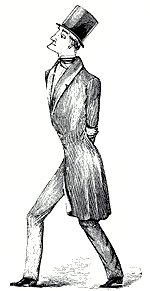
The buzz of Boston in 1849-50, the Parkman-Webster murder case began with the disappearance of one of the crimson’s great benefactors, George Parkman, a Boston Brahmin known for his Ministry of Silly Walks gait about town (see right). According to Oliver Wendell Holmes, Sr. (who appeared as a witness at the trial of Parkman’s accused murderer), “he abstained while others indulged, he walked while others rode, he worked while others slept.”

Also, he inherited a ridiculous sum of money, and was tight with the debtors to whom he lent it.

Back before collection agencies, Parkman disappeared in November 1849 while making the rounds to shake down his borrowers. Within days, suspicion settled on Harvard anatomy and geology professor John Webster, who had squandered his own pile of money buying rock collections and maintaining appearances and such, and sank into desperate hock to the jutting-chinned ambulator who had helped him land the Ivy League appointment in the first place.

A weighty circumstantial case soon formed against Webster, with the invaluable aid of a snoopy janitor who turned up human remains in the office and testified to incriminating-sounding conversations.

Elites-on-elite crime epidemics always churn the scandal mills. Henry Wadsworth Longfellow’s wife Fanny wrote a friend,

You will see by the papers what dark horror overshadows us like an eclipse. Of course we cannot believe Dr. Webster guilty, bad as the evidence looks. … Many suspect the janitor, who is known to be a bad man and to have wished for the reward offered for Dr. Parkman’s body. … I trust our minds will be soon relieved, but, meanwhile, they are soiled by new details continually.

“Harvard professors do not often commit murder,” or so they say. (This was still a century before Robert McNamara.)

Boston high society was about to see a whole different side of Harvard.

Although perhaps individually explicable — anatomists had plausible reasons to have human remains at work, and other anatomists than Webster could have had access to his office — the cumulative weight of Webster’s ham-handed attempts to declare that he had paid up his debts to Parkman just before the latter’s mysterious disappearance, of the discovery of what (disputed) dental forensics declared to be Parkman’s dentures, of the ghastly appearance of a torso (disputedly) declared to be Parkman’s stuffed in a tea chest at Webster’s offices started to really make the man look guilty.

In view of a mediocre defense, the jury convicted Webster of whacking his own professional benefactor, in the university building erected on said benefactor’s donated plot of land.

Talk about donor recognition.

While the prof’s seeming post-conviction acceptance of guilt — in a plain strategem to secure clemency — and generally shifty demeanor have cemented him as the definitive perpetrator in the standard historical reading,* Fanny’s snobbish take on the “bad man,” janitor (and moonlight body-snatcher) Ephraim Littlefield, has not been entirely lost to the tradition.

At the end of the day, everything about the case is circumstantial — indeed, besides being historically noteworthy for the first use of dental forensic evidence in a murder trial (forensics we might find rather speculative and unconvincing today), Webster’s case generated a landmark ruling from the judge’s jury instruction establishing “reasonable doubt” as the threshold for criminal conviction rather than the “absolute certainty” Webster’s prosecutors had no hope of attaining; that ruling influences American jurisprudence down to the present day.

And one cannot but notice how many of the circumstances — creepily playing Sherlock Holmes with a freelance dig into the professor’s furnace to discover charred bones, for instance — were provided by the fellow-suspect-turned-star-witness Littlefield, who niftily reaped the $3,000 reward for his offices in substituting Webster for himself under the pall of suspicion.

According to peripatetic crime blogger Laura James, a forthcoming (2009) book promises to revisit the sensational trial, “to examine all the intricacies for ourselves — not aided by the eager voice of the janitor.”

* Bemis, one of the prosecutors, wrote the go-to source on the Webster trial, available from Google Books; another contemporaneous account is here.

On this day..

1747: Alexander Blackwell, who left them smiling

On this date in 1747,* the Swedes beheaded Scottish-born adventurer Alexander Blackwell for meddling with their line of succession.

Blackwell, “a man of mercurial and adventurous temperament,” had his printing business busted in England for having failed to precede it with the required apprenticeship, and was thrown in jail as a debtor.

To extricate the family from poverty, Blackwell’s wife Elizabeth thereupon launched an amazing career as an herbal limner, drawing, engraving, and hand-coloring editions with hundreds of plants that became a standard reference in the field in the late 1730’s, and whose revenues managed to liberate her spouse. (Elizabeth is still remembered on a plaque at the Chelsea Old Church, in her old neighborhood.)

That mercurial ex-deadbeat might have done better to stick close by his now highly esteemed wife (or possibly his brother, a bloviating classicist), but the wanderlust sent Alex abroad to wash ashore in Stockholm as physician to King Frederick I, where he was soon convicted (on evidence uncertain, apart from the torture-extracted confession) of having intrigued to alter the royal line of succession further to enmeshing Sweden in an alliance with Britain.

He protested his innocence on the scaffold. More memorably, perhaps, he laid his head the wrong way upon the chopping block, requiring the executioner to correct him — whereupon Blackwell cracked wise that he, after all, lacked experience at the art of being beheaded.

Mental Floss mined this outstanding exemplar of gallows humor in a cartoon about memorable exits. (Via History News Network.)

* Some sources, like this Google Books biography, offer August 9 as Blackwell’s execution date. The 11-day discrepancy is due to the still-pending adoption of the Gregorian calendar: July 29 was the date on the Julian calendar still in use in the realms both of Blackwell’s birth and death; in 1752 and 1753, respectively, Britain and Sweden would adopt the Gregorian system.

On this day..