1946: Marcel Petiot, Vichy serial killer

Paris, 1942.

On the run from the Gestapo — as a Jew or a Gypsy, a common criminal or a Resistance fighter whose cover is blown — you get wind of a man who can help.

“Dr. Eugène” will (for a fee) spirit you over the Pyrenees and thence to South America. In his house at rue le Sueur, you make the arrangements. One small matter: the tropics requires an inoculation, which le bon docteur will readily provide. One small prick of the needle and then …

The needle contained cyanide and the destination turned out to be a lime pit, and so “Dr. Eugène” — Marcel Petiot — was guillotined this date in 1946.

His opportunistic exploitation of the dangerous Vichy years is what he’s famous for, but Petiot had decades of crime behind him by the time he got his phony “underground railroad” up and running.

From youthful compulsive thieving, Petiot graduated into a shady medical practice in Villeneuve-sur-Yonne where he was the resident black market abortionist.

He’s thought to have killed a mistress there, and maybe a couple of others, but was able to segue into a political career by winning the mayoralty of Villaneuve when he sabotaged his opponent’s campaign appearances. The sticky-fingered Petiot naturally plundered the town treasury and was forced out of office in 1931.

By the time the war years had rolled around, Petiot had judiciously relocated to Paris where he retained his capacity for professional advancement in the face of profoundly disturbed behavior: he was institutionalized for kleptomania the same year he was appointed an official médecin d’état-civil.

So he had the requisite two-faced background for his whackadoodle wartime “escape route”, which he creepily code-named “Fly-Tox.”

Twists and turns elided — trutv.com and crimemagazine.com both have detailed biographies/case histories — Petiot’s enterprise was quasi-exposed early in 1944 when the stink of incinerating bodies prompted neighbors to summon the police and uncover his charnel house.

Amazingly, Petiot was able to beg off with the claim that he was a Resistance activist — these were French police — and that the victims were Nazis or collaborators who had been eliminated by his network on orders. The Gestapo had sniffed him out too late in the war to do anything about him, but its judgment that Petiot was a “dangerous lunatic” actually turned out to bolster the deranged doctor’s case that he was an anti-fascist.

The alibis fell apart as the war wrapped up, and Petiot was finally recognized in a Paris manhunt and brought to trial for 27 homicides. Police thought 60-plus was more like it — maybe even into the hundreds — but secured 26 of the 27 counts. That’s more than enough to do a man to death, especially since they were the for-fun-and-profit murders of desperate people already on the run from the late and hated occupying army. Bit of a touchy subject in France in ’46.

But there was good news.

This London Times (May 27, 1946) observed that Petiot’s beheading marked

the first time that the guillotine has been used since the war. Until now executions have been by firing squads. Although gruesome, it is one more indication of the return of this country to normal civil ways of life.

On this day..

2010: Zheng Minsheng, child-stabbing doctor

This morning in Nanping, China, former doctor Zheng Minsheng was shot to death for a headline-grabbing knife attack on schoolchildren just five weeks ago.

In a brazen attack as efficient as it was unanticipated, Zheng knifed 13 kids at Nanping City Experimental Elementary School on March 23. Eight of them died.

“The methods used by the defendant Zheng Minsheng were extremely savage, the circumstances of the crime were particularly evil,” the Fujian Province high court said in rejecting his appeal.

The apparent motivation? Being jilted by his girlfriend.

That’s not the sort of trigger calculated to impress Chinese courts that have little sympathy for mental illness claims.

For this shocking crime, justice was swift. But you’d have to question its deterrent effect, since there was yet another high-profile knifing attack on schoolchildren on the very day of Zheng’s execution — part of an “alarming spate of school knifings.”

On this day..

1845: John Tawell, the man in the Kwaker garb

On this date in 1845, John Tawell was publicly hanged in Aylesbury (while broadsheets were hawked beneath the scaffold to the crowd of thousands) for the murder of his mistress — making history as the first criminal apprehended with the use of the telegraph.

Tawell had had an interesting 60-plus years on the planet. He did well as a young banker on the make to avoid the halter for the capital crime of forging banknotes.*

In those sanguinary days of our penal code, this crime, if brought home, would have led to his certain condemntion and ignominious execution as a felon. The particulars of the affair were, however, suppressed as far as possible, on account of the insuperable disinclination of the bankers to be in any way instrumental in taking away human life.**

Clapped in irons and sent to Australia, he waxed wealthy — “by his fortunate, and, it is to be presumed, honest trading,” our wry biography remarks. (As a pharmacist. That’s what we in the biz call “foreshadowing.”)

Tawell returned to England in 1831, got Sarah Hart as a bit on the side (she’d initially been hired to nurse Tawell’s dying wife), and then married a respectable Quaker woman. To conceal the affair — or perhaps because the payola Tawell was obliged to send for the maintenance of his mistress and the kids he begat with her was chewing into his straitened finances — Tawell poisoned Hart on New Year’s Day 1845.

Unfortunately for him, he was noticed leaving the scene of the crime by a neighbor, who found the victim before she had even expired.

Tawell had hopped a slow train for London ahead of apprehension, but it transpired that the station had installed the newfangled telecommunications device, the telegraph, which was requisitioned to dispatch to Paddington station a famous missive.

A murder had just been committed at Salt Hill and the suspected murderer was seen to take a first class ticket to London by the train that left Slough at 7.42pm. He is in the garb of a Kwaker with a brown great coat on which reaches his feet. He is in the last compartment of the second first-class carriage.

(The telegraph didn’t have a “Q”, so they had to improvise a phonetic spelling. k l8r.)

(This landmark police event is not to be confused with the first use of wireless telegraphy to apprehend a criminal — the next century’s very similar philandering-apothecary-on-the-lam case of Dr. Crippen.)

Caught, convicted,† condemned. (And confessed, secretly, to the prison chaplain.) The usual. Botched strangulation hanging. Hardly unusual. Love triangle murder? Downright trite.

But still: Tawell’s strange and variegated life left a strange and variegated legacy. (pdf)

In Australia, the memory of Tawell lingered for many years after his death because considerable legal argument took place about the validity of the Crown’s hndling of his property there. The Governor, Sir William Denison, affixed the Great Seal of the colony to the grant documents on his own initiative, which creted a serious difference between him and his chief minister. Known as the “Great Seal case”, it dragged on for some 16 years before it was resolved. It provided a dramatic epilogue to Tawell’s activities.

John Tawell had pharmacy qualifications of a sort, and he was no better or worse than many of the doctors around Sydney at the time who had received no regular professional instruction. When Tawell ventured into competition with the medical establishment in the colony it was a huge gamble because until 1820 many government doctors saw private patients and had clerks to do their dispensing, usually from hospital stores. He showed that independent pharmacy could thrive away from the medical shadow, but the commercial nature of his success also showed that the founding of independent pharmacy in Australia occurred as a retailing activity rather than as a needed profession.

* As a teen, Tawell was friends with a Quaker linen-draper who was himself ultimately executed for forgery, Joseph Hunton.

** This claim for bankers’ gentility is advanced in the context of the story of a banker who in fact went on to commit murder. Aside from that obvious paradox, it will come as no surprise to any denizen of the post-bailout neoliberal era that bankers proved more than ready to involve themselves in human misery, sufficiently remunerative. If Tawell’s sweetheart plea bargain reveals anything about the financier class, it’s that bankers aren’t keen on precedents for taking away bankers’ lives.

† John Tawell’s trial lawyer, the eminent jurist and politician Sir Fitzroy Kelly, disputed the coroner’s poisoning conclusion by arguing that Sarah Hart might have just eaten too many apple seeds. (Prussic acid, aka hydrogen cyanide, does occur naturally in many fruits.)

This attempted Chewbacca defense earned the barrister the nickname “Apple-pip Kelly”. However, since the cutting-edge technology of the day was only telegraph and not Twitter, the case does not appear to have launched any of Apple-pip Kelly’s progeny into lucratively pointless careers as famous-for-being-famous socialites.

On this day..

1971: Martyred Intellectuals’ Day in Bangladesh

This date’s observance marks the systematic execution by (West) Pakistani forces of the intellectual class of East Pakistan at the end of the civil war which would detach the east as the independent nation Bangladesh — an unavenged war crime as cynical as it was brutal.


Executed intellectuals in the Dhaka Rayerbazar, 1971.

This was not a single discrete massacre, but a continuing policy during the March-December 1971 war. December 14, just two days before the Pakistani army surrendered, was the peak date of a dreadful endgame paroxysm that saw hundreds of scholars, teachers, lawyers, doctors, artists, writers, engineers, and the like rounded up and summarily executed in a bid to decapitate the new Bengali state’s intelligentsia.

Though the martyrs were subsequently venerated in Bangladesh, the higher-stakes regional geopolitics have always made effective redress a nonstarter.

On this day..

1823: Dr. Edme Castaing, the first to kill with morphine

On this date in 1823, French physician Edme Castaing expiated upon the scaffold history’s first conviction for murder with morphine.

The good doc used the drug, a new twist on an ancient remedy only recently brought to market, apparently to poison off one of two wealthy brothers with the connivance of the other wealthy brother, the latter of whom stood in danger of being disinherited.

And then, the beneficiary of that crime wrote a will of his own to the profit of the poisoner.

Do not try this at home.

Castaing, naturally, poisoned off the other brother, too, and relieved some considerable financial distress along with, one must think, the burdensome company of a complete dullard.

The science of toxicology,” however, “was not greatly advanced at this time, and … the above conclusion was based on presumption rather than fact.”

While today, such a case might be ripped from CSI, in 1823 it entailed an uncertain trial with varying (and wrong) medical testimony and a circumstantial trail of witnesses drawing flailing rebuttals from the accused that ran towards the unconvincing and the contradictory. (Follow the twists and turns from a contemporary chronicle here.)

Quite convicted in the public eye (a verdict history has had little cause to revisit), Castaing was judicially acquitted of the murder of Hippolyte Ballet, and doomed by the barest 7-5 majority verdict for the second Ballet boy. The London Times complained in its report of the execution (printed Dec. 9, 1823), that

[t]he faculty speak in very harsh and unmeasured terms of Dr. Pellatan, who neither described with care and accuracy, what he himself observed on opening of the body of Ballet, nor gave them the means of forming an opinion themselves, by bringing to Paris the intestines of the deceased. The physicians join the rest of the world in ascribing Ballet’s death to substances administered by Castaing, but they regret that criminal justice could not, owing to the neglicence or ignorance of Pellatan, obtain more satisfactory proofs of the crime. Beyond his own confessions, contradictions, and admissions, there was confessedly no ground to convict him.

A few years later, Victor Hugo (we keep meeting him here) had the title character in “The Last Day of a Condemned Man” occupying Castaing’s former cell, and evidently thought the matter possessed sufficient notoriety to name-check the headless poisoner decades afterwards in Les Miserables.

On this day..

1996: Dr. Mohammad Najibullah

On this date in 1996, the man who once ruled ruled Afghanistan under the aegis of a superpower succumbed to the tender mercies of his country’s fundamentalist insurgency.

Mohammad Najibullah was the last president of the Soviet-backed Democratic Republic of Afghanistan. Unfortunately for Najibullah, he was on the job when Moscow decided to throw in the towel on the Soviet-Afghan War.

After losing the subsequent civil war, the former President was trapped for a nervous few years in Kabul — blocked from joining his family in flight to India by the offices of former Soviet client and present-day American client Abdul Rashid Dostum.

When Kabul finally surrendered to the Taliban in 1996, the hated onetime Communist viceroy — whose stepping-stone to that post was heading the hated Afghan secret police — had a problem.

At the instigation of future Taliban second-in-command Mohammad Rabbani, Najibullah and his brother were hauled out of the U.N. compound where they had taken refuge, publicly beaten, tortured and castrated, and strung up on a traffic barricade.

There was a new sheriff in town.


On this day..

1864: Doctor Edmond-Désiré Couty de la Pommerais, poisoner

At dawn this morning before the walls of La Roquette, a homeopath convicted of poisoning his mistress was beheaded for one of Paris’s most sensational crime dramas of the 1860’s.

The ill-fated Madame de Pauw had fallen suddenly ill and expired in the doctor’s care; means and opportunity were obvious, and motive readily adduced from the handsome life insurance policies of the expired woman.

La Pommerais was convicted on this basis of killing his paramour in the midst of a farcical insurance scam, with noted forensic scientist Ambroise Tardieu establishing to the court’s satisfaction the presence of the poison digitalin.

(One can read a detailed 1865 critique of Tardieu’s conclusions and testimony, a reminder that the criminal justice system’s struggles with the uses and limitations of forensic science are a longstanding concern. This (if one takes it as such) murder, which reads in retrospection like a classic in the genre of comedic criminality, might have been the perfect crime absent an obvious pecuniary design: the death was put down to a routine cause and only scrutinized when an anonymous tip and/or the suspicious insurance adjusters led the authorities to exhume the body 13 days after burial.)

American newsman George Alfred Townsend chanced to be abroad in Paris on this occasion, and recorded the scene as “thousands of Parisians bent their steps the night before the execution” in Campaigns of a Non-combatant — excerpted at length here for its topicality to this blog.

The news had gone abroad that la Pommerais would not be pardoned. It was also generally credited that this would be the last execution ever held in Paris, since there is a general desire for the abolition of capital punishment in France, and a conviction that the Legislature, at its next session, will substitute life-imprisonment.* This, with the rarity of the event, and that terrible allurement of blood which distinguishes all populaces, brought out all the excitable folk of the town; and at dusk, on the night before the expiation, the whole neighborhood of La Roquette was crowded with men and women. All classes of Parisians were there, — the blouses, or workingmen, standing first in number; the students from the Latin Quartier being well represented, and idlers, and well-dressed nondescripts without enumeration, — distributing themselves among women, dogs, and babies.

Venders of galeaux, muscles, and fruit were out in force. The “Savage of Paris,” clothed in his war plumes, paint, greaves, armlets, and moccasins, was selling razors by gaslight; here and there ballad-mongers were singing the latest songs, and boys, with chairs to let, elbowed into the intricacies of the crowd, which amused itself all the night long by smoking, drinking, and hallooing. At last, the mass became formidable in numbers, covering every inch of ground within sight of the prison, and many soldiers and sergeants de ville, mounted and on foot, pushed through the dense mass to restore order.

At midnight, a body of cavalry forced back the people from the square of La Roquette. A number of workmen, issuing from the prison-gates, proceeded to set up the instrument of death by the light of blazing torches. The flame lit up the dark jail walls, and shone on the helmets and cuirasses of the sabre-men, and flared upon spots of the upturned faces, now bringing them into strong, ruddy relief, now plunging them into shadow. When the several pieces had been framed together, we had a real guillotine in view, — the same spectre at which thousands of good and bad men had shuddered; and the folks around it, peering up so eagerly, were descendants of those who stood on the Place de la Concorde to witness the head of a king roll into the common basket. Imagine two tall, straight timbers, a foot apart, rising fifteen feet from the ground. They are grooved, and spring from a wide platform, approached by a flight of steps. At the base, rests a spring-plank or bascule, to which leather thongs are attached to buckle down the victim, and a basket or pannier filled with sawdust to receive the severed head. Between these, at their summit, hangs the shining knife in its appointed grooves, and a cord, which may be disconnected by a jerk, holds it to its position. Two men will be required to work the instrument promptly, — the one to bind the condemned, the other to drop the axe. The bascule is so arranged that the whole weight and length of the trunk will rest upon it, leaving the head and neck free, and when prone it will reach to the grooves, leaving space for the knife to pass below it. The knife itself is short and wide, with a bright concave edge, and a rim of heavy steel ridges it at the top; it moves easily in the greased grooves, and may weigh forty pounds. It has a terrible fascination, hanging so high and so lightly in the blaze of the torches, which play and glitter upon it, and cast stains of red lights along its keen blade, as if by their brilliance all its past blood-marks had become visible again. A child may send it shimmering and crashing to the scaffold, but only God can fasten together the warm and throbbing parts which it shall soon dissever. And now that the terrible creature has been recreated, the workmen slink away, as if afraid of it, and a body of soldiers stand guard upon it, as if they fear that it might grow thirsty and insatiate as in the days of its youth. The multitude press up again, reinforced every hour, and at last the pale day climbs over the jail-walls, and waiting people see each other by its glimmer. The bells of Notre Dame peal out; a hundred towers fall into the march of the music; the early journals are shrieked by French newsboys, and folks begin to count the minutes on their watches. There are men on the ground who saw the first guillotine at work. They describe the click of the cleaver, the steady march of victims upon the scaffold-stairs, the rattle of the death-cart turning out of the rue Saint Honore, the painted executioners, with their dripping hands, wiping away the jets of blood from the hard, rough faces; nay! the step of the young queen, white-haired with care, but very beautiful, who bent her body as she had never bent her knee and paid the penalty of her pride with the neck which a king had fondled.

At four minutes to six o’clock on Thursday morning, the wicket in the prison-gate swung open; the condemned appeared, with his hands tied behind his back, and his knees bound together. He walked with difficulty, so fettered; but other than the artificial restraints, there was no hesitation nor terror in his movements. His hair, which had been long, dark, and wavy, was severed close to his scalp; his beard had likewise been clipped, and the fine moustache and goatee, which had set off his most interesting face, no longer appeared to enhance his romantic, expressive physiognomy. Yet his black eyes and cleanly cut mouth, nostrils, and eyebrows, demonstrated that Couty de la Pommerais was not a beauty dependent upon small accessories. There was a dignity even in his painful gait; the coarse prison-shirt, scissored low in the neck, exhibited the straight columnar throat and swelling chest; for the rest, he wore only a pair of black pantaloons and his own shapely boots. As he emerged from the wicket, the chill morning air, laden with the dew of the truck gardens near at hand, blew across the open spaces of the suburbs, and smote him with a cold chill. He was plainly seen to tremble; but in an instant, as if by the mere force of his will, he stood motionless, and cast a first and only glance at the guillotine straight before him. It was the glance of a man who meets an enemy’s eye, not shrinkingly, but half-defiant, as if even the bitter retribution could not abash his strong courage … he seemed to feel that forty thousand men and women, and young children were looking upon him to see how he dared to die, and that for a generation his bearing should go into fireside descriptions. Then he moved on between the files of soldiers at his shuffling pace, and before him went the aumonier or chaplain, swaying the crucifix, behind him the executioner of Versailles — a rough and bearded man — to assist in the final horror.

It was at this intense moment a most wonderful spectacle. As the prisoner had first appeared, a single great shout had shaken the multitude. It was the French word “Voila!” which means “Behold!” “See!” Then every spectator stood on tiptoe; the silence of death succeeded;** all the close street was undulant with human emotion; a few house roofs near by were dizzy with folks who gazed down from the tiles; all the way up the heights of Pere la Chaise, among the pale chapels and monuments of the dead, the thousands of stirred beings swung and shook like so many drowned corpses floating on the sea. Every eye and mind turned to the little structure raised among the trees, on the space before La Roquette, and there they saw a dark, shaven, disrobed young man, going quietly toward his grave.

He mounted the steps deliberately, looking towards his feet; the priest held up the crucifix, and he felt it was there, but did not see it; his lips one moment touched the image of Christ, but he did not look up nor speak; then, as he gained the last step, the bascule or swingboard sprang up before him; the executioner gave him a single push, and he fell prone upon the plank, with his face downward; it gave way before him, bearing him into the space between the upright beams, and he lay horizontally beneath the knife, presenting the back of his neck to it. Thus resting, he could look into the pannier or basket, into whose sawdust lining his head was to drop in a moment. And in that awful space, while all the people gazed with their fingers tingling, the legitimate Parisian executioner gave a jerk at the cord which held the fatal knife. With a quick, keen sound, the steel became detached; it fell hurtling through the grooves; it struck something with a dead, dumb thump; a jet of bright blood spurted into the light, and dyed the face of an attendant horribly read; and Couty de la Pommerais’s head lay in the sawdust of the pannier, while every vein in the lopped trunk trickled upon the scaffold-floor! They threw a cloth upon the carcass and carried away the pannier; the guillotine disappeared beneath the surrounding heads; loud exclamations and acclaims burst from the multitude; the venders of trash and edibles resumed their cheerful cries, and a hearse dashed through the mass, carrying the warm body of the guillotined to the cemetery of Mt. Parnasse. In thirty minutes, newsboys were hawking the scene of the execution upon all the quays and bridges. In every cafe of Paris some witness was telling the incidents of the show to breathless listeners, and the crowds which stopped to see the funeral procession of the great Marshal Pelissier divided their attention between the warrior and the poisoner, — the latter obtaining the preponderance of fame.

(This attention-getting execution attracted an apocryphal story† (pdf) that the severed head of La Pommerais was subject to a “wink test” to determine whether consciousness survived the fall of the blade.)

The doctor bequeathed the world a book on homeopathic medicine, which the discerning reader of French can peruse free.

* Actually, the last execution in France was still 113 years away.

** Rashomon-like, not all observers concurred as to the event’s quiet solemnity. The New York Times reported that

[t]he language of those non-official persons who assembled to witness this expiation of a great crime was brutal to the last decree. They hissed and hooted as the convict was about to mount the ladder, and were loudest in their brutal demonstrations when the crucifix was pressed to his lips. The blade had scarcely severed his head from his body, when a rush was made to do violence to the trunk. The troops were obliged to interfere, and had some difficulty in repelling the crowd, which was excited by the sight of a ‘gentleman criminal’ to a pitch of savage ferocity … The Pays, in noticing this expiation of a great crime, states that the crowd retired in silence. But I am in a position to affirm that the contrary was the cxase.

† Put about — as a hoax? — by Auguste Villiers de l’Isle-Adam.

On this day..

1871: The Paris Commune falls

On this date in 1871, the last barricade of the Paris Commune fell to the onslaught of the army — and a legion of Parisians fell to the army’s firing squads.

On the evening of that bright Sunday when the insurrection finally collapsed, a Sunday when the streets of central Paris were crowded with returning bourgeois, all expressing their satisfaction that the struggle was at last over, the city’s walls were placarded with a proclamation emanating from MacMahon. “Inhabitants of Paris,” said he, “the Army of France has come to save you. Paris is delivered. At four o’clock our soldiers carried the last position occupied by the insurgents. Today the struggle is over, order, work and security will now revive.

I read that announcement in the Rue de Rivoli, not far from the Hotel-de-Ville. A moment later, however, I heard a discharge of musketry … Several insurgents who had been taken fighting were being shot. (My Adventures in the Commune, Paris, 1871, an anti-Commune source)

The day was climax and curtains for the first working-class seizure of power in industrial Europe, but in truth indiscriminate reprisal executions had been underway since troops of the conservative Versailles government first breached rebellious Paris on May 21.

What followed was semaine sanglante, the “bloody week” — each barricade’s surviving defenders executed summarily, and anyone in the city liable to a similar fate if the nearest French officer disliked the cut of his or her jib. Rumors swept the city that women of the Commune were torching buildings, for instance, and suddenly any woman in the street could be killed as an arsonist; some firefighters were shot as saboteurs when the “water” they threw on such flames failed to speedily quench them,* and was consequently adjudged to be kerosone.

And heaven help he who should chance to resemble one of the wanted Communard leaders!

Any passer-by calling a man by a revolutionary name caused him to be shot by soldiers eager to get the premium … Members and functionaries of the Commune were thus shot, and often several times over, in the persons of individuals who resembled them more or less.


Un rue de Paris en 1871, by Maximilien Luce.

The total body counts are guesswork: the killing ran far ahead of the record-keeping. Twenty thousand, or thirty, or more are thought to perished by summary execution. Even the press of the bourgeoisie, whose sword arm the Versailles men comprised, was aghast. London’s Times filled its broadsheets with calumnies upon the Commune, but noted on May 29:

“The Revolution is crushed;” but at what a cost, and amid what horrors! … the Communists seem not very much worse than their antagonists. It sounds like trifling for M. Thiers to be denouncing the Insurgents for having shot a captive officer “without respect for the laws of war.” The laws of war! They are mild and Christian compared with the inhuman laws of revenge under which the Versailles troops have been shooting, bayoneting, ripping up prisoners, women and children, during the last six days.

Whatever the true death toll, it massively surpassed that of the much more eagerly commemorated Revolutionary Terror.

Not for Executed Today to number what the butchers themselves could not. In a city turned charnel house in the midst of a Week of Blood, a few scenes of mortality from the day the Commune fell. (Heavily sourced to the very pro-Commune — hence potentially sensational — History of the Commune of 1871)

This people, heroes in the face of the foreigner, must therefore by called assassins, criminals, wretches, because they died for the Universal Republic, because in defense of their beliefs, their conscience, their idea, they preferred, in their fierce enthusiasm, to bury themselves in the ruins of Paris rather than abandon it to the coalition of despots a thousand times more cruel and more lasting than any foreigner.

-Lissagaray

The 147 Fédérés at Communards’ Wall

At a wall still consecrated to leftists in the Pere Lachaise cemetery of Belleville, 147 were summarily shot.

The 147 are acclaimed as the last defenders of the Commune.

the Commune is in its death throes. Like the dragon of fairy lore, it dies, vomiting flames … What must these men feel who are killing and being killed in the cemetery! To die among the dead seems horrible. But they never give it a thought; the bloody thirst for destruction which possesses them allows them only to think of one thing, of killing! Some of them are gay, they are brave, these men. That makes it only the more dreadful; these wretches are heroic! Behind the barricades there have been instances of the most splendid valour. A man at the Porte Saint-Martin, holding a red flag in his hand, was standing, heedless of danger, on a pile of stones. The balls showered around him, while he leant carelessly against an empty barrel which stood behind. — “Lazy fellow,” cried a comrade. ‘”No,” said he, “I am only leaning that I may not fall when I die.”

Paris Under the Commune, an anti-Commune source

Communard Eugene Varlin

Varlin, alas! was not to escape. On Sunday the 28th May he was recognized in the Rue Lafayette, and led, or rather dragged, to the foot of the Buttes Montmartre before the commanding general. The Versaillese sent him to be shot in the Rue des Rosiers. For an hour, a mortal hour, Varlin was dragged through the streets of Montmartre, his hands tied behind his back, under a shower of blows and insults. His young, thoughtful head, that had never harboured other thoughts than of fraternity, slashed open by the sabres, was soon but one mass of blood, of mangled flesh, the eye protruding from the orbit. On reaching the Rue des Rosiers, he no longer walked; he was carried. They set him down to shoot him. The wretches dismembered his corpse with blows of the butt-ends of their muskets.

Varlin was shot along with a nameless batch of others to whom the March 18 execution of Generals Lecomte and Thomas had been hastily imputed (they were held at the generals’ execution site, to contemplate their sin). A pro-government paper allowed that Varlin “died game.”
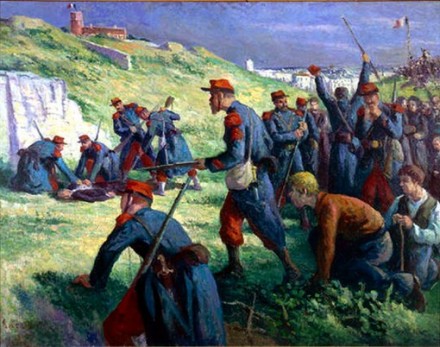

L’execution de Varlin, another Maximilien Luce scene.

Many at the stock exchange

According to the Paris Francais as quoted by this Marxist review of the events

It is at the Bourse that there was to-day the largest number of executions. The doomed men who attempted to resist were bound to the iron railing.

The stock exchange is “a fit place, to be sure, for this sort of business,” observes our interlocutor.

Eighty-plus defenders of Belleville, at the Arc de Triomphe

The London Times editorialized on May 31 upon this incident when the Marquis de Gallifet plucked from the mass of Belleville’s May 28 captives “eighty prisoners, principally soldiers of every arm, linesmen, artillerymen, and Zouaves, [who] were set apart and afterwards led to the right of the rampart to be shot.”

The French are filling up the darkest page in the book of their own or the world’s history. The charge of ruthless cruelty is no longer limited to one party or to one class of persons. The Versailles troops seem inclined to outdo the Communists in their lavishness of human blood. The Marquis de Gallifet is escorting a column of prisoners to Versailles or Satory. He “picks out eighty-two of them, and shoots them at the Arc de Triomphe.” Next came a lot of 20 firemen, then a dozen women, one aged 70. On another spot our Correspondent came upon “80 corpses, piled upon each other, a mass of arms and legs and distorted faces, while the roads and gutter literally flowed with blood.” About 1,000 are said to have thus suffered. By this wholesale and summary execution of prisoners in batches of 50 and 100, not only must the innocent perish with the guilty, but many must bear the penalty of imaginary guilt.

An utterly disconnected Englishman, according to the paper’s correspondent, was accidentally among the four score at the Arc, and only saved by the fortuitous intervention of a Belgian attache.

an English officer somehow got mixed up in the procession, and was forced to keep in it by the escort, who, out of 5,000 prisoners, could not, of course, be expected to recognize one innocent man … it so happened that some of the prisoners tried to escape, and to make an example the leader of the cavalry escort, the Marquis de Gallifet, a man who is not prone to err on the side of mercy, had then and there 81 shot, and the English officer was all but one of them, his explanations being at first refused the slightest attention. Human life has, in fact, become so cheap that a man is shot more readily than a dog.

Socialist physician Tony Moilin

One single fact was Tony Moilin reproached with: that of having on the 18th March taken possession of the mairie of his arrondissement, and having thus had a share in giving the signal for the insurrection …

The court-martial condescended to tell him that the fact of the mairie, the only one he could be reproached with, had in itself not much importance, and did not merit death, but that he was one of the chiefs of the Socialist party, dangerous through his talents, his character, and his influence over the masses; one of those men, in short, of whom a prudent and wise Government must rid itself when it finds a legitimate occasion to do so

[A] respite of twelve hours was granted him in order that he might make his testament, write a few words of farewell to his father, and finally [marry his pregnant lover] … on the 28th May, in the morning, Tony Moilin was led into the garden a few steps from the palace and shot. His body, which his widow claimed, the surrender of which had been at first promised, was refused her. (History of the Commune of 1871)

The unnumbered dead of Lobau Barracks

Since morning a strong cordon is being formed round the theatre (Châtelet); where a court-martial is permanently established. From time to time one sees a band of fifteen to twenty individuals coming out, composed of National Guards, civilians, women and children fifteen to sixteen years old.

These individuals are condemned to death. They march two by two, escorted by a platoon of chasseurs, who lead and bring up the rear. This cortege goes up the Quai de Gevres and enters the Republican Barracks in the Place Lobau. A minute after one hears from within the fire of platoons and successive musketry discharges; it is the sentence of the court-martial which has just been executed.

The detachment of chasseurs returns to the Chatelet to fetch other prisoners. The crowd seems deeply impressed on hearing the noise of the shootings.

This is another publication’s story cited in the History of the Commune of 1871, which itself also details the court-martial procedures of this drumhead tribunal:

Thousands of prisoners who were led there were first of all penned in upon the stage and in the auditorium, under the guns of the soldiers placed in the boxes; then, little by little, like sheep driven to the door of the slaughter-house, from wing to wing they were pushed to the saloon, where, round a large table, officers of the army and the honest National Guard were seated, their sabres between their legs, cigars in their mouths. The examination lasted a quarter of a minute. ‘Did you take arms? Did you serve the Commune? Show your hands.’ If the resolute attitude of a prisoner betrayed a combatant, if his face was unpleasant, without asking for his name, his profession, without entering any note upon any register, he was classed. ‘You?’ was said to the next one, and so on to the end of the file, without excepting the women, children, and old men. When by a caprice a prisoner was spared, he was said to be ordinary, and reserved for Versailles. No one was liberated.

The classed ones were at once delivered to the executioners, who led them into the nearest garden or court. From the Châtelet, for instance, they were taken to the Lebau Barracks. There the doors were no sooner closed than the gendarmes fired, without even grouping their victims before a platoon. Some, only wounded, ran along by the walls, the gendarmes chasing and shooting at them till they fell dead. … There were so many victims, that the soldiers, tired out, were obliged to rest their guns actually against the sufferers. The wall of the terrace was covered with brains; the executioners waded through pools of blood.


Summary executions — death squads — continued for days or weeks afterwards in Paris; martial law throttled left organizing in the city; and those “fortunate” enough to have been captured alive were processed in a steady stream of judicial executions over the months yet to come.

The Commune, a palpably subversive example even in the present day, was destroyed in every way possible for the Versailles government. But its example could hardly be forgotten.

Marx would write The Civil War in France of the only proletarian revolution he would actually witness in his lifetime.

The next generation’s subversives also took inspiration from the Parisian example … and lessons from its mistakes. Lenin — a fond student of the Commune, who was eventually buried wrapped in a Communard banner — said that

two mistakes destroyed the fruits of the splendid victory. The proletariat stopped half-way: instead of setting about “expropriating the expropriators”, it allowed itself to be led astray by dreams of establishing a higher justice in the country united by a common national task; such institutions as the banks, for example, were not taken over … The second mistake was excessive magnanimity on the part of the proletariat: instead of destroying its enemies it sought to exert moral influence on them; it underestimated the significance of direct military operations in civil war, and instead of launching a resolute offensive against Versailles that would have crowned its victory in Paris, it tarried and gave the Versailles government time to gather the dark forces and prepare for the blood-soaked week of May.

“The lesson learnt by the proletariat will not be forgotten,” Lenin vowed, and his own revolution gained a vital object lesson in the Bloody Week of Paris, and an anthem besides: Communard Eugene Pottier, fleeing the Versailles army’s slaughter, wrote the verses that have been sung ever since by millions dreaming of a better world — the Internationale.

* Water can accelerate a fire, under the right circumstances.

On this day..

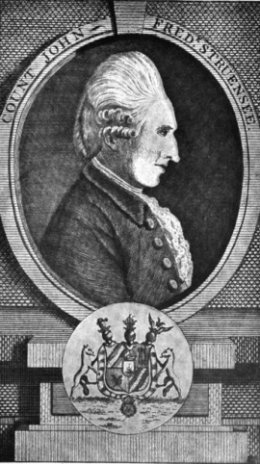
1772: Johann Friedrich Struensee, the doctor who ran Denmark

The 1700s were a time of radical reform, and as the Enlightenment reached the shores of Denmark, it suddenly became possible to be a professed atheist and not lose your head. That is, of course, as long as you didn’t also try to usurp the crown, undermine the aristocracy, and agitate the commoners while you were at it.

Such was the course that ended the rise of Johann Friedrich Struensee on this date in 1772. His friend and sometime cohort Enevold Brandt (Danish Wikipedia entry) was put on the block on the same day.

Struensee was born in 1738 in present day Germany and educated in Prussia, a doctor by trade and a budding Enlightenment political writer by practice. He seemed an unlikely character to involve himself in the court of King Christian VII of both Denmark and Norway, but Struensee was a vain and social man who managed to befriend the right people at the right time.

The first was Brandt. The second was Count Schack Karl Rantzau. A lawyer and Supreme Court justice, Brandt was a court favorite* and planted Struensee’s name as a capable doctor: young, kind, and competent, he would make a perfect personal physician for a king known for being a bit off: Christian was likely schizophrenic. Rantzau, meanwhile, was Count of the Holy Roman Empire, exiled from Copenhagen some 15 years before he met young Struensee, and eager to get back into politics.

In June 1768, Struensee took a post as the king’s traveling physician in England, and he immediately attached to Christian’s loneliness. The regent was interested in literature, philosophy, and music, and Struensee obliged him with patient regard for his charge, for which he was duly rewarded with access to a social life much more fulfilling than in Prussia. As a traveling physician, though, Struensee’s post had a finite span, and he lobbied hard to become a member of the Danish court.

With some help from others in the king’s court, Struensee managed to retain a permanent post, and his clamber up the nearest cliff to power began.

The young doctor, it seems, had a talent for playing two sides for personal gain. It started with the king, who had immense trust in Struensee and began to confide almost everything. Struensee was tactful with this information, adhering to an early form of patient-doctor privilege that endeared him to Christian. The other side was Queen Mathilde, Princess of Wales, by all accounts a beautiful woman who was not happy in Denmark and even less happy to be married to a mad and deteriorating king.

Mathilde initially disliked Struensee — or, at the very least, was indifferent to his actions. But near the end of 1769, the queen finally admitted Struensee into her chambers, and their relationship took off. He ably gamed Mathilde by convincing her that she was the kingdom’s future; Christian, meanwhile, remained ill, and Struensee remained a steady presence in his life. Come spring, Crown Prince Frederick VI also came under Struensee’s care, and as smallpox ravaged Copenhagen, the doctor pressed for inoculation. The king and queen assented, Frederick survived the epidemic, and Struensee garnered himself an official advisorship. It’s also suspected that, while Struensee and Mathilde watched over Frederick as he recovered from the inoculation,** their love affair began.

With a taste of power, Struensee pressed King Christian VII for cabinet changes — which he got — and was named Privy Councilor before 1770 was out. Now the principal advisor to the king, Struensee was able to advance his Enlightenment agenda, notably freedom of the press, the abolition of torture, limiting the death penalty, changing the rules of appointments, numbering the houses in Copenhagen, lighting the streets, and, perhaps in anticipation, removing penalties against those who produced illegitimate children. He was a bold visionary, but he also intoxicated by his growing power … and his programme obviously gored many an ox.

Struensee ascended still further early in 1771 when the king became practically unfit to rule. He was mentally faltering, and Struensee was all but running the show, and more.

In early July, the queen gave birth to a daughter who was widely assumed to be Struensee’s child. Days later, and just three years after being introduced to King Christian VII, Johann Friedrich Struensee effectively appointed himself Privy Cabinet Minister with dictatorial authority through one of King Christian’s edicts. Struensee’s orders would now have the force of law, and, as Christian’s proclamation noted, “They shall be immediately obeyed.”


Enevold Brandt (top), not to be confused with Brandt, the Big Lebowski lackey (bottom).

Struensee spent the next six months turning the European aristocracy inside-out and foisting an aggressive set of cabinet orders on the Danish people — over 1,000, by some counts. Having ridden on the coattails of a queen and king, he now pushed them aside. He moved the court to Schleswig-Holstein, in Prussia, and pleasingly enjoyed both the prerogatives of aristocracy and a middle class contempt for them.

Struensee was, to say the least, not a favorite abroad;† that he and his friends dominated the king and queen did not sit well with Danish commoners. Even Brandt was becoming disaffected, writing in a letter asking for either a larger salary or a resignation from the court:

No despot ever arrogated such power as yourself, or exercised it in such a way. The King’s pages and domestics tremble at the slightest occurrence: all are seized with terror. They talk, they eat, they drink, but they tremble as they do so. Fear has seized on all who surround the minister, even on the Queen…

But Brandt stayed on, and as 1771 drew to a close, Copenhagen became hostile territory for the royal family and their favorite doctor.

After the season’s first masquarade ball, on 16 January 1772, the Queen Dowager — Christian’s step-mother — Juliana Marie exposed Struensee’s affair and had Struensee, Brandt, the queen,‡ and many other Struensee accomplices arrested, ostensibly by order of the king.

Struensee was charged with lèse-majesté, a crime against the crown, for his affair with the queen; though he initially denied the charges — and though Mathilde did her best to shield him from harm — he was found guilty. Brandt was charged with the same crime for allegedly assaulting the king after being himself threatened with a flogging for impertinence (he even had a nip at Christian’s finger). Brandt’s punishment was the same. Each had his right hand chopped off, then was beheaded, drawn, and quatertered.

The queen, meanwhile, went into exile in France. Juliana Marie effectively ruled the kingdom through her son for over a decade, rolling back many of Struensee’s reforms and reverting power back to the aristocracy. This also turned out to be unpopular (the Danes and Norwegians are fickle people), and Mathilde’s son Frederick VI was able to regain power for his father in 1784, eventually moving to liberal reforms more in line with his erstwhile physician’s ideals.

Struensee’s epic rise and fall have spawned a variety of writings since his death. A memoir appeared just months after his execution which detailed his final months. He was also the subject of the Per Olov Enquist novel The Royal Physician’s Visit, which examines his life from multiple perspectives. Queen Mathilde’s life was put to ballet by Peter Maxwell Davies. And for a more contemporary cultural artifact, there’s the 2012 film A Royal Affair.

* Brandt was a court favorite, but after attempting to destroy the position of another minister, he was briefly expelled from Copenhagen, shortly after Struensee accepted his post.

** These inoculations predated “safe” inoculations by non-fatal, related disease strains such as cowpox. Frederick would have been made ill through the small pox strain Variola Minor, which had a mortality rate of about 1%. By contrast, Variola Major was fatal in about 30% of cases.

† While Struensee seems to have been book smart, his feel for international politics was limited, and his standing abroad would have unraveled had it ever raveled in the first place. He repeatedly upset the Russians, and Mathilde’s relatives were not pleased with him. Had he not been downed by public sentiment, it seems likely he would have fallen victim to one of his many royal detractors abroad.

‡ In a curious twist, Rantzau was the queen’s arrestor, and one of the principal conspirators in the dowager’s plot was a cabinet minister Struensee was responsible for ejecting very early in his career.

On this day..

1585: William Parry, Vile and Base

On this date in 1585, a Welsh doctor convicted of attempting to assassinate Queen Elizabeth I paid the penalty of treason at Westminster.

Not to be confused with William “The Refrigerator” Perry.

Whether William Parry really did so plot is a bit obscure, but as a spy and double agent who made the bread to service his considerable debts by informing on supposed Catholic plots against Her Majesty, he’d been walking a dangerous line for several years.

(Actually, Parry had done well to win a royal pardon — and then a seat in Parliament! — after receiving a death sentence for assaulting one of his creditors several years earlier.)

Parry seemingly attempted to entrap one Sir Edmund Neville* into a proposed “plot” to assassinate the Queen, perhaps intending to then inform upon him. Instead, it seems, Neville ratted out Parry. (Some versions of the tale have Parry actually making the attempt, and losing his nerve at the last moment.)

If the extensive account of the trial given in the public-domain The Lives and Criminal Trials of Celebrated Men is to be credited, Parry remarkably pled guilty to treason — portraying himself as a sort of off-the-wagon Catholic, continually plagued by and resisting the temptation to plant a blade in the queen — and played for clemency.

Death I do confess to have deserved; life I do with all humility crave, if it may stand with the Queen’s honour and policy of the time … Pardon poor Parry and relieve him [of his troubled conscience].

He then embarked on a strange hair-splitting dispute with the judges over whether he had ever really meant to kill Elizabeth.

He was hung, drawn and quartered at Westminster within a fortnight, now maintaining his total innocence — notwithstanding his epigram in doggerel.

It was pittie
One so wittie
Malcontent:
Leaving reason
Should to treason
So be bent.
But his gifts
Were but shifts
Void of grace:
And his braverie
Was but knaverie
Vile and base.

* Possibly a relative of fugitive Catholic noble Charles Neville, Earl of Westmoreland.

On this day..