(Thanks to Tim Goodwin at Asia Death Penalty for the guest post -ed.)
On this day one year ago, a promising young Nigerian soccer player was taken from his cell in Singapore’s Changi Prison. It was dawn on a Friday morning, execution time in a country that has come to be known for its uncompromising use of the death penalty.
Tochi, and his football kit. (
Source)

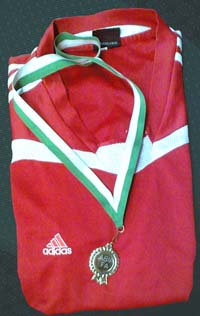

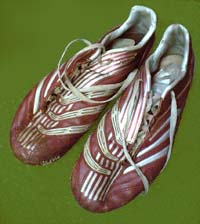
Iwuchukwu Amara Tochi, 21, and his co-accused Okele Nelson Malachy, 35, were hanged one after the other in the prison’s death chamber. Tochi’s lawyers had been informed he would die that morning, but it had not been announced that Malachy would also hang.
Later that day the Central Narcotics Bureau (CNB), Singapore’s “primary drug enforcement agency”, issued a 138 word statement. With the terse formality that is common to statements by Singapore’s criminal justice authorities, it noted:
The appeals of both Tochi and Malachy to the Court of Appeal and to the President for clemency have been turned down. Their sentences were carried out this morning at Changi Prison.
Tochi was arrested at Changi Airport on 28 November 2004, in possession of 100 capsules of diamorphine, or 727.02g of high grade heroin, which the CNB claimed was worth “about $1.5 million”. He said in a later interview [.doc] that he had arrived in the country expecting to be met by an African man named Mr Marshall. He did not have enough money to clear immigration, and an airport hotel called the police when he attempted to take a room. Malachy was identified as his contact after flying in from Indonesia, although he strenuously denied any connection with the drugs.
Tochi claimed he was carrying the package for a man named Mr Smith, who had befriended him at Sunday services at St Andrew’s Church in Islamabad, Pakistan. He had become stranded in Pakistan while attempting to travel to Dubai, where he hoped to play soccer professionally. As a boy, he represented Nigeria in soccer tournaments, travelling to Senegal when he was 14 to play in a West African youth Championship.
According to Tochi, Mr Smith asked him to take a package of herbs to a sick friend in Singapore, saying he could then apply to play for Singapore soccer clubs. He agreed, and was given a ticket and $200 in cash.
Many sites on the web have quoted the trial judge’s acknowledgement that there was no proof that Tochi knew he was carrying heroin:
There was no direct evidence that he knew the capsules contained diamorphine. There was nothing to suggest that Smith had told him they contained diamorphine, or that he had found that out on his own.
The trial judge was clearly doubtful of Tochi’s knowledge. Nevertheless, he found the defendant had “wilfully turned a blind eye on the contents of the capsules because he was tempted” by what police claimed was an offer of US$2000 in payment.
But the prosecution didn’t have to prove Tochi knew; it was up to him to prove that he didn’t know what was in the capsules. If he couldn’t prove his ignorance of that fact — a challenging philosophical notion in itself — then the law would presume he knew, and therefore convict him of drug trafficking. Under section 18(2) of Singapore’s Misuse of Drugs Act:
Any person who is proved or presumed to have had a controlled drug in his possession shall, until the contrary is proved, be presumed to have known the nature of that drug.
The Misuse of Drugs Act reverses many principles that are taken as central to a fair trial, including the burden of proof and the idea that a court should consider the facts of the case before deciding a penalty.
Amnesty International reports that the Act contains a series of presumptions that:
shift the burden of proof from the prosecution to the accused. This conflicts with the universally guaranteed right to be presumed innocent until proven guilty. Amnesty International is gravely concerned that such presumptions erode the right to a fair trial, increasing the risk that an innocent person may be executed…
The Act applies a mandatory death penalty for a wide range of drug offences, including for importing more than 15 grams of diamorphine or pure heroin.
Possession of relatively small amounts of drugs — by the standards of many countries — is classed as “trafficking” in that drug. Trafficking in that drug carries a mandatory death penalty. Courts have no power to consider the individual circumstances of the case.
Famously described as “Disneyland with the death penalty” by novelist William Gibson, Singapore brings together a record of social order and strict political control, and an unwavering use of the death penalty, particularly for drug-related offences. (Such as a similar recent case profiled here -ed.)
No surprises then that Tochi was convicted of drug trafficking and sentenced to death in December 2005. His appeal was rejected in March 2006, with the judge pausing only to note that the accused had to prove he didn’t know what was in the bag:
Under s 18(2) of the Act, the first appellant was presumed to know the nature of the drugs in his possession. The burden thus shifted to him to persuade the court on a balance of probabilities that he did not know that he was carrying drugs or that what he was carrying were drugs.
The appeal court judge acknowledged Tochi’s claim that he didn’t know, but agreed that he hadn’t proven his ignorance.
Seven months before Tochi’s execution, his brother Uzonna told a reporter from IPS News he had not told their parents that their son, who once supported the family, was now on death row.
“My poor parents will die if they hear that a child who has worked so hard to sustain them is facing a death sentence,” he said.
Tochi was hanged in the face of widespread international protest: legal efforts and a presidential appeal in Nigeria, urgent global appeals from Amnesty International activists, intervention from a United Nations human rights expert, and discreet but unequivocal opposition from a small group of human rights activists within Singapore itself.
Reflecting the colonial origins of the country’s modern death penalty, Tochi was “hanged by the neck till he [was] dead”, in the words of Singapore’s Criminal Procedure Code. The same British legal phrase was taken with the empire to, among other countries, the United States, India, Pakistan, Brunei and Malaysia.
Mr Smith has not been found.
On this day..
- 1866: The Nashville murderers of William Hefferman
- 1796: Jerzy Procpak
- 2015: A man in al-Shaddadah, "I won't forgive you"
- 1950: Anton van der Waals, traitor
- 1318: Sir Gilbert Middleton, son of iniquity
- 1849: Andrew Tyler, clairvoyant
- 1681: Isabel Alison and Marian Harvey, Covenanters
- 1909: Remy Danvers
- 1894: George Painter, Chicago infamous
- 1891: Ramon Lopez, a Spaniard, aged 38 years
- 1996: John Albert Taylor, the last American to face a firing squad
- 1939: Three Men For Murder, But Not Isidore Zimmerman

 As tweeted @executedtoday, Shaikh has been at the eye of a media firestorm the past week, though without himself being aware of his impending (and publicly announced) execution until family members who had raced to China to plead for mercy met with him within the past day.

