
On this date in 1520, four days after the Danish King Christian II gained the Swedish throne, nearly 100 prominent supporters of Swedish independence were executed en masse as a civil war’s apparent victors purged their enemies.
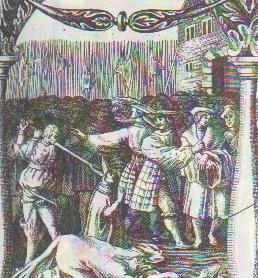 The Stockholm Bloodbath followed years of conflict between supporters of the Danish-dominated Kalmar Union and independence advocates under the banner of Sten Sture the Younger. With Sture’s death in battle earlier in 1520, the unionists had gained the upper hand. Stockholm, the last outpost of resistance, had held against four months’ siege before accepting a general amnesty in exchange for capitulation.
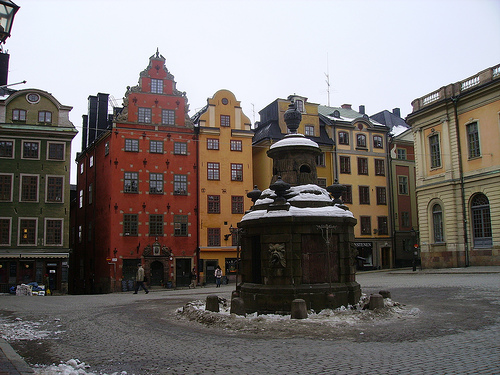
But with the city in hand, Christian — known to Swedish history as “Christian the Tyrant” — had its leaders charged for having deposed during the conflict the pro-union Archbishop Gustav Trolle, construed as an offense against the Church not in the temporal authority’s power to reprieve. Less than 24 hours after this legal maneuver was sprung, public beheadings of prelates, merchants and burgomasters were underway at Stortorget* — and Sture’s remains were exhumed and posthumously burnt at the stake.
It proved a Pyrrhic victory for the Danish party.
Inside of three years, Christian himself had been deposed with multiple lands and factions throughout his realm in open revolt. Gustav Vasa, whose father had been one of the Stockholm Bloodbath’s victims, would not only decisively break Denmark’s hold on Sweden but found the Vasa Dynasty under which Sweden would burgeon into one of Europe’s great powers.
*One Hans Brask survived the purge despite having endorsed the removal of Archbishop Trolle. Brask supposedly placed a note under his seal on this document saying “To this I am forced and compelled.” This cunning device gave the Swedish tongue the word Brasklapp — a secret reservation.
On this day..
- 1738: George Whalley and Dean Briant, wife-murderers
- 1842: The prisoner-mutineers of the Governor Phillip
- 1721: Catharaina Margaratha Linck, lesbian
- 1873: Twelve Cuban revolutionaries
- 1866: Robert Dodge, haunter
- 1944: Joseph Watson and Willie Wimberly Jr.
- 1793: Madame Roland, éminence grise
- 1752: James of the Glen
- 1676: Anna Schmieg and Barbara Schleicher, Langenburg witches
- 1861: Sushun, by Empress Dowager Cixi
- 1969: Nahashon Isaac Njenga Njoroge, assassin of Tom Mboya
- 1845: Lavinia Burnett and Crawford Burnett
- 1892: Jens Nielsen, the last in Denmark
