1681: Isabel Alison and Marian Harvey, Covenanters

We turn today to William Crookshank’s (certainly partisan) narrative of the hanging of two Scottish Covenanters on this date in Edinburgh, as told in his The history of the state and sufferings of the Church of Scotland.


On the 25th of December some of the students in the College of Edinburgh brought to the head of the Cowgate the effigy of the pope in his robes, with his keys, mitre, and triple crown; and, when they had excommunicated him, they carried him about in a chair, like that wherein he is elected at Rome, to the foot of the Blackfriars’ Wynd. The students, knowing the thing had taken air, gave out that they were to carry his holiness in procession to the Grassmarket, the place of the execution of criminals; whereupon the guards marched thither. Meanwhile the boys marched in procession by the Black-friars’ Wynd to the High-street, three of them going before with lighted torches. Being come thither they condemned his holiness to be burnt: accordingly the torchmen blew up the effigy with gun-powder, notwithstanding their being attacked by some soldiers commanded by Linlithgow and his son; whom they warned to beware whom he struck, since he had relations among them.

The Duke of York’s [the future James II -ed.] being now in Scotland sharpened the edge of the persecution; so that no less than twenty were executed in the course of this year 1681.

The sufferers had, it is true, declared against the king’s authority, for which many of them were hanged, and otherwise persecuted by their enemies, and’censured by their friends. They branded them as madmen, enemies to government and civil society; but it is very plain that they never opposed government or monarchy as such, but only wicked, perjured, and persecuting governors. These they did oppose, and that for the very same reasons that brought about the Revolution and the protestant succession.

I cannot express this better than in the words of the author of the Memoirs of the Church of Scotland, when speaking of the Torwood excommunication. Says he,

I desire the impartial reader to compare it with the memorials above-mentioned, [to wit, the memorial to the Prince of Orange from the people of Great Britain, to invite him to come to their assistance] and see if it be posible for any British protestant, who owns the justice of the Revolution, to reflect upon the zeal of these people, without blushing for himself and the whole nation, that they did not see and abhor the tyranny of those reigns sooner; then they had joined with those people instead of censuring their zeal; the Revolution had then been brought about without sovereign help at all; the Prince of Orange had then been called over, as peaceably as King George, to take possession of the crown; and the blood of near 20,000 people, who were one way or other murdered and destroyed by that now abdicated race of tyrants, had been saved. What a shame is it, says he, to us, and how much to the honour of these persecuted people, that they could thus see the treachery and tyranny of those reigns, when we saw it not; or rather, that they had so much honesty of principle, and obeyed so strictly the dictates of conscience, as to bear their testimony early, nobly, and gloriously to the truth of God and the rights of their country, both civil and religious; while we all, though seeing the same things, yet betrayed the cause of liberty and religion, by a sinful silence and a dreadful cowardice.

But suppose, through the treatment, the unacountable treatment they met with, they had gone a little beyond due bounds, and though sometimes their expressions were not so well chosen, can that either condemn the principles of religion and liberty upon which they acted; nay, or their actual disowning those tyrants, who, for nothing but the matters of their God and Saviour, had declared them outlaws, rebels and traitors? Besides, the blood of many was shed, against whom they could prove nothing, but what they extorted from them by their ensnaring questions. Nay, even some of the weaker sex were hanged or drowned on this score. But I shall relate the matters of fact as they happened in the order of time.

It was a dreadful affront to the Duke of York to find his holiness treated in such a manner, on that grand festival the 25th of December; and therefore the sycophant managers must not overlook such an indignity.

Accordingly, on the 4th of January, the masters of the college declared their abhorrence of what their scholars had done; and on the 6th, the council commanded the magistrates to order the college gates to be shut, and the classes to be dissolved. About this time several of the students were imprisoned, besides Mr Ridpath, which so exasperated the rest, that it is said, they threatened to burn the provost’s house at Priestfield, because the magistrates, who were patrons of the college, instead of protecting them, had acted violently against them; and in a few days the house of Priestfield was burnt.

Whereupon the council, on the 17th, issued a proclamation, offering 2000 merks and a remission, to any who should discover the actors: but it does not appear that any discovery was made …

The order of time leads me to the case of Isobel Alison and Marion Harvey, two young women, who were executed this month, to the perpetual disgrace of the bloody managers, who could have no acts of what they called rebellion, in the least, to lay to their charge.

When they were taken, I know not. Isobel Alison was apprehended at Perth, where she lived, only for speaking against the severity used to sundry good people there; for they could accuse her of nothing else. Marion Harvey was seized while going one day from Edinburgh to hear sermon in the fields, and was last year before the council. But though they had nothing against these two young women, they were resolved to shed their blood: and therefore upon what they owned at their examination they founded their indictment, and took away their lives. That the reader may have a specimen of the injustice of this period, that afterwards became common, I shall here insert the substance of their examination first before the council, and next before the lords of justiciary.

When Isobel Alison was before the council, she was interrogated as follows:

Q. Can you read the Bible?

A. Yes.

Q. Do you know the duty we owe to the civil magistrate?

A. When the magistrate carrieth the sword for God, according to what the scripture calls for, we owe him all due reverence; but when they overturn the work of God, and set themselves in opposition to him, it is the duty of his servants to execute his laws and ordinances on them.

Q. Do you own the Sanquhar declaration? [a speech disavowing Presbyterian allegiance to the government]

A. I do own it.

Marion Harvey’s examination before the council was upon the same points with that of her fellow-sufferer … Only, among other tilings, they said, Will you cast away yourself so? To which shy replied, I love my life as well as any of you, but would not redeem it upon sinful terms. They said, the rock, the cod and bobbins, were as fit for her to meddle with as those things. They offered her the assistance of ministers, but she would have none of their pro. vidiug

On the 17th of January they were brought before the Lords of Justiciary; for it was the constant practice at this time, the one day to bring such as fell into their hands before the council, and there by ensnaring questions, to bring them into a confession of such things as they accounted treason, and next day to prosecute them before the criminal court. These two women were accused for hearing at field-conventicles, harbouring Messrs Cargill, Cameron, &c. owning the Rutherglen and Sanquhar declarations, &c.

When Isobel Alison was before them, she was examined as follows:

Q. Do you abide by what you said the last day?

A. I am not to deny any thing of it. She owned she had converged with David Hackstoun, and disowned their authority.

Q. Do you disown us and the king’s authority in us?

A. I disown you all because you carry the sword against God, and not for him, and have, these nineteen or twenty years, made it your work to dethrone him, by swearing, year after year, against him and his work, and assuming that power to a human creature which is due to him alone, and have rent the members from their Head, Christ.

… Then they said, Your blood be on your own head, we shall be free of it. She answered, So said Pilate, but it is a question if it was so; and ye have nothing to say against me, but for owning of Christ’s truths and his persecuted members. They made no reply, but desired her to subscribe what she had owned, and, upon her refusing, did it for her.

Marion Harvey, before the justiciary, owned the Sanquhar declaration, &c. and then protested that they had nothing to say against her as to matter of fact; but only that she owned Christ and his truth, his persecuted gospel and members; of which she said, Ye have hanged some, others you have beheaded and quartered quick. To this they said nothing; but called those who were to sit on the jury, who appeared with reluctance. One of them said, He did not desire to be engaged in this matter; but he was obliged: then he desired that the confessions of the two prisoners might be read, because he knew not what they had to say against them. When he was ordered to hold up his hand and swear, he fell a-trembling. The jury being fixed, the confessions were read, and the advocate in a speech, aggravated every particular, in order to prove them guilty of treason. Some of the jury urged that there was no fact proved against them. The advocate said, But treason is fact; and taking himself again, he said, It is true, it is only treason in their judgment, but go on according to our law; and if you will not do it, I will proceed. The jury brought them in guilty on their own confession; however, the passing of the sentence was deferred till the 21st, when they were both condemned to be hanged at the Grassmarket on the 26th.

Meanwhile, on the 20th, the council enlarged the powers of the laird of Meldrum for apprehending those who were in the rebellion. The many searches which were made in consequence of this were most oppresive. The same day the magistrates of Edinburgh were ordered to call all the masters of coffee-houses before them, and obliged them to come under a bond of 5000 merks, to suffer no news-paper to be read in their houses, but such as are approved of by the officers of state.

Next day all the students in the college of Edinburgh were ordered to retire fifteen miles from that place, within twenty four hours, and not to come within these bounds without leave from the council, under the pain of being treated as seditious persons. A fine protestant government, to make such a splutter about burning the pope! But it was decent to compliment his Royal Highness the Duke!

On the 26th, Isobel Alison and Marion Harvey were executed according to their sentence. The reader will find what passed between them and Mr Riddel in the Cloud of Witnesses, together with their respective testimonies. When they were brought from the prison to the council-house, in order to be carried from thence to the place of execution, Marion Harvey said, with a surprising chearfulness and heavenenly transport, Behold, I hear my Moved saying unto me, Arise, my love, my fair one, and come away. When in the council-house, Paterson bishop of Edinburgh (such was the spirit of the man!) said, Marion, you said you never would hear a curate, now you shall be forced to hear one; and immediately ordered one of his suffragans, whom he had prepared for the purpose, to pray. When he began, she said to her fellow-prisoner, Come, Isobel, let us sing the 23d Psalm; which they did, and thereby drowned the curate’s voice, and confounded their persecutors.

Their behaviour on the scaffold is not to be omitted. Isobel having sung the lxxxiv Psalm, and read Mark xvi, cried over the scaffold, and said, Rejoice in the Lord ye righteous; and again, I say, rejoice. She was not suffered to pray till she came to the foot of the ladder. As she went up, she cried out, ‘O be zealous, sirs, be zealous, be zealous! O love the Lord, all ye his servants! O love him; for in his favour is life!’ And added, ‘O ye his enemies, what will ye do? Whither will ye fly in that day? for now there is a dreadful day coming on all the enemies of Jesus Christ. Come out from among them, all ye that are the Lord’s people.’ Then she concluded, ‘Farewell all created comforts; farewell sweet Bible in which I delighted most, and which has been sweet to me since I came to prison; farewell Christian acquaintances. Now into thy hands I commit my spirit, Father, Son, and Holy Ghost.’ Then the executioner threw her over.

Marion Harvey likewise sung Psal. lxxxiv. and having read Mal. iii, she said, ‘I am come here to-day for avowing Christ to be Head of his church and King in Zion. O seek him, sirs, seek him and ye shall find him: I sought him and I found him; I held him, and would not let him go.’ Then she rehearsed briefly the heads of her written testimony. Going up the ladder she said, 0 my fair one, my lovely one, come away. And, sitting down on the ladder, she said, ‘I am not come here for murder; for they have no matter of fact to charge me with ; but only by judgment. I am about twenty years of age: at fourteen or fifteen I was a hearer of the curates and indulged; and while I was a hearer of these I was a blasphemer and Sabbath-breaker, and a chapter of the Bible was a burden to me; but since I heard this persecuted gospel, I durst not blaspheme nor break the Sabbath, and the Bible became my delight.’ Upon this the commanding officer called to the executioner to throw her over, which he did accordingly.

On this day..

1688: Goodwife Ann Glover, Salem trial run

On this date in 1688, colonial Boston hanged its last witch … or, its first Catholic martyr.

Goodwife Ann Glover was an Irishwoman who had been among some 50,000 Catholics deported to Barbados* by Oliver Cromwell during the 1650s.

1688 finds her with a daughter, desperately poor, as housekeepers in Boston to one John Goodwin and his family.

After one of Goodwin’s daughters accused the Glovers of stealing some linen, the daughter got cussed out and — per Cotton Mather’s credulous account of the washerwoman’s devilry — “visited with strange Fits, beyond those that attend an Epilepsy or a Catalepsy, or those that they call The Diseases of Astonishment.” In fact, four Goodwin children began suffering these symptoms, and would do so for weeks on end, only abating enough for meals and a good night’s sleep. (They would finally be cured, weeks after their supernatural tormenter’s hanging, by having to fast for a couple of days.)

The family doctor diagnosed “an hellish Witchcraft.” Mather has an extensive description of their thrashings, but his contemporary, Boston merchant Robert Calef, charged in his anti-Mather tract More Wonders of the Invisible World that Mather himself did not shy from “taking home one of the children, and managing such intrigues with that child, and printing such an account of the whole … as conduced much to the kindling of those flames, that in sir William‘s time threatened the destruction of this country.”

This Glover case is Cotton Mather’s underreported debut on the witchcraft scene. With the moderating hand of his father away, the ambitious 25-year-old divine took on a starring role in the drama. He would boast of it in published material in the years following, and as Thomas Hutchinson later observed,

The printed account was published with a preface by Mr. Baxter, who says, ‘the evidence is so convincing, that he must be a very obdurate Sadducee who will not believe.’ It obtained credit sufficient, together with other preparatives, to dispose the whole country to be easily imposed upon by the more extensive and more tragical scene, which was presently after acted at Salem … these books were in New-England, and the conformity between the behavior of Goodwin’s children and most of the supposed bewitched at Salem, and the behavior of those in England, is so exact, as to leave no room to doubt the stories had been read by the New England persons themselves, or had been told to them by others who had read them. Indeed, this conformity, instead of giving suspicion, was urged in confirmation of the truth of both.

Years later, when the public turned against Mather’s appalling leading role in the Salem Witch Trials, one of the Goodwin children was among the parishioners whom Mather detailed to come to his defense. “[Mather] never gave me the least advice, neither face to face nor by way of epistles, neither directly nor indirectly,” insisted Nathaniel Goodwin, later to become the executor of his estate. “[H]e never advised me to anything concerning the law, or trial of the accused person.”**

Eventually persuaded by the children’s mysterious or staged illnesses, the town magistrates hauled Goody Glover in for questioning and set upon her poor command of the King’s English. Glover was a native speaker of Gaelic; she had lived in Boston for only a few years, and it’s likely that whatever degree of English she picked up in her indenture in Barbados was heavily creolized by that island’s enormous mid-17th century influx of African slaves for the sugar plantations.

Whatever she said sounded like it came straight from perdition to the ears of Cotton Mather.

she being sent for by the Justices, gave such a wretched Account of her self, that they saw cause to commit her unto the Gaolers Custody. Goodwin had no proof that could have done her any Hurt; but the Hag had not power to deny her interest in the Enchantment of the Children; and I when she was asked, Whether she believed there was a God? her Answer was too blasphemous and horrible for any Pen of mine to mention. An Experiment was made, Whether she could recite the Lords Prayer; and it was found, that tho clause after clause was most carefully repeated unto her, yet when she said it after them that prompted her, she could not Possibly avoid making Nonsense of it, with some ridiculous Depravations. …

It was not long before the Witch thus in the Trap, was brought upon her Tryal; at which, thro’ the Efficacy of a Charm, I suppose, used upon her, by one or some of her Cruel the Court could receive Answers from her in one but the Irish, which was her Native Language; altho she under-stood the English very well, and had accustomed her whole Family to none but that Language in her former Conversation; and therefore the Communication between the Bench and the Bar,’ was now cheefly convey’d by two honest and faithful men that were interpreters.

Just imagine how apoplectic this guy would be if he ever heard “para Espanol o prima dos.”

One can readily picture confusion and malice multiplying one upon the other as it passes not only between two different tongues but also between two different cosmologies. We don’t know very much about Ann Glover; even her name is a slave name. But she was Catholic, and so had a religious world of saints and symbols that her persecutors could readily equate with demons. (Querying her in the condemned cell at one point, Mather is told that “saints” forbid her cooperating with his Protestant exhortations, but he understands it as “spirits” — apparently the Gaelic word is one and the same — and he presses her for the identities of these infernal agents.) She probably did not remotely share her prim persecutors’ regard for temperance and submission. She was of course poor and uneducated, ready prey for the entrapment of a well-schooled prig who could scarcely conceive the lives she had already led in Ireland and Barbados. If one likes, one might take her as the luckless victim of a conservative clergy’s backlash against the slow fade of its authority.

Glover’s broken speech and wrong religion surely made it easy to “other” her. Even so, at least in Mather’s construction, Goodwife Glover’s condemnation reads as if it proceeded with at least the partial participation of the accused.

Several rag dolls were recovered from Glover’s home, and Mather says that Glover agreed that these were “her way to torment the Objects of her malice … by wetting of her Finger with her Spittle, and streaking of those little Images.” Even if this matter is just as her foe depicts it, Glover wouldn’t exactly by the only person in history to be irritated by her employer, nor to satisfy her vengeance on some fetish of an untouchable enemy.

Glover might herself have believed in the folk magic whose practice was only slowly ebbing away at this time; Mather even says that Glover obligingly healed a boy whom she had bewitched when his mother testified at her trial.

Or she might have defiantly embraced the sorcery accusations against her as a last rebuke to the Puritans who had torn her from hearth and home all those years before and now despised her as an idolatrous papist. Her contemporary defender Robert Calef just thought she was a bit out of her gourd; “the generality of her answers were nonsense, and her behaviour like that of one distracted,” giving “crazy answers to some ensaring questions.” The court actually explored this possibility as well by empaneling a group of medical men to explore Glover’s competency. They found her compos mentis.

It’s too bad that we don’t have Goodwife Glover’s own account of herself. Instead we read her through axe-grinding interlocutors.

Mather wearied his victim with demands to convert, along with an interpreter since “she entertained me [in her cell] with nothing but Irish.” (He didn’t mean whiskey.) It was only “against her will” that Mather prayed with her — or maybe more like “at her” — although he also claimed to have extracted an admission that other witches were operating who would continue to afflict the Goodwin children.

She was drawn on this date to the gallows at Boston Neck — coincidentally almost the very spot where Boston’s Catholic Cathedral of the Holy Cross stands today.

There’s a precious alleged† first-person account of her execution:

There was a great concourse of people to see if the Papist would relent … Her one cat was there, fearsome to see. They would to destroy the cat, but Mr. Calef would not [permit the cat to be killed]. Before her execution she was bold and impudent, making to forgive her accusers and those who put her off … She predicted that her death would not relieve the children, saying it was not she afflicted them.

November 16 is now, by a 1988 tricentennial resolution of Boston’s considerably more Catholic-friendly city council, Goody Glover Day in that city. What better spot to celebrate than at Goody Glover’s Irish pub?

* Such deportees were said to be “Barbadosed”.

** This is not the only link between those Massachusetts witch-hunts; Rebecca Nurse, one of the women hanged at Salem, might have visited Ann Glover in jail.

† So far as I have been able to determine this widely-reproduced quote sources entirely to a 1905 Journal of the American Irish Historical Society piece. This was itself reproduced from a strongly partisan article titled “A Forgotten Heroine” and published in a devotional Catholic magazine, The Ave Maria. It was written by Harold Dijon, an instructor at a Baltimore Catholic school, without primary footnotes — only a general citation that it has “been gleaned from Cotton Mather, Upham, Drake, Moore, Owens, Calef, Cartrie, and papers of the Massachusetts Historical Society.” I have not been able to locate the document Dijon quotes here.

On this day..

1681: Leticia Wigington, apprentice-flogger

On this date in 1681, Leticia, Letitia, or Laetitia Wigington was hanged at Tyburn for beating her apprentice to death.

A case that would presage the next century’s better-remembered Brownrigg outrage, the Ratcliff Catholic coat-maker Wigington and her lodger John Sadler took five quid from one of Sadler’s fellow-sailors to apprentice their daughter.

On Christmas Eve 1680, Ms. Wigington took exception to the 13-year-old Elizabeth Houlton’s performance or caught her stealing from them or something, and set about thrashing her. After taking an hour to fashion a cruel cat o’ nine tails so they could really give it to her, these two

stript the poor Child barbarously and immodestly stark naked, and [Wigington] held her and ram’d an Apron down her Throat, to prevent her crying out, and the foresaid [Sadler] most inhumanely whipt her for 4 hours or more, with some short intervals of their Cruelty, and, having made her body raw, and all over bloody, sent for Salt, and salted her wounds, to render their Tortures more grievous. Of which Savage usage she dyed next morning [i.e., Christmas].

Salted her wounds?

Sadler fled, and was on the run for nearly a month; he was sentenced to die on February 25 and specifically prohibited from pleading for royal pardon before his March 4 execution.

Wigington got off a little “easier”, pleading her belly after a January conviction and delaying execution all the way to September 9. That’s quite a wait — a suggestive wait, one might think, though no actual record remains to confirm that Wigington left a little bundle of joy behind her to the world’s cat o’ nine tails.

For her part, Wigington went to her death asserting her innocence — “as the Child unborn” — and denouncing her enemies for inducing her “Apprentice Rebecca Clifford by name, who was not full 12 years of age, to swear against me” falsely.

On this day..

1686: Jonathan Simpson, merchant turned highwayman

Jonathan Simpson, hanged on this date in 1686, had a good many virtues to judge by the account of his life left by the Newgate Calendar.

He was, first, an enterprising man, who served his apprenticeship “with reputation” and then set up shop as a successful linen-draper in the city of Bristol.

This business enabled him to augment the fortune of his own business by marrying a merchant’s daughter — “but the union proved unhappy, because the young lady was before engaged in affection to a gentleman of less fortune in the neighbourhood, whom her father hindered her from having, and with whom she continued a familiarity that soon displeased her husband.”

Such a scenario has been the germ of many a denizen of this here blog, but Simpson didn’t reach the gallows doing anything as straightforward as murdering his rival or his spouse out of pique.

Instead — and the Calendar leaves the hows and whys of this translation unexplored — he channeled his jealousy into a crime spree. Maybe that’s just the writer’s projection: fella went around the bend, it must’ve been because of a woman. The Newgate Calendar, too, had a home life, and many was the Briton who dreamt of escaping the drudgery of it all for a life of adventure and romance making gentlemen stand and deliver.

At any rate, Simpson managed a career of 18 months on the road, burning through his linen-draper savings (and his highwayman “earnings”) to escape a couple of potential capital prosecutions. (At this time, criminal complaints were initiated by private prosecutions, meaning that a victim prepared to accept direct restitution could potentially be bought off pressing a case.)

This brings us to another of Simpson’s admirable qualities: his silver tongue.

One can only speculate how he wheedled his onetime victims behind closed doors to drop their suits. But the Newgate Calendar attests to the man’s wit under pressure once he was finally hauled to the fatal tree.

It turns out that Simpson did well in business because his family had done well in business before him, and dad staked him to £1,500 when the lad went into business himself. These prosperous burghers accordingly rallied to exert their own wealth and influence behind the scenes to obtain for their kin a timely commutation, delivered only “when he was at Tyburn, with the halter about his neck, and just ready to be turned off in company with several others.” Then bureaucracy happened.

When he was brought to the prison door, the turnkey refused to receive him, telling the officer that, as he was sent to be executed, they were discharged of him, and would not have anything to do with him again, unless there was a fresh warrant for his commitment; whereupon Simpson made this reflection: “What an unhappy cast-off dog am I, that both Tyburn and Newgate should in one day refuse to entertain me! Well, I’ll mend my manners for the future, and try whether I can’t merit a reception at them both the next time I am brought hither.”

That’s kind of funny, right? In a self-destructive braggadocio sort of way?

And then Simpson demonstrated a third quality that (in addition to dad’s money) helped him succeed in commerce before his midlife crisis: his phenomenal industry. Simpson, we are told, committed “above 40 robberies” in Middlesex in the six weeks after his reprieve, a healthy pace of one per day.

He robbed the powerful (our writer credits him with a successful stickup of the king’s own son); he robbed the hoi polloi (“the robberies he committed on drovers, pedlars, market-people, etc., were almost innumerable”); he robbed on ice skates;* when he was finally captured, it was by two captains of the Foot Guards whom he was also attempting to rob.

The man lived to rob. On this date in 1686, he finally died for it.

* The online text versions of the Calendar notice Simpson’s skatebourne pilfering during “the great frost of 1689, which held thirteen weeks,” obviously not chronologically correct relative to his execution date. This is an error, likely on the part of software somewhere along the line; the year in question should be 1684 (computers like to mix up fours and nines). 1684 was one of the longest and deepest winter freezes on record, leaving the iced-over Thames bustling with Londoners at the “Frost Fair”.


“[W]hat unheard of rendezvous is daily kept upon the face of [London’s] navigable river; what long and spacious streets of booths and tents are builded; what throngs of passengers, both horse and foot, do travel; what pyramids of provisions, baked, boiled, and roast; what deluges of wine, coffee, beer, ale, and brandy, for sale; what fleets of vessels sailing upon sledges; what troops of coaches, caravans, and waggons; what games and new invented sports and pastimes, bull-baiting, bear-baiting, &c.; together with shops for the vending of most sorts of manufactures and for working artificers, the account of which alone would require a volume to describe …” (Source)

On this day..

1680: John Marketman, jealous chirurgeon

On this date in 1680, an unusual public execution took place in West Ham.

John Marketman (Manchetman) was a ship’s surgeon, which he spelled “chirurgeon” because it was olden days. Being away at sea gave him a lots of time to picture how his wife Mary Snerlin back home might be cuckolding him, and when he arrived back one time to apparent corroborating information, he went a little nutso.

According to the trial record from the spring 1680 Chelmsford Assizes,

the circumstances of the bloody Deed was sworn to as followeth, the Prisoner being newly come on Shore, having been at Sea for a considerable time, was informed that she had been over lavish of her Favours to a Neighbour of hers, being by profession a Shoemaker; he being newly come from Sea and coming home as it is said surprized her too familiar with the said Shoemaker, whereupon he in a Rage threatned [sic] her, yet notwithstanding the Rage of Jealousie, he seemed reconciled, but to the contrary retaining an inward hatred, which she perceiving, fled to a neighbours house, thinking to stay whilst his Anger was overpast, yet he with a seem’d Reconciliation, came to invite her home, and came up to her as if he would imbrace her, but with his bloody hands he stab’d her with a Knife under her Right Breast, about four inches deep,* of which Wound she in a little time died, only confessing her innocence, at his Trial he did not deny the Fact, and after his being convicted did confess his Rashness in proceeding on such Cruelty, without the least remorse, after he was found Guilty of wilful Murder and received Sentence of Death, he seemed exceeding Penitent, and did bewail his cruel Crime, shedding many Tears, that he had given himself over to the suggestions of the Prince of darkness, and so continued to the utmost.

There are somewhat different twists on the underlying facts of the case from different sources — like the profession of the alleged lover, and the question of whether Marketman caught them in flagrante delicto or merely heard town gossip, and the matter of whether he took revenge with cold calculation or in more of a drunken fury. Fill it out however you like; in outline we have one of the stock classics of homicide.

But at receiving his sentence, Marketman did something remarkable: he asked the judge to alter the sentence and be hung not at the usual execution spot in Chelmsford, but in West Ham — “the town where he did perpetrate the wicked act.”

Marketman, you could say, really went all-out from that very first moment to put on a full-dress, no-holds-barred scaffold performance par excellence. He should have been in the business of scripting deaths.

Besides hanging in West Ham, Marketman had his mother (“poor Soul drowned in Sorrow,” in the words of a pamphlet titled “True Narrative of the Execution of John Marketman”**) lead him personally to the gallows. There a minister preached on 2 Corinthians 7:9, “I rejoice, not because you were grieved, but because you were grieved into repenting” — demonstratively comforting Marketman that his imminent strangulation would stand “a monument to divine justice … in and thorow you, God sheweth the consequences of a sinful and wicked life.”

This was the evolving principle of executions as exemplary deterrence, and Marketman was ready to play the part in his final turn. He spoke for a long time, with the swooning mother right there as evidence, on how he

had been very disobedient to his too indulgent parents, and that he had spent his youthful days in profanation of the Sabbath and licentious evils of debaucheries beyond expression, and that he had been over penurious in his narrow observance of his wive’s ways, desirous that all should pray to the Eternal God for his everlasting welfare, and with many pious expressions ended this mortal life.

In focusing on the theatrical aspects of Marketman’s execution, we don’t mean to suggest that the sea-chirurgeon’s encounter with his death was in any way insincere: present-day executions too comprise a ritualized performance in which a good many dying prisoners are very willing to participate. (Modern American executions behind prison walls don’t map to the take-warning-from-my-fate discourse, but it’s quite common for those on the gurney to offer victims’ witnesses the “closure” shibboleth.)

The early-modern condemned were widely expected to give a pedagogical account of themselves before execution, and widely complied with the expectation. Marketman simply underscores the surprising extent to which a fellow will not only comply but actively assert his part in his own death. Marketman wanted his hanging to embody redemption, instruction, and the majesty of the law that hanged him. Maybe in his heart of hearts he even wanted that before he knifed poor Mary Snerlin.

The chirurgeon went so far as to write a prison letter to his supposed rival: “As for the injury you have done me, I freely from my heart forgive you, begging God to give you grace that you may unfeignedly repent of all your sins, that God may have mercy on your soul.”

See J.A. Sharpe, “Last Dying Speeches: Religion, Ideology and Public Execution in Seventeenth-Century England,” Past & Present, May 1985.

* Say what you will about chirurgeons, they know about killing.

** This source also says his wife was pregnant, which must have added some vinegar to Marketman’s cuckoldry suspicions.

On this day..

1684: Jane Voss, narrow escapee

On this date in 1684, Jane Voss was hanged

We pass over for this entry her four companions in death: a couple of forgettable gentleman highwaymen; a murderer fled to the continent; a coiner named D’Coiner.

Each a fellow with an interesting tale of his own, no doubt, but for Jane Voss one notices her perpetual proximity to the gallows. It’s a reminder that for a certain class of person, the omnipresent prospect of a sudden trip to the hanging-tree — intended as a mortal terror — was little but the everyday circumstance of a life nasty, brutish and too often short.

A chapbook of the day’s crop* records that the notorious Jane’s “frequent felonies and often Convictions have made her known to most in and about London, she having been above 12 times in Newgate, and several times Condemned to dye.”

She fortuitously escaped such a fate as an an accessory to Thomas Sadler’s theft of the High Chancellor’s ceremonial mace eight years before.

Not being a principal culprit in that escapade, Voss got off with penal transportation, only returning (at least insofar as the English authorities knew) legally after her transportation term had ended.

Our correspondent alleges that “no less than 7 Persons, whom had passed for her Husbands, have at several times been Executed for Robberies, &c.” Indeed, one notorious highwayman named John Smith (alias Ashburnham) hanged earlier in April 1684 had made a point of asking the Newgate Ordinary to send word to Jane Voss to cool it lest she follow him.

Alas, it was right about this time that Jane snatched her last silver tankard. She’d had too many reprieves to escape this time … save for the mandatory stalling mechanism of pleading her belly.**

* “True account of the behaviour, confessions, and last dying words, of Capt. James Watts, Capt. Peter Barnwell, Daniel D’Coiner alias Walker, Richard Jones, and Jane Voss alias Roberts,” 1684. (via Early English Books Online)

** Here’s Jane Voss’s Old Time Restoration England Pregnancy-Simulating Potion: drink “a Gallon of New Ale and Honey” before examination. Use as needed.

On this day..

1680: A Madrid auto de fe

On this date in 1680, the Spanish capital of Madrid celebrated an enormous auto de fe, culminating with 18 executions plus eight people posthumously burned and 22 fugitives “executed” in effigy. (Source of the numbers)

This signal event needed every drop of sunlight from the long summer’s day. Staged for the appearance of the royal family itself, it likewise pulled in every available case from around Spain: the regional cities shipped their apostates and heretics to Madrid to dignify the main event with a suitable quantity of prey.

It began with a morning ceremonial procession of prisoners, nearly a hundred — every source seems to have a slightly different figure — in the traditional Inquisitorial manner. This account comes from an English contemporary, as reprinted in Human Judgment: The Eye of the Beholder. (Note: paragraph breaks added, and ubiquitous capitalization of nouns removed, for better readability.)

A scaffold, fifty feet in length, was erected in the Square, which was raised to the same height with the balcony made for the King to sit in. At the end, and along the whole breadth of the scaffold, at the right of the King’s balcony, an amphitheatre was raised, to which they ascend by twenty-five or thirty steps; and this was appointed for the Council of the Inquisition, and the other Councils of Spain. Above these steps, and under a canopy, the Grand Inquisitor’s rostrum was placed so that he was raised much higher than the King’s balcony. At the left of the scaffold and balcony, a second amphitheatre was erected of the same extent with the former, for the criminals to stand in.

A month after proclamation had been made of the Act of Faith, the ceremony opened with a procession [on June 29], which proceeded from St. Mary’s church in the following order. The march was preceded by an hundred coal merchants, all arm’d with pikes and muskets; these people furnishing the wood with which the criminals are burnt. They were followed by Dominicans, before whom a white cross was carried. Then came the Duke of Medina-Celi, carrying the Standard of the Inquisition. Afterwards was brought forwards a green cross covered with black crepe; which was followed by several grandees and other persons of quality, who were familiars of the Inquisition. The march was clos’d by fifty guards belonging to the Inquisition, clothed with black and white garments and commanded by the Marquis of Povar, hereditary Protector of the Inquisition.

The procession having marched in this order before the palace, proceeded afterwards to the square, where the standard and the green cross were placed on the scaffold, where none but the Dominicans stayed, the rest being retired. These friars spent part of the night in singing of psalms, and several Masses were celebrated on the altar from daybreak to six in the morning. An hour after, the King and Queen of Spain, the Queen-Mother, and all the ladies of quality, appeared in the balconies.

At eight o’clock the procession began, in like manner as the day before, with the company of coal merchants, who placed themselves on the left of the King’s balcony, his guards standing on his right (the rest of the balconies and scaffolds being fill’d by the embassadors, the nobility and gentry).

Afterwards came thirty men, carrying images made in pasteboard, as big as life. Some of these represented those who were dead in prison, whose bones were also brought in trunks, with flames painted round them; and the rest of the figures represented those who having escaped the hands of the Inquisition, were outlaws. These figures were placed at one end of the amphitheatre.

After these there came twelve men and women, with ropes about their necks and torches in their hands, with pasteboard caps three feet high, on which their crimes were written, or represented, in different manners. These were followed by fifty others, having torches also in their hands and cloathed with a yellow sanbenito or great coat without sleeves, with a large St. Andrew’s cross, of a red colour, before and behind.


Detail view (click for the full image) of a Goya painting of Inquisition prisoners in the sambenito.

These were criminals who (this being the first time of their imprisonment) had repented of their crimes; these are usually condemned either to some years imprisonment or to wear the sanbenito, which is looked upon to be the greatest disgrace that can happen to a family. Each of the criminals were led by two familiars of the Inquisition.

Next came twenty more criminals, of both sexes, who had relapsed thrice into their former errors and were condemn’d to the flames. Those who had given some tokens of repentance were to be strangled before they were burnt; but for the rest, for having persisted obstinately in their errors, were to be burnt alive. These wore linen sanbenitos, having devils and flames painted on them, and caps after the same manner: five or six among them, who were more obstinate than the rest, were gagged to prevent their uttering any blasphemous tenets. Such as were condemned to die were surrounded, besides the two familiars, with four or five monks, who were preparing them for death as they went along.

[skipping the seating arrangements … ]

About twelve o’clock they began to read the sentence of the condemned criminals. That of the criminals who died in prison, or were outlaws, was first read. Their figures in pasteboard were carried up into a little scaffold and put into small cages made for that purpose. They then went on to read the sentences to each criminal, who thereupon were put into the said cages one by one in order for all men to know them. The whole ceremony lasted till nine at night; and when they had finished the celebration of the Mass the King withdrew and the criminals who had been condemn’d to be burnt were delivered over to the secular arm, and being mounted upon asses were carried through the gate called Foncaral, and at midnight near this place were all executed.


Francisco Ricci‘s grand painting of the Madrid auto de fe represents events from throughout the day simultaneously. Image from Wikimedia Commons.

As best I can determine, two condemned people bought their lives with last-second conversions, leaving 18 to die for Judaizing … or, in one case, for converting to Islam. It will suffice to say that a very large, very ornate, and very long ceremony unfolded, and that at the end of it the flames consumed a number of people (and even more mannequins) associated with the Abrahamic faith.

“These punishments,” observed a French diplomat who witnessed the proceedings, “do not significantly diminish the number of Jews in Spain and above all in Madrid where, while some are punished with great severity, one sees several others employed in finance, esteemed and respected though known to be of Jewish origin.” Actual eliminationist Jew-hunting was so 1492.

Great as were these astounding spectacles, their day was passing. In fact, this was it — the long, sweltering, tiresomely gaudy day that it passed.

Spain in 1680 was in the grip of plague, famine, and deflation; though there’s value to the state in the distraction of a circus, there’s also the very substantial cost of putting the bloody thing on, especially on such a scale, especially when you’re going to let off most of the victims but not until you sock them away in prison and feed them for months or years until the next auto.

It seems that by the 17th century this end-zone spike of the Inquisition had become quite an encumbrance: procedures required the Inquisition to dispose of certain cases in autos de fe, which, because they had to be put on just so, were increasingly rare, and clogged up gaol cells in the meanwhile. There’s a reason besides spectacle that all the rest of Spain gratefully dumped its religious criminals on Madrid on this date.

The model just wasn’t sustainable.

Over the 1680s, practical pushback reconfigured the venerable ritual into something less burdensome to the public purse. This date’s event was very far from the last auto de fe in Spain, but it’s seen as the last of the classic, public-festival spectaculars evoked by the term. They would, in the future, become (mostly) smaller, (usually) shorter, and (somewhat) less garish affairs conducted not on public plazas but on church grounds, and with most cases of reconciliation simply handled quickly, quietly, and locally.

On this day..

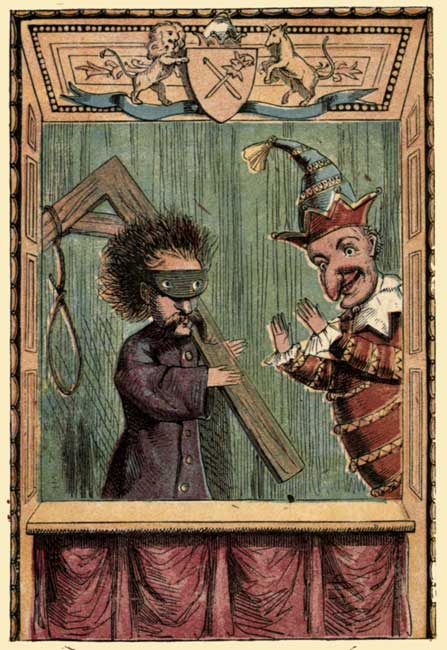
1686: Paskah Rose, Jack Ketch interregnum

On this date in 1686, the English executioner Paskah (or Pascha) Rose was hanged at Tyburn for burglary — by his predecessor and his successor, the famed hangman Jack Ketch.

(c) image from Peter Herring, used with permission. Also see this illustration

The “Jack Ketch” character from a Punch and Judy puppet show: traditionally, Punch gets the better of their meeting and hangs Jack Ketch.

The Irish immigrant Ketch is the first name in English executioners. Indeed, you can call any of his successors right down to Pierrepoint a “Jack Ketch” and be perfectly understood.

The immediate successor, however, was Ketch’s own assistant — who inherited top billing after Ketch went to jail for “affronting” a sheriff.

Jack Ketch had been trodding the scaffold-boards, hanging, beheading, and drawing-and-quartering for two-plus decades at that point: he’s thought to have been appointed in 1663, and he’d inserted himself into those performances rather more prominently than an executioner ought by botching some of Restoration England’s most high-profile executions.

There’s little reliable information about these early executioners, but it seems Ketch’s reputation for clumsiness had forced him to issue an “Apologie” justifying himself.

But the man unquestionably had longevity in his favor, which is more than Paskah Rose could say.

Within months of becoming the chief London executioner, Rose and another man were chased down in the act of burgling clothes from a house, “the Goods found in Rose’s Breeches.”

Rose and his co-defendant Edward Smith accordingly hanged along with three others at Tyburn this date — by Jack Ketch, now returned from his carceral retirement for one last tour.

Ketch died late that same year of 1686, but has lived on in any number of ballads, doggerels and broadsides immortalizing the name. He was surely aided in this by the less impressive caliber of many who succeeded him: it wasn’t long after Ketch dispatched Pascha Rose that another “Jack Ketch” — an ignoble profession that wouldn’t until centuries hence be drawn from the country’s respectable classes — also met Pascha Rose’s same fate.

There’s a now-public-domain Autobiography of Jack Ketch by 19th century English writer Charles Whitehead.

On this day..

1689: William Bew, flatterer

This was the hanging-date in 1689 of William Bew, the less-noted younger brother of a more impressive (but by this time deceased) highwayman “Captain Bew”.

Will, too, took to the road. His thieving career might not have been outstanding, but it did give the Newgate Ordinary occasion to wax smug over the nigh-literary comeuppance young Bew once delivered to feminine vanity.

The following story, which Bew himself used to tell, is of an adventure of Bew with a young lady, whom he overtook on the road, with her footman behind her. He made bold to keep them company a pretty way, talking all along of the lady’s extraordinary beauty, and carrying his compliments to her to an unreasonable height. Madam was not at all displeased with what he said, for she looked upon herself to be every bit as handsome as he made her. However, she seemed to contradict all he told her, and professed with a mighty formal air that she had none of the perfections he mentioned, and was therefore highly obliged to him for his good opinion of a woman who deserved it so little. They went on in this manner, Bew still protesting that she was the most agreeable lady he ever saw, and she declaring that he was the most complaisant gentleman she ever met with. This was the discourse till they came to a convenient place, when Bew took an opportunity to knock the footman off his horse; and then addressing himself to the lady, “Madam,” says he, “I have been a great while disputing with you about the beauty of your person; but you insist so strongly on my being mistaken, that I cannot in good manners contradict you any longer. However, I am not satisfied yet that you have nothing handsome about you, and therefore I must beg leave to examine your pocket, and see what charms are contained there.” Having delivered his speech he made no more ceremony, but thrust his hand into her pocket and pulled out a purse with fifty guineas in it. “These are the charms I mean,” says he; and away he rode, leaving her to meditate a little upon the nature of flattery, which commonly picks the pocket of the person it is most busy about.

On this day..

1686: A man and a woman broken on the wheel in Hamburg

The New York Times of Dec. 30, 1900 provides this date’s entry, featuring the unusual scene of a woman being broken on the wheel.


In the diary of that remarkable man, Gen. Patrick Gordon, who left Scotland in 1651 a poor, unfriended wanderer, and, when he died, in 1699, had his eyes closed by the affectionate hands of his sorrowing master, the Czar Peter the Great, the following entry is to be found, under date Hamburg, March 22, 1686:

This day, a man and a woman, a burgher of the towne being the womans master, for murthering, were carted from the prisone to the house where the murder was committed; and there before this house, with hotte pinsers, the flesh was torren out of their armes, and from thence were carted to the place of justice without the towne, and there broken and layed on wheeles.


Executions by breaking wheel: early 18th century engraving. (Source: Wikipedia).

On this day..