1757: The Tipplers Revolt leaders

On this date in 1757, 17 people went to the scaffold over wine prices in Portugal.

The seeds of these hangings had been sown back in 1703 when the Methuen Treaty gave Portuguese wines favorable tariff treatment in exchange for reciprocal advantages exporting English wool to Portugal.* “The Portugal Wines,” Daniel Defoe noted, “became our general Draught all over England” with this arrangement, since the deal enabled those libations to undercut French claret.

A nearly thirtyfold boom in wine shipments in the first half of the 18th century brought conflict over the proceeds. Struggling to keep up with demand, some growers adulterated the product, causing friction between the English export “Factors”** and the Portuguese producers.

With this profitable but acrimonious relationship at its most tense point, the authoritarian Marquis de Pombal introduced a royal agency charged with quality control — an act that also made Portugal’s Douro wine region the world’s first demarcated regional appellation. Pombal’s quality control regime, in turn, caused prices for the now-unadulaterated wine to spike.

While this triggered more complaints from the unappeasable British Factors, price changes also hit much closer to home: everyday Portuguese also found the price of regular table wine suddenly rising to their considerable consternation. Take away the wine from your populace at your peril.

On the morning of February 23, 1757, taverngoers and -keepers in Porto marched the streets of Porto in opposition to the royal monopoly, and the protests turned violent: a judge was roughed up, and some property vandalized.

Pombal suppressed ruthlessly this “Tipplers’ Riot” or “Tipplers’ Revolt” (the term “revolt” seems like an overstatement).

On October 14 of that same year, 13 men and four women involved in the mob were put to death in a Porto clapped under martial law. Dozens of others were sent to the galleys, exiled to Portugal’s colonies, or stripped of their property. Pombal, as was his wont, got his way … and the lucrative Methuen Treaty impressively persisted until 1840.

* Part of a larger strategic arrangement joining England, Holland and Austria against Spain and France.

** British exporters of the general Draught were collectively known as the “Factors”; their 1790 trade association and gentleman’s club building, the Factory House, is still to be seen in the city of Porto. “Adulterations” included the addition of grape brandy to stabilize the wine shipment, a practice that subsequently became accepted — and indeed, characteristic of port wine.

On this day..

1944: Six German POWs, for Stalingrad’s Dulag-205

On this date in 1944, Wehrmacht Oberst Rudolf Körpert, his deputy Hauptmann Carl Frister, and officers Fritz Müsenthin, Otto Mäder, Richard Seidlitz and Kurt Wohlfarth, were shot in the Soviet Union for their treatment of Russian prisoners of war at Stalingrad.

This was nearly two years on since the Germans had surrendered the eastern front’s horrific signature battle.

The six captured men were principals at the little-known Dulag-205, a transit camp the Wehrmacht erected at Stalingrad for Soviet prisoners of war pending westward deportation to less extemporaneous prisons. (And less extemporaneous mistreatment.)

A minuscule 10 acres, the camp was eventually crammed with up to 3,400 prisoners, triple its anticipated capacity. There was nowhere to send them once the Germans were fatally encircled, and as supplies failed in the last terrible weeks of the besieged Kessel (“cauldron”), the subsistence prisoner rations of putrefying-horseflesh soup were cut off entirely.

Several dozen dropped dead of starvation, overwork, and summary execution each day thence until the merciful end. When the Red Army finally took control of the camp on Jan. 22, 1943, it discovered corpses with obvious signs of cannibalism.

Frank Ellis has the definitive treatment of this affair in “Dulag-205: The German Army’s Death Camp for Soviet Prisoners at Stalingrad” (Journal of Slavic Military Studies, March 2006), and the facts in this posts are drawn from Ellis’s examination of the Dulag-205 interrogation and trial records.*

Our captured men enjoyed the company of NKVD and SMERSH interrogators for a number of months, under what duresses one shudders to imagine.

The rescued Soviet soldiers — who were themselves suspect in the eyes of Stalinist authorities merely for having been captured — provided ample firsthand corroboration of Dulag-205’s miserable conditions.

“The guards were allowed to shoot without any warning at prisoners who approached the barbed wire barrier, who tried to jump the queue for food and at prisoners who tried to have a piss in the wrong place,” one POW told his Soviet interrogators. “Hardly any water or bread was given to the prisoners. The prisoners slept in the dugouts without any bedding, jammed tight. The prisoners were never able to rest since they had to sleep standing and sitting. … There were no baths in the camp. During my whole time in the camp — about 5 months — I did not wash once.”

Moscow had by this time already begun rolling out war crimes trials relating to the German invasion. The guys who were captured with starving Red Army prisoners cannibalizing one another were going to be a prime target.

The subaltern officers, according to Ellis, generally tried to put the blame on Körpert and further up the chain of command, and understandably so. Mäder was a mere adjutant. Siedlitz was the director of camp construction. They weren’t the ones who got the Sixth Army encircled or cut prisoner rations or even made camp-specific decisions like when to set the dogs on a disobedient captive. They had no ability to transfer the prisoners back to the Soviets or to any less horrible detention on their side of the lines. Otto Mäder:

My service in the Dulag was a great spiritual torment for me. It was dreadful to see the terrible condition of Russian prisoners.

I stand before the court at that time when the main culprits responsible for the death of 3,000 Soviet prisoners — Field Marshall Paulus, the army’s chief-of-staff, General Schmidt, Lieutenant-Colonel Kunowski and the army quartermaster — do not stand before the court. They are not only guilty of the death of Soviet prisoners-of-war, but have put us on the accused’s bench!

You’d expect the guy to say that to a Soviet tribunal, certainly — especially a lawyer, which Mäder was also — but that doesn’t make it untrue. This case was actually evaluated in post-Soviet Russia for possible posthumous rehabilitation. (No dice.)

Intriguingly, the Wehrmacht officers were not tried for violations of the Geneva Conventions; indeed, the USSR had not ratified all of the Geneva Conventions, and this put Germany (which had ratified them) in an ambiguous position relative to its non-ratifying belligerent. (A less kind way to say it might be that the difference served to rationalize dreadfully inhumane treatment.)

Rather, Körpert et al were charged under Soviet laws promulgated only after the Battle of Stalingrad, a sketchy maneuver which Ellis thinks suggests that prosecutors hoped to avoid setting a precedent that could be cited by Germany relative to the USSR’s none-too-gentle treatment of its own prisoners of war.

* Ellis also has a topical recent book out, The Stalingrad Cauldron: Inside the Encirclement and Destruction of the 6th Army.

On this day..

1435: Agnes Bernauer

On this date in 1435, the Duke of Bavaria-Munich had his son’s commoner mistress drowned.

Agnes Bernauer (English Wikipedia link | German) was supposed to have been the daughter of an Augsburg barber, though hard details about her life are hard to come by owing to her social class.

By 1432, she’s demonstrably a part of the Munich court; it’s thought that the prince Albert (the future Duke Albert III) must have met her at an Augsburg tournament in 1428.

The nature of her relationship to the Bavarian heir, too, must largely be guessed at. It’s been widely hypothesized that they might have married secretly.

Such a marriage might explain the shocking end to the Agnes-Albert relationship by situating it as a threat to dynastic succession: Albert was Ernst’s only legitimate son, and the Bavarian patrimony had been subdivided and fought over among Wittelsbach kin over the preceding decades.

Whatever the reason, Ernst took the disapproving (maybe) in-law act quite a lot farther than most. While Albert was out on a hunt, Ernst had Agnes seized, condemned for witchcraft, and executed by drowning in the Danube River on Oct. 12, 1435.

Upon hearing of the death of his beloved, Albert bitterly deserted his father for Ernst’s cousin and rival Louis VII, Duke of Bavaria-Ingolstadt. The prospect of capping domestic homicide with civil war loomed for several months until father and son were reconciled — and one must guess, once again, at how that conversation went. Albert endowed a perpetual mass for Agnes which is still said annually. A Bernauer chapel containing a tomb relief of Agnes, erected as an apology by Duke Ernst, remains a tourist draw in Straubing.

The star-crossed love of Agnes and Albert has proven irresistible to the arts over the centuries, with a special boom in the Romantic era.

King Ludwig I of Bavaria composed a poem in her honor; several 19th century stage tragedies (most notably that of Friedrich Hebbel) explore the story; and Carl Orff made it into an opera, Die Bernauerin.

On this day..

2009: Behnoud Shojaee, Mohammad Mostafaei client

At dawn this date in 2009, Iran hanged Behnoud Shojaee in Tehran’s Evan Prison for a murder committed while he was still a juvenile.

His attorney, Mohammad Mostafaei, later had to flee Iran in the face of persecution over his own activism against the death penalty, and the juvenile death penalty in particular.

Mostafaei wrote a Farsi post detailing the harrowing moments leading up to the Shojaee’s hanging, complete with the young offender kneeling in front of the parents of his victim imploring them to exercise their power to spare his life. That post, excerpted below, was translated to English by the site Persian2English.com.

The plan was to get the parents of the victim to drop the case so he would be spared from execution. We could hear the prayers of the activists from outside the prison. After a few minutes we were admitted into another salon. Behnoud was there along with a few of the prison guards. When the parents of the victim entered the room, Behnoud kneeled in front of them and begged them to not execute him. The head of convictions prepared the conviction papers. A few of the prison guards, Mr. Oliyaifard, and I went to the parents of the victim and begged them to not go through with the execution. The mother of the victim replied, “I cannot think right now. I have to put the rope around his neck.” After a few minutes we heard the Call for Prayer. Behnoud walked to another room to say his last prayers. He went to ask God for forgiveness.

After the prayer we all went to the prison grounds. My entire body was shaking and I didn’t know what would become of this boy without a mother. When Behnoud kneeled in front of the parents of the victim, he told the mother, “I don’t have a mother. Please act as a mother and tell them to not execute me.” We all went to another room. In that room there was a metal stool and a blue plastic hanging rope suspended above it. The parents of the victim entered that room. Then they brought Behnoud into that horrible room where they carried out the executions. I had never heard of sole executions in Evin prison. I thought it strange that only Behnoud was being executed that night.

Maybe this was his unfortunate fate that took him to die all alone. The people present in the room asked the parents to forgive and to stop the execution. The mother said you have to put the rope around his neck. Behnoud stood on top of the stool and they put the rope around his neck. After only a few seconds the mother and father of the victim ran toward the stool and pulled it away.

On this day..

Corpses Strewn: The Streltsy

Peter the Great’s ruthless destruction of the Streltsy played out as bloody public theater in October of 1698.

A strelets (or strelitz in a more Germanic transliteration) was a professional guardsman stationed in the Russian capital. Ivan the Terrible had formed the corps initially in the 16th century to give himself a standing musketeer* force when he otherwise had to depend on dicey peasant recruits.

By the 18th century, they were just one more sclerotic Russian bureaucracy.

Their nominal duty to garrison Moscow against invaders was nearly superfluous. Top-level Streltsy had ample time to exploit their tax-favored treatment to become merchants … from which some made enough money to hire out other underemployed Streltsy to fill their occasional duty shifts. Once elite recruits, they now handed down their cushy appointments father to son. Further down the lists, rank-and-file Streltsy politicized as pro-peasant, anti-foreigner, and supportive of the Old Believer movement.

So an institution of 22,000 armed men in the capital with grievances and free time: any government would find this dangerous.


The fall of the Streltsy is connected intimately with the rise of Peter the Great, and some backstory on the latter will be necessary to make sense of the former.

Peter’s father was Alexis I, who ruled Russia from 1645 to 1676. (He’s notable for backing the church reforms that opened the schism between mainline Orthodoxy and the unreconstructed Old Believers.)

Alexis had two wives and sixteen legitimate children, but at his death he left a shaky succession. The crown passed initially to the sickly teenager Fyodor III, but Fyodor died in 1682 without an heir of his own.

Who would rule next? The families of Tsar Alexis’s two wives, the Miloslavskys and the Naryshkins, contended for power.

Ivan, the only remaining son of Alexis’s Miloslavsky first wife, was mentally infirm. Peter, the son of Alexis’s (still-surviving) Naryshkin second wife, wasn’t even 10 years old yet.

A boyar duma selected Peter, the younger son of the younger wife.

On this, the Miloslavsky family incited the Streltsy to revolt with rumors that the upstart Naryshkins had poisoned off Fyodor and shoved aside the legitimate heir, nicely marrying these grievances to long-overdue Streltsy back pay the cash-poor government had been withholding. The result was a savage May 1682 mutiny of guardsmen who ran amok through the undefended Kremlin. Scenes of unspeakable horror played out before young Peter’s own eyes: shaggy praetorians ransacking the palace in search of noblemen whom Peter had grown up around, and who were now wildly accused of regicide, treason, and tight-fistedness. These men would be put to savage and summary death by the armed mob: hurled onto spearpoints, tortured to death in the dungeons, or just cut apart on the streets. To abate the rampaging death squad after several harrowing days, Peter’s mother was forced to give up her own brother Ivan — especially hated of the Streltsy — to torture and murder.


Alexei Korzukhin’s 1882 depiction of the Streltsy dragging Ivan Naryshkin to his death as a young Peter the Great consoles his mother.

The Streltsy had threatened to slaughter every last boyar in the Kremlin had she not done so.

Their depredations forced the appointment of the infirm Miloslavsky candidate Ivan as Peter’s co-tsar, both sovereigns under the regency of Ivan’s strong-willed elder sister Sophia.

They carried that day and, by virtue of Sophia’s rule, the remainder of the 1680s. But as Peter aged into manhood, the two parties were bound for confrontation once again, and Peter finally took Russia in hand and forced Sophia into a convent in 1689.

So that’s the scene: Peter’s in charge. He has a living rival locked up in a nunnery. And the Streltsy have a definite preference between them.


For obvious reasons, Peter returned the low opinion of the Streltsy.

Due care for his throne dovetailed conveniently with payback for uncle Ivan’s murder, and Peter took every opportunity to reduce the privileged position of this dangerous body in favor of his new Preobrazhensky and Semenovsky regiments. After the Azov campaigns in the mid-1690s, Peter returned in triumph with his prized western-trained armies, leaving Streltsy to garrison his Black Sea outpost.

Disaffected Streltsy started thinking that Sophia would look real good back on the throne.

In June 1698, incensed by an order to march hundreds of miles to the Polish-Lithuanian frontier — and having been secretly in contact with Sophia — four Streltsy regiments mutinied and made for the capital. Peter was away in Vienna, but his general Alexei Shein intercepted the rebels 30 miles from the city and routed them. “Not one got away,” in the words of the communique to Peter. Shein himself executed well over 100 of the captured Streltsy right in the field. Another nineteen hundred were left to wait the pleasure of their returning sovereign and enemy.

Peter was not a man for half-measures; his city, St. Petersburg, remains today a monument to his vision but was thrown up on a fetid quagmire over the bones of countless laborers. Progressive despots don’t always encounter a backward army whose claims to semi-feudal privileges throw the country into commotion, but when they do, they purge wholesale.

“How sharp was the pain, how great the indignation to which the Czar’s Majesty was mightily moved, when he knew of the rebellion of the Strelitz, betrayed openly a mind panting for vengeance,” wrote the Austrian diplomat Johann Georg Korb — present in Moscow for the occasion, and a man whom the xenophobic Streltsy might well have lynched given the opportunity.

[Peter] began to have suspicions of everybody’s loyalty, and began to cogitate about a fresh investigation. The rebels that were kept in custody, in various places in the environs, were all brought in by four regiments of the guards, to a fresh investigation and fresh tortures … No day, holy or profane, were the inquisitors idle; every day was deemed fit and lawful for torturing. As many as there were accused there were knouts, and every inquisitor was a butcher.


The Morning of the Execution of the Streltsy by Vasily Surikov (1881). In fact, there were several different Streltsy executions in October 1698, which Surikov has pictorially conflated.

The journal of the astonished Korb is our guide for the Streltsy executions. “The whole month of October was spent in butchering the backs of the culprits with knout and with flames: no day were those that were left alive exempt from scourging or scorching, or else they were broken upon the wheel, or driven to the gibbet, or slain with the axe,” he notes.

For the occasion, we’re introducing a new post series concept. These executions did not occur on consecutive days, but on several different days over the course of October 1698 — each occasion with a macabre new twist on the proceedings to make the lesson really stick. Intermingled with our regular fare, we’ll cover each distinct execution anniversary as the days come, looping back to this parent series post on each occasion.

In all, 1,182 Streltsy prisoners were put to death. Most of the rest were exiled to Siberia. By 1705 the Streltsy force had been completely abolished.

One last footnote: Peter interrogated his half-sister Sophia personally over her role in the potential coup, and he threatened to handle her like Queen Elizabeth handled Mary, Queen of Scots. (Kinship was no safeguard from brutality where Peter was concerned.) In the end he decided to spare her — but forced her into a cloister under heavy guard, never allowed to receive visitors until her death six years later.

* Strelets derives from the Russian verb to shoot; when formed around 1550, they were armed with arquebuses.

On this day..

1698: The Streltsy executions begin

This entry in our Corpses Strewn series on the October 1698 extirpation of the Streltsy is courtesy of the diaries of Austrian diplomat Johann Georg Korb, an eyewitness to the events.

To this exhibition of avenging justice the Czar’s Majesty invited all the ambassadors of foreign fovereigns, as it were to aflert anew on his return that fovereign prerogative of life and death which the rebels had disputed with him.

The barracks in Bebraschentsko end in a bare field which rises to the summit of a rather steep hill. This was the place appointed for the executions. Here were planted the gibbet stakes, on which the foul heads of these confessedly guilty wretches were to be fet, to protract their ignominy beyond death. There the first scene of the tragedy lay exposed. The strangers that had gathered to the spectacle were kept aloof from too close approach; the whole regiment of guards was drawn up in array under arms. A little further off, on a high tumulus in the area of the place, there was a multitude of Muscovites, crowded and crushing together in a dense circle. A German Major was then my companion; he concealed his nationality in a Muscovite dress, besides which he relied upon his military rank and the liberty that he might take in consequence of being entitled by reason of his being in the service of the Czar to share in the privileges of the Muscovites. He mingled with the thronging crowd of Mufcovites, and when he came back announced that five rebel heads had been cut off in that spot by an axe that was swung by the noblest arm of all Muscovy. [i.e., Peter’s own] The river Jaufa flows pall the barracks in Bebraschentsko, and divides them in two.

On the opposite fide of this stream there were a hundred criminals set upon those little Muscovite carts which the natives call Sbosek, awaiting the hour of the death they had to undergo. There was a cart for every criminal, and a soldier to guard each. No priestly office was to be seen; as if the condemned were unworthy of that pious compassion. But they all bore lighted tapers in their hands, not to die without light and cross. The horrors of impending death were increased by the piteous lamentations of their women, the sobbing on every fide, and the shrieks of the dying that rung upon the sad array. The mother wept for her fon, the daughter deplored a parent’s fate, the wife lamenting a husband’s lot, bemoaned along with the others, from whom the various ties of blood and kindred drew tears of sad farewell. But when the horses, urged to a sharp pace, drew them off to the place of their doom, the wail of the women rose into louder sobs and moans. As they tried to keep up with them, forms of expression like these bespoke their grief, as others explained them to me: “Why are you torn from me so soon? Why do you desert me? Is a last embrace then denied me? Why am I hindered from bidding him farewell?” With complaints like these they tried to follow their friends when they could not keep up with their rapid course. From a country seat belonging to General Schachin [Shein] one hundred and thirty more Strelitz were led forth to die. At each side of all the city gates there was a gibbet erected, each of which was loaded with six rebels on that day.

When all were duly brought to the place of execution, and the half dozens were duly distributed at their several gibbets, the Czar’s Majesty, dressed in a green Polish cloak, and attended by a numerous suite of Muscovite nobles, came to the gate where, by his Majesty’s command, the imperial Lord Envoy had flopped in his own carriage, along with the representatives of Poland and Denmark. Next them was Major-General de Carlowiz, who had conducted his Majesty on his way from Poland, and a great many other foreigners, among whom the Muscovites mingled round about the gate. Then the proclamation of the sentence began, the Czar exhorting all the bystanders to mark well its tenor. As the executioner was unable to dispatch so many criminals, some military officers, by command of the Czar, came under compulsion to aid in this butcher’s task. The guilty were neither chained nor fettered; but logs were tied to their legs, which hindered them from walking fast, but still allowed them the use of their feet. They strove of their own accord to ascend the ladder, making the sign of the cross towards the four quarters of the world; they themselves covered their eyes and faces with a piece of linen (which is a national custom); very many putting their necks into the halter sprang headlong of themselves from the gallows, in order to precipitate their end. There were counted two hundred and thirty that expiated their flagitious conduct by halter and gibbet.

On this day..

1968: Pierre Mulele, hoodwinked

On this date in 1968,* Congolese revolutionary Pierre Mulele was shot by firing squad in Kinshasa.

The anti-colonialist (French link) Mulele served as Minister of Education in the leftist government of Patrice Lumumba, overturned by a western-backed coup in 1961.

Trained up in Maoist doctrine in China, Mulele took to the country to launch a strange insurrection from Kwilu, then fled to neighboring Republic of the Congo (aka Congo-Brazzaville, after its capital city) when that project collapsed.

Mulele was lured back to his home Congo in late September of 1968 under an amnesty extended by the Mobutu regime.

In retrospect, it might have been better not to trust Mobutu.

Foreign Minister Justin Bomboko … personally escorted the former rebel across the Congo River from the neighboring Congo Brazzaville, while Mobutu was on a private visit to Morocco. On his arrival, Mulele was feted over champagne and caviar. But Mobutu had hardly returned to Kinshasa when he announced that Mulele was not covered by the amnesty and that he would be tried as a war criminal.

He got a 15-hour military trial on October 8, with execution the very next day. Though the press reports aver merely that he was shot, Michela Wrong’s In the Footsteps of Mr. Kurtz: Living on the Brink of Disaster in Mobutu’s Congo** reports a quite more grisly spectacle.

tortured to death by soldiers. His eyes were pulled from their sockets, his genitals ripped off, his limbs amputated one by one as he slowly expired. What remained was dumped in the river.

That sounds … unsanitary.

As a result of this state perfidy — “an act of kidnapping and of international piracy” against an “authentic heir to the ideal which inspired Patrice Lumumba,” in the undiplomatic official statement† — Congo-Brazzaville broke off diplomatic relations with Congo-Kinshasa.

* Some sources have Mulele’s execution on Oct. 3, but the contemporary newspaper reports make clear that Mulele was tried on the 8th and shot on the 9th. Oct. 3 appears to be the date Mobutu publicly announced that Mulele would not be covered by amnesty.

** This site has been in the footsteps of Mr. Kurtz as well.

† London Times, Oct. 10, 1968.

On this day..

1295: Thomas Turbeville, undercover knight

As related by Bartholomew Cotton’s Historia Anglia:


A certain knight, Thomas Turbevile by name, who had been taken by the French at the siege of Rheims, and detained in prison by the said King of France, came over to England with traitorous designs, and said that he had escaped from the prison of the said King of France; whereupon, he was kindly received by our lord the King of England, and much honoured. But after he had remained some little time in the Court of our lord the King of England aforesaid, he attempted to send a certain letter to the King of France; whereupon, his messenger carried the same to our lord the King of England, and gave him a full and open account of the treachery of his employer. The traitor, suspecting this, took to flight, but was taken shortly after. The tenor of his treasonable letter was as follows:

“To the noble Baron and Lord Provost of Paris, sweet Sire, at the Wood of Viciens, his liege man at his hands, greeting. Dear Sire, know that I am come to the Court of the King of England, sound and hearty; and I found the King at London, and he asked much news of me, of which I told him the best that I knew; and know, that I found the land of Wales in peace, wherefore I did not dare to deliver unto Morgan the thing which you well wot of. And know that the King has fully granted peace and truce; but be you careful and well advised to take no truce, if the same be not to your great advantage; and know that if you make no truce, great advantage will accrue unto you, and this you may say to the high Lord. And know that I found Sir John Fitz-Thomas at the King’s Court, for the purpose of treating of peace between him and the Earl of Nichole as to the Earldom of Ulvester [Ulster]; but I do not yet know how the business will turn out, as this letter was written the day after that the Cardinals had been answered; wherefore I did not dare touch at all upon the business that concerns you. And know that there is little watch kept on the sea-coast towards the South; and know that the Isle of Wycht is without garrison; and know that the King is sending into Almaine [Germany] two earls, two bishops, and two barons, to speak to, and counsel with, the King of Almaine as to this war. And know that the King is sending into Gascoigne twenty ships laden with wheat and oats, and with other provisions, and a large amount of money; and Sir Edmund, the King’s brother, will go thither, and the Earl of Nichole, Sir Hugh le Despenser,* the Earl of Warwyk, and many other good folks; and this you may tell to the high Lord. And know that we think that we have enough to do against those of Scotland; and if those of Scotland rise against the King of England, the Welsh will rise also. And this I have well contrived, and Morgan has fully covenanted with me to that effect. Wherefore I counsel you forthwith to send great persons into Scotland; for if you can enter therein, you will have gained it for ever. And if you will that I should go thither, send word to the King of Scotland, that he find for me and all my people at their charges honourably; but be you well advised whether you will that I should go thither or not; for I think that I shall act more for your advantage by waiting at the King’s Court, to espy and learn by enquiry such news as may be for you; for all that I can learn by enquiry I will let you know. And send to me Perot, who was my keeper in the prison where I was; for to him I shall say such things as I shall know from henceforth, and by him I will send you the matters that I fully ascertain. And for the sake of God, I pray you that you will remember and be advised of the promises that you made me on behalf of the high Lord, that is to say, one hundred livres of land to me and to my heirs. And for the sake of God, I pray you on behalf of my children, that they may have no want so long as they are in your keeping, in meat or in drink, or in other sustenance. And for the sake of God, I pray you that you be advised how I may be paid here; for I have nothing, as I have lost all, as well on this side as on the other; and nothing have I from you, except your great loyalty, in which I greatly trust. Confide fearlessly in the bearer of this letter, and shew him courtesy. And know that I am in great fear and in great dread; for some folks entertain suspicion against me, because that I have said that I have escaped from prison. Inform me as to your wishes in all things. Unto God [I commend you], and may he have you in his keeping.”

The said Thomas was seized on the Saturday next before the Feast of Saint Michael [29 September], and taken to the Tower of London; and on the Saturday next after the Feast of Saint Faith [6 October] he had his trial, and departed in manner underwritten:

He came from the Tower, mounted on a poor hack, in a coat of ray [a striped coat], and shod with white shoes, his head being covered with a hood, and his feet tied beneath the horse’s belly, and his hands tied before him: and around him were riding six torturers attired in the form of the devil, one of whom held his rein, and the hangman his halter, for the horse which bore him had them both upon it: and in such manner was he led from the Tower through London to Westminster, and was condemned on the dais in the Great Hall there; and Sir Roger Brabazun pronounced judgment upon him, that he should be drawn and hanged, and that he should hang so long as anything should be left whole of him; and he was drawn on a fresh ox-hide from Westminster to the Conduit of London, and then back to the gallows; and there is he hung by a chain of iron, and will hang, so long as anything of him may remain.

* Father of the more famous Hugh Despenser, lover of Edward II.

On this day..

1536: Sebastiano de Montecuccoli, poisoner of the heir?

On this date in 1536, Italian nobleman Sebastiano de Montecuccoli was torn apart at the Place de la Grenette in Lyons for poisoning the dauphin Francis, heir to the French throne.

Sebastiano de Montecuccoli was a knight from Ferrara who had arrived in France in the train of the Catherine de’ Medici when she was married off to the no. 2 French prince Henri. He was fast friends with the royal princes, but his proximity to the family horribly turned against him when the 18-year-old Francis played a game of tennis, then caught ill and dropped dead. The last thing poor Francis had done was ask Montecuccoli for a glass of water.

In an era of forensics-by-guesswork, a sudden and unexplained death inevitably drew suspicions of poison — all the more so in a France gone security bonkers in the wake of the Affair of the Placards.

So just was in that glass of “water,” eh?

Sebastiano, upon his arrest, was found to possess a tome of poisons. This was a common enough interest among his class. (Catherine de’ Medici also had an interest in poison.) Nevertheless, it was great material for tunnel-vision investigators, and the young Italian soon provided a corroborating self-incrimination under torture: Sebastiano had offed the crown prince on orders from France’s longtime rival Charles V, who also just happened to be fighting a war with France over the duchy of Milan at that very moment.

Sebastiano attempted to recant this confession once he was off the rack, but to no avail. Many 16th century contemporaries could descry the eventual consensus of posterity that Sebastiano was a naif, and not an assassin. (Francis likely died from a disease.) Less generous by far was the judgment of the Lyonnaise citizenry who fell upon and ravaged Sebastiano’s body after it had been torn apart by horses.

Thanks to the unexpected death of the heir that triggered this horrible punishment, Francis’s brother Henri advanced to the crown prince seat and eventually became Henri II of France (until Henri’s own unfortunate sporting mishap) … and that Italian bride Catherine de’ Medici became Queen of France.

On this day..

1943: Yitskhok Rudahevski and family

(Thanks to Meaghan Good of the Charley Project for the guest post. -ed.)

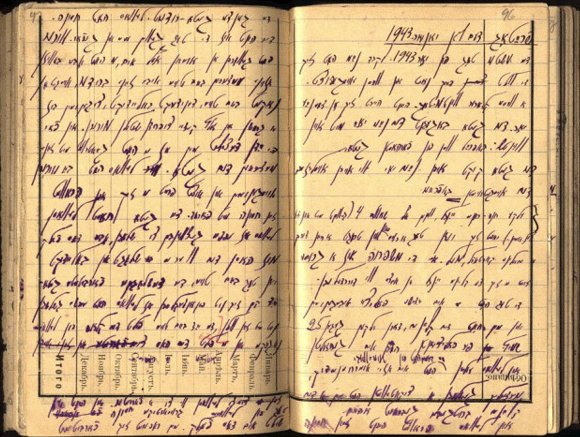
Sometime in early October 1943, fifteen-year-old Yitskhok Rudashevski and his entire family were rousted out of their hiding place in the Vilna Ghetto, taken to nearby Ponary, shot to death and buried in a mass grave.

The Rudashevski family were among the last remnants of a once-vibrant Jewish community in the city once known as “the Jerusalem of the north” for its culture and scholarship. People came there from as far away as the United States to study in its highly regarded yeshivas.
After the start of World War II, Vilna was annexed by the Soviet Union. It became a sanctuary to Jews fleeing from the Nazis, who occupied western Poland.

All of that changed on June 22, 1941, when Operation Barbarossa began. On the day Germany invaded the USSR, there were approximately 80,000 Jews living in Vilna, many of them refugees from the Nazi terror. By the time the Red Army arrived and kicked the Nazis out three years later, Vilna’s Jewish population had been reduced –through starvation, disease, deportation and executions — to zero.

Yitskhok (also spelled Yitzhak, Yitzak, etc., or anglicized to Isaac), was thirteen years old at the time his city was occupied by the Germans.

An only child, he was the son of a typesetter and a seamstress. Talented in writing, history and languages, he was also a faithful Communist and a member of the Pioneers, the Communist youth organization.

From June 1941 to April 1943 he kept a diary in Yiddish. Yitskhok had a sense of the significance of his account; at one point he wrote, “I consider that everything must be recorded and noted down, even the most gory, because everything will be taken into account.”

He not only wrote about his own life and his family and friends, but about the wider community events and the devastation the Germans wrought on his people. The historian Allan Gerald Levine called him “an astute and passionate observer of the times,” and compared him to Anne Frank.

Nor was the diary Yitskhok’s only writing project.

When one of his teachers, a beloved figure in the ghetto, died, he wrote a eulogy for the man and read it out before a large audience. He was a member of a literary group and was also attached to the ghetto’s history project, for which he interviewed ghetto residents about their lives:

I got a taste of the historian’s task. I sit at the table and ask questions and record the greatest sufferings with cold objectivity. I write, I probe into details, and I do not realize at all that I am probing into wounds … And this horror, this tragedy is formulated by me … coldly and dryly. I become absorbed in thought, and the words stare out of the paper crimson with blood.

The Vilna Ghetto, whose population initially numbered 40,000, had a rich cultural life, just like prewar Jewish Vilna had. There were theaters, cabarets, the symphony, art exhibits, a library, public lectures, and underground schools for both children and adults.

Vilna Jews saw art, music, literature and the pursuit of knowledge as a form of resistance. As Jacob Gens, head of the “ghetto’s Judenrat, put it, cultural activity gave a person “the opportunity to free himself from the ghetto for a few hours … We are passing through dark and difficult days. Our bodies are in the ghetto, but our spirit has not been enslaved.”

Reality intruded, however, and in the final analysis the Vilna Jews were doomed to extinction.

Yitskhok’s final diary entry was dated April 7, 1943, two days after five thousand Vilna Jews had been rounded up and shot at Ponary. He was understandably in a very grim mood. His prophetic last line was, “We may be fated for the worst.”

On September 23, 1943, the Nazis began the final liquidation of the Vilna Ghetto, which had by then been reduced to about 10,000 people. After a selection, those who could work were sent off to labor camps in Estonia and Latvia, where almost all of them died due to the brutal conditions there.

Children, the elderly, and the sick were shot at Ponary or sent to the extermination camp Sobibor and gassed.

Yitskhok, his parents and his uncle’s family chose to go into hiding rather than take their chances at the selection. In hiding he sank into apathy and said very little. After about two weeks in the hideout, they were discovered and taken to their deaths.

The only surviving member of Yitskhok’s family was his teenage cousin, Sarah “Sore” Voloshin. Somewhere on the route to Ponary she was able to escape. She joined a partisan group in the forest and survived until the Red Army liberated the area in the summer of 1944. After the war was over, she returned to the family’s hiding place and found Yitskhok’s diary. As of 2010, Sore Voloshin was still alive in Israel.

And the diary she retrieved had become one of the major sources on day-to-day life in the Vilna Ghetto.

Yitskhok Rudashevski suffered and died in just the same way as hundreds of thousands of others, but unlike them he did not remain anonymous: he is one of the ghetto’s most famous inhabitants. His writings have been published in their original Yiddish and in Hebrew, German and English translations. Extracts of his diary can be found in several anthologies, and it’s available in its entirety under the title The Diary of the Vilna Ghetto.

On this day..