1851: John McCaffary, the last hanged by Wisconsin

On this date in 1851, the domestic abuser John McCaffary (or McCaffrey) was publicly hanged in Kenosha, Wisconsin.* His crime — singularly ill-concealed — was a noisy row with his wife Bridgett that ended with him tipping her into a rain barrell and holding her in it until she stopped moving.

Neighbors alerted by Bridgett’s shrieks arrived to find the newly-minted widower redwet-handed, and his late wife stuffed in the backyard butt.

There had been a few executions in Wisconsin before McCaffary’s, but this was the first one after Wisconsin attained statehood in 1848. It was attended by a large crowd of 2,000 to 3,000 onlookers — a third of them female, to the special chagrin of newsmen.

And those 2,000 to 3,000 onlookers, as it turned out, witnessed something never to be repeated. From that day until this, the state of Wisconsin has never again put a human to death.**

The crowd played a part in that eventuality. Wisconsin was a reforming northern state — in a few years, the anti-slavery Republican Party would be founded there — and the spectacle of public enjoyment under the gallows struck as regrettable the sorts of people who, say, write Madison Democrat editorials. (“Murder before the people, with its horrors removed by the respectability of those engaged in its execution.” (Source))

Christopher Latham Sholes, a Kenosha publisher whose main claim to historic fame was later inventing the first commercially successful typewriter,† was seated in the Wisconsin State Assembly in 1852 as a Free Soiler. He too had denounced the execution in his newspaper — “the crowd has been indulged in its insane passion for the sight of a judicially murdered man … we hope this will be the last execution that shall ever disgrace the mercy-expecting citizens of the State of Wisconsin.” (See It Happened In Wisconsin, 2nd, or this link.) As a legislator, he put his political capital where his editorials were and spearheaded a successful campaign to get rid of capital punishment.

On July 12, 1853, Wisconsin followed the example of its neighbor, Michigan, and abolished the death penalty full stop.
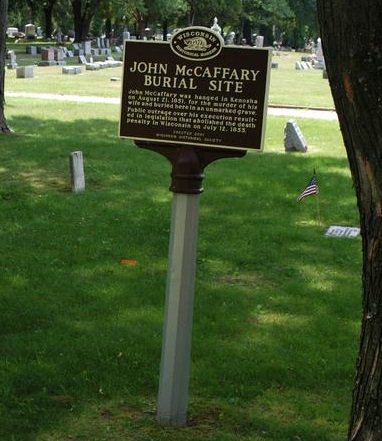

Burial marker for McCaffary in Kenosha’s Green Ridge Cemetery, erected in 2001. ((cc) image from Matt Hucke.) The McCaffary house on Court Street is also a registered historic landmark, and possibly haunted by Bridgett’s ghost.

There’s a handy roundup of resources related to the McCaffary execution here.

* The present-day name. Kenosha was then known as Southport.

** According to Invitation to an Execution: A History of the Death Penalty in the United States, there was an 1868 Wisconsin execution under Oneida (not Wisconsin) law, conducted on tribal lands.

† Said typewriter also debuted the now-standard QWERTY keyboard layout.

On this day..

1897: Michele Angiolillo, assassin of Canovas

On this date in 1897,* anarchist Michele Angiolillo was garroted in Vergara prison for assassinating the Spanish Prime Minister.

Angiolillo (English Wikipedia entry | Spanish) was an Italian expatriate in England who was so incensed by the procesos de Montjuic — a spasm of indiscriminate arrests and torture that followed an anarchist bombing in Barcelona — that he resolved to avenge the crime against his brothers.

“He read of the great wave of human sympathy with the helpless victims at Montjuich,” Emma Goldman wrote of Angiolillo. “On Trafalgar Square he saw with his own eyes the results of those atrocities, when the few Spaniards, who escaped Castillo’s clutches, came to seek asylum in England. There, at the great meeting, these men opened their shirts and showed the horrible scars of burned flesh. Angiolillo saw, and the effect surpassed a thousand theories; the impetus was beyond words, beyond arguments, beyond himself even.”

That named “Castillo” whose clutches rent so much flesh was the Spanish Prime Minister Antonio Canovas del Castillo, a statesman whose pioneering contribution to the art of manufactured consent was the turno system whereby two major Spanish political parties alternated turns in power/opposition and mutually connived to engineer ceremonial elections to that effect.

Upon his shoulders rested responsibility for the Barcelona torture regime.

And Angiolillo took it upon his shoulders to hold the executive to account.

Slipping into Spain with false papers, Angiolillo found Canovas taking a restorative visit to the Santa Agueda thermal baths and shot him dead on August 8.

As guards overcame the gunman — much too late — Canovas’s wife shrieked at him, “Murderer! Murderer!” The shooter gave her a bow and asked her pardon, for “I respect you, because you are an honorable lady, but I have done my duty and I am now easy in my mind, for I have avenged my friends and brothers of Montjuich.” (There are different versions of this bit of faux-politesse reported; suffice to say that in any form the remark was more pleasurable for Angiolillo to deliver than for the widow to receive.)

Official undesirables, by no means limited to anarchists who had survived Inquisition tactics in Montjuic, could scarcely contain their glee. New York anarchists avowed their support. Cuban and Puerto Rican separatists fretted only that the glory of the deed did not belong to one of their own. The Cubans specifically (and correctly) anticipated that the death of Canovas spelled the imminent recall of “Butcher” Weyler, the island’s strongman governor who had brutally crushed a rebellion there.**

His trial was undertaken within days, a mere formality considering that Angiolillo obviously shared the pride taken in his act by his overseas supporters. He justified the murder with reference not only to the torture and execution of anarchists at Montjuic, but of the execution of Philippines independence martyr Jose Rizal a few months prior.

* There are some sites proposing August 19 or 21. Period press reports are unambiguous that the correct execution date is August 20.

** William Randolph Hearst’s New York Journal would publish a banner headline during the imminent Spanish-American War triumphantly asking readers, “How do you like the Journal’s war?” Its claim to ownership stemmed in part from Hearst’s relentless hyping of Weyler’s (very real) atrocities over the preceding years.

On this day..

1738: Helena Curtens and Agnes Olmans, inviolable dignity

On this date in 1738, the last victims of witch trials in the Lower Rhine were burned at the stake in Gerresheim, an ancient German city today subsumed by Düsseldorf.

More eccentric than demoniacal, the sicky 14-year-old Helena Curtens reported having seen some ghostly apparition during a curative pilgrimage to Kevelaer, and received from him some towels with weird occult inscription. (She actually did have such towels.)

This adolescent attention-seeking turned into a whole thing when judge Johann Weyrich Sigismund Schwarz’s long ears caught hold of Gerresheim’s wagging tongues.

The whole idea of witches and witchcraft was trending ever less fashionable at this time, but not for Schwarz: he routed Curtens’s occult encounter into the judicial Hexenprozess and got on record an accusation against her neighbor Agnes Olmans as well as the usual stuff about playing the harlot with a visiting devil.

Their case extended for more than a year; Helena Curtens was 16 by the time she burned.

In that time, Curtens stayed curiously committed to her crazy story, even knowing that it was putting her under the shadow of the stake.

Olmans, by contrast, fought with every fiber the allegations that her young neighbor kept confirming. Olmans even fell ironic victim to the uneven development of rational witch-law reform when she tried to demand that she be put to the ordeal of water to prove her innocence: it turned out that this backwards practice of pseudo-forensics had been barred in 1555, so Schwarz could not order it. At trial, her denials were easily overcome by the gossip of neighbors, and even her own husband — who recalled that the mother-in-law had a distinctly witchy reputation. Hey, ’til death do us part, babe.

Today, there’s a public stone monument to these milestone sorceresses, the Gerresheimer Hexenstein (“Gerresheim witches’ stone”)

Its inscription reads:

Human dignity is inviolable.
For Helene Mechthildis Curtens and Agnes Olmanns.
Burned in Gerresheim on August 19, 1738.
After the last witch trial in the Lower Rhine
and for all those tortured and outcast

On this day..

476: Basiliscus, victim of the fine print

At some point around August 476 — the exact date(s) lost to history — the deposed Eastern Roman Emperor Basiliscus was executed most cruelly with his family.

But having himself played for power with ruthlessness to equal his rivals, Basiliscus was hardly in a position to complain about the treatment. Besides, his killers were just playing by the rules.

The mid-470s saw a confused succession of countercoups toppling short-lived successors to the able Leo I.

The succession went initially to a a 7-year-old grandson whose father, an Isaurian warrior, was proclaimed co-emperor to give the state adult supervision. When the kid died mysteriously (or “mysteriously”) months into his reign, the dad became Emperor Zeno.

As a “barbarian” who had married into the imperial family, Zeno couldn’t catch a break from the capital. He was run out of town in January 475 by a conspiracy of grandees, who elevated our man Basiliscus to power. (Basilicus nailed down the throne by executing his chief rival among the plotters for Big Man in Constantinople.) Basiliscus had been a general in his own right with a somewhat mixed track record; the highlight entry on his c.v. was a gigantic 468 invasion of Carthage that came to such catastrophic grief tht Basiliscus upon his return had to hide out in the basilica of Hagia Sophia claiming sanctuary to protect himself from popular fury.* Eventually the lynch mob died down and Basiliscus copped a pardon from Emperor Leo and returned to prominence in time to be a leading player in the putsch.

Demonstrating his customary aptitude for great undertakings, Basiliscus immediately busted as emperor. A huge fire ravaged Constantinople under his watch. He recalled exiled Monophysite clergy, leading the patriarch of Constantinople to drape icons in the Hagia Sophia in black.

It wasn’t long before daggers were drawn for Basiliscus in his scheming court, just as they had been for Zeno.

In fact, it was Zeno himself who would be the instrument of his successor’s destruction.

A general dispatched to Isauria to take care of the absconded Zeno got word of the gathering discontent and switched to backing the former and now future emperor. As they marched together on Constantinople, a second general sent to stop them also backstabbed Basiliscus by making an arrangement with Zeno to march his defending army down the wrong road. The barbarian warlord looked pretty good to the Senate by now, and it threw open the gates of Constantinople to welcome back its former master in August of 476. Basiliscus for the second time in his life made tracks for the sanctuary of Hagia Sophia.

It’s said that the restored Zeno got rid of Basiliscus without violating the church via a nasty little ruse: he got the former emperor to abandon sanctuary with a promise never to spill his blood, then promptly had Basiliscus together with his wife and his son thrown into a dry cistern at some Cappadocian fortress to desiccate from exposure. Zeno would have made a great lawyer.


Basiliscus forced into the cistern.

The restored Emperor Zeno reigned for 15 more years, during which he caused a schism in the church and played a lot of backgammon. Legend has it that he too met a horrific end by deprivation when he drank himself into such a stupor** that he was buried as dead, and finally awoke to find himself entombed. By now quite unpopular himself, he was roundly ignored as he pounded on the inside of his sarcophagus shouting for aid.

Robin Pierson’s History of Byzantium podcast handles this period in episodes 2 and 3.

* Procopius accuses Basiliscus of negligence verging on treason in this operation by accepting a plea (and a bribe) by the defending Vandals to defer the attack for a few days on some pretext. “If he had not purposely played the coward and hesitated, but had undertaken to go straight for Carthage, he would have captured it at the first onset.”

** Or alternatively (but less expressively, in moral terms), fell very ill — an epileptic coma, perhaps.

On this day..

1714: Constantine Brancoveanu and his sons

Three centuries ago today, Wallachian prince Constantine Brancoveanu was beheaded in Istanbul with his four sons.

Brancoveanu (English Wikipedia entry | Romanian) had fallen foul of the Sublime Porte, which dominated Wallachia, by dallying with the Ottomans’ European rivals, the Habsburgs and the Russians.

During the then-current installment the oft-renewed Russo-Turkish War derby, he actually massed armies for a potential swing all the way to the anti-Ottoman team. Breaking those up and returning Peter the Great’s gifts after the Russian clock got cleaned did not a tribute of loyalty make in the eyes of Turkey.

Not only Contantine but his entirely family — wife, four sons, and six daughters — were carried thereafter to Istanbul prisons. On the Feast Day of the Blessed Virgin, in the presence of the Sultan himself and of Christian diplomats who would be sure to put the word out, his four sons Constantine, Stefan, Radu and Matei were beheaded in his presence, as was the Wallachian treasurer Enache Vacarescu. The 60-year-old prince exhorted them as they endured their martyrdoms to remain steadfast, until at last he too lost his head. (Istanbul Christians managed to give the bodies honorable burials after fishing them out of the Bosphorus. The remains were later translated to Bucharest.*)

Most of the web sites about Branacoveanu and family are in Romanian; he was in his quarter-century reign a great cultural patron. The first Romanian Bible was completed in his time, and he undertook a great building program whose distinctive architectural stile still bears his name — Brancovenesc.

The Romanian Orthodox church conferred upon the martyred family the laurels of sainthood in 1992, a fine time to honor Romanian independence from foreign domination although of course by that time the Ottomans were yesteryear’s news and the outside heavy in question was the Russians.


Brancoveanu and his sons, from a mural at a monastery Brancoveanu founded.

Constantine also has a full panoply of secular miscellany in his honor: roads, statues, ballads, a metro station named after him, and so forth.

* At least, the alleged remains; it is well not to turn a forensic lens on saintly relics, and when Brancoveanu’s tomb was opened at the bicentennial of his death the skeleton therein appeared by the state of its teeth to be that of a man half Brancoveanu’s age. (Source)

On this day..

1793: Walter Clark, hanged women’s father

On this date in 1793, Walter Clark was executed for burglary at Morpeth, with one Margaret Dunn. Clark rates a mention in the spirit of the apple not falling far from the tree: a year before Clark’s conviction and hanging, his two daughters Jane and Eleanor had suffered the same fate with William Winters for a murder committed just up the road from Morpeth.

On this day..

1864: Barney Gibbons, chance recognition

One hundred fifty years ago today, Barney Gibbons was executed by musketry by the Civil War Union army in St. Louis, Missouri.

Gibbons was among the many soldiers in that chaotic war who in the time before identity cards and omnipresent databases deserted the respective armies at their convenience. Whatever the fulminations of the right-thinking against such behavior, only a slight risk of capture and exemplary punishment attended such an act.

Gibbons’ own slip into the statistically improbable might be the slightest imaginable risk of them all.

The New York native was enlisted in the Seventh Infantry Regiment when it was sent at the outset of hostilities to the New Mexico theater of the war; there he slipped away from the march one day and re-enlisted in the Confederate army, serving against his former comrades in several battles — notably Glorieta Pass.

Then Gibbons deserted the Confederate army as well, turned up as a teamster in New Orleans, and eventually made his way to St. Louis.

And that was that, or at least it often would have been. By 1864, who could bother to search out an obscure private fallen off the march three years before?

One summer’s day in 1864, however, a former 7th Infantry sergeant named Richard Day chanced to pass Barney Gibbons on the street and somehow recognized him. “He has a cut upon his lip, and a peculiar manner of walking,” Day would later insist at the court-martial. “Capt. Jones of our company was always at him because he never could walk like a soldier, he would throw his head forward and his arms to the rear. He always walked with his hands open and fingers apart even when he had gloves on.”

Now, despite the certitude of our verbiage so far, the fact of the matter is that “Gibbons” denied all this all the way to the stake — and there were no better forensics on offer than Day’s personal recollection. That was pretty much state of the art, even if we now know that eyewitnesses are highly error-prone.

We pick up Gibbons’s horrifying last moments (following Catholic baptism) via the New York Times correspondent, as reprinted by the Cleveland Plain Dealer on August 23, 1864:

Although there is not at the post of St. Louis an officer who ever witnessed an execution, the preliminaries were conducted in a skillful, orderly and decent manner. — All the troops of the post were in attendance, and a hollow square having been formed with one side open toward the embankment of the for, the condemned man was placed beside a post, with a seat attached, his common pine coffin lying on the ground beside him. After making a brief statement, in which he denied having deserted, but said that he straggled and was overtaken by the rebels, he pronounced his sentence most unjust …

He was seated, and his arms tied behind the post, a white cap was drawn over his face, and six musketeers drawn up within fifteen feet of his breast. The command was given:

“Make ready.”

“Aim.”

“Fire” and two bullets entered the abdomen. And now succeeded a few seconds in which transpired a scene which shook the stoutest heart, and made every human creature present shudder. From beneath the ghastly cap came a wail of agony which pierced every ear, and as the utterance “Oh! oh! too low,” escaped from the lips of the quivering form writhing in the throes of a horrible death, every one seemed paralyzed with horror. With a quick motion the officer of the squad waved the six muskets aside and four others took their place. “Make ready.” “Aim” — but mercifully before the third command was given, the four pieces were discharged, three leaden messengers of death entering the sternum, and a mighty convulsive shudder ended the being of the poor deserter. What an eternity of woe in those intervening few seconds! What a crowding of events from infancy, hallowed by a mother’s love and prayers to the dreadful details of the present scene! Yet, all passed before the mind’s eye of the dying man, and the wonderful palimpsest of his brain touched by the consciousness of instant death, gave him to see in a second all that had been for years forgotten, ere he entered upon the unknown.

The error in firing arose from the fact, discovered too late for remedy, that the sights of the muskets were set for long range.

On this day..

1912: Sing Sing’s seven successive sparks

New York’s electric chair handled record traffic on this date in 1912: seven successive electrocutions.

The first two men committed unrelated and isolated crimes.

  • John Collins got drunk and started firing a pistol in his Manhattan apartment. Police responded, and Collins shot a patrolman through the chest when they entered his domicile and tried to arrest him.
  • Joseph Ferrone, a violent wife-murderer who reacted to his guilty verdict by smashing a glass and slashing a juror with the jagged edge before he was restrained.

The last five were the culmination of another record: six people (these were nos. two through six) executed for one homicide. More specifically, and this was their newspaper billing, “Six Italians”.

Ringleader Lorenzo Cali

Lorenzo Cali, Santo Zanza, Vincenzo Cona, Salvatore DeMarco, Angelo Giusto and Filippo DeMarco were all Sicilians who were among the million-plus emigres to leave the island in the wake of the devastating 1908 Messina earthquake, had washed up at Croton Lake outside of New York working on the aqueducts that supplied that swelling metropolis with its fresh water.

It was backbreaking work at less than $2 a day, with tent barracks for recuperation because it was a prohibitive two-hour train ride back to the last stop on the New York subway.

In 1911, Cali caught wind of the passing of a nearby farm owner — Henry J. Griffin, whose comfortable home (usually occupied by boarders from the aqueduct’s managerial ranks) must have looked a fair sight from the muddy workers’ tents. It was said that he had left his wife not only that property but a $3,000 insurance policy. That would be a good four times the average annual earnings of a workingman at the time: had that policy been cashed out, grabbing the proceeds would be a better day’s labor by far than tending the aqueduct.

On the night of November 8-9 of that year, our Six Italians — led by Cali, who had made a point of casing the house over the preceding weeks — stole by moonlight into the woods near the house and waited for the male residents to leave for the day. Once they did, the Italians raided the farm.

Though they easily overpowered the three women left there, they didn’t find any $3,000. One of the women, Mary Hall, the young wife of an aqueduct superintendent, lost her composure in the face of the bandits screaming at her to produce more money; desperate to control her sobbing and shrieking, Santo Zanza stabbed her fatally in the chest.

But as the men fled the house with pennies on their hoped-for fortune and a dying woman at their back, the other two matrons of the house summoned police — Aqueduct Police, actually, a special force detailed to keep order in the unruly laborers’ shanties. Four of the men were arrested in the vicinity that afternoon; Cali, the ringleader, made it back to his Brooklyn tenement but was caught there two days after the murder. Only Salvatore DeMarco, known to his confederates as “Penolo”, remained on the lam.

A speedy succession of four different trials (Filippo DeMarco and Cali opted to be tried together) commenced at the Westchester County courthouse in White Plains before the month was out. Heavy guard (“Black Hand” notes kept arriving at the judge’s door; for fear of a possible rescue attempt by underworld characters, Italians were barred from attending the trial) did not in the least encumber their rapidity.

Angelo Giusto had implicated Santo Zanza as the killer (“the confession was wrung from the prisoner by up-to-date third-degree methods,” a newspaper reported) and a cycle of desperately competing confessions and accusations ensued among the lot to easily doom them all. The general thrust of the non-Zanza defendants was that the whole thing was a robbery only, and that Zanza had gone rogue in knifing Mary Hall to death. Even if true, however, those statements amounted to confessing capital crimes under felony murder rules imputing to all participants in the criminal enterprise joint liability for all its consequences. There was one death by one man’s hand, but all six were murderers.

Twenty-six days after Mary Hall’s death, all five Italians stood together in the courtroom to receive their death sentences. The trials had taken just a few hours apiece; jury deliberations consumed less than a quarter-hour for all cases save that of the youngest, Giusto.


New York Times headlines from November 29 (left) and December 6 of 1911. “Less than thirty hours’ actual court time was used in the four trials,” the latter article reported by way of high-fiving the state’s attorneys. “It is believed that Westchester has established a new record for the quick disposal of murder cases in this State.”

Two days after that, the last fugitive Salvatore DeMarco was finally arrested at his East Flatbush apartment. He was tried, convicted, and condemned all in a single day on December 19.

As the short appeals process unfolded over the ensuing months, public pressure for mercy was exerted by the Italian consulate specifically on behalf of the men who had not bloodied their own hands. Even Santo Zanza, who was executed separately from the rest on July 12, climbed aboard, and gave statements designed to accentuate his own culpability and underscore his fellows’ innocence of his design. But considering the sensational nature of the crime, and its context of growing public fear of violent crime rife among New York’s Italian immigrants, this was not one to recommend itself to the governor‘s clemency.

There is a detailed Crime Library summation of this case that begins here; note that most of its navigation links insert a gratuitous (and link-breaking) space after the phrase /croton in the web address; clicking through the 15-page story requires some annoying manual url manipulation.

On this day..

1792: William Winter, Elsdon Moor gibbet habitue

Atop a hill called steng Cross at the Northumberland village of Elsdon stands an eerie heirloom of England’s gallows history: Winter’s Gibbet. (Or “Winter’s Stob”, to use the local parlance.)


(cc) image from Flickr user johndal

It was here — within sight of the spot where he had murdered an old shopkeep to plunder her stores — that William Winter was gibbeted in chains following his August 10, 1792 hanging at the Westgate of Newcastle. In this fate, he followed his father and brother, hanged four years prior at Morpeth.

According to William Weaver Tomlinson’s Comprehensive Guide to the County off Northumberland,

In 1791 there lived here an old woman named Margaret Crozier, who kept a small shop for the sale of draper and other goods. Believing her to be rich, one William Winter, a desperate character, but recently returned from transportation, at the instigation, and with the assistance of two female faws [vendors of crockery and tinwork] named Jane and Eleanor Clark, who in their wanderings had experienced the kindness of Margaret Crozier, broke into the lonely Pele on the night of 29th August 1791, and cruelly murdered the poor old woman, loading the ass they had brought with her goods. The day before they had rested and dined in a sheep fold on Whisker-shield Common, which overlooked the Raw, and it was from a description given of them by a shepherd boy, who had seen them and taken particular notice of the number and character of the nails in Winter’s shoes, and also the peculiar gully, or butcher’s knife with which he divided the food that brought them to justice. No news, however, of Jane and Eleanor Clark’s fate.

This last line, however, is mistaken: Jane and Eleanor were hanged with William Winter. Indeed, “such was the uncommmon strength of William Winter, that, after receiving sentence of death, he carried both his female companions, one under each arm, from the bar, and across a wide street to the old Castle; supporting, at the same time, his own heavy chains, as well as the irons affixed to the women.” Afterwards, these lightweights weren’t gibbeted, but given over for dissection.

Winter’s rotting corpse hung for many years on his gallows. After it fell apart, the structure was dismantled — but in 1867 the English naturalist Walter Trevelyan, now landlord of the site, had a replica erected with a wooden mannequin. That figure was in its turn stolen, and over the years only the oft-stolen and -replaced wooden head has remained; even the gallows itself was torn down at least once. But it has weathered the years and borne the dim memory of William Winter down to the present day.


At the base of the Winters Gibbet sits a stone that was once the base of a Saxon cross that gave Steng Cross its name — an old medieval marker on the road from Elsdon to Wallington and Morpeth.

(cc) images above from Flickr users Phil Thirkell (first two) and just1snap (last two)

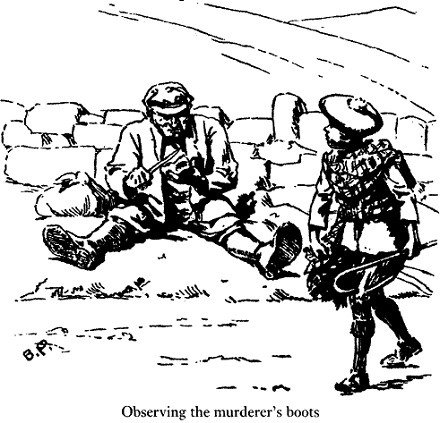
That legend alluded to by Tomlinson, that the shepherd’s boy was able to identify Winter by the pattern of his hobnails, was later exploited as an exemplar of watchfulness in Lord Baden-Powell‘s seminal Scouting for Boys, the book that launched the scouting movement.

“The following story, which in the main is true, is a sample of a story that should be given by the Instructor illustrating generally the duties of a Boy Scout,” runs the introduction to a three-page exegesis on the “strong, healthy hill-boy” who easily covered several miles after passing Mr. Winter, came upon the scene of the crime, recognized the bootprints, and summoned constables whom he guided back to the escaping murderer.

Thus the boy did every part of the duty of a boy scout without ever having been taught.

He exercised —
Woodcraft
Observation without being noticed
Deduction
Chivalry
Sense of duty
Endurance
Kind-heartedness

That last virtue Baden-Powell attributes by dint off the youth’s being broken-hearted at beholding the gibbet, to realize he had caused the criminal’s death. “You must not mind that,” says a magistrate to the child in a fabricated dialogue. “It was your duty to the King to help the police in getting justice done, and duty must always be carried out regardless of how much it costs you, even if you had to give up your life.”


Illustration from Baden-Powell’s Scouting for Boys.

The historical Robert Hindmarsh sort of did pay that most extreme price for his duty; allegedly he was so terrified of reprisals that it led him to an early grave just a few years later. This circumstance, instructive of the marauding family’s reach and impunity, might be further bolstered by the popular superstition that Elsdon Moor is also haunted: a “Brown Man of the Moors” tale predates this crime, but is also sometimes conflated with the purported apparition of William Winter himself.

On this day..

1849: Friedrich Neff, 1848 Revolutions radical

On this date in 1849, the German revolutionary Friedrich Neff was shot at Freiburg.

A law and philosophy student, Neff had been one of the firebrands of the Baden incarnation of Germany’s 1848 Revolutions.

These stirrings for political liberalization and national unification in the loose 19th century German Confederation, which comprised dozens of duchies and principalities left over from the dissolved Holy Roman Empire, were just the sort of thing to inspire student radicals like Neff.

Neff‘s Heidelberg was an initial center of the movement, led by Friedrich Hecker* and Gustav Struve. (All links in this sentence are German Wikipedia pages.) Though Hecker and Struve were established lawyers who most certainly had something to lose, they led rebel guerrillas into the field against the troops dispatched to crush the republican stirrings. They didn’t have much success, but it’s the thought that counts.

On September 21, 1848, Struve unavailingly proclaimed a German Republic in Baden, an event that is known as the Struve-Putsch and whose defeat four days later closes the first chapter of the 1848 revolutions (at least in Baden).

As a Struve-Putsch supporter (and an open advocate of political violence even before that), Neff had been obliged to flee to Switzerland and onward to Paris. That positioned him perfectly when the 1848 revolution scheduled an 1849 comeback to be the man to muster a legion of Baden exiles who would attempt to topple the duchy.

“This legion was the wildest band which the revolution brought forth,” this history of the revolution recounts. “It was commonly called the Legion of Fugitives, because composed largely of political refugees from Baden, who had fought under Hecker and Struve … There were also in the Legion many daring adventurers, some of whom were still wearing the red trousers of the Algerian Foreign Legion of France.” But these, too, were easily crushed, and Neff was arrested fleeing into exile. His last letter urged his mother to “remain firm and steadfast. I will go to death tomorrow as calmly as I once strolled in our garden — would that I had ten lives to give for the cause.”

Neff is a hero to social democrat types in present-day Germany, and there are public monuments him — like this plaque marking his birthplace in Rümmingen.


(cc) image from Erik Vogelpohl.

* Haberdashers might be familiar with the Heckerhut, a wide-brimmed, high-peaked hat popularized by Friedrich Hecker.

On this day..