1797: Thomas Starr, penknife murderer

“Sermon preached at Haddam [Connecticut], June 14, 1797. On the day of the Execution of Thomas Starr, condemned for the murder of his kinsman Samuel Cornwell by seven wounds given him, by a penknife, in the trunk of his body, July 26th, 1796, of which he languished a few days and died; with a sketch of the life and character of said Starr,” by Enoch Huntington, pastor of the First Church of Christ of Middletown, Connecticut.


Also available online here.

The good minister was brother to the late governor of the state, and (eventually) maternal grandfather to abolitionist William Huntington Russell, co-founder of famed Yale secret society Skull and Bones. Russell was a personal friend of anti-slavery militant John Brown and received the honorary rank of Major General for his service organizing the Connecticut militia for the Civil War.

On this day..

1941: Pittsburgh Phil

On this date in 1941, Brooklyn gangster Pittsburgh Phil went to the Sing Sing electric chair.

The smart-dressed Pittsburgh Phil* — “Harry Strauss” to his parents or just plain “Pep” to his friends — was the most notorious contract killer of the Springsteen-worthy crime syndicate Murder, Inc.. He racked up an alleged body count well north of 100 — possibly several multiples of that figure — popping whomever some organized crime figure needed to be rid of. (Like this guy.)

Pep eschewed any single m.o., murdering with blades and bullets and garrotes and lungs full of water, and he rarely even carried a weapon lest it incriminate him on a chance arrest. Well did he know this tradecraft, for he beat no fewer than 17 prosecutions in New York. The man also took hit assignments all around the country, for other crime lords in cities whose patrolmen did not recognize him by name and reputation.

And fittingly, it took another assassin to kill him.

Fellow Murder, Inc. killer Abe “Kid Twist” Reles — a childhood buddy with whom he’d come up in the Prohibition crime world via Meyer Lansky‘s organization — got caught in the government’s sights and realized that his only probable purchase on life involved giving evidence against his mates.

We’ve seen that his testimony did in Frank Abbandando and Harry Maione, even though Reles had “fallen out of a window” before those goons sat in the mercy seat. Reles likewise gave up Pittsburgh Phil, who in Raymond Chandler’s was “electrocuted with a sneer on his face” on this date along with his fellow Murder, Inc. plugger Buggsy Goldstein.

* Why did they call him “Pittsburgh Phil”? Who knows! He is at any rate not to be confused with groundbreaking horse bettor George “Pittsburgh Phil” Smith.

On this day..

1895: A day in death penalty around the U.S. (McTeague edition)


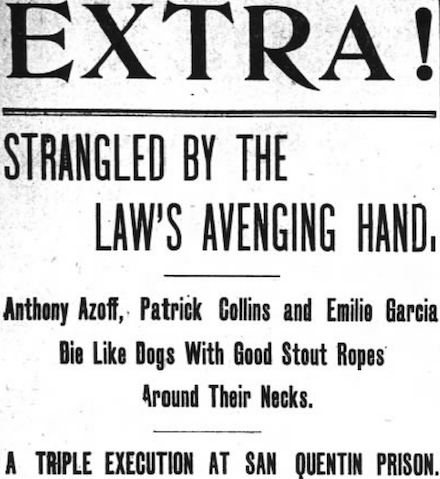
Headline from the Tacoma (Wash.) Daily News, June 7, 1895.

On this date in 1895, the hangman noosed for the cycle with single, double, and triple executions in three different U.S. states.

Arkansas

In Morrilltown, William Downs or Downes for criminally assaulting a woman called Pauline Bridlebaugh.

“On the scaffold Downs declared that he was guilty of part but not all he was charged with,” according to multiple newspaper reports. The eight-foot fall failed to snap his neck, and Downs strangled to death over 15 agonizing minutes.

Alabama

“Lee Harris and Abe Mitchell, colored murderers, highwaymen and thieves, were hanged here [Birmingham] today before 2000 people for the murder of Grocerymen Merriweather and Thornton. Both bodies were turned over to the undertakers, who purchased them several weeks ago for $18 from the men themselves.”


From the Oakland Tribune, June 7, 1895.

California

Three Californians hanged, sequentially, at San Quentin prison on the morning of June 7 in an affair timed to ensue the arrival of the 7:40 train from San Francisco, carrying about 100 official witnesses.

Emilio Garcia stabbed and slashed to death a San Bernardino old timer whom he believed to possess a hoard of gold.

Anthony Azoff fatally shot a Southern Pacific detective in the course of a botched robbery of that railroad firm’s offices; he was balked of a suicide attempt in the hours before his execution.

And Patrick Collins acquired more lasting infamy than any of his scaffold brethren by sensationally stabbing to death his estranged wife at the kindergarten where she worked when she refused his demand to hand over her wages.

Collins’s guilt was very apparent, so his trial gave the horrified public ample rein to sketch the brute in terms of the era’s crackpot racist typologies. In one Examiner article tellingly titled “He Was Born for the Rope,” it was postulated that “if a good many of Patrick Collins’ ancestors did not die on the scaffold then either they escaped their desert or there is nothing in heredity … Seeing him you can understand that murder is as natural to such a man when his temper is up as hot speech is to the anger of the civilized.”


Various newspaper images of Patrick Collins, from The Construction of Irish Identity in American Literature.

Be they ever so headline-conquering in their time, such crimes are like to fade speedily from the public memory. Collins, the man who slaughtered his tightfisted wife, and Collins, the savage ethnic archetype, have improbably survived his moment of notoriety, by imparting to literature the inspiration for San Francisco novelist Frank Norris‘s 1899 offering McTeague.

In McTeague, a vicious husband murders the wife he has abandoned when she refuses him money. The murderer here presents as an overpowering ancestral beast within — attributable, says Christopher Dowd, to Norris’s “study of criminal anthropology, particularly the school of thinking developed by Cesare Lombroso regarding atavism, hereditary criminality, degeneration, and criminal physiognomy. According to Donald Pizer, by the time Norris wrote McTeague, he had developed a ‘preoccupation’ with the themes of atavism and reversion, and ‘particularly with the role of heredity in causing either an obvious physical or mental devolution or a return to an earlier family condition’. Suddenly, Norris had a way to explain the behavior of his murderous protagonist — he was born a criminal, having inherited the degenerate traits and predilections of his Irish ancestors. Combined with the newspaper reports of the Collins murder, criminal anthropology gave Norris all the tools he needed to write, what Pizer calls, ‘that mythical creature of literature, a naturalistic tragedy'”. For example, Norris zooms through the disordered mind of McTeague as he struggles to control himself on one occasion.

He was disturbed, still trembling, still vibrating with the throes of the crisis, but he was the master; the animal was downed, was cowed for this time, at least.

But for all that, the brute was there. Long dormant, it was now at last alive, awake. From now on he would feel its presence continually; would feel it tugging at its chain, watching its opportunity. Ah, the pity of it! Why could he not always love her purely, cleanly? What was this perverse, vicious thing that lived within him, knitted to his flesh?

Below the fine fabric of all that was good in him ran the foul stream of hereditary evil, like a sewer. The vices and sins of his father and of his father’s father, to the third and fourth and five hundredth generation, tainted him. The evil of an entire race flowed in his veins. Why should it be? He did not desire it. Was he to blame?

McTeague does not exit upon the gallows as did his real-life inspiration; instead, having murdered and robbed his wife, the fugitive flees to the scorching desert of Death Valley where he faces a fight to the finish with a friend/rival who has pursued him. McTeague overpowers this foe, but the man’s dying act is to handcuff himself to McTeague — condemning the latter to sure death.

McTeague has long been in the public domain; it can be perused here; a Librivox audio reading of the book is available here. It’s also been adapted to at least two films in the silent era — including one of the genre’s greats — plus a more recent PBS radio drama, an opera, and miscellaneous other media.

On this day..

1900: Guzeppi Micallef, Maltese felon

This tale of a dreadful Maltese wife-murder arrives via the Times of Malta’s roundup of sensational hanging crimes on that Mediterranean island. Now independent, Malta was still British-controlled at the time of the events in this excerpt.

A marker outside Corradino Prison records the people hanged on its gallows, including Guzeppi Micallef

The murder of 19-year-old Roza Micallef is undoubtedly the most sensational uxoricide of the 19th century. Roza was precious for her husband, Guzeppi, but he was fearful of losing her. This fear was the result of jealousy.

The couple, who had been married only for a few months, lived in a farmhouse at Maghtab. Roza’s parents objected to the marriage as Guzeppi’s brother was married to Roza’s sister and their marriage was not a happy one. However, Roza did not take heed her parents’ warnings and married Guzeppi.

Roza and her husband used to work in the fields with her parents. She was a lively woman and enjoyed talking to relatives and friends. Her husband objected to this behaviour and warned her to be less talkative. Two days prior to the murder, she was seen waving to her uncle, Alessandro. This affectionate gesture triggered off the quarrel Guzeppi had with his wife on the night of the murder.

After sunset on October 8, 1899, Roza’s brother, Teofilio, heard his brother-in-law crying for help as his wife had been hit by a shot accidentally fired by his shotgun. According to Guzeppi, the shotgun was resting against the wall when he accidentally hit it with his foot. The firearm slid to the ground and was discharged accidentally, hitting Roza in her breast.

When the police were called, Teofilio told them that some time before he heard the shot he called on his brother-in-law, Guzeppi, to give him some money. Teofilio said that when he was at his sister’s house he was sure that something wrong was afoot; however, he chose not to interfere.

Regarding the shot, Teofilio said that when he heard the firing of a shotgun he thought that Guzeppi had shot his neighbour’s dog which was barking at that time.

The post-mortem examination revealed that the shotgun had been discharged from a high position and not from the floor as Guzeppi had affirmed in his statement. Moreover, court experts appointed to investigate the case further confirmed that Roza did not die as a result of an accident.

Guzeppi was charged with his wife’s murder and his trial opened on May 28, 1900. The prosecution produced witnesses who testified that the accused was very jealous of his wife. However, Dr Etienne Micallef, the defence counsel, maintained that the accused was jealous because he feared he might lose his wife’s love and had no intention of killing her.

As the accused was found guilty with a unanimous vote, he was sentenced to death.

Representatives of the Chamber of Advocates, the president of the Chamber of Commerce and the Council of Government petitioned the [Lord] Grenfell [Governor of Malta] to commute the sentence but he refused the appeal.

Micallef was hanged on June 6, 1900. He was only 20 years old and the only man in Malta since 1800 to have been hanged for uxoricide.

On this day..

1806: Dominic Daley and James Halligan, hated foreigners

On this date in 1806, immigrants Dominic Daley and James Halligan were hanged at Northampton, Massachusetts. In the words of one widely reproduced report, “They persisted in their innocence to the last moment, although there were perhaps not a single one of the numerous spectators present, which was presumed to amount to nearly 15,000, who entertained a doubt of their guilt.”

Today, nearly everyone thinks them innocent.

The case began, as many wrongful convictions do, with a particularly outrageous crime — a young farmer, Marcus Lyon, found dead in a Massachusetts creek en route to his home in Connecticut. He’d been shot through the chest and his brains battered out of his skull. The motive: robbery.

In the absence of substantive evidence, some witnesses with vague reports of strangers on the fatal turnpike furnished tissue for an entire theory of the case, and through the misapprehended focus of tunnel vision the strangers became Irishmen, and the Irishmen became Dominic Haley and James Halligan.

In the close aftermath of American independence, New England was still overwhelmingly Anglo-Saxon and Protestant. Most of the Irish people about at this moment were also Protestants: large-scale Irish Catholic immigration into the region only began in the 1820s and it panicked the normies when it came, with preachers and politicians railing against the insidious incursions of idolatrous papists.

So in 1805, when the hunt for strangers settled on two Irish-born Catholic immigrants … well, what was left to know? Just days later, a North Wilbraham Congregationalist minister thundered from the pulpit,

We see the evil attending a continued influx of vicious and polluted foreigners in this country. Many of the outrages we suffer proceed from this source. Who break open our homes in the unsuspecting hours of sleep? Who set fire to our large cities and towns for the sake of plunder? And who rob and commit murder on our highways? We are far from exculpating all of our own native citizens; we regret, indeed, that so many of them disgrace themselves and injure society by evil deeds. But these things notwithstanding, we are doubtless justified in saying, that a great proportion of the crimes above mentioned, together with many others which might be named, are committed by foreigners. And that atrocious deed which has so recently congealed all our blood with horror, in this place, is supposed to have been perpetrated by foreigners. Look at the annual reports of the overseers of the prisons and you will find them be principally occupied by foreigners

The first planters of this country were, generally speaking, men of pure lives and good morals and they were induced to come here for the sake of religion. And, for a long time, they maintained a wholesome and orderly state of society. But since the rapid increase of our commerce with other nations, and the great ingress of foreigners, many of whom are said to come here for the sake of escaping the retribution of justice in their own country; we have ripened apace in all the arts of vice and depravity. Some, who come among us from abroad, we readily acknowledge to be worthy and good men, and we cordially welcome their approach. But the number of these is comparatively small. The best and most useful citizens are cautiously retained, while the worst are readily parted with. Hence the rapid influx upon us, of late, of the most violent and abandoned of the human race. The late and present disturbances in foreign countries have greatly increased the calamity. The prisons of Europe and the West Indies are now disgorging themselves upon our shores; and this country is thus becoming the general asylum of convicts. This is a sore evil, and will furnish an increasing number of inhabitants for our prisons and victims for the halter.

The case in court would comprise 24 witnesses not one of whom had witnessed the crime; at most they could suggest that two strangers had taken the same well-trafficked public road on the same day as the victim, who was also a stranger in these parts. Even this much was not certain among the witnesses; their renderings were vague, tentative, contradictory — but witness recollections and prejudicial readings of circumstance soon shaped themselves around the shared understanding of events, and from so much smoke they wove the hemp.

The friendless immigrants’ court-appointed attorney, Francis Blake, who had been tasked with this first capital case of his life a bare 48 hours before the trial opened, made a vehement, eloquent, and futile address to the jury against “this illiberal, this inhuman prejudice” closing around the throats of his clients.

That the prisoners have, however, been tried, convicted, and condemned, in almost every bar-room, and barber’s-shop, and in every other place of public resort in the county, is a fact which will not be contested. That the sentence of the law has not been anticipated, and that they have not already suffered the penalty of death, may be ascribed rather to defect of power, than to lenity of disposition, in many of their accusers …

There is yet another species of prejudice, against the influence of which it is my duty to warn you. I allude to the inveterate hostility against the people of that wretched country, from which the Prisoners have emigrated, for which the people of New-England are peculiarly distinguished …

Pronounce then a verdict against them! Condemn them to the gibbet! Hold out an awful warning to the wretched fugitives from that oppressed and persecuted nation! Tell them that although they are driven into the ocean, by the tempest which sweeps over their land, which lays waste their dwellings, and deluges their fields with blood; — though they float on its billows upon the broken fragments, of their liberty and independence; — yet our inhospitable coast presents no Ararat upon which they can rest in safety; that although we are not cannibals, and do not feast upon human flesh, yet with all our boasted philanthropy, which embraces every circle on the habitable globe, we have yet no mercy for a wandering and expatriated fugitive from Ireland. That the name of an Irishman is, among us, but another name, for a robber and an assassin; that every man’s hand is lifted against him; that when a crime of unexampled atrocity is perpetrated among us, we look around for an Irishman; that because he is an outlaw, with him the benevolent maxim of our law is reversed, and that the moment he is accused, he is presumed to be guilty, until his innocence appears! …

The lives of the prisoners are now consigned to your disposal. Before you proceed to the performance of this awful duty, let me borrow the language of one of their countrymen, not degraded by the ignominious reproaches against his nation, but elevated to the highest rank among the orators of the elder world by the most splendid talents, the purest patriotism, and the most unsullied integrity. Let me beseech you to “remember that there is another than a human tribunal, where the best of us, will, on one day, have occasion to look back on the little good we may have done. In that solemn trial may your verdict on this day give assurance to your bones and afford you strength and consolation in the awful presence of an adjudging God!”

The words fell on deaf ears.

Daley and Halligan maintained their innocence from arrest to execution, but in the end they would require the offices of another foreign refugee, Father Jean-Louis de Cheverus, a French-born priest in Boston, who had fled the anti-clerical paroxysms of his own homeland. (Later, he would become the first Catholic Bishop of Boston.) It’s said that he stayed in jail with his charges, as no one in Northampton would suffer the papist priest to sleep under their own roof — and that his ministrations to them included the first Catholic mass said in that city.

Folklore cropped up around the 1830s to the effect that a local man had given a deathbed confession exonerating the hanged Irishmen … and that this murderer was the kinsman of one of the witnesses against Daley and Halligan. I cannot establish that this is any more than a just-so story, a fable, but even so it speaks to the continuing injury done by this execution to the now-growing Irish Catholic community. In time that demographic’s maturing numbers and political muscle flipped the story of Daley and Halligan from one of foreigners ripened in depravity to a sobering caution against bigotry and rush to judgment.

We have no real way, now, to access a definitive assessment of guilt or innocence; we can certainly say with confidence that the evidence was appallingly flimsy to hang a man even for the time. Both Daley and Halligan were posthumously exonerated by a writ of Massachusetts Gov. Michael Dukakis in 1984. Dukakis discussed that action, and history’s view of the Daley-Halligan railroading, in a 2011 panel available in podcast form here.

For additional resources, check this Historic Northampton page (already linked several times within this post). Below, you can read the entirety of an 1806 publication reporting the trial, from which the defense lawyer’s remarks have been drawn.

On this day..

1718: A horse thief and two travelers, “the worst rideing that ever I rid”

This date’s post brings us back to one of our regular wells, James Kelly’s Gallows Speeches From Eighteenth-Century Ireland … and the days when a life was cheaper than a horse.

The three men hanged together on this date all concurred in their stories that only one of them stole the horses in question and the other two merely thumbed rides on his extra mounts as passing travellers. Whether or not this is true or was simply their common play for a potential ⅔ pardon posterity obviously has no way of determining.

The Last Speech and Dying Words of
Daniel O Neal, Edmond Mc. Guire, and Henery Graham

who was Executed near St. Stevens Green, on Wednesday June the 4th 1718.

Good Christians,

I was Born in the North of Ireland, of very good honest Parents, who brought me up very Tenderly, and never speard any Cost to Instruct and bring me up in the fear of God, Alas! all was in vain, for tho’ I took all the care that I could to attain to Learning but at the end I prov’d very Careless of the fame, for I neglected both the laws of God and Man, or else I had never been brought to this shameful End, it is true I was taken up for the Stealing of three Horses, and two Mares, and these my fellow Sufferers along with me, but as I shall Answer the great God, they Die Innocently, for as I was Riding along the Road, I overtook these my fellow Sufferers who seeing me leading 4 Horses asked me if I would let them ride, I tould them they should, now as I am a dying Man this is all they knew of it, which grives me to the Heart, and indeed I am more sorry for their Death, than my own.

I freely forgive all the World, and I beg forgiveness of all those whom I ever offended, I am now about six and thirty Years of Age, I die a [sic] of the Church of England, and the Lord have mercy on my Soul, Amen.

This is my true Speech and no other

Daniel O Neal

The Speech of Edmond M’Guire.

Good Christians,

I Was born in the North of Ireland, of Poor, but honest Parents, who with their Industry, Care and Labour, brought me to these Years, during which time, I behav’d my self true and honest in the World, and endeavour’d very hard for my Bread; but I being born to hard Fortune, I was taken up by one Mr. Legg, for being concern’d in stealing of three Horses and two Mares; ‘tiw true I had one of the aforesaid Beasts under me, but the way I came by it was in the manner following: I having been in Dublin for some time, was willing to return home to my Wife and Children, and overtaking Daniel O Neale, my fellow Sufferer; he having the Cattle abovemention’d, I ask’d him if he wou’d let me Ride, he said he wou’d oblige any Traveller as much as he could, and so bid me Mount one of the Horses, which I did, and was very thankful to him for his kindness; but to my great Sorrow, it has prov’d the worst rideing that ever I rid in my life: Now as I am a dying Man, I was never guilty of Stealing the value of two Pence in all my Life: nor had I any Hand in stealing those Beasts which I am to Dye for. I forgive all the World, as I hope to be forgiven. I am about 40 Years of Age, and Dye a Roman Catholik, and the Lord have Mercy on my Poor Soul. Amen, Amen.

The Speech of Henry Graham.

Good Christians,

I was born in the North of Ireland, of very honest Parents, who was very tender over me, and brought me up in the fear of GOD as much as in them Lay; but Fortune has been very Cruel to me, or else I had never came to this Place, for I liv’d with my Parents will I came to get a Wife; and indeed it was my Fortune to get a poor honest Girl, who endeavour’d very honest for her Bread as well as I, but the World frowning upon me, I went and listed in the Army, where I behav’d myself as became a good Subject, at lenth [sic] I was broak, and so return’d home to my Wife again, but my Business calling me home to Dublin, to my great Sorrow I went there, but having finish’d my Business, I was going home again, where unfortunately I met with Daniel O. Neal, and Edmond M’Guire a Riding along the Road, to whom I said, pray let me Ride, and indeed, they freely comply’d, but I had not Rid long before we were all taken and committed to Goal, and from that brought to Dublin, so Try’d and found Guilty of the same, and now brought to [t]his Place to end my life, now as God is my Judge, before whom I hope to appear in short time, I had neither Art nor Part in stealing of the said Horses, or any of them, and I die in Charity with all Men, and do freely forgive those who Swore away my Life as I hope to be forgiven, I am about 30 years of Age. I die a Protestant and the Lord have mercy on my Soul.

Henry Graham.

On this day..

1503: A banderaio and an executioner

Courtesy of Emotions in the Heart of the City (14th-16th century), we travel to Florence during its between-Medicis republican interim* for a very emotional execution:

On the morning of 29 May 1503, outside the city’s great Gate of Justice,** a young flag-maker (banderaio) was put to death for having murdered another banderaio. In a scene that struck the throng of spectators as an outrage, the executioner had failed to cut off his head even after three blows of his sword. The sight must have been grisly, for the attending mounted captain was next forced to move in and club the flag-maker to death. The compassion of the crowd now pivoted into incandescent rage. A tumult broke out, as men and boys directed a cannonade of rocks at the executioner. There was, in addition, something oddly religious about the event, because rocks were also thrown at the men hooded in black, the members of the religious confraternity who were there to offer comfort to the unfortunate banderaio. They had to flee for their lives. The executioner was killed, and children then lugged his corpse around, worked their way back into the city, and dragged the body all the way up to the Franciscan Church of Santa Croce. Were they sending a message to Savonarola‘s great local enemies, the Franciscans? There was a possible religious subtext to this episode : some contemporaries claimed that the hangman had been punished — he was the very same man — for having first insulted and then hanged Savonarola five years previously. It goes without saying that he had died without last rites, and the dragging about of his body again touched on something religious in being subject to a ‘ceremony’ of desecration.

Although I cannot locate an online version of this document, it appears to me that a primary source for this incident is the chronicle of Simone Filipepi. This historian is a bit less famous than his little brother Alessandro Filipepi … who is inscribed in the annals of art’s history by his nickname (meaning “Little Barrel”) as Sandro Botticelli.

Tangentially, readers might also enjoy this 1625 instance of a clumsy executioner being lynched: in that case, his proposed prey actually survived the scaffold. A similar fate nearly befell notorious English hangman Jack Ketch, after his maladroit butchering of the Duke of Monmouth in 1685.

* This period prior to the restoration of the Medici was also Machiavelli’s political heyday. (He wrote his classics of statecraft after Giuliano de’ Medici subsequently recaptured Florence from the pie-eyed republicans and retired Machiavelli to countryside exile.)

** This public domain English translation of Guido Carocci‘s classic Firenze Scomparsa (Bygone Florence) illuminates some of the relevant topography.

A tower which now only consists of four stone walls, plain and undecorated, but which some day must have been much higher and surmounted by battlements, rises at the end of the Lungarno apposite the viale Carlo Alberto.

It is the sole remnant, the only souvenir of a number of ancient buildings which were situated in this position, and were known as the old mint (Zecca Vecchia).

Previous to the demolition of the walls the tower reared its massive proportions on the river bank in the midst of the ramparts of a dismantled fortress, near a mill race and buildings next the walls which at this point showed traces of a walled up gate.

The buildings next to the tower seemed a mixture of old and modern construction with large arched rooms, long corridors and balconies overhanging the canal from the Arno — which gave motive power to the wheels of various cloth mills.

These houses, which grouped en masse were of singular picturesqueness, completed the view of green banks and vine covered hills lining the river and were full of interesting historical associations.

A postern gate was situated here, flanked by a tower on the river bank to defend the city from a water attack; this was called the Gate of Justice, and its name calls up painful and melancholy memories. Outside the walls at the end of a meadow beyond the moat was a small low church whose facade was frescoed with sad subjects. In this meadow was placed the gallows and executionary scaffold. The Gate of Justice was generally closed for the better security of the city and was only thrown open for the passage of religious companies accompanying condemned criminals to the place of execution.

The street through which they passed to the gate was very appropriately known as Via Malcontenti, (Street of the Discontented).


Via dei Malcontenti, Florence (c. 1880) by Telemaco Signorini.

In 1346 criminals condemned to death were brought to a chapel, still in existence, next to the church of San Giuseppe in Via Malcontenti were tied to an iron ring which may still be seen in the pavement, but afterwards the little church outside the walls was built for this last grim service. [If this artifact still exists, I would be indebted to anyone who can supply a picture of it. -ed.]

The church was used as a resting place where the penitent might offer his short and final prayer before being handed over to the executioner.

The victims’ bodies remained suspended on the gallows for days in order to act as a wholesome warning to all evil disposed persons, but the Florentines, who must have their little joke even on the most solemn subjects, called these meadows which formerly belonged to the Nemi family, the paretaio of the Nemi (bird-catching place of the Nemi).

The gate of Justice was walled up during the great siege, and after that the lugubrious procession passed through the Porta alla Croce. In our times traces of this gate, partly buried in the raised soil, could still be seen previous to the destruction of the old walls and above it the hole through which every defensive missile might be hurled on attacking parties below.

On this day..

1753: George Robertson, prick

We are indebted to the redoubtable medical historian Dr. Lindsey Fitzharris for the substance of this post, which she brought to our attention on her blog, The Chirurgeon’s Apprentice. Fans of the macabre, and particularly of the recurring medicinal theme here at Executed Today, are sure to enjoy her book The Butchering Art: Joseph Lister’s Quest to Transform the Grisly World of Victorian Medicine — or her “Under the Knife” video series.

We (and Dr. Fitzharris) enter these sensitive parts via a bit of junk preserved at the Royal College of Surgeons: the severed penis which long ago inhabited, along with the bacterium Neisseria gonorrhoeae, the trousers of a highway robber named George Robertson.

Neither bacterium nor reader will be surprised to discover that when Robertson and a couple of other hard men knocked down James Holland in Mansfield Street to dispossess him of his hat and his wig, the pestilential thief resided at “a bawdy-house” (per the evidence of his perfunctory trial).

We don’t know the ins and outs of what this specimen got up to when Robertson had his liberty — only that its condition was so obvious that it interested the doctors. With nary a care for patient privacy, the Ordinary of Newgate emitted to the public that Robertson felt “so ill with the foul Disease, as not to be able to walk, and wished himself dead, because he had no Money or Friend to put him in the Hospital.”*

Agony though it might have been to our dissolute footpad, such cocks excited the physicians.

Dr. Fitzharris directs our attention to A Treatise on the Venereal Disease, by Robertson’s contemporary, the surgeon John Hunter. Hunter might well have fondled this very todger in his own day; as we learn from this turgid treatise, he and his colleagues found in the engorged members of the hung a penetrating scientific tool. The eightfold execution in the spring of 1753 that Hunter references below might be a previous Tyburn hanging date, of February 12, 1753. (That hanging included Robertson’s accomplice John Briant or Bryant: no word on the condition of John Briant’s John Thomas.)

Till about the year 1753 it was generally supposed, that the matter from the urethra in a gonorrhoea arose from an ulcer or ulcers in that passage; but from observation it was then proved that this was not the cafe. It may not be improper to give here a short history of the discovery of matter being formed by inflammation without ulceration.

In the winter 1749, a child was brought into the room used for dissection, in Covent Garden, on opening of whose thorax a large quantity of pus was found loose in the cavity, with the surface of the lungs and the pleura furred over with a more solid substance similar to coagulable lymph. On removing this from those surfaces they were found intire. This appearance being new to Dr. Hunter, he sent to Mr. Samuel Sharp, desiring his attendance, and to him it also appeared new. Mr. Sharp afterwards in the year 1750, published his Critical Enquiry, in which he introduced this fact, “That matter may be formed without a breach of substance;” not mentioning whence he had derived this notion. It was ever after taught by Dr. Hunter in his lectures ; we however find writers adopting it without quoting either Mr. Sharp or Dr. Hunter. So much being known, I was anxious to examine whether the matter in a gonorrhoea was formed in the same way. In the spring of 1753 there was an execution of eight men, two of whom I knew had at that time very severe gonorrhoeas. Their bodies being procured for this particular purpose, we were very accurate in our examination, but found no ulceration, the two urethras appeared merely a little blood-shot, especially near the glans. This being another new fact ascertained, it could not escape Mr. Gataker, ever attentive to his emolument, who was then attending Dr. Hunter’s lectures, and also practising dissection under me. He published, soon after in 1754, a treatise on this disease, and explained fully, that the matter in a gonorrhoea did not arise from an ulcer, without mentioning how he acquired this knowledge; and it has ever since been adopted in publications on this subject. Since the period mentioned above, I have constantly paid particular attention to this circumstance, and have opened the urethra of many who at the time of their death had a gonorrhoea, yet have never found a fore in any ; but always observed that the urethra near the glans was more blood-shot than usual, and that the lacunae were often filled with matter.

* As usual, the Ordinary plied the condemned while they languished in Newgate. However, he broke with his usual practice and did not make the trip to Tyburn for this triple execution, “because as they all three died Roman Catholicks, I did not choose to attend, to give them the Opportunity of turning their Backs upon me, as a Protestant Minister, which I knew they must do if I did.”

On this day..

1989: Stephen McCoy, botched

Rapist-murderer Stephen McCoy succumbed to a badly botched lethal injection in Texas on this date in 1989.

McCoy, according to the Death Penalty Information Center,

had such a violent physical reaction to the drugs (heaving chest, gasping, choking, back arching off the gurney, etc.) that one of the witnesses (male) fainted, crashing into and knocking over another witness. Houston attorney Karen Zellars, who represented McCoy and witnessed the execution, thought the fainting would catalyze a chain reaction. The Texas Attorney General admitted the inmate “seemed to have had a somewhat stronger reaction,” adding, “The drugs might have been administered in a heavier dose or more rapidly.”

McCoy with two accomplices, James Paster and Gary LeBlanc, had committed a cut-rate murder for hire, grossing $1,000 to shoot someone’s ex-husband in the parking lot of a club. Paster, who actually pulled the trigger on that murder, suggested to his mates that they would all rest a little easier in one another’s silence if they jointly committed two more homicides, with each taking his own turn as the murderer.

To that end, they kidnapped one Diana Oliver in November 1980, gang-raped her, and had McCoy take her life with an improvised garrote. Their third victim was 18-year-old Cynthia Johnson, abducted from her stranded vehicle on New Year’s Eve 1980, and also raped and strangled to death.

Paster was also executed. LeBlanc copped a long prison sentence for cooperating with the state against his accomplices.

On this day..

1883: Not Alferd (sic) Packer, #nerdprom attendee

The National Press Club is probably best known for its White House Correspondent’s Dinner. This site prefers to think of it as the site of the Alferd Packer plaque, a memorial to a cannibal who avoided hanging.


(cc) image from Kurt Riegel.

The plaque is rather unassuming, its simple polished brass declaring: “The Alferd Packer Memorial Grill — In Memory of Stan Weston 1931-1984.” Weston was the public affairs officer at the U.S. Department of Agriculture, who came up with a 1977 contest to name the USDA’s new cafeteria. But hold that thought for now.

Packer was born in Pennsylvania in 1842. He made his way west and joined the Union Army in Minnesota, then ambled on into the Rockies as a pioneer after the Civil War. In a particularly stunning feat of incompetence, he and five others separated from a larger expedition and tried to make it across a mountain pass in January 1874. Three months later, Packer arrived on the other side, declaring that he got separated from the other five.

But Packer had taken money and effects from them, which made the remaining members of his expedition more than a little suspicious. Caught out in a lie, Packer confessed to a carnivorous progress through his comrades: Israel Swan froze to death, and he was eaten; James Humphreys died a few days later, and he was eaten; then Frank Miller was likely murdered and eaten; and George “California” Noon fell to the pistol of Wilson Bell. With Bell armed and dangerous, Packer claims to have killed him and taken a bit of a snack for the road.*

Packer was arrested shortly after his return, but he slipped his bonds and escaped to Wyoming. There the law finally caught up to him. He was returned to Colorado, where a judge sentenced the cannibal to death.

The hanging was not to be. Packer appealed the conviction, which was ultimately overturned by the Colorado Supreme Court; on retrial he was remanded for a 40-year prison sentence instead. He was paroled in 1901, took a job as a guard at the Denver Post (who had, incidentally, helped him make parole), and died in 1907.

Back to the memorial grill.

Why would the USDA honor such an odd historical figure? Politics.

In 1977, newly appointed Secretary of Agriculture Bob Bergland had a beef with the General Service Administration, which refused to terminate the Nixon-era contract award for cafeteria services and food. Bergland’s response? Let the disgruntled employees name** and shame. The USDA cafeteria became the Packer Memorial Grill,† and Bergland paraded the press through the facility, taking every opportunity to point out just how similar he felt the food was to the diet of the honoree.

The contract was rescinded later in 1977. The plaque, meanwhile, was taken off the wall just a week after its installation. Initially, the GSA claimed it was not approved prior to installation, but it turns out the building manager, a GSA employee named Melvin Schick, simply found the name distasteful.

All of which begs the question of how it ended up gracing the National Press Club’s bar, emblazoned with Stan Weston’s name. The answer probably lies in Wesley McCune, founding member of the “Friends of Alferd Packer” and member of the National Press Club. Schick returned the plaque to Weston after the goings-on at the USDA cafeteria, and Weston hung it in his office. McCune’s group met most Aprils to hold an Alferd Packer dinner at the National Press Club. Stanley D Weston died in July of 1984, and while it’s unclear when the plaque went up, by 1989, this unusual object had a permanent home.

* A memorial was placed at Cannibal Plateau in the 1920s.

** The plaque was originally purchased by Bob Meyer and Stan Weston.

† And it wasn’t the first! The University of Colorado has had an Alferd Packer Restaurant & Grill since 1968.

On this day..