1825: Tahvo Putkonen, Finland’s last peacetime execution

Finland’s last peacetime execution occurred on this date in 1825: the instrument was an axe.

Farmhand Tahvo Putkonen, deep in a blue gap celebrating both Christmas and his December 26 name day in 1822, went off his rocker at the party he was hosting because of a guest’s actual or imagined transgression against good manners.

The drunken Putkonen suddenly attacked that guest, farmer Lasse Hirvonen, until this ill-tempered host got kicked out of his own house by the rest of the celebrants. Once he’d convinced everyone that he’d calmed down, he got back in the house and mortally bashed Hirvonen over the head with a firewood log.

Putkonen spent a long-for-the-time 2.5 years appealing against the legal proceedings before they finally struck off his head. So pedants take note: although he has the distinction of being the last peacetime execution, his was not the last peacetime crime that led to execution: one Abraham Kaipainen managed to commit murder (July 31, 1823) and reach the headsman’s block (October 30, 1824) all while Tahvo Putkonen was still fighting his sentence.

The very last executions in Finnish history took place in 1944, during the Continuation War — Finland’s local installment of World War II, fought against the Soviet Union.

Capital punishment is today formally abolished in Finland.

On this day..

2018: Shoko Asahara and six Aum Shinrikyo followers, for the Tokyo sarin attack

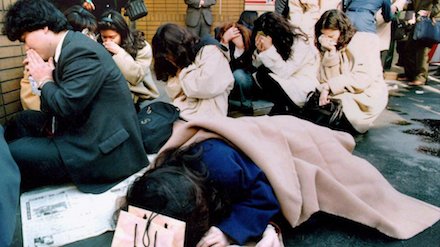
Shoko Asahara and six of his followers in the Aum Shinrikyo cult were hanged today in Japan as authors of one of the most infamous terrorist attacks in recent history: the sarin attack on the Tokyo subway of 1995.

Thirteen people died and several thousand more were injured when members of this millenial sect deposited punctured bags of homemade liquid sarin on multiple rail lines of Tokyo’s subway during Monday rush hour.

It was only one of several gas attacks perpetrated by Aum Shinrikyo during the 1990s; just nine months previous, they had killed nine people in a sarin attack in Matsumoto. But it is by far the most notorious. Images of stricken commuters, blinded and suffocating under the nerve agent’s influence, sprawled on the transit platforms or outside them shocked orderly Japan in 1995, especially so since it came fast on the heels of the devastating January 1995 Kobe earthquake.

These comprised “two of the gravest tragedies in Japan’s postwar history,” according to Haruki Murakami’s Underground: The Tokyo Gas Attack and the Japanese Psyche. “It is no exaggeration to say that there was a marked change in the Japanese consciousness ‘before’ and ‘after’ these events.” Japanese Justice Minister Yoko Kamikawa struck a similar chord in announcing the hangings today: “These crimes … plunged people not only in Japan but in other countries as well into deadly fear and shook society to its core.”

Its mastermind Shoko Asahara, the first man executed this morning, emerged soon thereafter into public view a bedraggled and half-blind fanatic, almost the picture of an agent of chaos. Shockingly, his cult had been able to thrive in the early 1990s thanks in part to murdering an attorney who was investigating Aum Shinrikyo back in 1989.

Beyond the seven hanged on July 6, 2018, six additional members of the cult still remain under sentence of death in Japan for the Tokyo subway atrocity.

On this day..

1828: William Rice but not John Montgomery, who cheated the hangman with prussic acid

(Thanks to Meaghan Good of the Charley Project for the guest post. -ed.)

Just before 6:00 a.m. on July 4, 1828, prison officers arrived at the cell of disgraced ensign John Burgh Montgomery in Newgate Prison‘s condemned hold.

They were there to escort Montgomery to his hanging. The 33­-year-­old would have been one of the last in England executed for for the crime of uttering forged notes — except that his wardens instead found him lying stone dead. With the aid of prussic acid, the counterfeiter had cheated the hangman of half his day’s prey, leaving his prospective gallows partner, thief William Rice, to face the hemp alone.

Although his guards had confiscated his razor and penknife as a routine precaution against suicide, no one had expected Montgomery to take his own life. He had pleaded guilty before the court and seemed resigned to his fate. In custody he was a model prisoner, spent his last days writing to his loved ones, and “addressed himself with great anxiety to his religious offices.”

Nobody was able to figure out how the condemned man came by enough poison to kill thirty people and how he kept it hidden, given that he and his cell were regularly searched.

The Irish-­born Montgomery, Nicola Sly records in her book Goodbye, Cruel World… A Compendium of Suicide,

was said to be a very respectable, well­-educated man, who had once held a commission in the Army. However, after inheriting a considerable fortune, he frittered it away and resorted to passing phony banknotes to support his rather dissipated lifestyle. Given his pleasing looks, gentlemanly appearance and good manners, he was very successful, since nobody thought him capable of any wrongdoing. However, he was caught after becoming careless and making the mistake of committing frequent repeated offense in a small geographical area of London.

Montgomery left behind several letters, marked by expansive tragic romanticism but no hint of suicidal intent. One letter was for the prison surgeon, asking that his body be used for dissection. He said that by this he wanted to provide some positive contribution to the public to make up for his crimes. He asked that his heart be preserved in spirits and given to his girlfriend.

To the girlfriend he wrote,

My dear idolized L.,

One more last farewell, one more last adieu to a being so much attached to the unhappy Montgomery. Oh, my dearest girl. If it had been in the power of anyone to avert my dreadful doom, your kind exertions would have been attended with such success. Oh, God, so poor Montgomery is to die on the scaffold. Oh, how dreadful have been my hours of reflection, whilst in this dreary cell.

Oh, how tottering were all my hopes; the bitterness of my reflection is bitter in the extreme. This will be forwarded to you by my kind friend Mrs. D. I should wish you to possess my writing portmanteau. Oh, I wished to have disappointed the horrid multitude who will be assembled to witness my ignominious exit. Farewell forever,

P.S. Here I kiss fervently.

The jury on the inquest into Montgomery’s death recorded a verdict of felo de se, meaning that Montgomery had willfully and knowingly taken his own life whilst of sound mind. As such, his body was buried in the graveyard of St. Sepulchre­-without-Newgate at night, and without any memorial service.

On this day..

2006: Sedley Alley

A gentleman with the interesting name of Sedley Alley was executed by lethal injection in Tennessee on this date in 2006, for the positively horrific rape-murder of Lance Corporal Suzanne Marie Collins.

True crime writer John Douglas has explored this case in Journey Into Darkness and Law & Disorder.

The ghastly crime occurred in 1985, when the 19-year-old Collins went for a jog at Millington Air Force Base; her attacker stabbed her about the head with a screwdriver and raped her with a tree branch so violently that the branch tore the young woman’s lung.

Alley’s next-day confession followed by his shifting accounts of the events led him to try a hail-mary insanity defense at trial … a surprising contrast to the innocence claim he floated late in his appeals process.

The generation-long labyrinth of judicial appeals between homicide and execution led Collins’s parents, Jack and Trudy, to become outspoken victims’ rights advocates. “There never will be closure,” Jack Collins once told a filmmaker. “What you get is a modicum of peace. You get a feeling that somebody cares. The state of Tennessee cared enough about our daughter that it carried out an execution on her killer. But no closure until the day we die.”

On this day..

1942: Gordon Cummins, the Blackout Ripper

It was a black hood for the Blackout Ripper on this date in 1942.

Charming Royal Air Force serviceman Gordon Frederick Cummins gave rein that February to a theretofore unarticulated inclination to femicide, attacking six women in the course of a single week, four of whom were killed by strangulation. The pattern of perverse post-mortem mutilations led one examiner to characterize the wanted man as “a savage sexual maniac”. This predator’s opportunistic use of the city’s protective cloak of air raid darkness reminds a similar spree perpetrated on the Berlin S-Bahn: truly, all men are brothers.

For a few days, this special horror gripped the wartime capital, so recently under enemy blitz. As fingerprint expert Frederick Cherrill, whose evidence would help to tie up Gordon Cummins’ noose, wrote in his now-out-of-print autobiography,

Women police in ordinary clothes strolled about the streets in the hope of being accosted by the unknown killer. So great was the terror which swept like a wave over the square mile in which these crimes had been committed that the regular street-walkers who haunted the area were too scared to venture out. [several of the victims were prostitutes -ed.] Small wonder, for nobody knew when or where the killer would strike again. That he would strike again seemed certain, for the lust of killing appeared to have siezed him in a merciless grip

Unlike his permanently elusive Whitechapel namesake, the Blackout Ripper was not long at his liberty once he loosed the beast within: crime scene forensics were still coming of age in this period, but the ample evolution of the bureaucratic state did for Cummins. On lucky Friday, February 13, Greta Hayward had fought off her attacker with the help of a passerby’s interruption. Cummins, when he fled, abandoned his RAF gas mask case … which was helpfully stamped with a serial number identifying its owner. He was arrested on February 16, just eight days after the start of his spree. (Scotland Yard, however, would later claim that his fingerprints connected him to two previous London murders, from October 1941.) It took a jury 35 minutes to convict him.

On this day..

1865: Thomas King, heartstabber

From the public domain History of Siskiyou County, California Illustrated with Views of Residences, Business Buildings and Natural Scenery, and Containing Portaits and Biographies of its Leading Citizens and Pioneers.

THOMAS KING.

After lying in jail two years, and receiving two trials, hoping for a release from the extreme penalty of the law until a few weeks before his death, Thomas King was executed on the twenty-third day of June, 1865, for a heartless and causeless murder, for dealing a death-blow, unprovoked and unexpected. He was born in Ireland, and when about twelve years of age, left his home because his parents had punished him for some offense. For several years he roamed about the United Kingdom, the associate of bad characters, until for the commission of
some felony he was transported to Australia.

When the Crimean war was raging, a regiment was raised among the convicts, by order of Lord Raglan, the men being given their liberty at the close of the war. In this regiment King enlisted, and after the fall of Sebastopol received his discharge. He made his way to Halifax, and from there to California, and to this county. After mining at Humbug, Scott Bar and various other places, he went to the south fork of Scott river, where he committed the terrible crime, for which the law exacted the penalty of his life.

On the second of July, 1863, having already become considerably under the influence of liquor, he entered French’s saloon, and began flourishing a knife in a threatening manner, and was deprived of it by the barkeeper. Among others in the saloon was James Duffy, who had been drinking, and whom King accused of having his knife. The accusation was denied, and upon being informed where the knife was, King demanded it from the barkeeper and it was restored to him. Throwing the weapon upon the floor and striking a tragic attitude, he exclaimed: “There lays me dagger. Whoever picks it up, dies by me hand.”

Not dreaming of danger, Duffy stooped, picked up the weapon and laid it upon the counter, saying, “You wouldn’t kill me, your best friend, would you?” “Yes, I would,” he said, as he took up the knife and made several false motions, touching Duffy’s breast with the handle, while the victim stood there smiling, unconscious of danger. Suddenly King reversed the knife, and with a, quick, hard blow, buried it deep in Duffy’s heart, the murdered man sinking to the floor with the exclamation, “You have cut me.” King made a pass with the bloody weapon at the barkeeper, and then sprang to the door and fled. The horrified witnesses of the tragedy stood for an instant in blank amazement, and then hastened in pursuit of the murderer, whom they soon overtook and secured after a slight resistance.

He remained in jail until the following February, when, after a trial lasting three days, he was found guilty of murder in the first degree, and was sentenced by Judge E. Garter to be executed Friday, March 18, 1864. An appeal to the Supreme Court gained for the condemned man a new trial, based upon the construction of a statute, and not upon the merits of the case. He was again tried in September, and was sentenced to be hanged on Friday, November 4, 1864, but an application to the Supreme Court produced a stay of proceedings until the case could be reviewed by that body. While awaiting the decision of the court, on Saturday, the eighth of February, 1865, he made a bold, and for a time, successful attempt to regain his freedom. Confined in the jail, which was the old wooden building first erected by the county, were also George Foster and Robert Ferry, both under a sentence to the penitentiary for grand larceny, and McGuire, a deserter from the army. The last named was allowed in the corridor, and was in the habit of calling for water. About eight o’clock on the night in question Foster succeeded in getting out of his cell, and after releasing the prisoners from their cells, had McGuire call for water, as usual, and when Jailor McCullough opened the door he was seized, gagged, and bound, and the prisoners escaped, having their irons still upon them. They had been gone but twenty minutes when their flight was discovered. The town was aroused, and people started in all directions in search of the fugitives. About daylight Ferry was caught at Cherry creek by John Hendricks and others. having been unable to get rid of his irons. About two o’clock Sunday afternoon William Short and Charles Brown found King in a clump of manzanita bushes, near Deming’s old brickyard, but a short distance south-west of Yreka. His long confinement of nineteen months had so weakened him that he had been unable to proceed further or to remove the irons from his limbs, although one of them he had succeeded in sawing partially through. A party composed of Livy Swan, A.V. Burns, J. Babb, A.D. Crooks, Sherman, Stone, and Groots, in pursuit of Foster and McGuire, stopped Monday night at Cherokee Mary’s, a resort for thieves, nine miles from Yreka. About four o’clock Tuesday morning the two fugitives approached the house and were ordered to surrender, and upon attempting to escape were fired upon by Jesse Sherman, with a shot gun, and Foster was wounded in the head and captured, while McGuire escaped by flight. Foster had succeeded in removing his irons, and now, severely wounded, was conveyed again to jail, while McGuire went to Fort Jones, and, finding escape impossible, gave himself up. Foster and Ferry had the terms of their sentences increased, while McGuire, who would have been released in a few days, was sent to San Quentin for two years for his little exploit in jail-breaking.

George Foster, alias Charles Mortimer, alias Charles J. Flinn, was the leader in the jail delivery, a hardened and reckless felon, and ended his career upon the scaffold. He was first sent to San Quentin from San Francisco for three years, and when his term expired, went back, chloroformed a man and robbed him of $1,800, was arrested, and escaped from officer Rose, by knocking him senseless and nearly cutting his throat. He then came to Siskiyou county, and was soon sentenced to three years for grand larceny, which term was increased to seven years for his participation in the jail delivery. After his release he continued his career of crime, finally murdering a woman in Sacramento, September 19, 1872, for which act he paid the penalty upon the gallows, not, however, until his brother lost his life in a desperate attempt to release him from the jail in which he was confined while awaiting the day of his execution.

The Supreme Court having reviewed the case and sustained the decision of the lower court, King was brought before Judge Garter in May, and was sentenced to be hanged on Friday, June 23, 1865. Preparations were accordingly made by Sheriff A.D. Crooks by erecting a gallows in the jail-yard. King’s conduct during the trials had been one of bravado and defiance, and this he maintained to the last, being quite abusive while on the scaffold. He remarked as they were leading him from his cell to the place of his death, “I’m the handsomest man here, if I am going to be hung.” But few spectators were admitted within the jail walls to witness the last act of this terrible drama, which culminated at nine minutes to two o’clock. The murderer who thus received the just punishment for the crime, nearly two years after he had plunged the fatal knife into an innocent and unsuspecting bosom, was buried a little east of town, near the remains of Crowder and Sailor Jim, executed several years before.

On this day..

1894: William Whaley, “the horror of the situation”

This ghastly description of a botched hanging comes courtesy of the out-of-print The palace of death, or, the Ohio Penitentiary Annex: A human-interest story of incarceration and execution of Ohio’s murderers, with a detailed review of the incidents connected with each case by H.M. Fogle (1908):


Chapter 19

William Whaley
June 22, 1894

A negro robber who beat out the brains of Allen Wilson, near Yellow Springs, Ohio, with a dray pin. Hanged June 22, 1894

A Brutal Robber Meets a Just Fate


William Whaley, serial number 25,257, was executed in the Ohio Penitentiary Annex twelve minutes after the birth of a new day, June 22, 1894, for the brutal murder of Allen Wilson, a thrifty and hard working colored man.

The crime was committed near Yellow Springs, Greene County, Ohio, on the night of June 6, 1893. Robbery was the motive for the crime, and a dray pin the instrument of destruction. He sneaked upon his victim in the dark, and literally beat his brains out.

Whaley was a young man not over twenty-five years of age, and with perhaps one exception, was the most profane man that was ever incarcerated in the Ohio Penitentiary Annex. He refused all spiritual consolation, and cursed his executioners almost with his dying breath. He was a cowardly cur, and betrayed his cowardice while on the scaffold. Three times he sank to his knees as the noose was being adjusted. The attending Guards were compelled each time to assist him to his feet, and finally to hold him up by main strength until the rattle of the lever shot his body through the open trap. Being almost in a total state of collapse, the body instead of plunging straight through the opening, pitched forward, striking the side of the door, thus breaking the force of the fall. For this reason the neck was not broken, and death was produced by the slow and harrowing process of strangulation.

Reader, if you have never seen a sight of this kind you cannot understand or comprehend the horror of the situation. Time after time the limbs were drawn up with a convulsive motion, and then straightened out with a jerk. The whole body quivered and shook like one might with the ague; while the most hideous and sickening sounds came from the throat. This continued for eighteen minutes; but to one looking on it seemed an age. After eighteen minutes the sounds ceased; the body became perfectly still; the limbs began to stiffen; the heart-beats to weaken. In just twenty-six minutes after the drop fell the last pulsation was felt, and the doctor solemnly said: “Warden, I pronounce the man dead.”

The outraged law had been avenged, and a soul unprepared had been ushered into Eternity.

On this day..

1890: Elizabeth and Josiah Potts, wife and husband

On this date in 1890, an affectionate married couple hanged together in Elko, Nevada, for a murder they insisted they had not authored.

We obtain this headline and the associated (nationally circulated) story from the San Diego Union of June 26, 1890.

[Associated Press Dispatches.]

ELKO, Nev., June 20. — Elko is in a ferment of excitement, many parties pouring in to witness the execution of the Potts family for the murder of Miles Fawcett in January, 1888. Over sixteen women have already applied for permits to witness the execution, which were refused.

The conduct of Mrs. Potts during the past five days has been an alternation of hysterical crying, screaming and swearing at her husband, who mopes the time away in solitude. Yesterday morning at 5 o’clock she attempted to commit suicide, gashing her wrists and trying to smother herself. The vigilance of the death watch prevented further injury but she fainted from loss of blood. Both the Potts retired early last night in a nervous condition.

At 10:30 o’clock the Sheriff read the death-warrants to Josiah and Elizabeth Potts. The reading of the warrant took place in the doorway of the latticed cell, which Josiah has occupied for so long a period.

He stood in a despondent attitude, with his head bowed down against the iron bars, and not once during the reading of the warrant did he lift his head. His wife stood erect, clad in a neat muslin suit draped in black, with a red rose in her bodice. She was pale, but with a most determined aspect in every feature. During the reading of her own warrant only once did she show any emotion whatever, and she convulsively clutched her throat when her husband’s was being read, and when the words “hanged by the neck till you are dead” were reached, she gave a hysterical gasp and seemed to exhibit much feeling.

The reading of the warrants was finished at 10:30, and both the condemned people emerged from the jail, where they had been confined for eighteen months, and proceeded outside the door to the yard between the Courthouse and jail, in which the scaffold had been erected. The sunshine relieved in a measure the gruesome surroundings. During the readings of the warrants, and evidently owing to the intense nervous strain on every one, a Deputy Sheriff was so overcome that he had to call for a glass of water.

At the conclusion of the reading Mrs. Potts earnestly ejaculated:

I AM INNOCENT AND GOD KNOWS IT,

and Josiah Potts reiterated, “God knows we are innocent.” The gloomy procession led the way through a side door and with a bravery unexpected by the sixty-odd spectators, the condemned couple seated themselves on stools provided on the scaffold, while the deputies speedily proceeded to bind them with leather straps, Mrs. Potts helping to adjust them herself while Potts sat through it all in stolidity.

When everything had been properly adjusted, they were directed to rise and all of the attendants shook hands with the condemned unfortunates. The attendants held the strap attached to Mrs. Potts’ manacled wrists and Potts made several most earnest endeavors to clasp the hands of his wife but without accomplishing it. Finally a touch on her wrist caused her to turn her eyes toward his and a mute appeal of love caused their lips to meet. As the rope was stretched around Mrs. Potts’ neck she clasped her hands together, and lifting her eyes towards the sky, exclaimed “God help me; I am innocent.”

Her husband reiterated in a hollow tone, “God knows we are innocent,” as the black caps were drawn over their heads.

The words of the clergyman who had remained with them to the last broke the silence by saying: “Put your trust in God and He will see you righted,” and then the drop fell. Instantaneously,

MRS. POTTS WAS A CORPSE,

owing to her heavy weight. Her flacid [sic] flesh caused a rupture of the carotid artery and a stream of blood burst forth from under the chin of the dead woman, staining her white raiment. To the great surprise of all who had seen Potts’ emaciated condition his vitality was great, it being a fraction over fourteen minutes, as counted by the Associated Press reporter, before life was pronounced extinct by Drs. Meiggs and Petty.

At 11:08 the body of Mrs. Potts was cut down when it was seen that her excessive weight on the five foot and a half drop had almost dissevered her head from the trunk, the muscles in the back of her neck alone supporting the connection.

About nine minutes later Josiah Potts’ body was cut down and the body of himself and wife, in the absence of any claiming friends, were deposited in the potter’s field of the Elko grave yard half an hour later.

After the interment of the bodies of Mr. and Mrs. Potts, District Attorney Love, accompanied by an Associated Press reporter, placed in the potter’s field all the remains of the murdered Fawcett known to exist above the earth. The box of bones had been in the District Attorney’s office at the Courthouse from the time when he first started to search for the criminals.

THE CRIME

for which the couple was executed was the murder of Miles Fawcett, 70 years of age, at Carlin, January 1st, 1888, because he insisted on being paid some money due from Potts. He visited Potts and this was the last seen of him until his dead body was discovered some months after by a person who rented the house formerly occupied by Potts.


That’s the end of the Union article.

Despite the incriminating circumstances of Mr. Fawcett’s disappearance, many people found the Potts’s insistence upon their innocence persuasive … especially after a last message from Elizabeth Potts reached public ears.


Laramie (Wyoming) Daily Boomerang, June 24, 1624.

Innocent or guilty, Elizabeth Potts remains the first, last, and only woman ever legally executed in Nevada. As of this writing (mid-2018) the Silver State has not had any woman on death row since Priscilla Joyce Ford died in 2005.

On this day..

1944: Seisaku Nakamura, Hamamatsu Deaf Killer

(Thanks to Meaghan Good of the Charley Project for the guest post. -ed.)

On this date in 1944, nineteen-year-old serial killer Seisaku Nakamura was hanged for a series of horrific murders in wartime Japan. He killed at least nine people, perhaps as many as eleven, many of them while he was still a minor.

Nakamura, born deaf, was ostracized by both his family and society at large for his disability. Robert Keller, in his Asian Monsters: 28 Terrifying Serial Killers from Asia and the Far East,* notes:

It has been noted that many serial killers who suffer such ostracism retreat into a fantasy world, fueled most often by revenge fantasies. This was certainly the case with Seisaku Nakamura. He developed a near obsession with the Samurai culture and enjoyed watching movies where Samurai slaughtered their victims with lethal Katana swords.


The 47 Ronin (1941).

Yet on the surface all appeared normal. Seisaku was a bright boy who excelled at school. He was polite and deferential. He endured his condition without complaint. He’d grown, too, into a tall and strapping youth.

All was not normal, however.

According to Nakamura’s later confession, he committed his first two murders on August 22, 1938, when he was only fourteen. He tried to rape two women, he said, and murdered them after they resisted. This account has never been confirmed; perhaps he was boasting, or perhaps the murders did occur and the Japanese military government kept them out of the news.

Nearly three years passed before he committed another homicide: on August 18, 1941, Nakamura stabbed a woman to death and nearly killed another. Two days later, he stabbed and hacked another three victims to death. The police had a suspect description, but hushed up the information about the crimes for fear of causing a panic.

On September 27, Nakamura got into an argument with his brother at their parents’ home. The result was a bloodbath: he stabbed his brother in the chest, turned the knife on the rest of the family, stabbing and slashing his father, sister, niece and sister-in-law. Amazingly, only Nakamura’s brother died. Questioned by the police, the survivors refused to cooperate, saying they were afraid of retribution if they named their attacker.

Nearly a year passed with no bloodshed, but on August 30, 1942, Nakamura targeted another family. He saw a young woman on the street, followed her home, where her husband and three children were. Nakamura began his attack on the mother, and when her husband tried to defend her, he stabbed them both to death. He then slaughtered their two youngest children and turned his attention to the oldest, a girl. He started to rape her, then inexplicably broke off his assault and ran away, leaving her alive.

The survivor provided a good witness description to the police, who had their eye on Nakamura already; they had come to believe the reason his family wouldn’t say who attacked them the year before was because their attacker was one of their own.

The “Hamamatsu Deaf Killer” was arrested and quickly tried, found guilty, and sentenced to death in spite of his youth and the parade of witnesses ready to say he was insane.

Little is known about him and his crimes, as Japanese government suppressed most of the information.

* As we’ve previously noted, we cite the titles, we don’t write the titles.

On this day..

1581: Christman Genipperteinga

June 17 of 1581 was the alleged condemnation date — the best specific calendar date we have — for the German robber/murderer Christman Genipperteinga or Gniperdoliga, who was broken on the wheel for a reported 964 murders.


See? June 17.

A 1581 pamphlet “Erschröckliche newe Zeytung Von einem Mörder Christman genandt” is the earliest account we have of our inaptly named Christman (German Wikipedia entry | the surprisingly much more detailed English), and even this first source supplies us the seemingly outlandish body count.

Our man is supposed to have made a lair in the Rhineland wilds from which he preyed on German and French travelers, and even turned murderer of other bandits after partnering with them.

We of course lack any means to verify independently this murder toll exceeding six per month throughout the whole of his thirteen-year career; if we’re honest about it, we’re a little light on verification that this guy wasn’t a tall tale from the jump. Whether or not he really drew breath, or profited from the pre-modern propensity to overcounting bodies, his fame was certainly magnified by the burgeoning print culture … and its burgeoning fascination with crime. Joy Wiltenburg in Crime & Culture in Early Modern Germany:

It was in the 1570s that reports of robber bands multiplied, reaching a peak in the 1580s and continuing in lower numbers into the seventeenth century. Accounts of such activity were far-flung, from Moravia in the modern Czech Republic to Lucerne in Switzerland and from Wurttemberg in southwestern Germany to Bremen in the north. Although violence and malevolent magic were the most sensational aspects of the bands’ reported activities, stealing was central to their existence.

Even among these ubiquitous broadsheet outlaws, Christman Genipperteinga’s near-millennium stuck in the public imagination.

As years passed, the story has resurfaced in chronicles, histories, and popular lore running all the way down to our present era of listicle clickbait … and they’ve all somehow made this monster into an even more sinister figure than a mere nongenti sexagintuple slayer. Dubious evolutions include:

  • Genipperteinga kidnapping a woman and forcing her to become his mistress, murdering all the children they produced. (She subsequently betrays him to the authorities by arranging to leave a trail of peas to lead them to his hideout.)
  • Genipperteinga cannibalizing his victims, including his own infants.
  • And, Genipperteinga having literal supernatural powers (invisibility, congress with dwarven artificers).

For a larger-than-life criminal, a longer-than-death execution. The story goes that our Christman endured nine agonizing days on the breaking-wheel, his tormentors fortifying him with hearty drinks every day in order to prolong his sufferings.

Again, this real or fanciful detail profits by comparison to the trends in enforcement emerging to meet the social panic over crime. This was a period when Europe saw the death penalty flourish both in terms of its violent spectacle and, as Wiltenburg notes, its raw frequency:

There is some evidence that the swell in crime reports in the later decades of the sixteenth century coincided with a time of generally intense prosecution. According to figures compiled by Gerd Schwerhoff, a number of localities had especially high levels of execution in this period. Augsburg, for example, shows a distinct rise in the proportion of criminals executed in the last four decades of the sixteenth century — double or more the proportions of the preceding and following periods. Nuremberg too had a substantial rise in the last decades of the sixteenth century, with lower numbers before and much lower figures by the mid-seventeenth century. Zurich similarly executed a much higher proportion in the sixteenth century than in the fifteenth or the seventeenth, although its figures are not broken down by decade.

On this day..