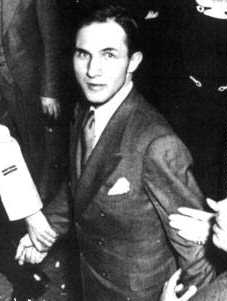
1979: John Spenkelink, the harbinger

On this date in 1979, John Spenkelink was electrocuted in Florida — the first man executed involuntarily in the U.S. since 1967.

A series of court decisions in the 1970’s had scrapped the country’s old death penalty institutions and obliged legislators to restructure the process. Now, the new architecture was in place and the decade-long hiatus in actual executions was drawing to a close.

Gary Gilmore had earned trivia-question notoriety as the first put to death under the new regime two years before, but Gilmore was always an outlier, a bizarrely active exponent of his own death who greased the skids for himself.

Spenkelink was the true harbinger. For six years, a span which seemed long then but would today rate on the speedy side, Spenkelink resisted death with every tool at his disposal. Florida officials fought just as stubbornly to kill him.

An itinerant parolee, he had in 1973 shot a fellow drifter named Joseph J. Szymankiewicz.

Spenkelink claimed that Szymankiewicz had stolen his money, forced him to play Russian roulette, and sexually assaulted him, all of which seemed within the vicious character attested of the victim. But the killing itself was clearly not a moment of passion or immediate self-defense: Spenkelink had left their shared hotel room, returned with a gun, and shot his man in the back.

In the new Court-mandated balancing act between “aggravating” and “mitigating” factors whose intent was to harmonize unfair application of the death penalty, this evident premeditation is what doomed Spenkelink. (The fact that Spenkelink committed the crime for pecuniary gain — that is, to get back his own money — also militated against him. The Clark County (Ind.) Prosecutor’s site has some legal briefs in addition to media reports on the case.)

In the larger reality not circumscribed by legal briefs, the defendant wasn’t exactly Charles Manson. More considerable than the act itself was where it occurred (North Florida) and the rootless, friendless character of its author — a “white nigger”. As Florida Supreme Court Justice Richard Ervin put it:

As usual under “discretion,’ it is left to sentencing judges to determine in particular cases who will get death. We know intuitively who will: the poor, the underprivileged, the public defender clients, the blacks and other minority people, the mentally incompetent or those holding unpopular or unorthodox ideologies. The affluent usually escape the death penalty.

The result here is an old story, often repeated in this jurisdiction where the subconscious prejudices and local mores outweigh humane, civilized understanding when certain segments of the population are up for sentencing for murder.

Or in Spenkelink’s epigram, which he often signed to prison correspondence, “capital punishment means those without capital get the punishment.”

The last of his 22 appeals* was rejected by the Supreme Court this very day. Ten minutes later, trussed hand and foot with each of his orifices stopped up and two shots of whiskey for the ride, Spenkelink was presented in Old Sparky to the event’s official witnesses.** It had been 15 years since the chair’s last use; prison officials didn’t remember how to operate it — but they managed to pull it off with no more than the electric chair’s average ration of gruesomeness.

Five minutes later, Spenkelink was declared dead — and the death penalty was back in America.†

* Filed by David Kendall, later to gain a measure of fame as Bill Clinton’s personal attorney during his impeachment.

** Spenkelink was gagged when the blinds were opened to the witnesses, and denied a final statement (his famous bon mot about those without the capital is sometimes mistakenly reported as his last words). Since the witnesses had not seen the prisoner brought in, rumors spread that he had fought the guards, even that his neck had been broken in the altercation and that he was dead or dying by the time the first 2,250-volt jolt hit him. This rumor in turn caused the state not only to exhume and autopsy Spenkelink, but to institute a policy of autopsying all executed prisoners … and the documentary trail created by this policy contributed to the Sunshine State’s later legal and public relations headaches with its execution protocols.

† Executions would remain freak events — one or two a year — until the mid-1980’s when they finally resumed taking place with regularity sufficient to return them to the everyday fabric of American life.

On this day..

1917: Dr. Arthur Waite, the Playboy Poisoner

On this date in 1917, a 29-year-old former dentist took a seat in Sing Sing’s electric chair — his poisoning career nipped in the bud by woman’s intuition.

Here’s the scenario, as sketched in the rip-roaring Criminal Poisoning: Investigational Guide for Law Enforcement, Toxicologists, Forensic Scientists, and Attorneys (I’ve added paragraph breaks for ease on the eyes):

The first dentist in our collection, Dr. Waite, was a good looking raconteur, who most likely preferred playing tennis to practicing dentistry. He grew up in Grand Rapids, Michigan, and after graduating from dental school went to South Africa to practice. Waite eventually left Africa under some suspicious accusations and returned to Michigan, where he wooed and married the daughter of John and Hannah Peck.

John Peck was a millionaire pharmacist who owned a reputable drug company in the city. The newlyweds were furnished with posh accommodations in New York City by the grateful Pecks. There, Arthur spent much of his time dabbling in the area of bacteriology, and also took on a mistress.

In January 1916, shortly after Hannah Peck arrived to visit the Waits in New York, she suddenly became ill and died. Her body was immediately cremated and returned to Michigan for burial. In March of the same year, John Peck also went to New York to console his daughter and her husband over the death of his wife. He too soon became ill and died. However, before his body could be cremated an anonymous telegram was received in Grand Rapids stating “suspicion aroused, demand autopsy.” Surprisingly, the autopsy indicated that John Peck was loaded with arsenic, and an investigation ensued.

The accusing finger eventually pointed to the playboy dentist, and he was taken in for interrogation. A search of his dwelling revealed numerous bacterial cultures, as well as texts dealing with toxicology. Under interrogation, Dr. Waite changed his story numerous times. First he stated that he had obtained arsenic for his father-in-law, who wanted to commit suicide to end his grief over the loss of his wife. Then Dr. Waite claimed his own body was inhabited by the spirit of an evil Egyptian priest, who had instructed him to kill his in-laws in order to gain their wealth. Eventually, Dr. Waite felt if he told what had actually happened the courts would find him insane, so he revealed the whole story of administering typhoid, pneumonia, diphtheria organisms, and arsenic while the Peck’s [sic] were undergoing work in his dental chair.

It did not take the jury long to see through the manipulations of Dr. Waite, and they convicted him of the murders. Dr. Waite was electrocuted at Sing Sing Prison on May 24, 1917.

That decisive anonymous tip, it emerged, came from a New Jersey schoolteacher named Elizabeth Hardwick, whose father, one Dr. Cornell, was cousin to the victim. Here’s how the New York Times reported it (pdf) a few years later, ruminating on the chancy breaks that sometimes solve criminal cases:

The day after Mr. Peck’s death, Dr. Cornell called at the Waite apartment to pay his respects. Waite, with the Peck millions almost in his hands, forgot his suavity for a moment and greeted his father-in-law’s cousin so rudely that Dr. Cornell was hurt. At home that night the doctor expressed his amazement at the demeanor of the erstwhile gracious Waite.

This set the seal on the suspicions which Miss Hardwick had always harbored. Saying nothing to any one she hurried to the telegraph office and sent a telegram to Percy Peck, the murdered man’s son, in Grand Rapids.

“This case,” said Commissioner Faurot, “was interesting because a woman’s intuition seized upon a moment’s carelessness on the part of one of the most fiendish murderers in police records to undo the criminal. Without her, the authorities never would have investigated the case. Waite certainly would have murdered his wife and perhaps others before he got through.”

Long forgotten now, Waite — who had smooth-talked his way into New York society seemingly with designs of cutting a swath of bodies through it* — made quite the infamous figure in his day. This Times article (pdf again) from days after his arrest suggests a whiff of the case’s sensation to contemporaries.

* The authorities, who naturally had no incentive to downplay the menace of their killer, figured his wife, his mistress and his mistress’ husband were next in line — though there was also no obvious way Waite could have cashed in on the latter two.

On this day..

1936: Bruno Richard Hauptmann, The Most Hated Man in the World

On this date in 1936, a German immigrant went to New Jersey’s electric chair for kidnapping and murdering the infant son of famed aviator Charles Lindbergh.

Snatched

The kidnapping of the Lindbergh boy in 1932 had touched off an outpouring of public compassion matched only by the clumsiness of the investigation. The circus that formed around a father desperate to retrieve his boy — and prone to rash decision-making thereto — pulled in underworld figures, military intelligence officers (including the founder of the CIA’s forerunner and the father of Gulf War General Norman Schwartzkopf), a meddlesome schoolteacher, and queer characters like “Cemetery John,” who somehow managed two meetings with Lindbergh’s intermediaries, making off with a box full of ransom cash without anyone so much as tailing him, much less having to fork over the hostage.

The boy, in fact, was dead, and would be discovered weeks later, a few miles from the Lindbergh house, in such a state of decomposition as to suggest that, by accident or intention, he had suffered a fatal head injury almost at the moment of his abduction.

Two years’ fruitless investigation ensued, with leads that frustratingly faded away and at least two suspects who committed suicide. The police job had been a hash from the start, between amateurish cock-ups like failing to measure footprints found on the scene and security breaches in the chaotic weeks following the kidnapping. Most damagingly, a newspaper laid hands on an early ransom note and printed it, making it impossible subsequently to positively discern the kidnapper’s real notes from hoaxes.

But John Law had done one thing right: paid the ransom in soon-to-be-obsolete gold certificate. As they’d hoped, someone was finally caught spending this distinctive currency: Bruno Hauptmann.

Hauptmann actually went by “Richard”, but with its unerring sense of the Zeitgeist, the press played up his menacing alien moniker. After two and a half years, the public was ready to hate someone, and an illegal immigrant with a criminal record* from the late war’s great enemy was pretty much made to order.

Trial of the Century

The one thing Hauptmann didn’t do was confess — and that necessitated the “Trial of the Century,” or in Mencken’s coinage, “the greatest story since the Resurrection.”

It was O.J. before 24-hour cable. Journalists packed the small-town courtroom of Flemington, N.J.; for six weeks early in 1935, an aggressive prosecutor vied with a flamboyant (but cripplingly dissolute) defense attorney hired for the penurious defendant by the Hearst newspaper empire in exchange for inside information.

This newsreel footage of the trial consists mostly of Hauptmann’s own testimony, and even at seventy-plus years’ distance it crackles with drama — and with the persecutorial atmosphere that sealed Hauptmann’s fate, guilty or not. (The defendant often sounds uncertain and evasive in these clips — it cannot have helped his standing with the jury, but it is worth recalling that English was not his native language.)

History’s Verdict

The case was circumstantial, the most powerful circumstance, of course, being Hauptmann’s possession of ransom money — thousands of dollars worth, as it turned out, stashed in his garage. Hauptmann said a friend had left it when returning to Germany; the alibi didn’t convince many, but Hauptmann stuck to it to the end, even refusing to accept a commutation in exchange for a confession. This audio of a convicted Hauptmann still maintaining his innocence comes from the New Jersey Star-Ledger blog.

[audio:Bruno_Hauptmann.mp3]

Much other evidence against him — shaky eyewitness testimony, doubtful courtroom forensics — seems less damning, especially from the perspective of time. Unexplored problems — why would a professional carpenter build such a shoddy ladder? How could he have known the (rare) night the Lindberghs would actually be home? — gesture emptily towards other suspects never pursued, though they are very far from authoritatively exonerating Hauptmann. Ultimately, it’s a case with many unclear data points, whose importance and configuration invite dispute. (Here‘s a site dedicated to Hauptmann’s innocence, including this article (.pdf) outlining the main arguments his partisans make.)

Even the verdict’s defenders, and there are many, concede that portions at trial were exaggerated or outright perjured in an atmosphere hardly conducive to dispassionate review. Whether that makes Hauptmann “guilty but framed” or plausibly innocent (of the kidnapping, if not of opportunistic extortion) has been the subject of far more rumination than this blog can hope to assay.

A few of the many books about the Lindbergh case

An enigmatic criminal tied to an enigmatic icon in a painfully public four-year drama that transfixed the nation and still inspires debate: that “Trial of the Century” marquee holds up pretty well.

* In Germany; Hauptmann’s record was clean stateside — apart, that is, from Charles Lindbergh, Jr.

On this day..

1933: Giuseppe Zangara, who is not on Sons of Italy posters

On this date in 1933, Giuseppe Zangara went to Florida’s electric chair for the murder of Chicago mayor Anton Cermak — the man he had accidentally shot while attempting to assassinate President-elect Franklin Delano Roosevelt.

Zangara had to stand on a chair to take the shot: he was only five feet tall. This image is from Miami Police of Yesterday, a site by a descendant of one of the officers who arrested Zangara.

A strange and strangely forgotten man, the Italian immigrant came within inches of dramatically altering American history.

On February 15, 1933, at a Roosevelt speech in Miami’s Bayfront Park, Zangara perched himself on a metal folding chair within ten meters of the man who was then President-elect, but somehow managed to miss him. A bystander, Lillian Cross, grabbed his arm, and others in the crowd wrestled him down.

Certainly Zangara would be better remembered if he had shot Roosevelt (and Roosevelt would be very much less remembered), but his head-scratching persona accounts for at least some of his obscurity.

He’s sometimes called an anarchist — the early 20th-century equivalent of calling him a terrorist — and he talked the talk. Here, his last words:

You give me electric chair. I no afraid of that chair! You one of capitalists. You is crook man too. Put me in electric chair. I no care! Get to hell out of here, you son of a bitch [said to the chaplain] … I go sit down all by myself… Viva Italia! Goodbye to all poor peoples everywhere!… Lousy capitalists! No picture! Capitalists! No one here to take my picture. All capitalists lousy bunch of crooks. Go ahead. Pusha da button!

Zangara was a working-class immigrant. But his specific motivation for murdering Roosevelt seems murky at best — there’s no clear subversive organization or cause with which Zangara seemed a dedicated fellow-traveler. The wikipedia page about him describes his lifelong stomach pains as the cause of his act, which seems a queer thing to make a fellow shoot a president.

The major conspiracy proposal, that the anti-mob mayor Cermak was the real target all along of a mafia-engineered hit (here (.doc) is a version) is highly speculative, to put it generously. (Update: More on this here, via Chicagoland) Certainly Zangara might have been, as he claimed and most believe, a lone nut — many have done worse for less cause.

The world didn’t have long to unravel this man’s mysteries; justice moved with a rapidity terrifying even by the standards of the time — as reflected in the title of one of the books about him, The Five Weeks of Giuseppe Zangara.

Zangara had already been sentenced to a long prison term for the several bystanders his errant shots had struck when Anton Cermak finally succumbed — after 19 painful days — to a gut shot. Two weeks after that, his killer was dead, too.

During his first trial, the judge pressed him on his motivation, as reported in a press clipping that became part of Zangara’s FBI file:

Q. Have you ever been in jail before? Ever been in any trouble?

A. No, this is the first time.

Q. Did you ever hurt anyone before?

A. No, me no hurt anyone.

Q. Did you plan this shooting?

A. No.

Q. When did you decide to do it?

A. I got it in my mind capitalist hurt people. They are to blame for my stomach hurting. My stomach was hurting bad. It was like I was on fire. It burns my mind, I act like a drunken man. It came in my mind when I was suffering.

At this trial — the one before Cermak died — he pled unsuccessfully for execution: “I am sorry only because I did not kill. I am sorry about nothing. Put me in the electric chair.” It reads like “suicide by cop”.

Zangara might not be a name of Oswaldesque dimensions among the assassinariat, but he comes in for a scene in Stephen Sondheim’s strange musical theater, Assassins.

Officially, Zangara was punished for the man he killed, not the soon-to-be-President he was (presumably) aiming at. But such a close scrape for such a transformative American leader, a man sometimes credited with saving capitalism from itself in an age of crisis, has made Zangara’s one famous act fodder for alternative history that asks the question “what might have been?”

On this day..

1942: Frank Abbandando and Harry Maione, mob hitmen

On this date in 1942, mobsters Frank Abbandando and Harry Maione were electrocuted in New York’s Sing Sing prison for murder.

The two had risen together from an Ocean Hill, Brooklyn, gang to help weld together Murder, Inc. in the 1930’s — which, as its press-conferred moniker suggested, executed hits for the mob.

Dozens of corpses were left in their trail, and it was long odds that the spectacularly mangled body of a minor loan shark and suspected police informant killed in 1937 would be the one to haunt them. But when the government brought the heat against Murder, Inc., a collaborator in that hit turned state’s evidence and testified against Abbandando and Maione.

Pep has an ice pick. Happer has meat cleaver. It is the kind you chop with, you know, butcher cleaver. Abby grabs Rudnick by the feet and drags him over to the car. Pep and Happy grab it by the head. They put it in the car. Somebody says “It don’t fit.” Just as they push the body in it gives a little cough or something. With that, Pep starts with the ice pick and starts punching away at Whitey. Maione says “Let me hit the bastard one for luck.” And he hits him with the cleaver some place on the head.

Convicting mobsters was no mean feat — after all, they tended to whack informants — and the arrogant Abbandando in particular was shocked that his powerful connections didn’t manage to rig the trial.

But he and Maione were not altogether bereft of underworld consolation in their hour of need.

Three months before they were electrocuted, the stool pigeon in their trial “fell” to his death from a New York hotel room. It was just hours before he was to testify against Cosa Nostra boss Albert Anastasia, who would escape his fortuitously weakened prosecutors and eventually take over Murder, Inc., in its mid-1940’s twilight.

On this day..

1963: Ralph Hudson, the last man executed in New Jersey

On this date in 1963, Ralph Hudson was electrocuted in New Jersey for stabbing to death his estranged wife.

It was to be the last execution in New Jersey.

No prisoner has been put to death in the Garden State these past 45 years. And last month, New Jersey became the first state to abolish the death penalty legislatively since Iowa and West Virginia did so in 1965.

Whether the move will be a sign of things to come remains to be seen.

In 2005 — the death penalty’s future has been debated in New Jersey for some time — the former governor’s stepson remembered the toll this day’s event exacted from its participants.

In 1963, the year in which New Jersey last employed the death penalty, I was an adolescent. My late stepfather, Governor Richard J. Hughes, found himself in the position of Chief Executive with the power to end or continue the life of a fellow human being. Years later he told me how tortuous it was to be thrust into that role.

The last execution in New Jersey, of Ralph Hudson in 1963 for the murder of his wife Myrtle, was carried out during my father’s administration. The painful decision to allow Hudson’s execution to go forward profoundly impacted him.

Time has shed light on the impact of the Hudson execution that cold January day in 1963. Hudson’s attorney never accepted another death penalty case. Seeing his client go to the execution chamber had exacted too great an emotional toll. Many years later Hudson’s executioner, Dow P. Hover, borrowed from New York, was discovered dead in his Plymouth, the engine running and the window open – in a closed garage.

On this day..

1936: Albert Fish

On this date in 1936, serial killer Albert Fish was electrocuted in New York’s Sing Sing Prison for a cannibalistic murder.

The deeply troubled Fish“deranged, but sane”, the doctors thought him — was condemned for murdering and eating a 10-year-old girl.

He was free and clear of the crime until, seven years later, he sent the child’s parents a grotesque taunting letter* that ultimately led police back to its author.

From posting that note to riding the lightning was a bare 14 months, but Fish found time to confess to additional murders (and deny others — the doubtful relationship of any Fish statement to reality makes it difficult to pin down his criminal career exactly).

The newspapers called him “The Werewolf of Wysteria” and “The Brooklyn Vampire”; if as a serial killer he was far from the most prolific, the thoroughgoing strangeness of his mind has made him, at least to some, enduringly fascinating** — as this documentary trailer suggests:

A 2007 feature film, The Grey Man, is also based on Fish’s exploits.

* The mother was illiterate, and her son had to read aloud to her Fish’s descriptions of cannibalism.

** Others find him less than interesting

Part of the Themed Set: The Spectacle of Private Execution in America.

On this day..

1943: Sue Logue, George Logue and Clarence Bagwell

On this date in 1943, as the New York Times laconically led the story, “[t]wo men and a woman died in the electric chair … bringing to eight the number of deaths in ‘The Logue Case,’ which started over a dead calf.”

This culmination to an operatic South Carolina feud has a book all its own, and that scarcely seems equal to the events.

The dead calf in question* belonged to the Logue family, and (your headsman wouldn’t make this up) had been kicked to death by a mule of the neighboring Timmermans. Perhaps mistaking themselves for a cartoon parody, the two leading families of rural Edgefield County, S.C., used the incident to escalate a long-simmering feud.

Killing higher up the food chain soon followed.

The Timmerman patriarch wasted the Logue patriarch — Sue Logue’s husband and George Logue’s brother — but claimed self-defense and was acquitted. (Body Count: 1)

So Sue and George hired (via nephew Joe Frank Logue) a down-on-his-luck plasterer to even the score. Clarence Bagwell said he’d kill everyone in the county for $500, but he earned his fee just by gunning down old man Timmerman. (Body Count: 2)

The investigation brought the law to the Logue doorstep, and the requisite gun battle ensued. A sharecropper on the farm was killed. So was the sheriff — he was Sue Logue’s cousin — and the sheriff’s deputy. (Body Count: 5)

“[T]he only circuit court judge in South Carolina history to have made love to a condemned murderess as she was being transferred … to Death Row.” (Source)

The officers’ death necessitated the appearance of the man who now became the senior law enforcement official in the county: Strom Thurmond, still a local judge and a few years away from his vault into national prominence as a segregationist presidential candidate and 46-year South Carolina Senator.

Thurmond waded through the posse and talked the trio into surrendering. His warning that they were liable to be lynched must have been compelling in any circumstance, but the old goat was a uniquely qualified ambassador: he’d been having an affair with Sue Logue.

Small wonder the trial venue was moved. “[N]o section of the county could be found that did not include a relative of theirs.” (Source)

And small good it did the Logues, who died with their hireling in the early morning hours this day. (Body Count: 8)

For such an outlandish case, it earned only muted national coverage — a pittance reckoned against the feeding frenzy latterly occasioned by such relatively meager gruel as Scott Peterson. World War II stole its thunder, although local interest was intense.

Yet it lives on for the involvement of Thurmond in a second guise that rates as quite possibly the juiciest slice of death row gossip in American history. According to Ol’ Strom: An Unauthorized Biography of Strom Thurmond:

Randall Johnson, a black man who supervised “colored help” at the State House and often served as driver and messenger, drove Sue from the women’s penitentiary to the death house at the main penitentiary in Columbia.** In the back seat with her, he said many years later, was Thurmond, then an Army officer on active duty. They were “a-huggin’ and a-kissin’ the whole day,” said Johnson, whom Thurmond later as governor considered a trusted driver… In whispered “graveyard talk” — the kind of stories not to be told outsiders — the word around SLED (State Law Enforcement Division) was that Joe Frank said his aunt Sue was the only person seduced on the way to the electric chair.

* A “prize calf,” to be fair.

** On Christmas Day, according to Dorn.

Part of the Themed Set: The Spectacle of Private Execution in America.

On this day..

1911: Charles Justice

On this date in 1911, Charles Justice was electrocuted by the State of Ohio.

It was an ironic end, since when serving an earlier stint in the state penitentiary shortly after the electric chair was introduced, Justice had hit upon the idea of metal clamps in place of leather straps to more securely hold down the chair’s clientele and avoid burnt flesh.

The improvement, duly implemented, was there awaiting its creator.

On this day..