1928: Ruth Snyder and Judd Gray

On this date in 1928, a suburban femme fatale and the corset salesman who had murdered her husband were electrocuted at Sing Sing prison.

“A cheap crime involving cheap people,” one writer called it.

“Ruthless Ruth,” as the press inevitably called her, was on the wrong side of 30 and married to a wet blanket on the wrong side of 40 from whom she couldn’t even get away during the day because they worked for the same boating magazine.

The banal hell of the bourgeoisie.

Ruth had a banal solution: commence affair with handsome, limp-willed corset salesman (also married) from New Jersey.

Given a large enough metropolis with a large enough pool of adulterous data points, it must be statistically inexorable that a certain proportion will resolve the love triangle by throttling the cuckold with a wire.

But only that remorseless calculator in the sky can compute why these two, of all those thousands, were the ones not to run off together, or let the affair fizzle, or just continue to rendezvous indefinitely into the future. They certainly weren’t constitutionally cut out for crime; they set up the room in a poor simulacrum of a robbery, and told of a couple of unknown Italians* who’d broke in and done poor Albert Snyder to death.

For their poor judgment and for the speedy collapse of their crummy alibi, journalism owes them a debt of gratitude.

The execution of a woman was quite sensational; Ruth Snyder was to be the first electrocuted since 1899.

For the occasion, The New York Daily News hired a Chicago Tribune journalist to witness the execution … and at the moment the current struck, Tom Howard hoisted his pant leg and secretly snapped with a one-use camera one of the most indelible images the death chamber offered the 20th century, to be splashed in a few hours’ time on the Daily News‘ cover under the headline

DEAD!

The Snyder-Gray adulterous melodrama and its violent conclusion inspired novelist James Cain‘s Double Indemnity, and the noir film of the same title with Barbara Stanwyck as the black widow at the center of the web.

It also inspired the state of New York to begin searching official witnesses to its electrocutions.

* Blame-the-Italians here is a Roaring Twenties Queens version of fingering the black man. The murder was committed in May 1927, just as the Sacco and Vanzetti case was approaching its climax.

On this day..

1903: William Ennis, wife-murdering cop

On this date in 1903, a nine-year veteran of the Brooklyn police became the first member of the thin blue line to die in the electric chair.

Then 31-year-old William Ennis had gunned down his estranged wife (and, not fatally, his mother-in-law) early the preceding year, and his attempt to claim insanity at trial was rejected as shamming.

This slice of New York color is the second story in this New York Times column reporting the day after the crime.

While in a frenzy of rage, as a result of heavy drinking and brooding over family troubles, William H. Ennis, a policeman attached to the Adams Street Station, Brooklyn, early yesterday morning broke into the hime [sic] of Mrs. Alice Gorman, his mother-in-law, in Canarsie, wounded her seriously with a bullet from his revolver, and then shot and killed his wife, who was living there.

He then rushed from the house and ran along the railroad tracks to East New York, two miles distant, where he was found asleep in a room in a hotel by the police several hours later. …

Two weeks ago Mrs. Ennis had her husband in court on a charge of non-support, and he was ordered to pay her a weekly stipend. At that time Ennis declared that he would “rot in jail” before he would pay his wife any money unless she left her mother’s house and returned to live with him. …

Early on Saturday morning he reported sick at Adams Street Station and was excused from duty. It was learned that he came to Manhattan and in the evening was arrested at Forty-second Street and First Avenue for intoxication and disorderly conduct, but at the East Thirty-fifth Street Station was allowed to go when it was found that he was a policeman.

On this day..

1984: Alpha Otis O’Daniel Stephens: hear it live

On this date in 1984, Alpha Otis O’Daniel Stephens was electrocuted in Georgia for the execution-style murder of Roy Asbell after the latter surprised Stephens in the course of a burglary.

Stephens makes these pages for two reasons:

First, he survived his initial electrocution, requiring a second application of the lethal current — awful, though not exactly unheard-of.

Second, it emerged years later that the Georgia Department of Corrections was making audio recordings of its executions as a secret archive of the proceedings.

Several hours’ worth of these (subsequently leaked) recordings from various different Georgia electrocutions are available at SoundPortraits.org.*

We begin our trip back in time to Georgia’s execution chamber with the atmospheric sound of the warrant for his execution being read to the condemned and the witness — nicely juxtaposing the sentence of death with the body responsible for administering it: the Georgia Department of Offender Rehabilitation.

[audio:Alpha_Otis_O’Daniel_Stephens_warrant.mp3]

But the real action is the sound behind the curtain as prison officials realize the electrocution has not killed their man, wait agonizing minutes for the still-living body to cool enough for doctors to examine it officially, and begin the execution cycle anew. From the sound of it, they only barely killed him with the second pass: the officials are worrying openly that it looks like he’s still breathing very late in the procedure.

This file, obviously, comes with a content advisory sticker — though it lacks any directly identifiable hideous sound from the chair, or the prisoner, or the witnesses, the routine narrative of a prison bureaucrat as a man dies dreadfully in the next room is an altogether different order of horror.

[audio:Alpha_Otis_O’Daniel_Stephens_botched_execution.mp3]

This audio file was helpfully clipped by Dysfunctional Playground from the Pacifica radio Democracy Now! broadcast which aired it; the clip is itself an abridged version of a 20-minute original with long silences and unintelligible content excised.

The transcript of the abridged clip as aired by Democracy Now! follows below. Willis Marable, the main speaker on the tapes, was an assistant warden.


UNIDENTIFIED: Carry out the execution by the order of the court. There’s no reason to delay.

UNIDENTIFIED: Very well. On my count of three, press your buttons. One, two, three.

WILLIS MARABLE: The execution now has begun. There was one small jerk from the condemned at the time the execution was initiated. He is sitting very still now, and we are also now into the second phase of the execution. We are now into the third phase of the execution. No movement from the condemned. No activity, no movement from the witnesses. He appears to be relaxing a little bit more now. There’s sixty seconds remaining on the third phase of the execution. There is a slight movement from the condemned’s head. He seems to be moving his head from side to side slightly.

UNIDENTIFIED: I show the time is 12:19.

WILLIS MARABLE: Commissioner, he is still moving his head, and he seems to have slumped down in a relaxing-type position in the chair. But his head is moving from side to side slightly. Commissioner, Mr. Low, the execution is completed at this time. The electrical panel box is secured and locked. I do not detect any movement from the condemned at this time. He seems to have stopped moving his head and also his arms.

UNIDENTIFIED: I show the time is 12:20.

UNIDENTIFIED: You are in the lapse time countdown, is that correct?

WILLIS MARABLE: Yes, sir. We’re into the first minute of the lapse time now. No movement from any of the witnesses, and at this time no movement from the condemned. We have now completed one minute of lapsed time, four minutes remaining. Two minutes of lapsed time completed at this time, three minutes remaining. Still very little movement from any of the witnesses, and I detect no movement from the condemned at this time.

UNIDENTIFIED: I show the time is 12:22.

WILLIS MARABLE: Commissioner?

COMMISSIONER: Yes?

WILLIS MARABLE: Mr. Low?

COLONEL LOW: Yes.

WILLIS MARABLE: There is some slight movement. He’s still moving his head slightly. The only thing we can do is continue until the physicians can check him after the lapse time has expired.

COLONEL LOW: Don’t vary from your checklist.

WILLIS MARABLE: OK, sir. OK, we have completed three minutes of lapsed time, two minutes remaining. Commissioner? Mr. Low?

COLONEL LOW: Yes.

WILLIS MARABLE: He is still moving his head slightly, kind of a bobbing up-and-down movement. Commissioner?

COMMISSIONER: Yes.

WILLIS MARABLE: Mr. Low? We have completed four minutes of lapsed time. We have one minute remaining. And from my vantage point I do detect or it seems to be that he is breathing. Commissioner? Mr. Low? We have completed the five minutes lapsed time. Stand by for the physicians’ check. Commissioner?

COMMISSIONER: Yes?

WILLIS MARABLE: It appears the doctors agree with me that he’s still breathing. You want us to check him and then go through it again, or just go ahead and go through it again?

COMMISSIONER: Check him, and then go through it again. Definitely check him. Don’t vary from the checklist.

WILLIS MARABLE: Alright.

COMMISSIONER: Have them check him.

WILLIS MARABLE: OK. [inaudible] We’re going to do it again?

UNIDENTIFIED: It doesn’t say so.

WILLIS MARABLE: OK.

UNIDENTIFIED: It remains on.

WILLIS MARABLE: OK.

UNIDENTIFIED: The time is 12:26 and thirty seconds.

WILLIS MARABLE: Commissioner?

COMMISSIONER: Yes.

WILLIS MARABLE: The doctors have verified that he is still alive.

COMMISSIONER: Repeat the execution.

WILLIS MARABLE: Very well. You ready to go again?

COMMISSIONER: Better check all the connections. Val?

VAL: Yes, sir.

COMMISSIONER: Did you tell the witnesses that you’re repeating?

VAL: No, I didn’t.

COMMISSIONER: I think you should tell them.

VAL: OK. You want me to just advise them that—

COMMISSIONER: Just advise them—

VAL:—repeating the process and not go into any detail?

COMMISSIONER: That’s right.

VAL: OK.

WILLIS MARABLE: Commissioner? The superintendent is entering the execution chamber and approaching the mic at this time to advise the witnesses that we will proceed again with the execution.

COMMISSIONER: Well, listen, you can’t tell them—tell them there were some vital signs remaining, so the execution will repeat. See if you can get that message to them.

WILLIS MARABLE: It’s too late now. He’s already briefed them, and he’s on the way back in, sir.

COMMISSIONER: Fine, alright.

UNIDENTIFIED: I show the time is 12:28.

UNIDENTIFIED: OK, Commissioner, we’ll proceed at this time.

COMMISSIONER: Proceed.

UNIDENTIFIED: On my count of three, you press your button. One, two, three.

WILLIS MARABLE: Commissioner? Mr. Low? The execution is initiated again at this time. The condemned made one big jerk, and now he is relaxing in the chair. I do not detect any other movement from the condemned at this time. We have completed the first and second phase of the execution. We are now into the third phase. I do detect his head moving from side to side again. We’re still into the third phase of the execution. Commissioner? Mr. Low?

COMMISSIONER: Yes.

WILLIS MARABLE: He is still at this time moving his head from side to side and appears to be breathing. We’ll continue it just like we did previously.

UNIDENTIFIED: We’re going to have to check that [inaudible].

WILLIS MARABLE: We have fifteen seconds remaining on the third phase of the execution. Commissioner, Mr. Low, the third phase of the execution is completed. The equipment is switched off, secured at this time. We are now into the five-minutes lapse time.

COMMISSIONER: What is the status on the condemned?

WILLIS MARABLE: Sir, he appears to be breathing to me.

COMMISSIONER: You’re going to have to have them check those sponges and check their connections or something. There’s something they don’t have connected right, Willis.

WILLIS MARABLE: Yes, sir. Do you want us to go ahead and complete this whole thing and then—

COMMISSIONER: Yeah, complete the phase, and then you’re going to have to make the check.

WILLIS MARABLE: OK, sir. Commissioner, Mr. Low, we have completed one minute of lapse time. We have four minutes remaining. I might also advise at this time that I do not detect any movement from him at this time. He appears to have stopped moving. Still no movement from any of the witnesses. They were just sitting very still, observing the condemned in the chair.

UNIDENTIFIED: I show the time at 12:32.

WILLIS MARABLE: We have now completed two minutes of phase time, lapse time. We have three minutes remaining. I might also add that I do not detect any movement from the condemned. Commissioner, Mr. Low, we have now completed three minutes lapse time. We have two minutes remaining. There is still no movement from the condemned. Commissioner, Mr. Low, we have completed four minutes of lapse time. We have one minute remaining. Still no detectable movement from the condemned. He does seem to have stopped moving entirely. Commissioner, Mr. Low, we have completed our five minutes lapse time. Stand by for the physicians’ check.

At this time, the superintendent and the two physicians are entering the execution chambers for their check. The first doctor is now in the process of making his check for vital signs.

UNIDENTIFIED: I show the time at 12:36. I show the time is 12:37.

WILLIS MARABLE: The second doctor is still in the process of conducting his check for vital signs. The superintendent is at this time, Commissioner, Mr. Low, is still in the process of briefing the witnesses that at 12:37 hours this date the condemned was pronounced dead. He has instructed all witnesses to depart the witness room. Back to the front of the institution. At this time, the curtains are drawn.

* Here’s another recorded Georgia execution we’ve featured.

On this day..

1890: William Kemmler, only in America

On this date in 1890 the iconic symbol of the American death penalty made its grisly debut upon the person of William Kemmler at New York’s Auburn Prison.

The long New World tradition of hanging condemned prisoners came under fire as a barbarism in the late 19th century, leading reformers to look for killing procedures less likely to result in a horrendously protracted strangulation or a midair decapitation. As Empire State Governor David Hill put it,

The present mode of executing criminals by hanging has come down to us from the dark ages, and it may well be questioned whether the science of the present day cannot provide a means for taking the life of such as are condemned to die in a less barbarous manner.

On this stage, Executed Today presents a rogues’ gallery of homo Americanus, the salesmen and swindlers who would help the U.S.A. ride the lightning.

The Dentist

A true renaissance man, Buffalo dentist Dr. Alfred Southwick, applied his active mind to the need to better kill a fellow, and soon hit upon an inspiration — that is to say, a town drunk hit upon an electrical generator and died instantaneously, and the observant Southwick said “eureka!”

Without the subsequent industry of this neglected gentleman, who added to his repertoire scientifically-minded electrical butchery of animals alongside political gladhandings to bring a flutter to a busybody’s heart, the Chair’s entire oeuvre of machismo-sadism might have missed the country altogether. Just imagine living in a world where New York had pioneered its other leading reform alternative: lethal injection.

(This, incidentally, is why the chair is a chair, and not a bed or a stake or a St. Andrew’s Cross: because the guy who thought of it spent all day administering his own tender mercies to seated penitents.)

The Plutocrats

As Southwick nagged his senator and shocked stray cats into the great hereafter, the gears of commerce strove relentlessly ever-onward. The business of America was ever business, and never more so than the Gilded Age.

And the business of killing people was about to become the biggest business there was.

The age of electricity was buzzing into incandescence, and two rival standards were at currents amped over eventual dominance of this stupendous industry. Thomas Edison’s earlier Direct Current (DC) standard was being challenged by Nikolai Tesla’s Alternating Current (AC), backed by the financial muscle of George Westinghouse.

Cheaper and more efficient, AC tilted the playing field against Edison. Seeing his days numbered, the Wizard of Menlo Park fought back the way any dinosaur industry would: dirty.

AC, Edison said, was too dangerous for consumer use — a lurking killer. “Is this what your wife should be cooking with?” And he started taking up traveling road shows zapping large animals with AC to demonstrate the rival product’s deadliness. (This press coined the term “electrocution” from these spectacles.)

This clip of the electric demise of a circus elephant — don’t hit “play” if you’re not up for animal cruelty — is from some years later (Edison kept tilting at windmills and megafauna carcasses as his DC empire disappeared), but it’ll give a sense of the horrifying spectacle.

(Topsy, it should be noted, was being put down as a danger and not strictly for kicks.)

Elephants? Horses? Dogs?

How about a human?

With the New York legislature’s embrace of Southwick’s seated voltage people-eater, Edison turned his PR gears on the state, demanding they adopt his competitor’s “deadlier” current for the contraption. And they did, reflecting a widespread belief inculcated by Edison’s experiments — as this New York Times article on an Edison crony’s public livestock-killing show in the days leading up to the advent of the electrocution law indicates:

The experiments proved the alternating current to be the most deadly force known to science, and that less than half the pressure used in this city for electric lighting by this system is sufficient to cause instant death.

After Jan. 1 the alternating current will undoubtedly drive the hangmen out of business in this State.

Too bad for Edison that the business he was really trying to kill was made of sturdier stuff.

The Alcoholic Vegetable Merchant

As the 1880’s wane, we come at last to our subject — in several senses of the term — an illiterate nobody of German stock who chanced to kill his common-law wife with just the right timing to join in a new kind of experiment.

William Kemmler mounted a “cruel and unusual punishment” appeal against his sentence funded by Westinghouse himself: no dice. Perhaps appreciating the odd foothold on history he was about to attain, he showed little worry as he entered the execution room and sat himself — “undoubtedly the coolest man in the room,” a journalist present reported.

The End of the Beginning

That reporter’s description for the New York Herald graphically captures humanity’s first horrible encounter with this “humanitarian” machine, beginning with the prisoner’s parting remarks.*

Doubtless he knew that his words will go down in history and he had his lesson well learned. He addressed his audience [in] a commonplace way and without hesitation.

“Well, gentleman, I wish everyone good luck in this world, and I think I am going to a good place, and the papers have been sa[yi]ng a lot of stuff that isn’t so. That’s all I have to say.”

And so with a parting shot at what he was good enough to refer to not long ago as “those d—d reporters,” William Kemmler took his leave of earth. The quiet demeanor of the man as he entered had made a strong impression on those in the room. His self-possession after his oratorical effort simply amazed them. He got up out of his chair as though he were anxious to try the experiment, not as though he courted death, but as though he was thoroughly prepared for it. …

There was no delay. Kemmler constantly encouraged the workers at the straps with “Take your time; don’t be in a hurry; do it well; be sure everything is all right.” He did not speak with any nervous apprehension.

Warden Durston leaned over, drawing the buckle of the straps about the arm. “It won’t hurt you, Bill,” he said, “I’ll be with you all the time.”

A minute later Kemmler said, “There’s plenty of time.” He said it as calmly as the conductor of a streetcar might have encouraged a passenger not to hurry.

Kemmler was pinioned so close that he could hardly have moved a muscle except those of his mouth.

The Warden took a last look at the straps. “This is all right,” he said.

“All right,” said Dr. Spitzka, and then bent over and said, “God bless you, Kemmler.”

“Thank you,” said the little man, quietly.

“Ready?” Said the Warden.

“Ready,” answered the doctors.

“Goodbye,” said the Warden to Kemmler. There was no response.

GAVE THE SIGNAL.

The Warden stepped to the door leading into the next room. It was then forty-three and one-half minutes past six o’clock by the prison clock. “Everything is ready,” said the Warden to some one hidden from view in the next room.

The answer came like a flash in the sudden convulsion that went over the frame of the chair. If it seemed rigid before under the influence of the straps, [it] was doubly so now has it strained against them.

The seconds ticked off. Dr. McDonald, who was holding the stopwatch, said “Stop.”

Two voices near him echoed, “Stop.”

The Warden stepped to the door of the next room and repeated the word “Stop.”

As the syllable [passed] his lips the forehead of the man in the chair [grew] dark [in] color, while his nose, or so much of it as was exposed, appeared a dark red.

There was very little apparent relaxation of the body, however. [A] fly lighted on the nose and walked about unconcernedly. The witnesses drew nearer to the chair.

“He’s dead,” said Spitzka, authoritatively.

“Oh, yes, he’s dead,” said McDonald.

“You’ll notice,” said Spitzka, “the post-mortem appearance of the nose immediately. There is that remarkable change that cannot be mistaken for anything else, that remarkable appearance of the nose.”

The other doctors nodded [assent]. They looked at the body critically for a minute and then Spitzka said, [“]oh, undo that now. The body can be taken to the hospital.”

“Well, I can’t let you gentlemen out of here until I have your certificates,” said the Warden.

FOUND SIGNS OF LIFE.

It was while this businesslike conversation was going on that Dr. Balch made a discovery.

“McDonald,” he cried, “McDonald, look at that rupture,” he pointed at the abrasion of the skin on Kemmler’s right thumb. In the contraction of the muscles the figurehead[?] scraped against it and removed the skin, and from that little [wound] blood was flowing-[an] almost certain indication of life.

A low cry of horror went through the assemblage.

“[Turn] on the current,” excitedly cried Dr. Spitzka. “This man is not dead.”

The crowd fell back from the chair, as though they were in danger. The Warden sprang into the closed door and pounded on it with his hand.

“Start the current!” he cried. As he spoke of fluid began to drop from Kemmler’s mouth and to run down his beard; a groaning sound came from his lips, repeated and growing louder each time.

It seemed [an] age before the card was again turned on. In fact it was just seventy-three seconds from the end of the first contact when the first sound was heard to issue from Kemmler’s lips, and it was not more than a half [minute] before the card was again turned on.

RECOVERING CONSCIOUSNESS.

But every second to that time the horrible sound from those groaning lips was becoming more distinct, [a straining] of the chest against the leather harness stronger and more evident.

The man was coming to life. The spectators grew faint and sick. [Men] who had stood over dead and dying [men] and had cut [men] to pieces without an emotion [grew] pale and turned their heads away.

One witness was forced to lie down while one of the doctors fanned him.

But [the end] came at last. There was another convulsion of the body, and … it became rigid with the rigidity of iron.

“That man wasn’t dead,” cried Spitzka excitedly. As he spoke the body twitched again. The electrician had given the current gain new alternation and now 2,000 volts [were] playing in short, successive shocks down Kemmler spine. The sound ceased with the first convulsion, but the fluid continued to trip from the mouth and down the beard, making the body a sickening spectacle.

“Keep it on now until he’s killed,” said one of the doctors. …

“Keep it on! Keep it on!” Cried Warden Durston through the door.

Silence reigned for a moment. A bell without began to [toll] solemnly. …

BURNED BY THE CURRENT.

Then from the chair came a sizzling sound, as of [meat] cooking on hand. Following it immediately a billow of smoke came from the body and filled the air of the room with the odor of burning hair.

There was a cry from all the members of the little group, and Warden Durston cried through the door leading to the next room to [turn] the current off.

(Also of interest: the New York Times‘ (non-eyewitness) report on the affair.)

More shocking — so to speak — papers ran the next day’s headline “Kemmler Westinghoused,” the verb “to Westinghouse” being another shameless Edisonian bid to stamp his marketing project onto the Queen’s English. This fine, rounded, archaic neologism the right sports anchor could resuscitate as a fresh synonym for thrashing, horsewhipping, poleaxing, or else (in greater justice) for moderation and decency as the only principal in the sordid affair that rejected death-dealing by electricity.

(Officially, Edison also opposed the death penalty. Like Dr. Guillotin, he was doing his part for humanity in the meantime … just with a little skin in the game. Did we mention the business of America is business?)

Westinghouse, for his own part, thought the Kemmler debacle would nip the electric chair in the bud, and he was scarcely the only one.

Official reviews for the “art of killing by electricity” were, ahem, mixed.

“They could have done better with an axe.”**
-George Westinghouse

“Strong men fainted and fell like logs on the floor.”
-New York Herald

“Revolting … a disgrace to civilization.”
-New York Times

“We live in a higher civilization from this day on.”
-Alfred Southwick

Books (remarkably numerous!) about the creation of the electric chair

It should, in fairness, be noted that the U.S. was not the only country (pdf) to mull an electrocution chair in the 19th century … but it was (and for a long time remained) the only one to actually use one.

* The Herald excerpt, along with several other articles from the same paper about the Kemmler execution, is here, but the text has obviously been generated from a scan with uneven results. As I do not have access to the originals, [bracketed] remarks in the excerpt indicate this author’s own interpretations or interpolations of seemingly mistaken transcriptions.

** Some sources make it “would have done better with an axe.”

On this day..

1989: Horace Franklin Dunkins, Jr., “just hope that he was not conscious”

Minutes after midnight this date in 1989, Alabama’s executioners electrocuted a developmentally disabled murderer. Nine minutes later, after rewiring the chair, they finally managed to kill him.

Alabama’s fifth execution of the “modern” era initially made the headlines as the nation’s first execution of a mentally impaired prisoner after the Supreme Court’s controversial Penry v. Lynaugh decision (since overturned) green-lighted the death penalty for developmentally disabled defendants.

Horace Franklin Dunkins, Jr. and an accomplice had raped a mother of four, tied her to a tree, and stabbed her to death, an unquestionably horrific crime. A black man with a white victim deep in Dixie … well, his IQ in the high sixties wasn’t going to help him do anything but waive his right to remain silent. The jury at his trial didn’t hear about his borderline mental retardation — Penry would require that juries get that information in the future — and at least one juror later said that little tidbit would have made the difference in Dunkins’s case.

At any rate, the buzz in this morning’s papers wasn’t about the circumstances of Dunkins’s entry into the criminal justice system, but his clumsy exit from it into the great hereafter.

According to the account of a Dr. John Vanlandingham:*

I saw Dunkins in the electric chair and I heard the generator start…. After a short period of time the other doctor … and I were called into the execution chamber. I could see that Dunkins was breathing…. I checked his peripheral pulse, in his wrist, and it was normal. I listened to his heart and his heartbeat was strong with little irregularity…. I told an official that Dunkins was not dead. Dr. – and I returned to the witness room…. I again heard the generator begin.

“I believe we’ve got the jacks on wrong,” the prison guard captain called out. It was flatly not enough current to kill, although it apparently did the killer the favor of knocking him out.

From 12:08 to 12:17, Dunkins sat motionless and seemingly unconscious while the execution team went all MacGyver on Yellow Mama. Once they’d fit Tab A into Slot B into Lethal Electrode C, they were finally able to try again. The doctors pronounced death 19 minutes after the switch had first been thrown.

”I regret very very much what happened,” the Alabama Prison Commissioner, Morris Thigpen, said at a news conference after the execution. ”It was human error. I just hope that he was not conscious and did not suffer.” (The New York Times)

* Dr. Vanlandingham was participating in the execution despite an injunction by the American Medical Association, which considers it a violation of the Hippocratic Oath. Physicians’ involvement (or not) in executions is a thorny ethical issue of its own; Vanlandingham, however, is not the only doctor to break the taboo.

Part of the Themed Set: Embarrassed Executioners.

On this day..

1999: Allen Lee “Tiny” Davis, the end of the road for Old Sparky

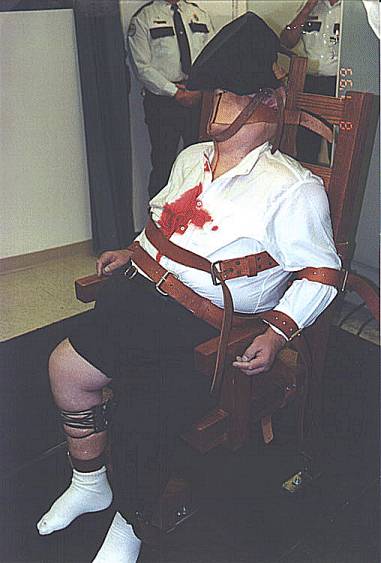
On this date in 1999, America’s obesity epidemic met Florida’s death penalty politics in the ugly electrocution of Allen Lee “Tiny” Davis.

The reader will discern that Tiny earned his nickname ironically. Reportedly 159 kg (350 pounds) at his death, he’d put his ample heft to work bludgeoning a pregnant mother of two beyond recognition with a revolver handle back in 1982 … and then shooting to death the now-motherless two.

As his appeals meandered through the courts, Davis got fatter — and got high blood pressure, arthritis, hypertension and a wheelchair. Meanwhile, the death penalty was meandering its own way across the weird political chessboard of the Sunshine State.

For the American death penalty nowadays, it’s Texas and then everyone else … but time was that Florida was the capital of capital punishment.

It conducted the first “modern” involuntary execution in 1979. It had carried out three executions before anyone else had more than one. And when the the drip-drip-drip pace of one or two execution nationwide per year in the early 1980’s finally burst into a torrent, Florida led the way with eight of the 21 executions in 1984.

Not until late in 1986 did Texas overtake Florida in the body count sweepstakes.

All that time, Florida was happily using its vintage electric chair, Old Sparky (one of several electric chairs with that moniker), built in 1923 of 100% oak wood and prison labor. And the more the chair’s quasi-medieval ickiness drove other states to lethal injection, the more Floridians cherished electrocution.

Law-and-order Tampa mayor Bob Martinez won the governorship in 1986 on the promise that “Florida’s electric bill will go up.” There was a high-profile botch in 1990, and another in 1997 — flames shooting from the inmates’ heads. What was the state’s Attorney General going to do about it? “People who wish to commit murder, they’d better not do it in the state of Florida because we may have a problem with the electric chair.” Under pressure to move to lethal injection — the chair’s unsightly malfunctions were spawning legal and public relations nightmares that were gumming up the gears — the legislature voted nearly unanimously to keep Old Sparky.

And then along came a giant.

After three-quarters of a century and 266 jobs, Old Sparky was “falling apart” … and that was going to be a problem for a man of Davis’ carriage.

The killer’s lawyers argued that Davis was so fat he couldn’t conduct electricity efficiently and would be slowly cooked to death. According to Slate, Florida authorities were nervous that he’d break the chair during his electrocution and send a disconnected live cable scything into someone else in the room.

It was time for the unthinkable: Florida retired Old Sparky and built a new chair … and supersized it. (Image, from the Florida Department of Corrections)

And it worked, in that it killed Tiny. But what a mess — especially when an ensuing Florida Supreme Court opinion once again upheld the constitutionality of electrocution, and a dissenting judge attached the photos on this page to his opinions. Naturally, they became a grisly Internet sensation.

Old Sparky’s custom-built successor would only manage this single execution before Florida finally got on the lethal injection bandgurney.

Or at least, it’s only managed one so far. Old electric chairs don’t die, they just fade away … and in Florida, Tiny Davis’s chair remains available for condemned prisoners who choose it. Since this date in 1999, none have.

On this day..

1959: Charles Starkweather, Nebraska spree killer

Just past midnight this date in 1959, Charles Starkweather was electrocuted in Lincoln, Nebraska, for a mass-murdering road trip with his jailbait date that claimed ten lives.*

A loner and loser, Starkweather’s spree in January 1958 caught the national imagination and has never quite let it go since — the prototypical despair of miscarried white masculinity, a primal scream from the underbelly of the American dream.

Bowlegged, myopic, slightly speech-impaired, Starkweather was an outcast at school and fought back with his fists, then dropped out entirely and into a yawning dead-end economic life collecting garbage from the wealthier quarters of Lincoln. “The more I looked at people the more I hated them because I knowed they wasn’t any place for me with the kind of people I knowed,” he said in his confession. Starkweather palliated his isolation by aping James Dean, dreaming of a big robbery score, and losing his heart to 14-year-old Caril Ann Fugate, in whose adolescent eyes the beaten boy felt his stature grow.

He — or maybe they together — killed her parents when they tried to interfere in the relationship, and then eight days of murderous desperation ensued that riveted Lincoln and the nation: they lived a few days with the corpses, shooing neighbors away with a story about the flu, then fled like animals, killing ruthlessly for a couple of cars and a place to spend the night and heading for Wyoming — all to no end that would make a lick of sense, not even the cockeyed hope that there was somewhere to go to outrun the gore. Killing and running had just become what they did to keep from having to stop.

I had hated and been hated. I had my little world to keep alive as long as possible and my gun. That was my answer. (Source)

Four months after he murdered the Fugate family and not yet 20 years of age, Charles heard his own death sentence from jurors in the city he’d briefly but unforgettably terrorized. (There’s a pdf timeline of the case from the Lincoln Evening Journal here.)

He lived cruelly, and it went cruelly with him to the last; offered a chance to donate his eyes, Starkweather retorted that “nobody ever did anything for me when I was alive. Why should I help anybody when I’m dead?” According to the Los Angeles Times, the doctor who was supposed to pronounce the prisoner dead himself suffered a fatal heart attack minutes before the electrocution.

Fugate’s tender age and sex spared her a death sentence, even though Starkweather said that she ought to be “sitting in my lap” when he went to the chair. She was paroled in 1976 and has mostly stayed out of view since. Laura James at CLEWS recently posted an update on her whereabouts.

More detailed annotations of this notorious duo’s life and times can be found here and here; the Lincoln Journal Star recently published an online 50-year retrospective on the case with high production values.

But if Starkweather’s James Dean fixation denoted the pull of celebrity glamor culture, his death left an enduring legacy for a world that had nothing for him in life, a haunting name recognition few school shooters or bell tower snipers have been able to hold since. He captivated the boyhood Steven King:

I do think that the very first time I saw a picture of [Starkweather], I knew I was looking at the future. His eyes were a double zero. There was just nothing there. He was like an outrider of what America might become.

The title track of Bruce Springsteen’s 1982 album Nebraska is written as a first-person narrative by Starkweather, to the tune of a desolate acoustic accompaniment that imbues the killer’s brutality with an aching loneliness.

They wanted to know why I did what I did
Well sir I guess there’s just a meanness in this world

Martin Sheen wonderfully rendered a (heavily fictionalized) Starkweather character opposite Sissy Spacek on the silver screen in Badlands (1973):

Rather less artistically consequential, the 1963 low-budget film The Sadist, also based on the Starkweather case, is in the public domain and available free on Google video:* Starkweather killed a gas station attendant in a separate incident weeks before, so his body count is 11, with ten of them on his infamous spree.

On this day..

1953: Julius and Ethel Rosenberg, “the first victims of American fascism”

On this date in 1953, Julius and Ethel Rosenberg were put to death in Sing Sing’s electric chair as Soviet spies.

Divisive since it was handed down — or more precisely, since a famous article in London’s Guardian challenged the verdict and helped elevate it into a latter-day Dreyfus case — the Rosenbergs‘ sentence has inspired so much acrimony over several generations that merely to observe the date is to invite a debate capable of eminently more heat than light.

Where to begin with a case so towering in the recent cultural milieu?

A textbook might say that Julius and Ethel were convicted of passing atomic secrets to the Russians, that they maintained their innocence and their defenders carried that flame years after their deaths, and that intelligence files opened after the Cold War — notably the Venona project — apparently confirmed that Julius was a spy after all, though Ethel seems to have been little more than an approving bystander and Julius, come to think of it, never had anything so worthwhile as atomic secrets to share with Moscow. This information (which does have its own skeptics, albeit a small minority) undermines the maximal “absolute innocence” position that this day’s victims always asserted, but it’s a curious leap to take it as vindicating the legal outcome.

“My husband and I must be vindicated by history; we are the first victims of American fascism.”

Half a century on, juridical guilt or innocence seems distinctly secondary in the lasting importance of the Rosenberg trial, the two-year battle to save them, and their potent symbolic afterlives.

The Rosenbergs are the only stateside judicial executions for espionage since the Civil War.* That is a remarkable distinction, after all; so, how comes it that it is held by — to state the case against them in its strongest imaginable terms — two enthusiastic but bush-league players, and not by the likes of Aldrich Ames? How was it that a judge with a largely center-liberal career on the bench would read them a sentence of death hysterically accusing these Lower East Siders of causing the Korean War?

[Y]our conduct in putting into the hands of the Russians the A-bomb years before our best scientists predicted Russia would perfect the bomb has already caused, in my opinion, the Communist aggression in Korea, with the resultant casualties exceeding 50,000 and who knows but that millions more of innocent people may pay the price of your treason.

I feel that I must pass such sentence upon the principals in this diabolical conspiracy to destroy a God-fearing nation, which will demonstrate with finality that this nation’s security must remain inviolate; that traffic in military secrets, whether promoted by slavish devotion to a foreign ideology or by a desire for monetary gains must cease.

It is here in the age of McCarthyism, in the shadow of the USSR’s balance-altering A-bomb test in 1949, that the Rosenbergs stand in sharpest relief — not because of “guilt” or “innocence”, but as the ne plus ultra of that era’s range of social discipline.

A few years before, the United States and the Soviet Union had made common cause against Hitler in World War II, the United States pumping war materiel to Russians bearing the brunt of the fighting.

No longer operative.

The Communist Party USA enjoyed membership rolls pushing six figures; other socialist parties and movements had found niches in American life in the interwar years.

As the Great War gave way to the Cold War, the great powers remained nominal allies (that’s the reason the Rosenbergs weren’t tried for treason), but shifted rapidly into conflict. The American polity organized to expel the red menace by rendering it foreign and criminal — ideological rigging for the forty years’ imperial contest ahead. Loyalty oaths, blacklists, the House Un-American Activities Committee … in the whole of the self-conscious construction of communism as “contagion”, the power and willingness of the state to kill Julius and Ethel Rosenberg formed the tip of the spear, and an ugly contrast to that same state’s solicitous handling of Nazi scientists then developing the vehicles to deliver atomic technology to Moscow in mushroom cloud form.

Though different in many particulars, the thrust will be familiar to any sentient denizen of post-9/11 America: the extreme penalty enforces a wall between the suspect and abject (but tolerated) loyal liberal and the enemy left. Depend upon Ann Coulter for the most brutal articulation:

We need to execute people like John Walker [the American-born soldier captured fighting for the Taliban in 2001] in order to physically intimidate liberals, by making them realize that they can be killed, too. Otherwise, they will turn out to be outright traitors.

Like most symbols, the Rosenbergs came by their exaltation by accident; at the strictly personal level, their deaths are nearly operatic performances of human stubbornness and bureaucratic inertia. Investigators rolling up a spy ring** were looking for confessions and names to keep the indictments coming.

Julius refused to provide either, so his wife was arrested for leverage against him on the reasoning that he would confess to protect her. The gambit failed: both prisoner and hostage remained obstinate. The government’s bluff had been called, and it ruthlessly executed its threat.

Had the two really been responsible for starting a war, execution would hardly begin to cover the bill — yet to the very foot of the chair, the condemned, and Julius especially for the sake of his wife, were pressed with offers of mercy for confessing and “naming names”.

Abjure or expire: show trial logic.

[audio:Julius_and_Ethel_Rosenberg.mp3]

An Execution in the Family

Given names to name, the personal mystery of their silence — the ultimate heroism or folly or tragedy or transcendence — only deepens the resonance of their fate both for contemporaries and posterity, the poignance of their orphaned children’s subsequent path, the contrast with Ethel’s brother David Greenglass who has since admitted to perjuring testimony against Ethel in order to shield his own wife. (Greenglass says the Rosenbergs died from the “stupidity” of not copping a deal of their own.)

Even before Julius and Ethel went to the chair this date,† they had become the emblem of a paranoid age. In the days following, Sartre savaged the United States for trying “to stop scientific progress by a human sacrifice”:

Your country is sick with fear. You’re afraid of everything: the Russians, the Chinese, the Europeans. You’re afraid of each other. You’re afraid of the shadow of your own bomb.

Decades later, the shadows haven’t faded altogether. In playwright Tony Kushner’s imagination, the spirit of Ethel stalks her real-life prosecutor, closeted McCarthy henchman Roy Cohn, as he succumbs to AIDS in the 1980’s.‡

Rosenberg resources — and vitriol — are in plentiful supply online and off. A good starting point on the case is this page at the University of Missouri – Kansas City. Be sure to check the tale of a last-ditch legal maneuver that almost succeeded.

* There is one partial exception in the unusual case of six German saboteurs electrocuted in Washington, D.C., during World War II on a charge sheet that included espionage. The hearing was held by a military commission and only one of the six was an American citizen, so it was far from the regular judicial process — if one can call it that — the Rosenbergs faced.

** Originating in the investigation of Klaus Fuchs, the man who actually did what Julius and Ethel Rosenberg were accused of doing — passing atomic secrets to Moscow — although with debatable ultimate effect for the Soviets’ research. Fuchs served nine-plus years in a British prison and was released to East Germany; more than a few were galled at the difference between his sentence and the Rosenbergs’.

Stateside, George Koval was another spy far more valuable to Moscow in the nuclear race than were the Rosenbergs. Koval got away clean and died in Moscow in 2006.

† Julius first, then Ethel. Her execution was botched; repeated shocks were required to kill her.

‡ Cohn’s posthumous autobiography did acknowledge illegally rigging the Rosenberg trial, as his Kushner character does.

On this day..

1934: Three inept murderers (with a fourth to come)

On this date in 1934, three members of a quartet that had — eventually, with Keystone Cops ineptitude — killed a vagrant in an insurance scam during the Great Depression were electrocuted at Sing Sing.

Mike Malloy, the victim of Daniel Kriesberg, Anthony Marino and Frank Pasqua (and Joseph Murphy, whose execution this day was stayed, but who followed his collaborators to the chair on July 5 of that same year), has chiseled out a weirdly Bunyanesque footnote of Americana as “the man who wouldn’t die.”*

The troubles the would-be murderers had getting rid of the 50-year-old drunk after they conned him into signing less than $2,000 worth of insurance papers are outright black comedy. The New York Daily News remembered this noteworthy homicide last year. Yes, it’s murder, but it happened 75 years ago. Go ahead and laugh.

After several weeks of feeding Malloy free liquor [in an attempt to have him drink to death], Marino noted that it was starting to cost him money. More distressing was Malloy’s health: His pallor had lifted and spirits soared courtesy of the free booze. More active measures would be required to hasten Malloy’s demise.

Murphy, a former chemist, told Malloy that some “new stuff” had come in. Malloy drank it, commented on how smooth it tasted and then collapsed to the floor. They dragged him to the back room and anticipated that they would need to pay off a physician for a “hush job” death certificate.

One hour later, a refreshed Malloy bounded back to the bar with a mighty thirst, unaffected by the alcohol Murphy had laced with car antifreeze.

Over the next few days the gang spiked Malloy’s drinks with stronger doses of antifreeze, then turpentine and, finally, horse liniment with rat poison. Malloy kept beaming and kept drinking, soaking up the good times spent with his new friends. The crew decided a switch to food would best hasten Malloy’s death.

Marino served him raw oysters – soaked in wood alcohol. After downing two dozen, Malloy was so enthused by the cuisine that he encouraged Marino to open up a restaurant. The next course included an entrée of rotten sardines mixed with tin shavings. Same result.

Next, the plotters got Malloy stupefied and escorted him to Claremont Park, stripped off his coat, and in the middle of winter opened his shirt and poured 5 gallons of water on him before dumping him into a snowbank. If poisoned liquor and food couldn’t kill Malloy, then the cold blasts of a New York winter would.

Or so they thought. The next evening, Malloy showed up at the speakeasy wearing a new suit. He had really tied one on the night before, he explained, and wound up nearly naked in the park. Fortunately, the police had found him and a welfare organization outfitted him with new clothes.

Exasperated, the gang hired a cab driver, Harry Green, and offered him $150 to run Malloy down with his vehicle. On Jan. 30, 1933, a nearly unconsciously drunk Malloy was driven from Marino’s to Pelham Parkway. Murphy stood him up in the middle of the roadway, and Green backed up his taxi two full blocks to build up enough speed to complete the job. Somehow, Malloy stumbled to safety. They then took Malloy to Gun Hill Road. This time, Green hit him.

The gang gleefully retreated to Marino’s and again waited for an announcement of Malloy’s demise. For days nothing appeared in the newspapers.

Where was he? Malloy was recovering in the hospital under a different name, having sustained a fractured skull, a concussion and a broken shoulder. The indestructible barfly returned several weeks later to the speakeasy and announced he had an awful thirst. The boys’ jaws dropped.

Now desperate, they contacted a professional hit man, but his $500 fee was too expensive. They then shanghaied another drunk, Joe Murray, stupefied him with liquor and stuffed his coat pocket with Malloy’s ID and ran him over with a cab. Murray, a substitute for Malloy in every way, recovered from his injuries after two months in Lincoln Hospital. The only way to knock off Malloy, the gang determined, was murder, clean and simple.

They finally had to stuff a rubber hose down his maw and gas him through it.

Astonishingly, this blockheaded crew came within a fingernail’s breadth of getting away with it, just as they’d gotten away with their innumerable attempted murders** — evidence, really, of just how overrated an achievement the “perfect crime” is. A little baksheesh for a death certificate with a fake cause-of-death, a quick trip to the pauper’s cemetery, and they had already set about collecting the insurance policies before anyone got suspicious.

With four shiftless conspirators and at least two other people who’d been let in on the plot, though, once the sniffing started, their goose was cooked. Soon enough, so were the killers. And it only took the state of New York one try apiece.

* The young Steven Spielberg’s Amazing Stories television show dramatized this implausible story. Why The X-Files never made use of it, no one can say.

** The Daily News reckons it at six; a 1934 New York Times piece counted 10. The investigation suggested that they’d actually done someone else for insurance before, using the winter exposure method that Malloy survived.

On this day..

1997: Henry Francis Hays, whose crime cost the Klan

On this date in 1997, an Exalted Cyclops of the Ku Klux Klan went to Alabama’s “Yellow Mama” for lynching a black teenager.

Henry Francis Hays, son of a top Klan officer in Alabama, had vented dissatisfaction with a jury’s failure to convict a black defendant for a white policeman’s murder by grabbing and stringing up a random black, 19-year-old Michael Donald.

Hays and his 17-year-old accomplice skated for more than two years because Mobile’s finest figured a publicly hanged black man probably had it coming from some drug deal.* Only through the victim’s mother’s persistence — she got Jesse Jackson involved, which helped involve the FBI — did the real murderers feel the heat.

Before long, the Klan would wish it had stayed out of the kitchen.

After Hays’ conviction, Michael Donald’s mother brought a civil action against the United Klans of America with the help of the Southern Poverty Law Center. The $7 million liability verdict she won financially destroyed the United Klans — perpetrators of some of the 1960s’ most infamous anti-civil rights terror — and Donald was awarded its national headquarters building in Tuscaloosa, Ala.

This novel keys on the Michael Donald lynching as part of a (fictional) Mobile teen’s coming of age.

Hays wasn’t through making the sort of history he’d rather not have made.

When his turn in the electric chair finally came in 1997, he became the first white in Alabama put to death for an offense against a black in 84 years.**

Seemingly less cocksure in answering for his crime than he had been in committing it, Hays had always maintained his innocence. A few days before walking his last mile, he finally confessed to the Mobile chapter head of the NAACP.

* Michael Donald was not, in fact, involved in drugs.

** There haven’t been any other executions for white-on-black crime since Henry Hays, a span of 11 more years and 22 more executions as of this writing. (via the Death Penalty Information Center’s Execution Database)

On this day..