1800: Three Canadian pirates in Philadelphia

On this date in 1800, French Canadiens Joseph Baker (anglicized from Joseph Boulanger), Peter Peterson (LeCroix), and Joseph Berouse hanged in Philadelphia for a murderous mutiny.

That trio had seized control of their schooner Eliza, slaying three men in the process. They had a view to selling off the cargo but none of the three knew how to navigate the vessel — so they were obliged to bargain with the deposed captain William Wheland to sail them to Spanish territory. Eventually Wheland was able to get the drop on his mutineers, locking up LaCroix and Berouse in the hold while Baker was at the helm, then surprising the Canadian ringleader to get his ship back.


Norwith Courier, July 30, 1800

Whelan turned the naughty help over to a U.S. Navy ship, and in the consequent trial back at Philadelphia “his narrative alone was sufficient to carry conviction with it. The facts were too strong to admit a doubt of the commitment of the horrid crime with which the prisoners stood charged, and the jury, with very little hesitation, gave in their verdict guilty.” (Maryland Herald, May 1, 1800.)

The men died, penitent, at an execution island in the city harbor, “in the view of an immense concourse of spectators, who crouded the wharfs and the shipping.” A sorrowful confession purportedly taken down from Baker himself survives and can be read in full online.

On this day..

1945: Pvt. George Edward Smith, on VE Day

(Thanks to Robert Walsh for the guest post. Mr. Walsh’s home page has a trove of articles about historical executions, including another American serviceman hanged at Shepton Mallet. -ed.)

VE (Victory in Europe) marked the official end of hostilities in the European theatre of operations and quite possibly the largest and most joyous celebration in human history.

Unless, of course, you happened to be former US Army Air Forces Private George Edward Smith.

While most of the rest of the world basked in the joy of victory and the relief of the European war being over, Private Smith had a rather more pressing engagement to think about. The rest of the population might be about to enter a brave new world, but Smith was about to depart rather suddenly from the old one.

It was his execution day.

Smith, previously serving at RAF Attlebridge in Norfolk with the US Air Force’s 784th Bombardment Squadron, wouldn’t be celebrating the end of the European war. He’d be watching the clock tick relentlessly down to 1 a.m. when he’d be escorted from the Condemned Cell at Her Majesty’s Prison, Shepton Mallet, Somerset (loaned to the US military for the duration of the war). He’d be sat near the gallows pondering a past that was about to cost him his life while hoping for a reprieve that wouldn’t arrive and a future that was already lost.

While most of the world celebrated, George Edward Smith was going to die.

Smith’s guilt wasn’t in any doubt. Near RAF Attlebridge lay the sleepy Norfolk town of Honingham and the stately home named Honingham Hall (demolished in the 1960s).

Honingham Hall and the adjoining land were home to distinguished diplomat Sir Eric Teichmann, a long-serving figure vastly experienced in the Far East and serving as advisor to the British Embassy at Chungking. He’d noticed, as so many country gentlemen do, that he had a problem with poachers. December 3, 1944 would be the last time he had a problem with anything. It was in the small hours of the morning that he met George Edward Smith.

Smith and his accomplice Private Wijpacha had ‘borrowed’ a pair of M1 carbines from the base armoury and decided to do a spot of illicit hunting. Teichmann, familiar with the fact that poachers aren’t usually violent offenders and will usually run if challenged, heard gunshots from nearby woodland and went out to investigate. He went out unarmed, challenged Smith and Wijpacha — and Smith promptly shot him once through the head with his M1. Both men fled hurriedly back to their base, hoping that their absence wouldn’t be noticed.

Of course, a senior British diplomat lying murdered in the woodland was noticed.

Before long both men were arrested and questioned, during which Smith confessed, a confession he later retracted claiming that it was made under duress. That, not surprisingly, cut no ice whatsoever with either the American military or the British authorities. Smith and Wijpacha were court-martialled at RAF Attlebridge and Wijpacha (who hadn’t fired a shot) received a lengthy prison sentence. Smith, the triggerman, drew the death penalty.

Under the Visiting Forces Act, 1942 the Americans were free to try, imprison and condemn their own criminals independent of the British system of justice, not that it would have made any difference to Smith’s case. Murder was then a capital crime in Britain regardless of the criminal’s nationality. If Smith hadn’t been condemned by an American court-martial then a British trial would have seen the judge don the legendary ‘Black Cap’ and pass what British reporters once called ‘the dread sentence’ especially given the status of the victim.

Smith was promptly shipped to the prison at Shepton Mallet in the county of Somerset to await a mandatory review of his case and, if clemency was refused, execution.

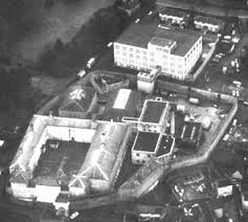
View of Shepton Mallet (left) and its execution shed (right)

Shepton Mallet had been a civilian prison for centuries before being turned over to the British military, who then lent it to the Americans as part of the Visiting Forces Act. Until its final closure a few years ago Shepton Mallet remained the oldest prison in the UK still operational, a dubious distinction now belonging to Dartmoor. There were, however, a few difficulties with the arrangement.

The Americans carried out 18 executions at Shepton Mallet during their tenure between mid-1942 and September, 1945. Two (Alex Miranda and Benjamin Pyegate) were by firing squad, upsetting local people, who knew very well what it meant to live next to a military prison and hear a single rifle volley at 8 a.m. The American military also preferred hanging common criminals to allowing them to be shot like soldiers.

The problems were simple. The locals didn’t like firing squads made no secret of it. Not surprisingly, there were complaints. The US military felt being shot was too good for most of its condemned and the British didn’t like the methods and equipment used by American hangmen, who had acquired a nasty and thoroughly-deserved reputation for using badly-designed scaffolds, the wrong type of rope and the antiquated standard drop instead of a drop length scientifically calculated by the prisoner’s weight.

The British also regarded American hanging equipment as outdated, while American military hangmen John Woods and Joseph Malta were entirely unfamiliar with the British kit. And British hangmen had evolved hanging to almost an art, needing mere seconds to complete the procedure.

Another problem was that the gallows at Shepton Mallet hadn’t been used since March, 1926. By 1942 it was considered unfit for service and needed replacing. A compromise had to be reached, and was.

The Americans could continue executions at Shepton Mallet, but the vast majority (16 out of 18) were performed by British hangmen using a British gallows in an extension built onto the end of one of the cellblocks. The Americans were permitted their usual practice of having the condemned stand strapped, noosed and hooded on the gallows while their death warrant and charge sheet were read out and then being asked for any last words. This caused executioner Albert Pierrepoint, master of the speedy hanging, to complain at what seemed to him a cruel, unnecessary delay in ending the prisoner’s misery.

Pierrepoint also complained about overcrowding in the gallows room during executions. At a British hanging there would be the prisoner, the hangman, his assistant, the prison Governor, the Chief Warder, the doctor, the Chaplain and two or four prison officers. At an American military hanging there were usually twenty or so people clustered around the trapdoors and lever. He felt a hanging should be both quick and perfect and that a crowded gallows room invited disaster.

Hangman Thomas Pierrepoint.

By VE Day the arrangement was well-established. Thomas Pierrepoint, uncle of Albert and brother of Henry (both of whom were also hangmen) performed 13 of the 16 hangings at Shepton Mallet while Albert performed the remaining three when he wasn’t busy elsewhere.

Their assistants were Steve Wade, Herbert Morris and Alexander Riley. Tom Pierrepoint had performed the last hanging at Shepton Mallet in 1926 (that of murderer John Lincoln) assisted by Lionel Mann. While the two firing squads were performed at 8 a.m., the hangings would be carried out at 1 a.m. which was discreet enough not to arouse neighbors’ ire.

Smith’s case was reviewed. Not surprisingly, his appeal was denied as were other requests including (most generously, under the circumstances) one from Lady Teichmann, widow of his victim. His date was set for 1 a.m. on what turned out to be the very day Europe’s guns fell silent. Tom Pierrepoint would do the job assisted by Herbert Morris. Smith was transferred to the Condemned Cell a few days prior to the execution date where he was granted free access to the military Chaplain.

When the time came, while the rest of the population celebrated the arrival of a new world and Smith contemplated his departure from the old one, it went as smoothly as could be expected. Smith was taken from his cell wearing standard military uniform, from which any badges or flashes marking him as a soldier were deliberately removed. Paperwork was completed signifying his dishonourable discharge from the US military as a common criminal and the US military were determined that he should die like one.

Given the delays caused by the reading of the charge sheet and death warrant and Smith being asked for his last words (he apparently had none) it took 22 minutes between Smith being taken from his cell and being certified dead by the prison doctor. Compare this with a standard British execution (minus the bureaucracy and speechifying) where 22 seconds would have been considered twice as long as was needed to do the job. Smith’s punishment, however, wasn’t done yet. Executed American servicemen were initially buried at Brookwood cemetery, but then moved to the notorious ‘Plot E’ of the Oisne-Aisne Military Cemetery in France. Plot E is deliberately hidden from the rest of that cemetery. Its residents have no names on their graves, only numbers. They have no headstones or crosses, only flat stone markers. No American flag hangs in their plot. It doesn’t appear on the plan of the cemetery even today and the markers are placed facing away from the graves of other Americans. Visits to Plot E are still discouraged and it wasn’t until a Freedom of Information request in 2009 that the names of those buried there were released.


A view of the “Dishonored Dead” in Plot E, Oise-Aisne American Cemetery. (cc) image by Stranger20824.

Whatever they may have done, and some committed truly dreadful crimes, it seems distasteful to virtually deny their existence and shame them even after death. It also denied their families and friends the chance to visit and grieve, despite the fact that they themselves had committed no crime.

That said, it’s no different to the routine imposed on condemned British criminals. In fact, the British death sentence expressly demanded that inmates be buried in unmarked graves within the prison walls inflicting the same suffering on their friends and relatives. The British hanged were officially designated ‘Property of the Crown,’ many of whom were not properly reburied until after abolition. At many British prisons they still remain in unmarked graves according to the following sentence:

Prisoner at the Bar, it is the sentence of this Court that you be taken from this place to a lawful prison and thence to a place of execution where you shall be hanged by the neck until you are dead, and that your body be afterwards cut down and buried within the precincts of the prison in which you were last confined before execution. And may the Lord have mercy upon your soul.

Remove the prisoner …

On this day..

1791: William Jones, “in a country out of the reach of my enemies”

On this date in 1791, a man named William Jones hanged in Newark, N.J.

Jones cut an apologetic figure at his public execution, and a confession he signed off in the hours before was widely reprinted in New England newspapers. (This transcription is from the Boston Independent Chronicle of May 26, 1791.)

Knowing that without repentance there can be no salvation, and without a sincere confession of our public transgressions, there can be no true repentance, therefore I would give glory to God, exonerate and ease my own wretched mind; and as far as possible, afford that satisfaction to the public, by confessing my crimes, that others may take warning by my awful but just end, and be preserved from such horrid iniquities. This is the only reparation I can make to society, for the evil I have done, for which I am righteously, in the midst of my days, cut off from among men.

I confess I have been exceedingly wicked from my youth. I have been habitually addicted to Sabbath breaking, swearing, keeping evil company, gaming, drinking to excess; and when in liquor, passionate and quarrelsome, and have indulged myself to a high degree in other base and horrid abominations.

But the crime for which I am now to die, I would, with the greatest exactness relate. — I solemnly declare, I never intended to kill Mr. Shotwell, nor had I, at any time, as far as I know, murderous intentions in my heart against him, yet, I was the unfortunate man, that, to gratify my wicked passions, was the occasion of his death. I had long had a spite against Shotwell, because I looked upon it, that he & another man had injured me much, and were the cause of my being obliged to settle a civil prosecution, commenced against me, greatly to my wrong. Therefore I had often said, I would whip, beat or flog Shotwell, but as I never had a thought in my heart to murder him; as a dying man, I never said, I would kill him.

On the evening of Friday the 1st day of April, about or a little after sun down, I saw Samuel Shotwell pass my mother’s house driving cattle or a pair of oxen. In sometime, afterwards, I arose, went out into the road, and followed after him. I met Letts and stopped and talked with him for some minutes perhaps six or eight; then we parted and I followed after Shotwell. I crossed the fence in order to cut off a crook in the road and re-crossed the fence into the road still behind him. About three quarters of a mile from where I had seen Letts, I overtook Shotwell, and, without speaking a word to him, or he to me, I knocked him down with my fist, and there kicked him in the face and head, having on a pair of strong heavy shoes. I then passed the fence into the field opposite to where Shotwell lay. In a short time I saw him rise and go on the road, and I went along in the field. I had thoughts of going to a certain house, at no great distance before us, but before I came to the house, I altered my purpose, and so passed the fence into the road before Shotwell and going back along the way, I presently met him. I knocked him down again with my first, and again kicked him, and left him, and went on the road home. After sitting by the fire a little while, I went to bed, but was very uneasy lest I had beat Shotwell too much.

With regard to the club, of which much was said in the course of my trial, I never had it in my hand, nor did I ever see it, till the next day at the Coroner’s inquest. It was not the weapon I made use of nor had I any weapon whatsoever; but by knocking down Shotwell and kicking him in the manner related, I was the unhappy cause of his death.

I leave this testimony and confession, that my awful conduct may be a warning to others, that they by my dreadful fate, may be admonished to refrain from evil company, and from allowing themselves in drunkenness, wrath, malice or intemperate passions. My wickedness has brought me to this just and awful doom. May all others hear and fear!

WILLIAM JONES

A sad end for Messrs. Jones and Shotwell both; readers of the 21st century as well as the 18th ought to hear and fear.

But to the end of this awful but uncomplicated tragedy, we have this curious broadsheet published later in 1791.

What to make of this artifact?

One notices at first blush that as the document was printed in broadsheet form, it was presumably intended for the enrichment of its publisher … and we might suppose treacherous albeit not unpassable footing on the route from anyone actually party to such an occult missive in real life to a hustler harvesting gawkers’ pennies on the incredible secret. Indeed, it would be a profoundly ill turn for Jones or his correspondent, for no better reason than a gloat, to expose the physician of his deliverance to the sanctions that might attend unmasking. If this pamphlet’s remarkable claims were recapitulated in any other media at the time, I have not been able to locate it.

Even presuming that we have a sensational forgery, our bulletin does have something to say to us yet, and not only about the evergreen human fascination with surviving an execution.

This is a document from the Enlightenment, an interval where the vaunting progress of human ingenuity designed even to steal a march from the reaper himself by reviving the drowned or reanimating the dead.

Hangings were survived sometimes — not commonly, but often enough that the phenomenon was familiar and occasionally the enterprising condemned even schemed to accomplish it intentionally. Such a scenario necessarily inspired artists, whose fabulisms would only have reflected the fancies of their audiences. The scaffold was already being given over routinely as the portal to spiritual escape for the penitent knave crushed by his sin … why not the escapism of the flesh, too?

Maybe our broadsheet publishers took inspiration from the fantastic story a couple of years prior of a different man living through his hanging in Massachusetts. Though that earlier tale was perhaps more overtly crafted for moral instruction, the particulars of the harrowing procedure are much the same: the assistance of an obligingly altruistic doctor, the agonizing pain of resuscitation, and the convenient vanishing into unverifiable distant anonymity. Even Nathaniel Hawthorne would allude via a minor character in The Blithesdale Romance to the legend that an English banker executed in the 1820s had duped the hangman — and not unlike our William Johnson, Hawthorne judged that living phantom and his stolen years “a mere image, an optical delusion, created by the sunshine of prosperity, … [who] seemed to leave no vacancy.”

On this day..

1854: John Hendrickson, junk science victim

On this date in 1854, an Albany, N.Y. man named John Hendrickson hanged for the murder by aconite poisoning of his wife, Maria. “He has suffered the highest penalty of the law,” New York’s Weekly Herald pronounced the next day — “but whether justly or not, will likely never be known on earth.”

Whatever the prisoner’s denials,* a web of suspicious circumstances clasped the hemp around his throat. Hendrickson, whose family had some money and connections, fought the conviction tooth and nail; his then-unusual three appeals, plus clemency petition to the governor, stretched the time from conviction to execution out to nearly a year. “The evidence adduced … was so entirely circumstantial, and the testimony of the scientific men so liable to doubt and contradiction, that it was generally feared the murderer would escape,” a Boston Post correspondent reported.** But not to worry: “the atmosphere of guilt seemed to surround him in the whole county; not a man could be found that, at heart, believed him innocent.” We’re scarcely prepared at this distance to assert an affirmative case for the man’s innocence, but in some ways it reads like an antebellum Cameron Willingham case, all the way down to the dubious forensic evidence.

Like Willingham, Hendrickson was a less than stellar husband. He was noted for abusing his wife, philandering, and doing both together when he “communicated to her a loathsome veneral disease.”

The supposed murder motivation was his wife’s recent inheritance of the estate of her father, who died just a few months before the murder. Little could really be proven save by inference from the man’s bad character; in classic tunnel-vision fashion, the record suggests nearly every data point became fixed according to this theory. For example, Hendrickson’s trial prosecutors read into evidence — in the part of their presentation they called the “Moral Evidence” — that Hendrickson remarked at his wife’s autopsy that “they won’t find arsenic.” You and I might think he’s saying that the examination will dispel the gathering suspicions of poisoning, and saying it by reference to the chemical that was the metonym for poisoning in the nineteenth century. For the state, his uttering these words was

as if he knew (as he undoubtedly did) the precise poison which she had swallowed — as if he knew that that common poison, which is found in most cases of the kind, had not been given by the murderer in this case, and hence they won’t find arsenic. Ah! gentlemen, it was nature speaking out, as she often unconsciously or unguardedly will, disclosing the otherwise well concealed and apparently undiscoverable crime.

(This is why you don’t talk to police.)

The district attorney introduced evidence courtesy of chemists named Salisbury and Swinburne, to the effect that it was no mean arsenic that carried away Maria Hendrickson but the more exotic potion of aconite — derived from a toxic herb seeded (per Ovid) by Cerberus himself.

One can peruse the evidence presented in the case here, but the most remarkable part of this trial record is the appendix — wherein numerous medical men, including a former teacher of Dr. Salisbury, skewer the forensic processes used to decide that Maria Hendrickson died by poison and even offer to reproduce them in person under the eyes of Gov. Horatio Seymour to prove their unreliability. Their findings harshly undercut the only concrete evidence that any murder took place at all.

“I am pained and oppressed with the conviction that the medical witnesses for the prosecution have, in a main point of this case, abused the confidence with which criminal courts so often compliment the man of science,” one writes — words that could still today be applied to many disciplines of junk science that have disappeared bodies into oubliettes on the strength of lie detectors, bite mark analysis, matching hair samples, and suchlike hocus-pocus.

We turn from the contemplation of this subject with feelings of sorrow, not that any of ours have been crushed under the wheels of mutilated justice, set in motion by ignorance and false science, but we feel now, as we have always felt, that a great personal wrong has been committed under the authority of law, for which there can be no atonement, as the dead cannot be brought to life, nor the blasted feelings of the living restored.

It would be well, too, for judges and jurors, who are very often hasty and inconsiderate in letting their feelings and prejudices get the better of their judgment, to remember that life, human life, is neither a toy nor a rattle, but the gift of God; when once extinguished, no matter how, it is gone forever, and the dead never rise again.

-Dr. Charles A. Lee, reviewing the Hendrickson case

* Hendrickson’s final message to his parents via his spiritual advisor, on the eve of his hanging:

To-morrow I am to die, and standing as I do on the brink of eternity, I wish to say to you, in the presence of that God before whom I am so soon to appear, that I am entirely innocent of the crime of murdering my wife. I did not give her poison. I do not know that any one gave her poison. She did not come to her death by violence of any kind, so far as I know. I believe she died a natural death. She did not vomit on the night of her death. [This remark touches the disputed forensic evidence; vomiting would be a symptom of poisoning, and state chemists’ assertion that Maria had done so was among the conclusions challenged by outside scientists. -ed.] I never knew that there was such an article as aconite in the world, until after I was in jail. Nor did I know it by any other name. I do not know that I have anything further to add, except to say some farewell words to my parents. But you will remember what I have said to you, and inform them of it. I wish you to make it public.

** Transcribed here via the Portland (Me.) Advertiser of Apr. 18, 1854.

On this day..

1867: Modiste Villebrun, but not Sophie Boisclair

(Thanks to Meaghan Good of the Charley Project for the guest post. -ed.)

On this date in 1867, Modiste Villebrun was hanged in Sorel, Quebec, in what would be the last execution before Canada became its own country. His partner in crime, Sophie Boisclair, might very well have been executed alongside him had she not been pregnant.

Villebrun, a lumberjack from St. Zephirin, was having an affair with Boisclair and they wanted to get married. They had two slight problems to deal with, in the form of their respective spouses. In those times, divorce was unthinkable. Murder, apparently, was not.

Jeffrey E. Pfeifer details their crimes in his book Death By Rope: An Anthology of Canadian Executions:

The first victim was Villebrun’s wife, and their plan seemed to work well. No one suspected foul play when the previously healthy woman died, or at least no one could prove anything. Braced by their success, the lovers soon turned their attention to Boisclair’s husband, Francois-Xavier Jutras. Boisclair suggested to her husband that they should allow Villebrun to move in with them since the death of his wife had left him all alone. Jutras agreed to his wife’s request and almost immediately Boisclair began to lace his food with her “special” ingredient. It was not long before the strychnine took effect and Jutras was dead.

Unfortunately for the two lovers, a suspicious doctor demanded an autopsy, which revealed the dead man’s body was saturated with poison. Villebrun and Boisclair soon found themselves arrested.

They were tried separately and both were convicted in short order and sentenced to death. When asked, at sentencing, whether she had anything to say, Boisclair announced she was expecting a baby. She got a temporary reprieve until delivery, and got the opportunity to watch Villebrun’s execution from the window in her cell.

Ten thousand people attended his hanging.

Seven months later, Boisclair gave birth to his child, and her sentence was commuted to life imprisonment.

“Boisclair ended up serving 20 years in the penitentiary,” records Pfeifer, “before being released, a broken woman.”

On this day..

1612: The slave rebels of Mexico City

On this date in 1612, Spanish colonial authorities smashed an alleged plot among Mexico City’s black slaves with a grisly mass execution.*

In Mexico as elsewhere in the Americas, African labor had been imported en masse in the 16th and 17th centuries; David Davidson estimated** that Mexico City had a black population ranging from 20,000 to 50,000. And as elsewhere in the Americas, they frequently resisted: Mexico City slave risings dating back to the 1540s had badly shaken the city, and led the viceroy Luis de Velasco to worry in 1553 that “this land is so full of Negroes and mestizos who exceed the Spaniards in great quantity, and all desire to purchase their liberty with the lives of their masters.”

The most illustrious name of this era was Gaspar Yanga, who was kidnapped into bondage from the Gold Coast, and escaped bondage by leading a large band of fugitive slaves into the highlands of Veracruz and founded an outlaw colony that still bears his name today.

Yanga’s palenque — known in his time as San Lorenzo de los Negros de Cerralvo — had to fend off military action by the Spanish authorities from 1609 until a truce in 1618.

Still, a truce was possible: a refuge like San Lorenzo offered slaves the unwelcome-to-their-masters prospect of escape from the scourge economy, but the real threat to New Spain was that purchasing liberty with lives bit.

As we have seen in the American South, the situation on the ground begat paranoia that makes it nigh impossible for later interlocutors to disentangle fact from fantasy: was there really a phenomenal slave rebellion nipped in the bud? Or just informers and torturers refracting the terrors of those outnumbered Spaniards?

The slaves in this case were said by a Portuguese merchant who overheard them to be readying themselves to exploit Spanish inattention during Holy Week celebrations, and to bloody those days by falling upon their masters and taking possession of the colony. In the inevitable rounds of arrests and torture that ensue, the alleged plot as recorded by the annalist Chimalpahin (Spanish link) sounds suspiciously like a psychosexual projection, for it

involved castrating any surviving Spanish males, making sexual slaves of white women, and gradually “blackening” the latter’s descendants.**

Certainly the punishment blackened Mexico City; our correspondent uses this same word to describe the condition of the gibbeted corpses when they were finally let down from their gallows on the feast of the Holy Cross. Even then, the flesh of the would-be slave kings could not rest: most were beheaded posthumously and mounted on pikes while six others were quartered for display on all the roads entering the capital. This in itself was a small moderation for the public good. Chimalpahin reports that doctors advised the state that “if all the dead were to be quartered and hung up in the main streets to rot, their stench will blow a sickness across the city.”

* Thirty-five is the execution count supplied by Chimalpahin; some sources give 33.

** “Negro Slave Control and Resistance in Colonial Mexico, 1519-1650,” The Hispanic American Historial Review, Aug. 1966.

† Maria Elena Martinez, “The Black Blood of New Spain: Limpieza de Sangre, Racial Violence, and Gendered Power in Early Colonial Mexico,” The William and Mary Quarterly, Jul. 2004.

On this day..

1942: Robert “Rattlesnake” James, the last man hanged by California

(Thanks to Meaghan Good of the Charley Project for the guest post. -ed.)

On this date in 1942, red-haired Robert S. James became the last man judicially hanged in the state of California. He’d earned the noose three times over. The press called him “the Diamondback Killer” or “Rattlesnake James”.

“Robert James,” records Robert Keller in his book 50 American Serial Killers You’ve Probably Never Heard Of, Volume Five, “must rank as one of the most creative killers in the annals of American crime. Not content with such mundane methods as shooting, stabbing or strangling, James resorted to such inventive devices as auto wrecks, drowning and rattlesnake bites.”

James’s cunning homicides and his proclivity for cross-country travel meant his crimes went unnoticed for years.

Born Major Raymond Lisenba in 1895, he seemed destined to a hardscrabble life of Alabama sharecropping like his parents until his brother-in-law paid for him to go to Birmingham and attend barbering school.

In 1921, at age 26, Lisenba married. His wife quickly left him, however, and filed for divorce, citing extreme cruelty. James moved to Kansas and married again, and began an affair with a young local girl. He made her pregnant, and after her father showed up at his barbershop with a shotgun, Lisenba skipped town and moved to Fargo, North Dakota, abandoning wife no. 2. He also changed his name.

From here on out, he goes by Robert S. James.

In 1932, “Robert” married Winona Wallace and took out a life insurance policy on her. After three months of wedded bliss, they went on an outing to climb Pike’s Peak. During the journey, though, the couple was in a single-car accident and Winona sustained a serious head injury, while her husband was completely unharmed: he had jumped out of the out-of-control vehicle just before impact.

The police who responded for some reason thought nothing of the bloodstained hammer they noted in the car’s back seat.

Although Winona’s head wound was grave, she pulled through, and was discharged from the hospital after two weeks, with no memory of the accident. She never recovered that memory because shortly after arriving home she drowned in her own bathtub. Her husband suggested she had still been suffering vertigo from the head injury.

James collected on Winona’s $14,000 life insurance policy, moved back to Alabama and married again. He found he was unable to take out a policy on the new wife, however, and filed for an annulment on the very day of their wedding.

Undaunted, James turned his attention to his nephew, Cornelius Wright. He insured the young man, with double indemnity in case of accidental death, then invited him over to visit. During the visit, James lent Cornelius his car. Cornelius drove it off a cliff and was killed.

The insurers paid.

Curiously, James sent a telegram to his sister informing her of her son’s death before it actually happened.

James moved to Los Angeles and married a fifth time. It was wife #5, Mary Busch, who proved to be his undoing.

In 1935, James conspired with an acquaintance named Charles Hope to murder Mary. They decided to use rattlesnakes, and Hope obtained two large Colorado diamondbacks to do the job. The snakes had names: Lethal and Lightning. They performed well in field tests on chickens.

Mary was pregnant at the time, and James convinced her to get a home abortion. To this end, she allowed herself to be tied to a chair, blindfolded and gagged for the procedure. Her husband then forced whiskey down her throat to quiet her, and he and Hope shoved her bare foot into a box containing the rattlers.

They left her there to die, but when they returned later, Mary was still alive, although had been bitten three times. James dragged her into the bathroom and drowned her in the tub, then he and his accomplice threw her body into an ornamental fish pond on his property.

Then James called the police to report the tragic accident.

Authorities who arrived at the scene found Mary lying in very shallow water. Her grieving widower mentioned she had dizzy spells quite often and would fall down. The police speculated she might have been bitten by a rattlesnake and then, in shock, stumbled into the pond. They did a search of the property and did find something strange: a bottle containing black widow spiders, hidden in a corner of the garage. But what did that have to do with anything?

Mary’s death was ruled accidental and James collected yet another insurance payout.

He appeared to have gotten away with it again.

However, several months later, it came undone.

A sharp insurance investigator found out about James’s previous wives and the fact that one of them had drowned after being heavily insured. The investigator informed the police, who bugged James’s house and discovered he was committing incest with his niece.

This was a crime in California, although she was a legal adult. The police hauled him in for questioning. “Interrogation techniques,” remarks Keller, “were somewhat more brutal than they are today and under questioning, James let something slip about Mary’s death. Investigators immediately seized on this and eventually extracted a confession.”

Charles Hope’s role in the crime came out — he’d been paid $100 for his assistance in the murder — and he turned state’s evidence and was sentenced to life in prison. During the trial, Lethal and Lightning were presented as evidence, and Lethal caused a bit of a stir in the courtroom when it escaped during lunch.


Star witness.

The Los Angeles Times notes, “Columnist Walter Winchell dropped by the courtroom; so did actor Peter Lorre, who studied James’ impassive face and beady eyes for one of those psychotic killer roles he often played.”

James was inevitably convicted of Mary’s murder and sentenced to death, but prolonged his life with a few years of appeals. In Lisenba v. California, the Supreme Court upheld his confession in spite of the third-degree methods by which it was obtained.

The lag from trial to execution caused by Rattlesnake’s judicial review, however, made him by the time of his hanging the last convict whose death sentence predated California’s adoption of the gas chamber. California was executing in volume at this period, and almost all by gas: everyone knew as Robert James went to the gallows that he was to be the last to die on that anachronistic device.

And the executioner — who to be fair was probably out of practice — underscored the reason for that shift by botching the job, leaving his prey to strangle to death for ten ghastly minutes. San Quentin‘s warden, Clinton Duffy, an opponent of the death penalty described the hanging to reporters but his story was deemed too graphic to be printable. In this more permissive age we can use it with impunity … but it’s liable to put you off your appetite.

The man hit bottom, and I observed that he was fighting by pulling on the straps, wheezing, whistling, trying to get air, that blood was oozing through the black cap. I observed also that he urinated, defecated and the droppings fell on the floor, and the stench was terrible. I also saw witnesses pass out and have to be carried from the witness room. Some of them threw up. It took ten minutes for the condemned man to die.

When he was finally dead enough to cut him down, “big hunks of flesh were torn off” James’s purple face; “his eyes were popped,” and his tongue “swollen and hanging from his mouth.” (source)

On this day..

1836: Isaac Young/Heller, axman

On this date in 1836, a troubled (ex-)family man named Isaac Young — latterly going by Isaac Heller — was publicly hanged in Liberty, Indiana for axing his entire family to death in a fit of madness.

Young hailed from Pennsylvania, and the reason he had changed his name and moved to Indiana was that he had done a similar thing in his native haunts.

As a teenager in the 1820s, Isaac Young had been seized strangely by the spiritual tremors abroad during America’s Second Great Awakening. A baptized zealot who fancied himself blessed with the power of prophesy, Young was also captive to an inescapable — and seemingly defeatist — impression of being forever pursued and haunted by the devil. Young’s religious thunderings tended to produce more interest in the utterer’s state of mind than in the listener’s state of soul, and the youth was known to succumb to “gusts of passion.”

Eventually, those gusts blew a hurricane.

Young lived with his brother, who had a wife and a 10-year-old orphan girl — and, little did they know, the devil watching over them all. One night in 1830, Young awoke with a start at a sound he perceived upon the stair, convinced that some entity had entered the room he shared with the little girl; his religious eccentricities jumbling him right into lunacy.

“The Kingdom of Heaven is at hand!” Young bellowed at the dragon from Revelations come to visit him in his nightshirt in Dauphin County. He tried to grapple with the phantom but missed it, and of a sudden he turned his frenzy on the girl, battering her furiously. Young would later say that he was “forcibly impelled” to the attack by an overwhelming “duty” to “destroy” the child; his brother and his sister-in-law attempted to intervene but Young seized a club and with a berserker rage chased them from the house — then returned to his cowering little roommate, and sawed off her head with his knife.

He was acquitted of this murder by reason of his manifest insanity, but this was not a time and place with resources to aid the mentally ill. All anyone could think to do was to keep him chained in the poor house until after a few months he appeared to return to reason — at which point he was finally released and blew town, now rechristened with his mother’s maiden name.

In the hamlet of Liberty, the new man Heller escaped the devil … for a few years. He opened a grocery store and married a woman named Elizabeth McCollam with whom he had a happy brood of three children.

Until one day the gusts returned to swirl his soul again.

“The first symptom of insanity noticed in this county was about three years ago [i.e., 1833], by a young man who was going home with him on a Sabbath evening,” the Connersville (Ind.) Watchman reported in a profile that was widely reprinted around the Republic.*

The young man noticed something very extraordinary in his manner, and was much affected. At length he asked him what was the matter. He replied in effect that a superhuman influence or inspiration was upon him. Soon after he became very much excited on religious subjects … Witnesses stated that for several days at a time, during the last two or three years, he would act like a wild man or a raving maniac. During that time he was twice taken into the care of the overseers of the poor and kept some time as an insane person.

Heller’s neglect of his work soon exhausted his family’s modest reserves and left wife and children surviving on the charity of neighbors, spiraling Heller even deeper into depression, and in his “great horror of the poor house” he owned “that he would rather die than be separated from his family.” One hears in these words a man with the walls closing in about him … or else, a man hammering out the rationale for the madness he has already determined to undertake. There was calculation in Heller’s fatal outburst; a neighbor visited on the morning of his hecatomb and found the family in good spirits and Heller cogent. The disturbed patriarch waited until the guest was well away before he

took his axe from under the bed, went to the fire, turned round [and] commenced rubbing the fingers of one hand over the edge. His wife asked him what he was going to do — he replied he was going to chop some wood. About this time the woman told the children to get some apples out from under the bed. the two little ones immediately crawled under the bed, and the little sister-in-law stood near the bed looking at Heller. She saw him raise the axe and strike his wife one full blow about the chin and neck. Seeing this she sprang to the door, threw it open and fled for the nearest neighbor’s between a quarter and a half a mile off, crying murder as she ran. After she had fled some two hundred yards, she saw Heller come round the end of the house and look after her. Heller states that after he had despatched his wife he went out of the house and looked after the little girl — that he then went back into the house — his little boy came towards him, when he split him down and chopped his head off. He then dragged his little daughter Sarah out from under the bed — placed his foot upon her breast — she raised her hands for protection, and at the first blow he cut off the fingers of one hand and nearly took off her head. He then went and rolled the mother off of the infant on which she had partly fallen, and cut its head off.

His spiritual torments and probable schizophrenia here are the framework — a cynic might say, the excuse — for a much more commonplace scourge: the murderer said “in justification of the act ‘that they were likely to become a county charge, and that he would rather see them in their present situation.'” (Connecticut Courant, Mar. 21, 1836) In the confession he willingly supplied later, he admitted having attempted to set his homicidal plan in motion several times prior, once even brandishing a butcher’s blade over his wife like the Psycho shower scene before she soothed him. Elizabeth Heller must have been a woman of remarkable calm under pressure; unfortunately for her, resources for abused spouses were about as plentiful as those for the mentally ill.

“Nearly all … who know any thing about the case, regard it as incomprehensibly mysterious,” the newspaper reports concluded. “Many who know the most about it, say they hardly know how or what to think of it. It is doubted whether the annals of crime can produce a parallel case, and it is devoutly hoped they never may!”

But the annals of crime hold many mansions, as readers of this here site surely know.

Heller’s final, “successful” outburst was actually just one of a number of grisly mass-murders by family fathers who through the closely intimate exertion of a bloody blade drenched their domestic idylls with the gore of their loved ones — enough even to form a discernible pattern. Struggling to come to grips with this “homicidal insanity” or “monomanie-homicide”, the early American psychologist Isaac Ray lamented the “painful frequency” of cases “where the individual, without provocation or any other rational motive, apparently in the full possession of his reason, and oftentimes in spite of his most strenuous efforts to the contrary, imbrues his hands in the blood of others, — oftener than otherwise, of the partner of his bosom, of the children of his affections.” Incomprehensible perhaps, but scarcely unparalleled: what could make sense of this “horrid phenomenon”?

Pious family men turning Middle America domiciles into charnel houses was the going postal of settler-era America, and maybe Ray even had the Young/Heller-style addled religiosity in mind when he noted that absent some rational accounting the mind would default “to that time-honored solution of all the mysteries of human delinquency, the instigation of the devil.”

In a review of the period’s “familicide” cases, Daniel Cohen (“Homicidal Compulsion and the Conditions of Freedom: The Social and Psychological Origins of Familicide in America’s Early Republic,” Journal of Social History, Summer, 1995) speculates that the revolutionary grant of personal autonomy exacted a dangerous emotional toll upon men who felt themselves failures or simply could not pay “the high psychic costs of economic freedom, particularly for men prone to anxiety and depression.” Isaac was surely prone.

The efforts of those men to submit to supernatural authority were less single-minded pursuits of spiritual perfection than desperate attempts to evade seemingly irresolvable personal conflicts, most importantly between moral demands (or social obligations) and destructive urges or desires. It was ultimately less important for them to avoid sin than to resolve dilemmas or evade choice. When the breathless individual freedom of the early republic collided with the relentless responsibilities of paternal stewardship, the result was an implosion of self-destructive violence … the beginning not the end of a disturbing national tradition …

Many social barriers had fallen in post-Revolutionary America, but several unhappy men could still not control the rain, or the currency, or their own darker impulses. Where others may have perceived boundless opportunities, they experienced gnawing fears and terrifying compulsions. Situations of free choice did not inspire them with a “heady feeling of command” or a “sense of marvelous potential,” to use Robert Wiebe’s expansive phrases, but drove them instead to desperation. Physical unsettlement, economic insecurities, and religious speculations all combined to baffle and torment them. Unable to cope with the perplexities of life in a free society, they constructed internal imperatives to evade and annul that very freedom. By their actions, each tacitly endorsed John Cowan’s conclusion in prison: “Liberty would be more horrible to me than death.” Thus did a handful of troubled Americans confront freedoms profound enough to transform sober Christians into deluded visionaries, loving husbands into axe-wielding assassins, and tidy republican households into slaughterhouses.

Where Pennsylvania acquitted, Indiana convicted — but within even a few years the cooling of passions stirred by the slaughter led many to regret the judgment. According to this volume, even the judge later acknowledged that he ought to have set aside the verdict owing to Heller’s state of mind.

* We’re channeling this via the Gloucester (Mass.) Telegraph of May 4, 1836.

On this day..

1770: King David Hartley, Yorkshire coiner

On this date in 1770, the King of Yorkshire counterfeiters hanged (along with one of his subjects) at York’s Tyburn gallows.

Hartley was the chief of a band of currency manipulators who achieved surprising success and longevity operating from the haunting moors of England’s north.* Known (in order of least to greatest geographical specificity) as the Yorkshire, or West Riding, or Cragg Vale coiners, their operation was a straightforward shaving precious metal from coins but found its edge — so to speak — in their lair’s remoteness from the capital.


Illustration of the coining tools for Portuguese money seized from King David’s band, from The Yorkshire Coiners, 1767-1783. (Portuguese coins, a Cragg Vale specialty, were in active and legal circulation in England at this time, along with other continental coinage.)

According to this public domain volume about the criminals, the first recognition of their activities by law enforcement occurred in 1767, when a coin-clipper named Greenwood “confessed who learnt him the art of clipping in your neighbourhood” — which makes it sound like those artists were already both numerous and practiced. The next year, a man named Joseph Stell hanged for the crime, but the Leeds Intelligencer editorialized in 1769 against “the number of Sweaters and Filers of Gold coin [who] still continue to infest the Western part of this County with impunity” because “if they are suffered to go on a few years in this public and daring manner, it is supposed the current gold coin of the nation in general will be reduced a fifth part.” (A parliamentary inquiry in 1773 found that the overall weight of the country’s coinage came up a full 9% short of its face value: certainly not entirely the work of Cragg Vale, but an alarming state of affairs.)

The business had an undeniable appeal despite the occupational hazard of the gallows. With England awash in the whole world’s specie as the dominant mercantile power, the West Riding became a veritable Silicon Valley for currency entrepreneurs. It’s thought their number might have ranged into the hundreds.

Gold Coin, which has heretofore been so scarce among us as to command a large Premium against Bills of Exchange, flows in upon us with great Rapidity from all parts of the Island; and by the Hocus Pocus Touch of a Number of experimental Philosophers and Chymists (not by an addition to its weight, but by an ingenious Multiplication of its Numbers) is so greatly increased, that all Payments in Paper will soon be at an end … [they] are in a fair Way of drawing Half the Gold in the two Kingdoms into this happy Country … If you wish to be rich, and can sacrifice a few nonsensical Scruples to that Deity, make haste hither, and you may soon be instructed in these Mysteries, which, (with great Ease and Pleasure) will enable you to convert a thousand of your old-fashioned Guineas into Twelve Hundred, and, with a moderate Industry, to repeat the Process every Week.

-Letter from Halifax, July 14, 1769

This letter reflects an alarming situation: not merely the extent of the operation but the degree to which it had become normalized, winked-at, and even integrated into Yorkshire’s economic circuits. “It had become a common practice of the moneyed people — the merchant and manufacturers of the Parish of Halifax — and of those by which that Parish was surrounded, comprising a large portion of the West Riding of the County of York, to carry on a somewhat lucrative business with the Coiners,” one observer wrote. “The central body, if such it may be called, with, for a time, ‘King David’ at its head, was constituted into a kind of Banking Company, with whom certain capitalists deposited large amounts in the shape of guineas.” After all, this bank could offer steady guarantees of investment return.

But bubbles are blown for the bursting, and however many Yorkshiremen had been looking the other way while chymists multiplied guineas, it was about this time that officers of the law started putting the screws to the Yorkshire coiners. (Needless to say, the illicit bank’s merchant customers weren’t handled quite the same way.)

Confrontation came into the open with the 1769 arrests of our man David Hartley (nicknamed “King” for self-evident reasons) and at least a half-dozen others. York Castle’s bowels began to fill up with coiners and collaborators, courtesy of a crown excise officer named William Dighton (or Deighton). Dighton bgan rolling up the gang in a very modern way: starting with bribes to obtain informants and then using their information to smash through the cells.

But so vaunting were the Yorkshire coiners that David Hartley’s brother Isaac put up a £100 reward for the murder of William Dighton — and two guys duly ambushed him in a dark lane in Halifax in November 1769 and shot Dighton dead. This gambit by Isaac was much more loyal than it was wise, for the effrontery to murder an agent of the state invited a ferocious counterattack. (It also didn’t help David Hartley in the least: there was no plan to break him out, only vindictiveness against his persecutor.) The Marquess of Rockingham — the once (1765-66) and future (1782) Prime Minister — was dispatched to the scene to avenge the murdered Dighton, and had 30 coiners in custody by Christmas.

The coiners were done shooting back by this point, and the remaining tales form a tissue of outlaw desperation — flight from manhunts, maneuvering to mitigate death sentences, informing on one another. (Its particulars, and the evidence marshaled against various coiners, can be read in detail at the public domain history already cited.) David Hartley was brought up on capital charges at the next assizes;** his former comrades, including the assassins of Dighton, were hunted to ground. Soon, such counterfeiters as might still be found were reduced to their customary posture, in hidey-holes leaching a few dank groats from the neglected plumbing under the economy, rather than as retail concerns with banking ledgers and armed toughs.

But they left countless others besides — passive co-conspirators, whose wealth their shaving and filing had enlarged and who like King Charles‘s regicides could never fully be brought to book. And they’re not done to this very day: a coiners’ museum is reportedly in the works to capture a few tourist dollars, too.

* Wuthering Heights takes place in Yorkshire, and the Cragg Vale outside of Halifax is within a tormented moonlight ramble of the real locations that inspired its settings.

** Death sentences came down liberally at the assizes, but were (almost) as liberally reprieved — including, for the instance at hand, all of the following: “Thomas Harrison and Benjamin Smith, for Burglary; Benjamin Parkinson, for returning from Transportation; Richard Whitfield, for stealing Linen Cloth from a Bleaching Field; William Dalby, and Robert Moor, alias William Moor, for Horse-stealing; William Owen, George Carr, and John Tunningly, for Cow-stealing; and Robert Allerton, for Sheep-stealing.” (London Public Advertiser, April 13, 1770.)

On this day..

1803: Michael Ely, personator

On this date in 1803, Michael Ely hanged at Newgate Prison for feigning a bit of glory in the ongoing Napoleonic Wars.

The crime was no stolen valor stuff, but “personation” — fraudulently presenting oneself as a different person, in this case with a plain pecuniary objective.

After the HMS Audacious returned from campaigning against Napoleon in the Mediterranean, where she had the honor to capture the 74-gun French man-of-war Genereux near Malta, Audacious crew members were entitled to shares of a royal prize bounty for their acquisition. (Genereux thereafter flew the Union Jack until the ship was broken up in 1816.)

Ely presented himself to the crown’s prize agent as the Audacious seaman Murty Ryan to collect Ryan’s jackpot of one pound, 12 shillings.

One problem: Francis Sawyer was actually acquainted with the crook personally and (so he testified later) “I told him I knew his name was not Murty Ryan.” Ely countered by alleging that he had changed his name to avoid punishment after deserting a previous impressment — a phenomenon that Sawyer agreed was “quite common” and a good enough excuse that Sawyer paid him out, albeit suspiciously. But once the real Murty Ryan showed up looking for his share, Audacious crew members were able to verify that whatever his name might be, that first guy had never been aboard their ship.

On this day..