1875: William Hole, family tragedy

(Thanks to Meaghan Good of the Charley Project for the guest post. -ed.)

On this date in 1875, William Marwood* executed William Hole at Bristol Prison for the murder of his wife the previous summer.

Any murder story is a sad and brutal one, but William Hole strikes this writer as an especially pathetic and pitiful specimen of killer.

As told in Nicola Sly’s book Bristol Murders, William and his wife Alice had been married thirty years by the time of her death. What had initially been a happy relationship went downhill after their only child, a son named James, was killed in an accident. William in particular was inconsolable and attempted suicide.

Further misfortune befell him: three years after his son’s death, William was thrown from a horse-drawn cart and sustained a serious head injury. He was probably brain-damaged, and he definitely suffered from horribly painful, intractable headaches for the rest of his life. His sense of melancholy deepened and he regularly threatened to kill himself. The depression turned into paranoia and delusions. He started hearing voices.

The Baptist parents had been teetotalers through three decades of marriage, but after his head injury William took to alcohol to quiet his demons, and so did his wife. They were constantly quarreling and the more they drank they more they argued.

In spite of the couple’s fights, however, and William’s alcoholism and chronic headaches, he wasn’t a complete basket case. He was, for example, able to run his own successful barge business, employing several men. He was well-liked in the area and didn’t have a reputation for violence or criminality.

Until, that is, the night of August 28, 1874, when sometime after 10:30 p.m. the entire neighborhood was roused by screams of “Murder!”

William, it seems, had come home blind drunk and suffering from another of his headaches. He found Alice slumped on the doorstep, also drunk. He knocked her to the ground, went inside and locked her out. Some time later he asked her, twice, to come indoors. Both times she refused. The second time her husband went out into the street, hit Alice again and went back inside. When he re-emerged he was carrying a knife.

A neighbor witnessed all of this and she watched the bloody events that followed. In Sly’s words,

William lunged at his wife, sending her sprawling to the ground. He then bent over her and made two quick slashes with the carving knife across Alice’s throat… Illuminated by a streetlamp was a ghastly scene. Alice Hole was slumped against the kerb, her arms waving, with blood pumping from her throat. William had once again retreated to his own house and was sitting calmly on his windowsill.

Two female neighbors asked William to help them carry Alice into the house and he refused, saying, “She shan’t come in. Take her anywhere; I have killed her and I shall be hung.” Somehow the women got Alice inside her house by themselves and laid her out on the living room rug. She bled out before the doctor arrived.

When the police showed up, William was ready and waiting for them. He told one officer, “Here I am. I did it. I shall not run away. Take me if you like.” He did, however, ask for one last drink of brandy, since he wouldn’t be having another for a long time. This was refused.

At the police station he said, “This is all through a drunken wife,” and confessed in great detail, even going so far as to mime the murder in front of the police. Then he begged to be allowed to drown himself. Request denied, of course, so he tried and failed to strangle himself with his own handkerchief. Denied alcohol in prison, this habitual drunkard began suffering the symptoms of delirium tremens.

He would later claim he had no memory of the murder, although he never denied having done it.

At trial, Hole’s two attorneys used the defense of insanity, pointing out his prior head injury, his prior suicide attempts, his alcoholism, and the fact that he had been dead drunk at the time of the murder. But, summing up the case, the judge told the jury that if William Hole knew what he was doing and knew it was wrong, he had to be found guilty. Given that he had confessed freely and anticipated the likelihood that he “shall be hung,” it would to be hard to argue he didn’t realize the nature and consequences of his actions.

A successful bargeman turned employer and local philanthropist, our troubled soul attracted an energetic campaign for reprieve — but the Home Secretary denied a petition of 30,000 to stay the execution.

* Marwood’s command of the scientific hanging craft was on display as usual. The next morning’s York Herald reported that “Marwood, the executioner, provided a drop of five feet, and Hole being a heavy man, weighing 16 stone, death was instantaneous”

On this day..

1889: William Henry Bury, Jack the Ripper suspect

The last execution in Dundee, Scotland occurred on this date in 1889 — and some folk suspect that the fellow that fell through the gallows-trap might have been the great bogeyman of a different place: Whitechapel.

Orphaned son to a fishmonger who was broken when he fell under the wheels of his own laden cart and a mother who expired in a lunatic asylum, William Henry Bury just so happened to be resident of Whitechapel’s adjacent East End neighborhood of Bow when the former experienced a notorious spate of murders in 1888. Bury marked his time as an unsuccessful sawdust merchant vending to Whitechapel taverns, and as a downright atrocious husband drinking and whoring away the modest inheritance of his wife Ellen, then returning home to thrash her for it.

Proximity and misogyny begin the case for William Bury as a possible Jack the Ripper candidate, but it was a host of more specific circumstances that really interested posterity and contemporaries alike.

The Ripper killings abated in the autumn of 1888; nobody really knows why, though in making the case for Bury as the murderer, William Beadle has suggested that heavy fog that season complicated Bury’s post-slaughter escape routes back to Bow. By January, Bury had moved away to Dundee dragging along his reluctant, and now penniless, wife. Other Whitechapel homicides extending up to 1891 might be copycat crimes or coincidences, but all of the so-called “canonical five” consensus victims of Jack the Ripper were in their graves by the time Bury left town. Ripper or no, Bury is known to have committed knife attacks on at least two women (and threatened his wife with same); he’s also a likely suspect for the December 1888 strangulation murder (sans mutilation) of Rose Mylett, one of the several possible Ripper crimes outside the canonical five.

Days after moving to Dundee, Bury strangled his wife with a rope … and gashed open her abdomen, eerily mirroring the Whitechapel killer’s horrific attacks. (Although Bury’s slashes of Ellen were not as deep or ferocious as those associated with the Whitechapel killer.)

Finding he could not get the body out of the apartment, and recollecting that people were bound to notice that his wife had vanished, Bury eventually went to police with a preposterous story that he had awoken to find his wife a suicide several days before and then — strange topic to bring up — hid the body for fear that this Whitechapel emigre would be taken for Jack. Someone clearly did so, for when police investigated they found strange chalk graffiti: “Jack Ripper is at the back of this door”, “Jack Ripper is in this seller”. The operative assumption is that Bury himself scratched them but these creepy notices at a crime scene have a whiff of street vigilantes tagging the murderer as in Fritz Lang’s M. Then again, the Burys were strangers who had just arrived from the epicenter of a notorious crime spree, and Dundee probably had prankster schoolboys in abundance.

London police and Scotland Yard sniffed around Bury and didn’t find enough whiff of the Ripper to charge him up as the Whitechapel murderer, but not all were persuaded. Executioner James Berry was reportedly convinced that in Bury he had noosed England’s legendary monster, and a Scotland Yard detective — despite failing to get anything but denials out of his interrogations — allegedly agreed, telling the hangman, “We are quite satisfied that you have hanged Jack the Ripper. There will be no more Whitechapel crimes.” We have suggestive — nothing is dispositive with Jack, much to the profit of amateur sleuths down the years — hints that Ellen too believed this, as she is said to have remarked to Dundee acquaintances who quizzed her about the killings in her former neighborhood things like “Jack the Ripper is taking a rest.” Meaningless conversational nicety, or clue from the bedmate of the monster?

There are of course dozens of Jack the Ripper suspects from then and now; Bury isn’t even the only one who ultimately got executed. And there are reasons to doubt Bury beginning most obviously with his clumsy performance for the Dundee police: seemingly very far from the cool and shrewd sociopath we commonly suppose for the Whitechapel Ripper.

But there’s a lot that fits, too, and even though Bury always denied the charge, some part of him — be it a confessional mode, or a starfucking one — couldn’t resist hinting. When that hangman Berry implied in the last moments that Bury should unburden himself of the Whitechapel crimes, his mark repelled the attempt with tantalizing non-denials, e.g. “I suppose you think you are clever to hang me … but because you are going to hang me you are not going to get anything out of me.”

On this day..

1886: Robert Silas Fowler, lustful

It is said on the 7th of last May, the day before the execution of Mose Caton, [Robert] Fowler danced a jig on the gallows and said:

“Well, within twenty-four hours Caton will be in hell,” and a short time after the execution remarked: “Who in the hell will be the next one?”

St. Louis Globe-Democrat, April 24, 1886

You know what they say: if you have to ask …

Robert Fowler was an irascible Union County, Ky. man who had gone to work on a farm, fallen for the farmer’s beautiful daughter, been spurned, and pulled the old Humbert Humbert by instead marrying her 49-year-old widowed aunt.

But Fowler continued to nurse an unrequited lust for 18-year-old beauty Lida Burnett, and it would eventually prove fatal to them both. Fowler ditched her aunt at one point to take another run at the girl, failed, returned to the aunt, and finally jealously threatened Burnett that he would kill her should she make an engagement with anyone but himself.

So Fowler was the natural suspect* when Miss Burnett — having defiantly pledged someone her troth — set out on horseback from her cousin’s house one evening and never made it home.

The ensuing search turned up the poor young lady’s remains, nearly headless from two deep gashes in her throat. News reports from the period are oddly mixed on the question of whether she had been ravished, too.

Fowler’s residence yielded up bloody clothes, still wet from the killer’s attempt to wash them out. “It is thought,” reported the Globe-Democrat blandly on Aug. 19, 1885, “that he will be lynched to-night.”

Contrary to expectations, Fowler survived long enough to let the law take its course. He acknowledged his guilt on the scaffold before a reported crowd of 5,000 or more in Morganfield, who got two hangings for the price of one after Fowler snapped the rope and fell to the ground the first time he was dropped.

* Actually, he was the third suspect: two black men who’d been seen in the vicinity were investigated first.

On this day..

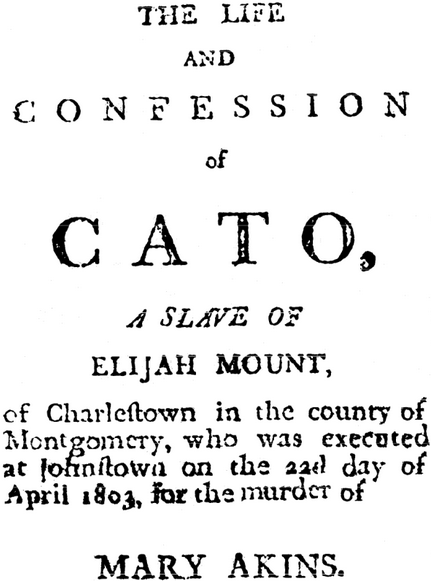
1803: Cato, slave of Elijah Mount

The following confessional and its exhausting run-on sentence arrive courtesy of a pamphlet published at the time and reprinted in Free Blacks, Slaves, and Slaveowners in Civil and Criminal Courts: The Pamphlet Literature.

The Life and Confession of Cato, a Slave of Elijah Mount, or Charlestown in the county of Montgomery, who was executed at Johnstown on the 22d day of April 1803, for the murder of Mary Akins.

Containing many incidents of his life and conduct not before made public. Faithfully written from his own words, while under sentence of death in prison.

LIFE and CONFESSION &c.

In offering to the public the following narrative I feel no other interest than the good of mankind, nor have I any other object in view than to caution the careless and unwary against pursuing that vicious course which has been the means of plunging me at this early period of life into that dreadful dilemma in which I am now involved.

Altho nature had doomed me to a state of obscurity and degradation, I might have remained happy in this unenviable situation, had not the vicious habits I had contracted in the earlier stages of my youth driven me into excesses which have proved my ruin. Pursued by the hand of justice, I have thus early been arrested in my vicious career: drawn from the deep & solitary recesses of obscurity and debasement, to the bar of justice, I am condemned to recieve [sic] the punishment which my guilt has so justly merited, as a warning and example to those I leave behind. It may be somewhat interesting to those I am about to leave to be informed of the causes which have produced those (to me) dreadful effects.

The following pages contain a brief history of my short and wicked life, and such reflections as have been produced in my mind by a retrospective view of my conduct; they are submitted to the public as the last words of a dying sinner.

I am this day seventeen years and five weeks old. I was born of African parents; slaves to Mr. Benjamin Ward of Middlesex county State of New-Jersey, in whose family I lived until about four years ago, previous to which my parents purchased their freedom, and left my master’s family.

My master was a man of very corrupt and immoral habits, subject to habitual intoxication, and most of the vices which flow from that fertile scource [sic] of human depravity. Among other things he almost totally neglected his family concerns, the consequence was that I and my brothers and sisters were left to govern ourselves, and form such habits and principles as our inclinations led us to pursue.

We were not only neglected as to our morals and habits, but were badly provided for with the necessaries of life, our table was but illy supplyed [sic], our cloathing [sic] would scarcely cover our nakedness, much less protect us against the inclemency of the seasons. Thus were we permitted to spend our time in idleness and want, which produced in us an inclination, and afforded us liesure [sic] and opportunities to practise almost all kinds of evil.

I was thus in a manner abandoned by my master and only guardian, in a hopeless state of slavery, with no prospect before me to stimulate my ambition, or direct the youthful ardor that glowed in my breast to the pursuit of any laudable object, I sunk even below the degraded station which nature had assigned me.

I formed connection with such as were willing to associate with me, those were of course a motly tribe of the most abandoned of the human race, among whom it was my chief ambition to become famous, and it may readily be conjectured what was the measure of fame in a society where wickedness was the standard of merit, and lewdness and profanity esteemed the higest [sic] accomplishments of its members.

Hence I became extremely wicked, and subject to almost every vice my tender years were susceptable [sic] of, such as cursing, profane swearing, lying and sabath-breaking [sic; he will repeat this word several times more with the same spelling], with a number of other lewd practice, all which I indulged without restraint, and all my vicious habits increased with my age. My master occasionally chastised me, but this was generally so indiscreetly done, that, instead of a reformation it produced the contrary effect, and I became obstinate and headstrong.

In this situation I lived until I was about thirteen years of age, during which time tho’ I indulged in almost all kinds of wickedness which my tender age was capable of, I do not recollect of having committed any thing legally criminal, except, that I once stole a shilling out of a bakers drawer, with which I bought some cake and shared it with my companions, but being detected, I confessed the fact, and was severely chastised for it.

At length my master dying, his estate fell into the hands of his heirs, who found it so involved that they were under the necessity of selling the personal property. Among the rest I was sold to Mr. Elijah Mount, who then lived in New-Jersey, but afterwards moved to Charlestown, Montgomery county, state of New-York.

I now found my situation entirely changed, my new master was quite the reverse from my old one, he was moral, sober, industrious and frugal, paid great attention to the comfortable support and instruction of his family, nor did he neglect to extend his benevolence to me. He soon laid me under such restraints as in a great measure reformed my external deportment. He totally prohibited my profaneness and instructed me in the principles of christianity, [sic] but, alas! the inbred vicious habits I had contracted in the earlier part of my life, had made such a deep impression on my mind that, altho I found myself under the necessity of complying with his regulations in my conduct, they were far from producing a radical reformation in my principles. On the contrary, I found, that, tho I was constrained to abandon the vicious habits of cursing, profane swearing and sabath=breaking at least publicy, the corrupt principles I had imbibed daily acquired strength as I grew up and became capable of carrying them into effect.

I became lewd to that degree that my lasciviousness overleaped all bounds of discretion, and I indulged it in the most wanton and abominable excesses, so that not even the brutal part of the creation escaped the rage of my unruly passions, the innocent lamb and the loathsome swine indiscriminately became its victims.

I also extended my lewd desires, to those whom nature had placed above me, I however found the gratification of those desires so obstructed by my debased situation, that I could not flatter myself with a hope of indulging them as a favour. I was therefore impelled by their impetuosity to endeavour to obtain by violence what I could not effect by solicitation, I was rash and inconsiderate, destitute of fortitude and circumspection by which I was soon led into the error that now terminates my existence.

The first attempt I made to gratify these lewd desires, was on the body of a young woman in the town of Charlestown whose name for her sake I chuse to with-hold from the public. The circumstances of this nefarious attempt were as follows. It was on a sabath day. I together with some young men of the neighbourhood, who I likewise do not chuse to expose at this time, by publishing their names to the world, were together in an orchard, when this young woman came in. She had by some means or other become obnoxious to them, and soon after she appeared they proposed to me to make an attempt on her chastity, they offering me a small pecuniary compensation, and promised to withdraw to afford me an opportunity, which they accordingly did, while I made the attempt, but I did not succeed, for before I could effect my purpose two of her brothers (small boys) came in sight, and I fled.

This transaction was not disclosed, it is probable the young woman who was the subject of it, from motives of modestly declined complaining, or pursuing measures to bring me to justice; and those who were concerned with me and who ought rather to have protected her agianst any violence offered by me, than to have encouraged me in such an abominable attempt,) could have no motive in divulging a crime in which they themselves were so deeply implicated, and by these means I evaded the punishment which I so justly deserved.

Having thus escaped with impunity, I felt encouraged to pursue my wicked inclinations, my obscurity however prevented my having many opportunities of indulging my passions.

At length however, my attention was attracted by that unfortunate victim of my inordinate passion, who fell a sacrifice to my wantoness, [sic] and ferocity, for which I am now to suffer the just punishment of the law.

Her name was Mary Akins, daughter of Mr. Samuel Akins, of Charlestown, in the county of Montgomery. She was a girl of about twelve years of age, her father lived on a part of my master’s farm, she came to my master’s house on the morning of Sunday the thirteenth day of February last, for the purpose of attending public worship, having heard that a minister was to preach there that day, but being disappointed in her object, and the weather stormy, she remained there til the sun about half an hour high in the afternoon, her father lived about half a mile from my master’s, the road leading across the fields, I had formed a design of making an attempt on her chastity and watched an opportunity to follow her undiscovered, which soon offered, and I as readily embraced, I soon overtook her in an obscure place, where we could not be discovered from either house, with a determination of carrying my nefarious purpose into effect, I passed by her, she appearing offended at my presence, accosted me saying “who wants to keep your company you black devil” I replied I was not going to keep her company, upon which she again accosted me in the same manner adding “you black son of a bitch” to which I made the same reply as before and immediately assaulted her, threw her down, and attempted a violation of her chastity but not effecting it I permitted her to rise, as soon as she found herself disengaged she attempted to escape towards my master’s, threatening to have me brought to justice, upon which my guilt beginning to operate on my mind, and dreading the consequences of a discovery, I determined to prevent it by committing a crime still more heinous, and in an instant determined to deprive her of the power of exposing me, by depriving her of her life I had no sooner come to this resolution than I siezed [sic] a small stone which lay in my way, and I could conveniently hold in one hand, by this time she had advanced about ten or twelve yards from the place where I had made the first attempt upon her towards my master’s, I again assaulted and threw her down, struck her with the stone I held in my hand, on the crown of her head with such force as stunned her and blood issued from her mouth and [obscure], in this situation I again attempted to carry my first design into effect, but was again baffled by her incompetency, I then disengaged from her, blood on my feet and threw the same stone with which I had before struck her on the head, this I repeated twice, and then left her in the agonies of death, and expiring, finding some blood on my hands, I washed them and retired towards home, my conscience had however by this time awakened, and the horrors of my guilt began to agitate my mind, but I endeavoured to sooth my waring [sic] conscience with reflections that I had not been discovered, and that the only one privy to this horrid scene had been deprived of the power of discovering it by the very act that now filled my mind with remorse, under those reflections I had [obscure] some distance, when I began to apprehend, that she might perhaps recover, and have strength enough to reach home, or at least to communicate the transaction and discover its agent, to some one who might pass that way, I therefore returned to the place where I had been engaged in this sanguinary scene, and where its subject lay breathing her last (for she yet breathed.) to remove the apprehensions I had entertained of her revival, I placed two rails crosswise on her neck, and the one end of each under the fence by the side of which she lay, having thus secured her against all possibility of recovering, I retired a second time.

I now returned home, it being about sunset, and no one having noticed my absence, I went about my work as usual, and in about fifteen minutes her brother came in search of her, I heard him making enquiry for her, and passing by him into the house I familiarly asked him what he would think if he should find her dead? to which he replied that he would be much frightened, little thinking that those words carelessly spoken were to be the means of betraying me, they however made a deeper impression on the mind of the young man than I expected; & in searching for the author of this melancholy event, afforded a clue to discover its author, and fixed the suspicion on me.

Soon after the departure of the young man his mother came to my master’s, and informed him that she feared some misfortune had befallen her daughter as her bonnet had been found and she was missing; this excited great consternation, and my master and others went with her in search of her daughter; whom they soon found & carried home. The next morning Mr. Akins came to my master’s and charged me with the crime, informing my master of the grounds of his suspicion: I denied it, but by threats and promises was prevailed upon to confess it at last.

I was immediately bound and carried before Benjamin Van Veghten Esq. for examination, where I made the like confession; as I also did before the Coroner’s inquest. I was then committed to jail for my trial which I had on the 24th of March last, a conviction was a matter of course, my sentence was pathetically delivered by the presiding judge, during which awful scene I remained insensible.

I have since been benevolently attended by the reverend clergy of different denominations, who merit my warmest acknowledgments for their solicitude for my future happiness, I cannot however flatter myself with a hope of mercy; my approaching dissolution exites dreadful sensations in my mind, which I am unable to suppress; my sentence is just but [obscure] reconcile myself to my fate.

The foregoing narrative contains a faithful history of the chief incidents and material transactions of my life, as far as I recollect them; I have no motives to conceal anything; whatever else has been laid to my charge I deny.

Hence let masters learn the necessity of paying due attention to the instruction of their servants, had I not been neglected in my youth, I might have escaped this tragical end.

Let servants learn obedience and resignation, for had I paid due respect to the admonitions of my late master, and contented myself in my late situation, I might yet have been happy; let them also learn to shun the company of that worthless class of citizens, who being despised by their own society seek that of slaves, these are sure guides to destruction, such were those who offered me a reward to commit a rape.

Hence also let parents who profess christianity, (as the parents of these young men did) learn the danger of letting their children stroll about in idleness in such company, especially on sabbath days; and let profaners of that day remark that my worst crimes have been the effects of that sin.

In short let every description of sinners learn the danger of deferring repentance to the cross, if they have one favourable instance, they have a cloud of melancholy examples. I feel the necessity of a Saviour, but my heart is a rock at the door of the sepulcher which I am not able to remove, and I stand on the brink of eternity under the gloomy apprehensions of everlasting misery and despair.

Johnston Jail, April 22d 1803.


Although it sounds as if Cato (or the confessor who obviously composed his testimonial) was pessimistic about the prospects for his everlasting soul, we have firmer information on the unedifying disposition of the youth’s mortal flesh: a Dr. John Ball of Franklinton, Ohio (a settlement today absorbed into the city of Columbus) secured it and kept it in his closet “in order to keep his personal effects secure from the prying eyes of servants. The skeleton was so suspended that should the closet door be opened by one not acquainted with the secret, Cato’s jaws would gnash together and his head would wag in a manner calculated to strike terror into inquisitive female hearts.”

On this day..

1895: A quintuple lynching in Greenville, Alabama

(Thanks to Meaghan Good of the Charley Project for the guest post. -ed.)

On this date in 1895, three black women and two black men were lynched in Greenville, Alabama for the murder of Watts Murphy, white.

Watts was a “young man of great prominence” who was said to be the nephew of Alabama’s former governor, Thomas H. Watts. He was killed on April 17, aged about thirty. When he failed to arrive home, his family began looking for him. Finally, one of the family servants confessed to what he knew: Watts had been working in the field with six black people, three men and three women, and one of the men hit him on the head with a tree limb. The others beat him unconscious and carried his body to a secluded area, where the women gathered loose brush, piled it on top of Watts’s body, and set the heap ablaze.

Newspapers reported grisly details about the crime, saying that the murderers kept piling wood on the fire until there was nothing left but the victim’s teeth, his heart and his liver, which “for some unknown reason failed to burn.”

Just why the murder happened has been lost to history, and various contradictory rumors floated around. According to one story, one of the men planned to kill him in revenge for “an imaginary wrong of a trivial nature.” In another account, it was an impulsive act of violence, the result of an argument.

Daily Inter Ocean (Chicago, Ill.), April 22, 1895

Zeb Caley or Calley, Martha Greene, Alice Greene, Mary Deane, and John Rattler were arrested on April 20 near Butler Springs, Alabama, and charged with murder. (The third man who was implicated, left unnamed in press reports, got away.) A group of men was charged with transporting the five prisoners sixteen miles to the security of jail in Greenville. They set off at 11:00 p.m. At 3:00 a.m., while the party was en route, a mob of approximately 100 men brandishing Winchester rifles surprised the party on the road, surrounded them and took the prisoners away.

The members of the mob tied each person’s hands, lead them one by one to the side of the road, and hanged them from trees. Later that day the bodies were seen by people passing by on their way to church.

On April 29, the sixth suspect in the crimes, who has never been identified, was found hanging from a tree in the same general area as the other ones. He had been dead for about a day.

On this day..

1785: Alexander Stewart, the first to hang at the Tolbooth

We’ve recently featured in these pages the very last hanging at Edinburgh’s old Grassmarket, scene of innumerable executions potent in Scottish history.

Beginning in 1785, public hangings were relocated to the Tolbooth, a medieval civic building that had been converted into a notorious prison — an era that was officially christened on this date in 1785 with the sacrifice of a juvenile delinquent.

the first person executed at the west end of the old city gaol, was Alexander Stewart, a youth of only fifteen, who had committed many depredations, and at last had been convicted of breaking into the house of Captain Hugh Dalrymple, of Fordell in the Potterrow, and Neidpath Castle, the seat of the Duke of Queensberry, from which he carried off many articles of value. It was expressly mentioned by the judge in his sentence that he was to be hanged in the Grassmarket, “or any other place the magistrates might appoint,” thus indicating that a change was in contemplation; and accordingly, the west end of the old Tolbooth was fitted up for his execution, which took place on the 20th of April, 1785.

Demolished in 1817, the Tolbooth survives today as a much-spat-upon heart design in the cobblestones marking the gaol’s former location.

On this day..

1947: Jozef Tiso, collaborationist Slovakian President

The first and only president of Nazi Germany’s puppet Slovak state, Jozef Tiso, was hanged on this date in 1947 as a traitor.

A Catholic priest in the twilight years of Austria-Hungary, Tiso got in the ground floor on the growth industry of nationalism when that polity fell apart after World War I.

Declaring himself a Slovak, he became during the 1920s — the first years of Czechoslovakia — an increasingly prominent exponent of the right-wing Slovak People’s Party, which he represented in the Czechoslovakian parliament from 1925. By the time party founder Andrej Hlinka passed away in August 1938, Tiso was the natural heir — and right in time for the crisis of Czechoslovakia’s dismemberment on behalf of Sudetenland Germans.

Berlin’s policy, too, was for an independent Slovakia — in fact, more stridently than Tiso himself, who mapped as a moderate within his own party, more supportive of gradual methods than revolutionary ones. “A Czech state minus Slovakia is even more completely at our mercy,” Goering mused in October 1938. “Air base in Slovakia for operation against the East very important.”

In secret negotiations with Slovakian leaders during the autumn and winter of 1938-39, the Third Reich’s brass made clear that its intention to guarantee Slovakia’s independence was an offer that could not be refused. When Slovakian separatist movements triggered the Prague government’s military occupation of Slovakia on March 9, 1939, Tiso was summoned to Berlin where Hitler gave him an ultimatum on March 13:

The question was: Did Slovakia want to lead an independent existence or not? … It was a question not of days but of hours. If Slovakia wished to become independent [Hitler] would support and even guarantee it … (Shirer)

The next day, Tiso was back in Bratislava, reading the terms to the Slovak Diet — with the clear undertone that the deed would be accomplished by Wehrmacht boots if it were not done by parliamentary votes. Tiso became the Prime Minister of the First Slova Republic that very evening (he became President later in 1939), and soon implemented an enthusiastically rigorous anti-Semitic line. (Tiso had been on about the Jews right from the start of his public career in the early 1920s.)

Slovakia is not a populous country, so its deportations made only a modest contribution to the Holocaust in absolute numbers. But from a prewar census population of 88,951 Jews, some 70,000 were deported to German camps and over 90% of these died. Thousands of others fled Slovakia as refugees; today, Slovakia’s Jewish populace has all but disappeared.

Captured in Bavaria after the war, Tiso was extradited by the Americans back to Communist Czechoslovakia where a court condemned him for collaboration, judging that he had been “an initiator, and, when not an initiator, then an inciter of the most radical solution of the Jewish question.” He was hanged in his priestly garb three days after that verdict.

On this day..

1841: Peter Robinson, Tell-Tale Heart inspiration?

On this date in 1841, Peter Robinson hanged for a New Jersey murder. Little could he have imagined that he was on his way to the literary canon.

A wealthy merchant and banker named Abraham Suydam had disappeared, and suspicion quickly settled on Robinson — one of his debtors, who suddenly seemed to be a little bit flush with cash and a timepiece too rich for his station in life.

Robinson was arrested and examined before the Mayor of New Brunswick, and from his confused manner and contradictory statements, it was determined that his house should be searched. Accordingly the Mayor, accompanied by several constables, and a number of citizens, proceeded to Robinson’s house for the purpose of searching it. Every room, nook and corner in the upper stories of the house were searched, but without success. At last one of the constables proposed to adjourn to the cellar and see what could be discovered there. This proposition caused the greatest trepidation on the part of Robinson, who strongly remonstrated against it.

He stated that if the floor of his cellar was removed, it would endanger the safety of the building, and there was no telling what would be the consequences. This only made the party feel the more convinced of Robinson’s guilt, and they immediately commenced operations removing the plank of the cellar. A few boards and the earth underneath only had been removed, when the dead body of the unfortunate Mr. Suydam, to the astonishment of all present, was found. His skull was found to be dreadfully fractured, and his head was horribly disfigured by the marks of blows which had been inflicted on it. From the state of his body, it is supposed that he was murdered eight or nine days ago. (New York Commercial Advertiser (Dec. 15, 1840.)

It is commonly thought — thought there does not appear to be any direct evidence for it — that this nationally infamous body-under-the-floorboards murder helped to inspire Edgar Allan Poe‘s classic short story “The Tell-Tale Heart”.*

Published in January 1843, “The Tell-Tale Heart” features a young man who murders an old man, stashes his body under the floor, then pleasantly dissipates the suspicions of the police until a sensation of the victim’s heart noisily throbbing overwhelms him into a confession:

Was it possible they heard not? Almighty God! — no, no! They heard! — they suspected! — they knew! — they were making a mockery of my horror! — this I thought, and this I think. But anything better than this agony! Anything was more tolerable than this derision! I could bear those hypocritical smiles no longer! I felt that I must scream or die! — and now — again! — hark! louder! louder! louder! louder! —

“Villains!” I shrieked, “dissemble no more! I admit the deed! — tear up the planks! — here, here! — it is the beating of his hideous heart!”

Poe’s nameless character denies a motive for the crime, attributing it only to the victim’s “eye” — a mythologizing device which has surely aided the story’s longevity.

Object there was none. Passion there was none. I loved the old man. He had never wronged me. He had never given me insult. For his gold I had no desire. I think it was his eye! — yes, it was this! He had the eye of a vulture — a pale blue eye, with a film over it. Whenever it fell upon me, my blood ran cold; and so, by degrees — very gradually — I made up my mind to take the life of the old man, and thus rid myself of the eye forever.

But if Robinson was the source material, the occult power of the old man’s “eye” was nothing but the oldest motive in the world: plain old luchre.

In 1839, Robinson had borrowed $400 from Abraham Suydam to buy a lot and begin construction of a home upon it, but soon found himself (to use a familiar but anachronistic parlance) underwater.

“Every one to whom I owed a few dollars was after me to sue or get me to give my furniture for the debt,” Robinson recounted in a tearful confession 48 hours before his hanging. (We excerpt it here from the April 17, 1841 Baltimore Sun.) “I did so; I did all that I could; I was driven nearly crazy by these debts … I let them take my furniture until there was scarcely any thing left in the house; and I was ashamed to let any one come into it to see how very poor we really was, and how bad off.”

The dunning of creditors and the passion of the crime left the murderer’s mind awash in dollars and cents.

Even facing a far more considerable penalty than bankruptcy, Robinson’s confession is obsessed with the winnowing margins of his former debts; scarcely a paragraph elapses without citation of a meticulous mental ledger-book. Robinson recalled the bills incurred to construct his home (“I bought about $250 worth of lumber … The mason work was done for me by Mr. Chessman; for this I was to pay Mr. C. $210. I paid him $110 in cash, and gave him a mortgage for $100 … I had bought some sash frames for my house of a man, and they came to $22.25” …). He dwelt on his negotiations with Suydam and complained of the lender’s tightfistedness; he recalled the precise value of what he was able to steal from Suydam’s body (“$10 in money, not a cent more … [in] his pantaloons pockets … only two shillings and a penknife”) and the expenses incurred to evade justice (he offered his brother $50 to burn his house down for the insurance, then took a bath unloading Suydam’s gold watch — it “was worth double what I got for it”); yet even so, he was still a little proud of his diligence assailing his debt, in contrast with “Thorne who bought a lot close by mine” and with whom “Mr. Suydam got out of patience.” The killer even had the brass to pat himself on the back for not destroying the papers Suydam had on him: thus, “the relations of Suydam, and his friends, can’t say that they lose any money by the murder.”

So, about that murder.

Luring Suydam to his house to make a payment on Thanksgiving Day, Robinson invited him down to the creepy basement to do business, having prepared his instrument like Patrick Bateman.

At this time I took up a mallet, which I had placed in the basement ready to knock him over with. I then went into the front basement, Mr. Suydam in front of me. I followed behind with the mallet in my hand, he not noticing the same. My intention then was to murder him in the front basement — but my heart failed me. We then went up stairs again in the back room, I carrying the mallet against the palm of my hand. We stood by the fire talking about the house. He was there nearly fifteen minutes. I stated that my wife staid a long time.

He told me that he would go out and take a wall, and return again. He started to go, and I followed, until he got just through the doorway of the back room, which is within three or four feet of the back door, in the entry. I then knocked him down on his knees with the mallet, by striking him n the back of his head, through his hat. He undertook to rise, when I struck him again on the head, and he fell over, and laid still and senseless. I then supposed he was dead, and laid the mallet down; I then went and turned the button of the front door, which all this time was unfastened; and I went down into the front basement. I then went to work and began to dig a small hole; after I had been digging for two minutes, I thought I would not leave the body up stairs; so I went up stairs to bring him down. I saw him on his hands and knees, with his face and hands all bloody. He cried out, “Oh! Peter!” once or twice. Had he begged for his life then, I believe I should have let him off; but I did not want to drag him down stairs alive, and I didn’t want to see him linger there in misery; so I seized the mallet, and again struck him on the head, which knocked him perfectly dead, as I supposed. …

I discovered a chain hanging out of his pocket, and drew from it his gold watch, and put it in my own pocket. I then dug the hole larger, and in throwing out the dirt I threw about half a load of it on his body and head, which completely covered it. He then groaned a little, but I shuddered to hear him, and so I got out and stood upon the dirt and on his head to smother him! He then groaned so hard that I got off from him and struck him with the edge of the spade upon the head, which sunk completely to the brain, and which killed him instantly! …

I now felt as if my heart was completely black, and I was so hardened and callous, and yet so cool and deliberate, that I could have murdered many more. I could, without flinching or hesitating, have killed twenty men if they had come on me one by one.

I don’t believe that I was over a half hour doing the whole exercises of the whole thing! For I had a kind of knack of doing work somehow that others hadn’t. And why, sir, I’ve took hold of floor plank before now, and done forty-five of them in one day, that is, planed and ploughed and grooved them; whereas from sixteen to eighteen is a day’s work for some men.**

As if to complete the American Gothic quality of the crime, Robinson fell through the rope on the first attempt to hang him, then painfully strangled to death on the second try.

* Poe took up a very similar theme — the criminal psychology of a domestic murder concealed by subterranean immurement — later that year in “The Black Cat” (published in August 1843).

** His last wish in this confession: “whatever you do, don’t let the doctors get hold of me and make medicine of me.”

On this day..

1851: James Jones and Levi Harwood, but not Hiram Smith

For the April 15, 1851 hanging of James Jones (James Burbage was his actual name) and Levi Harwood, we crib from PlanetSlade’s collection of murder ballads. While this ballad amply narrates the murder committed in a home invasion, click through to PlanetSlade to find out about the third man who wasn’t hanged — the one who actually pulled the fatal trigger, but who saved himself by testifying for the crown to send his mates to the gallows.

Of all the crimes on Earth the worst,
Foul murder is of all accursed,
Assassins are by all abhorred,
Despised by men, condemned by God.

We are condemned and death is nigh,
And in two dismal cells we lie,
James Jones and Harwood: it is true,
We’ve murder done, no pity knew.

A minister of God we’ve slain,
For sake of gold, man’s curse and bane,
Poor Mr Hollest kind and good,
We left him weltering in his blood.

To Frimley Grove, ’twas there we went,
On robbing we were fully bent,
The rector’s house we soon broke in,
And then to plunder did begin.

With faces masked, disguised to all,
And pistols loaded well with ball,
Like vile assassins on we crept,
To where the good old couple slept.

But Mrs Hollest struggled brave,
And nobly fought their lives to save,
Undaunted, boldly bore her part,
A woman with a warrior’s heart.

Her husband had one ruffian down,
And held him firmly on the ground,
The coward wretch for help did call,
‘Twas then the other fired his ball.

Thy wound was fatal, good old man,
Thy blood in streams around it ran,
We both escaped while thou didst bleed,
And now we suffer for the deed.

How could we thus such monsters prove,
To murder those whom all did love?
To want thou didst assistance lend,
And ever was the poor man’s friend.

Widows weep thy loss: they mourn,
The only friend they had is gone,
And orphans’ tears they quickly fall,
For thou a father’s been to all.

And Mrs Hollest? She was kind,
Distress in her a friend did find,
Her sole delight it seemed to be,
To dry the tears of misery.

So we confess the crimes we’ve done,
Is there no hope on Earth? There’s none,
Grim death will drag us to the tomb,
A scaffold is the murderers’ doom.

On this day..

1546: Alice Glaston, age 11

(Thanks to Meaghan Good of the Charley Project for the guest post. -ed.)

On this date in 1546, one Alice Glaston was hanged in the town of Much Wenlock in Shopshire, England together with two other prisoners.

The court records for that time and place have been lost, so so the crime for which Alice was hanged is not known. We do know one thing about her, though: she was, at eleven years old, the youngest girl to be executed in England’s history. (But not the youngest person. That honor goes to eight-year-old John Dean, who was hanged for arson in Abingdon in 1629.)

In 2014, Paul Evans released a radio play about Alice’s death titled The Spirit Child.

On this day..