1995: Ken Saro-Wiwa and the Ogoni Nine

On this date in 1995, author Ken Saro-Wiwa and eight fellow activists of the Movement for the Survival of the Ogoni People (MOSOP) were hanged by the Nigerian military junta in Port Harcourt.

Saro-Wiwa, the author of works such as Sozaboy, was already considered among Nigeria’s greatest writers before becoming an activist for the rights of his Ogoni people in the face of Nigeria’s lucrative and ecologically destructive Niger Delta oil trade.

Few benefits of that trade returned to the politically marginalized Ogoni, whose overwhelming response to MOSOP’s organizing soon began choking off oil exploitation in Ogoniland and brought a violent response from the Nigerian dictatorship — operating hand in glove with Shell Oil, as Saro-Wiwa himself noted in his closing remarks to the sham tribunal that convicted him of inciting a murderous riot.

I repeat that we all stand before history. I and my colleagues are not the only ones on trial. Shell is here on trial and it is as well that it is represented by counsel said to be holding a watching brief. The Company has, indeed, ducked this particular trial, but its day will surely come and the lessons learnt here may prove useful to it for there is no doubt in my mind that the ecological war that the Company has waged in the Delta will be called to question sooner than later and the crimes of that war be duly punished. The crime of the Company’s dirty wars against the Ogoni people will also be punished.

In my innocence of the false charges I face here, in my utter conviction, I call upon the Ogoni people, the peoples of the Niger delta, and the oppressed ethnic minorities of Nigeria to stand up now and fight fearlessly and peacefully for their rights. History is on their side. God is on their side. For the Holy Quran says in Sura 42, verse 41: “All those that fight when oppressed incur no guilt, but Allah shall punish the oppressor.” Come the day.

Though Saro-Wiwa’s hanging helped quell Ogoniland sufficiently for Shell to resume production, it left an opposition martyr. Saro-Wiwa’s prison diary was published shortly after his hanging; his son, journalist Ken Wiwa, has written a biography; and separate UK- and Canada-based organizations exist to carry on his memory and work.

The tensions left unresolved in the Delta, meanwhile, have spawned ever more militant resistance movements.

On this day..

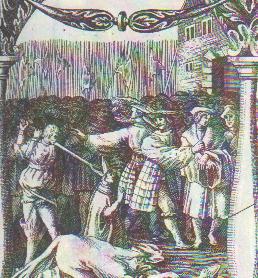
1520: Stockholm Bloodbath

On this date in 1520, four days after the Danish King Christian II gained the Swedish throne, nearly 100 prominent supporters of Swedish independence were executed en masse as a civil war’s apparent victors purged their enemies.

The Stockholm Bloodbath followed years of conflict between supporters of the Danish-dominated Kalmar Union and independence advocates under the banner of Sten Sture the Younger. With Sture’s death in battle earlier in 1520, the unionists had gained the upper hand. Stockholm, the last outpost of resistance, had held against four months’ siege before accepting a general amnesty in exchange for capitulation.

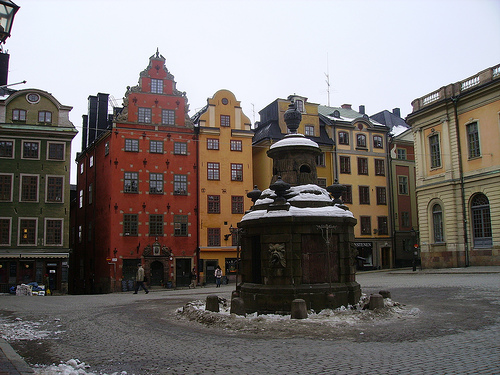
But with the city in hand, Christian — known to Swedish history as “Christian the Tyrant” — had its leaders charged for having deposed during the conflict the pro-union Archbishop Gustav Trolle, construed as an offense against the Church not in the temporal authority’s power to reprieve. Less than 24 hours after this legal maneuver was sprung, public beheadings of prelates, merchants and burgomasters were underway at Stortorget* — and Sture’s remains were exhumed and posthumously burnt at the stake.

Stortorget

It proved a Pyrrhic victory for the Danish party.

Inside of three years, Christian himself had been deposed with multiple lands and factions throughout his realm in open revolt. Gustav Vasa, whose father had been one of the Stockholm Bloodbath’s victims, would not only decisively break Denmark’s hold on Sweden but found the Vasa Dynasty under which Sweden would burgeon into one of Europe’s great powers.

*One Hans Brask survived the purge despite having endorsed the removal of Archbishop Trolle. Brask supposedly placed a note under his seal on this document saying “To this I am forced and compelled.” This cunning device gave the Swedish tongue the word Brasklapp — a secret reservation.

On this day..

1925: Sidney Reilly

On this date in 1925, legendary British spy — and subsequent James Bond inspiration — Sidney Reilly was shot in a forest outside Moscow for his efforts to overthrow the Soviet government.

Fact blends insensibly into fiction in Reilly‘s biography; much of what is known or believed about him is conjectural or colored by his posthumous valorization, such the 1967 book Reilly: Ace of Spies written by [the son of] his onetime cloak-and-dagger collaborator Robin Bruce Lockhart — who was himself a close friend of Bond author Ian Fleming.

However, even at the word of less sensational biographers — such as Andrew Cook — Reilly lived a life almost too extraordinary for belief.

A Jewish child of tsarist Russia born in what is now the Ukraine, Reilly claimed to have escaped Odessa by faking his death and hopping a ship bound for Brazil. Like much of Reilly’s life, the story is unverifiable, but by hook or by crook — and possibly by way of a murder in France — he arrived in London in 1895, hitched himself to a wealthy woman a few months after the suspicious death of her husband (discarding the inconvenient surname Rosenblum in the process), and became entangled with British intelligence.

In the first decade of the 20th century, he apparently spied promiscuously on England’s imperial rivals Germany and Russia, though the particulars are disputed. He arrived in Port Arthur, Russia, shortly before the outbreak of the Russo-Japanese War and may have provided the Japanese fleet intelligence enabling it to navigate the mined harbor — in addition to a copious side business in war profiteering. He may also have had a hand in capturing British oil concessions in Persia and reconnoitering behind German lines during World War I.

Like his fictional heir 007, he gambled often and left a string of lovers and mistresses in his wake. His true allegiances, and the extent to which his exploits were inflated or outright fabricated, are debated to this day.

The adventures that brought both death and fame were his machinations to overthrow the Bolshevik government in the fraught early months after Lenin took power. A planned coup d’etat in September 1918 came to grief and Reilly fled Russia steps ahead of the authorities, who subsequently condemned him to death in absentia.

Notwithstanding the sentence, which had been ruthlessly visited on his less-fortunate conspirators, Reilly was lured back to the USSR in 1925 by the Soviet counterintelligence project Operation Trust. Intending to meet anti-Bolshevik agitators, he was instead arrested at the border and tortured at the infamous Lubyanka Prison, where he kept notes on cigarette papers about enemy interrogation techniques for the eventuality of an escape or release that never came.

Part of the Themed Set: Spies.

On this day..

1936: Edgar André

On this date in 1936, communist politician Edgar Andre was beheaded in Fuhlsbüttel Prison for treasonous complicity in the Reichstag Fire.

This 1936 German pamphlet denouncing Andre’s execution concludes: “Edgar André lives. In his spirit, we march: Despite all.”

A politician raised in Belgium, Andre had bolted the Socialist Party of Germany for the Communist Party in the early 1920’s, becoming a major labor leader in Hamburg. Andre was arrested within days of the 1933 Reichstag Fire as Adolf Hitler crushed official leftist opposition.

But Andre was not brought to trial for over three years — by which time torture had crippled and deafened him, and the political climate made the doubtful nature of the evidence against him scant protection in the courts. His conviction and sentence were a foregone conclusion.

The Spanish Civil War, which erupted over the summer of 1936 between Andre’s trial and execution, saw the service of a battalion in the International Brigades named for Edgar Andre.

Just days after Andre was beheaded, that battalion entered its first action — with German volunteers helping stave off fascist capture of Madrid. The unit’s hymn commemorated their namesake:

[audio:Das_Batallion_Edgar_Andre.mp3]

On this day..

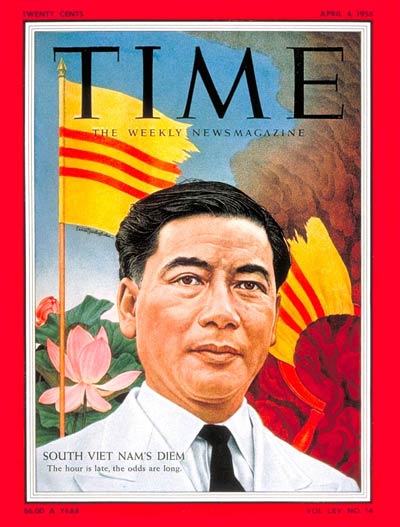
1963: Ngo Dinh Diem

On this date in 1963, Ngo Dinh Diem, the first president of South Vietnam, was executed in the back of an armored personnel carrier along with his younger brother and secret police chief, Ngo Dinh Nhu, the day after their government had been overthrown in a military coup.

Born into the Buddhist country’s Catholic elite, Diem was brought up as a French colonial administrator but fled Vietnam in 1950 under a death sentence from Ho Chi Minh’s nascent Vietminh. Over several years living and lecturing in the United States, he established his anti-communist bona fides with influential conservatives and was returned to his native country as Prime Minister when the U.S. inherited the foundering French war against nationalist guerrillas.

Fearing communist victory at the polls, Diem blocked scheduled 1956 elections to unify North and South Vietnam, making an interim division permanent. But Diem made an inconsistent American client, often spurning Washington’s advice and alienating the Buddhist majority with heavy-handed authoritarianism that eventually prompted Buddhist monks to begin public self-immolation as a form of protest.

The government responded by arresting monks.

By now more a liability than an asset, Diem was ousted with the blessing of a fellow Catholic head of state, John F. Kennedy.

This first successful coup — Diem had already quashed attempted putsches in 1960 and 1962 — began a cycle of internecine revolts in which weak South Vietnamese governments were toppled in rapid succession … leaving Saigon ever more visibly the puppet of Washington, and dragging the United States ever more deeply into the Vietnam War.

On this day..