1944: Lilo Gloeden, Erich Gloeden and Elisabeth Kuznitzky

On this date in 1944, Berlin housewife Elisabeth “Lilo” Gloeden was beheaded with an axe in Plotzensee Prison, along with her husband and mother.

They had been sentenced — and intentionally made an example of — just three days before for hiding a fugitive from the July 20 Plot to assassinate Hitler.

As Martin Gilbert observes in The Second World War: A Complete History, the fury of Hitler’s domestic crackdown came in inverse proportion to Germany’s fortunes in war.

[The family’s] fate was then publicized, as a warning to anyone else who might try to shelter the enemies of the Third Reich.

The fate of that Reich could not, however, be seriously in doubt. On the day of Lilo Gloeden’s execution, American troops drove the Germans from Mackwiller, in the Saar, inside Germany’s pre-war frontier. In Hungary, the Red Army entered Eger, less than twenty-five miles from the central Slovak frontier.

Part of the Themed Set: Women Against Fascism.

On this day..

1941: Zoya Kosmodemyanskaya

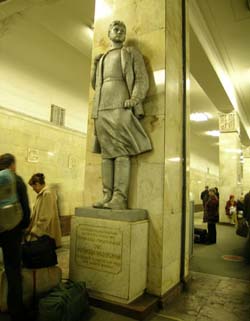
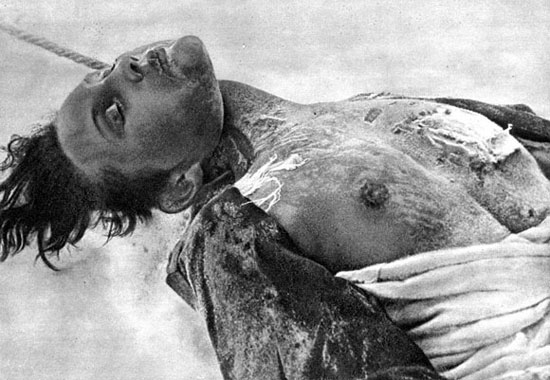
On this date in 1941, Soviet partisan Zoya Kosmodemyanskaya was hanged by the Wehrmacht for sabotaging buildings behind German lines near Moscow.

A statue of Zoya Kosmodemyanskaya stands vigil over Moscow’s World War II-era Partizanskaya metro station. Image used with permission.

One of the most famous Soviet war heroines and the first woman decorated as Hero of the Soviet Union during World War II, the 18-year-old had quit school to volunteer for a partisan unit only a few weeks before her hanging as Russia mobilized against Hitler’s race towards Moscow.

Known simply as “Tanya”, the nom de guerre which was the only information she volunteered during two days of torture, the power of the press offered her apotheosis into a propaganda coup for the Kremlin, and a symbol of courage that would long outlive Stalin. Before the public execution, the Nazis paused to photograph the scene; Kosmodemyanskaya availed the lull to harangue the Germans — “you can’t hang all 190 million of us!” — and call on the Russian villagers present to resist occupation.

Her bayoneted, mutilated body hung on the gibbet until the Red Army recaptured the village; witnesses related the tale of her dying heroism to a newsman.

It was only after the story of “Tanya” hit the press in January 1942 that her identity was established … and then promulgated widely. Anonymous and obscure in death, Zoya Kosmodemyanskaya would inspire millions and become the heroic emblem of other women partisans.


Soviet propaganda poster unabashedly modeled on the already-iconic image of Zoya Kosmodemyanskaya’s abused corpse.

Zoya, a 1944 Soviet film, was scored by Dmitri Shostakovich.

Part of the Themed Set: Women Against Fascism.

On this day..

1922: Six Greek former ministers of state

On this date in 1922,* on the morning after a revolutionary tribunal held them liable for treason in the catastrophic Greek loss of Smyrna, six former high-ranking political and military officials of the Greek government were shot in Athens.

The long-running national conflict between liberals and monarchists had boiled over during World War I, setting the stage for increasingly bitter internecine conflict played out against the backdrop of a misbegotten foreign adventure.

Greece’s territorial aspirations after World War I.

As the Ottoman Empire — Greece’s neighbor and historical rival — collapsed in the aftermath of the world war, Athens under liberal colossus Eleftherios Venizelos set her sights on a vast pan-Hellenic domain spanning Constantinople, western Anatolia, and the Black Sea coast.

In 1919, backed — even pushed — by the British, Greece occupied Smyrna, a multiethnic economic hub in Asia Minor. But cruelty towards the Turkish population sparked immediate resistance which soon blended insensibly into the burgeoning Turkish National Movement, already on the path towards its destiny of forging the modern state of Turkey.

As the Greek army pressed outwards from Smyrna, it became drawn into full-fledged war. In 1920, the Greek government turned over (as it was often wont to do) and under the ascendant monarchists whose irredentism was not to be upstaged “fantasy began to direct Greek policy” — like a quixotic scheme to march on Constantinople rather than hold a defensible position. Greece’s European allies and sponsors began to cut bait.

September 14, 1922: Smyrna burns.

Far from threatening Constantinople, the Greeks suffered one of their greatest disasters — the “Catastrophe of Asia Minor”, when Ataturk drove them back to, and then out of, Smyrna, emptying the once-cosmopolitan city of thousands of Greek (and Armenian) refugees fleeing a sectarian carnage. Some swam out of the burning city only to be refused aid by ships of nations unwilling to be drawn into the affair politically.

In the dismayed Greek capital, anti-monarchist officers who had been purged by the new government revolted and rounded up the opposition’s leadership. “The Six” who faced public trial for treason included three former Prime Ministers:

With two other ministers of state and a general, they comprised all but one member of the offending monarchist government, a bloody thoroughness the New York Times compared to Robespierre. Western governments temporarily broke off relations.

After the day’s bloody deeds, Venizelos returned from exile to conclude the war on Turkish terms, including “population exchange” — fragrant euphemism — to solidify each government’s demarcation as a nation-state and ratify the destruction of Smyrna (renamed Izmir) as a multiconfessional melting pot.

Today, Smyrna is largely forgotten by those to whom it is not intensely remembered — and among the latter, its meaning is ferociously contested. To Turks, a chapter in their founding expulsion of foreign occupation; to Greeks, the calamitous end of the ancient Hellenic presence in Asia Minor; to each, a touchstone for one another’s atrocities; to others of a less parochial frame of mind, a parable of the perfidy of an entire enemy faith, or a subplot in the great game for Ottoman oil, or as Henry Miller conceived it writing in the antechamber of the second World War, the avatar of a stunted and cynical moral sense among European powers that would lead them to their next great reckoning:

Even the most ignorant yokel knows that the name Attila is associated with untold horrors and vandalism. But the Smyrna affair, which far outweighs the horrors of the first World War or even the present one, has been somehow soft-pedalled and almost expunged from the memory of present day man. The peculiar horror which clings to this catastrophe is due not alone to the savagery and barbarism of the Turks but to the disgraceful, supine acquiescence of the big powers.

Smyrna, like the Boxer Rebellion and other incidents too numerous to mention, was a premonitory example of the fate which lay in store for European nations, the fate which they were slowly accumulating by their diplomatic intrigues, their petty horse-trading, their cultivated neutrality and indifference in the face of obvious wrongs and injustices.

*Greece did not adopt the Gregorian calendar until 1923, the last European country to do so — so the date in Greece on the day of the execution was actually November 15.

On this day..

1919: Felipe Angeles

On this date in 1919, Mexican hero General Felipe Angeles was shot at dawn in Chihuahua, hours after a military tribunal condemned him for rebellion.

Angeles, a humane and cosmopolitan socialist, had tacked a unique course through the dangerous Mexican Revolution. The career artillerist’s military counsel was a high card in the hands of the revolutionaries, and helped to make the coruscating career of Pancho Villa. Crucially, Angeles advised Villa to seize the mines of Zacatecas, dealing a mortal blow to the putschist Huerta government by throttling its currency at the source.

But that brilliant maneuver countermanded an order of the Revolution’s moderate political face, Venustiano Carranza, and both personality conflicts and support for more radically redistributionist measures soon sundered the Villa factions’ alliance with Carranza.

Angeles hitched his destiny to Pancho Villa and is historically recalled as the “angelic” opposite number to the famed guerrilla’s other top military henchman, the murderous Roberto Fierro. The three lend themselves almost implausibly to allegorical literature — “the decisive biographical proof of Villa’s duality … found in the two men closest to him, equidistant and extreme extensions of his nature.” (Enrique Krauze)

Angeles aimed, perhaps, at a statesmanship that might have remembered him the father of his country.

‘It was the recurrent dream of the impotent revolutionary intellectual: to play Plato to some powerful but pliant popular caudillo.’ This may well be an accurate analysis of Angeles, who probably had ambitions to be president of Mexico, with Villa as the power behind the throne but based in Chihuahua, allowing Angeles free rein to implement radical reforms in the capital

… Angeles probably saw Villa as a tabula rasa on which he could imprint his ideology. The problem was that Villa had no taste for abstract thought; as [John] Reed remarked ironically: ‘You had to be a philosopher to explain anything to Villa.’

To the grief of both, Villa neglected Angeles’ expertise when the Villists faced Carranzo at arms. Against advice, Villa abandoned Mexico City, failed to attack when the constitutionalists were tenuous, then spurned guerrilla operations for a frontal assault into the teeth of a foe with numerical superiority and lethal tactical advances culled from the slaughterhouse of World War I.

All was postscript after the Battle of Celaya — Villa maintaining for a few years as a bandit force and famously raiding New Mexico while his strategist drifted into exile in Texas before returning to Mexico on a quixotic peacemaking mission that led him instead to a show trial.

Angeles’ end came with the all the dignity of his romantic age. Before his judges — before all the world — he gave “full and clear expositions of his history and his ideas about everything from politics to ontology. It was clear that he knew this was his end, and he seems to have written a kind of intellectual memoir in the protracted answers … he was not defeated morally so much as physically.”

Angeles himself arranged particulars of his own execution with the Carranza men detailed to shoot him. He enjoys posthumous esteem commensurate with his qualities in life:

On this day..

1799: Judith van Dorth

On this date in 1799, Judith van Dorth was shot on the outskirts of Winterswijk for supporting an attempted restoration of the House of Orange to the Dutch throne against the Batavian Republic.

Although the Netherlands had been a Republic for two centuries, it was torn by revolutionary conflict from the mid-1780’s — predating the French Revolution, but finally coming to power in 1795 when its neighbor’s mass conscript armies drove William V of Orange to England.

The 52-year-old van Dorth, an impoverished noble of Orangist sympathies, recklessly tried to raise an internal revolt [linked page in Dutch] backing an English-Russian invasion to restore William in 1799.

The uprising came to nothing, and after the invasion — a footnote in the sweep of Revolutionary Wars — was repelled, van Dorth was condemned for treason by a military tribunal to set an example. [linked page in Dutch]

She was shot within 24 hours near Winterswijk’s Jewish cemetery, and apparently survived the barrage. One of the firing squad had to shoot again when he saw her move — legend has it that this occurred when she had already been packed into her coffin.

She remains the only woman in history executed by a Dutch military court. A biography of her life is available in Dutch.

The House of Orange, one of the most successful of European dynasties, regained power in the Netherlands following the Napoleonic Wars. William V’s great-great-great-great-granddaughter Queen Beatrix reigns there today.

On this day..

1695: Zumbi dos Palmares

On this date in 1695, Zumbi dos Palmares, the last leader of Brazil’s most famous free colony of fugitive slaves, was captured by the Portuguese and summarily beheaded.

From the very beginning of European settlement in the New Wold, Maroon communities of escaped slaves, free-born blacks, Indians, poor whites, and mixed-race outcasts formed at the fringes of slave states.

Colonial power did not welcome their presence.

Consequently, the community of Palmares faced repeated harassment from the Portuguese and the Dutch West Indies Company from the time of its establishment around 1600 — even as it burgeoned into a kingdom of over 30,000 inhabitants.

Zumbi, a black free-born in Palmares, was kidnapped by such a sortie and raised with a missionary priest who taught him Portuguese and Latin. At 15, he escaped and returned to Palmares, quickly rising to prominence and in 1678 overthrowing his adoptive uncle King Ganga Zumba when the latter attempted to accept peace under Portuguese rule.

Zumbi’s skepticism was vindicated when the followers of Zumba who had defected to Portugal were re-enslaved, but free Palmares soon faced intensified Portuguese pressure. In 1694, artillery finally battered its largest settlement into submission — forcing its ruler into the bush, where he long eluded capture.

In Zumbi’s honor, November 20 is a Brazilian celebration of national pride and especially pride for those of African descent … while the king who would not be a slave has lent his name, somewhat paradoxically, to an international airport.

On this day..

1491: Eight current and converted Jews at an auto de fe

On this date in 1491, the murder of the Holy Child of La Guardia was punished with an auto de fe and the public execution of eight Jews — some practicing, some converted to Christianity (who enjoyed the mercy of strangulation before being burnt) — and three others already dead but exhumed for the occasion.

The auto de fe — literally, “act of faith” — was a public ritual of religious penance for the condemned. Though its performance did not always precede the execution of its participants, it became closely associated with the savagery of the Spanish Inquisition.

In the hysteria of the Holy Child of La Guardia case — one of history’s better-remembered instances of “blood libel” implicating Jews in the ritual murder of Christian children — the result was foreordained.

Knitting together (inconsistent) confessions obtained under torture, the famed Inquisitor Torquemada proved a conspiracy of Jews had kidnapped and crucified a child further to the concoction of a magic potion that depended on the heart of an innocent Christian — despite a fruitless high-and-low search for some missing child who might have been the actual victim.

After this day’s gaudy public slaughter, a cult sprang up around the supposed martyr, adored in a chapel erected where one of the prisoners had once had a home — the very spot, it was said, where the Jews conspired. The Holy Child was a staple of Spanish literature down to the 20th century and is still venerated in La Guardia.

But Torquemada aimed for results well beyond Christendom’s martyrology, and the wretches at the stake would not be this day’s only victims.

John Edward Longhurst argues in The Age of Torquemada that the Inquisitor seized on the Holy Child case to orchestrate “his heart’s desire — the expulsion of all Jews from Spain.”*

Early the next year, the Spanish monarchy obliged, permanently remaking Spain:

If Ferdinand and Isabella were hesitating over expelling the Jews from Spain, the discovery of this latest Jewish plot would surely resolve all doubts. The Auto de Fe of November, 1491, exploited the affair to its fullest, emphasizing not only all the gruesome details of the Murder but the Jewish menace to Christians intended by it. The sentence against the Jew Juce Franco, read aloud to the great crowd at the Auto de Fe, identifies him as a seducer of Christians to the Law of Moses in language that clearly foreshadows the Edict of Expulsion four months later

We may be sure that Ferdinand and Isabella were treated to a lengthy account of this case. It also is clear, from their own observations in the Edict of Expulsion, that Torquemada impressed on them the determination of the Jews to persist in their efforts to seduce Christians to Judaism. As long as they were permitted to remain, the danger of infection would never be eliminated, no matter how harsh the measures employed against them.

* Or, their forcible conversion … which would then keep the Inquisition in business for years to come.

On this day..

1226: Frederick of Isenberg

On this date in 1226, Count — although he had been stripped of this title — Frederick of Isenberg, a German noble, was broken on the wheel for the murder of his cousin, the Archbishop of Cologne.

The proximate cause of the dispute between the two was said to have been Frederick‘s exploitation for his own benefit of an abbey he administered, to which the Archbishop, Engelbert of Berg, took exception. Underlying the conflict are the the outlines of power politics in fractious medieval Germany.

Engelbert was an aggressive and effective Archbishop, and the power he won for his diocese came at the expense of other claimants. Frederick was not likely the only noble menaced by the inroads of the vigorous bishop. One theory has it that, despite the 47 wounds found on the cleric’s body, the ambush Frederick laid for him aimed only to capture him as a hostage — a not unheard-of negotiating strategem of the period.

No matter Frederick’s intent, what he achieved was excommunication and the loss of all lands, title and wealth — including his castle, razed by the Archbishop’s successor. A year after the murder Frederick was captured returning from Rome, where he had sought to have his excommunication lifted. He suffered one of the more excrutiating forms of execution, his shattered body lingering alive overnight displayed atop a stone pillar.

Engelbert, who in life had been no stranger to worldly politics and himself had been excommunicated in his youth for backing an anti-papal power, was incorporated into the Catholic Church’s martyrology for his death in defense of the abbey and (though never formally canonized) has sometimes been venerated as a saint.

On this day..

1002: St. Brice’s Day Massacre

On this date over a millennium past, according to the chronicle of John of Wallingford, King Ethelred the Unready of England conducted a massacre of Danes living in the realm.

The character of this sanguinary event — named after a fourth-century French bishop whose feast day Nov. 13 happens to be — lies half-buried in history’s shifting sands. Surely the slaughter of every Dane in a Britain then very much in the Scandinavian orbit would have been not only morally reprehensible but logistically unimaginable.

The accepted, albeit sketchy, story has it that to consolidate his own authority — or to check an actual or suspected plot against him — Ethelred ordered the surprise apprehension and summary execution of some sizable number of Danish lords and mercenaries. British historian Thomas Hodgkin characterizes it as a sort of coup d’etat.

On this date, it was the Danes who were unready for Ethelred.

But whatever its true extent or immediate object, it occurred within the context of intensifying conflict between the English crown and Scandinavian aspirants. Ethelred was to spend the better part of his life struggling — both militarily and through the ruinous tribute of Danegeld — to hold back the incursions of the Viking king Sweyn I.

The St. Brice’s Day Massacre exacerbated those tensions. Sweyn’s sister was apparently among those massacred, and — whether driven by vengeance or simply availing a pretext — Sweyn resumed harrying the English kingdom in the following years.

By 1013, Sweyn had driven Ethelred to Normandy and ruled all of England, welding together a Norse empire fringing the whole north of Europe.

But the empire — and England’s place in it — proved an historical cul-de-sac. Authority in England would be contested for another half-century, gradually sapping the crown’s strength until the Norman Conquest in 1066 swept aside Viking power and set England on a course that would redefine its history.

Update: The story of Ethelred, Normandy, and the Vikings told in Episode 3 of Lars Brownworth’s Norman Centuries podcast:

[audio:http://c4.libsyn.com/editions/58550/17915/03-richard-the-good.mp3]

The British History Podcast covers the St. Brice’s Day Massacre in episode 328.

On this day..

1831: Nat Turner

On this date in 1831, the slave Nat — remembered to history as Nat Turner after the surname of his original owner — was hanged, flayed and dismembered for leading the most notorious slave rebellion in antebellum America.

A deeply religious man known to other slaves as “The Prophet”, Nat followed what he took to be divine directive to launch a bloody uprising on the night of August 21-22 in Southampton County, Virginia. Using (at first) axes, knives and clubs to avoid attracting attention to gunfire, Nat’s band slaughtered whites from house to house, freeing slaves as they went. At least 55 whites were killed, and a like number of slaves by white militias that mobilized to put down the revolt … and then hundreds more slaves as far away as North Carolina suspected of some tangential involvement or simmering disloyalty.

The uprising was suppressed within two days, but it rooted so deeply in the conscience of the South that it persists to this day.

“I have not slept without anxiety in three months. Our nights are sometimes spent listening to noises.”
-Slaveowner after the rebellion

Nat Turner embodied slaveowners’ terror of the subject population living about them, outnumbering them, resentfully supporting Southern gentility at the end of a whip — the conundrum Jefferson had described barely a decade before as “we have the wolf by the ear, and we can neither hold him, nor safely let him go.” Arguably, the revolt hardened southern whites against moderating slavery; some legislatures tightened restrictions against teaching slaves to read, thinking that literate slaves like Nat were more liable to uprisings.

Conversely, he was a powerful martyr of resistance in the slave quarters, a symbol of scores of other lesser-known uprisings and of the countless more that lurked in dreams and fantasies, awaiting some spark of outrage, some sudden opportunity, some wild carelessness of death.

He was a figure of literature even before his death — The Confessions of Nat Turner, dictated to a white interrogator, left Nat’s own riveting testimony from the shadow of the gallows; the Virginia-born white novelist William Styron used the same title for a controversial 1967 historical novel which earned a Pulitzer but drew a critical rebuttal from many black writers. (Nat Turner also stalks the memory of Styron’s semi-autobiographical narrator in Sophie’s Choice.) More recently, Nat has received graphic novel treatment.

Historians of every stripe, meanwhile, have struggled over the meaning of the man’s deeds and — especially — his paradoxical legacy as symbol.

Update: The occasion received a tribute in Alabama about the time this post went up.

On this day..