1989: Nicolae and Elena Ceausescu

On this date in 1989, 71-year-old dictator Nicolae Ceausescu and his wife Elena were condemned by a secret military tribunal and immediately shot in Targoviste as Communism in Romania suddenly, stunningly collapsed.

The last of the Revolutions of 1989 that toppled Communism through much of Eastern Europe in a matter of weeks left the indelible image of the man who had dominated Romanian politics since the mid-60’s bewildered as a party-summoned mass rally at Bucharest’s Revolution Square turned against him.

It was to be Ceausescu’s last public address. Within a day, the country had slipped from his control; before week’s end, he would face a firing squad with “The Internationale” on his lips at the conclusion of a drumhead trial.

In a confused political situation — the police who intercepted Ceausescu and his wife held them for several hours, attempting to divine which way the winds were blowing before handing them over to the mutinous army — Romanian state television would soon broadcast footage of the trial and the first couple’s corpses (though not the execution itself).

Caution: This video contains graphic footage

Immediately afterwards, Romania abolished the death penalty. Nicolae and Elena Ceausescu remain the last people executed in that country.

On this day..

1684: Baillie of Jerviswood

On this date in 1684, the Scottish patriot Baillie of Jerviswood was convicted of treason and immediately executed, for his part in the Rye House Plot against the Stuart King Charles II.

Baillie was a lesser player in the Protestant scheme — whose nature and extent, or even existence, are matters of historical debate — supposedly to do away with the Catholic-leaning ruler and his outright catechumen brother and heir James. Baillie was implicated under torture, and while disowning any part of a conspiracy declined — “with striking truthfulness” — to deny a design on Scottish rebellion.

His summary hanging would enter the pantheon of English depravities in the north country, but he achieved another sort of immortality as well.

During an earlier stint in prison, a proscribed fellow patriot’s 12-year-old daughter had smuggled him messages — becoming acquainted with Baillie’s own son, whom she would eventually wed. The girl gained fame in adulthood as Lady Grizel (or Grisel, or Griselle) Baillie.

“Werena my Heart’s licht I wad dee”
-Lady Baillie

THERE ance was a may, and she lo’ed na men;
She biggit her bonnie bow’r doun in yon glen;
But now she cries, Dool and a well-a-day!
Come doun the green gait and come here away!

When bonnie young Johnnie cam owre the sea,
He said he saw naething sae lovely as me;
He hecht me baith rings and mony braw things—
And werena my heart’s licht, I wad dee.

The legendary tableau of intrigue between Baillie and his future daughter-in-law was itself fruit for literature, given time enough to ripen into legend. Kinswoman Joanna Baillie, one of the great litterateurs of the early 19th century, made use of the episode to open a lengthy ballad to Lady Grizel in Metrical Legends of Exalted Characters:

I.
Within a prison’s hateful cell,
Where, from the lofty window fell,
Thro’ grated bars, the sloping beam,
Defin’d, but faint, on couch of stone,
There sat a pris’ner sad and lone,
Like the dim tenant of a dismal dream.
Deep in the shade, by low-arch’d door,
With iron nails thick studded o’er,
Whose threshold black is cross’d by those
Who here their earthly being close,
Or issue to the light again
A scaffold with their blood to stain,–
Moved something softly. Wistful ears
Are quick of sense, and from his book
The pris’ner rais’d his eyes with eager look,–
“Is it a real form that thro’ the gloom appears?”

II
It was indeed of flesh and blood,
The form that quickly by him stood;
Of stature low, of figure light,
In motion like some happy sprite;
Yet meaning eyes and varying cheek,
Now red, now pale, seem’d to bespeak
Of riper years the cares and feeling
Which with a gentle heart were dealing.
“Such sense in eyes so simply mild!
“Is it a woman or a child?
“Who art thou, damsel sweet? are not mine eyes beguiled?”

III
“No; from the Redbraes’ tower I come;
“My father is Sir Patrick Hume;
“And he has sent me for thy good,
“His dearly honour’d Jerviswood.
“Long have I round these walls been straying,
“As if with other children playing;
“Long near the gate have kept my watch
“The sentry’s changing-time to catch.
“With stealthy steps I gain’d the shade
“By the close-winding staircase made,
“And when the surly turnkey enter’d,
“But little dreaming in his mind
“Who follow’d him so close behind,
“Into this darken’d cell, with beating heart, I ventured.”

IV
Then from the simple vest that braced
Her gentle breast, a letter traced
With well-known characters, she took,
And with an eager, joyful look,
Her eyes up to his visage cast,
His changing countenance to scan,
As o’er the lines his keen glance past.
She saw a faint glow tinge the sicky wan;
She saw his eyes thro’ tear-drops raise
To heaven their look of silent praise,
And hope’s fresh touch undoing lines of care
Which stress of evil times had deeply graven there.
Meanwhile, the joy of sympathy to trace
Upon her innocent and lovely face
Had to the sternest, darkest sceptic given
Some love of human kind, some faith in righteous Heaven.

V
What blessings on her youthful head
Were by the grateful patriot shed,
(For such he was, good and devoted,
And had at risk of life promoted
His country’s freedom and her faith,
Nor reck’ning made of worldly skathe)
How warm, confiding, and sincere,
He gave to her attentive ear
The answer which her cautious sire
Did to his secret note require;–
How after this with ‘quiries kind,
He ask’d for all she left behind
In Redbraes’ tower, her native dwelling,
And set her artless tongue a-telling,
Which urchin dear had tallest grown,
And which the greatest learning shown,
Of lesson, sermon, psalm, and note,
And Sabbath questions learnt by rote,
And merry tricks and gambols play’d
By ev’ning fire, and forfeits paid,–
I will not here rehears, nor will I say,
How, on that bless’d and long-remember’d day,
The pris’ner’s son, deserving such a sire,
First saw the tiny maid, and did admire,
That one so young and wise and good and fair
Should be an earthly thing that breath’d this nether air.

On this day..

1948: Amir Sjarifuddin

On this date in 1948, leftist former Indonesian Prime Minister Amir Sjarifuddin was summarily executed by forces of the infant Indonesian Republic for his participation in an attempted coup d’etat three months before.

A Dutch-educated Communist politician who had adhered to an anti-fascist “common front” position, Sjarifuddin was a vigorous activist against the Japanese occupation during World War II — and lucky to avoid execution for it.

Indonesia’s declaration of independence following the war sparked the National Revolution, during which Sjarifuddin emerged a leading player of the left as rival factions maneuvered against each other within Indonesia under pressure from the Dutch colonial power looking to reassemble its old dominions.

Sjarifuddin briefly served as the fledgling state’s second prime minister, but resigned in January 1948 after an unpopular diplomatic foray to calm tensions with the Dutch. His support for a botched and premature revolt by Communist officers in September sealed his end as a political factor and eviscerated left influence in the revolution, confining the latter’s character to an essentially nationalist one.

The rising’s suggestion of internal division may also have encouraged the Dutch incursion into Java on this date. There was a touch of poetic justice if that was the case: Republican troops, melting away from superior firepower for an insurgency campaign, opted to execute Sjarifuddin and about 50 other captured leftists before retreating rather than free them.

According to George Kahin, Sjarifuddin rendered with his death one last service to his nationalist — if not his Communist — ambitions:

[O]nce the [Indonesian] government … had put down the [September] rebellion and shot its leaders, it was no longer possible for the Dutch to make American officials and the US Congress believe — as previously many of them had — that most leaders of the Republic were under strong Communist influence and that their government was providing a bridge to an ultimately Communist Indonesia.

Its Marshall Plan aid threatened, the Netherlands recognized Indonesian independence in 1949.

On this day..

401 B.C.E.: Clearchus of Sparta

Around this time in the late autumn or early winter some weeks following the Battle of Cunaxa, the general of a Greek mercenary army — along with most of its other commanders — was treacherously seized by a Persian satrap and summarily beheaded.

In the train of the Peloponnesian War‘s devastation, sturdy Greek hoplites with bills to pay found a lucrative gig backing a Persian prince‘s bid to seize the throne.

The prince marched the Hellenes deep into Persia before falling in battle at Cunaxa in Mesopotamia, a discomfiting scenario alike for the stranded but still-potent invading army and the somewhat outclassed Persians.

The seizure around this day of the veteran soldier and former tyrant of Byzantium Clearchus — lured under color of friendship — aimed to crush the Greeks’ morale, but instead feathered the laurels of “the Ten Thousand”. This “marching Republic” hastily self-organized and proceeded upon an astonishing escape, intrepidly fighting its way north over the ensuing year to the Black Sea, and thence to hearth and home.

The Greeks’ perseverance offers one of classical antiquity’s stock testimonies to the resilient polis — and at this stage, practically the last breath of that dying spirit. More to the immediate point, it illustrated strikingly the Persian army’s vulnerability to the phalanx, exploited to decisive effect in the century to come by Alexander the Great.

One of the replacement generals, Xenophon, immortalized the Greeks’ march in the Anabasis.

After the generals had been seized, and the captains and soldiers who formed their escort had been killed, the Hellenes lay in deep perplexity — a prey to painful reflections. Here were they at the king’s gates, and on every side environing them were many hostile cities and tribes of men. Who was there now to furnish them with a market? Separated from Hellas by more than a thousand miles, they had not even a guide to point the way. Impassable rivers lay athwart their homeward route, and hemmed them in. Betrayed even by the Asiatics, at whose side they had marched with Cyrus to the attack, they were left in isolation. Without a single mounted trooper to aid them in pursuit: was it not perfectly plain that if they won a battle, their enemies would escape to a man, but if they were beaten themselves, not one soul of them would survive?

Haunted by such thoughts, and with hearts full of despair, but few of them tasted food that evening; but few of them kindled even a fire, and many never came into camp at all that night, but took their rest where each chanced to be. They could not close their eyes for very pain and yearning after their fatherlands or their parents, the wife or child whom they never expected to look upon again. Such was the plight in which each and all tried to seek repose.

The tale’s motif was borrowed for a 1965 novel of a New York gang struck leaderless making its way out of hostile territory, later adapted for a cult 1970’s film:

On this day..

1635: Ivan Sulyma

On this date in 1635, Cossack commander Ivan Sulyma was put to death in Warsaw for razing the Kodak Fortress on the Dnieper River.

Sulyma‘s death, a footnote historically, unfolded in the rising action of Zaporozhian Cossacks‘ conflict with the Polish-Lithuanian empire then at the peak of its power.

Those famed corsairs of the steppes made their way in the world by plunder. The European powers at play around the Black Sea domains of the Zaporozhian host — Poland, Russia and the Ottoman Empire — each struggled to exploit Cossack raiders for their own ends of statecraft.

The Zaporozhian Cossacks, as portrayed by Ilya Repin

It was perhaps the misfortune of Poland to claim suzerainty during this unruly horde’s upswinging arc. The Poles endeavored to gather the Cossacks into the formal apparatus of the state, “registering” an elite corps of Cossacks inducted into the armed forces while reducing the remainder to peasantry.

The registry’s size and privileges became a permanent bone of contention, driving a cycle of uprisings through the 1620’s and 30’s that sapped Cossacks’ loyalty to the Polish crown.

Sulyma was a partisan of the militant unregistered Cossacks, fresh from war against the Ottomans. He returned to find that Poland had thrown up a fortress controlling the Dnieper, with an eye both to checking Cossack provocations against the now-peacable Turks, and to controlling internal Cossack disturbances.

Sulyma sacked the fortress, slaughtering its 200 inhabitants, but the disturbance was quickly put down and loyal registered Cossacks handed over the rebel. By the late 1630’s, Poland had imposed a peace of arms on the region … but hardly a secure one. As historian Orest Subtelny notes:

[E]ach successive uprising reflected the growing strength and military sophistication of the rebels. Their numbers grew, their tactics improved, and Cossack identification with the plight of the peasantry and the defense of Orthodoxy deepened. The decade-long Golden Peace merely masked a problem that was waiting to explode again.

It exploded in 1648. Where Sulyma had failed, Bohdan Khmelnytsky would succeed — breaking the Cossack lands permanently free of Poland.

Remembered to the modern state of Ukraine as a father of the country, Khmelnytsky’s immediate achievement was to rearrange the balance of power in Eastern Europe. Poland, ravaged by invading Swedes just as the Cossacks slipped away, fell into permanent decline — leaving a vacuum filled by Russia, which soon pulled the Cossacks into its orbit.

On this day..

1937: Teido Kunizaki

On this date in 1937, Japanese intellectual Teido Kunizaki was shot as a “spy of the Japanese army” in Moscow.

The reader is not deceived to infer from the date and place the dread hand of Stalin’s NKVD at the height of the Soviet purges. The fate of the Soviet Union’s tiny community of Japanese emigres, one of the hidden chambers in a house of horrors, only became fully understood after the Soviet Union collapsed.

The leader of the Japanese section of the German Communist Party in Weimar Germany, Kunizaki’s opposition to Japanese intervention in China and involvement in a publication as subversively titled as Revolutionary Asians had made him unwelcome in Germany shortly before Hitler took power.

But arriving in Russia in September 1932 with his German wife, he stepped into a struggle for power within the Japanese Communist Party’s Russian organs.

According to Tetsuro Kato, the professorial Kunizaki was among those denounced by another seminal Japanese communist, Kenzo Yamamoto — a working-class activist who distrusted intellectuals.

Kunizaki’s execution this day was only one of many wrought on the Japanese party by the Soviet secret police in the dangerous exchange of accusations and denunciations. On this date, Yamamoto himself was already in prison; early in 1939, he would swallow the same draught as Kunizaki — denounced, as it emerged after the Cold War, by yet another of Japan’s revered old Marxists.

In the 1920s and 1930s, there were about 100 Japanese who dreamed of living in “the paradise of the working class” and went to the USSR. These people were mainly communists, who were oppressed by the imperial police in Japan. There were also ordinary workers, intellectuals and artists who were not communist … Almost all Japanese living in the USSR [in the 1930’s] faced the same destiny. The exact number of victims is not yet known, but I now estimate there to have been about 80 Japanese [shot by the NKVD].

On this day..

43 B.C.E.: Cicero

On this date in 43 B.C.E., the 63-year-old Roman statesman Cicero, fleeing the proscription of the Second Triumvirate, was caught and decapitated near his villa south of Rome.

Arrogant, eloquent and opportunistic, Cicero was a polarizing figure in his forty years in the public eye. He was a Senator from an upstart family who espoused the conservative Republican cause, and a master rhetorician. Twenty years earlier, he had received the honorific Pater Patriae for steering the Roman Republic through the Catiline conspiracy.

But not Cicero nor any other Roman had healed the social rot in which Catiline’s plot sank roots. The Republic continued to weaken even as Cicero poured out the volumes of rhetoric and philosophy for which later generations would celebrate him.

Ironically, Cicero survived the resumption of civil war in 49 B.C.E. despite backing the losing faction; it was the (momentary) peace between Marc Antony and Octavian that doomed him: to consolidate power, the dictators proscribed numerous political rivals.

Cicero, a bitter nemesis of the assassinated populist Julius Caesar and his heir apparent Antony, was among the casualties.

Plutarch described the scene:

[H]is assassins came to the villa, Herennius a centurion, and Popillius a tribune, who had once been prosecuted for parricide and defended by Cicero; and they had helpers … Herennius hastened on the run through the walks, and Cicero, perceiving him, ordered the servants to set the litter down where they were. Then he himself, clasping his chin with his left hand, as was his wont, looked steadfastly at his slayers, his head all squalid and unkempt, and his face wasted with anxiety, so that most of those that stood by covered their faces while Herennius was slaying him. For he stretched his neck forth from the litter and was slain, being then in his sixty-fourth year. Herennius cut off his head, by Antony’s command, and his hands — the hands with which he wrote the Philippics.

It would be too glib to say that the Republic died with him, for Cicero himself recognized that Caesar’s war had already fatally compromised it. When Antony and Octavian at length returned to arms to settle their accounts with one another, nothing but the pantomime would remain.

After a bloody century, Rome had her peace at last.

[T]he first example, prototype, and original of tyranny has been discovered by us in the history of our own Roman State, religiously founded by Romulus … We have observed Tarquin, not by the usurpation of any new power, but by the unjust abuse of the power which he already possessed, overturn the whole system of our monarchical constitution.
-Cicero, “On The Commonwealth”

The BBC’s In Our Time does Cicero in podcast form here.

Part of the Themed Set: The Fall of the Roman Republic.

On this day..

41 B.C.E.: Arsinoe IV, Cleopatra’s sister

On an unknown date late in 41 B.C.E., Cleopatra’s younger sister and rival Arsinoe was put to death in Asia Minor as the famous queen cemented her fatal alliance with Mark Antony.

Like Cleopatra herself, Arsinoe lived her short life in the internecine maelstrom of Ptolemaic politics under the sway of a Roman Empire itself immersed in civil strife. Violent death was something of an occupational hazard.

Nevertheless, had some flash of prescient irony visited her when Antony’s legionaries unsheathed their blades, she might well have wondered at the small happenstances of fate that left her a nigh-forgotten footnote in her sister’s story, rather than the other way around.

Three siblings had grasped at the Egyptian throne during the Alexandrian War, and whether it was charm or cold calculation won Caesar’s backing for Cleopatra, Arsinoe and her brother Ptolemy XIII still pressed the Roman garrison of Alexandria with a vastly superior force in a battle that was said to have set the Library of Alexandria aflame.

Timely Roman reinforcements decided the matter, and Arsinoe was marched in chains at Caesar’s sumptuous quadruple Triumph of 46 B.C.E. — though she was spared the execution that typically concluded such an ignominy and instead packed off to a temple on the coast of modern-day Turkey.*

In Margaret George’s historical novel The Memoirs of Cleopatra, the danger of maintaining an enemy who has styled herself Queen is neatly summarized in a conversation between Caesar and Cleopatra set after the Triumph:

“I have spared Arsinoe.” [said Caesar]

My [Cleopatra’s] first feeling was a rush of relief. My second was worry. Arsinoe the proud would not retire quietly.

“Where is she to go?”

“She has requested sanctuary at the great Temple of Diana in Ephesus,” he said. “And I will grant it, if you agree.”

Ephesus! Too close to Egypt! Better send her to Britain! Yet … I would gamble, and be merciful. Perhaps I was not enough of a Ptolemy after all. Arsinoe would not have granted it.

“Yes, I will allow it.”

That very perception of her potential danger hung over Arsinoe like the sword of Damocles.

The sword fell — figuratively and literally — five years later after Cleopatra seduced Mark Antony at Tarsus in the autumn of 41. Her terms for Egypt’s alliance supposedly included elimination of this lingering rival — though if Arsinoe had made common cause with Caesar’s Republican assassins, Antony may well have had his own reasons to dispatch the young woman.

Arsinoe’s death helped seal a pact that was itself destined for a bloody end. Distracted by his foreign paramour, Antony steadily lost political ground to his adversary Octavian. In another decade’s time, open war broke out again.

The Egyptian fleet would gather at Ephesus, not far from Arsinoe’s final resting place, bound for the catastrophic Battle of Actium whose outcome added Cleopatra’s and Antony’s blood to the soil from which sprung the long reign of Octavian — soon to be styled Augustus Caesar, the first emperor of Rome.

* A Temple of Artemis — either in Miletus (as Appian has it), or the wonder of the world in Ephesus (as Josephus has it). She met her death at the temple — whichever it was — dragged to its steps and put to the sword. Ephesus seems to be the more generally accepted locale, and an octagonal tomb there has been speculatively identified as Arsinoe’s.

Part of the Themed Set: The Fall of the Roman Republic.

On this day..

63 B.C.E.: Publius Cornelius Lentulus

On this date in 63 B.C.E., Publius Cornelius Lentulus was executed by strangulation in Rome’s Tullianum for conspiring to overthrow the Roman Republic.

He was one of the key figures in the Catiline conspiracy, a political intrigue set against a ruinous social crisis that pushed the country to the precipice of civil war.

Roman had fought Roman intermittently over much of the preceding 70 years in episodes underpinned by a class conflict pitting wealthy landowners (politically represented by the Senate) against the growing populations of plantation slaves who tilled their fields and urban plebeians displaced from independent farming on the other. Debt was choking the Roman economy.

Catiline, an ambitious politician from a fading patrician family, had sought the consulship on a populist platform of debt forgiveness; failing to win the office through legal channels, he maneuvered to take it by force. The affair is known mostly through the testimony of its enemies, so it is difficult to gauge the true mixture of opportunism and conviction that informed the conspirators.

A cliffhanger sequence of moves and countermoves against the consul Cicero ensued, highlighted most spectacularly by one of Cicero’s famous orations driving every Senator to seat himself away from Catiline — who nevertheless rose passionately in his own defense.

Catiline left Rome to raise an army in the countryside, leaving Lentulus (himself a former consul) to manage the intrigue within Rome.

Lentulus made the least of the moment, dilating when he could have acted and exposing the plot by dint of a ham-handed attempt to involve visiting Gauls with grievances of their own.

The arrested conspirators’ fate was debated in the Senate this very morning. The young Gaius Julius Caesar, then conducting an affair with Cicero’s Cato’s [correction] sister, stood against (illegal) summary execution, but the victories he would enjoy over Cicero yet lay some years into the future; fearing an attempted rescue, the Senate’s grim sentence was carried out immediately. Cicero personally escorted Lentulus to his death.

Lentulus’ failure likewise doomed Catiline, whose army shrunk from desertions before its commander hurled it into martyrdom with a stirring speech that recalled in passing “how severe a penalty the inactivity and cowardice of Lentulus has brought upon himself and us.”

Part of the Themed Set: The Fall of the Roman Republic.

On this day..

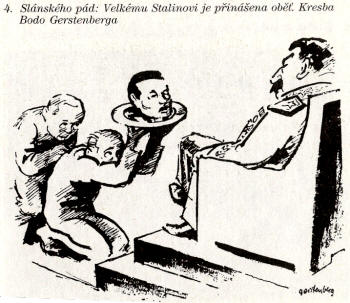
1952: Rudolf Slansky and 10 “conspirators”

On this date in 1952, eleven high-ranking Czechoslovakian politicians were hanged at Prague’s Pankrac Prison two weeks after a show trial purging unreliable elements from the Communist party.

One of the most infamous show trials in Czechoslovakia saw 14 high-ranking Communists — eleven of them Jews — railroaded for a “Trotskyite-Titoist-Zionist activities in the service of American imperialism”. Three received life sentences. The other eleven went to the gallows.

While the roots of the persecution, especially the undertones of anti-Semitism, sink into the id of the Stalinist Eastern bloc, the most evident proximate cause was the USSR’s assertion of control over its satellite states at a time when Josip Tito was successfully charting a course of independent communism. Purges in Poland, Bulgaria and Hungary had taken place in the years before.

The Soviet agents rounding up suspects for Stalin did not trifle with small game. Rudolf Slansky was General Secretary of the Communist Party and therefore the second-most powerful man in the country; by the time he was tried, after a year in prison under torture, he was publicly denouncing himself.

Otto Sling, whose name became synonymous with forbidden heterodoxy, did likewise — “I was a treacherous enemy within the Communist Party … I am justly an object of contempt and deserve the maximum and the hardest punishment.”

And Vladimir Clementis, the Slovak Minister of Foreign Affairs, was erased from a photo taken with the Czechoslovakian President, a circumstance Milan Kundera reflected upon in The Book of Laughter and Forgetting:

In February 1948, the Communist leader Klement Gottwald stepped out on the balcony of a Baroque palace to harangue hundreds of thousands of citizens massed in Old Town Square … Gottwald was flanked by his comrades, with Clementis standing close to him.

The propaganda section made hundreds of thousands of copies of the photograph taken on the balcony where Gottwald, in a fur hat and surrounded by his comrades, spoke to the people. On that balcony the history of Communist Bohemia began. Every child knew that photograph, from seeing it on posters and in schoolbooks and museums.

Four years later, Clementis was charged with treason and hanged. The propaganda section immediately made him vanish from history and, of course, from all photographs. Ever since, Gottwald has been alone on the balcony. Where Clementis stood, there is only the bare palace wall.

The hanged were rehabilitated in 1963.

Artur London, who received a life sentence and was released after rehabilitation, wrote about his experiences in The Confession, subsequently a 1970 Costa-Gavras film. The wife and son of Deputy Minister of Foreign Trade (and Auschwitz survivor) Rudolf Margolius have also both written memoirs covering the trial.

The younger Margolius in particular, who has staunchly defended his father as an essentially apolitical man and not a Communist apparatchik, has been in the thick of present-day disputes in Czechoslovakia’s successor states over whom is due sympathy and recognition for bygone political crimes.

On this day..