1865: Four for Abraham Lincoln’s assassination

On a sweltering July 7, 1865, a mere 12 weeks after Abraham Lincoln was shot at Ford’s Theater, four of his assassin’s accomplices were hanged in the courtyard of the District of Columbia’s Washington Arsenal — present-day Fort McNair, and specifically its tennis courts.

Booth, on the far left, playing Marc Antony in Julius Caesar opposite his brothers. He had Brutus’ example in mind, as he wrote in his diary while on the run: “with every man’s hand against me, I am here in despair. And why? For doing what Brutus was honored for.”

The exact nature of the conspiracy against the man who had seen the North to victory in the Civil War has been debated ever since actor John Wilkes Booth lodged a ball from his one-shot Derringer behind Honest Abe’s ear. But it was a conspiracy — an astoundingly bold one.

Simultaneous with Booth’s successful attack upon Lincoln, there was an unsuccessful attempt to kill Secretary of State William Seward; it would emerge in the investigation that another man had been detailed to murder Vice President Andrew Johnson, but got drunk and chickened out. The apparent upshot: with the President and Vice President dead, new national elections would be required to replace the Senator who would become acting president — and with the Secretary of State dead too, there’d be nobody to implement them. Booth was trying to paralyze the North with its own constitutional machinery in some desperate hope of reviving the defeated South.

Ten Against D.C.

Hundreds were detained in the stunning assassination’s immediate aftermath, but ten would ultimately be the federals’ targets. A massive manhunt pursued Booth through southern Maryland and into Virginia, where he was killed in a shootout. John Surratt, who had conspired with Booth in an earlier plot to kidnap the president — that failed plot had been reconfigured into the assassination — escaped from the country.

The other eight were rounded up and stashed at the Arsenal to face a military tribunal. It was a highly controversial arrangement: the war had entered a gray area — Robert E. Lee’s surrender just days before the murder had effectively ended the war, but when the trial opened in May Confederate President Jefferson Davis was still at large, and the last Southern general wouldn’t lay down his arms until late June. The District of Columbia was still technically under martial law … so would it do to use a military court?

Military Tribunal

So the government asked itself: government, would you rather have looser evidentiary rules and a lower bar of conviction than you would have in civil court? The government duly produced for the government an opinion that the military characteristic of the assassination — that is, to help whatever southern war effort still obtained — licensed the government to use the military courts.

That didn’t sit well with everyone. One former Attorney General griped:

If the offenders are done to death by that tribunal, however truly guilty, they will pass for martyrs with half the world.

Indeed, a year later, the Supreme Court’s landmark ex parte Milligan ruling would forbid the use of military courts where civilian courts are open — which they were in Washington, D.C.

That, of course, was too late to help Booth’s comrades. It would be a military trial, with a majority vote needed for conviction and no right of appeal but to the president for the most infamous crime of the Republic. Everyone had a pretty good idea what the results would be.

A cartoon depicting the defendants as Gallow's (sic) Birds.

Rogues’ Gallery

Two of the four today were doomed from the outset under any juridical arrangement imaginable: Lewis Powell (also known as Lewis Paine or Lewis Payne) had made the attempt on Secretary of State Seward; David Herold had guided him there with the getaway horse, and later escaped along with Booth. They were in way past their eyeballs. George Atzerodt, the schmo who couldn’t rise to the occasion of popping Andrew Johnson, looks a bit more peripheral from the distance of a century and a half, but in the weeks following the assassination he was much too close to the action to have any hope. All received death sentences.

Two others — Michael O’Laughlen and Samuel Arnold — had been involved in Booth’s earlier scheme to kidnap the president, but didn’t seem to have much to do with the murder. Still another two — Ned Spangler and Dr. Samuel Mudd* — were lesser participants. They all received long prison sentences for their pains, and the three of them still surviving were pardoned by Andrew Johnson as he left the presidency in 1869.

That left Mary Surratt, mother of the fugitive John and the only woman in the dock, the focus of attention and controversy. The 42-year-old widow owned a downtown boardinghouse, plus a tavern of sufficient importance at a Prince George’s County, Maryland, crossroads, that its community was called Surrattsville.**

The conspirators met frequently in her lodgings; Surratt maintained her innocence beyond that, but evidence and witness testimony began to pile up heavily against her … especially when Seward assailant Lewis Powell wandered into her place looking for refuge right while the police were questioning her. Booth and Herold turned out to have made a pit stop at her Surrattsville tavern to pick up a package of guns that Mary had prepared for them.

Though Surratt’s avowal of ignorance was not widely believed, a gesture of presidential mercy was anticipated — many thought (and think) she went on trial as a virtual hostage for her absconded son, who declined to take the bait. Strangely, five members of the nine-judge panel who condemned Mary Surratt turned around and asked President Johnson for clemency. Johnson claimed never to have seen the memo, but his mind seemed pretty made up — when Surratt won a habeas corpus stay on the morning of her scheduled hanging, he promptly “specially-suspended” the writ specifically to hang her:

I, Andrew Johnson, President of the United States do hereby declare that the writ of habeas corpus had been heretofore suspended in such cases as this; and I do hereby specially-suspend this writ, and direct that you proceed to execute the order heretofore given upon the judgment of the Military Commission.

Harsh treatment, and possibly well-deserved, for the first woman executed by the U.S. government. Even so, it does seem a curious thing when all is said and done that the mother of “the nest that hatched the egg” was worth a special suspension of the Great Writ, and even the stagehand who just held Booth’s horse for him caught six years, but old Jeff Davis — who apart from having figureheaded a treasonous four-year insurrection was implicated for giving Booth’s kidnapping plot official Confederate sanction — got to retire to write his memoirs.

Fine pages on the Lincoln assassination are here, here and here. There are also contemporary newspaper accounts posted online as filed for The Boston Post and The New York Herald.

The Surratt houses, by the way, are still standing. The Maryland tavern is kept as the Surratt House Museum by the Surratt Society. The downtown boarding house is a Chinese restaurant … marked with a plaque remembering more momentous doings than bubble tea.

The Chinatown restaurant where Mary Surratt had her boarding house ...

... as marked by plaque ...

... and how it looked back then.

* The panel voted 5-4 to hang Mudd, a Maryland doctor who not only set the leg Booth broke when he leaped onto the stage after shooting Lincoln, but then misdirected Booth’s pursuers. However, the rules for the trial said a two-thirds majority was required for execution.

** They changed the name after the unpleasantness. Today, it’s Clinton, Maryland.

On this day..

1882: Charles Guiteau, James Garfield’s colorful assassin

On this date in 1882, America’s weirdest assassin recited fourteen verses of the Gospel of Matthew and (sans requested orchestral accompaniment) a poem of his own composition entitled “I am Going to the Lordy,” and was hanged in the District of Columbia jail for shooting forgettable Gilded Age president James Garfield.

Mad as a march hare, Charles Julius Guiteau had irritated the obscure reaches of the Republic near four decades, trying his hand at free love, law, newspapering* and evangelism. A contemporary account of his religious flimflammery survives:

Charles J. Guiteau (if such really is his name), has fraud and imbecility plainly stamped upon his (face). (After) the impudent scoundrel talked only 15 minutes, he suddenly (thanked) the audience for their attention and (bid) them goodnight. Before the astounded 50 had recovered from their amazement…(he had taken their money and) fled from the building and escaped.

Having failed at each characteristic American monkeyshine more comprehensively than the last, he naturally gravitated to politics; while today Guiteau might tilt with his psychoses on some vituperative blog, in 1880 he published and delivered as a speech a widely-ignored crackpot encomium** for his eventual victim. Guiteau reckoned the GOP carried the 1880 elections on the strength of such rhetorical thunderbolts as “some people say he [Garfield] got badly soiled in that Credit Mobilier transaction but I guess he is clean-handed.”

Stunned that his contributions did not earn him a diplomatic posting to France, Guiteau stepped out of obscurity and into this blog’s pages by shooting the ungrateful (and unguarded) executive in the back at a Washington, D.C. train station (since demolished, and today occupied by the National Gallery of Art).

“To General Sherman: I have just shot the President. I shot him several times as I wished him to go as easily as possible. His death was a political necessity. I am a lawyer, theologian, and politician. I am a stalwart of the Stalwarts. I was with Gen. Grant, and the rest of our men in New York during the canvass. I am going to the Jail. Please order out your troops and take possession of the Jail at once. Very respectfully, Charles Guiteau.” (Click for the full image.) From the Georgetown Charles Guiteau collection.

Thoughtfully, he had already hired a cab to take him to jail, where he expected to be liberated by General William Sherman.

Malpractice

The bugger of Garfield’s assassination is that Guiteau was no better at killing presidents than he was at electing them. Despite his exultation “Arthur is President now!”, he actually inflicted what could have been a non-fatal flesh wound that through ten-thumbed medical intervention became an agonizing eighty-day Calvary for the miserable Garfield.

Doctors jabbed unwashed hands into the the wound, failing to dig out the bullet they were looking for but successfully turning the three-inch wound into a crater, puncturing Garfield’s liver, and passing him Streptococcus. Alexander Graham Bell invented a metal detector to find the missile, but the damn thing gave a bad reading … because Garfield was lying on a bed with metal springs. His doctors, feuding with one another and with the press, instituted a regimen of rectal feeding — “Nutritive enemas — consisting of beef bouillon, egg yolks, milk, whiskey, and several drops of opium … Garfield’s flatulence became intolerable,” according to one biographer — that “basically starved him to death.”† He lost 100 pounds before succumbing; the autopsy concluded that Garfield probably would have lived if not for the medical attention, which didn’t stop the doctors from submitting a sizable invoice to the feds for services rendered.

(In a moment of lucidity, Guiteau defended himself with the observation “The doctors killed Garfield; I just shot him.”)

Not Ha-Ha Funny

Horribly hilarious, this American Absurdistan. “Except for the dead-serious details of his assassinating President Garfield and being in all likelihood clinically insane, Charles Guiteau might be the funniest man in American History,” Sarah Vowell put it.

Guiteau’s circus trial — with the defendant constantly interrupting to harangue participants, object to his own attorneys or converse with the spectators, plus the macabre appearance of the late Garfield’s actual vertebrae (now at Washington D.C.’s National Museum of Health and Medicine) as an exhibit — was for all that a landmark test of evolving law around criminal insanity.

Just as Garfield probably would have survived his injury had he been treated by the next generation’s medical norms, Guiteau probably would have survived his brush with the law if treated by the next generation’s legal norms.

Against an almost-too-strict-to-achieve earlier bar for legal insanity, a more accommodating jurisprudential norm called the M’Naghten Rules or M’Naghten Test was even then being adopted from English courts: essentially, did the “criminal” realize his act was wrong? Still the basis for legal insanity claims in much of the U.S. today, the first trial of a presidential assassin would be the M’Naghten standard’s trial by fire.

While the judge gave ample leeway for the defense to use M’Naghten, the legal standards it implied were still not widely understood and the medical testimony about Guiteau’s mental condition was (embarrassingly, for the profession) wildly contradictory. Ultimately, the judge cued the jury that “the law requires a very slight degree of intelligence indeed” on Guiteau’s part to impute him with sufficient criminal culpability to hang. There were cheers in the courthouse when the jury took an hour to decide that Guiteau had that very slight degree of intelligence indeed.

In the final analysis, as Charles Rosenberg observes in The Trial of the Assassin Guiteau: Psychiatry and the Law in the Gilded Age, the jurors’ prompt conviction of the widely hated, barking-mad defendant underscored the real-life constraints of dry legal theory as applied by an outraged community to a notorious offender:

[T]he Guiteau case demonstrated anew that the circumstances of a particular case had ordinarily as much to do with its disposition as the precise injunctions of rules of law … Many observers agreed after the trial that if an individual of Guiteau’s marked eccentricity had killed an ordinary man … he would almost certainly not have been convicted; very likely he would not even have been brought to trial. Similarly, while Garfield lay on his sickbed, it was commonly assumed that his assailant would be institutionalized if the President should survive. But if not, then not.

Reckoning the gesture could cost him the 1884 Republican nomination, Chester A. Arthur declined to spare his “benefactor” (“Arthur has sealed his own doom and the doom of this nation,” was Guiteau’s reaction, picturing fire and brimstone) and left Guiteau to his strange and lonely fate. The latter was talked out of an early plan to go to the gallows in the Christlike garb of only his undergarments, but did insist upon delivering his incoherent parting ramble in a high-pitched childlike tone (“the idea is that of a child babbling to his mama and his papa”).

Wrapping up this surreal historical episode in a neat little bow, Charles Guiteau got his own bluegrass tune:‡

For more adventures through Guiteau’s looking glass, there’s a fine page at the University of Missouri-Kansas City.

* One of Guiteau’s failed newspaper ventures was to exploit the telegraph to reprint original content from other outlets. That one looks a lot less harebrained in retrospect: it’s a primitive model of the wire service, and latterly of RSS-based distributors like Google News.

** Scans of Guiteau’s apologia for Garfield — via Georgetown’s Charles Guiteau collection — are here: cover, pages 1-2, page 3.

† You really want to know more about the South Park-esque practice of rectal feeding? Garfield’s quack physician published this pamphlet in 1882.

‡ The “Charles Guiteau” ditty is actually a rather shameless knock-off of a murder ballad for James Rodgers, an Irish immigrant hanged in New York in 1858.

On this day..

1975: Prince Faisal ibn Musa’id, royal assassin

On this date in 1975, a Saudi prince knelt in the public square before Riyadh’s Great Mosque, and 10,000 onlookers watched a golden-hilted sword took off his head for regicide.

It is little enough to say that, twelve weeks before, Faisal ibn Musa’id (transliterated several different ways — ibn or bin; Musa’id, Musaid, Musaed, or Musad) had approached his uncle King Faisal and shot him three times at point-blank range.

The reason(s) why a prince of the realm should do such an extraordinary thing are the real issue. They were murky then, and remain so to this day.

Certainly, when the monarch of the world’s leading oil producer is slain shortly after denying his product to the world’s leading oil consumer … well, speculation is bound to happen, even if the oil embargo was wrapped up a year before the murder. The assassin had studied (lackadaisically) in the United States a few years before, fueling hypotheses of a CIA hit, but there’s not even much of a satisfying just-so story to go with that, to say nothing of supporting evidence.

Whatever reasons there were seem to have been internal — a personal vendetta arising ultimately from the kingdom’s uneven confrontation with modernity so sensitively treated in Abdelrahman Munif’s Cities of Salt novels.*

The prince’s brother Khalid (or Khaled) had been slain by Saudi Arabia’s security forces in 1965 after demonstrating against television’s entry into the kingdom, an innovation authorized by King Faisal to the chagrin of strict Wahhabists. Khalid remains a martyr figure to Islamic fundamentalists to this day, and the conventional supposition is that Prince Faisal shot King Faisal in vengeance served 10 years cold; some accounts have him announcing as much at the moment of the murder.

(The conspiratorial palace intrigue version suspects Prince Fahd (or Faud) of using the aggrieved young man as his instrument in a coup; a defector from the Saudi diplomatic corps also inculpated Fahd along these lines. King Faisal’s death made Fahd the de facto ruler of Saudi Arabia upon the accession of a politically disinterested brother; Fahd ascended the throne officially when that brother died in 1982 — the succession was passing brother-to-brother, rather than father-to-son — and had steered the ship of state for 30 years by the time of his own death in 2005.)

The official inquiry concluded, as such things do, that Faisal killed Faisal alone, and though early reports had the shooter mentally unbalanced, authorities eventually figured him sane enough for trial and the full measure of the law’s majesty.

Faisal ibn Musa’id remains the only royal prince judicially executed by the House of Saud.

* An assassination inspired by Faisal’s shows up in the second novel of the cycle, Trench.

On this day..

1594: Rodrigo Lopez, Shylock inspiration?

On this date in 1594, a 70-year-old Portuguese physician was torn apart at Tyburn before a jeering London mob for attempting to poison Queen Elizabeth I.

Born around 1525 to a family of conversos — Jewish converts forcibly converted to Christianity — Rodrigo Lopez (alternatively, Lopes) went abroad because the Spanish Inquisition menacingly suspected him of secretly maintaining the faith of Abraham.*

For us, the man’s true doctrines might be a matter for his god. In the 16th century, Lopez never could outrun his Jewishness.

Establishing himself in London in 1559, nearly the precise midpoint of his life, Lopez built a thriving medical practice, eventually rising in 1586 to the attendance of Her Majesty herself. England in those days was scrapping with the mighty Spanish empire, one front of which was endlessly byzantine diplomatic intrigue. It happened that Elizabeth gave harbor to a Portuguese pretender (Lopez had attended him, too), whose circles the Spanish were naturally endeavoring to infiltrate.

Some nefarious machinations in this ambit that came to light in 1593 opened an investigation characteristically heavy on the torture, and Lopez’s name came up. Allegedly, the doctor was negotiating to take Spanish gold for slipping the Queen a mickey.

Lopez doesn’t seem to be any less capable of greed or intrigue than anyone else at court, but poison? It was doubted at the time, the prosecution itself a product of the courtly rivalry between Essex and Cecil.** Despite a confession (extracted by torture, like the accusations), even Elizabeth never seems to have really bought the charge: she held Lopez more than three months after his sentence before finally permitting the punishment to go forward, and pensioned his family when the treason conviction entitled her to confiscate their property.

The London mob entertained no such nuance. When Lopez was hauled to the scaffold this day for his public butchery — still protesting that he “loved the Queen as he loved Jesus Christ,” derisively taken as a backhanded confession by spectators who didn’t doubt the practicing Protestant was really a Jew — it elevated popular anti-Semitism to fever pitch.

Hath not a Jew eyes?

Lopez, or at least the popular mood of Jew-baiting current after his trial, is thought to have helped inspire William Shakespeare’s use of the Shylock character in The Merchant of Venice — one of the most controversial and captivating of all the Bard’s creations, a villain far more compelling (and sympathetic) than the play’s lightweight good guys and one whose place in the Shakespeare canon and the fabric of Elizabethan England is still vigorously debated.

Is Shylock a vicious caricature? A sublimely three-dimensional human? Both? Wherever the “real” William Shakespeare stood on the matter of religious equality, he put one of literature’s great apologias for it in Shylock’s mouth:

* Insincerely converted Muslims and Jews were a choice target of the Inquisition in the 16th century; many thousands were driven to emigrate. For the fate of some other crypto-Jews who fled to Spain’s possessions in the New World, see here.

** Lopez’s Javert, the Earl of Essex, lost the power struggle a few years later … and with it, his own head.

On this day..

1997: Henry Francis Hays, whose crime cost the Klan

On this date in 1997, an Exalted Cyclops of the Ku Klux Klan went to Alabama’s “Yellow Mama” for lynching a black teenager.

Henry Francis Hays, son of a top Klan officer in Alabama, had vented dissatisfaction with a jury’s failure to convict a black defendant for a white policeman’s murder by grabbing and stringing up a random black, 19-year-old Michael Donald.

Hays and his 17-year-old accomplice skated for more than two years because Mobile’s finest figured a publicly hanged black man probably had it coming from some drug deal.* Only through the victim’s mother’s persistence — she got Jesse Jackson involved, which helped involve the FBI — did the real murderers feel the heat.

Before long, the Klan would wish it had stayed out of the kitchen.

After Hays’ conviction, Michael Donald’s mother brought a civil action against the United Klans of America with the help of the Southern Poverty Law Center. The $7 million liability verdict she won financially destroyed the United Klans — perpetrators of some of the 1960s’ most infamous anti-civil rights terror — and Donald was awarded its national headquarters building in Tuscaloosa, Ala.

This novel keys on the Michael Donald lynching as part of a (fictional) Mobile teen’s coming of age.

Hays wasn’t through making the sort of history he’d rather not have made.

When his turn in the electric chair finally came in 1997, he became the first white in Alabama put to death for an offense against a black in 84 years.**

Seemingly less cocksure in answering for his crime than he had been in committing it, Hays had always maintained his innocence. A few days before walking his last mile, he finally confessed to the Mobile chapter head of the NAACP.

* Michael Donald was not, in fact, involved in drugs.

** There haven’t been any other executions for white-on-black crime since Henry Hays, a span of 11 more years and 22 more executions as of this writing. (via the Death Penalty Information Center’s Execution Database)

On this day..

1962: Adolf Eichmann

On this date in 1962, the architect of the Final Solution received such justice as could be meted to him on earth at Israel’s Ramla Prison.

Adolf Eichmann, the vacuum cleaner salesman turned SS Obersturnbannfuhrer, remains the only person judicially executed in the history of modern Israel, whose intelligence services kidnapped him from Argentina where he had settled after the war.

Other Nazis had used the “only following orders” defense with little success in the Nuremberg Trials shortly after World War II. On trial years later (and at the hands a Jewish state) Eichmann — a bookish, unmenacing man who invoked Kant — posed the questions of individual responsibility and human psychology in starker terms.

To be sure, he was no anonymous functionary. Neither, however, had he dirtied his nails at the stomach-churning business end of the Holocaust: rather, he had engineered the stupendous logistical project of deporting Eastern Europe’s Jews for extermination, an (impressive) accomplishment worth exponentially more lives than any Einsatzgruppe could ever account for, yet simultaneously abstract from the upshot.

Eichmann said he did it without ill-will towards its subjects — simply to obey and to achieve.

The Banality of Evil

[I]f it was of small legal relevance, it was of great political interest to know how long it takes for an average person to overcome his innate repugnance of crime, and what exactly happens to him once he has reached that point. To this question, the case of Adolf Eichmann supplied an answer that could not have been clearer or more precise.
-Hannah Arendt

Hannah Arendt took him at his word* and saw in Eichmann the abyss gazing back into us, into his judges — not a monster but a man unsettling in his normalcy, whose job was not TPS reports or quarterly sales results but turning humans into ash.

The company man. The career man. Every man, standing in for countless thousands more who pushed the papers that drove the trains to Auschwitz.

What for Eichmann was a job, with its daily routine, its ups and downs, was for the Jews quite literally the end of the world.

Not everyone accepts her conclusions, but Arendt’s characterization of “the banality of evil” has become the man’s epigraph. And Eichmann disturbs us precisely because we seem to be able to meet him on his terms, even sympathize with him when the horror of his crimes begs for a monster like Streicher or Goebbels we could safely consign to the Other.

Arendt’s turn of phrase has a certain breezy (hackneyed, even) life in the public discourse, but her analysis of Eichmann’s careerism remains a challenging and deeply relevant one for we heirs of the world that hanged him.

The complete transcript of Eichmann’s trial is available online here. Video of his trial has been posted online here (in English) and here (original languages).

* Albeit with some reservations; others have argued that Eichmann was considerably more personally invested in his mass-murder project than his demeanor at trial admitted. Certainly he had an interest in showing the mellower Eichmann when he was on trial for his life.

On this day..

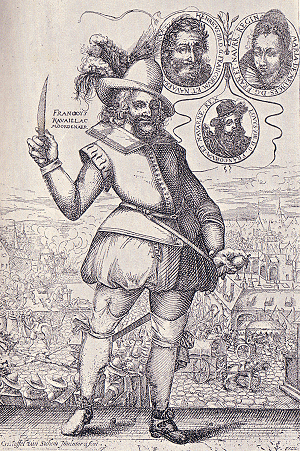
1610: Francois Ravaillac, because Paris was worth more than a mass

On this date in 1610, the fanatical Catholic who assassinated Henri IV of France was ripped apart on the Place de Greve.

The road to this man’s calvary begins long before his infamous crime, even long before the birth of his illustrious victim.

The Protestant Reformation — so richly represented in the executioner’s annals — had fractured France in the 16th century.

After decades of voluptuously indecisive Catholic-versus-Hugeunot slaughter, matters had finally been settled by the man upon whom French absolutism would erect its (ill-fated) edifice.

Henri IV, the first Bourbon monarch and a Huguenot, had unified the country by the sword, capped by his memorably politic conversion to Catholicism in 1593 to win over the holdout capital of Paris — the occasion of his understated declaration that “Paris is worth a mass”.

Let us tarry here to appreciate “the good king Henri” in a kaleidoscope of flattering artwork to the tune of Vive Henri IV, the monarchy’s unofficial anthem after its subject’s passing:

Did you catch that last image?

Henri’s fine gesture of sectarian triangulation and the reign of relative calm it inaugurated were naturally resented by godly partisans of both camps who either considered his conversion a betrayal or considered the king a closet Protestant.

At the crazed end of this latter spectrum, we meet our day’s principal, Francois Ravaillac.

Readers unconstrained by time may enjoy this Tolstoyan trek into the regicide’s mind and milieu, but it will suffice us to say that the modern shotgun-wielding postal clerk who just seemed like a quiet, harmless type to all his coworkers might like the cut of Ravaillac’s jib. A bit of a loner, a bit of a professional washout, with a penchant for religious visions and a passel of ill-arranged grievances … by this point in the movie, that’s about what you expect the police profiler to be reciting.*

It is only right that such a contemporary-sounding lone nut story ought to have a vigorous conspiratorial counternarrative.

There has always been a strong suspicion that behind Ravaillac’s hand was the work of the scheming Catholic Duc d’Epernon, perhaps even with the complicity of Henri’s wife Marie de’ Medici, who had conveniently been crowned as queen the day before the murder** and promptly teamed up with Epernon to cement an alliance with a traditional French rival, the ultra-Catholic Habsburgs.

Balzac, for one, had no doubt about it:

all of [her] actions were prejudicial to France … Marie de’ Medici wasted the wealth amassed by Henri IV.; she never purged herself of the charge of having known of the king’s assassination; her ‘intimate’ was d’Epernon, who did not ward off Ravaillac’s blow, and who was proved to have known the murderer personally for a long time. … [T]he victory Richelieu at last won over her (on the Day of the Dupes) was due solely to the discovery the cardinal made, and imparted to Louis XIII, of secret documents relating to the death of Henri IV.

The historical jury is out on that question, presumably for good.

If Ravaillac was a conspirator, he proved to be a damned good one, denying under repeated torture that he had any accomplices. On this date, the tortures reached their crescendo and conclusion — to the horrible delight of the Parisian mob, as reported by Alistair Horne (via The Corner):

On 27 May, still protesting that he had acted as a free agent on a divinely inspired mission, Ravaillac was put to death. Before being drawn and quartered, the lot of the regicide, on the Place de Grève scaffold he was scalded with burning sulphur, molten lead and boiling oil and resin, his flesh then torn by pincers. Then his arms and legs were attached to horses which pulled in opposite directions. One of the horses “foundered,” so a zealous chevalier offered his mount; “the animal was full of vigour and pulled away a thigh.” After an hour and a half of this horrendous cruelty, Ravaillac died, as the mob tried to prevent him receiving last rites. When he finally expired,

“…the entire populace, no matter what their rank, hurled themselves on the body with their swords, knives, sticks or anything else to hand and began beating, hacking and tearing at it. They snatched the limbs from the executioner, savagely chopping them up and dragging the pieces through the streets.”

Children made a bonfire and flung remains of Ravaillac’s body on it. According to one witness, Nicholas Pasquier, one woman actually ate some of the flesh. The executioner, supposed to have the body of the regicide reduced to ashes to complete the ritual demanded by the law, could find nothing but his shirt.

Ravaillac was the last Frenchman drawn and quartered for a century and a half — but his punishment as a regicide formed the precedent for that handed down in 1757 to Damiens.

* No need, though, as Francois wasn’t hard to catch: he stepped up to Henri’s carriage when it was caught in a traffic jam on May 14, 1610, and stabbed the king to death plain as can be. He was lucky (sort of) to avoid a lynching.

** Rubens later painted a gaudy celebration of this event.

On this day..

1820: Karl Ludwig Sand, a curious strand of German history

Alexandre Dumas recognized the name of Karl Ludwig Sand, who lost his head on this date in 1820 in Mannheim, Germany, for the murder of the dramatist and humorist August von Kotzebue.

The assassination of von Kotzebue* worried the Prussian monarchy — then headed by Friederich Wilhelm III — and precipitated a series of proclamations, reforms, and internal struggles that finally led to a full-scale rebellion 30 years later.

A print showing Sand stabbing August von Koetzebue. Sand is reported to have shouted, “Here, you traitor to the fatherland!”

Sand was a member of a Burschenschaft,** a liberal student fraternity organization which appealed to nationalist Germans seeking a unified German nation-state, and he and others in his group regarded von Kotzebue as a plague on their cause. Von Kotzebue was then Councillor of the Russian Legation, the culmination of over a decade in the Russian civil service, and a spinmeister for the Russian regime. In 1816, while Sand was in college, von Kotzebue was tasked with managing the flow of information into the Prussian state in an effort to increase the monarch’s popularity in Germany.

At the very least, then, von Kotzebue had no love for the Burschenshaft movement from the start, which originated in the university town of Jena, and he did not hold back his criticisms in his weekly literature newpaper Literatische Wochenblatt. He casually disparaged the Burschenschaften, as this stab in the review of a novel in one of the earlier editions evidences:

Longing and love in the work is described in a way which, in the judgment of the Jenaer Recensenten, resembles a light Spring rain that is at least refreshing. That is more than one can say of the Jenaer Literature-Zeitung, which roughly resembles an autumnal rain that simply makes one wet without refreshing at all.

But the student organizations were on the rise during Sand’s time at university as a theology student, and the turbulent events in France during his final days in school were having ripple effects across the German populace. It was in this climate that a young man who was “distinguished at once by the gifts of the mind and the faculties of the soul” (as his Gymnasium rector put it) and who sought to become a pastor was drawn to the nationalistic movement. Sand’s opposition to the imperial rule of Prussia became increasingly more urgent after his studies, and he was determined to make a statement through action, eschewing what he called “simply writing and talking.” On March 23, 1819, the 22-year old found von Kotzebue in his house and stabbed him in front of several witnesses. Sand was quickly arrested and sentenced to death.†

A print depicting the Wartburg Festival of 1817, Burschenschaft colors prominently displayed. (Click for larger image.)

As a result of von Kotzebue’s murder, Prince Klemens Wenzel von Metternich set down a series of decrees, known as the Karlsbad Decrees, which sought to quell any thoughts of rebellion before they could fully ferment. The decrees limited both university activity and press activity, constraining the actions of university employees and setting down harsh restrictions on anyone who might dare question the monarch’s authority.

Sand’s contemporaries outside of Germany were hardly pleased with the death of von Kotzebue, which they saw as the precursor to a greater turmoil, and two decades of removal from the event proved a powerful force. By the time Dumas visited the site of Sand’s beheading and penned his own biography of the man, a thorough rendering of Sand’s brief life — much of it reconstructed from Sand’s writings and the memories of those who knew him — the rebellion of the Burschenschaften was once again afoot, this time with permanent consequences for the German people.

In the end, nationalism and constitutionalism were not the panaceas Sand and other Burschenschaefter may have liked. While Sand would hardly have counted as a Nazi (his Puritanical theology would have fallen on deaf ears in that regime), he would have recognized that group’s near-religious fervor of the public book burnings anti pro-German sentiments as a distant echo of the Burschenschaft’s Wartburg Festival.†† Indeed, the so-called Third Reich could never have existed without the Second Reich, whose seeds Sand and his fellow nationalists were sowing a half century early when his fateful date with the axe arrived.

* The name is also spelled “Kozebue” by some sources.

** The Burschenschaften were roughly based on the Lützow Free Corps, an academic paramilitary group which fought during the Napoleonic Wars. During their height of popularity, the Burschenschaften adopted the black-red-gold flag that was reclaimed by the Frankfurt Parliament in 1949 to be the official German flag.

† In the end, Sand and von Kotzebue were buried at the same cemetery.

†† The Wartburg Festival, held in 1817, was a celebration of Martin Luther’s proclamation against the church. An interesting discussion of the appeal of such festivals to the students of the day is given in The Course of German Nationalism: From Frederick the Great to Bismarck.

On this day..

1941: Maurice Bavaud, who couldn’t get a shot off

Early this morning in 1941, a Swiss theology student had his head cut off at Berlin’s Plotzensee Prison for plotting to kill Adolph Hitler.

Maurice Bavaud, 25 at his execution, cuts one of the more quixotic (the link is French) of the many figures who schemed Hitler’s death — and also one of the more affecting, for at this early date he might have spared Europe most of the great war’s horror.

But Bavaud was also, fundamentally, a poor assassin.

Apparently motivated by pique at Germany’s repression of Catholicism — he’s most commonly cast as a lone gunmen, although there are also theories that he was affiliated with a wider network of students — Bavaud slipped into Germany in 1938 and spent the ensuing weeks knocking around Bavaria looking for a chance to do the thing.

That November, the chancellor turned up for the 15th anniversary of the Beer Hall Putsch* … to which Bavaud secured VIP seating. The aspiring assassin had only a low-caliber pistol, but as the Fuhrer passed his vicinity, a copse of saluting arms from the spectators around him obstructed any chance to shoot. November 9, 1938 instead became famous for other reasons.

One can appreciate at this juncture the young man’s discouragement and desire to leave Germany. One can understand that, penniless, he felt obliged to sneak aboard a passenger train. But one will strain very hard to imagine why even the most desperate straits should impel a man to do either of these things while still carrying the incriminating pistol and notes revealing his plans. When he was nabbed for skipping the fare, his situation quickly became catastrophic, with the help of Gestapo torturers. (One can see, in Bavaud’s own hand, a 1940 letter to his family informing them of his sentence here.)

Switzerland essentially exerted no diplomatic effort on behalf of their subject, and this fact informed the Swiss courts which, years after the war, posthumously reduced Bavaud’s sentence. Germany eventually paid reparations to the family of the man who tried to off their head of state.

Update: Maurice Bavaud has been officially rehabilitated by Switzerland.

* He wasn’t even the best failed Hitler assassin in the Bürgerbräukeller that day.

On this day..

2002: Ahmed Sultan and Mohammad Humayun, who murdered Meena

On this date in 2002, the killers of one of Afghanistan’s most noted feminists were hanged in Mach Jail outside Quetta, Pakistan.

Afghan feminist Meena Keshwar Kamal had founded in 1977 the Revolutionary Association of the Women of Afghanistan. RAWA works (and has done so against the successive Soviet, Taliban and Karzai regimes) for secularism, democracy and equality — per this poetic manifesto of its founder (Source):

I am a woman who has awoken
I have arisen and become a tempest through the ashes of my burnt children
I have arisen from the rivulets of my brother’s blood
My nation’s wrath has empowered me
My ruined and burnet villages replete me with hatred against the enemy
O compatriot, no longer regard me as weak and incapable
My voice has mingled with thousands of arisen women
My fists are clenched with fists of thousands of compatriots
To break together all these sufferings, all these fetters of slavery
I am the woman who has awoken
I’ve found my path and will never return.

Meena was assassinated in Quetta in 1987 just shy of her 31st birthday; that her killer(s) be brought to justice was long one of RAWA’s key political demands, and the organization supported this day’s hanging.

RAWA itself — which enjoyed a brief turn at the height of worldwide vogue as the United States prepared to invade Afghanistan and found itself suddenly inspired by the plight of women under the mullahs — holds its fallen founder as a martyr and continues to agitate.

On this day..