1478: Pazzi Conspiracy attempted … and suppressed

On this date in 1478, a coup d’etat against the Medici family in Florence was attempted during Easter mass — and by day’s end, its leading perpetrators had been hanged.

The Pazzi conspiracy implicates, even more than the municipal political rivalries of the Pazzi and Medici families, the peninsular geopolitics pitting Florence against the Pope, each side with its own constellations of allied lords and city-states.

The arrangement of players and their assorted interests is amply covered elsewhere; we shall suffice for this space to say that the Pazzi were a family of wealth and lineage (another death-sentenced Florentine, Dante, had dropped a couple of their ancestors into his infernal tableau), and proceed to the aftermath.

When one strikes a king, one must strike to kill. In this case, the co-ruling Medici brothers, Giuliano and Lorenzo were both attacked — but Lorenzo survived, and visited a terrible vengeance upon the assailants.

An enraged mob — the Pazzi had misjudged the city’s mood to begin with, and committing murder in church was ill-calculated to win sympathy — and a star chamber of Medici loyalists immediately began rounding up the numerous conspirators, many of whom were summarily hanged from the windows of the Palazzo Vecchio.

Along with a number of obscure foot soldiers and family retainers who suffered such indignities as being thrown from high windows onto cobblestones and torn apart by the mob, the most prominent victims this day were Francesco de Pazzi (the link is to his Italian wikipedia page) and Archbishop Francesco Salviati, a papal loyalist whose grievance against Florence for delaying his seat as archbishop of Pisa had done much to instigate the conspiracy.

They were far from the only victims: fugitives who had escaped the city were hunted for weeks and months thereafter, although Lorenzo “the Great” — who cuts the very model of the enlightened prince to posterity, rightly or not — was disposed in several cases to grant mercy to innocents against the dictates of political expediency.

However, the culpable after this day had every reason to fear. Perhaps the most affecting story is that of elderly Pazzi patriarch Jacopo de Pazzi (Italian again), caught in flight by Tuscan villagers whom he tried desperately (and unavailingly) to bribe for the privilege of suicide rather than a return to the fate of his kinsmen. Florentine communal pride celebrated popular participation in vengeance against the papal plot. Botticelli was commissioned to paint the executed conspirators hanging in their death throes on the very facade of the palace where they had in fact been put to death.

The Pazzi family wasn’t quite blotted out literally — later, it would even be restored to the city — but a comprehensive sentence of civic damnatio memoriae followed in the weeks after the immediate danger was checked. The family property was confiscated, its name and coat of arms banished, even the public festival its Crusader forebear had inspired was (unsuccessfully) renamed. For a time, merely to marry a Pazzi was to exclude oneself from public office.

Niccolo Machiavelli was a boy of eight at the time the Pazzi conspiracy was attempted. As a political theorist in later years, the event would liberally illustrate his writings. In Machiavelli’s Discourses (available free from Project Gutenberg), for instance, the Pazzi conspiracy is a lesson in the danger of conspiring against two princes at once, the risk inherent in having any great number of people aware of the plot, and the unpredictable small turns of fortune and minor slips in execution upon which a great matter may succeed or fail.

[I]n these grave undertakings, no one who is without such experience, however bold and resolute, is to be trusted.

The confusion of which I speak may either cause you to drop your weapon from your hand, or to use words which will have the same results. Quintianus being commanded by Lucilla, sister of Commodus, to slay him, lay in wait for him at the entrance of the amphitheatre, and rushing upon him with a drawn dagger, cried out, “The senate sends you this;” which words caused him to be seized before his blow descended. In like manner Messer Antonio of Volterra, who as we have elsewhere seen was told off to kill Lorenzo de’ Medici, exclaimed as he approached him, “Ah traitor!” and this exclamation proved the salvation of Lorenzo and the ruin of that conspiracy.

Machiavelli also renders his account of this day’s affair in his History of Florence, another Gutenberg freebie.

A detailed exploration of the event is available here.

On this day..

1868: John Millian, who martyred a madam

On this date in 1868, Mark Twain witnessed a Frenchman hanged in Virginia City, Nevada for murdering a popular prostitute.

Julia Bulette had turned up murdered in January 1867, her parlor ransacked for valuables. The crime went unsolved for several months until John Millian — or, Millain or Milleain — was caught selling one of her dresses.
The immigrant spoke very little English and was effortlessly convicted, though he maintained his innocence to the gallows.

Some three thousand people turned out for the hanging … among them Mark Twain, who was back to visit the town where he had lived a few years before, writing for a local newspaper.

He wrote about the execution in a letter from Virginia City, published in the Chicago Republican May 31, 1868 and only recently excavated by Nevada archivist Guy Rocha:

NOVEL ENTERTAINMENT.

But I am tired talking about mines. I saw a man hanged the other day. John Melanie, of France. He was the first man ever hanged in this city (or country either), where the first twenty six graves in the cemetery were those of men who died by shots and stabs.

I never had witnessed an execution before, and did not believe I could be present at this one without turning away my head at the last moment. But I did not know what fascination there was about the thing, then. I only went because I thought I ought to have a lesson, and because I believed that if ever it would be possible to see a man hanged, and derive satisfaction from the spectacle, this was the time. For John Melanie was no common murderer — else he would have gone free. He was a heartless assassin. A year ago, he secreted himself under the house of a woman of the town who lived alone, and in the dead watches of the night, he entered her room, knocked her senseless with a billet of wood as she slept, and then strangled her with his fingers. He carried off all her money, her watches, and every article of her wearing apparel, and the next day, with quiet effrontery, put some crepe on his arm and walked in her funeral procession.

Afterward he secreted himself under the bed of another woman of the town, and in the middle of the night was crawling out with a slung-shot in one hand and a butcher knife in the other, when the woman discovered him, alarmed the neighborhood with her screams, and he retreated from the house. Melanie sold dresses and jewelry here and there until some of the articles were identified as belonging to the murdered courtezan. He was arrested and then his later intended victim recognized him.

After he was tried and condemned to death, he used to curse and swear at all who approached him; and he once grossly insulted some young Sisters of Charity who came to minister kindly to his wants. The morning of the execution, he joked with the barber, and told him not to cut his throat — he wanted the distinction of being hanged.

This is the man I wanted to see hung. I joined the appointed physicians, so that I might be admitted within the charmed circle and be close to Melanie. Now I never more shall be surprised at anything. That assassin got out of the closed carriage, and the first thing his eye fell upon was that awful gallows towering above a great sea of human heads, out yonder on the hill side and his cheek never blanched, and never a muscle quivered! He strode firmly away, and skipped gaily up the steps of the gallows like a happy girl. He looked around upon the people, calmly; he examined the gallows with a critical eye, and with the pleased curiosity of a man who sees for the first time a wonder he has often heard of. He swallowed frequently, but there was no evidence of trepidation about him — and not the slightest air of braggadocio whatever. He prayed with the priest, and then drew out an abusive manuscript and read from it in a clear, strong voice, without a quaver in it. It was a broad, thin sheet of paper, and he held it apart in front of him as he stood. If ever his hand trembled in even the slightest degree, it never quivered that paper. I watched him at that sickening moment when the sheriff was fitting the noose about his neck, and pushing the knot this way and that to get it nicely adjusted to the hollow under his ear — and if they had been measuring Melanie for a shirt, he could not have been more perfectly serene. I never saw anything like that before. My own suspense was almost unbearable — my blood was leaping through my veins, and my thoughts were crowding and trampling upon each other. Twenty moments to live — fifteen to live — ten to live — five — three — heaven and earth, how the time galloped! — and yet that man stood there unmoved though he knew that the sheriff was reaching deliberately for the drop while the black cap descended over his quiet face! — then down through the hole in the scaffold the strap-bound figure shot like a dart! — a dreadful shiver started at the shoulders, violently convulsed the whole body all the way down, and died away with a tense drawing of the toes downward, like a doubled fist — and all was over!

I saw it all. I took exact note of every detail, even to Melanie’s considerately helping to fix the leather strap that bound his legs together and his quiet removal of his slippers — and I never wish to see it again. I can see that stiff, straight corpse hanging there yet, with its black pillow-cased head turned rigidly to one side, and the purple streaks creeping through the hands and driving the fleshy hue of life before them. Ugh!

This text, as well as a local paper’s report of the hanging, are also here.

Though Twain’s take on the hanging may attract our attention in posterity, the most famous party in the affair is the victim, Julia Bulette. A public figure in life, she was publicly mourned in death and quickly attained mythic status with the full panoply of secular laurels — dimestore paperbacks, “Bonanza” adaptations, and audio book treatment by the Nevada Library and Archives:

[audio:JuliaBulette.mp3]

On this day..

1936: Bruno Richard Hauptmann, The Most Hated Man in the World

On this date in 1936, a German immigrant went to New Jersey’s electric chair for kidnapping and murdering the infant son of famed aviator Charles Lindbergh.

Snatched

The kidnapping of the Lindbergh boy in 1932 had touched off an outpouring of public compassion matched only by the clumsiness of the investigation. The circus that formed around a father desperate to retrieve his boy — and prone to rash decision-making thereto — pulled in underworld figures, military intelligence officers (including the founder of the CIA’s forerunner and the father of Gulf War General Norman Schwartzkopf), a meddlesome schoolteacher, and queer characters like “Cemetery John,” who somehow managed two meetings with Lindbergh’s intermediaries, making off with a box full of ransom cash without anyone so much as tailing him, much less having to fork over the hostage.

The boy, in fact, was dead, and would be discovered weeks later, a few miles from the Lindbergh house, in such a state of decomposition as to suggest that, by accident or intention, he had suffered a fatal head injury almost at the moment of his abduction.

Two years’ fruitless investigation ensued, with leads that frustratingly faded away and at least two suspects who committed suicide. The police job had been a hash from the start, between amateurish cock-ups like failing to measure footprints found on the scene and security breaches in the chaotic weeks following the kidnapping. Most damagingly, a newspaper laid hands on an early ransom note and printed it, making it impossible subsequently to positively discern the kidnapper’s real notes from hoaxes.

But John Law had done one thing right: paid the ransom in soon-to-be-obsolete gold certificate. As they’d hoped, someone was finally caught spending this distinctive currency: Bruno Hauptmann.

Hauptmann actually went by “Richard”, but with its unerring sense of the Zeitgeist, the press played up his menacing alien moniker. After two and a half years, the public was ready to hate someone, and an illegal immigrant with a criminal record* from the late war’s great enemy was pretty much made to order.

Trial of the Century

The one thing Hauptmann didn’t do was confess — and that necessitated the “Trial of the Century,” or in Mencken’s coinage, “the greatest story since the Resurrection.”

It was O.J. before 24-hour cable. Journalists packed the small-town courtroom of Flemington, N.J.; for six weeks early in 1935, an aggressive prosecutor vied with a flamboyant (but cripplingly dissolute) defense attorney hired for the penurious defendant by the Hearst newspaper empire in exchange for inside information.

This newsreel footage of the trial consists mostly of Hauptmann’s own testimony, and even at seventy-plus years’ distance it crackles with drama — and with the persecutorial atmosphere that sealed Hauptmann’s fate, guilty or not. (The defendant often sounds uncertain and evasive in these clips — it cannot have helped his standing with the jury, but it is worth recalling that English was not his native language.)

History’s Verdict

The case was circumstantial, the most powerful circumstance, of course, being Hauptmann’s possession of ransom money — thousands of dollars worth, as it turned out, stashed in his garage. Hauptmann said a friend had left it when returning to Germany; the alibi didn’t convince many, but Hauptmann stuck to it to the end, even refusing to accept a commutation in exchange for a confession. This audio of a convicted Hauptmann still maintaining his innocence comes from the New Jersey Star-Ledger blog.

[audio:Bruno_Hauptmann.mp3]

Much other evidence against him — shaky eyewitness testimony, doubtful courtroom forensics — seems less damning, especially from the perspective of time. Unexplored problems — why would a professional carpenter build such a shoddy ladder? How could he have known the (rare) night the Lindberghs would actually be home? — gesture emptily towards other suspects never pursued, though they are very far from authoritatively exonerating Hauptmann. Ultimately, it’s a case with many unclear data points, whose importance and configuration invite dispute. (Here‘s a site dedicated to Hauptmann’s innocence, including this article (.pdf) outlining the main arguments his partisans make.)

Even the verdict’s defenders, and there are many, concede that portions at trial were exaggerated or outright perjured in an atmosphere hardly conducive to dispassionate review. Whether that makes Hauptmann “guilty but framed” or plausibly innocent (of the kidnapping, if not of opportunistic extortion) has been the subject of far more rumination than this blog can hope to assay.

A few of the many books about the Lindbergh case

An enigmatic criminal tied to an enigmatic icon in a painfully public four-year drama that transfixed the nation and still inspires debate: that “Trial of the Century” marquee holds up pretty well.

* In Germany; Hauptmann’s record was clean stateside — apart, that is, from Charles Lindbergh, Jr.

On this day..

1757: Robert-Francois Damiens, disciplined and punished

On this date in 1757, Robert-Francois Damiens became the last Frenchman to suffer the dreadful punishment of drawing and quartering.

Damiens attempted to assassinate King Louis XV, inflicting, however, only a slight dagger wound.

He may be best-known today as the subject of the jarring opening passage of Foucault’s Discipline and Punish, in which the full flower of this medieval torture* is described in detail by way of contrasting it with the regimented penal institutions that would sprout up in a few decades’ time. Here’s Foucault’s rendering of the scene:

On 1 March 1757 Damiens the regicide was condemned “to make the amende honorable before the main door of the Church of Paris”, where he was to be “taken and conveyed in a cart, wearing nothing but a shirt, holding a torch of burning wax weighing two pounds”; then, “in the said cart, to the Place de Grève, where, on a scaffold that will be erected there, the flesh will be torn from his breasts, arms, thighs and claves with red-hot pincers, his right hand, holding the knife with which he committed the said parricide, burnt with sulphur, and, on those places where the flesh will be torn away, poured molten lead, boiling oil, burning resin, wax and sulphur melted together and then his body drawn and quartered by four horses and his limbs and body consumed by fire, reduced to ashes and his ashes thrown to the winds” (Pièces originales…, 372-4).

“Finally, he was quartered,” recounts the Gazette d’Amsterdam of 1 April 1757. “This last operation was very long, because the horses used were not accustomed to drawing; consequently, instead of four, six were needed; and when that did not suffice, they were forced, in order to cut off the wretch’s thighs, to sever the sinews and hack at the joints…

“It is said that, though he was always a great swearer, no blashemy escaped his lips; but the excessive pain made him utter horrible cries, and he often repeated: ‘My God, have pity on me! Jesus, help me!’ The spectators were all edified by the solicitude of the parish priest of St Paul’s who despite his great age did not spare himself in offering consolation to the patient.”

Bouton, an officer of the watch, left us his account: “The sulphur was lit, but the flame was so poor that only the top skin of the hand was burnt, and that only slightly. Then the executioner, his sleeves rolled up, took the steel pincers, which had been especially made for the occasion, and which were about a foot and a half long, and pulled first at the calf of the right leg, then at the thigh, and from there at the two fleshy parts of the right arm; then at the breasts. Though a strong, sturdy fellow, this executioner found it so difficult to tear away the pieces of flesh that he set about the same spot two or three times, twisting the pincers as he did so, and what he took away formed at each part a wound about the size of a six-pound crown piece.

“After these tearings with the pincers, Damiens, who cried out profusely, though without swearing, raised his head and looked at himself; the same executioner dipped an iron spoon in the pot containing the boiling potion, which he poured liberally over each wound. Then the ropes that were to be harnessed to the horses were attached with cords to the patient’s body; the horses were then harnessed and placed alongside the arms and legs, one at each limb.

“Monsieur Le Breton, the clerk of the court, went up to the patient several times and asked him if he had anything to say. He said he had not; at each torment, he cried out, as the damned in hell are supposed to cry out, ‘Pardon, my God! Pardon, my Lord.’ Despite all this pain, he raised his head from time to time and looked at himself boldly. The cords had been tied so tightly by the men who pulled the ends that they caused him indescribable pain. Monsieur le [sic] Breton went up to him again and asked him if he had anything to say; he said no. Several confessors went up to him and spoke to him at length; he willingly kissed the crucifix that was held out to him; he opened his lips and repeated: ‘Pardon, Lord.’

“The horses tugged hard, each pulling straight on a limb, each horse held by an executioner. After a quarter of an hour, the same ceremony was repeated and finally, after several attempts, the direction of the horses had to be changed, thus: those at the arms were made to pull towards the head, those at the thighs towards the arms, which broke the arms at the joints. This was repeated several times without success. He raised his head and looked at himself. Two more horses had to be added to those harnessed to the thighs, which made six horses in all. Without success.

“Finally, the executioner, Samson, said to Monsieur Le Breton that there was no way or hope of succeeding, and told him to ask their Lordships if they wished him to have the prisoner cut into pieces. Monsieur Le Breton, who had come down from the town, ordered that renewed efforts be made, and this was done; but the horses gave up and one of those harnessed to the thighs fell to the ground. The confessors returned and spoke to him again. He said to them (I heard him): ‘Kiss me, gentlemen.’ The parish priest of St Paul’s did not dare to, so Monsieur de Marsilly slipped under the rope holding the left arm and kissed him on the forehead. The executioners gathered round and Damiens told them not to swear, to carry out their task and that he did not think ill of them; he begged them to pray to God for him, and asked the parish priest of St Paul’s to pray for him at the first mass.

“After two or three attempts, the executioner Samson and he who had used the pincers each drew out a knife from his pocket and cut the body at the thighs instead of severing the legs at the joints; the four horses gave a tug and carried off the two thighs after them, namely, that of the right side first, the other following; then the same was done to the arms, the shoulders, the arm-pits and the four limbs; the flesh had to be cut almost to the bone, the horses pulling hard carried off the right arm first and the other afterwards.

“When the four limbs had been pulled away, the confessors came to speak to him; but his executioner told them that he was dead, though the truth was that I saw the man move, his lower jaw moving from side to side as if he were talking. One of the executioners even said shortly afterwards that when they had lifted the trunk to throw it on the stake, he was still alive. The four limbs were untied from the ropes and thrown on the stake set up in the enclosure in line with the scaffold, then the trunk and the rest were covered with logs and faggots, and fire was put to the straw mixed with this wood.

“…In accordance with the decree, the whole was reduced to ashes. The last piece to be found in the embers was still burning at half-past ten in the evening. The pieces of flesh and the trunk had taken about four hours to burn. The officers of whom I was one, as also was my son, and a detachment of archers remained in the square until nearly eleven o’clock.

“There were those who made something of the fact that a dog had lain the day before on the grass where the fire had been, had been chased away several times, and had always returned. But it is not difficult to understand that an animal found this place warmer than elsewhere” (quoted in Zevaes, 201-14).

Among the throngs in attendance that day was Casanova who, according to his memoirs, rented out a windowed flat to watch that stomach-churning torture for four hours with some male friends and female companions.

One of the legendary libertine’s friends found this moment, serenaded by the prisoner’s “piercing shrieks”, opportune for an altogether different adventure of the flesh:

The three ladies packing themselves together as tightly as possible took up their positions at the window, leaning forward on their elbows, so as to prevent us seeing from behind. The window had two steps to it, and they stood on the second; and in order to see we had to stand on the same step, for if we had stood on the first we should not have been able to see over their heads. I have my reasons for giving these minutiae, as otherwise the reader would have some difficulty in guessing at the details which I am obliged to pass over in silence.

Tiretta kept the pious aunt curiously engaged during the whole time of the execution, and this, perhaps, was what prevented the virtuous lady from moving or even turning her head round.

Finding himself behind her, he had taken the precaution to lift up her dress to avoid treading on it. That, no doubt, was according to the rule; but soon after, on giving an involuntary glance in their direction, I found that Tiretta had carried his precautions rather far, and, not wishing to interrupt my friend or to make the lady feel awkward, I turned my head and stood in such a way that my sweetheart could see nothing of what was going on; this put the good lady at her ease. For two hours after I heard a continuous rustling, and relishing the joke I kept quiet the whole time. I admired Tiretta’s hearty appetite still more than his courage, but what pleased me most was the touching resignation with which the pious aunt bore it all.

Casanova’s Complete Memoires are available free online; this episode is recounted in the first chapter of “Paris and Holland”.

* Damiens’ punishment was in fact already archaic at the point when it was inflicted. Somewhat unsure of itself, the court sought precedent in the last regicide executed — Francois Ravaillac, who in 1610 was also the most recent person to suffer this horrific penalty. The clumsiness of the Damiens’ execution can surely be attributed to the art being a century and a half out of practice.

On this day..

1933: Giuseppe Zangara, who is not on Sons of Italy posters

On this date in 1933, Giuseppe Zangara went to Florida’s electric chair for the murder of Chicago mayor Anton Cermak — the man he had accidentally shot while attempting to assassinate President-elect Franklin Delano Roosevelt.

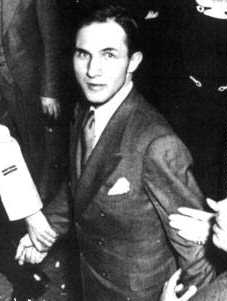
Zangara had to stand on a chair to take the shot: he was only five feet tall. This image is from Miami Police of Yesterday, a site by a descendant of one of the officers who arrested Zangara.

A strange and strangely forgotten man, the Italian immigrant came within inches of dramatically altering American history.

On February 15, 1933, at a Roosevelt speech in Miami’s Bayfront Park, Zangara perched himself on a metal folding chair within ten meters of the man who was then President-elect, but somehow managed to miss him. A bystander, Lillian Cross, grabbed his arm, and others in the crowd wrestled him down.

Certainly Zangara would be better remembered if he had shot Roosevelt (and Roosevelt would be very much less remembered), but his head-scratching persona accounts for at least some of his obscurity.

He’s sometimes called an anarchist — the early 20th-century equivalent of calling him a terrorist — and he talked the talk. Here, his last words:

You give me electric chair. I no afraid of that chair! You one of capitalists. You is crook man too. Put me in electric chair. I no care! Get to hell out of here, you son of a bitch [said to the chaplain] … I go sit down all by myself… Viva Italia! Goodbye to all poor peoples everywhere!… Lousy capitalists! No picture! Capitalists! No one here to take my picture. All capitalists lousy bunch of crooks. Go ahead. Pusha da button!

Zangara was a working-class immigrant. But his specific motivation for murdering Roosevelt seems murky at best — there’s no clear subversive organization or cause with which Zangara seemed a dedicated fellow-traveler. The wikipedia page about him describes his lifelong stomach pains as the cause of his act, which seems a queer thing to make a fellow shoot a president.

The major conspiracy proposal, that the anti-mob mayor Cermak was the real target all along of a mafia-engineered hit (here (.doc) is a version) is highly speculative, to put it generously. (Update: More on this here, via Chicagoland) Certainly Zangara might have been, as he claimed and most believe, a lone nut — many have done worse for less cause.

The world didn’t have long to unravel this man’s mysteries; justice moved with a rapidity terrifying even by the standards of the time — as reflected in the title of one of the books about him, The Five Weeks of Giuseppe Zangara.

Zangara had already been sentenced to a long prison term for the several bystanders his errant shots had struck when Anton Cermak finally succumbed — after 19 painful days — to a gut shot. Two weeks after that, his killer was dead, too.

During his first trial, the judge pressed him on his motivation, as reported in a press clipping that became part of Zangara’s FBI file:

Q. Have you ever been in jail before? Ever been in any trouble?

A. No, this is the first time.

Q. Did you ever hurt anyone before?

A. No, me no hurt anyone.

Q. Did you plan this shooting?

A. No.

Q. When did you decide to do it?

A. I got it in my mind capitalist hurt people. They are to blame for my stomach hurting. My stomach was hurting bad. It was like I was on fire. It burns my mind, I act like a drunken man. It came in my mind when I was suffering.

At this trial — the one before Cermak died — he pled unsuccessfully for execution: “I am sorry only because I did not kill. I am sorry about nothing. Put me in the electric chair.” It reads like “suicide by cop”.

Zangara might not be a name of Oswaldesque dimensions among the assassinariat, but he comes in for a scene in Stephen Sondheim’s strange musical theater, Assassins.

Officially, Zangara was punished for the man he killed, not the soon-to-be-President he was (presumably) aiming at. But such a close scrape for such a transformative American leader, a man sometimes credited with saving capitalism from itself in an age of crisis, has made Zangara’s one famous act fodder for alternative history that asks the question “what might have been?”

On this day..

1963: Jean-Marie Bastien-Thiry, model for the Jackal

On this date in 1963, clutching a rosary, French officer Jean-Marie Bastien-Thiry was shot by a firing squad in the Paris suburb Ivry-sur-Seine for attempting to assassinate Charles de Gaulle.

Perhaps no anticolonial struggle left a more considerable intellectual and cultural footprint than the Algerian War of Independence against France. It gashed the French polity as well; the right violently rejected the swelling sentiment to end their country’s 132-year occupation. It is often said that the conservative Charles de Gaulle was the only man who could have engineered the departure with the support of a sufficient portion of the populace — but a sufficient portion by no means meant all, and every blunder multiplying the [French] body count was laid on de Gaulle’s head besides.

On August 22, 1962 — just weeks after that war successfully expelled the European power — an assassins’ team led by Bastien-Thiry (collaborating with the far-right Organisation de l’armée secrète) unleashed a machine gun fusillade at de Gaulle’s car. Hundreds of shots were fired; miraculously, the president and all his aides all escaped unharmed.

Although the actual gunmen were reprieved by their intended target, their manager was not. Said de Gaulle,

The French need martyrs … I gave them Bastien-Thiry. They’ll be able to make a martyr of him. He deserves it.

Certainly Bastien-Thiry had that in mind. At his trial (as recorded by a sympathetic French-language website), he addressed his conduct to posterity:

Nous avons exercé le droit de légitime défense contre un homme, au nom de ses victimes, au nom de nos concitoyens et au nom de nos enfants ; cet homme est ruisselant de sang français et il représente la honte actuelle de la France. Il n’est pas bon, il n’est pas moral, il n’est pas légal que cet homme reste longtemps à la tête de la France ; la morale, le droit et la raison humaine s’unissent pour le condamner. La vérité que nous avons dite, et que bien d’autres que nous ont dite avant nous, restera attachée au nom de cet homme, où qu’il aille et quoi qu’il fasse. Un jour cet homme rendra compte de ses crimes : devant Dieu, sinon devant les hommes.

Bastien-Thiry’s sensational plot, and the ongoing efforts of the OAS to murder de Gaulle, inspired Frederick Forsyth’s novel The Day of the Jackal, and a classic 1973 film of the same title:

Part of the Themed Set: The Written Word.

On this day..

1877: Jack McCall, Wild Bill’s murderer

On this date in 1877, Jack McCall was hanged in Yankton, South Dakota, for the murder of Wild Bill Hickok.

It was the most notorious crime in the old west: the legendary gunfighter and lawman shot from behind playing poker in the gold rush town Deadwood, S.D. on August 2, 1876.

McCall‘s grievance against Wild Bill remains unclear, which seems no less than properly atmospheric. One version has him losing at cards to Hickok the night before the murder, then humiliated to accept Hickok’s charity for his evening meal. Since Deadwood sprang up on Lakota Sioux land in defiance of treaty obligations and thus was an outlaw settlement without legal oversight, McCall might also have been engaged by another party to eliminate the town’s de facto source of law further to some private profit.

That speculation gains some circumstantial support from the surprising proceedings the following day. An impromptu “miner’s court” acquitted McCall — the defendant claimed to have been avenging the murder of a brother who does not seem to have ever existed at all — of a murder they plainly knew he committed. This obliging verdict prompted a newspaper to remark,

Should it ever be our misfortune to kill a man … we would simply ask that our trial may take place in some of the mining camps of these hills.

McCall made for Wyoming, but couldn’t resist boasting of his famous crime, which was known to have graduated into a fair gunfight in his retelling. The times and the lands were unsettled enough that with an ounce of discretion he might have vanished. Instead, his loose lips got him nabbed by a federal marshal and extradited back to South Dakota — where he learned that the miner’s court verdict of an illicit settlement didn’t count as a legal acquittal for purposes of double jeopardy.

His hanging this morning — with the pertinent last words, “draw it tighter, Marshal” — was the first legal execution in South Dakota.

Like the reason for his one memorable act, McCall was an obscure character; his background was uncertain even when he lived. It was only through his victim that he left an imprint: he certainly elevated the legend of Hickok, whose cinematic demise also bequeathed to the arcane poker argot the term “dead man’s hand” — a pair of aces and a pair of eights (or more specifically, the black aces and black eights; the fifth card is uncertain) — after the last hand of cards Wild Bill ever held.

The dead man’s hand. Image used with permission.

On this day..

1853: János Libényi, who stabbed an emperor and built a church

On this date in 1853, eight days after attempting to assassinate Austrian Emperor Franz Joseph I, Hungarian nationalist János Libényi was hanged on Vienna’s Simmeringer Haide (the link is in German).

Libenyi was hardly the only one who designed on the life of one of the world’s longest-serving rulers of one of the world’s least cohesive polities. On February 18, Libenyi stabbed the emperor in the neck — a part of the anatomy fortuitously protected by a very sturdy military collar the (at this time) 23-year-old monarch wore habitually.

The would-be assassin was immediately subdued by an Irish count and a nearby butcher, both of whom received Austrian ennoblement for their trouble.

An emotive outpouring of official thanksgiving commensurate with an age of political reaction greeted Franz’s survival. His brother — yet many years and many miles from his own rendezvous with the executioner — took up donations for Vienna’s spectacular Votivkirche, a literal votive offering to God for Franz Joseph’s deliverance:

Image via flickr, (cc) lionscavern.com.

The future Elvis of the Austrian waltz scene, Johann Strauss, then a 27-year-old cranking out career-enhancing patriotic fare, said symphonically what the Votivkirche said architecturally with this “Rescue Jubilation March” (op. 126):

[audio:Rettungs_Jubel_Marsch.mp3]

This short entry on the German wikipedia — in German, of course — further outlines the affair.

On this day..

1680: La Voisin, poisoner to the stars

On this date in 1680, Catherine Monvoisin was burned at the stake in the Place de Greve, a casualty of the “Poison Affair”.

The Poison Affair was rooted in a spate of (suspected) poisonings in France during the later part of the 17th Century. In 1670, the Duchasse d’Orleans, nee Princess Henrietta Anne Stuart the daughter of deposed and executed King Charles I of England, died suddenly. Some years before, the Duchasse, a great friend, and possibly lover, of her brother-in-law King Louis XIV, had convinced the king to exile her husband’s paramour, her rival for power. Although the results of an autopsy suggested that the duchasse died from an infection resulting from a perforated ulcer, popular opinion held that she had been poisoned by her husband’s exiled lover. Five years later, Marie-Madeleine-Marguerite d’Abray, Marquise de Brinvilliers, was executed for the murder of her father, brother and two sisters by poisoning (to gain control of their inheritances). These high-profiled murders, coupled with several other mysterious deaths at the time, heightened the aristocracy’s already considerable fear of poisoning.

In response to the aristocracy’s rising fear, Louis XIV instructed his chief of police to identify poisoners and neutralize the threat they posed. Accordingly, in 1679, a commission was established. The commission promptly began investigating, and arresting, fortune tellers, alchemists, and other purveyors of potions and powders. The police chief also re-established the Chambre Ardente (“burning court”) to try alleged witches and poisoners.

The most famous prisoner tried and convicted by the Chambre Ardente was Catherine Monvoisin. Known as La Voisin, she took up fortune telling, potion-making and midwifery when it became clear that her husband would not make a living in his chosen profession. Unlike her husband’s, her business thrived. Well-positioned women of the aristocracy flocked to her, seeking potions to secure the love of powerful men or to eliminate rivals (one such target of her craft was Louise de la Valliere, then-mistress of Louis XIV).

During the Poison Affair, La Voisin was named as a witch and a poisoner and sentenced to death. Before she died, however, she named many members of the aristocracy who had used her services. They clients she implicated included the king’s mistress Francoise-Athenais, the Marquise de Montespan, whom La Voisin said purchased aphrodisiacs and performed black masses with her to gain the king’s favor, and Francois Henri de Montmercy-Bouteville, the duc de Luxembourg. Although there was no evidence to corroborate La Voisin’s stories, her confession ruined the reputations of the people she named.

The Chambre Ardente was disbanded in 1682 under the weight of the growing scandal, as it began to involve more and more members of the aristocracy.

On this day..

1869: Patrick Whelan, Canada’s first assassin?

On this date in 1869, Irish immigrant Patrick Whelan was hanged at Ottawa’s Nicholas Street Gaol for the assassination of Canadian politician Thomas D’Arcy McGee.

McGee, a Father of the Confederation — Canada as a self-governing dominion was only months old when he was gunned down in Ottawa — was the first politician assassinated in the country, and for a century more, the only one. He may have been a sort of proto-Michael Collins, shot by onetime fellow-travelers in the Irish nationalist movement for going legit with the English.

It’s an open question whether the tailor convicted of his murder was actually one of them. Whelan, like McGee, was an Irish immigrant and supposedly a Fenian sympathizer. He also matched the gunman’s description.

Whelan was snatched up within 24 hours and convicted on essentially circumstantial evidence.

Hanged in a snowstorm before thousands, he maintained his innocence to the end — a plea that has had its advocates in posterity, including a high-profile recent play. Whelan bolsters his own case by haunting the jail where he met his fate … a structure which still stands today, now serving as a (singularly atmospheric) hostel.

Whelan is sometimes reported as the last man publicly hanged in Canada, although apparently he is not. (Officially, that honor belongs to Nicholas Melady.)

On this day..