1402: False Olaf

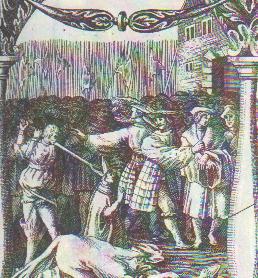
On this date in 1402, a Prussian commoner was put to death on the road between Falsterbo and Skanor in Sweden for masquerading as the long-dead King Olaf IV.

The real Oluf IV Haakonsson — or Olav, or Olaf — had inherited the crowns of Denmark and Norway and a claim to that of Sweden’s but died at the age of 17 in 1387. His mother, Margaret I (or Margrethe I), the real power behind the teenager, ruled outright upon her son’s death.

She proved an able hand and far-sighted ruler, cautiously welding Denmark, Sweden and Norway into the Kalmar Union that would hold until the 16th century. They called her “the Semiramis of the North,” centuries before Catherine the Great nicked the nickname.

But her son’s youthful demise had set persistent rumors abroad — that he was poisoned, for instance, and more to the point for our purposes, that he wasn’t dead at all.

So when his spitting image was recognized, and hailed as the prince of the realm … well, back in the day, equally audacious identity theft was attempted for much smaller stakes than a throne.

Anyway, “Olaf” got some robes befitting Olaf’s station and banged out some letters to Margaret demanding his kingdom back, and Margaret said, come on down.

That goes to show how far looks will take you in life.

Unfortunately for Olaf, his regal jawline wasn’t capable of enunciating Danish speech … so the jig was up as soon as he got to Margaret. One hopes he got a good ride out of his brief masquerade, because he was burned to ashes — possibly after being broken on the wheel — along with those presumptuous letters.

The date of False Olaf’s death comes from Horace Marryat’s 19th century Scandinavian travelogues, One Year in Sweden; including a visit to the isle of Gotland and A Residence in Jutland, the Danish Isles, and Copenhagen (both free reads at Google Books). In both volumes, Marryat identifies the date as the morning before Michaelmas.

The traditional last day of the harvest season celebrated on September 29, Michaelmas was once a four-star holiday on the medieval calendar.

There’s a fair amount of commentary online saying that an “Old Michaelmas” used to be celebrated on October 10 or 11. But that looks to this writer like an interesting inversion stemming ultimately from the celebration’s fall into obscurity as the entity once known as Christendom has become more secular and less agrarian — although it’s admittedly nothing to do with the fate of False Olaf, or Semiramis for that matter.

In 1752, when England finally switched to the Gregorian Calendar, the switch took place in early September.*

For logistical pragmatism (the harvest wasn’t going to come in 11 days earlier just because the calendar changed), the then-imminent Michaelmas got pushed back 11 days to October 10. October 10 then became known as “Old Michaelmas,” no longer Michaelmas by the church calendar but the 365-day interval from when it used to be celebrated, and more importantly, the real end of the harvest season.**

In the next century, the difference between Julian and Gregorian calendars would have advanced to 12 days, placing Old Michaelmas on the 11th; by this present day, it’d be 13 days in principle, but the original meaning of the holiday and the host of cultural traditions associated with it have fallen away … so “Old Michaelmas” is a footnote still pinned to October 10th or 11th, and moderns rediscovering it suppose from the name that it’s the former date of the feast.

* People inclined to think of their death dates as foreordained in heaven’s celestial notebook protested the switch: “give us back our 11 days!” This reform, incidentally, also moved the official beginning of the New Year to January 1 from Michaelmas’ springtime “Quarter Day” counterpart, March 25; winter dates from years prior are often written with both years, e.g. 1738/9. “Old Lady Day“, April 6, is still the beginning of the fiscal year in England, and Thomas Hardy uses its traditional contractual character in Tess of the D’Urbervilles (Aside: Tess’s hanged real-life inspiration) when the title character takes a farm job running through that date:

Tess was so wrapt up in this fanciful dream that she seemed not to know how the season was advancing; that the days had lengthened, that Lady-Day was at hand, and would soon be followed by Old Lady-Day, the end of her term …

At length it was the eve of Old Lady-Day, and the agricultural world was in a fever of mobility such as only occurs at that particular date of the year. It is a day of fulfilment; agreements for outdoor service during the ensuing year, entered into at Candlemas, are to be now carried out. The labourers — or “work-folk”, as they used to call themselves immemorially till the other word was introduced from without — who wish to remain no longer in old places are removing to the new farms.

… With the younger families it was a pleasant excitement which might possibly be an advantage. The Egypt of one family was the Land of Promise to the family who saw it from a distance, till by residence there it became it turn their Egypt also; and so they changed and changed.

** Residents of the former Soviet Republics who switched to the Gregorian calendar in the 20th century still celebrate both the familiar January 1 New Year’s and “Old New Year’s” 13 days later, and the same trick with the (lesser, there) holiday of Christmas too … packing four party occasions into a three-week span.

Part of the Themed Set: Semiramis.

On this day..

1676: Malin Matsdotter and Anna Simonsdotter, ending a witch hunt

On this date in 1676, two starkly contrasting women were executed for sorcery in Stockholm.

Anna Simonsdotter Hack — also known as “Tysk-Annika” — is the forgotten one of the pair, who played the expected role of a condemned witch and meekly gave herself over to the judgment. There were rewards for good behavior: Tysk-Annika had her head cleanly lopped off.

Malin Matsdotter, however, did not plan any reciprocal back-scratching with the men who came to kill her.

Accused by her own daughters of carrying their children — Malin’s grandchildren — to Satanic masses, “Rumpare-Malin” obstinately refused to cop to the charge. (Naturally, not confessing was a further indicator to the court that Satan was fortifying her defiance.) Without a confession, the authorities couldn’t assuage themselves by giving her the easy-ish death of decapitation; the law required burning at the stake.* A sack of gunpowder around the neck to speed things up was the best they could offer her.

Matsdotter maintained her innocence to the stake, frustrating the confessors, and when one of her daughters called on her to admit the crime, “she gave her daughter into the hands of the devil and cursed her for eternity.”

And maybe it worked. Judges may well have been wearying of the eight-year-old witch craze, but Matsdotter’s discomfiting end was the turning point; the cases dried up, existing sentences were overturned, and the clergy was summoned to draw a line under the proceedings by announcing from the pulpits that witches had been driven out of Sweden for good. Only one more witchcraft execution ever took place in Sweden — and that in 1704.

By the end of 1676, several of the most notorious accusers in the witch trials were being hunted for perjury by those very same courtrooms. Reportedly, Matsdotter’s daughter was herself executed for her fatal accusation.

* Previously, the law had not allowed a witchcraft execution without a confession, and in a notable case a few years before Matsdotter’s burning, two other women had escaped death by refusing to confess. Evidently, they closed that loophole.

On this day..

1747: Alexander Blackwell, who left them smiling

On this date in 1747,* the Swedes beheaded Scottish-born adventurer Alexander Blackwell for meddling with their line of succession.

Blackwell, “a man of mercurial and adventurous temperament,” had his printing business busted in England for having failed to precede it with the required apprenticeship, and was thrown in jail as a debtor.

To extricate the family from poverty, Blackwell’s wife Elizabeth thereupon launched an amazing career as an herbal limner, drawing, engraving, and hand-coloring editions with hundreds of plants that became a standard reference in the field in the late 1730’s, and whose revenues managed to liberate her spouse. (Elizabeth is still remembered on a plaque at the Chelsea Old Church, in her old neighborhood.)

That mercurial ex-deadbeat might have done better to stick close by his now highly esteemed wife (or possibly his brother, a bloviating classicist), but the wanderlust sent Alex abroad to wash ashore in Stockholm as physician to King Frederick I, where he was soon convicted (on evidence uncertain, apart from the torture-extracted confession) of having intrigued to alter the royal line of succession further to enmeshing Sweden in an alliance with Britain.

He protested his innocence on the scaffold. More memorably, perhaps, he laid his head the wrong way upon the chopping block, requiring the executioner to correct him — whereupon Blackwell cracked wise that he, after all, lacked experience at the art of being beheaded.

Mental Floss mined this outstanding exemplar of gallows humor in a cartoon about memorable exits. (Via History News Network.)

* Some sources, like this Google Books biography, offer August 9 as Blackwell’s execution date. The 11-day discrepancy is due to the still-pending adoption of the Gregorian calendar: July 29 was the date on the Julian calendar still in use in the realms both of Blackwell’s birth and death; in 1752 and 1753, respectively, Britain and Sweden would adopt the Gregorian system.

On this day..

1600: Linköping Bloodbath, the dawn of Sweden’s glory

On this date in 1600, five former supporters of King Sigismund were beheaded at Linköping, as Sweden broke free of Poland and of Catholicism.

Eighty years before, the Swedish Vasa dynasty had established itself by surviving one bloodbath. Now, it would set its greatest scion in line for the throne by inflicting another.

Sigismund was Sweden’s legitimate heir; he was also a characteristic product of dynastic intermarriage whose loyalties were splintered between fiefdoms. But most crucially of all, he had been raised Catholic in a realm turning decisively towards Protestantism.

Born of a Polish-Italian mother, he had secured the Polish-Lithuanian throne by election in 1589; when succession added suzerainty of Sweden, his realm was a personal union stretching across central Europe from the Arctic Circle to the Black Sea.

Which looked better on paper than it would work in practice.

The persecutory stage of the Catholic counter-reformation had been in full throat this past half-century, and the accession of a Catholic prince raised a Scandinavian alarm.

Busy governing Poland, Sigismund left his Protestant uncle Duke Charles to administer Sweden; within five years, civil war had erupted between the two and in short order the victorious soon-to-be King Charles IX had occasion to make example of the nobles who had backed Sigismund’s cause.

Charles himself would be a transitional figure in Sweden, but what a transition: his victory made possible the the subsequent scintillating reign of his son, Gustavus Adolphus — the able commander who would raise Sweden into a true European power.*

There would be an interesting coda in that reign to this day’s doings. Gustavus’ greatest general, Johan Banér, was the son of one of those put to death in Linköping. In another time, between other men, that one fellow’s father had seen the other fellow’s butchered might have put a blood feud between them. But as young men — the king was just 18 months his senior — they formed a permanent friendship, upon which they founded the military collaboration that shook northern Europe.

“My dad beheaded your dad”
“Let’s play!”

* Among Gustavus Adolphus’ numerous exploits was war with his father’s old rival — that is, with his cousin Sigismund — in the 1620s. Foreign relations between Sweden and Poland had turned understandably frosty, with Sigismund spending the rest of his long life eyeballing the lost crown.

On this day..

1520: Stockholm Bloodbath

On this date in 1520, four days after the Danish King Christian II gained the Swedish throne, nearly 100 prominent supporters of Swedish independence were executed en masse as a civil war’s apparent victors purged their enemies.

The Stockholm Bloodbath followed years of conflict between supporters of the Danish-dominated Kalmar Union and independence advocates under the banner of Sten Sture the Younger. With Sture’s death in battle earlier in 1520, the unionists had gained the upper hand. Stockholm, the last outpost of resistance, had held against four months’ siege before accepting a general amnesty in exchange for capitulation.

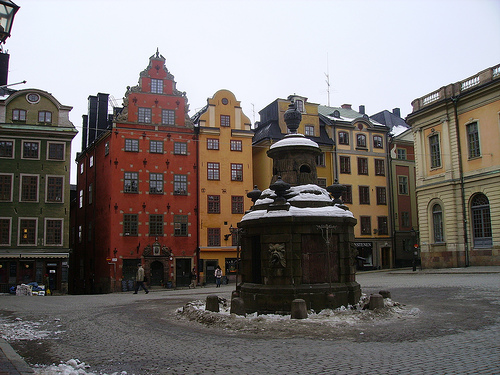
But with the city in hand, Christian — known to Swedish history as “Christian the Tyrant” — had its leaders charged for having deposed during the conflict the pro-union Archbishop Gustav Trolle, construed as an offense against the Church not in the temporal authority’s power to reprieve. Less than 24 hours after this legal maneuver was sprung, public beheadings of prelates, merchants and burgomasters were underway at Stortorget* — and Sture’s remains were exhumed and posthumously burnt at the stake.

Stortorget

It proved a Pyrrhic victory for the Danish party.

Inside of three years, Christian himself had been deposed with multiple lands and factions throughout his realm in open revolt. Gustav Vasa, whose father had been one of the Stockholm Bloodbath’s victims, would not only decisively break Denmark’s hold on Sweden but found the Vasa Dynasty under which Sweden would burgeon into one of Europe’s great powers.

*One Hans Brask survived the purge despite having endorsed the removal of Archbishop Trolle. Brask supposedly placed a note under his seal on this document saying “To this I am forced and compelled.” This cunning device gave the Swedish tongue the word Brasklapp — a secret reservation.

On this day..